Customer intelligence framework: best practices.
 By Jan Suski. I go deep on every review, checking every number against its source and digging up details other coverage misses, a habit from six years of SEO and link building for tech companies. Bylines at Surfer, Brand24, and Senuto. How the scoring works.
· Prefer this source on Google
A customer intelligence framework is the structure a company uses to turn scattered customer data into decisions someone makes. Done well, it pulls transactional, behavioral, psychographic, and attitudinal data into one place. It applies a consistent set of definitions across departments and routes the output to the teams that need it: marketing, support, product, and sales.
Done poorly, it's a dashboard nobody opens after the second month. This guide covers the practices that separate the two outcomes, the types of customer intelligence data a framework should ingest, and how a customer intelligence platform fits into the picture. The working examples below show the difference between a framework that gets used and one that gets ignored.
The short version 12 points · 50 seconds
- 01A single customer view beats three separate exportsSupport, marketing, and product see one record
- 02Blending first-party and third-party data covers both gapsFirst-party for existing, third-party for new
- 03Effective frameworks start with a decision before a toolThe purchase comes after the objective is set
- 04A CI platform resolves scattered records automaticallyNo analyst matching CRM and support logs by hand
- 05Duplicate records produce confident but wrong conclusionsData cleaning belongs earlier in the pipeline
- 06Customer intelligence differs from a company's internal reportingOne explains the customer, one explains the company
- 07One bad experience can cost a company a loyal customerPwC found 32% would leave after one bad experience
- 08Personalized experiences build loyalty more than generic onesTwilio Segment found 62% would leave without it
- 09Most companies already hold data they've never connectedAudit existing systems before buying anything new
- 10Combining data sources catches signals one source missesLogin drop plus a support ticket flags risk early
- 11Personalized outreach converts better than blanket campaignsOffers tied to what a customer did
- 12Unmanaged records end up duplicated across five systemsNobody outside IT can query enterprise data directly
What a customer intelligence framework does
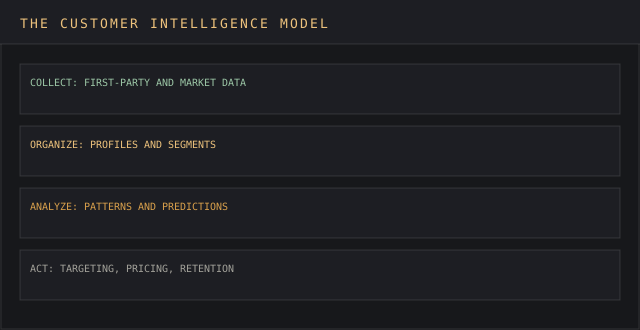
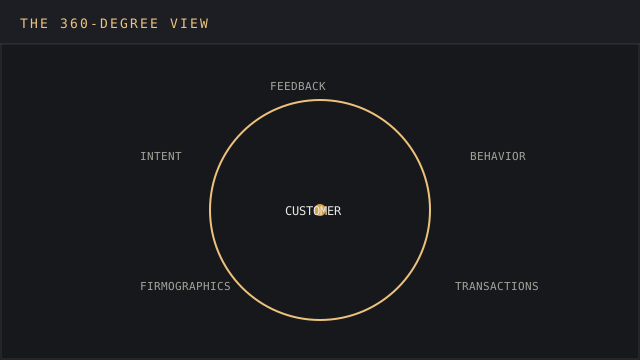
Customer intelligence focuses on understanding what customers want, how they behave, and why. A customer intelligence framework integrates data from various touchpoints: a CRM, a support desk, a web analytics tool, a point-of-sale system. The goal is one full view of the customer, replacing four partial ones.
That single view is the entire point: a support agent, a marketer, and a product manager should be looking at the same customer record. Three exports pulled on three different days is the failure mode.
Why a shared view beats separate ones
Creating a unified customer view avoids data silos and gives every team a single profile across channels. That matters more than most assume, until the day a customer complains to support about something marketing already knew was a problem.
Customer intelligence data that lives in one place gets acted on faster than the same data spread across three systems that don't talk to each other. A company that never solves this ends up making the same promise twice: once in an email, once in a support macro that says something different.
The customer over the company
CI is built around the individual customer's needs and behaviors, which is what distinguishes it from a company's broader internal reporting function. Business intelligence analyzes internal operations and performance metrics, revenue by region, headcount, supply chain throughput, and none of that tells a support rep why a specific customer is about to cancel.
A framework that conflates the two ends up with a dashboard full of company metrics and no answer to the one question a customer intelligence CI program exists to answer: what does this customer need right now.
Types of customer intelligence data a framework should include
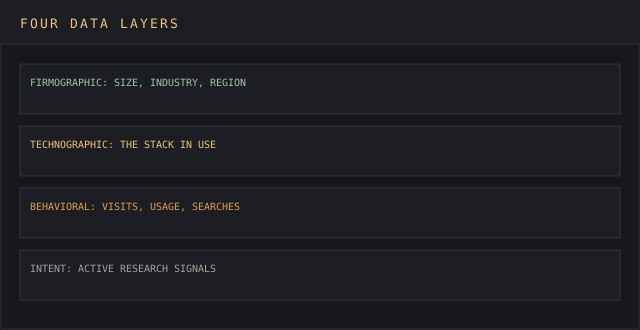
Effective segmentation uses multiple attributes beyond demographics to categorize customers accurately. That starts with knowing which data types exist and what each one is good for, the same sorting problem the wider types of market intelligence present. Demographic data includes age, gender, and education level, useful as a starting filter but weak on its own as a predictor of what an individual customer will do next.
Transactional data captures purchase history and spending patterns, and it's usually the most reliable signal a framework has, since it records what a customer did.
Behavioral and psychographic data
Behavioral data tracks customer interactions with brands online: page views, cart abandonment, feature usage inside a product, and support ticket history. Psychographic data reveals customer interests and attitudes, the layer that explains motivation, and it usually comes from surveys, reviews, or open-ended feedback.
Attitudinal data captures how a customer feels about a product or a brand, distinct from psychographic data in that it's tied to a specific experience. Combining demographic, transactional, and attitudinal data builds customer profiles that no single data type could produce alone.
First-party and third-party data
Third-party sources include social listening platforms. They capture what customers say in public. First-party data, collected directly by the business through its own transactions and interactions, forms the foundation of most frameworks. It's the data a company owns outright and controls the collection method for.
Third-party data includes credit scores and market trends, and it fills gaps first-party data can't, particularly for prospects a company hasn't sold to yet.
A framework that leans entirely on first-party data misses broader market trends. One that leans entirely on third-party data misses the specific transactional data that makes a customer profile useful in the first place. Most mature programs blend both. They weight first-party data higher for existing customers, third-party data higher for prospecting.
Building an effective customer intelligence strategy
An effective customer intelligence strategy starts with a question. The tool purchase comes after: which decisions will this data inform, and for whom? Organizations should establish clear objectives to guide data collection and analysis in customer intelligence work. A team that skips this step tends to collect data for its own sake and never use most of it.
A disciplined customer intelligence program ties every data collection effort back to a specific outcome: reducing churn, raising average order value, or shortening the time a support ticket takes to resolve.
Data collection and integration
Data collection across a CRM, an ecommerce platform, and a support desk only pays off if the systems feed a shared record in place of staying in separate silos. Data integration is where most customer intelligence efforts stall. The cause is rarely the technology. It stalls because the accountability for keeping records synced doesn't sit with any one team.
A customer intelligence strategy that assigns clear ownership over data integration tends to survive past the pilot stage.
Measuring what the framework produces
Successful customer intelligence frameworks enable actionable insights and require continuous measurement of their business impact. A framework that never checks if its recommendations changed a customer outcome is just an expensive way to store data points.
Use customer intelligence by tying a handful of specific metrics to the framework's outputs: churn rate, customer satisfaction score, average order value. Review those metrics on a set schedule.
Customer intelligence platforms and tools
A customer intelligence platform aggregates data from multiple customer touchpoints and resolves separate records into one profile per customer automatically.
The best customer intelligence tools do this resolution work without requiring an analyst to manually match records by hand. The right tools for a given team depend heavily on how many source systems already exist. How messy those systems are matters too.
Customer data platforms and machine learning
Many vendors now describe their systems as a customer data platform. That means the platform itself stitches a CRM export, a support log, and a web analytics report into a single profile, with no analyst matching records by hand.
Refresh cadence decides how much of this is usable, and the case for real-time data is strongest where a churn signal has a short window. Machine learning inside these systems spots patterns in customer behavior that a human reviewing the same data points by hand would likely miss. Predictive analytics extends that pattern recognition into a forecast: which customers are likely to churn, and which are likely to expand.
Choosing customer intelligence software
Customer intelligence software sits inside the wider market intelligence analysis stack. Customer intelligence software varies widely in what it automates versus what still needs manual review. Evaluating those tools against the specific decisions a team needs to make matters more than judging them against a generic feature list.
A customer intelligence tools stack built around real questions, picked over chasing every available feature, tends to get used. One bought because a demo looked impressive tends to sit unopened after the first quarter.
Customer intelligence best practices
A well-structured customer intelligence framework supports various levels of analysis including descriptive, diagnostic, predictive, and prescriptive work. Skipping straight to predictive analytics before a company can reliably describe what already happened is a common and avoidable mistake.
Embedding insights into workflows ensures they actively influence business decisions. That's the best practice separating programs that produce actionable insights from ones that produce reports nobody reads.
Data quality and data accuracy
High-fidelity insights require accurate profiles through data cleaning and deduplication practices, since a customer intelligence framework built on duplicate or stale records produces confident-sounding conclusions that are wrong. Data quality problems compound. A support agent working from an outdated record makes a bad recommendation, and that recommendation becomes a new, unreliable data point the next analysis cycle picks up.
Data accuracy checks belong earlier in the pipeline than most teams put them, ideally before the data ever reaches an analyst.
Privacy and governance
Data governance ensures compliance with regulations such as GDPR and the California Consumer Privacy Act, by centralizing consent and managing data access. A framework that treats this as a legal afterthought eventually runs into a request it can't honor.
Successful customer intelligence programs document, for every data source, what a customer consented to and where that consent is enforced. That way, a deletion or opt-out request doesn't require an engineer to manually chase down every system that touched a given record.
Keep the loop closed
Acting on customer intelligence insights improves customer satisfaction more reliably than collecting more data ever will on its own. A framework with mediocre data in daily use beats an excellent framework whose recommendations sit in a dashboard nobody checks.
Customer intelligence best practices come down to a short list: define the decision first, keep the data clean, respect consent, and close the loop between an insight and the action it's supposed to trigger. That's the whole discipline.
Customer intelligence vs. business intelligence
Customer intelligence is actionable insights derived from customer data, aimed at understanding what a customer needs and how they behave. Business intelligence provides insights on company performance and efficiency, the kind of reporting a finance or operations team relies on to understand its own internal numbers.
Customer intelligence helps improve customer experience and retention directly. That internal reporting discipline explains why the business itself is performing the way it is, a related but distinct question.
A mature organization runs both. A company that only tracks its own internal metrics has no way to explain why those metrics moved in the first place.
Benefits of customer intelligence
PwC's 2018 Consumer Intelligence Series found that 32% of all customers would stop doing business with a brand they loved after just one bad experience. That's the clearest evidence a company needs that customer experience and retention are tied directly together.
A customer intelligence CI program that catches a declining customer experience trend early gives a business room to fix the problem before that 32% figure becomes an actual, measurable loss of accounts.
Salesforce's State of the Connected Customer report found that 80% of customers say their experience should be better, given how much data companies already collect on them. That's a gap a well-run framework is built to close.
Epsilon's Power of Me study, with GBH Insights, separately found that 80% of consumers are more likely to do business with a company that offers a personalized experience. That's the commercial case for treating customer needs as specific to the account.
Customer satisfaction and loyalty
Businesses that act on customer expectations early tend to improve customer satisfaction and loyalty at the same time. The same early signal feeds pricing intelligence when the complaint is about cost, since the two measures move together more often than not.
Gartner's 2016 survey on customer experience in marketing found that 89% of companies expected to compete mostly on customer experience by 2016, up from just 36% four years earlier. That shift explains why customer satisfaction metrics now sit next to revenue metrics on most executive dashboards.
Twilio Segment's State of Personalization research adds a sharper version of the same point: 62% of consumers said a brand would lose their loyalty if the experience wasn't personalized. McKinsey's personalization research separately found 71% expect personalized interactions, with 76% getting frustrated when they don't get one. Both numbers point at customer needs a generic dashboard can't surface on its own.
Operational efficiency and business growth
Customer intelligence improves operational efficiency by cutting the time a team spends manually reconciling records across systems, freeing that time for work that drives business growth. Businesses using customer intelligence to spot at-risk accounts early protect existing customer lifetime value. Businesses using it to spot expansion signals grow that same lifetime value without chasing new customers to replace ones that already churned.
Gathering customer intelligence data
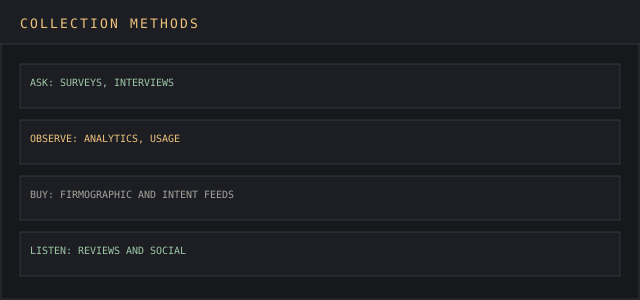
Collecting data from multiple sources provides a single customer view, and CRM systems are usually the primary source since that's where customer transactions and purchase history already live. The same sequencing applies to gathering market intelligence of any kind.
Gathering customer intelligence starts with an audit of what a company already has before it buys anything new. Most organizations discover they're collecting customer data in three systems already and never connected them.
Data sources worth prioritizing
The strongest data sources for a customer intelligence program are the ones closest to an actual transaction or interaction: a CRM, a support desk, web analytics. Customer surveys that ask directly about preferences follow those three. Businesses also gather behavioral data through app and web analytics, tracking customer interactions as they happen.
Surveys and direct feedback
Survey platforms such as Medallia exist to run this collection at scale and route the responses to an owner. That scale is what drives the budget line: our Medallia pricing report tracks what enterprise and SMB programs pay once EDR volume climbs.
Customer feedback collected through direct surveys fills a gap transactional and behavioral data can't. It explains why something happened, on top of what happened, the same split that separates market intelligence from market research.
A team that wants to understand customer preferences before a product decision has to collect data through a direct channel. No amount of analyzing data after the fact recovers a question nobody asked at the time.
Our customer feedback management platforms ranking covers the survey and feedback tools built for that direct channel.
Collecting customer intelligence this way is slower than pulling a transaction log, but it answers a different question, one a purely behavioral data set can't answer on its own.
Customer intelligence examples
A subscription business flags declining login frequency and pairs it with a support ticket about a specific feature. That's a working customer intelligence framework: transactional data, behavioral data, and customer feedback, all pointing at the same at-risk account before that customer cancels.
A retailer notices a customer's average order value rising after a personalized recommendation email. That's the same framework working in the other direction, turning customer intelligence analytics into an upsell.
Both examples share the same structure: one data source alone wouldn't have caught the signal, but combining customer intelligence data from two or three sources did.
Customer intelligence FAQs
What is a customer intelligence framework?
It's the structure a company uses to collect customer data from multiple sources, transactional, behavioral, psychographic, demographic, and attitudinal, and turn it into a single, current profile per customer that different teams can act on.
What are the main types of customer intelligence data?
Demographic, transactional, behavioral, psychographic, and attitudinal data make up the five types most frameworks track, often supplemented with first-party and third-party data depending on the source.
How is customer intelligence different from a company's internal reporting?
Customer intelligence focuses on the individual customer, their needs, behavior, and preferences, while that internal reporting discipline analyzes a company's own operations and performance.
What tools do teams use to build a customer intelligence platform?
Most rely on a platform built to unify records, layered on top of a CRM, support desk, and web analytics tool, paired with machine learning for pattern detection and predictive analytics for forecasting churn or expansion.
What's the biggest mistake in a customer intelligence strategy?
Collecting customer data without a specific decision in mind. A framework built around a defined question is the one most likely to produce actionable insights a team uses.
Customer intelligence, CRM, and the customer journey
Most customer relationship management systems already hold the transactional data and customer interactions a framework needs. The gap is rarely the CRM itself. It's a company treating customer relationship management records as call notes in place of a real data source for a broader program.
Mapping the customer lifecycle against that same CRM data shows where a framework should step in. A customer who used to log in weekly and stopped is a lifecycle signal a support team can act on, days before a cancellation request arrives. Tracking that signal alongside customer experience scores gives a fuller picture than either measure alone.
Marketing efforts and individual customers
Marketing efforts built on customer intelligence data reach individual customers with an offer tied to what that specific customer did. The channel-side measurement sits in digital marketing intelligence. A demographic guess applied to an entire list reaches nobody.
Personalized customer experiences built this way, an email timed to a browsing session, a recommendation tied to a past purchase, tend to convert better than a blanket campaign. They're built on customer preferences a framework already captured.
Marketing efforts that ignore this data end up repeating the same generic message to a customer who already told the company, through their own behavior, what they want. A poor customer experience delivered at scale this way is harder to walk back than a personalized message that missed the mark once.
Improving customer service with the same data
Improving customer service rarely requires new data. It requires giving a support agent the customer insights a marketing team already has. A rep who can see a customer's full purchase history, past complaints, and lifecycle stage resolves a ticket faster than one working from a blank case file. Needs that would otherwise take three transfers to surface become visible in the first minute of a call.
Customer behavior tracked across support, marketing, and product gives every department the same read on customer needs and the same experience baseline. That replaces three separate, partially overlapping guesses about what a given customer wants.
Data management, analytics, and where customer intelligence fits
Data management is the unglamorous half of any customer intelligence CI effort: deciding where a record lives, who can edit it, and how long it's kept once a customer relationship ends.
A company that treats data management as an IT chore ends up with the same customer record duplicated across five systems, none of which agree with each other by the time an analyst goes looking for an answer. Customer needs get lost somewhere in that disagreement.
Customer analytics, consumer data, and third-party sources
Customer analytics turns a company's own transaction and interaction logs into a repeatable process. AI market intelligence methods increasingly do the pattern work that used to need an analyst.
Consumer data purchased from a third-party data broker, alongside credit scores and other third-party data, extends that internal picture past a company's own customer base. It reaches into the broader consumer intelligence needed to evaluate a prospect nobody has sold to yet.
Enterprise data, the internal systems, warehouses, and reporting tools a large company already runs, is often the biggest untapped data source sitting inside a customer intelligence CI program. Nobody outside IT has been given access to query it directly.
Analyzing data and gathering it at scale
Analyzing data from a CRM export is a different exercise than analyzing customer data pulled from a live behavioral feed. A framework needs both kinds of analysis, plus a clear read on customer behavior itself, to produce a complete picture. Customer insights drawn only from transaction logs miss the behavior that happens between purchases, which is exactly what a continuous interaction feed is built to capture.
Business leaders who ask a team to gather customer intelligence data without specifying which decision it's meant to support usually end up with a warehouse full of data points. The answer is no clearer than before the project started.
The strongest data sources for this kind of work overlap with the ones already discussed: CRM records, support tickets, web analytics. They're supplemented by sources a company doesn't yet have direct access to, like syndicated market trend reports or public review sites, until it decides to collect that data directly too.
Bottom line
These best practices come down to a handful of disciplines repeated consistently: define the decision before collecting data, blend transactional, behavioral, psychographic, and attitudinal data into one profile, protect data quality and accuracy. Respect consent under laws like the California Consumer Privacy Act, and route every insight back into a workflow someone follows.
Programs that skip any one of these steps end up with plenty of customer data and little customer intelligence to show for it. For related reading, see our guides to customer intelligence, product intelligence, and buyer feedback intelligence tools.