Sales intelligence platforms: rankings and buying guide for 2026
 By Jan Suski. I go deep on every review, checking every number against its source and digging up details other coverage misses, a habit from six years of SEO and link building for tech companies. Bylines at Surfer, Brand24, and Senuto. How the scoring works.
· Prefer this source on Google
Quick comparison of the best sales intelligence platforms
Columns carry only dimensions where these platforms measurably differ. Contact search, CRM sync, and dashboards exist on all nine.
| # | Platform | Primary data type | Published pricing | Seat minimum | Verified cost benchmark |
|---|---|---|---|---|---|
| 1 | ZoomInfo | Contact, firmographic, intent | Free tier only | None stated | $33,500 median, 1,574 purchases |
| 2 | Gong | Call transcripts, deal signals | No | 15 seats | ~$1,600/user plus platform fee |
| 3 | Apollo | Contact data, sequencing | Yes, $0 to $119/user/mo | 3 users on Organization | Credit caps, no seat cap |
| 4 | 6sense | Anonymous intent, account scoring | No | None stated | $62,440 median, 385 purchases |
| 5 | Bombora | Publisher co-op surge data | No | None stated | $25,000 median, 35 purchases |
| 6 | LinkedIn Sales Navigator | Member profile, InMail | Yes, $89.99 to $149.99/seat/mo | None | 50 InMail credits per tier |
| 7 | Cognism | Phone-verified contacts | No | 5 seats per tier | ~$1,500-$2,500/user plus platform fee |
| 8 | Amplemarket | Intent plus automated outreach | Partial, $600/mo for 2 | 2 users | ~$80,000/yr at 25 users |
| 9 | Demandbase | Account intent plus ad delivery | No | None stated | $68,591 median, 187 purchases |
Sales intelligence platforms turn scattered signals, verified contact data, buying signals, call recordings, company data, into a working picture of who's ready to buy and why. This guide ranks nine sales intelligence tools against six evaluation criteria, prices every one of them against the same team, and gives a full features, pricing, and contract-terms breakdown for each.
Contract structure decides more of the real cost than the sticker price does. Gong won't sell fewer than 15 seats. ZoomInfo requires written cancellation 60 days before renewal. Bombora runs 12-month minimums with no monthly option, and Demandbase adds roughly $29,000 of onboarding before the platform fee.
Buyers researching this category also search it as sales intelligence software or sales intelligence tools; sales teams comparing all three phrases are shopping the same list of sales intelligence solutions, whatever term led them here.
Two of the nine changed leadership or market position in the last 14 months, and the platform ranked first here is defending a securities class action over how it renews contracts.
Prices, contract terms, and ownership were verified on 25 July 2026, and every Vendr figure was re-read on 1 October 2026.
What a 10-person sales team pays
Every figure below assumes the same buyer: a 10-person outbound sales team on annual billing, priced for year one including onboarding where a vendor publishes it. Quote-based platforms use Vendr's aggregated procurement data.
| # | Platform | Year-one cost for 10 seats | Basis | Contract floor |
|---|---|---|---|---|
| 1 | ZoomInfo | $33,500 | Vendr median, 1,574 purchases | Annual, 60-day cancellation notice |
| 2 | Gong | $24,000 plus platform fee | 15-seat minimum at ~$1,600/user, platform fee amount unpublished | 15 seats, $21,000 |
| 3 | Apollo | $14,280 | Organization tier, $119/user/mo | None, self-serve |
| 4 | 6sense | $62,440 plus $5,000-$50,000 implementation | Vendr median, 385 purchases | Annual |
| 5 | Bombora | $25,000 | Vendr median, 35 purchases | 12 months, no monthly option |
| 6 | LinkedIn Sales Navigator | $17,999 | Advanced, $149.99/seat/mo annual | None, self-serve |
| 7 | Cognism | $30,000 to $40,000 | $15,000-$25,000 platform fee plus ~$1,500/user | 5 seats bundled per tier |
| 8 | Amplemarket | Between $600/mo (2 users) and ~$80,000/yr (25 users) | Published anchor points | Annual |
| 9 | Demandbase | $68,591 plus ~$29,000 onboarding | Vendr median, 187 purchases | Annual |
Gong is the outlier worth reading twice. A 10-person team can't buy 10 seats, because the minimum is 15 and the contract floor is $21,000, so the smallest possible Gong deal prices five people who won't use it. Implementation runs a further $15,000 to $65,000 in year one, and renewals carry a 5 to 15% annual uplift unless a cap gets negotiated in.
The gap between cheapest and most expensive is close to five times before onboarding and closer to seven after it. Apollo at $14,280 and Demandbase at $97,591 all-in are not competing for the same buyer, whatever the category label suggests.
Back to top ↑Why sales intelligence platforms matter now
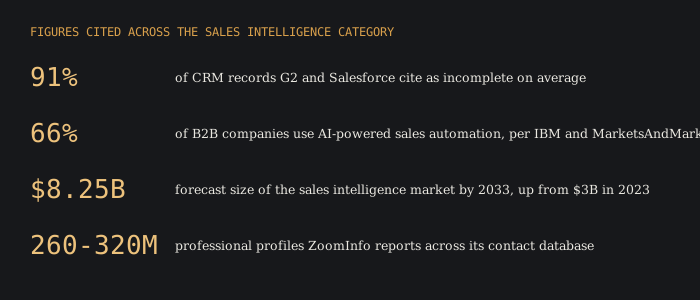
G2's sales intelligence category page cites CRM records running 91% incomplete on average, with roughly 70% decaying every year, and Salesforce's own research reaches the same 91% figure for data that's incomplete, stale, or duplicated.
Decay estimates vary more than most articles admit: Dun & Bradstreet puts contact decay near 30 to 40% a year and MarketingSherpa's often-cited figure works out closer to 22.5% annually at 2.1% a month, against that 70% top end. Average job tenure of 2.8 years is the mechanism underneath all of them.
Share of CRM records G2 and Salesforce cite as incomplete on average. Decay estimates below that top-line figure range from Dun & Bradstreet's 30-40% a year to MarketingSherpa's 22.5% a year.
That spread is the reason verification method matters more than raw record count. A vendor claiming a larger database against an unstated decay rate is describing volume.
Accurate prospect data is a function of how recently a record was checked and by what method, which is why Cognism's phone-confirmed Diamond tier and ZoomInfo's algorithmic match produce different connect rates from similar-looking sales data.
Outdated contact information costs twice over. Reps burn time on dead numbers, and bounced emails accumulate against a sending domain until deliverability drops for the messages that would have landed.
Manual data entry is the fallback every one of these sales intelligence tools replaces: a rep updating fields by hand can't keep pace with that decay rate, which is why AI powered enrichment sits inside nearly every platform in this ranking.
Marketing teams and sales teams increasingly share this tooling, since the intent signals useful for account-based marketing are the same buying signals a rep needs before a call, and the same signal often feeds the buyer feedback intelligence stack marketing runs on the other side of the deal.
What the category data shows
Adoption and market-size figures here come from vendor-adjacent sources, so treat them as approximate directional signals. Research cited by IBM and MarketsAndMarkets puts AI-powered sales automation use at 66% of B2B companies.
Forecasts put the sales intelligence market at $8.25 billion by 2033, up from roughly $3 billion in 2023 at a 10.7% compound annual rate, though competing analyses land between $8.76 and $9.26 billion for the same year and North America holds about 46% of current spend.
The productivity claims run more consistent than the market forecasts. G2 and Gong both cite a roughly 50% cut in the time reps spend on manual account research once a platform replaces browser-tab work, replacing hours of manual web research with pre-compiled account briefs.
ZoomInfo's own data cites an 84% lift in marketing-qualified leads, connect rates up to 7 times higher from verified direct dials, and a customer case where accurate data cut cost per click by 99%.
AI tools process larger data volumes faster and more consistently than a rep working by hand, which is what turns those figures into faster lead-to-meeting cycles.
AI-driven insights prioritize high-intent leads, automate the repetitive research tasks that used to fill a morning, and improve personalization by surfacing a prospect's stated challenges and recent company news before the first touch. B2B sales organizations and software companies are where these platforms pay off hardest, since both sell into named accounts with identifiable buying committees.
Five categories of sales intelligence tool
The nine platforms split into five product categories, and buyers who mix them up end up comparing a database against a call recorder.
Contact data platforms like ZoomInfo, Apollo, and Cognism sell verified records: emails, direct dials, firmographics. Intent data platforms like Bombora track content consumption across a publisher network to identify buying signals before a form gets filled. Conversation intelligence tools like Gong analyze sales calls for deal insights and rep coaching.
Sales engagement platforms like Apollo and Amplemarket combine data and outreach in one interface, so the record and the sequence live together. ABM platforms like 6sense and Demandbase use AI to identify in-market accounts for targeted campaigns across sales and advertising at once.
LinkedIn Sales Navigator sits outside all five as network-native prospecting, since its data comes from members maintaining their own profiles.
Evaluation criteria for the best sales intelligence platforms
Six factors separate a platform sales teams keep open from one that sits half-used in a browser tab, and they're the same six factors that set the ranking order above.
- Data accuracy and verification methods. How a vendor verifies emails and direct dials, algorithmic match versus phone-confirmed, drives real connect rates more than record count. A record that's fresh but never verified fails as often as one that's accurate but a year stale, so data has to clear both bars at once. Our guide to data source attribution techniques covers how to trace a bad record back to the vendor that supplied it.
- Integration depth with CRMs and sales engagement tools. Signals that stay inside a standalone dashboard get checked once a week. Native Salesforce, HubSpot, and Outreach or Salesloft integrations decide if reps see intelligence inside the workflow they already use. Shallow CRM integrations force a manual export, and intelligence stuck in an export never reaches the rep's actual queue.
- Real time alerts and trigger events. A job change, a funding round, or a pricing-page visit is only useful within days of happening, ahead of the next scheduled sync, the freshness problem covered in our note on real-time market intelligence. Job change tracking is the highest-value trigger event on this list, and pairing it with historical deal data lets a rep open with real context and skip the cold script.
- Conversation intelligence and revenue intelligence depth. The platform reads what was said on a call, beyond who was on it, and turns that into coaching insights and deal-risk signals.
- Data enrichment and contact freshness. How often records refresh, and if automated enrichment runs on lead creation. Enrichment should draw on behavioral data and company data together, or the cycle restates what a rep already knew. Automating this is what cuts manual data entry and lifts sales productivity.
- Pricing transparency and contract terms. Custom pricing is the category norm, so published starting points, seat minimums, cancellation windows, total cost of ownership beyond licence fees, and GDPR and CCPA compliance all matter most at renewal time.
- Vendor scope: platform versus point solution. Some names here are unified platform plays covering contact data through execution; others are single-purpose sales engagement tools that expect a second system underneath them.
Ask every finalist how it verifies emails and direct dials, algorithmic match versus phone-confirmed, before comparing record counts. A smaller, verified database often beats a larger, unverified one on real connect rate.
Top sales intelligence platforms, ranked
Nine platforms, split across contact and pipeline data, conversation intelligence, account-level intent, and outbound execution, each with the reasoning behind its position plus a full features, pricing, and contract breakdown.

ZoomInfo
·top pick·ZoomInfo is the only platform here that scores on all six criteria at once.
ZoomInfo combines roughly 260 to 320 million professional profiles and about 135 million verified direct dials with intent signals, technographic data, and org-chart mapping. Its own published guide reports up to 95% accuracy on first-party data and cites an 84% lift in marketing-qualified leads plus up to 7 times better connect rates from verified direct dials; those are vendor-reported figures.
The company repositioned around the category without changing its legal name, which is still ZoomInfo Technologies Inc. It changed its Nasdaq symbol from ZI to GTM on 13 May 2025, alongside the launch of GTM Studio.
The market has not rewarded the repositioning: in June 2026 the stock fell roughly 32 to 34% in a single session to a 52-week low of $2.94 on weak 2026 guidance and workforce reductions, and Jefferies downgraded it to Hold while cutting its target from $12 to $4, citing two years of soft client demand.
ZoomInfo requires 60 days of written notice before its auto-renewal date. A 2024 securities class action alleges the company made misleading statements about using coercive renewal policies and litigation threats to hold customers, and ZoomInfo has acknowledged to the Washington State Attorney General that some renewals were processed in error.
Why it's ranked #1. ZoomInfo is the only platform here that scores on all six criteria at once, data accuracy, CRM integration, real time alerts, conversation intelligence through Chorus, enrichment, and scale. Gong and Cognism each beat it on their specialty, conversation depth and EU phone verification respectively, and neither matches its breadth.
Features
- Continuous contact and company enrichment across professional profiles, firmographics, and technographics.
- WebSights website-visitor identification that de-anonymizes traffic at the company level.
- Chorus conversation intelligence, acquired in 2021, layered on the core contact database.
- Engage, a built-in sales engagement and dialer module for outbound sequencing.
- Native CRM integrations with Salesforce and HubSpot, plus intent and buying-signal alerts.
Pricing and contract terms
ZoomInfo pricing starts free. ZoomInfo Lite grants 10 reveal credits at signup, and further monthly credits only to accounts that join the ZoomInfo Community and contribute data. ZoomInfo doesn't publish that monthly figure anywhere.
Credits are spent when a record gets revealed, so the free tier bills on consumption.
Paid contracts jump sharply from there. The Professional plan runs $14,995 a year for 5,000 annual bulk credits, and Vendr records a median contract of $33,500 across 1,574 verified purchases. Mid-sized teams land at $25,000 to $35,000, and deployments exceed $60,000 once intent, ABM, Copilot, Chorus, or extra credits are added.
The Elite plan runs about $39,995 and includes Copilot plus pipeline tools. The extra spend doesn't buy additional data volume. Per-seat rates run $4,000 to $5,000 at Professional and $7,000 to $10,000 at Enterprise.
Who should skip it
Any team that can't guarantee it will still want the platform in 14 months. Cancellation requires written notice 60 days before the auto-renewal date, and this is the most heavily documented contract risk in the category. Edwin Dorsey's Bear Cave newsletter obtained hundreds of pages of small-business complaints about cancelling.
ZoomInfo acknowledged to the Washington State Attorney General that it had sometimes processed renewals in error. A securities fraud class action filed in 2024 alleges the company made misleading statements about using coercive auto-renew policies and litigation threats to hold customers through additional terms.
Switching trigger. Teams selling primarily into EMEA outgrow it on data quality, since North American depth is where ZoomInfo leads and Cognism's phone verification is where it doesn't.
Gong
Conversation intelligence built on recorded, transcribed sales calls.
Gong records, transcribes, and analyzes customer-facing calls, meetings, and emails. Amit Bendov and Eilon Reshef founded it in 2015. It reports about 4,000 customers, ARR past $500 million growing more than 55% year over year across ten consecutive quarters of accelerating growth, and counts half of the Fortune 10 as customers, naming Anthropic, Cisco, DocuSign, Google, ADP, and Thomson Reuters.
The valuation moved the wrong way. Gong raised $583 million across seven rounds, most recently a $250 million Series E in 2021 at $7.25 billion. A November 2025 secondary sale through Nasdaq Private Market priced it at $4.5 billion, a markdown of roughly 38% against that peak, with no new primary round announced since 2021.
Gong's valuation in a November 2025 secondary sale, down roughly 38% from the $7.25 billion it reached at its 2021 Series E, with no new primary round announced since.
Why it's ranked #2. Conversation intelligence, reading what was said on a call, is the criterion most directly tied to closing revenue, and nothing here does it as deeply. It drops below ZoomInfo because it has no native contact-discovery layer, failing the integration-depth criterion for teams without a data platform underneath it.
Features
- Automated call transcription across video, phone, and web conferencing tools.
- Smart Trackers that flag keyword mentions, competitor names, and objections inside calls automatically.
- Deal Board, a pipeline view built from conversation and CRM data together.
- Ask Anything, a generative-AI query layer for pulling answers from call history.
- Gong Engage, an outbound sequencing add-on for teams that want execution alongside analysis.
Pricing and contract terms
The structure matters more than the rate. Gong's pricing page prices licences per user and adds a platform fee based on the number of users supported, without naming an amount. Gong enforces a 15-seat minimum with a $21,000 contract floor and sells annual or multi-year terms only, paid upfront, with no monthly option. Vendr records a $55,346 median across 1,144 purchases, at 14% average savings.
Foundations runs about $1,600 per user, with negotiated deals landing $1,000 to $1,349. Implementation adds $15,000 to $65,000 in year one and renewals carry a 5 to 15% uplift unless capped. Forecast costs about $700 per user and Engage about $800; Engage requires a Foundations license for every user, which roughly doubles the per-user cost.
Who should skip it
Teams under 15 people, as a matter of arithmetic. The seat minimum means a 10-person team funds five unused licences before the platform fee.
Switching trigger. Below roughly $24,000 of annual budget Gong stops being reachable, since 15 seats at about $1,600 each set that floor before the platform fee and implementation are added.
Apollo
Contact database and outbound execution in one lower-cost platform.
Apollo pairs a database of 230 million-plus contacts and 30 million-plus companies with email sequencing, a dialer, CRM sync, and intent data. It reached a $1.6 billion valuation, and in March 2026 acquired signal-based revenue intelligence startup Pocus, which had itself raised $43.1 million led by Coatue. Terms weren't disclosed. Apollo was approaching $200 million in ARR at the time of the deal.
Why it's ranked #3. Apollo clears five of six criteria at a fraction of the cost of the platforms above it. It loses ground on data accuracy and freshness, where verification-first vendors like Cognism and scale leaders like ZoomInfo outperform it.
Features
- Prospecting, sequencing, and a Power Dialer inside a single unified platform.
- Chrome extension for pulling verified contact data while browsing LinkedIn or a company site.
- Deal Rooms and call recording for lightweight conversation intelligence.
- Signal-based revenue intelligence from the Pocus acquisition, layered on prospecting workflows.
- Published, credit-based pricing.
Pricing and contract terms
Four published tiers on annual billing: Free at $0, Basic at $49 per user monthly, Professional at $79, and Organization at $119 with a three-user minimum. Monthly billing lifts Basic to $65 and Professional to $99; Apollo's monthly view lists Organization at $149 and marks it annual only.
The credits are where the real limits sit. Each seat draws on one credit pool a year: 900 on Free, 30,000 on Basic, 48,000 on Professional and 72,000 on Organization.
Credits don't roll over, so unused allowance disappears at each billing cycle. Phone numbers consume 8 times the credits an email does, overage costs $0.20 a credit with a 250-credit minimum purchase, and the record selection limit runs 1,000 on Basic and 2,500 on Professional.
Who should skip it
Teams that budget from the per-seat rate. Published prices understate real cost once credit overages land, and buyer reports put active outbound teams at $150 to $400 per user monthly against an advertised $119.
Switching trigger. The export cap bites before the seat price does. A team pulling more than 4,000 records a month has outgrown Organization regardless of headcount.
6sense
Account-based intent platform that flags in-market accounts before they fill out a form.
6sense identifies anonymous account research through its Signalverse publisher network and scores accounts into buying stages before a prospect raises a hand. Founded in 2013, it raised $426 million across 10 rounds, reaching a $5.2 billion valuation at its 2022 Series E led by Blue Owl and MSD Partners.
Leadership changed on 9 September 2025, when Chris Ball became CEO and Jason Zintak moved to Chairman after eight years running the company. Zintak scaled revenue from $5 million to more than $250 million from 2017; Ball arrived from Instructure, where he was President and COO.
Why it's ranked #4. 6sense is the strongest performer on real time alerts and account intelligence, catching buying signals before a prospect converts. It sits below the top three on pricing transparency and time to value. See how it stacks up directly against ZoomInfo, the platform ranked #1, in our full 6sense vs ZoomInfo comparison.
Features
- Account identification that de-anonymizes website visitors at the company level.
- Predictive analytics that score accounts into buying-stage tiers using intent and firmographic data together.
- Advertising orchestration that targets in-market accounts from the same intent score.
- Native Salesforce and Microsoft Dynamics integration, plus a Chrome extension for contact data.
- Cross-channel campaign triggers fired from a single account-level intent score.
Pricing and contract terms
Vendr records a $62,440 median across 385 purchases, and buyer reports put enterprise deployments at roughly $50,000 to $300,000 plus $5,000 to $50,000 in implementation. Pricing is fully quote-based with no self-serve tier.
Who should skip it
Teams that need results this quarter. Users describe a two-to-three-month ramp before the platform feels intuitive, and intent scores read as opaque without an analyst interpreting them, which means the implementation cost buys a delay as well as a deployment.
Switching trigger. Below about $50,000 of annual budget 6sense isn't reachable, and Bombora supplies comparable account-level signal at a $25,000 median without the orchestration layer.
Bombora
The most credible pure intent-data specialist in this ranking.
Bombora's Company Surge draws on a consent-based Data Co-op of more than 5,000 publisher websites spanning 4.9 million unique domains and processing 16.6 billion interactions monthly. Roughly 86% of co-op sites share data exclusively with Bombora, and the company reports 81% intent precision against that co-op, the highest precision figure any vendor in this ranking publishes.
Bombora acquired Lem0n in March 2026.
Why it's ranked #5. It's the most credible pure intent-data specialist here. It ranks below the multi-criteria platforms because it's deliberately single-purpose: it supplies signal but no execution layer, so it can't score on integration depth or engagement the way a full platform can.
Features
- Topic-level surge scoring across a named publisher network of 5,000-plus sites, tracking content consumption to identify buying signals.
- Company-level signal designed to integrate into an existing ABM or CRM stack.
- Audience solutions for advertising activation built from the same intent data.
- No first-party traffic dependency, so smaller sites still get coverage through the co-op.
Pricing and contract terms
Vendr records a $25,000 median across 35 documented purchases, with the high at $80,450. Every contract runs a 12-month minimum with no monthly or pay-as-you-go option.
Who should skip it
Anyone without a platform to act on the score. Bombora sells signal, and 81% precision still means meaningful false positives without layered signals, so a team that can't route surge data into a sequence or an ad audience is buying a number nobody uses.
Switching trigger. Teams that want intent and orchestration in one system move to 6sense or Demandbase and pay roughly double to triple for the bundle.
LinkedIn Sales Navigator
Relationship and first-party signal data drawn from LinkedIn's own member graph.
Sales Navigator runs three tiers: Core at $119.99 per seat monthly or $89.99 billed annually, Advanced at $159.99 or $149.99 annually, and Advanced Plus by quote. Every tier includes 50 InMail credits a month, and unused credits roll over up to three months to a maximum of 150.
The tier difference is narrower than the price gap implies. Core and Advanced ship identical search functionality and the same 50 monthly InMail credits, so the extra $60 a month buys team collaboration and AI research features, TeamLink, Smart Links, CSV account matching, and buyer intent signals. Prospecting volume stays the same across both tiers.
Why it's ranked #6. It wins outright on pricing transparency and data enrichment currency, since member-maintained profiles update faster than any vendor pipeline. It fails the integration-depth and conversation-intelligence criteria: no dialer, no bulk enrichment, no call analysis.
Features
- 50-plus advanced search filters across company size, industry, seniority, and geography.
- TeamLink warm-introduction paths on Advanced and above.
- CRM-embedded experiences for Salesforce, HubSpot, Microsoft Dynamics, and Oracle on Advanced and above.
- Buyer intent signals based on engagement with a company's LinkedIn presence.
- Member-maintained profile data that updates as people change roles.
Pricing and contract terms
Core and Advanced are self-serve and published. Buyer reports put Advanced Plus, the enterprise CRM-integrated tier generally sold to teams of 10 or more, at roughly $1,600-plus per seat annually before volume negotiation.
Who should skip it
Teams whose bottleneck is volume. There's no bulk enrichment and no dialer, and 50 InMails a month caps outreach on both published tiers, so a high-volume outbound motion runs out of the product before it runs out of budget.
Switching trigger. At the point a team needs bulk export or automated sequencing, Apollo covers both for less than Advanced costs per seat.
Cognism
Phone-verified European contact data built around GDPR compliance.
Cognism's Diamond Data adds human-confirmed, phone verified mobile numbers on top of its contact database, reporting a 98% verification rate. That figure applies to the Diamond tier specifically. Cognism's own materials put accuracy at 87% or higher across the full verified-record database, a distinction worth confirming before assuming every record carries the same guarantee.
Why it's ranked #7. Cognism wins data accuracy and compliance outright for EU contact data. Its depth is geographically narrow: North American coverage trails ZoomInfo, and the platforms above it satisfy more of the six criteria for teams selling outside EMEA.
Features
- Diamond Data human phone verification, commanding a premium over algorithmic email enrichment.
- Built-in GDPR tooling: consent tracking, Do-Not-Call list checking, and data processing agreements.
- Chrome extension for contact data lookups while browsing.
- Intent-data integration for surfacing in-market accounts alongside verified contacts.
Pricing and contract terms
Cognism renamed its tiers in 2026: Platform Essentials became Standard and Platform-plus-Diamond-Data became Pro, both bundling five seats. Per-user rates run roughly $1,500 a year at the lower tier and $2,500 at the Diamond tier, on top of a base platform fee of $15,000 to $25,000 a year. Vendr's Cognism marketplace page returned a 404 on 1 October 2026, so no buyer-reported median is cited here. Our Cognism pricing report covers the tier change in full.
Pro typically costs 50 to 70% more than Standard for the same team size before add-ons. Onboarding adds $500 to $1,500, and phone-verified, DNC-screened numbers consume 2 to 3 times the credits of a standard record.
Who should skip it
Teams selling primarily into North America, and teams smaller than five people. Tiers bundle five seats regardless of actual headcount, so a three-person team pays for five.
Switching trigger. Once EMEA drops below roughly half of pipeline, the phone-verification premium stops paying for itself against ZoomInfo's broader North American coverage.
Signal-to-sequence execution: prospecting, personalization, and outreach run by one AI system.
Amplemarket's Duo copilot operates three agents: a Signal Agent monitoring 100-plus buying-signal types, a Research Agent building a digital-footprint profile per prospect, and a Sequence Agent generating multichannel outreach personalized to each prospect's own signals. It ranked as a leader in G2's Sales Engagement category in autumn 2024 and serves mainly Series A through Series C B2B SaaS companies.
Funding is the thing to weigh. Amplemarket has raised $12 million total across three rounds, a Series A in April 2022 at an $80 million post-money valuation, with no institutional round announced since.
Why it's ranked #8. It bundles signal detection and automated sequencing better than anything else here on the engagement criterion, and its contact-database depth is the shallowest of the platforms with enterprise ambition.
Features
- Duo AI Copilot with Signal, Research, and Sequence agents working together.
- AI-driven signal detection tied directly to automated, personalized sequencing.
- Native deliverability tooling built for the same outbound motion it powers.
- Multichannel outreach across email, LinkedIn, and phone from a single sequence builder.
Pricing and contract terms
Published startup pricing runs $600 a month for two users on an annual term, scaling to roughly $80,000 a year at 25 users.
Who should skip it
Teams with large total addressable markets. Contact depth doesn't match ZoomInfo or Cognism, so a big TAM still needs a dedicated data provider underneath, which turns a single line item into two.
Switching trigger. Four years without a new institutional round is the number to watch on a multi-year commitment, against Gong's $583 million and 6sense's $426 million.
Try it yourself
Sign up for Amplemarket
$600 a month for two users on the Startup plan, annual term.
May earn a commission if you sign up through this link, at no extra cost to you. Full affiliate disclosure.
Demandbase
Account-based go-to-market intelligence bundled with its own advertising platform.
Demandbase One unifies account identification, intent data, advertising, personalization, and sales intelligence. It's the only platform in this ranking with its own demand-side platform for programmatic advertising, supporting account-targeted display, LinkedIn, and connected TV inside the same system holding its intent and account data.
Why it's ranked #9. Its standout feature, the built-in ad-buying layer, answers a need most sales intelligence buyers didn't raise in the six criteria here. It's a strong ABM platform whose total cost of ownership is the highest in the ranking once advertising spend is counted. See the full Demandbase vs ZoomInfo comparison for how the two price and feature sets line up.
Features
- Native demand-side advertising tied to the same account and intent data used for sales prioritization.
- Account identification and intent scoring comparable in depth to 6sense, using AI to surface in-market accounts for targeted campaigns.
- Personalization tooling that adjusts web and ad experiences by account.
- Sales Intelligence Cloud module for contact-level data layered on account intent.
Pricing and contract terms
Vendr records a $68,591 median across 187 purchases, with the observed low at $24,000. Onboarding commonly runs about $29,000, and per-user fees add $1,200 to $3,000 a year depending on tier. Full ABM advertising deployments reach $100,000 to $200,000-plus once ad spend is included.
Who should skip it
Sales teams buying sales intelligence. The ad layer is the reason to pay Demandbase's premium, and a team with no programmatic budget pays for a demand-side platform it will never switch on.
Switching trigger. Teams that drop the advertising layer are buying 6sense's product at Demandbase's price, and the intent comparison is worth rerunning at that point.
Contract terms and exit cost
Exit terms in this category are contractual, and they're the least-documented part of any comparison.
ZoomInfo requires 60-day written notice before auto-renewal. Gong sells annual or multi-year terms only, with a 5-15% renewal uplift unless capped. Bombora runs a 12-month minimum with no monthly option at any price. Read the cancellation clause well before the first contract term ends.
ZoomInfo carries the most documented friction: 60-day written notice before auto-renewal, hundreds of pages of small-business cancellation complaints collected by the Bear Cave, an acknowledgement to the Washington State Attorney General that some renewals were processed in error, and a 2024 securities class action alleging misleading statements about coercive renewal practices.
Verbal requests and support tickets don't count as notice.
Gong sells annual or multi-year terms only, paid upfront, with contracts typically running two to three years and renewals carrying a 5 to 15% uplift unless a cap is negotiated. Bombora runs 12-month minimums with no monthly option at any price. Apollo is the cleanest exit in the ranking, since Basic and Professional are self-serve and month-to-month, though Organization is annual only and credits vanish at each cycle.
Stack position: what each platform replaces
Apollo and Amplemarket collapse a stack. Both fold contact data and outbound execution into one platform, which is why their per-seat prices compare against two line items, and it's why they're the best sales intelligence tools for a team that can't run two vendors.
ZoomInfo sits closest to a full replacement at enterprise scale, covering contact data, intent, conversation intelligence through Chorus, and sequencing through Engage. Gong, Bombora, and LinkedIn Sales Navigator all add to a stack instead. None of the three discovers contacts and sequences them, so each expects a data platform underneath.
6sense and Demandbase replace the marketing side, which is why they're bought by ABM teams and priced against advertising budgets.
Data enrichment, sales navigator, and CRM integrations
Contact enrichment only pays off when it lands inside the CRM record a rep already has open, so CRM integrations are a filter. A platform requiring a CSV export and re-import loses the freshness advantage enrichment is supposed to buy.
Done properly, the platform enriches CRM records automatically with verified data and routes leads without a human touching a spreadsheet, which is where the real-time accuracy gain shows up.
Sales navigator-style relationship data behaves differently from enrichment data: it's member-maintained, trading some data accuracy for currency, since a person updates their own job title faster than any enrichment pipeline catches it. Firm-wide relationship graphs built from a team's own email and calendar are scored in our relationship intelligence platforms ranking.
CRM lock-in is the clearest failure mode. HubSpot acquired Clearbit in November 2023 for a reported $150 million and folded it in as Breeze Intelligence, deprecating the standalone Enrichment, Logo, and Prospector APIs, with the Logo API shutting down in December 2024. The enrichment quality survived the acquisition; the portability didn't, and teams on Salesforce or Pipedrive lost the integration path entirely.
Types of sales intelligence
Five data types make up most of what a sales intelligence platform sells, and no single vendor covers all five at full depth.
Contact data is the base layer: verified emails, direct dials, and job titles, refreshed against the decay rates above, and ZoomInfo is the reference implementation. Firmographic and technographic data layers company size, industry, and tech stack on top, so a rep knows if the account fits the ideal customer profile at all.
Our customer intelligence guide covers how this same external data feeds retention and expansion decisions.
Intent and buying signals flag accounts in motion: topic surges, trigger events like funding rounds or job changes, and pricing-page visits. Conversation intelligence reads what happens after the call connects, transcribing and scoring deal risk from the words said, then turning that into coaching.
Account intelligence sits above all of it, scoring anonymous research activity into account-level buying stages for ABM orchestration.
Lead scoring and analytics reporting sit across all five, and they're the features that decide if the other data reaches a rep in a usable order. Better prospecting and targeting is the benefit every one of the five is sold on, and the platforms that deliver it are the ones that surface the signal inside the rep's existing queue.
The outcome the whole category is sold against is narrow: help sales teams identify opportunities and close deals faster. Where it works, it shows up as improved outreach effectiveness and pipeline creation, and data-driven insights lifting conversion rates against the same list worked cold.
Sales reps pull from internal and external data at the same time without necessarily noticing. Customer relationship management records hold the internal history, while a sales intelligence platform layers external context, intent, technographics, conversation signal, on top.
Combining multiple data sources this way turns a contact list into account insights a rep can act on. That's the full range of the types of sales intelligence a platform can realistically offer.
Other sales intelligence tools worth a shortlist mention
The nine platforms above cover most buying scenarios, and several narrower names are worth a look before signing.
Lusha competes with Apollo on quick contact lookups, with Pro running from $52.45 per user monthly on annual billing for 7,200 to 24,000 credits a year across two seats, and Premium from $299.95 monthly for 40,800 to 98,400 credits across five. Annual billing runs 25% under monthly, and the tiers price on a credit-volume slider. Our Lusha pricing report breaks down all five tiers, the credit costs and the hidden fees.
RocketReach targets the same lookup use case. Clay sits alongside these platforms, orchestrating enrichment across several data vendors at once.
SalesIntel and LeadIQ both compete with Cognism on human-verified contact data, and Seamless.AI targets the same budget-conscious buyer as Apollo, with a free tier and quote-only paid plans our Seamless.AI pricing report breaks down in full. None clears more of the six criteria than the platforms ranked above, so none changes the order.
Woodpecker covers a narrower job than the nine platforms above: cold email and LinkedIn outreach billed at $7 per 100 contacted prospects, with unlimited team members and email accounts included free. A team that already owns a contact database and just needs a lean sender fits Woodpecker better than a full sales intelligence platform.
Data privacy, GDPR, and CCPA compliance
Every platform here touches personal data, names, direct dials, job history, so compliance posture is a real evaluation criterion. Cognism builds Do-Not-Call checking, consent tracking, and data processing agreements directly into Diamond Data because EU regulators require that infrastructure before a vendor can legally sell mobile numbers there.
ZoomInfo, Apollo, and the other North American-headquartered platforms handle GDPR and CCPA through contractual terms.
Buyers selling into EMEA should ask each vendor for its data processing agreement and its source of consent for EU mobile numbers specifically. A general GDPR compliance statement isn't proof of a documented lawful basis for a given EU mobile record, and that gap is exactly where Cognism's category-specific build shows up against broader competitors.
How to choose the right sales intelligence platform
Start from the constraint that binds, since ranking position won't tell you which platform fits. Running the shortlist through our vendor evaluation scorecard forces a side-by-side on the six criteria above, replacing a gut call after a demo.
A team under 15 people can't buy Gong at all, because of the seat minimum, and lands on Apollo or Amplemarket for bundled data and execution.
Budget under $20,000 a year rules out every quote-based platform in this ranking, leaving Apollo at $14,280 and LinkedIn Sales Navigator Advanced at $17,999 for 10 seats. A team with no budget at all still gets ZoomInfo Lite's 10 signup credits and Apollo's free tier.
EMEA mobile numbers as a hard requirement point to Cognism, whose Diamond tier reports 98% phone verification and whose compliance tooling is built into the product.
Conversation intelligence as the actual gap points to Gong, provided the budget clears roughly $24,000 plus the platform fee before implementation.
Account-level intent without an execution layer points to Bombora at a $25,000 median; intent with orchestration points to 6sense; intent with programmatic advertising points to Demandbase.
Team size changes which sales strategies hold up. Enterprise sales teams running structured account planning get valuable insights from 6sense or Demandbase's account-intelligence layer; mid market teams and revenue teams without a dedicated analyst get more actionable insights from a simpler platform surfacing one clear signal at a time, skipping the dashboard full of scores nobody has hours to interpret.
Sales and marketing teams sharing a single unified platform also avoid the multiple tools problem, where the same account gets scored twice by two systems that never talk to each other.
Total cost of ownership is worth pricing before signing. Published per-seat rates exclude onboarding, credit overages, and the second platform layered on once the first one's gaps show, which is why Demandbase's $68,591 median becomes $97,591 with onboarding and Gong's $1,600 per user becomes $24,000 at the 15-seat minimum before its platform fee is added.
Sales performance, revenue intelligence, and what to measure
Track connect rate and reply rate against contact data source, response time from intent signal to first touch, and win rate on accounts flagged by intent or account intelligence versus cold outbound.
A platform that improves sales performance shows up in these numbers within a quarter; one that adds a dashboard doesn't. A win-loss analysis run quarterly is the fastest way to confirm the win-rate lift is real and not a seasonal blip.
None of this replaces sales process discipline. A platform can surface buyer intent data all day, but if reps don't log outreach efforts and update deal management fields, the promised shorter sales cycles never show up in measurable sales activity. Sales intelligence data feeds the CRM; it doesn't replace the judgment calls a rep makes on a live sales call.
Sales intelligence exists to shorten the gap between signal and the next sales calls; it doesn't replace the entire sales process a rep still runs by hand, and that holds across the whole sales intelligence category regardless of which platform a team buys.
Sales intelligence platforms FAQ
What is sales intelligence software?
Sales intelligence software collects and analyzes data about prospects and accounts, contact details, firmographics, intent signals, and conversation content, then delivers it to sales teams inside the tools they already use, so reps prioritize outreach by evidence. Buyers shopping for sales intelligence tools by that exact name are looking for the same category of product.
What is a sales intelligence platform?
A sales intelligence platform combines external data the CRM doesn't hold, verified contact data, buying signals, technographics, conversation analysis, with delivery into the rep's existing workflow. The nine platforms in this ranking split into contact-data platforms, intent data platforms, conversation intelligence, sales engagement platforms, and ABM platforms, and no single vendor leads all five.
What is the difference between CRM and sales intelligence?
A CRM records what your own team already knows: deals, contacts, and activity history. A sales intelligence platform adds external data the CRM doesn't have on its own, verified contact data, buying signals, technographics, usually feeding back into the CRM.
What is the role of sales intelligence?
It shortens the distance between who might buy and who is buying now by surfacing verified contact data, intent signals, and conversation-derived deal risk, so reps and RevOps spend time on accounts already showing signal, ahead of any list worked in alphabetical order.
What is the role of AI in sales intelligence platforms?
AI models classify incoming buying signals, prioritize high-intent leads, and automate call transcription and account research that used to take reps hours by hand. Research cited by IBM and MarketsAndMarkets puts AI-powered sales automation adoption at 66% of B2B companies. Every platform in this ranking still treats AI as an assist layer over human judgment, flagging and drafting.
How much do sales intelligence platforms cost?
For a 10-person team on annual billing, published tiers run $14,280 at Apollo Organization and $17,999 at LinkedIn Sales Navigator Advanced.
ZoomInfo starts free on its Lite tier with consumption credits, Apollo's Basic tier starts at $49 per user monthly, LinkedIn Sales Navigator Core at $119.99 monthly, and Lusha Pro from $52.45. Quote-based platforms record these Vendr medians: Bombora $25,000, ZoomInfo $33,500, and Demandbase $68,591 before roughly $29,000 of onboarding. Gong's 15-seat minimum sets a $21,000 contract floor before its platform fee.
Try it yourself
Sign up for Lusha
Free plan available, credit-based pricing after that.
 Visit Lusha →
May earn a commission if you sign up through this link, at no extra cost to you. Full affiliate disclosure.
Which sales intelligence platform is best for small teams?
Apollo and Amplemarket both bundle contact data with execution at startup-friendly pricing; LinkedIn Sales Navigator's Core tier at $89.99 a seat billed annually works for an individual rep who needs relationship data without a team contract. Gong is unavailable below 15 seats.
Can sales intelligence tools integrate with any CRM?
Most can, with exceptions. ZoomInfo, Cognism, and 6sense support Salesforce and HubSpot natively. Clearbit's Breeze Intelligence now works only inside HubSpot since the 2023 acquisition, the clearest exception in this category. Teams on other CRMs can see what Clearbit costs now, since every route to the data runs through a paid HubSpot seat.
Which sales intelligence tool is top rated in the market?
Rating depends on the criterion. Gong holds the deepest conversation intelligence and counts half of the Fortune 10 as customers; ZoomInfo holds the largest verified contact database at up to 95% first-party accuracy; Bombora publishes the highest intent precision figure in this ranking at 81%; Cognism reports 87%-plus accuracy across verified records and 98% phone verification on its Diamond tier.
Bottom Line
No single sales intelligence platform in this ranking covers contact data, conversation intelligence, and account-level intent at equal depth, which is why most revenue teams that outgrow one tool end up running two: a data and outbound platform paired with either a conversation layer or an account-intent layer.
Price the whole contract. Gong's 15-seat minimum, ZoomInfo's 60-day cancellation notice and pending securities class action over renewals, Bombora's 12-month floor, and Demandbase's $29,000 onboarding all decide more of year-one cost than any per-user rate on a pricing page.
Start with the gap costing pipeline today, and let the platform earn its renewal on connect rates and win rates.
Disclaimer
This page includes one or more affiliate links. If you sign up for a product through one of them, this site may earn a commission at no extra cost to you.