Competitive intelligence tools: rankings and buying guide for 2026
 By Jan Suski. I go deep on every review, checking every number against its source and digging up details other coverage misses, a habit from six years of SEO and link building for tech companies. Bylines at Surfer, Brand24, and Senuto. How the scoring works.
· Prefer this source on Google
Quick comparison of the best competitive intelligence software
Four of these vendors publish no rate card at all. For those, the figures come from Vendr's anonymized buyer dataset, so read them as observed deal data.
| # | Tool | Primary job | Pricing | Best fit |
|---|---|---|---|---|
| 1 | AlphaSense | Financial research and filings analysis | From about $24,000/year per user | Corporate strategy and market research |
| 2 | Crayon | Sales enablement and battlecards | $30,000/year Vendr median, $12,700 to $46,000 | Product marketing supporting sales |
| 3 | Contify | News and company update monitoring | $1,000 to $2,500/month | Programs tracking many competitors |
| 4 | Klue | Compete enablement and knowledge management | $30,000 median Vendr | Sales teams needing battlecards in the CRM |
| 5 | Similarweb | Digital performance and traffic estimates | $37,800 median Vendr | Marketing teams measuring market share |
| 6 | Semrush | SEO, PPC and content performance | $139 to $499/month | Digital marketing and keyword research |
| 7 | Brandwatch | Social monitoring and sentiment analysis | $50,000 median Vendr | Brand and communications teams |
| 8 | Crunchbase | Company, funding and headcount data | $49-$99 per user/month; $20,000 median Vendr | Corporate development |
| 9 | SpyFu | Competitor keyword and ad history | $39/month Basic, $79 Professional | Small teams on a fixed budget |
| 10 | Exploding Topics | Trend analysis and early demand signals | $39 to $249/month | Product strategy and content planning |
Competitive intelligence tools collect what your rivals do in public, then turn it into something a team can act on before the quarter closes. The category runs from $39 a month to more than $24,000 per seat per year.
Same job description. Two orders of magnitude apart on price.
The ten platforms below are grouped by the job they do. Some track pricing pages and product releases. Some read SEC filings and earnings call transcripts. Some watch social sentiment.
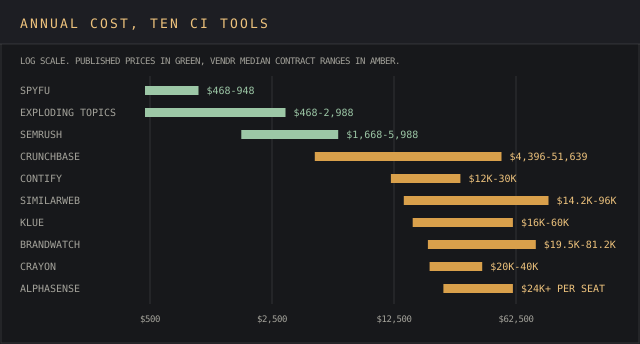
Vendr is a software buying platform, so its medians are what buyers signed. Klue buyers saved 18% against the opening quote on average, Crunchbase buyers 21%. Expect the first number a rep gives you to sit above these.
Evaluation criteria for competitive intelligence tools
Five criteria decide the shortlist, and they are the same five regardless of budget. The ranking below applies them in this order.
Data source coverage. Nothing downstream fixes a blind spot at the collection layer. Ask for the source list itself and check it covers your competitors' primary markets. Leave no stone unturned checking it, because a gap here stays invisible everywhere downstream.
Integration capabilities. A platform that pushes competitor alerts into Slack and Salesforce gets read. One that requires a separate login gets checked in week one and abandoned by week five.
Automation depth. Look for tools that automate collection and analysis. The weaker ones automate collection and hand you a raw feed. The difference is measured in analyst hours per week.
Total cost of ownership. Beyond the subscription: implementation, the analyst headcount to run it, per-seat expansion as sales asks for access, and the second tool you buy to cover the first one's gap.
Fit to your intelligence needs. A competitive strategy question and a keyword research question want different software. Buying the expensive one does not answer both. Paying more doesn't hand you the best of both worlds.
One test cuts through vendor demos. Ask the platform to show what changed across your five closest competitors in the last 30 days, then check the output against what you already know happened. Coverage gaps surface in about ten minutes.
Top competitive intelligence tools, ranked
Ranked on data source coverage, analysis depth, integration reach, and published price against delivered scope.
AlphaSense
Best fit: corporate strategy and market research teams tracking public companies, where a small analyst group needs depth on filings.
AlphaSense is a financial research platform that reads the documents competitors are legally required to publish. It is used by S&P 100 companies for market insights, which tells you both the depth and the buyer profile.
Features
- Semantic search across SEC filings, earnings call transcripts, broker research, and expert interview transcripts.
- Company and topic monitoring with alerts on filing and transcript language changes.
- Sentiment scoring on executive commentary across quarters.
- Expert call library covering private and public competitors.
- Advanced AI search that answers questions against the document corpus.
Pricing
Pricing starts at approximately $24,000 per year per user. Seat-based, so a five-person strategy team is a six-figure commitment before implementation.
The model punishes wide distribution, which is why AlphaSense tends to sit with a small analyst group. Our AlphaSense pricing report tracks a $17,500 median contract across 38 Vendr-recorded buyers, ranging from $9,250 to $51,000. Spread it across a full team and the seat count alone would cost an arm and a leg.
Pros
- Deepest coverage of financial filings and earnings call material in the category.
- Semantic search finds concept matches that keyword search misses entirely.
- Strongest fit for competitive benchmarking of public companies.
Cons
- Per-seat cost rules out giving access to sales reps.
- Coverage of small private competitors is thin compared to public ones.
- No battlecard or sales enablement layer.
Why it's ranked #1. No other platform here matches its depth on financial filings and expert transcripts, the highest-value source class for strategic research. It loses on price and distribution, and would rank lower for a team whose main job is arming sales reps.
Crayon
Best fit: product marketing teams arming a sales org, where competitor pricing and messaging changes have to reach reps the week they happen.
Crayon watches competitor digital footprints and packages what it finds for the people who answer objections on a call. It builds dynamic battlecards for sales teams, and the battlecard is the product.
Features
- Automated tracking of competitor website, pricing page, and messaging changes.
- Dynamic battlecards that update when the underlying competitor data changes.
- Win-loss tracking tied to named competitors.
- Slack and CRM delivery so competitor insights reach sales reps in workflow.
- Analyst curation layer that filters raw change detection into published intelligence.
Pricing
Vendr tracks a $30,000 median across 93 Crayon purchases, from $12,700 to $46,000 a year. That band covers the platform plus the seats a product marketing team and its supported sales org need.
Per-user economics land far better than a research platform priced per analyst.
Pros
- Battlecards stay current without a quarterly manual refresh.
- Adoption is high because the output lands in Slack and the CRM.
- Change detection on pricing pages and messaging is fast and specific.
Cons
- Weak on financial filings and earnings call analysis.
- The raw feed needs a curator; without one, alert volume gets out of hand and overwhelms the audience.
- Little value for teams with no sales function to enable.
Why it's ranked #2. It beats Contify on sales enablement and workflow delivery, which is where most CI programs fail. It loses to AlphaSense on source depth and analytical range, and its published price band is double Contify's floor. Our Crayon vs Klue comparison covers the head-to-head in detail.
Contify
Best fit: market intelligence programs tracking a large competitor, customer and supplier set on the lowest platform budget, with someone assigned to curate the feed.
Contify is a market and competitive intelligence platform built around source breadth. It tracks over 500,000 sources, and that number is the argument for buying it.
Features
- Monitoring across news, company websites, regulatory portals, and social channels at scale.
- Taxonomy-based tagging that routes company updates to the right internal audience.
- Custom newsletters and intelligence briefs generated from the monitored feed.
- Competitor, customer, and supplier tracking in one workspace.
- API and integration options for pushing intelligence into existing systems.
Pricing
$1,000 to $2,500 per month, so $12,000 to $30,000 per year depending on tier. The lower bound is the most accessible entry point of any full CI platform in this ranking. At that end of the market, it won't cost you an arm and a leg.
Pros
- Source count is the highest published figure in the category.
- Cheapest platform-grade option at the $1,000 monthly tier.
- Handles a wide competitor set without per-competitor pricing.
Cons
- Signal-to-noise depends heavily on how well the taxonomy is configured at setup.
- Battlecard and sales enablement layer is lighter than Crayon's.
- Volume can produce briefs nobody reads without editorial discipline.
Why it's ranked #3. It carries more sources than anything above it at a fraction of AlphaSense's price. It ranks below Crayon because raw coverage without a workflow destination is where CI programs stall, and Contify puts more of that burden on the buyer. Without that destination, coverage alone leaves a program dead in the water.
The three platforms above solve three different problems and are routinely compared as if they were substitutes. AlphaSense reads filings, Crayon watches web changes, Contify monitors news at volume. A shortlist containing all three is a shortlist that hasn't defined the question yet.
Klue
Best fit: sales teams that need battlecards inside the CRM and want proof reps are opening them.
Klue is a compete enablement platform sitting closer to knowledge management than to monitoring. The point is that a rep opening an opportunity against a named competitor finds a current, verified answer.
Features
- Competitor battlecards surfaced inside the CRM and in Slack.
- Field intelligence capture so reps submit what they hear on calls.
- Win-loss data linked to competitor and deal stage.
- Consumption analytics showing which cards reps open and which they skip.
- Automated collection from public competitor sources feeding the card library.
Pricing
Klue publishes no rate card. Vendr's dataset puts the median contract at $30,000 per year across 106 recorded purchases, spanning $16,000 to $60,000, and the Klue pricing report covers onboarding and escalation.
Buyers saved 18% on average against the opening quote, so treat the median as a budgeting anchor and expect the first number to arrive higher. Read between the lines on that first quote. There's usually room to move.
Pros
- Consumption analytics are the only honest measure of CI program usage.
- Field intelligence capture closes the loop between reps and the analyst.
- Knowledge sharing model keeps one version of the competitor story.
Cons
- No published pricing makes budget planning harder.
- Overlaps heavily with Crayon; running both is duplicated spend.
- Limited value for market-level or financial research questions.
Why it's ranked #4. Its consumption analytics and field-capture loop are stronger than Crayon's, but Crayon's published pricing and broader change-detection coverage put it ahead for most buyers comparing the two cold.
Similarweb
Best fit: marketing and strategy teams measuring online market share against rivals who publish no numbers.
Similarweb provides insights into web traffic and audience trends, the closest available proxy for online market share when competitors disclose nothing.
Features
- Traffic estimates by channel: organic, paid, direct, referral, social, email.
- Audience overlap between your domain and named competitors.
- Keyword and referral analysis showing where competitor demand originates.
- App download and engagement estimates alongside web data.
- Industry benchmarking against a defined competitive set.
Pricing
Quoted by seats, domains tracked, data history depth, and which intelligence modules you license. Vendr records a $37,800 median across 157 purchases, running from $14,220 to $96,000.
That spread reflects module selection more than seat count. Average saving against the opening quote was 12%, the smallest discount of any tool here.
Pros
- Best available estimate of competitor digital performance without their analytics access.
- Channel mix data explains competitor acquisition strategy directly.
- Audience overlap identifies the rivals you lose deals to.
Cons
- Estimate accuracy degrades on low-traffic domains.
- No product, pricing, or messaging change detection.
- Pricing opacity makes it hard to compare against Semrush on scope.
Why it's ranked #5. The strongest digital performance tool here and the only one that credibly estimates online market share, but it answers one question. It's a specialist's tool, worlds away from a jack of all trades.
Semrush
Best fit: digital marketing teams with no dedicated analyst, competing mainly in organic and paid search.
Semrush covers SEO, PPC, and content performance analysis. It is the default digital marketing intelligence platform for teams whose competitors compete mainly in search.
Features
- Competitor keyword research across organic and paid search.
- Ad copy history and estimated paid spend by competitor domain.
- Backlink and referring domain comparison.
- Content gap analysis against a named competitor set.
- Position tracking with alerts on competitor ranking movement.
Pricing
$139 to $499 per month, so $1,668 to $5,988 per year. The lowest tier in this ranking that still covers a full digital competitive analysis workflow, and roughly a fifth of Contify's entry price. It cuts to the chase on pricing where half this list makes you sit through a sales call first.
Pros
- Published pricing at every tier, no sales call required to budget.
- Keyword research and content gap analysis are the deepest in the category.
- Paid ad history reveals competitor messaging tests over time.
Cons
- Search-centric; competitors who acquire through sales or partnerships are invisible.
- No financial filings, news monitoring, or battlecard layer.
- Seat limits on lower tiers push growing teams up a pricing band quickly.
Why it's ranked #6. Best value on a pure cost-per-capability basis, and it beats SpyFu on data depth by a wide margin. It sits below Similarweb because search visibility is a narrower question than total digital performance.
Brandwatch
Best fit: brand and communications teams in consumer or community-driven markets where buyers discuss vendors in public.
Brandwatch tracks brand mentions and sentiment across public channels, and runs that at the scale where the sentiment number stops being noise. It sits alongside the wider social listening tools category.
Features
- Mention tracking across social platforms, forums, blogs, and review sites.
- Sentiment analysis segmented by product, campaign, and competitor.
- Share of voice comparison against a defined competitor set.
- Image and logo detection in visual social content.
- Social media management functions alongside the listening layer.
Pricing
Quoted by mention volume, historical data depth, seats, and which of the three product suites you license. Vendr shows a $50,000 median across 40 purchases, spanning $19,542 to $81,200. The devil's in the details on this one. Mention volume, history depth, seats and suite choice all move the number independently.
Volume pricing means a consumer brand and a B2B software company with identical seat counts land far apart.
Pros
- Sentiment analysis reveals customer perceptions competitors would never disclose.
- Share of voice is a defensible competitive metric for brand teams.
- Historical archive depth supports trend analysis across years.
Cons
- Low signal in categories where buyers don't discuss vendors socially.
- Volume pricing gets expensive fast for high-mention brands.
- No product or pricing change detection.
Why it's ranked #7. The strongest sentiment option here, but the input only exists in consumer-facing and community-driven markets. In enterprise B2B the same spend buys more elsewhere.
Crunchbase
Best fit: corporate development and strategy teams whose competitor set includes private companies with no filings to read.
Crunchbase tracks company formation, funding, headcount movement, and acquisition activity. For competitor sets that include private companies, it covers ground the filings-based platforms cannot reach.
Features
- Funding round history, investors, and valuation data where disclosed.
- Headcount trend and growth signal tracking.
- Acquisition and exit records by company and by sector.
- Saved searches with alerts on competitor funding and leadership changes.
- List building for corporate development and partnership screening.
Pricing
List pricing runs about $29 per user per month for Starter and $49 to $99 for Pro, billed annually. Enterprise, where API access and bulk export live, is quoted.
Vendr records a $20,000 median across 70 purchases with a $4,396 to $51,639 spread and 21% average savings, the largest discount rate of any tool here. Our Crunchbase pricing report checks that discount against G2's independently listed $588 annual rate.
Pros
- Covers private competitors that filings-based research platforms miss.
- Funding alerts give early warning of a rival about to expand, keeping you ahead of the curve.
- Low per-seat cost supports wide internal distribution.
Cons
- Coverage quality varies by geography and company size.
- Self-reported company data ages without correction.
- No monitoring of product, pricing, or messaging.
Why it's ranked #8. It solves the private-competitor blind spot better than anything above it and costs less than all of them, but it's a data source.
SpyFu
Best fit: small teams on a fixed budget who need competitor keyword and ad history and nothing else.
SpyFu records competitor keyword and advertising history and sells access to the archive. Narrow scope, and priced accordingly.
Features
- Historical organic and paid keyword rankings by competitor domain.
- Ad copy history going back years for a given domain.
- Estimated ad spend and click volume by keyword.
- Competitor keyword gap and overlap reports.
- Unlimited data export on paid tiers.
Pricing
$39 per month for Basic and $79 for Professional, so $468 to $948 per year. Level with Exploding Topics at the bottom of this ranking on entry price.
Pros
- Historical ad archive depth is strong relative to price.
- Published, low, predictable pricing with no sales process.
- Data export is unrestricted on paid tiers.
Cons
- Search and advertising only, no other competitive signal.
- Estimate accuracy trails Semrush and Similarweb.
- Interface and reporting are dated compared to the rest of the list.
Why it's ranked #9. At $39 a month it's the right answer for a team with no CI budget, and the ad history is the one place it beats tools costing ten times more. In that one category, it knocks costlier tools out of the park. It ranks below Semrush because Semrush does the same job better across more of the funnel for a manageable price step.
Exploding Topics
Best fit: product strategy and content teams looking for demand signals before a category has established vendors.
Exploding Topics surfaces search and social terms gaining volume before they reach mainstream coverage. It answers the question that comes before competitor analysis: which market is forming.
Features
- Trend detection with growth rate and time-to-peak estimates.
- Category filtering across industries and consumer segments.
- Related term clustering that maps an emerging topic's vocabulary.
- Historical trend data to separate a genuine market movement from a spike.
- Alerts on newly detected topics in tracked categories.
Pricing
Three published tiers, billed monthly. Entrepreneur is $39 for 100 tracked trends and 10 analyses. Investor is $99 for 500 trends, 100 analyses, trending startups, forecasting and CSV export. Business is $249 for 2,000 trends and 500 analyses.
Forecasting and startup tracking start at $99, so the $39 plan is a browsing licence. All three include a 7-day trial. Our Exploding Topics pricing report covers what the free plan still includes and where the API sits.
Pros
- Early demand signal that no competitor monitoring tool provides.
- Useful for product strategy before a category has vendors.
- At $39 the entry tier costs less than any other entry here.
Cons
- No competitor tracking of any kind.
- Trend data needs interpretation; the tool surfaces terms and leaves the conclusions to you.
- Weak in established B2B categories where search volume moves slowly.
Exploding Topics is a Semrush trademark and its support runs through app-center@semrush.com. Buyers running Semrush at #6 alongside it are buying from the same company twice, which matters if vendor diversification is part of why you're shortlisting. Run both and you're putting some of your vendor eggs in one basket, whatever the org chart says.
Why it's ranked #10. The only trend analysis entry here, and it earns a place for that, but it does none of the competitor work the other nine do. Treat it as an addition to a program.
What competitive intelligence tools do
These tools, sold as competitor analysis tools about as often as competitive intelligence platforms, gather information from competitor websites and social media, then filter through large datasets to highlight the relevant intelligence. That filtering is the product.
A single competitor publishes dozens of public signals a week across pricing pages, job posts, release notes, review sites, and executive LinkedIn activity. No analyst reads all of it by hand across a set of twelve rivals. Finding the handful that matter by hand is a needle in a haystack.
Collection, alerting, output
Automated collection is the first layer. Gathering runs on a set schedule, and monitoring tools notify teams of competitor website and pricing changes as they happen.
Speed is the whole argument for buying software over assigning an analyst, and the early bird catches the worm. A pricing change caught the day it ships is a sales objection you can answer. Caught six weeks later, it's a lost deal you're explaining in a post-mortem.
The output layer matters as much as the collection. Data visualization turns a stream of competitor data into performance metrics a product marketer can put in front of a sales team, which is why CRM integration ranks so high on most buying checklists.
Sentiment analysis reveals customer perceptions no press release will tell you. Reading review sites for the complaints a rival's customers repeat gives you the raw material for competitive positioning, for free, before you license anything. That's about as straight from the horse's mouth as competitive intelligence gets, and it costs nothing.
What separates a platform from a feed is the last step. Raw competitive data becomes actionable insight when it arrives attached to a decision someone owns.
The relevant items in any given week are a handful out of thousands collected. Everything else is archive.
Competitive and market intelligence: where the categories differ
Competitive intelligence watches named rivals. Market intelligence watches the market those rivals operate in. The distinction sounds academic until you're choosing software, at which point it decides half your shortlist.
Competitive intelligence analyzes market trends and company updates for a defined competitor set: pricing, hiring, product releases, funding, partnerships, messaging. Market intelligence platforms answer questions about market size, industry trends and buyer behavior, with the competitor view as one input among several.
Most programs need both. A product team asks two questions in the same meeting: is this segment growing, and who else is already selling into it. A tool built only for competitor tracking answers the second and guesses at the first.
Competitive intelligence vs business intelligence
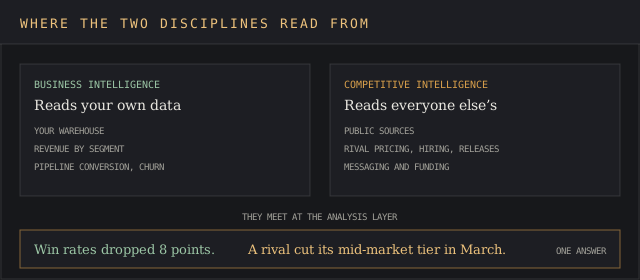
Business intelligence reads your own data. Competitive intelligence reads everyone else's. A BI stack queries your warehouse for revenue by segment, pipeline conversion and churn; a CI platform pulls from external sources to explain why a segment moved.
Your BI system tells you win rates dropped 8 points in mid-market deals. Competitive intelligence tells you a rival cut its mid-market price tier in March.
Neither number means much alone, and the split between the two disciplines is worth getting straight before you buy for the wrong one.
Six types of competitive intelligence platforms
The ten tools ranked above fall into six product categories. Two of the six, digital performance and SEO and advertising intelligence, are the ones marketers shop for as competitor analysis tools; the other four are what strategy teams buy. Buying two tools from the same category is the most common wasted spend in this market.
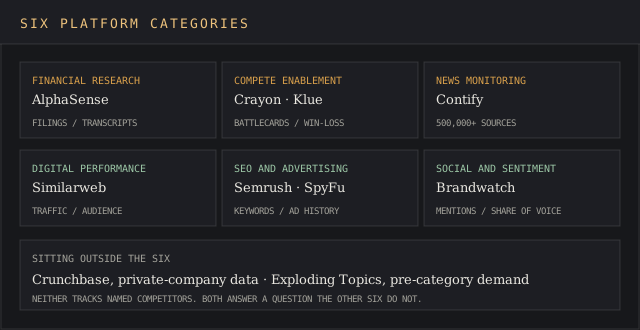
Financial research platforms read SEC filings, earnings calls, broker research and expert call transcripts. Semantic search across that corpus is the differentiator, and it's what corporate strategy teams pay the premium for.
Compete enablement platforms build battlecards, track win-loss reasons, and push objection handling to sales reps where they already work. These live or die on adoption. Tools built only for the win-loss side sit in the win loss analysis software ranking.
News and company monitoring platforms centralize public sources: news, regulatory portals, financial filings, company websites, patent registries, job boards. Volume of sources is the headline metric.
Digital performance tools analyze website traffic and engagement to estimate online market share, referral mix and audience overlap.
SEO and advertising intelligence covers online market share and keywords, plus paid ad copy and spend estimates. Keyword research is the entry point; competitive benchmarking is the payoff.
Social and sentiment platforms track brand mentions across public channels, and often bundle monitoring alongside publishing.
Patent intelligence sits outside all six. Tools that track competitor filing activity matter in hardware, pharma and semiconductors, and matter much less in SaaS, where the roadmap leaks through job posts, letting the cat out of the bag long before anything reaches a registry.
Data sources these platforms pull from
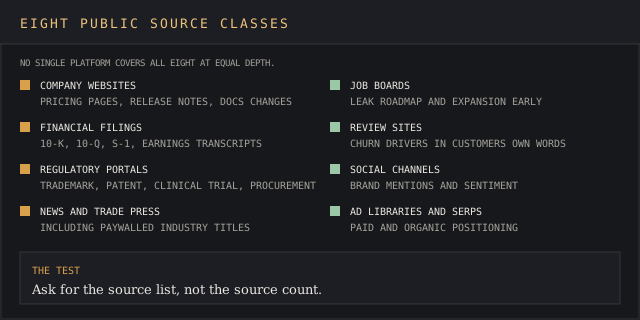
Data source coverage is the first thing to evaluate and the hardest thing to compare on a demo call. Two platforms both claiming to monitor competitors can differ by an order of magnitude in what they see.
Most mature programs run two or three tools. The pairing that works: one platform for depth on named competitors, one for digital performance, one for the market context around both.
Qualitative and quantitative data need different handling. Traffic estimates and ad spend are quantitative and comparable across quarters. Those estimates come from modeled panel data, and our clickstream data providers ranking shows which vendors publish their collection volume.
Qualitative material from earnings call language, sales-rep field notes and customer interviews carries more meaning and resists dashboards. A platform that only ingests structured data misses the more useful half.
Collaboration and knowledge sharing across teams
Competitive intelligence dies in a folder nobody opens. The programs that survive push intelligence into the tools people already have open.
A competitor alert that arrives in Slack gets read by nine people. The same alert in a weekly PDF gets read by the person who wrote it. The PDF version is preaching to the choir, if the choir shows up at all.
Collaboration matters more than dashboard design for one reason: the best competitor data in most companies is already inside the building, sitting in sales reps' heads after a lost deal. A platform that captures field intelligence turns 40 reps into 40 collectors.
Marketing, sales and product strategy each need a different slice of the same competitor picture. Maintaining three separate versions guarantees they diverge within a quarter. Without one shared source, the three teams stop being on the same page fast.
If a battlecard for your largest competitor was opened four times last quarter across a 60-person sales org, the problem is distribution. Route pricing changes to sales, hiring signals to product, funding news to corporate development, and each audience gets only what's relevant to its job.
How AI changed competitive intelligence software
AI improved the accuracy and speed of competitive intelligence analysis, and the change shows up in three specific places.
Collection. Automated scraping removed the maintenance work that used to consume an analyst's week whenever a competitor redesigned a page. That's the kind of grind that used to have analysts burning the midnight oil.
Extraction. Models pull the pricing change out of a 40-page filing or the roadmap hint out of an earnings call answer, clustering signals a human reads one at a time.
Interpretation. Sentiment scoring and generated summaries put a confidence level next to a claim, making the certainty explicit, though the summary is a starting point for an analyst.
Semantic search is the underrated piece. Matching concepts finds the competitor commentary keyword search walks past, and it's the main reason financial research platforms charge what they charge.
What AI has not solved is source coverage. A model applied to an incomplete feed produces confident summaries of a partial picture, which is worse than an obvious gap because it doesn't look like one.
Competitive intelligence companies and service providers
Some organizations buy the analysis. Competitive intelligence companies run the program as a service: analysts do the collection, write the strategic research and deliver briefs on a schedule.
The trade is control against headcount. A service engagement costs less than an analyst salary plus a platform license and starts producing in weeks.
It also means the institutional knowledge sits outside your company, and the depth of the work depends on how well you brief the provider.
Providers tend to be stronger on strategic research than on daily monitoring. A commissioned market analysis of a segment you're entering, or an industry analysis of a competitor set you've never tracked, is work a platform cannot do at any price.
The hybrid model is common at scale: a platform license for continuous monitoring, plus a provider for the deep-dive work a two-person team can't produce. Gartner maintains a category listing for competitive and market intelligence tools if you want vendor reviews alongside this shortlist. Gartner also sells analyst access by the seat, and our Gartner pricing report puts the median Gartner contract at $76,002 a year.
Building a competitive intelligence program
Software is the last decision. Four steps come before it.
1. Name the competitors. Five to twelve. Forty is a spreadsheet nobody reads. Include the two you lose to most often and the one nobody takes seriously yet. A set large enough to be thorough and small enough to keep current beats an exhaustive list refreshed once a year.
2. Write the questions. "Monitor competitors" is not a requirement. "Tell me within 48 hours when any tracked competitor changes a published price" is, and it's testable in a demo. Three to five questions of that shape define the tool you need.
3. Pick the delivery destination. Decide where intelligence lands before you decide what collects it: the CRM, Slack, a battlecard in the sales enablement tool, a monthly brief to strategy. Each implies a different integration requirement.
4. Assign the curator. A person still decides what matters this week. Programs without a named owner produce alert fatigue and then silence. Without a name attached to the job, it's too easy for everyone to pass the buck.
Only then does the tool choice matter, and by that point it usually narrows to two. Run both in a 30-day trial against the same competitor set and compare what each caught.
Scope the tracked set to your real competitive environment. The companies you lose deals to are often not the ones your category page lists, and B2B buyers in particular shortlist on peer recommendation. Track the wrong list and you're barking up the wrong tree before the program even starts.
Competitive intelligence tools FAQ
What are competitive intelligence tools?
Software that collects public information about named competitors from company websites, financial filings, news, job boards, review sites and social channels, then analyzes it and delivers the relevant parts to the teams that need it. The category spans keyword tools at $39 a month through research platforms above $24,000 per user per year.
What is the difference between competitive intelligence and market research?
Competitive intelligence is continuous and competitor-specific. Market research is project-based and market-specific. A CI platform tells you a rival changed its pricing on Tuesday; market research tells you how the segment values that pricing. Most strategy teams run both, and the distinction between the two decides which budget line pays for what.
How much do competitive intelligence platforms cost?
Published figures span $39 per month for SpyFu Basic and Exploding Topics Entrepreneur to approximately $24,000 per year per user for AlphaSense. Contify runs $1,000 to $2,500 monthly, Crayon's enterprise programs run at a $30,000 Vendr median a year, and Semrush publishes plans from $139 to $499 per month.
For the platforms that publish nothing, Vendr's buyer data puts median annual contracts at $50,000 for Brandwatch, $37,800 for Similarweb, $30,000 for Klue and $20,000 for Crunchbase. Those are unofficial. Sensor Tower, the app data option, sits at a $75,000 Vendr median across 40 purchases, per our Sensor Tower pricing report.
Do I need more than one competitive intelligence tool?
Most mature programs run two or three. No single platform covers financial filings, digital performance, social sentiment and product change detection at equal depth. The common stack is one monitoring platform, one of the digital competitor analysis tools (Semrush or Similarweb) and one market-level source.
Are competitor analysis tools different from competitive intelligence tools?
Same software, different search habit. "Competitor analysis tools" is what digital marketers call Semrush, SpyFu and Similarweb, which measure a rival's traffic, keywords and ad spend; "competitive intelligence platforms" is what strategy teams call Crayon, Klue and Contify, which track pricing, product and hiring changes across a named set of rivals.
Both groups sit in the ranking above, and the price spread between them, $39 a month for SpyFu against a $30,000 Vendr median a year for a Crayon program, shows they answer different questions.
Which competitive intelligence tool is best for a small team?
On published price and delivered scope, Semrush at $139 per month covers digital competitive analysis for a team with no dedicated analyst, and SpyFu at $39 covers ad and keyword history alone. Neither monitors product or pricing pages, so a small team that needs that moves up to Contify's $1,000 monthly tier.
Bottom line
Pick by the question you need answered, then check the price against it. AlphaSense for filings and expert research. Crayon or Klue for arming sales reps. Contify for breadth of monitoring at the lowest platform price.
Similarweb and Semrush for digital performance, Brandwatch for sentiment, Crunchbase for private competitors, SpyFu for a fixed small budget, Exploding Topics for early demand.
The tools differ less than the programs do. Two companies running the same platform get different results depending on one thing: someone owns the output, and it reaches the people making pricing, positioning and roadmap calls. Actions speak louder than words in this category. The tool matters less than who acts on what it finds. Buy the software last.