Lusha review: how accurate is its contact data in 2026
By Jan Suski. I go deep on every review, checking every number against its source and digging up details other coverage misses, a habit from six years of SEO and link building for tech companies. Bylines at Surfer, Brand24, and Senuto. How the scoring works.
Solo reps and small teams wanting a fast Chrome extension pulling emails & phone numbers straight off a LinkedIn profile, on the $0 free plan, a $49.90 Starter seat or $69.90 Pro.
Not for
Teams needing accurate coverage outside North America, or anyone processing Italian residents' data; the Garante fined Lusha €2 million and ordered that data deleted.
What it costs
Free at $0 with 40 credits a month, Starter $49.90, Pro $69.90, Premium $399.90 a month; only Scale is quoted. A phone reveal costs 5 credits, an email 1.
Fit for a solo marketer or founder78Credits roll over up to twice the monthly cap on Pro and Premium monthly billing only; Free and Starter credits don't carry.
Fit for enterprise with procurement45SOC 2 Type II and ISO 27701 support the enterprise case, but users report removal requests not always honored, or slow when they are.
Price transparency72Free, Starter, Pro and Premium rates are all published and only Scale needs a sales call; the yearly discount is a temporary SUMMER SALE promotion.
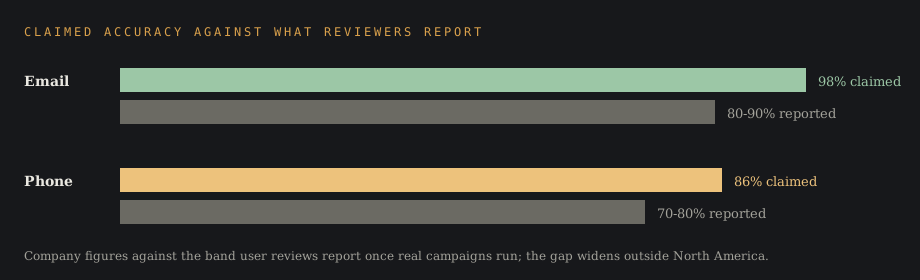
EU versus US data coverage20Lusha claims 98% email and 86% phone accuracy; reviewers running real campaigns reported 80-90% and 70-80%, a wider gap outside North America.
Support responsiveness35Reviewers report slow replies on complex credit and billing questions.
Integration depth70Native Salesforce, HubSpot and Microsoft Dynamics sync, plus API access on paid tiers for bulk enrichment.
Which database and accuracy numbers are Lusha's own, and which came from reviewers
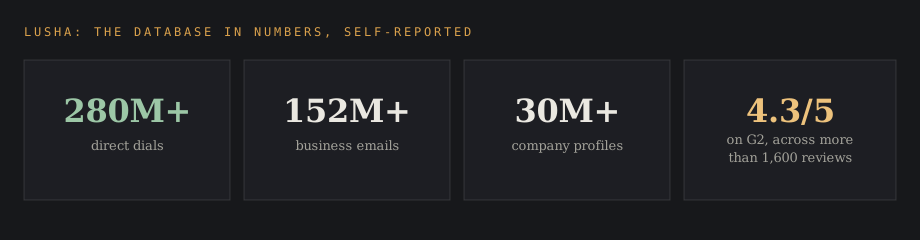
The 280 million direct dials, 152 million emails, 30 million company profiles and the 98% email and 86% phone accuracy claims are Lusha's own published figures, none of them independently audited. The 80% to 90% email and 70% to 80% phone bands come from user reviews, as does the reviewer who found half their phone numbers wrong on a follow-up call.
Prices, credit costs and the SUMMER SALE yearly discounts are Lusha's published rates, read off lusha.com and docs.lusha.com on 11 August 2026; the $15,999 median is Vendr's; the 4.3 rating is G2's across more than 1,600 reviews; the €2 million fine and the processing ban are Italy's Garante. Page updated 11 August 2026.
Try it yourself
Sign up for Lusha
Free plan available, credit-based pricing after that.
May earn a commission if you sign up through this link, at no extra cost to you. Full affiliate disclosure.
This Lusha review covers data accuracy, the credit system, pricing, compliance and how the platform compares with alternatives like ZoomInfo and Apollo.io. Lusha is a B2B sales intelligence and data enrichment platform built in Tel Aviv in March 2016 by Yoni Tserruya and Assaf Eisenstein, now headquartered in Boston with development offices in the Azrieli Triangle Tower.
The company raised $205 million in a Series B round in November 2021 from PSG and ION Crossover Partners at a $1.5 billion valuation. In December 2025 it cut 8% of its roughly 300-person workforce, about 24 employees, as part of a restructuring the company described as reallocating resources.
What is Lusha
Lusha provides contact data, company data and intent data to sales teams, marketing teams and recruiters who need verified contact information without manually searching company websites. The platform sits inside a browser extension, a web app and an API, letting a rep pull contact details for a prospect without leaving LinkedIn or a company's own site.
Lusha's data covers phone numbers, direct phone number lookups and business emails, and the company markets itself as a faster way to reach relevant prospects than manual research. Sales and marketing teams use Lusha alongside CRM systems like Salesforce, HubSpot and Microsoft Dynamics, syncing contact data directly into existing pipelines through CRM integration.
Lusha claims 98% accuracy for email addresses and 86% accuracy for phone numbers, figures the company publishes on its own site. User reviews indicate real-world accuracy may be lower than the marketing claims, and one reviewer noted only 50% of the phone numbers they pulled were accurate on a follow-up call.
Lusha's data accuracy drops sharply outside North America, a pattern smaller teams evaluating a global rollout should weigh before buying a large seat count. Lusha's email verification accuracy ranges from 95% to 98% according to the company, while user reviews report a wider band of 80-90% email accuracy and 70-80% phone accuracy once real campaigns run against the data.
Users report mixed accuracy results for smaller and niche companies, where contact data is sparser than it is for large public companies with well-indexed staff directories.
That gap between claimed and reported data accuracy matters most for teams that pay for phone reveals expecting a dial rate close to Lusha's stated 86%. A sales process built around outbound calling absorbs a bigger cost when a chunk of phone numbers turn out to be a wrong number, since every reveal spends a credit either way.
Three patterns repeat across the review base before any individual feature:
Lusha is noted for its fast prospecting capabilities, and reps commonly describe pulling verified contact information in seconds.
Lusha is often used as a supplement alongside other data tools, since no single provider blankets every company size and industry at the same data accuracy.
The platform can save substantial prospecting hours per month for a small sales team that would otherwise build lead lists by hand.
Lusha offers over 280 million direct dials across its database, alongside more than 152 million emails and over 30 million company profiles, sourced from public web data, user-contributed profile updates and licensed data partners. Those figures are self-reported by Lusha and have not been independently audited, which is the standard caveat across this category.
Chrome extension and browser extension
Lusha's Chrome extension reveals contact data directly from LinkedIn profiles, letting a rep click a button on a prospect's page. The browser extension also works across company websites, pulling verified contact data for people listed on a team or leadership page.
Reps who work LinkedIn heavily lean on the chrome extension for quick access to a prospect's direct phone number and email, and the browser extension is one of the most cited reasons users keep a paid plan active month over month.
Job change alerts and intent signals
Lusha provides job change alerts for real-time engagement, notifying a rep when a past contact moves to a new company where the same relationship could turn into a new deal. Intent signals layer on top of that, flagging accounts showing buying behavior so a rep can prioritize relevant prospects first.
Combining job change alerts with intent signals gives larger sales teams a way to route the best accounts to senior reps automatically.
CRM integration and API access
Lusha integrates with major CRMs like Salesforce and HubSpot, plus Microsoft Dynamics for teams running Microsoft's stack, syncing contact data and company data straight into existing records. CRM integration removes the manual step of copying a phone number or email from the browser extension into a deal record by hand.
API access is available on paid tiers, and full API access lets an engineering team build bulk data enrichment directly into an internal tool. Lusha's API supports bulk enrichment jobs for teams cleaning a stale contact list against Lusha's data before a big outreach push.
Lusha publishes four of its five tiers. Free is $0 for one seat and 40 credits a month. Starter runs $49.90 a month for one seat and 400 credits, Pro $69.90 for two seats and 600 credits, and Premium $399.90 for five seats and 3,400 credits.
Scale is the only tier behind a sales call, quoted on a custom seat count and a custom credit allowance per year. An email reveal costs 1 credit, a company record costs 1, and a phone reveal costs 5.
Rollover isn't universal. Monthly plans carry unused credits forward up to twice the monthly cap, but only on Pro and Premium; Free and Starter lose whatever they don't spend. Annual plans grant the whole year's credits upfront and reset the unused balance when the cycle ends.
The yearly discount isn't a standing rate either. Lusha runs it as a temporary promotion branded SUMMER SALE, applied to yearly billing only: 25% off Starter, 30% off Pro, 35% off Premium. Monthly billing shows no discount at all.
That drops Starter to $37.45 a month billed yearly with 4,800 credits granted upfront, Pro to $48.95 with 7,200, and Premium to $259.95 with 40,800. Lusha's own structured data gives the annual totals as $449.10, $587.16 and $3,119.21.
The credit system still bites a phone-heavy team. Five credits a reveal against one for an email means an outbound calling motion drains a plan roughly five times faster than an email-first one, which is the recurring complaint in reviews about credits running out mid-month.
May earn a commission if you sign up through this link, at no extra cost to you. Full affiliate disclosure.
User reviews: what G2 ratings show
Lusha has a 4.3 out of 5 rating on G2 from more than 1,600 reviews, a score that holds steady even as individual reviews flag specific frustrations with data accuracy and the credit system. Lusha is particularly effective for recruiting and sales development teams who need a high volume of contact information fast.
Many users experience outdated contact information in Lusha, since any contact database ages the moment someone changes jobs or a phone carrier, and Lusha's alerts about job moves only catch a fraction of moves before a reveal goes stale. Users report slow customer support response times for complex issues, a common complaint among reviewers who needed help reconciling a credit system billing question.
Reviewers weighing a lusha compare against a competing tool tend to cite two things most: how the data accuracy holds up for their specific company size and industry, and how the credit system's manual work of tracking phone reveals versus email reveals weighs against the cost.
Sales teams closing deals on tight quarterly business reviews say the browser extension's speed offsets some of the accuracy complaints, since a fast wrong number is cheaper to work around than a slow one.
Lusha claims compliance with GDPR and CCPA regulations, and the company holds SOC 2 Type II and ISO 27701 certifications that cover data handling and privacy management practices. Lusha's compliance posture is enterprise-grade from day one according to the company's own security documentation, a claim aimed at larger sales teams with a formal procurement and legal review process.
The Italian €2 million fine
The Garante ruling
Italy's data protection authority, the Garante, fined Lusha €2 million, ordered the company to stop processing the personal data of individuals in Italy, and required it to delete the data it had collected on them. The certifications did not prevent the regulator from acting.
The regulator's findings go to the heart of how the product is built. It said Lusha assembled its profiles from multiple sources including scraping social networks and buying records from other data brokers, then made the result available to customers for commercial and anti-fraud purposes.
The authority also noted the database held information on representatives of institutional leaders, public administrations, law enforcement agencies and the judiciary.
For a buyer, that changes the shape of the compliance question. A certification describes the controls a company operates; an enforcement action describes what a supervisory authority concluded about the lawful basis for the processing itself. A team selling into the EU should ask Lusha directly:
Which jurisdictions its data is currently offered in.
What changed in sourcing and processing after the ruling.
Who carries the liability if a prospect in a restricted market surfaces in a reveal.
Removal requests and consent
Users report Lusha does not respect data privacy requests in every case, and some individuals say a request data removal submission took longer to process than expected.
Lusha is accused of selling data without user consent by critics who argue that scraping public profiles for personal records crosses a line even when the underlying source, like a LinkedIn profile, is publicly visible; the Italian ruling gives that argument regulatory weight.
A team weighing that tension should ask their own legal counsel how Lusha's certifications sit against internal policy before buying a paid plan, since compliance certifications describe a company's controls. They don't settle every open question about data removal and consent that critics raise.
Compare it yourself
Sign up for Lusha
Start on the free tier before committing to a paid plan.
May earn a commission if you sign up through this link, at no extra cost to you. Full affiliate disclosure.
Lusha alternatives
RB2B offers real-time intent data for better prospecting, positioned as a narrower tool focused on identifying anonymous website visitors. ZoomInfo provides deeper datasets and stronger intent signals than Lusha, at a price point that usually runs higher for a comparable seat count.
Apollo.io is a strong all-in-one alternative for outbound-heavy teams that want lead generation, email sequencing and a contact database bundled into one prospecting platform. That combination replaces buying Lusha alongside a separate outreach automation tool. BookYourData guarantees 97% accuracy with no subscription fees, an appealing best lusha alternative for a team that wants pay-as-you-go bulk data enrichment without a recurring credit system bill.
Seamless.AI uses AI to find and verify sales leads in real-time, an AI feature some reviewers say catches data accuracy problems faster than Lusha's static reveal model. A team that only needs a cold email and LinkedIn sequencer, with no data lookups attached, fits Woodpecker instead, priced by the contacted prospect.
FullEnrich is the bulk-upload alternative once sidebar lookups run out: a waterfall over 20-plus providers, 1 credit a verified work email and 10 a mobile number against Lusha's 5-credit phone reveal, from $29 a month for 500 credits with unlimited users on every plan. It has carried no LinkedIn extension since June 2024, so a rep who wants the number inside the profile page stays with Lusha and a team enriching a CSV of a few thousand rows moves to FullEnrich.
Want AI-verified leads instead?
Sign up for Seamless.AI
Free plan with 50 credits a month, no card required. Pro and Enterprise are quote-only.
May earn a commission if you sign up through this link, at no extra cost to you. Full affiliate disclosure.
Picking between them comes down to company size, budget and how much a team wants B2B contact data bundled with outreach automation against Lusha's narrower, browser-first workflow.
Teams selling heavily into Europe should add one more filter to that comparison after the Italian ruling: how each vendor sources EU records and what it will put in writing about them.
Outbound workflows and automation
Lusha integrates with workflow automation tools so a revealed contact flows into a sequence without a rep manually copying a job title, company name and email into a separate outreach platform. That kind of lusha integrate step matters most for teams running automated outreach at volume, where a five-second manual copy repeated across hundreds of contacts adds up to real lost selling time.
Website visitors who show up anonymously in a company's analytics can be matched against Lusha's contact database, turning an anonymous page view into a named lead with a job title and direct emails attached. Combined with advanced filtering by company size, industry and seniority, that matching step helps a team build a B2B contact data list without pulling records that miss the buyer profile a rep is chasing.
B2B data quality shows up downstream in campaign metrics, and teams tracking bounce rates on cold email closely say a cleaner B2B contact list keeps bounce rates lower than a list scraped from an outdated source. Lusha markets its combination of verified emails and direct phone numbers as a way to build stronger pipelines than a team relying on a single, unverified data source.
Reviewers comparing tools for the best data available in a given market say the answer depends heavily on region and industry. A team building a B2B contact data workflow around Lusha typically pairs it with a second source for regions where Lusha's own coverage is thinner.
Lusha review verdict
This Lusha review found a platform that delivers fast, browser-first access to contact details and a large database of phone numbers, backed by real certifications and a credit system that rewards teams who mostly need email over phone reveals. The accurate data Lusha promises in its marketing does not always match what reviewers report once a list gets dialed at scale, and that gap is the main tradeoff a buyer accepts.
The second tradeoff is regulatory. A €2 million fine and a processing ban in one EU member state is a documented outcome, and a team whose pipeline runs through Europe should treat it as a procurement question.
Teams that read this Lusha review looking for a single verdict should weigh their own mix of phone versus email outreach, since the credit system pricing model rewards one pattern of use over the other.
For a small sales team testing the waters, the free plan's 40 monthly credits and Starter at $49.90 give a reasonably low-risk way to see how Lusha's contact data holds up against their own target accounts before signing an annual contract.
Ready to see it for yourself?
Start with Lusha's free plan
Test the data accuracy against your own target accounts.
May earn a commission if you sign up through this link, at no extra cost to you. Full affiliate disclosure.
Who Lusha is built for
Lusha suits sales teams and recruiting teams that need quick access to verified contact information without a heavy setup process, especially smaller teams that can't justify a longer onboarding for a bigger platform. A small sales team running most of its prospecting through LinkedIn benefits most from the chrome extension's direct pull of contact details from linkedin profiles.
Larger sales teams with dedicated revenue operations staff get more value from Lusha's CRM integration, API access and bulk enrichment tools, since those features cut manual work across a bigger book of accounts. Teams that rely heavily on phone outreach should model their credit math carefully before committing to a paid plan, since the 5-credit cost per phone reveal changes the real price per contact compared with a team that mostly emails prospects.
Setting up Lusha across a sales stack
Most teams start Lusha with the browser extension, then add workflow automation once a rep proves the contact data holds up against their own outbound results. Lusha integrates through native connectors for the major CRMs, and a second wave of workflow automation usually comes from a sequencing tool that picks up a revealed contact and starts a cadence automatically.
Teams that lusha integrate into a broader revenue stack get more consistent use out of intent data and job change alerts, since those signals only help if they land in a system reps check daily.
A rep who has to open a separate tab to see an intent data alert is less likely to act on it than one who sees the same signal inside their CRM.
B2B data hygiene matters just as much as the initial reveal. A contact pulled from Lusha six months ago can be stale by the time a campaign finally reaches it, so teams that re-verify phone numbers and emails against Lusha's data before a big push report better results than teams that treat an old export as current.
The Pro headline rate isn't a per-seat rate. $69.90 a month buys two seats, and every seat after that is a $49.90 per-user add-on, $598.80 a year each. Lusha's own pricing calculator confirms it: raising the Pro seat input from 2 to 3 moves the price from $69.90 to $119.80.
So ten people on Pro pay $69.90 for the two included seats plus eight more at $49.90. That's $469.10 a month, or $5,629.20 a year on monthly billing.
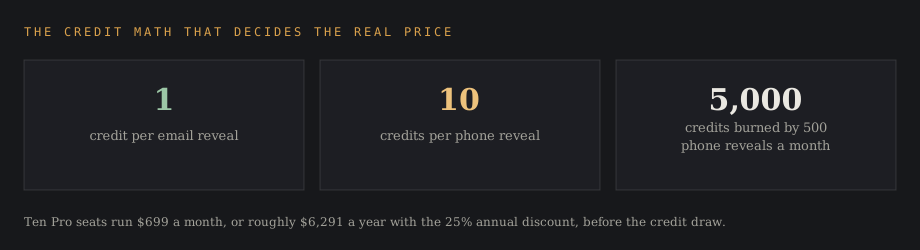
That base fee only covers the platform. Every email reveal spends 1 credit and every phone reveal spends 5, so a team pulling 500 phone numbers a month spends 2,500 credits before counting a single email lookup.
2,500 is the number that breaks the plan choice open. It sits well above Pro's 600 monthly credits and comfortably under Premium's 3,400, so a phone-first team of ten is buying Premium for the credit pool.
Rollover softens a slow month on Pro and Premium, up to twice the monthly cap, and does nothing for a team running at full volume every month. Free and Starter don't roll over at all. Vendr tracks a $15,999 median on negotiated Lusha contracts, across a purchase count it reports as either 85 or 144.
Lusha's December 2025 restructuring, which cut about 24 of the company's roughly 300 employees, did not change published pricing, though buyers negotiating a larger contract in the months after a workforce reduction sometimes find more room to push for custom terms than they would during a period of steady headcount growth.
Run your own numbers
Get started with Lusha
Free plan available, credit-based pricing after that.
May earn a commission if you sign up through this link, at no extra cost to you. Full affiliate disclosure.
How reps use the extension day to day
A typical workday starts with the chrome extension pinned to the browser toolbar, ready the moment a rep opens a prospect's LinkedIn page. One click reveals an email and a phone number, spending a credit only when the rep needs the contact.
The browser extension works the same way on a company's own site, which matters for reps prospecting outside LinkedIn, such as conference attendee pages or a leadership team listed on a corporate About page. That consistency is one reason the extension shows up so often in reviews as the single feature people keep after they cancel everything else.
Managers tracking credit system spend across a team usually set a monthly cap per rep, then review which reps burn through credits fastest on phone reveals versus email. A rep who reveals ten phone numbers and dials none of them is spending credit system budget without adding pipeline, a pattern managers say is easy to spot once usage reports are reviewed monthly.
Reveal just in time
Reps who reveal a contact right before they plan to call see a higher connect rate than reps who batch-reveal a list days in advance, since a phone number's accuracy window is shorter than an email address's. That single habit shift, revealing contacts just in time, is the most common tip Lusha users pass along to new reps.
Frequently asked questions
Is Lusha an Israeli company?
Lusha was founded in Tel Aviv in March 2016 and keeps a development center there, though the company is now headquartered in Boston, Massachusetts.
What kind of data does Lusha provide?
Lusha provides contact data including phone numbers, business emails, job titles and company data, plus job change alerts and intent signals layered on top of its core contact database. The company reports more than 280 million direct dials, over 152 million emails and more than 30 million company profiles.
What are the pros and cons of Lusha?
Pros include a fast Chrome extension, over 280 million direct dials and strong CRM integration; cons include data accuracy that drops outside North America, a credit system where each phone reveal costs five times an email, and a €2 million Italian data protection fine that ordered the company to stop processing Italian residents' data.
How much does Lusha cost a month?
Free is $0, Starter $49.90 a month, Pro $69.90 for two seats, and Premium $399.90 for five. Extra Pro seats add $49.90 each per month, and Scale is quoted by sales.
Does Lusha have a free trial?
Lusha doesn't run a time-limited trial. It offers an ongoing free plan, giving one user 40 credits a month to test data accuracy.
Is there a free version of Lusha?
Yes. Lusha's free tier gives one seat 40 credits a month at no cost. That's 40 email reveals, or 8 phone reveals at 5 credits each, and free-plan credits don't roll over.
Is Lusha trustworthy?
Lusha holds SOC 2 Type II and ISO 27701 certifications and claims GDPR and CCPA compliance. Against that, Italy's data protection authority fined the company €2 million and ordered it to stop processing Italian residents' personal data and delete what it held, and some users report slow handling of removal requests. Both facts belong in the same assessment.
Is Lusha GDPR compliant?
GDPR compliance is Lusha's own stated claim. Italy's regulator reached a different conclusion about its processing of Italian residents' data, issuing a €2 million fine alongside an order to stop processing and delete. A team selling into the EU should ask Lusha which jurisdictions its data is currently offered in and get the answer in writing.
Is Lusha allowed on LinkedIn?
Lusha's Chrome extension pulls contact data from public LinkedIn profiles, a practice LinkedIn has challenged in litigation against data-scraping tools industry-wide, and users should review LinkedIn's current terms before installing any browser extension of this kind.
What is better than Lusha?
ZoomInfo offers deeper datasets and stronger intent signals, Apollo.io bundles lead generation with outreach automation, and BookYourData offers pay-as-you-go pricing without a credit system, each a better alternative depending on company size and budget.
Where does Lusha get their data from?
Lusha's records come from public web sources, user-contributed profile confirmations and licensed data partnerships. Italy's regulator characterised the sourcing as including scraping of social networks and purchases from other data brokers.
Does Lusha scrape LinkedIn?
Lusha's Chrome extension reveals contact data while a user browses a LinkedIn profile, drawing on Lusha's own database, though the underlying dataset includes information originally sourced from public LinkedIn profiles.
What is better, Apollo or Lusha?
Apollo.io suits outbound-heavy teams that want lead generation and email sequencing bundled with contact data, while Lusha suits teams that want a fast browser extension for quick, targeted lookups.
What is Lusha used for?
Lusha is used for B2B prospecting, recruiting and lead generation, giving sales teams and recruiters verified contact information and intent signals to prioritize outreach.
How do I remove my information from Lusha?
A data removal request runs through Lusha's privacy policy, though users report the removal timeline can run longer than expected for a straightforward request.
Is Lusha better than LinkedIn Sales Navigator?
Lusha and LinkedIn Sales Navigator serve different jobs: Sales Navigator is built for LinkedIn-native search and messaging, while Lusha focuses on revealing direct phone numbers and emails a rep can use outside LinkedIn.
How much does Lusha cost?
Lusha costs $0 on Free, $49.90 a month on Starter, $69.90 on Pro, $399.90 on Premium, and a quoted rate on Scale. A temporary SUMMER SALE promotion takes 25% to 35% off yearly billing.
Does Lusha have an MCP server for AI agents?
Yes. Lusha runs a hosted MCP server at mcp.lusha.com with 22 tools for Claude and ChatGPT, separate from a smaller open-source version on GitHub. Access ships on every plan, including Free. Our full Lusha MCP review covers the tool list, the plan-access and accuracy discrepancies across Lusha’s own pages, and what’s missing compared with the REST API.
Disclaimer
This page includes one or more affiliate links. If you sign up for a product through one of them, this site may earn a commission at no extra cost to you.
 By Jan Suski. I go deep on every review, checking every number against its source and digging up details other coverage misses, a habit from six years of SEO and link building for tech companies. Bylines at Surfer, Brand24, and Senuto. How the scoring works.