Market intelligence tools collect, organize, and present data about competitors, customers, and market conditions so businesses can make faster, better-informed decisions. The right tool can surface a competitor's pricing change before your sales team loses a deal, or flag a shift in customer behavior weeks before it shows up in your pipeline.
This guide evaluates fifteen market intelligence tools across practical criteria: data quality, automation, integration capabilities, and pricing. Each tool serves a different primary use case, from outbound prospecting to financial research to supplier risk. The goal is to help you match the right market intelligence tool to the way your team works.
Feature lists only tell part of the story. The category spans competitive intelligence, customer intelligence, and market research platforms, so we scored each tool inside the job it claims to lead.
We focused on six criteria that decide if a tool delivers a competitive advantage after the contract is signed, the same lens behind every score on this site, and a discipline that pays: 94% of businesses say data and analytics are important for digital transformation, and BDO Canada reported an 87% reduction in data wrangling time after putting market intelligence to work.
Data coverage & refresh frequencysources, cadence, accuracy
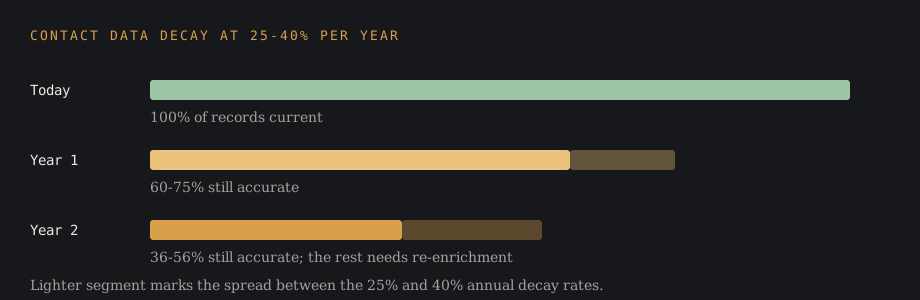
Data coverage and refresh frequency determine if you're working with real time data or stale records. Contact data decays at 25-40% per year, so a database left unrefreshed becomes a liability. We looked at how many sources each tool monitors, how often data updates, and how accurate that market data is across geographies.
Automation & AI featuresalerts, summaries, signal detection
Automation and AI features matter because manual data entry and manual research hit a ceiling fast. We evaluated language-parsing capability, AI-generated summaries, automated alerts, signal detection, and sentiment analysis that gauges customer emotions. The better AI models can identify patterns across disparate data sets and generate predictive insights about market trends faster than a human analyst reading the same sources.
Tools that identify emerging trends with minimal human supervision scored higher. (For a deeper look at this side of the category, see our guide to AI market intelligence.)
Integration depthSalesforce, HubSpot, Slack
Integration depth with CRM, marketing automation, and sales tools affects adoption. A tool that lives outside Salesforce, HubSpot, and Slack creates data silos. We checked for native integrations and data integration options.
Ease of useonboarding effort vs feature depth
Ease of use separates tools that get used from tools that get abandoned. A steep learning curve reduces adoption across marketing, sales enablement teams, and corporate strategy teams. We weighed onboarding effort against feature depth.
Pricing transparencypublished plans vs sales-quoted
Pricing transparency varies widely in this category. Some vendors publish plans; others require sales calls to learn the starting price. We noted where costs are clear and where hidden add-ons (seats, credits, renewal hikes) inflate the total.
Data governance & complianceGDPR, provenance, privacy controls
Data governance and compliance features are essential for organizations operating in global markets. GDPR requirements, data provenance, and privacy controls shaped our evaluation for tools handling contact-level data.
Quick comparison of the best market intelligence tools
Fifteen tools, one row each, with the price and the primary data type that separate them. Open a row for how far that tool reaches across the four types of market intelligence, and which alternatives buyers weigh against it.
Open the comparison table15 tools, price, data type, buyer
Open any row to see how far that tool reaches across the four types of market intelligence: competitor, product, market, customer. Scores are an editorial read of what each vendor documents, on the same basis as the verdicts elsewhere on this site, and no vendor publishes a number of its own. Nothing here scores Full on all four, which is why the stack section pairs them. The four scores add to a coverage total out of 400, and that total is what orders the ranking below.
Six risk domains: cyber, financial, ESG, compliance, geopolitical, operational
Public contract
$3,949,600 obligated for year one on DLA task order SP470425F0055
Its object is the supplier base, so three of the four buyer-facing types read empty by design.
The $919 million GSA SCRIPTS figure is a ten-year ordering ceiling shared across several awardees and a distributor. It caps what agencies may buy; it is neither revenue nor a price.
* AlphaSense, G2 and Medallia carry Vendr's anonymized buyer data, across 38, 526 and 160 purchases respectively. Every other price is the vendor's own published or reported number.
Many marketing intelligence tools overlap in some capabilities. The table highlights where each one leads. Most organizations end up stacking two or three tools to cover their full set of needs; at the digital end of the category, the line between market intelligence and marketing intelligence software mostly disappears.
Ordered by how much of the category each tool covers. Every profile carries a coverage total out of 400, four types of market intelligence scored 0-100 each, and that total sets the position. A tool that answers all four questions ranks above one that answers a single question well, which is why the narrow specialists sit lower here than their reputations suggest.
01
Circana
·top pick·
Consumer purchase and point-of-sale intelligence across 26 industries, from grocery to consumer electronics.
Circana is the business formed by the 2022 merger of IRI and NPD, serving almost 7,000 brands and retailers.
Why it stands out. Its Liquid Data platform combines point-of-sale data with consumer panel data, so it measures actual customer behavior at the register. For consumer preferences in physical retail, nothing else in this ranking comes close.
Fit, features & limitations
Best for. CPG, retail, and consumer-brand teams tracking market share, category performance, and shopper trends across the 26 industries Liquid Data covers, from grocery and health and beauty to consumer electronics.
Census-based point-of-sale repository deduplicating in-store, online, and omnichannel sales into one view of category performance.
Consumer panel data layered on top of register data, so share shifts can be traced to actual household behavior.
Test-and-learn dashboards that score pricing, promotion, and assortment tests on lift, ROI, and statistical confidence.
Annual benchmark research, including the U.S. CPG Growth Leaders report published every April.
Possible limitations. Enterprise-quoted pricing and a consumer-goods center of gravity; B2B, software, and services markets sit outside its data. Deployments run as service engagements, and buyers routinely run coverage checks against NielsenIQ, Numerator, and SPINS per category and geography before committing, since panel depth varies by market.
What the coverage scores are made of
Scored 0-100 against the four types of market intelligence, on the same reading used in the comparison table above. Each line names the evidence that set the number and where the tool stops. Coverage total 333 of 400, which is what sets this tool's position in the ranking.
Competitor intelligence60Workable. Rival share at the register, deduplicated across in-store, online and omnichannel sales. It measures what a competitor sold, never what it plans to do next.
Product intelligence95Full. Point-of-sale performance by item across 26 industries, with test-and-learn dashboards scoring pricing, promotion and assortment on lift, ROI and statistical confidence.
Market intelligence90Strong. A census-based POS repository plus consumer panel data, category by category. Panel depth varies by market, which is why buyers check coverage against NielsenIQ, Numerator and SPINS first.
Customer intelligence88Strong. Panel data ties share shifts to actual household behaviour. It sees the purchase and not the reasoning behind it.
02
G2 Market Intelligence
Software buyer intelligence from verified user reviews, satisfaction scores, and feature comparisons.
G2 aggregates verified reviews and comparisons across software categories, which makes it a lightweight competitive intelligence platform for software markets.
Why it stands out. G2 provides a window into consumer preferences and customer satisfaction based on real buyer feedback straight from verified users. For software companies, this type of market intelligence helps track how your product stacks up against competitors on specific features, support quality, and market positioning.
Fit, features & limitations
Best for. Product marketing teams and software companies tracking customer satisfaction, feature gaps, and competitor standing in software markets. See the SaaS market intelligence page for the full picture.
Verified software buyer reviews providing valuable insights into competitor products.
Satisfaction benchmarking and competitive feature analysis using real user data.
Market positioning insights based on review volume, satisfaction scores, and category rankings.
Integration with product management tools for roadmap planning.
Possible limitations. G2's coverage runs deep in software and technology markets and stops there, consumer goods, manufacturing, and non-tech verticals sit outside it. Reviews are self-reported and human-moderated, and no independent audit of the dataset exists.
Free sits at $0 and Starter at $299 a month, but Starter is closed to anyone over 100 employees, so no mid-market buyer reaches a published number. Market Intelligence itself is a feature inside the quote-only Enterprise package; Vendr's anonymized data puts the median G2 contract at $28,000 a year across 526 purchases, in a $12,000 to $73,655 range. There's no free trial and no self-serve demo.
What the coverage scores are made of
Scored 0-100 against the four types of market intelligence, on the same reading used in the comparison table above. Each line names the evidence that set the number and where the tool stops. Coverage total 310 of 400, which is what sets this tool's position in the ranking.
Competitor intelligence88Strong. Category standing, satisfaction scores and feature-level sentiment on every named rival in a software category, sourced from the customers using each product day to day, independent of vendor marketing.
Product intelligence92Full. Sentiment runs below product level to individual features, so a loved core product and a hated onboarding flow separate cleanly. The strongest product signal on this list.
Market intelligence45Partial. Market share estimates roll up from review data. Coverage stops at software and technology categories.
Customer intelligence85Strong. Verified buyer reviews carrying deal size, contract length, implementation time and repurchase intent. Self-reported and human-moderated, never audited.
03
Similarweb
Digital market intelligence across 1 billion+ websites and 8 million apps in 190-plus countries.
Why it stands out. Where other tools focus on contacts or keywords, Similarweb focuses on market understanding through traffic flows. You can see where a competitor's visitors come from, which channels drive engagement, and how market share and market trends shift over time. This makes it a strong tool for market analysis and strategic decision making.
Fit, features & limitations
Best for. Digital marketers and analysts tracking website performance, benchmarking against competitors, and estimating market share in global markets. It ranks #2 on digital marketing intelligence, which is the job it's built for; it doesn't appear on the retail analytics ranking at all.
Website traffic estimates and audience analysis tools for digital competitive analysis.
Channel-level breakdowns (organic, paid, referral, display, social) to benchmark channels side by side.
Mobile app analytics and market research capabilities.
SOC 2 and ISO 27001 compliance for data governance.
Possible limitations. Traffic estimates for sites with fewer than 100,000 monthly visits can deviate by 40-60% from actual analytics data. There's also a lag; estimates may be several weeks old. Similarweb is a traffic-and-audience specialist, B2B contact data, buyer intent, and prospecting databases sit outside its scope. Enterprise pricing is steep and shared only through sales.
What the coverage scores are made of
Scored 0-100 against the four types of market intelligence, on the same reading used in the comparison table above. Each line names the evidence that set the number and where the tool stops. Coverage total 238 of 400, which is what sets this tool's position in the ranking.
Competitor intelligence90Strong. Traffic, channel mix and audience for any site in a 1 billion-plus index, with no cooperation needed from the rival. Estimates deviate 40-60% below 100,000 monthly visits.
Product intelligence5Minimal. Mobile app analytics across 8 million apps touch product usage at the download and engagement level, and go no deeper.
Market intelligence88Strong. Market share and demand shifts across 190-plus countries, benchmarked channel by channel. The gap to Full is the several-week lag on estimates.
Customer intelligence55Workable. Audience behaviour, referral paths and engagement patterns, all anonymous and modelled. No identity, no contact record, no survey instrument.
04
Brandwatch
Social listening and consumer intelligence across social networks, news sites, forums, and review sites.
Brandwatch has run social media monitoring since 2006; Cision acquired it for $450 million in 2021.
Why it stands out. It monitors millions of sources for brand mentions, applying sentiment analysis to track how customer emotions shift around a brand, product, or competitor. When market intelligence depends on customer language and audience shifts, this is the deepest listening dataset in the ranking.
Fit, features & limitations
Best for. Brand, comms, and consumer-insight teams tracking sentiment, share of voice, and audience movement across social media platforms. The consumer intelligence guide covers the discipline it serves.
AI categorization that sorts raw posts and comments into themes, flags emerging topics, and filters bot activity out of mention spikes.
Influencer identification that surfaces accounts whose posts move opinion, well past raw follower counts.
Deep demographic and psychographic breakdowns of who is talking, with real-time alerts when conversation volume or sentiment turns.
Publishing, scheduling, and engagement across major networks in the same dashboard used for monitoring.
Possible limitations. The $108-per-month Essentials plan covers social management only; full listening suites are sales-quoted, typically over $1,000 per month, and one buyer reported $12,000 per year for three seats.
Users report a steep learning curve, support that hands tickets between reps, and occasional scheduled posts failing to publish. It reads conversation and no revenue: no contact, traffic, or financial data, and it is constrained by each network's API and privacy rules.
What the coverage scores are made of
Scored 0-100 against the four types of market intelligence, on the same reading used in the comparison table above. Each line names the evidence that set the number and where the tool stops. Coverage total 223 of 400, which is what sets this tool's position in the ranking.
Competitor intelligence48Partial. Share of voice and sentiment against named rivals across social, news and forums. It hears the conversation about a competitor and sees none of that competitor's own operations.
Product intelligence42Partial. Product complaints and praise surface as themes in the mention stream, with AI categorisation sorting them and filtering bot activity out of spikes.
Market intelligence40Partial. Emerging topics and audience movement read as market signal, bounded by what each network's API and privacy rules permit.
Customer intelligence93Full. Millions of sources monitored since 2006, with demographic and psychographic breakdowns of who is talking and real-time alerts when sentiment turns.
05
AlphaSense
AI-powered market research and semantic search across hundreds of millions of premium documents.
AlphaSense applies natural language processing across regulatory filings, earnings transcripts, broker research, trade journals, and expert call transcripts.
Why it stands out. The edge is document breadth. The generative search and summary tools let analysts ask a question across filings, transcripts and broker research at once and get a structured answer in seconds. AlphaSense serves over 6,500 organizations, including a large portion of S&P 100 companies, and surpassed $500 million in annual recurring revenue in late 2025.
On the financial data providers ranking it sits at #7 of 8, behind LSEG and Bloomberg, because it indexes what the market publishes, leaving primary market pricing to LSEG and Bloomberg.
Fit, features & limitations
Best for. Financial analysts, corporate strategy teams, and investment professionals who need to track market trends, monitor industry trends, and conduct deep industry analysis. New to the discipline? Start with what market intelligence is.
Access to premium financial documents, expert insights, and sector research.
Advanced semantic search across 500M+ documents for fast data analysis.
AI-powered trend monitoring to identify growth opportunities and emerging market trends.
Alerts on sector changes, competitive positioning shifts, and regulatory updates.
Possible limitations. AlphaSense's pricing is aimed at enterprise buyers, and signup runs through an enterprise sales process. Gaps exist for niche markets and small private companies. The platform stops short of go-to-market execution features, B2B contact data, and intent signals. Its generative AI can sometimes misinterpret hedged statements in source documents.
What the coverage scores are made of
Scored 0-100 against the four types of market intelligence, on the same reading used in the comparison table above. Each line names the evidence that set the number and where the tool stops. Coverage total 222 of 400, which is what sets this tool's position in the ranking.
Competitor intelligence82Strong. Filings, earnings transcripts and broker research on any covered rival, searched semantically in one query. It reads what a competitor has already reported, never a live pricing or product move.
Product intelligence40Partial. Product performance appears wherever an analyst or executive discusses it in a document. Nothing measures a product directly.
Market intelligence92Full. 500M+ documents across trade journals, sector research and expert-call transcripts, with alerts on regulatory and positioning shifts. Sector questions are the core use.
Customer intelligence8Minimal. Expert-call transcripts occasionally carry a buyer's view. There's no panel, no survey instrument and no behavioural data.
Competera collects over 10 million data points daily on competitor prices, product availability, and promotional activity.
Why it stands out. It connects competitor price monitoring directly to repricing decisions; Competera reports its deep-learning engine lifts enterprise clients' gross margin by 6%. On the pricing intelligence ranking it sits at #2 behind Pricefx, and it belongs on shortlists where pricing is the competitive battleground.
Fit, features & limitations
Best for. Retail pricing and category teams that need fresh competitor price feeds tied to optimization, past monitoring dashboards. The pricing intelligence guide explains the discipline.
Competitor price monitoring with configurable match quality, so a pricing team compares true equivalents.
A rules layer for guardrails (margin floors, brand positioning, price endings) sitting between raw feeds and repricing decisions.
A deep-learning optimization engine that weighs demand elasticity and price perception on top of the nearest rival's number.
Vendor-reported customer results include pricing workload dropping from 60 to 4 hours per week and 95%+ forecast accuracy.
Possible limitations. Enterprise-quoted pricing and a retail-only scope; the 6% margin-lift figure and the workload numbers are vendor-reported, so validate them against your own categories in a pilot. Implementation depends on clean product-feed data, and smaller retailers often find lighter monitors like Prisync or Wiser Solutions sufficient before optimization is worth paying for.
What the coverage scores are made of
Scored 0-100 against the four types of market intelligence, on the same reading used in the comparison table above. Each line names the evidence that set the number and where the tool stops. Coverage total 188 of 400, which is what sets this tool's position in the ranking.
Competitor intelligence85Strong. Over 10 million data points daily on competitor prices, availability and promotions, with configurable match quality so a pricing team compares true equivalents.
Product intelligence45Partial. Competitor product availability and promotional activity are tracked continuously. Your own product's performance is not.
Market intelligence40Partial. Demand elasticity and price perception modelled across a category, scoped entirely to retail with nothing outside it.
Customer intelligence18Some. Price perception is inferred from elasticity models.
07
FactSet
Standardised fundamentals on 86,000-plus companies, wrapped in an analyst workflow that runs inside Excel and PowerPoint.
FactSet, founded in 1978 and listed on the NYSE as FDS, aggregates over 800 data sources from more than 317 independent providers and resells the combination through its Workstation, 300-plus feeds, and an Office add-in.
Why it stands out. It's the one platform on this list whose own numbers are audited: $2,321.7 million in FY2025 revenue, and 247,000-plus users across 9,100 client companies by Q3 FY2026. Fundamentals run annual from 1980. The Office add-ins ship with the install, so the deliverable never leaves the tools an analyst already works in. It ranks #4 on financial data providers.
Fit, features & limitations
Best for. Buy-side analysts, research teams and deal teams whose output is a model, a screen or an attribution report.
86,000-plus companies across 115-plus countries on standardised financials, with 750-plus items in Fundamentals and 125-plus industry KPI metrics.
600,000-plus mergers, divestitures and spinoffs, 300 to 450 updated daily behind 244-plus logic and quality checks.
Add-ins for Excel, Word, PowerPoint, OneNote and Outlook, including Pitch Creator's 200-plus templates and 20-plus chart types.
A 24/7, 365-day support desk with two published phone numbers, scoring 9.3 on G2 quality of support across 20 reviews.
Possible limitations. No published rate card and no self-serve trial. Vendr's tracked contracts put the median at $20,523 a year against a $4,200 to $25,160 spread, and the steep learning curve is the complaint users repeat most: a new analyst isn't productive on day one.
It publishes no evaluated bond prices, so a desk pricing bonds needs Bloomberg's BVAL instead, and its messaging reaches support only against Bloomberg's 350,000-plus network. FactSet also took a 10% technology headcount reduction alongside its AI push, which is worth raising in a renewal conversation.
What the coverage scores are made of
Scored 0-100 against the four types of market intelligence, on the same reading used in the comparison table above. Each line names the evidence that set the number and where the tool stops. Coverage total 188 of 400, which is what sets this tool's position in the ranking.
Competitor intelligence78Strong. 86,000-plus companies on standardised financials, so any covered rival screens, models and compares on the same basis. It reads reported results and not live product moves.
Product intelligence15Some. Segment reporting inside company fundamentals is the closest thing to product-level detail here.
Market intelligence95Full. Over 800 sources from 317-plus independent providers, fundamentals annual from 1980, and 600,000-plus deals behind 244-plus quality checks. Market structure and valuation work is what the Workstation is for.
Customer intelligence0None. No buyer, consumer or audience data at any tier.
08
ZoomInfo
B2B go-to-market intelligence built around buyer intent data, firmographic profiles, and contact databases.
ZoomInfo combines sales intelligence with marketing execution tools (Engage, MarketingOS, Chorus) in a single platform that processes 1.5B+ data points daily.
Why it stands out. ZoomInfo's database includes roughly 260-320 million professional profiles and approximately 135 million verified direct-dial phone numbers. The platform pairs this with intent signals, technographic data, and org-chart mapping. Sales teams can identify in-market accounts, build prospect lists, and trigger outbound sequences inside one platform, and ZoomInfo customers grew their addressable markets by 40% on average.
Fit, features & limitations
Best for. B2B sales and marketing teams focused on pipeline building, account targeting, and outbound prospecting. Organizations with North America-heavy pipelines get the most accurate data. See the full B2B market intelligence breakdown.
Continuous data refresh across professional profiles, company records, and intent data.
Advanced buyer intent scoring to flag accounts showing purchase behavior.
Native CRM integrations with Salesforce & HubSpot, plus built-in workflow automation.
Technographic and firmographic filters for precise audience segmentation.
Possible limitations. Pricing starts around $15,000 per year, with median deal sizes reported at $30,000 to $35,000. That's steep for smaller teams. Data accuracy outside the US drops, and email deliverability rates land between 75-85% in many segments. The full platform takes real onboarding time, and contract terms often include auto-renewal clauses that are easy to miss.
What the coverage scores are made of
Scored 0-100 against the four types of market intelligence, on the same reading used in the comparison table above. Each line names the evidence that set the number and where the tool stops. Coverage total 162 of 400, which is what sets this tool's position in the ranking.
Competitor intelligence22Some. Firmographic and technographic records on rival companies, so a competitor can be sized. Nothing tracks what one ships, prices or announces.
Product intelligence0None. No product-performance data at any tier. ZoomInfo describes companies and the people inside them, never what those companies sell.
Market intelligence45Partial. Intent signals and org-chart mapping size an addressable market, and customers report growing theirs by 40%. It reads demand inside its own contact universe.
Customer intelligence95Full. 260-320 million professional profiles, roughly 135 million verified direct dials, and buyer-intent scoring layered on top. Built for exactly this job.
09
Crunchbase
A private-company database built around one object: the funding round, with the investors and amounts attached to it.
Crunchbase, headquartered in San Francisco, publishes 4M+ company profiles and reports 30M+ data updates a year.
Why it stands out. It answers a question none of the eleven above it do: who funded this company, how much closed, and when. Pro runs $99 a month, or $49 a month on annual billing at $588 for the first year under Crunchbase's introductory discount. Business starts at $199 a month billed annually. It ranks #6 on company data providers, where the leaders sell field depth and Crunchbase sells the funding event.
Fit, features & limitations
Best for. Corporate development, venture and research teams tracking funding, investors, and which private companies are moving.
4M+ company profiles with 30M+ updates a year, both Crunchbase's own figures.
Heat Score built from activity across an 80M-person network, plus unlimited saved searches and list alerts on both paid tiers.
Crunchbase Scout and AI Search on both tiers; Predictions & Insights is Business only.
Salesforce and HubSpot integrations, and SOC 2 Type II compliance stated in the pricing FAQ.
Possible limitations. Exports cap at 2,000 rows a month on Pro and 5,000 on Business, and the API is the only route past either. Both tiers auto-renew by default. The 7-day trial keeps exports locked the whole way through.
Coverage runs deep on venture-backed tech and thin everywhere else, and data is self-reported before publication. G2 reads 4.4/5 across 408 reviews against Trustpilot's 1.5/5 across 48, where the complaints are overwhelmingly about billing.
What the coverage scores are made of
Scored 0-100 against the four types of market intelligence, on the same reading used in the comparison table above. Each line names the evidence that set the number and where the tool stops. Coverage total 145 of 400, which is what sets this tool's position in the ranking.
Competitor intelligence75Strong. Who funded a rival, how much closed and when, plus investors, acquisitions and headcount movement across 4M+ company profiles. Self-reported and unverified before publishing.
Product intelligence0None. No product data of any kind.
Market intelligence50Partial. Funding flows map where capital is moving in a category. Coverage runs deep on venture-backed tech and thin on everything else.
Customer intelligence20Some. A Heat Score built from activity across an 80M-person network stands in for demand signal.
10
Medallia
Experience management: first-party feedback from surveys, calls, chats and support tickets, scored and routed to a named owner.
Medallia serves more than 2,000 companies by its own count, concentrated in retail, hospitality and financial services.
Why it stands out. Where G2 reads what buyers say in public, Medallia reads what your own customers say to you. Web, email, SMS, app, contact-centre call and website-intercept feedback lands in one record, with NPS and CSAT tracked per interaction and real-time alerts routing an angry response to a named owner. It ranks #2 on buyer feedback intelligence.
Fit, features & limitations
Best for. Customer experience and contact-centre teams that need a retained-revenue number attached to a feedback program.
Seven signal types scored separately: chat transcripts, call transcripts, support tickets, agent notes, social listening, employee ideas, and surveys.
Text analytics across free-text comments, with AI churn-risk scoring layered on top.
A Salesforce account record carrying days until renewal, revenue, open support tickets, and NPS side by side.
Voice-of-employee running on the same collection layer, scored by team down to the named manager.
Possible limitations. No published rate card. Vendr's aggregated data across 160 customers puts SMB buyers near $56,681 a year and enterprise buyers at $521,520, with implementation adding $50,000 to $200,000-plus on top of the licence. The free plan drops the analytics, which is the part you're buying.
Ownership is the sharper risk. Thoma Bravo took Medallia private at $6.4 billion in 2021, and an early-2026 debt-for-equity swap handed control to a Blackstone-led lender group, writing off roughly $5 billion of equity. Cap the annual uplift in writing before signing three years.
What the coverage scores are made of
Scored 0-100 against the four types of market intelligence, on the same reading used in the comparison table above. Each line names the evidence that set the number and where the tool stops. Coverage total 141 of 400, which is what sets this tool's position in the ranking.
Competitor intelligence0None. Nothing about rivals. It reads your own customers only.
Product intelligence45Partial. Free-text comments and support tickets surface product problems, scored by text analytics. It hears about the product without measuring it.
Market intelligence0None. No market data. Everyone it reads is already your customer.
Customer intelligence96Full. Seven signal types across web, email, SMS, app, contact-centre call and website intercept, with NPS and CSAT per interaction and AI churn-risk scoring. The deepest first-party customer read here.
11
6sense
Account-based marketing platform that turns buyer intent signals into target-account lists for B2B revenue teams.
6sense, founded in 2013, raised a $200 million Series E at a $5.2 billion valuation in 2022 and passed $200 million in annual recurring revenue by 2024.
Why it stands out. Where ZoomInfo leads on contact records, 6sense leads on timing: it identifies anonymous account research and predicts which accounts are in-market before they ever fill out a form.
Fit, features & limitations
Best for. B2B marketing and sales teams running account-based programs who want intent signals to decide which accounts to work, and when.
Third-party intent data from its Signalverse publisher network, scored continuously into buying stages: awareness, consideration, decision, purchase.
Account identification that de-anonymizes website visitors at the company level, turning unnamed traffic into named target accounts.
Native Salesforce and Microsoft Dynamics integration plus a Chrome extension for pulling contact data while browsing.
Cross-channel orchestration: display ads, website personalization, and outreach sequences triggered from the same intent score.
Possible limitations. Third-party buyer reports put median annual contracts around $55,000, with enterprise deployments from roughly $50,000 to $300,000 plus implementation costs of $5,000 to $50,000; end-of-quarter buyers with a competing quote report discounts of 15 to 37 percent.
Users describe a two-to-three-month ramp, intent scores that can feel opaque, and limited segment exports to ad platforms. A free tier with monthly lookup credits exists, but excludes intent and predictive scoring. Overkill below mid-market scale.
What the coverage scores are made of
Scored 0-100 against the four types of market intelligence, on the same reading used in the comparison table above. Each line names the evidence that set the number and where the tool stops. Coverage total 140 of 400, which is what sets this tool's position in the ranking.
Competitor intelligence0None. Nothing about rivals. The object is your buyers.
Product intelligence0None. No product data of any kind.
Market intelligence50Partial. In-market accounts identified across a defined addressable market and scored into awareness, consideration, decision and purchase stages. That's a slice of demand.
Customer intelligence90Strong. Third-party intent from the Signalverse publisher network plus de-anonymised website visitors, scored continuously. It resolves to an account and not a person, which is what holds it below Full.
12
Exploding Topics
Trend research software for spotting emerging topics months before they peak.
Exploding Topics, founded by Brian Dean and Josh Howarth and now part of Semrush, tracks a database of trending topics with growth data.
Why it stands out. It is the cheapest entry point in this ranking: plans start at $39 per month with a 7-day trial, and the trend database surfaces demand signals, product ideas, and startup categories while they're still small.
Fit, features & limitations
Best for. Founders, investors, and content teams searching for future trends and new-category signals ahead of the crowd.
A database of over 1.1 million tracked trends, with a curated set of 779,000+ emerging topics and products, each carrying search volume and growth data.
Machine-learning detection across search, social, and e-commerce signals, with human analysts cutting one-week fads before they reach the feed.
Tracking projects with acceleration alerts, meta-trend groupings, and a weekly analyst newsletter on the biggest movers.
Trending products and startups feeds, filterable by growth and price band, with API access on the $249 Business tier.
Possible limitations. Signals are directional, never diagnostic: it tells you a topic is growing without saying why or for how long, and four-digit growth percentages on small bases mislead without a second check. Any single vertical gets modest depth, and Semrush subscribers may find some discovery value already bundled in tools they pay for. Pair it with deeper data before betting a roadmap on it.
What the coverage scores are made of
Scored 0-100 against the four types of market intelligence, on the same reading used in the comparison table above. Each line names the evidence that set the number and where the tool stops. Coverage total 135 of 400, which is what sets this tool's position in the ranking.
Competitor intelligence0None. No competitor tracking of any kind.
Product intelligence25Some. A trending-products feed filterable by growth and price band flags whole categories. No individual product's performance is measured.
Market intelligence80Strong. 1.1 million tracked trends and 779,000-plus curated emerging topics, each carrying search volume and growth data, with human analysts cutting one-week fads. Directional, never diagnostic.
Customer intelligence30Some. Search and social growth curves stand in for demand. Nothing identifies who sits behind them.
13
Positive Surfer
On-page content scoring against the pages already ranking, plus citation tracking across five AI answer engines.
Positive Surfer, founded in Poland in 2017 and acquired by Positive Group on 21 October 2025, grades a draft against the SERP and says what to change.
Why it stands out. It's the only tool here that measures if AI engines cite you. The AI Tracker covers ChatGPT, Perplexity, Gemini, Google AI Overviews and Google AI Mode at prompt level, reporting visibility score, mention rate and average position, with Mention Gap naming the URLs those models cite instead. It ranks #5 on digital marketing intelligence, which orders on category coverage; it wins the AI-visibility criterion outright.
Fit, features & limitations
Best for. Content and SEO teams that publish weekly and want the answer-engine side of visibility measured.
Content Score 0-100 built from 500+ on-page signals read across the pages already ranking for the query.
Five published tiers, Discovery €49 through Peace of Mind €299 billed yearly, with Enterprise at €999.
Google Docs, WordPress, a Chrome extension, an API and Search Console, across more than 20 languages.
Surfer Pulse, a free daily 0-100 volatility score per engine, readable for ChatGPT and Google AI Overviews with no account.
Possible limitations. Backlinks, crawl errors and site speed sit outside the product, so it's one line in a stack. Credits expire at every monthly billing reset, which makes it a poor buy for a site publishing monthly. Even the €299 tier caps at 10 seats and 500 tracked pages.
The audit, Performance and internal-linking suggestions all lean on Google Search Console, so a messy configuration produces weaker output. Trustpilot reviewers also report that account settings offer no way to remove a stored card, that charges continued after cancellation, and that refunds on unused AI writing credits were refused.
What the coverage scores are made of
Scored 0-100 against the four types of market intelligence, on the same reading used in the comparison table above. Each line names the evidence that set the number and where the tool stops. Coverage total 125 of 400, which is what sets this tool's position in the ranking.
Competitor intelligence80Strong. 500-plus on-page signals read across the pages already ranking for a query, plus Mention Gap naming the URLs AI engines cite when they skip yours.
Product intelligence0None. No product data.
Market intelligence45Partial. SERP composition and answer-engine volatility across five engines read as demand signal, with a free daily 0-100 score per engine. Backlinks, crawl errors and site speed sit outside the product.
Customer intelligence0None. No customer data. The unit of analysis is a page. Nothing resolves to a person.
Learn the method
Take Surfer's free AI Search Optimization Masterclass
20 lessons across 7 modules, free, with a certificate on completion.
May earn a commission if you sign up through this link, at no extra cost to you. Full affiliate disclosure.
14
LinkedIn Sales Navigator
A prospecting seat on LinkedIn's own graph: 40-plus search filters, saved lists, alerts, and CRM sync over self-reported profiles.
Sales Navigator sits on top of the profiles everyone can already see and adds the filtering, alerting, and CRM write-back that turn them into a working list.
Why it stands out. Its data is first-party. Members maintain their own profiles, so a job change lands the day it's announced. A purchased contact database only catches it on the next refresh cycle, the failure mode every one of them shares. Core runs $79.99 a month billed annually and Advanced $135. It ranks #6 on sales intelligence.
Fit, features & limitations
Best for. Sellers and SDR teams working named accounts on LinkedIn, especially where the buying committee moves faster than a contact database refreshes.
More than 40 search filters across seniority, function, geography, years in position, and recent activity, with Boolean exclusions inside them.
50 InMail credits a month, reaching people whose email address you don't have; teams report 10% to 25% response on high-priority targets.
20 to 30 lead recommendations a week, generated from the leads already saved.
Salesforce and Microsoft Dynamics sync that writes activity back and flags accounts already sitting in pipeline.
Possible limitations. No email addresses and no phone numbers, so most teams pair it with a contact provider: ten Advanced seats plus ten Lusha Pro seats runs about $21,800 a year. Lead lists can't be exported to CSV. Billing is annual only, past the free trial itself.
Data validation written back into the CRM is Advanced Plus only, quoted from a reported floor of around $1,600 a year per seat, and the seat-against-licence tradeoff is the decision most buyers are making.
Try it yourself
Sign up for Lusha
Free plan available, credit-based pricing after that.
May earn a commission if you sign up through this link, at no extra cost to you. Full affiliate disclosure.
What the coverage scores are made of
Scored 0-100 against the four types of market intelligence, on the same reading used in the comparison table above. Each line names the evidence that set the number and where the tool stops. Coverage total 107 of 400, which is what sets this tool's position in the ranking.
Competitor intelligence0None. No competitor data. Rivals appear only as employers on the profiles you happen to search.
Product intelligence0None. No product data of any kind.
Market intelligence35Partial. Headcount movement, hiring patterns and company growth read as market signal across 40-plus search filters. There's no sizing figure and no share estimate.
Customer intelligence72Strong. First-party profiles that members maintain themselves, so a job change lands the day it's announced. No email address, no phone number and no CSV export is what caps it here.
15
Interos
Supplier network mapping and continuous risk scoring across 250 million+ companies and 11 billion supplier relationships.
Interos, based in Arlington, Virginia, scores every company in that graph on six risk domains and watches them continuously.
Why it stands out. Its subject is your vendors, which no other tool on this list covers. The i-Score spans cyber, financial, ESG, compliance, geopolitical and operational risk, and the map reaches two or three tiers past a direct vendor, depth Interos says only 10% of Fortune 1000 firms can see. It ranks #1 on supply chain risk management.
Fit, features & limitations
Best for. Resilience and procurement teams that need sub-tier supplier visibility.
250 million+ companies and 11 billion supplier relationships mapped, both Interos figures.
Continuous real-time monitoring and alerts, replacing the annual audit cycle.
Sanctions-list screening plus labor, ESG and geopolitical flags on the same record.
Alternative suppliers surfaced automatically when a disruption hits a mapped node.
Possible limitations. No published rate card, so the only checkable figures are federal contracts: $3,949,600 obligated for year one on Defense Logistics Agency task order SP470425F0055, against an $11,848,800 ceiling running to 13 August 2028. That order went through a reseller, so the figure carries margin.
The $919 million GSA SCRIPTS number gets quoted as revenue; it's a ten-year ordering ceiling shared across several awardees and a distributor, and it's neither revenue nor a price. Onboarding starts with data-integration work, and reading the output takes training.
What the coverage scores are made of
Scored 0-100 against the four types of market intelligence, on the same reading used in the comparison table above. Each line names the evidence that set the number and where the tool stops. Coverage total 85 of 400, which is what sets this tool's position in the ranking.
Competitor intelligence0None. No competitor data.
Product intelligence0None. No product data.
Market intelligence85Strong. 250 million-plus companies and 11 billion supplier relationships, scored on cyber, financial, ESG, compliance, geopolitical and operational risk, two or three tiers past a direct vendor. It maps the supply side of a market and nothing else.
Customer intelligence0None. No buyer-side data at all. Its subject is your vendors.
Every company lands on a different "right" market intelligence platform. The decision depends on three variables: use case, data coverage needs, and budget.
Choose based on primary use caseoutbound, content, finance, traffic
Your primary workflow determines which intelligence tool fits. If outbound sales and prospecting drive revenue, ZoomInfo's contact data and intent signals matter more than keyword rankings. If your team runs marketing strategies built on organic search and content, Positive Surfer scores the pages themselves and tracks which answer engines cite them.
Financial and strategic teams have different needs. AlphaSense covers earnings calls, filings, and expert insights for teams that need to spot inflection points in financial markets or track future trends across sectors. Similarweb fits teams benchmarking digital performance against competitors and estimating market dynamics across channels.
Choose based on data coverage requirementsgeography, documents, traffic volume
Data collection methods vary across these tools. ZoomInfo pulls contact-level data from public and proprietary sources, with the best coverage in North America. FactSet aggregates over 800 sources from 317-plus independent providers. Similarweb estimates traffic from ISP panels and web crawls. AlphaSense indexes premium financial documents and industry reports.
Match coverage to your needs. If you sell into European markets, ZoomInfo's data is weaker there, and you may need a provider like Cognism for EU compliance. If you track emerging technologies in niche industries, AlphaSense's document coverage might have gaps for small private companies. Similarweb provides stronger data for larger websites with meaningful traffic volumes. Our guide on how to gather market intelligence covers how to blend these sources.
Choose based on team size and budgetcontracts, adoption, data decay
Budget shapes what's practical. ZoomInfo's starting contracts sit around $15,000 per year, and full platform access often costs $30,000 to $35,000. AlphaSense and Similarweb run at enterprise price points too. Positive Surfer and Crunchbase publish pricing tiers, which makes them more accessible for smaller teams and individual practitioners.
Consider adoption costs alongside subscription costs. A tool that three people on your team use daily delivers more value than a platform with 50 features that sits unopened. Tools with steep learning curves (ZoomInfo's full suite, AlphaSense's document filtering) need onboarding investment. Narrower tools like Exploding Topics and Positive Surfer reach adoption faster.
Also budget for data decay. If you export contacts from any intelligence platform, expect 25-40% annual decay. That means ongoing re-enrichment costs or a persistent subscription to keep records current.
Which market intelligence tool is best for you?one-line verdict per tool
Market intelligence helps organizations track competitors, understand customer behavior, and make data driven decisions, companies using it report a 32% surge in pipeline. The right tool depends on your specific situation.
Choose Circana if you sell physical products and need purchase-level consumer data; it covers more of the category than anything else here, at 333 of 400.
Choose G2 if you're a software company tracking buyer satisfaction, feature gaps, and category standing through verified reviews.
Choose Similarweb if you want to benchmark digital performance, estimate competitor website traffic, and analyze audience behavior across international markets.
Choose Brandwatch for social listening and brand sentiment at scale, and AlphaSense if the job is searching hundreds of millions of documents at once, filings, transcripts, broker research and expert calls.
Choose Competera when retail repricing needs to run off live competitor feeds, and FactSet if the deliverable is a model, a screen or an attribution report built on standardised fundamentals going back to 1980.
Choose ZoomInfo if your team needs B2B pipeline building with buyer intent signals and you're willing to invest in an enterprise-grade platform with a competitive edge in contact data. It ranks eighth on breadth and first on the one type it owns.
Choose Crunchbase when the question is who funded a private company and when; Medallia when the feedback needs to come straight from your own customer base, skipping public review sites; 6sense when account targeting should run on intent signals.
Choose Exploding Topics for low-cost early trend detection, and Positive Surfer if you publish weekly and want the answer-engine side of visibility measured directly: it scores a draft against the pages already ranking, then reports if ChatGPT, Perplexity, Gemini, Google AI Overviews and Google AI Mode started citing the published version.
Choose LinkedIn Sales Navigator when the buying committee changes faster than a contact database refreshes, and Interos if the risk you're managing sits in the supplier base, and nobody in procurement can name your suppliers' suppliers.
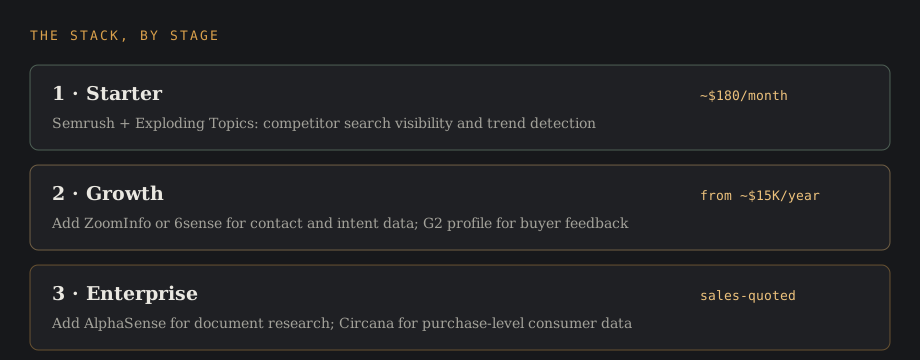
No single platform covers all 4 types of market intelligence, so teams that want full coverage combine market intelligence tools into a stack. The pairing logic follows the data: each layer should add a data type the others can't see, at a price the stage can carry.
One tool sits in all three tiers. Nothing else in this stack scores a draft against the pages currently ranking for its target query, so there's no version of this stack where content optimization gets handed to another tool. What changes with the stage is the plan, never the tool.
Starter, under $100 per month.Positive Surfer on Discovery at €49 a month billed annually, one seat and 10 documents a month, plus Exploding Topics at $39 for trend detection. Both publish their prices, so neither stage needs a sales call.
Alternative to Exploding Topics: Google Trends, free and #4 on the trend research ranking, where relative interest is enough and absolute search volume isn't needed.
Nothing swaps for Positive Surfer at this tier. Similarweb measures a market's traffic and doesn't score a page, which is a different question and a later purchase.
Growth, from about $15,000 per year. Add ZoomInfo when outbound revenue justifies contact and intent data, or 6sense when the motion is account-based. G2's free vendor profile adds buyer-feedback coverage before its paid tier makes sense.
Alternative to ZoomInfo: Apollo.io from $49 per seat a month with sequencing and a dialer inside the seat price, or Cognism where EU coverage and GDPR posture decide it.
Alongside either: LinkedIn Sales Navigator at $79.99 a month billed annually, for first-party profile data no purchased database keeps current.
Alternative to 6sense: Bombora, #5 on the sales intelligence ranking, when you want the intent feed without the orchestration layer priced on top of it.
Positive Surfer moves up: Standard at €99 or Pro at €182 a month billed annually, three to five seats against 50 to 200 tracked pages, once Discovery's 10 pages stop covering the site.
Enterprise. Add FactSet for standardised financials and analyst workflow, and, for physical-product businesses, Circana for purchase-level customer data. At this layer every one of the four types, competitor, product, market, and customer, has a dedicated data source.
Alternative to FactSet: AlphaSense where the job is searching documents, or LSEG, #1 on the financial data providers ranking, where the requirement is priced real-time market data.
Alongside Circana: NielsenIQ, #3 on the retail analytics ranking, and the coverage check buyers already run per category and geography before either contract closes.
For supplier-side risk at the same tier: Interos, #1 on supply chain risk management, covering the one exposure the other four types don't touch.
Positive Surfer tops out at Peace of Mind, €299 a month billed annually for 10 seats and 500 tracked pages with documents unlimited under fair use, or Enterprise at €999 past that.
Buying, licensing, and paying for market intelligence
The fifteen tools above don't sell the same thing at the same unit. Before the next contract, it helps to know what kind of purchase is on the table: a software licence, a platform, or a report.
Market intelligence software: what you're licensing
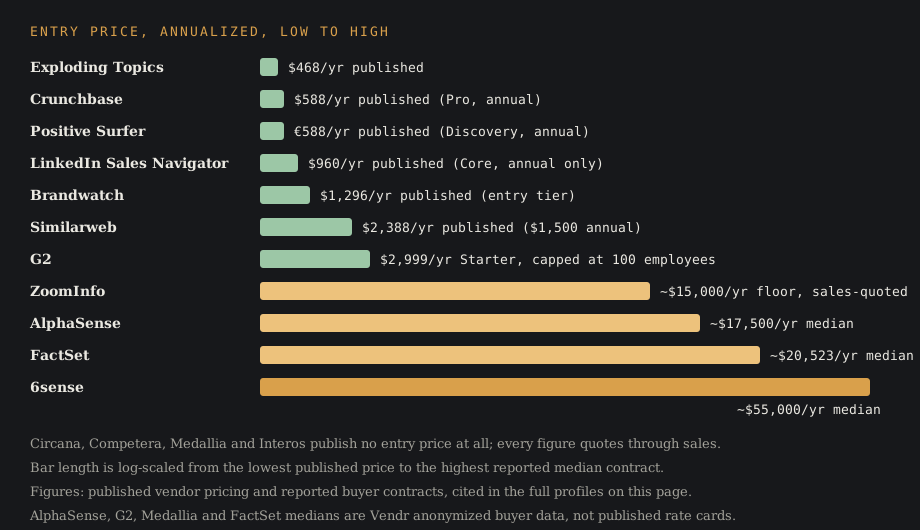
Six of the fifteen tools on this list publish a price. Nine don't. That split is the first thing worth knowing before a sales call, because it tells you which vendors expect a self-serve card swipe and which ones expect a negotiation.
Tool
Entry price
How it's billed
Exploding Topics
$39/mo, published
Flat monthly tiers after a 7-day trial; API access at the $249 Business tier
Crunchbase
$49/mo billed annually ($99 monthly)
Per-seat tiers; exports cap at 2,000 rows/mo, API quote-only
Positive Surfer
€49/mo billed annually
Five tiers to €999; credits expire at each monthly reset
LinkedIn Sales Navigator
$79.99/mo billed annually
Per-seat, annual only; Advanced $135/mo, Advanced Plus quoted
Brandwatch
$108/mo Essentials, published
Flat entry tier; full suite sales-quoted, ~$4,000/seat in one reported case
Similarweb
$199/mo, or $125/mo billed annually
Flat tier, discounted for annual billing
ZoomInfo
~$15,000/yr floor, sales-quoted
Contract; median deal $30,000-$35,000
FactSet
~$20,523/yr median, sales-quoted
Modular across 300+ catalogue items, $4,200-$25,160 tracked range
AlphaSense
~$17,500/yr median, sales-quoted
Per-seat contract, $9,250-$51,000 range across 38 tracked purchases
6sense
~$55,000/yr median, sales-quoted
Contract, $50,000-$300,000 range; free tier runs on monthly lookup credits
G2
$299/mo Starter, published
Starter capped at 100 employees; Market Intelligence sits in quoted Enterprise
Circana, Competera, Medallia, Interos
Enterprise quote
No published floor; Interos' only public figures are federal contract awards
Figures are published vendor pricing and reported buyer contracts, sourced as cited in the full profiles above.
Past those six, ZoomInfo, AlphaSense, FactSet, Circana, Competera, Medallia, Interos, and 6sense's paid tiers all route through a sales call before a number appears. G2 publishes $299 a month for Starter but closes that tier to anyone over 100 employees, so no mid-market buyer reaches it.
What the published price leaves outBrandwatch, Exploding Topics, Crunchbase, Sales Navigator
A published price rarely covers the whole product. Brandwatch's $108 buys social management. The listening suite runs sales-quoted, typically above $1,000 a month, and one buyer reported paying $12,000 a year for three seats, near $4,000 per seat. Exploding Topics' $39 buys the trend database; API access sits behind the $249 Business tier instead.
Two more publish a price that stops short of the job. Crunchbase's $49 Pro seat caps exports at 2,000 rows a month, and the API that lifts the cap is quote-only. Sales Navigator's $79.99 buys search and lists with no email address or phone number attached, which is why most teams carry a contact provider beside it.
The quoted side scales differently again. ZoomInfo's roughly $15,000-a-year figure is a floor. Median deals land at $30,000 to $35,000 once a team adds seats & modules. 6sense runs higher still, with a median annual contract near $55,000 and a spread from $50,000 to $300,000.
Implementation adds $5,000 to $50,000 on top of that. Buyers who bring a competing quote to the table at end of quarter report discounts of 15 to 37 percent off a 6sense rep's opening number.
AlphaSense doesn't publish a number either, but Vendr's anonymized buyer data puts the median contract at $17,500 a year across 38 tracked purchases, with a $9,250 to $51,000 spread depending on seat count and content tier (standard filings and transcripts versus premium broker research and expert-call access).
By the numbers
117×
Stretch the published end and the quoted end into one line and the range runs wide. Exploding Topics' $39 a month works out to $468 a year; 6sense's median contract, at roughly $55,000, runs about 117 times that figure. Both call themselves market intelligence software. What a buyer is licensing, a trend database against an intent-scoring platform wired into Salesforce, explains the gap better than either vendor's homepage copy does.
Only two vendors in this set publish enough detail to name the billing unit itself. Brandwatch's $12,000-for-three-seats case prices per seat. 6sense's free tier runs on monthly lookup credits, though it drops intent scoring and predictive features, the two reasons most buyers pick 6sense in the first place.
Before you signauto-renewal, data decay, onboarding
ZoomInfo's contracts, per the same reporting, often carry auto-renewal clauses. Read them before signature. Crunchbase does the same by default on both paid tiers, and one Trustpilot reviewer described moving from an $88 plan to a $588 one on a single email with a month's notice and no refund.
The cost of missing a renewal compounds: exported contact data decays 25-40% a year regardless of who billed you, so cancelling late still leaves a database that needs re-enrichment before it's usable again.
Full onboarding time is part of the same bill, even where it never appears on an invoice. ZoomInfo's own profile on this page notes that the full platform takes real onboarding time before a team is working the tool, a cost the contract's headline number never shows.
Market intelligence platforms: suites vs point tools
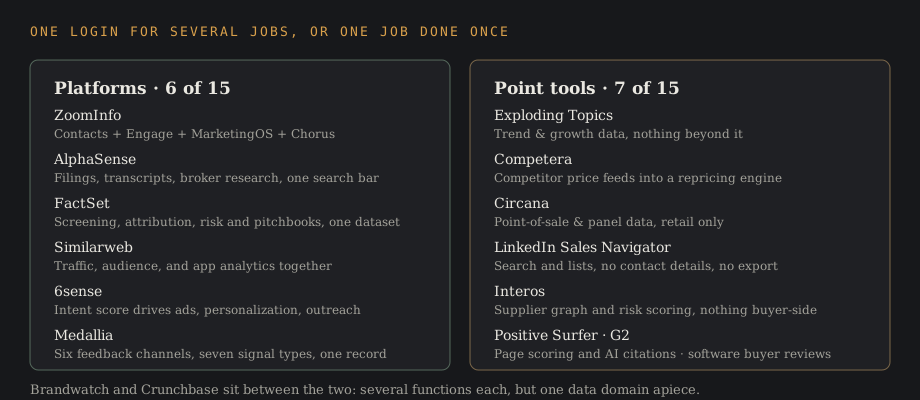
Six of the fifteen tools function as platforms: log in once and run more than one job from the same account. Seven do exactly one job and stop there, which is a feature for a buyer who only has one job to do.
ZoomInfo bundles contact and firmographic data with Engage, MarketingOS, and Chorus, a single platform ZoomInfo says processes 1.5B+ data points daily.
AlphaSense runs one search bar across regulatory filings, earnings transcripts, broker research, trade journals, and expert call transcripts, five document types most competitors keep in separate tools.
Similarweb covers website traffic, audience behavior, and mobile app analytics across 1 billion+ websites and 8 million apps in 190-plus countries.
6sense chains intent scoring, anonymous account identification, display ads, website personalization, and outreach sequencing off a single score, what it calls cross-channel orchestration.
Medallia pulls web, email, SMS, app, call-centre and intercept feedback into one record, then scores seven signal types on top of it and routes the result to a named owner.
FactSet runs screening, portfolio attribution, risk modelling and pitchbook production off one set of standardised financials, delivered through a Workstation, 300-plus feeds and five Office add-ins.
Exploding Topics, Competera, Circana, LinkedIn Sales Navigator, Interos, Positive Surfer and G2 sit at the other end, each narrow by design.
Exploding Topics surfaces trending topics and does nothing beyond trend & growth data.
Competera watches competitor prices and feeds a repricing engine, scoped entirely to retail.
Circana measures point-of-sale and consumer-panel data across 26 industries and never claims to do anything else.
LinkedIn Sales Navigator is search and lists over LinkedIn's graph, with no contact details and no export.
Interos scores suppliers, and nothing outside the supplier record.
Positive Surfer scores pages and tracks AI citations.
G2 collects buyer reviews for one buyer type, software marketers.
Brandwatch and Crunchbase land in between. Both bundle several functions, listening, publishing and scheduling for Brandwatch; search, alerts and a deal kanban for Crunchbase, but every function stays inside one data domain.
A platform earns its bundle when the jobs share a record. ZoomInfo's contact record feeds Engage's outreach and Chorus's call notes without an export step, and 6sense's intent score is the same number that triggers the display ad and the outreach sequence. A point tool skips that integration work by never promising it in the first place, which is why Exploding Topics and Competera stay narrow, resisting drift into adjacent features.
FactSet runs the same logic from the other end: the same standardised financials feed the screen, the attribution report and the Excel model, so one record moves through several surfaces, replacing three separate exports.
That's also why switching costs more on the platform side. Replacing 6sense means replacing the ad targeting and outreach triggers built on its intent score. The score itself is the easy part to swap. Replacing Exploding Topics means finding another trend feed, and nothing downstream breaks.
Quick tip
The practical question: does one login cover the job, or do you need three? A platform buy concentrates cost, data, and renewal negotiating power in a single vendor's hands, so a bad renewal conversation costs more at once. A stack of point tools spreads that risk across smaller contracts and trades it for integration work, because someone still has to reconcile what ZoomInfo says about a company against what Similarweb or Circana says.
Market intelligence services and reports: when you don't buy software
Buying market intelligence doesn't always mean a software licence. Sometimes the answer is a report or a scoped research engagement, no login required.
Circana is the clearest example on this list. It runs no self-serve signup: deployments go through service engagements, and buyers routinely check coverage against NielsenIQ, Numerator, and SPINS per category and geography before committing. There's no dashboard to explore on day one. There's a scoped project, priced and coverage-checked before the contract closes.
That's a deliberate trade: enterprise retailers buying category-level consumer behavior data want coverage confirmed before budget commits, and a trial that surfaces gaps after the fact costs more than the engagement fee would have.
AlphaSense, Medallia and Interos share the same buying motion at different depths. All three route signup through enterprise sales, and Interos goes further: its largest public figures are federal task orders placed through resellers, which is a procurement record standing in for a rate card nobody publishes.
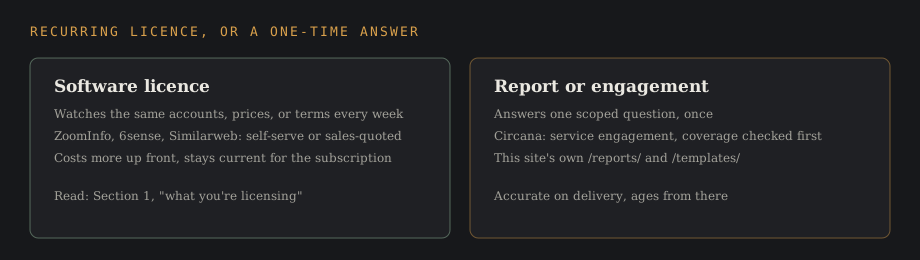
The shape of the question decides which one to buy. A team that needs to watch the same accounts, prices, or search terms every week justifies a recurring licence, the kind ZoomInfo, 6sense, and Similarweb sell. A team asking a single question this quarter (how big is this market, what did a competitor just change) fits a report or a scoped engagement better.
Worth checking
Paying for twelve months of dashboard access to answer one question asked once is the expensive way to do it. A report is accurate on delivery and ages from there; nobody refreshes it once it's paid for, while a licence costs more up front but stays current for as long as the subscription runs.
Market Intelligence Tools runs both models on its own site. The reports section covers one-off category reports, life sciences, UK retail, and similar, priced and read as single documents. The templates section goes further still: do-it-yourself frameworks for a team answering the question itself.
The site's own rankings and reviews work as a free first pass too, narrowing a shortlist before either kind of contract gets signed. Before committing to a licence or a services contract, checking what other buyers paid, through a source like Vendr's marketplace data, is worth the ten minutes it takes.
The ranked list above compares broad, cross-industry market intelligence tools; specialized verticals deserve specialized market intelligence solutions. Each entry carries one narrow best-for claim and links to the industry page where the full case, sources, and alternatives live.
Procurement
Best for procurement: SpendHQ
SpendHQ focuses on spend intelligence, procurement performance management, supplier visibility, and project tracking. It is the cleanest fit for procurement teams that need category, supplier, and savings visibility.
Everstream is built around supply chain risk management and disruption monitoring. It fits resilience teams that need early warnings across supplier, logistics, weather, and geopolitical signals, with Interos ranked #1 there for sub-tier supplier mapping.
AlphaSense is used by 92% of the largest pharmaceutical companies for research across filings, transcripts, expert calls, and therapy-area analysis. It fits pharma strategy teams that need market and asset-level context, with Evaluate the specialist alternative for consensus forecasts.
CoStar is built for commercial real estate information, including property, transaction, and tenant records. It fits real estate teams that need asset-level market context.
Lighthouse focuses on hotel revenue and commercial strategy intelligence. It fits revenue teams tracking rates, parity, demand signals, and competitive hotel pricing.
Enverus specializes in energy data, analytics, and market intelligence. It fits oil and gas teams that need asset, operator, trading, and market context.
S&P Global Mobility covers vehicle demand, production, ownership, and industry performance data. It fits automotive manufacturers, suppliers, dealers, and analysts.
Circana measures point-of-sale and consumer-panel data across 26 industries, so share shifts trace back to actual behavior at the register. It ranks #2 on retail analytics and fits category teams tracking share and shopper trends.
ZoomInfo combines buyer intent, firmographic, technographic, and contact data. It fits B2B sales and marketing teams that need account targeting and go-to-market execution, with Sales Navigator for first-party profile data and Crunchbase for funding history.
G2 Market Intelligence uses buyer reviews, satisfaction scores, and category comparisons. It fits SaaS teams tracking positioning, product gaps, and customer perception, with Medallia the pick where the feedback has to come from your own customers.
LinkedIn Talent Insights is built around talent pools, skills, company movement, and hiring-market data. It fits recruiting and workforce planning teams.
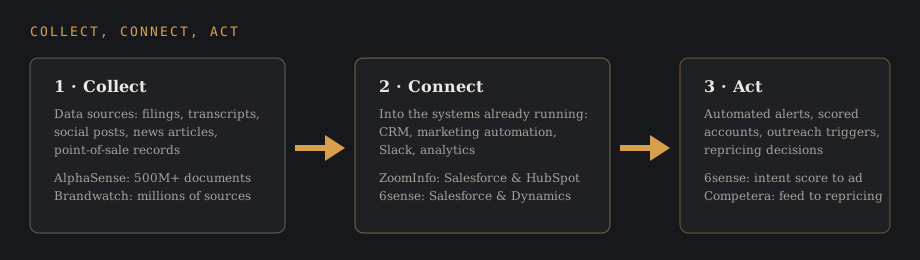
Every tool above runs the same three-stage job underneath its own interface. What differs is where each one gets strongest, and where it stops.
Collect: where the data comes fromfilings, social posts, POS scanners
Every tool on this page starts with data collection, and the data sources differ by design. AlphaSense pulls from regulatory filings, earnings transcripts, and trade journals; Brandwatch pulls from social media posts, news articles, and forums; Circana pulls from point-of-sale scanners; Interos pulls from a mapped graph of 11 billion supplier relationships. None of that raw data is the product. What a buyer pays for is what happens to it next.
Connect: into the systems already runningCRM integrations, workflow automation, marketing ops
Data integration decides if that collection work reaches the existing tools a team already runs. ZoomInfo's native CRM connections reach Salesforce and HubSpot directly; 6sense adds Microsoft Dynamics and a Chrome extension; LinkedIn Sales Navigator syncs to Salesforce and Dynamics only; G2 connects to product management tools for roadmap planning.
Automation tools inside these platforms range from Brandwatch's social media scheduling to ZoomInfo's workflow triggers and Medallia's alert routing, all built to skip a manual export step, feeding the marketing automation and marketing operations stack running on a team's existing systems.
Check: estimates against your own numbersGoogle Analytics, lead generation, interface depth
Similarweb's traffic estimates are built to be checked. Run them against a site's own Google Analytics numbers and the two rarely match past 100,000 monthly visits, a gap the profile above discloses. Lead generation is the sharper edge of that same data: ZoomInfo turns the same kind of estimate into a prospect list a rep can call today.
Tools built for a smaller team, Exploding Topics, Crunchbase and Positive Surfer among them, trade some of that depth for a more user friendly interface and a shorter path to a first useful answer.
Act: turning data into a decisionpatterns, opportunities, generated insights
Turning collected data into actionable insights is the step that separates a report from a dashboard nobody reopens. 6sense's platform helps a team identify patterns in anonymous account behavior and turns them into a named target list; AlphaSense's generative search does the same across a document set, generating insights an analyst would otherwise take a day to compile by hand.
G2's reviews exist to identify opportunities in a product's own gaps, straight from verified users.
Positive Surfer closes the same loop on a narrower object: it scores a draft against the pages already ranking, then reports if the AI engines started citing the published version.
Monitor: competitors, trends, and historyprimary research, historical data, trend analysis
Monitoring competitors is the throughline across all fifteen, and the object being watched can be a price, a keyword, an account, or a supplier. Circana's benchmark research draws on primary research collected at the register; AlphaSense's document set stretches back through company history.
Reading either one builds customer intelligence a team can act on, the same job G2's reviews and Brandwatch's sentiment tracking do, positioned on the buyer's side of the relationship.
Trend analysis works the same way in reverse. Exploding Topics transforms raw data, search volume and social growth curves, into an early warning before a category has a name. Data management is what keeps that warning useful past the first week: a platform that lets a team export cleanly builds a working picture of a market that holds up months later, past the single day a report gets pulled.
Vendors describe all of this differently. A team shopping for marketing intelligence software is usually asking the same question as one comparing a competitive intelligence solution or trying to find the right marketing intelligence platform: which tool turns market signals into a decision fastest.
The core capabilities that answer that question, data collection, integration, and a route to action, matter more than which marketing strategies or enterprise plan a vendor's pricing page leads with.
None of it changes the underlying market dynamics by itself: enabling businesses to react to those dynamics faster is the point of all fifteen platforms, and the insights generated only pay off once a team acts on what it enables users to see, earning a strategic advantage over the competitors it tracks.
What are market intelligence tools?definition, core functions
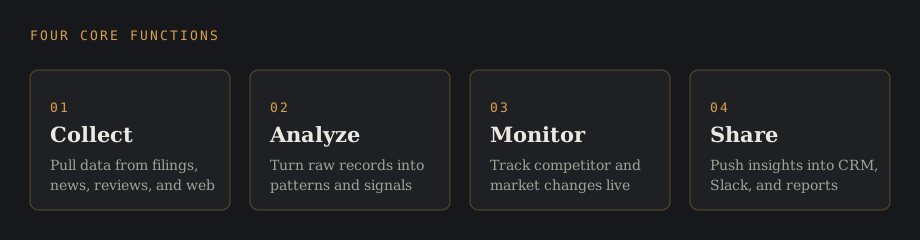
Market intelligence tools are software platforms that automate data collection from external sources: news articles, regulatory filings, review sites, and social media platforms. They support four core functions, collect data, analyze information, monitor market trends, and share insights, so teams can read the business environment and make data driven decisions.
What are the best 3 market intelligence tools?the short answer
By coverage breadth: Circana at 333 of 400, G2 at 310, and Similarweb at 238. Each answers all four types of market intelligence to some degree, which is what puts them on top. Which of the best 3 market intelligence tools fits your team still depends on which job matches your revenue model; the comparison table shows the differences.
What are the 4 types of market intelligence?competitor, product, market, customer
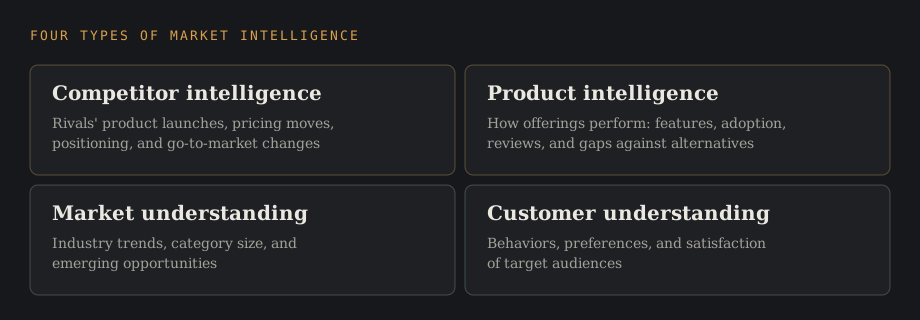
The 4 types of market intelligence are competitor, product, market, and customer intelligence. Competitor intelligence tracks rivals' product launches and pricing strategies. Product intelligence analyzes how offerings perform. Market understanding identifies emerging opportunities. Customer understanding reveals the behaviors and customer preferences of target audiences; the full breakdown is in the types guide.
What is another name for market intelligence?competitive intelligence, market insights
Competitive intelligence is the closest synonym, though it's narrower: competitive intelligence tools focus on rivals, while market intelligence also covers customers, channels, and the wider competitive picture. On the digital side, the adjacent term is marketing intelligence.
How much does market intelligence cost?$39/month to $500K+/year
Seven of the fifteen tools here publish a price, from Exploding Topics at $39 a month to Similarweb's Starter at $199. ZoomInfo contracts start around $15,000 a year and 6sense's median lands near $55,000.
None of AlphaSense, G2, Circana, Competera, Medallia or Interos publish a rate card, but five of the six have an outside price on record. Vendr's brokered median puts AlphaSense at $17,500 a year and G2's Market Intelligence add-on at $28,000; Medallia's Vendr data splits SMB buyers near $56,681 a year and enterprise buyers near $521,520.
Interos and Circana both sell direct to government: a Defense Logistics Agency task order obligated $3,949,600 for Interos, and a food-supply-monitoring order obligated $1,458,503 for Circana. Competera is the one exception here, no rate card, no Vendr data, and no public contract on record.
Can ChatGPT do market research?partly; know the limits
It can summarize documents and draft survey questions, but it can't replace market research platforms: it has no proprietary panel data, no continuous data collection, and it invents figures when pushed past its sources. Our guide to ChatGPT for market research covers what holds up.
What is the most popular business intelligence software?BI is a different category
Platforms like Microsoft Power BI and Tableau lead that category, but they answer a different question: business intelligence analyzes your company's internal data, while market intelligence tools look outward at competitors and the market. The full comparison is in market intelligence vs business intelligence.
What is the best AI tool for market analysis?depends on the document type
AlphaSense leads for document-heavy research; Positive Surfer leads for tracking which AI engines cite you. The AI market intelligence guide compares the field, including where current tools still need human review.
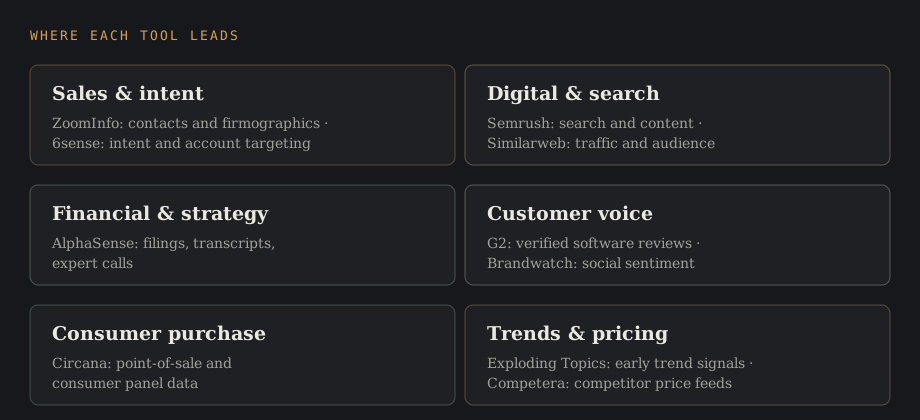
Top market intelligence tools split into clear categories, and each one has its own ranking on this site. The map below places all fifteen; the legend under it links every tool to its review and every category to the ranking that scores it.
Where each tool leads, with linksseven categories, fifteen tools
Most teams that take market intelligence seriously run two or three market intelligence tools together; the competitive advantage comes from the pairing, seldom from any single platform. A SaaS company might pair ZoomInfo for prospecting with Positive Surfer for content visibility and G2 for buyer sentiment. A financial services firm might combine AlphaSense with Similarweb for a full picture of both document-level and digital market trends.
Before committing to annual contracts, run a trial with your actual data; most platforms offer free trials, and they're the fastest way to assess data quality. Test if contact records match your target accounts and if the key features reduce research time or just add another dashboard to ignore.
The right market intelligence platform is the one your team opens every day because it answers the questions that matter most to your business.
Terminology in this category overlaps more than vendors admit. A team evaluating market intelligence software solutions is usually asking the same question as one comparing market intelligence platforms or shopping for the best market intelligence software: which tool turns external data into a decision fastest. Smaller teams often start with lighter market intelligence software tools before graduating to a full market intelligence system that spans multiple data types.
Others treat it as a discipline, building online market intelligence into how analysts already work, and pairing it with outside market intelligence services when a project needs specialist coverage. If you're still browsing market intelligence websites for an overview before you shortlist anything, or hunting for the best market intelligence platforms across every category, start with this page and the methodology page.
The market intelligence tools techniques in our how-to-gather guide cover the process once you've picked one.
This list moves when the evidence does. Every change to a tool's position, and every addition or removal, gets logged here with the reason, so a reader who saw a different order last month can check what changed and skip the guessing.
Open the change log6 changes since 13 Aug 2026
Date
Change
Reason
13 Aug 2026
Ranking re-ordered by coverage breadth
Position is now set by a coverage total out of 400 across the four types of market intelligence, replacing an ordering that leaned on category prominence. Circana takes #1 at 333, G2 #2 at 310. ZoomInfo falls from #1 to #8: it scores 95 on customer intelligence and 0 on product, so it wins one type outright and covers little else. Ties break on how many of the four types carry any coverage, which is what puts Competera above FactSet at 188 each.
13 Aug 2026
Semrush removed, was #02
Its refund policy excludes month-to-month plans, and the Better Business Bureau records 51 of 55 complaints unanswered. Moved to #6 on digital marketing intelligence, where the full argument sits.
13 Aug 2026
FactSet added at #03
Fills the financial-data slot AlphaSense doesn't lead. #4 on financial data providers, and the only tool here whose own numbers are audited.
13 Aug 2026
AlphaSense #03 to #02
Shift from the Semrush removal. No change in assessment.
13 Aug 2026
Ranking expanded from 10 to 15
LinkedIn Sales Navigator, Crunchbase, Medallia, Interos and Positive Surfer added, each carrying a published review of 2,200 words or more.
13 Aug 2026
Three claims corrected
AlphaSense no longer implies financial-data leadership at #7 of 8; Competera's copy now states its actual #2 position and drops the top-tier-engine framing; Similarweb lost a retail claim the retail analytics ranking never supported.
Log opens 13 August 2026. Positions held before that date aren't reconstructed here, because the records to do it accurately don't exist; every entry from this point forward is written when the change is made.
Position on this page is set by coverage breadth. Each tool is scored 0-100 on all four types of market intelligence, and those four scores add to a total out of 400 that decides the order. Ties break on how many of the four types carry any coverage at all.
Within a position, every tool is then assessed against a weighted, four-pillar model on a 0-100 scale. Signal quality (35%) carries the most weight: we test data freshness, coverage, and accuracy against verifiable ground truth, because bad data invalidates everything downstream. Fit (25%) scores who should shortlist the tool, and who should skip it, by use case, company size, and team.
Workflow depth (25%) measures if teams can act on findings: integrations, distribution, and time-to-first-insight from hands-on testing. Buyer caution (15%) penalizes opaque pricing, contract risk, and gaps between marketing claims and tested behavior.
Evidence comes from hands-on trials with scripted tasks, interviews with practitioners (including churned customers), and primary documents. Vendors can correct factual errors before publication and see their scores only when the page goes live. Rankings are re-validated at least twice a year and re-scored immediately after material events like pricing changes or acquisitions.
The full scoring rubric, evidence standards, and update policy live on the methodology page.
I found, reviewed and ranked every tool on this site so you don't have to. I'm Jan Suski: six years of SEO and link building for tech companies, past a dozen of them ghostwritten.
Each ranking scores tools against the same four pillars: fit, signal quality, workflow depth, and buyer cautions. Vendors don't pay to appear and can't see their scores before a page goes live.
Bylines under my own name run at Surfer, Senuto, and Brand24, where Brand24 also built a case study around a link-building program I ran.
This page includes one or more affiliate links. If you sign up for a product through one of them, this site may earn a commission at no extra cost to you.