Company data providers: rankings and buying guide for 2026
 By Jan Suski. I go deep on every review, checking every number against its source and digging up details other coverage misses, a habit from six years of SEO and link building for tech companies. Bylines at Surfer, Brand24, and Senuto. How the scoring works.
· Prefer this source on Google
Quick comparison of company data vendors
Ten providers with the record type each one is strongest on, what entry costs, and who the data suits.
| # | Provider | Strongest data | Entry price | Best fit |
|---|---|---|---|---|
| 1 | Coresignal | 500+ company fields, employee and jobs data | Free tier, then from $49 a month | Data teams building products on company data |
| 2 | Bright Data | Public web data at scale | From $2.50 per 1,000 records | Engineering teams wanting raw inputs |
| 3 | People Data Labs | Company and person datasets | Free tier, then from $98 a month | Product teams embedding enrichment |
| 4 | Bureau van Dijk | Corporate ownership and financials | Quoted, enterprise | Risk, compliance and investment analysis |
| 5 | OpenCorporates | Legal entity registry records | From £2,250 a year | Compliance teams needing the official record |
| 6 | Crunchbase | Funding rounds and private company data | $20,000 median* | Teams tracking funded companies |
| 7 | Global Database | International company intelligence | Quoted | Teams needing coverage outside the US |
| 8 | MixRank | Technology signals with history | Quoted | Technographic tracking over time |
| 9 | ZoomInfo | Company plus contact data | $33,500 median* | Sales and marketing teams |
| 10 | LinkedIn Sales Navigator | Member-declared company and role data | From $119.99 per seat a month | Relationship-led research |
Medians marked * are anonymized buyer-reported contract values published by Vendr. Everything else is the price the vendor publishes itself.
Company data providers sell structured records about businesses: firmographics, ownership, funding rounds, technology signals, hiring and financials, delivered by API or dataset.
The buyers are engineering, data and strategy teams building something. Reps working a list buy elsewhere. That distinction decides which vendors below make sense, and the data providers guide maps it against the other six categories.
Monthly deterioration in data accuracy across this category. Refresh frequency matters more here than raw record counts, and a dataset bought in January is a different dataset by March.
What company data providers offer
Company data providers aggregate information from public records, company websites, social media and commercial partnerships, then structure it so a machine can read it. Bright Data works one layer further upstream, selling that public-web collection as feeds, datasets or a scraping API and leaving the structuring work to the buyer.
Six data categories cover almost everything sold in this market.
Firmographic, employee and job postings data
Firmographic data includes company name, location, size, industry, revenue and founding year. It is the base layer every other dataset attaches to.
Employee data covers headcount, seniority mix, function split and movement over time. Jobs data and job postings data show what a company is hiring for right now, which is the earliest public signal of a strategy change.
Company data can reveal competitor moves and hiring trends before either is announced, which rewards a team willing to read between the lines. Job boards are the collection point, and the lag between a role appearing and a plan existing is usually months.
Registry, ownership and financial data
Legal entity records come from company registries: incorporation, officers, filings, status. This is the only company data with an official source behind it.
Ownership data maps corporate structures, parents and subsidiaries. Financial data encompasses metrics such as company revenue and profitability, while financial and risk data includes credit scores, payment history and bankruptcy records.
Technographic data provides insights into the technology stack a company uses, and intent data reveals behavioural signals indicating interest in a category. Both are inferred, which is worth remembering when a vendor prices them like registry data.
How to choose a company data provider
Businesses evaluate data providers on freshness, accuracy and compliance, in that order. The right company data provider depends on what you are building.
Data freshness and the cost of inaccurate data
Top providers update records in real-time or daily. Coresignal provides real-time data updates every six hours; Global Database updates many records within 24 hours; MixRank updates monthly while tracking over five years of history.
Those are three different products. Six-hour refresh suits an application; monthly with deep history suits trend analysis; neither is better in the abstract.
Inaccurate data wastes time and resources, and at 15% monthly deterioration a dataset bought in January is a different dataset by March. Ask what percentage of records changed in the last refresh. The devil's in the details, and the date the job ran tells you nothing.
Ask for a data sample
Providers should allow access to data samples before purchase, and the ones that refuse are telling you something about data quality.
Assess data quality on your own accounts. Pull a data sample of 100 companies you already know, then check data depth field by field: how many have revenue, how many have a working website, how many have employee counts within range of the truth.
Check data structure while you are there. Two providers can offer the same data points and deliver them in formats that differ by a week of engineering work.
How you integrate company data
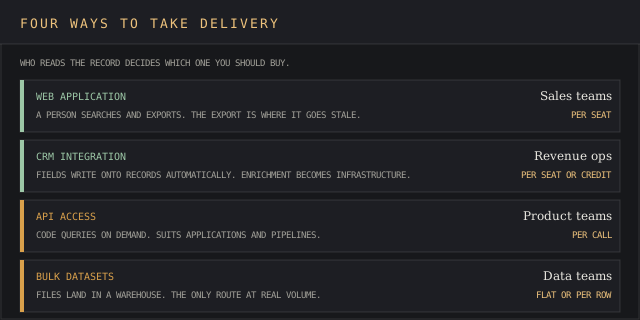
API integrations allow direct access for integration into existing software systems, which is how most company data gets consumed. Bulk datasets suit analysis; APIs suit applications; natural language search suits analysts who do not write queries.
Coresignal supports natural language queries for data retrieval, which is unusual in this market and useful for teams without a data engineer to hand.
Ethical data collection matters commercially as well as legally. Ask how public web data was gathered, under which terms, and what happens to your access if a source changes its policy. A vendor that cuts corners here passes that liability straight to you. Bright Data publishes GDPR and CCPA compliance documentation for exactly this reason.
Top company data providers, ranked
Ranked on data depth, refresh frequency, delivery flexibility and how much engineering effort sits between the contract and a usable record.
Coresignal
The deepest structured company dataset in this ranking, built for teams that need breadth and multiple delivery paths over a polished sales interface.
Coresignal indexes more than 500 structured company data fields across 75 million company profiles, plus more than 839 million linked employee profiles, delivered by API, bulk dataset or natural language search. Refresh cadence varies by dataset over one blanket schedule across the whole catalog.
Why it's ranked #1. The combination of field depth, delivery flexibility and price per record is unmatched here. It loses nothing to the enterprise platforms except a sales-facing interface, which its buyers do not want. That range keeps Coresignal ahead of the curve on all three measures at once.
Data and engineering teams building products or models on company data who need breadth and several delivery paths over a browsable UI.
Features
- 500+ structured company data fields across 75 million company profiles.
- 839 million linked employee profiles tied to the company record.
- Delivery by API, bulk dataset or natural language search.
- Historical data retained for trend and change-detection work.
- Free plan available for testing before a paid commitment.
Pricing and limits
Free plan for evaluation, Starter from $49 a month, Pro from $800 and Premium from $1,500. Annual billing takes 20% off, and per-record rates range from $0.196 down to $0.005 at volume.
Who should skip it
Teams that want a sales-facing interface a rep can browse without touching an API. Coresignal is built for a data pipeline, and a team without engineering resources to consume it gets less value than the field count implies.
Switching trigger. A team that wants company data delivered inside a CRM with contacts and intent signals attached finds that at ZoomInfo instead.
A public-web data collection platform delivering raw feeds and datasets, built for engineering teams that will structure the signal themselves over buying a finished company database.
Bright Data runs a large-scale proxy and scraping infrastructure that collects public web data, then delivers it as structured feeds, off-the-shelf datasets or a scraping API depending on how much processing the buyer wants done for them. The company sells collection at scale, and turning that collection into a usable company record is engineering work the buyer still does, often building the schema from scratch.
Why it's ranked #2. The most flexible source here and the least finished. It ranks below Coresignal because a buyer is purchasing raw collection, and the schema, dedupe and validation work between a feed and a usable record is still ahead of them.
Engineering teams that want public web data as raw material and will structure, dedupe and validate the signal themselves.
Features
- Web scraping infrastructure spanning company websites, job boards, marketplaces and directories.
- A dataset marketplace with pre-collected company-level datasets available off the shelf.
- Scheduled refresh options so a dataset stays current without a manual re-pull.
- Compliance tooling around collection, including consent and robots.txt handling.
- A scraping API for teams that want raw HTML or JSON with no proxy infrastructure to run themselves.
Pricing and limits
Datasets start at $2.50 per 1,000 records, so 100,000 records costs $250. Subscribing to scheduled refreshes cuts the per-record rate by up to 80%. New accounts also get 5,000 free credits a month, renewing monthly, across the Web Unlocker, SERP API, Web Scraper API, and Scraper Studio, no card required. The Browser API joined that same pool in September 2026.
Who should skip it
Teams without engineering capacity to clean and structure scraped output. Bright Data sells collection, and the work between a raw feed and a finished company record lands on the buyer. A team without that capacity risks biting off more than it can chew.
Switching trigger. A team that wants a finished, structured company record with no scraping pipeline to maintain finds that at Coresignal instead.

See the raw data yourself
Visit Bright Data
Company datasets start at $2.50 per 1,000 records, with refresh subscriptions cutting the rate up to 80%.
 Visit Bright Data →
May earn a commission if you sign up through this link, at no extra cost to you. Full affiliate disclosure.
People Data Labs
A developer-first data API selling company and person records with documented schemas, built for teams embedding company enrichment inside their own software over buying a seat-based tool.
People Data Labs sells datasets and a REST API covering companies and individuals, with published field schemas and predictable match logic aimed at engineering teams over sales reps. Company records link to person records where a match exists, giving one call for both.
Why it's ranked #3. The cleanest developer experience in this ranking, with a free tier a developer can test against before committing budget. Field depth per company trails Coresignal, which is the gap between third and first. Close but no cigar on the metric that matters most to teams buying by field count.
Product and engineering teams embedding company and person enrichment inside their own software over buying a seat-based tool.
Features
- Company and person records sourced from multiple data providers.
- API-first delivery with published, predictable schemas.
- Bulk data files for offline and batch work.
- Global data coverage with documented match-confidence logic.
Pricing and limits
The free plan gives 100 records a month. Pro starts at $98 a month for 350 records, and Enterprise is quoted. Annual billing takes 20% off.
Who should skip it
Sales and marketing teams that want a browsable UI over an API. People Data Labs has no native CRM interface, so a team without engineering resources to build against it gets less value than the price implies.
Switching trigger. A team that wants a sales-facing interface with no API integration to build finds that at ZoomInfo instead.
Bureau van Dijk
A Moody's-owned company database built for ownership structures and audited financials, priced and sold like an enterprise research terminal over a prospecting tool.
Bureau van Dijk, acquired by Moody's Analytics in 2017, now operates under the Moody's Orbis name and indexes more than 635 million entities from upward of 170 underlying data sources, with more than 2 billion ownership links mapping parent, subsidiary and beneficial-ownership structures, the whole nine yards. Where audited financials are unavailable, Orbis applies a qualitative risk score built from size, management and years in business over leaving the field blank.
Why it's ranked #4. The strongest financial and ownership data available here, and the least useful for anything resembling lead generation. Depth runs in one direction.
Risk, compliance and investment analysis teams that need ownership structures and audited financials over a prospecting list.
Features
- Corporate ownership and subsidiary mapping across more than 2 billion links.
- Standardized financial statements from filings, plus modelled projected financials where filings are unavailable.
- Qualitative risk scoring for private entities carrying no public financials.
- Cross-border industry-code mapping to a single global classification system.
- Coverage across more than 170 underlying data sources and 635 million entities.
Pricing and limits
Quoted, enterprise, priced by coverage and seats. Bureau van Dijk carries no public rate card, and Vendr has no listing for it or Moody's Orbis, so no median-contract figure exists to cite. Moody's sells its ESG Solutions scores through enterprise licensing as well, and our ranking of ESG data providers places them seventh.
Who should skip it
Teams without a compliance or investment-research use case. G2 reviewers cite a slow platform, login and session friction, and ownership data that needs independent verification before it goes into a filing, with thinner coverage in the Middle East, Africa and for newer companies.
Switching trigger. A team that wants a fast, self-serve sample before committing finds an easier evaluation path at Coresignal or OpenCorporates.
OpenCorporates
The registry record itself, sourced directly from official company filings with provenance attached to every field, built for compliance work over sales prospecting.
OpenCorporates aggregates more than 100 million company records across upward of 200 jurisdictions, pulling directly from each territory's official company register, straight from the horse's mouth, and attaching a source citation to every field. An openness score rates how transparent each underlying registry is, telling a buyer how far to trust a given jurisdiction's data before relying on it.
Why it's ranked #5. Provenance is its entire proposition, and no commercial aggregator matches it on that. Coverage of anything beyond the legal record is thin, which caps it here.
Compliance and KYC teams that need the official registry record with a citation attached over an inferred or modelled field.
Features
- Registry-sourced incorporation, status and filing data across more than 200 jurisdictions.
- Officer and director records tied to the underlying registry filing.
- A source citation and an openness score attached to every jurisdiction.
- API and bulk SFTP access for programmatic and batch use.
- A complimentary access tier for journalism, academic and anti-corruption use.
Pricing and limits
Essentials runs £2,250 a year for 500 API calls a month, Starter £6,600 for 2,500, Basic £12,000 for 5,000. Bulk delivery by SFTP sits on a quoted Enterprise tier with internal and external use rights.
Who should skip it
Teams that need financials, credit scores or contact data alongside the legal record. OpenCorporates carries none of those fields, and its usefulness inside any one jurisdiction depends on how complete that jurisdiction's underlying registry is.
Switching trigger. A team that needs financial statements and ownership structure layered on the legal record finds that at Bureau van Dijk instead.
Crunchbase
A private-company database built around funding events, investors and headcount movement, which is company data on businesses that publish nothing else.
Crunchbase covers private companies through funding rounds, investors, acquisitions and headcount movement, sourced from a mix of self-reported founder updates, public filings and its own research team, and it sees events that filings-based sources never do, funding news that's hot off the press well before a registry filing catches up.
Why it's ranked #6. The best private-market event coverage here, with the cheapest published entry point in this ranking. Narrow field depth outside funding is what keeps it mid-table.
Teams whose company-data trigger is a funding round, investor name or headcount inflection over a static firmographic filter.
Features
- Funding history including round size, date and lead investors.
- Acquisition and IPO tracking across the private-to-public lifecycle.
- Headcount and hiring trend estimates on private companies.
- Saved searches with alerts, plus API access on the enterprise tier.
Pricing and limits
Free search sits under paid Pro and Business tiers. Vendr records a $20,000 average negotiated contract across 73 deals.
Who should skip it
Teams that need company data outside the funded-startup world. Crunchbase's depth comes from tracking funding events, and that signal thins fast once a company stops raising or was never venture-backed.
Switching trigger. A buyer needing depth across bootstrapped or public companies over funded startups finds broader coverage at Coresignal or Global Database.
Global Database
An international company database built for coverage across jurisdictions a US-centric provider treats as an afterthought, refreshed faster than most global datasets manage.
Global Database updates a large share of its records within 24 hours, a fast cycle for a provider spanning this many countries and regulatory regimes, which keeps it ahead of the curve against providers that only move fast on domestic records. Financial and credit indicators sit alongside standard company data, aimed at teams doing due diligence or credit risk work across borders.
Why it's ranked #7. Global coverage with a genuine refresh cycle is rarer than it should be. Field depth per record trails the specialists ranked above it.
Teams whose coverage problem is geographic, needing company data across jurisdictions with a refresh cycle faster than a quarterly batch update.
Features
- Company records spanning industry, size, location and ownership structure internationally.
- Financial and credit indicators alongside standard company data.
- 24-hour refresh on a large share of tracked records.
- API and platform access, with contact data layered on the same record.
Pricing and limits
Custom pricing by market and coverage, quoted per deployment.
Who should skip it
Teams whose footprint is US-only. The international breadth that makes Global Database useful for cross-border work stops mattering against domestic specialists, and per-record depth trails the field.
Switching trigger. A buyer whose accounts sit inside one country over spanning several finds deeper per-record data at Coresignal or Bureau van Dijk.
MixRank
A technology-adoption tracking platform built for teams that need to see how a company's tech stack and app footprint change over time, over a static snapshot of what it uses today.
MixRank tracks technology adoption across more than 80 million websites and 20 million iOS and Android apps, scanning roughly 150,000 app SDKs a day, with the vendor's own site now reporting update intervals measured in hours over the monthly cycle older listings for this vendor cite. Delivery runs by API or direct sync into a Snowflake, Redshift or PostgreSQL warehouse, aimed at data teams over sales reps who keep an eye on stack changes over time.
Why it's ranked #8. The app-level SDK detection here runs deeper than a simple tech-stack lookup, and most competitors in this ranking do not track it. A quoted-only entry price near $24,000 a year and thin buying-signal or outreach tooling rule it out for anything but a data pipeline.
Data engineering teams tracking technology and app adoption over time who will consume the feed through a warehouse sync.
Features
- Technology and app-SDK detection across more than 80 million websites and 20 million iOS/Android apps.
- Roughly 150,000 app-SDK scans a day, with update intervals measured in hours.
- 45 million company records and 800 million people and employee profiles.
- Delivery by API or direct sync into Snowflake, Redshift or PostgreSQL.
Pricing and limits
Quoted only, on 12-month contracts with no self-serve option. Reported entry pricing runs near $24,000 a year, with enterprise configurations reaching $60,000 or more.
Who should skip it
Sales teams wanting buying-signal alerts or outreach tooling built in. MixRank has none, and TrustRadius reviewers score its contact-data accuracy around 5.8 out of 10, below the technology-tracking side of the product.
Switching trigger. A team that wants technology signal paired with outreach and alerting finds that at ZoomInfo instead.
ZoomInfo
A sales-facing company database with contact data and a CRM integration already built, priced and shaped for a revenue team over a data pipeline.
ZoomInfo pairs an expansive, accurate company database with contact data, intent signals and technographic fields on the same record, integrating directly into the CRM systems revenue teams already run. That combination is the default choice for a sales org and an expensive one for a team buying company data as raw material. Paying per seat for records a pipeline consumes can cost an arm and a leg when the actual reader is code.
Why it's ranked #9. For a sales team it would rank first. For anyone buying company data as raw material it is the wrong shape and the wrong price. Our B2B data providers ranking judges it on that footing.
Sales and marketing teams that want company data with contact data attached and a CRM integration already built.
Features
- Company records with contact data, intent signals and technographic fields on one record.
- Organizational charts that re-parent contacts to a new owner after an acquisition.
- Native CRM integration alongside API access for custom builds.
- Credit-based seat licensing tied to CRM records.
Pricing and limits
Quoted per seat with credit allocations, and there is no free plan. Vendr records a $33,500 median contract across 1,567 purchases, spanning $7,200 to $155,460, with 22% average savings off list.
Who should skip it
Teams buying company data as raw material for a pipeline or model. ZoomInfo prices and packages for seats, and that per-seat model is expensive for data consumed by code over a person.
Switching trigger. A team that wants structured company data at a per-record price with no seat licensing finds that at Coresignal instead.
LinkedIn Sales Navigator
Member-declared company and role data updated by the people who work there, straight from the horse's mouth in a market full of secondhand updates, held inside one interface with no export path out.
Sales Navigator runs on member-declared profile data, which makes company headcount and role information unusually current against providers refreshing on a quarterly or annual cycle. The tradeoff is access: there is no export and no API, so every lookup happens one company at a time inside the LinkedIn interface.
Why it's ranked #10. Genuinely fresh data, locked behind a screen. Without export or API it stays locked to one-at-a-time lookups and never functions as a data source, which is what this ranking is about.
Researchers who need current role and company detail for one-off lookups and are willing to work inside one interface.
Features
- Company and people search with advanced filters.
- Headcount and growth indicators sourced from member profiles.
- Job-change alerts and shared-connection paths.
- CRM sync on higher tiers.
Pricing and limits
Published per-seat plans, with a free trial: Core at $119.99 a month or $1,079.88 a year, Advanced at $159.99 or $1,799.88.
Who should skip it
Any team that needs the data outside the LinkedIn interface. With no export and no API, company data from Sales Navigator stays inside the LinkedIn interface with no path into a pipeline, a scoring model or a segmentation, which limits it to manual, one-company-at-a-time research.
Switching trigger. A team that needs the data to flow into a pipeline or scoring model finds an exportable, API-accessible alternative at Coresignal or People Data Labs.
Company data enrichment in the CRM
Data enrichment services update and clean existing records in a business's CRM, which is usually a better first purchase than buying new records.
Company data enrichment fills the fields nobody completed at form-fill: industry, employee data, revenue band, tech stack. Existing data becomes usable.
Real time data enrichment on record creation is the version that compounds. Every account entering the CRM arrives complete, so the decay problem starts from a better baseline. A stitch in time saves nine here, since catching gaps at record creation beats fixing a stale account six months later.
High quality data in a CRM changes what sales and marketing teams can segment on. Accurate firmographic data is what separates a target account list from a spreadsheet of company names, and the most accurate firmographic data comes from providers that refresh in hours.
What a company database is used for beyond sales
Company data providers are essential for sales prospecting, market research and risk management, and the last two are where this category differs from a contact database.
Market mapping. A complete company database lets you size a segment properly: how many companies exist at what revenue band in which geography. Market intelligence work starts here, and guesswork starts when the data does not cover the long tail.
Investment analysis. Private company data, funding rounds and ownership structures feed diligence on targets that publish nothing. Predictive analytics on hiring and technology signals extend that to companies with no financial disclosure at all.
Risk assessment. Credit indicators, bankruptcy records and ownership chains support supplier and counterparty checks, since a single red flag buried in the ownership chain can sink a deal late. Compliance teams need the registry record.
AI training. Company data supports AI by providing structured real-world context, which is why several providers here now sell explicitly to model builders.
Companies use market intelligence data to identify industry trends and perform competitive analysis, and a company database with historical data does that better than one that only holds the present.
Company data providers against a B2B data provider
The categories overlap enough to confuse a shortlist. A B2B data provider sells contact data with company records attached, priced per seat and built for a rep. Business data providers sell company records with contacts as a secondary field, priced per volume and built for a system.
ZoomInfo and the contact platforms sit in the first group. Coresignal, Bright Data and People Data Labs sit firmly in the second. Crunchbase and Global Database straddle both.
Pick by consumer. If a person reads the record, buy the sales tool. If code reads it, buy the dataset, because paying per seat for data your application consumes is the most common overspend in this market.
Business needs decide the data strategy. Teams that want both usually run one of each. A single vendor that does both tends to do neither well, the jack of all trades problem that shows up whenever one vendor chases both markets at once.
Weighing data vs. contacts
See what Bright Data collects
A dataset marketplace of pre-collected company records, plus a scraping API for raw HTML or JSON with no proxy infrastructure to run.
Visit Bright Data →
May earn a commission if you sign up through this link, at no extra cost to you. Full affiliate disclosure.
Company data providers FAQ
What is a company data provider?
A vendor that collects, structures and sells information about businesses: firmographics, ownership, financials, technology, hiring and funding. Delivery is by API, bulk dataset or platform, and buyers range from sales teams to model builders. Vendors built purely around bulk data delivery, outside the company-data niche, are ranked separately in our data buying companies guide.
Which company database offers the most accurate firmographic data?
Accuracy depends on geography and company size more than on vendor. Coresignal refreshes every six hours across 75 million company profiles; Bureau van Dijk is stronger on financials for entities that file them; OpenCorporates is definitive on legal status because it cites the registry. Test all three on your own segment before deciding.
How do I integrate company data into my CRM?
Through a native integration where one exists, or through an API that writes into the account object on creation and on a schedule. Bulk file imports work for a one-off backfill and fail as an ongoing process, because nobody remembers to run them, the classic dropped ball that leaves a CRM stale again within a quarter.
What do company data providers offer that contact databases do not?
Ownership structures, registry records, financials, funding history and technology signals with history. A contact database gives you people at companies; a company database gives you the companies themselves, including ones nobody is selling to.
How fresh should company data be?
Depends on use. Operational systems need daily or better, given data accuracy can deteriorate by 15% monthly. Market mapping and investment analysis tolerate monthly, and benefit more from depth of historical data than from recency.
Do company data providers offer free trials?
Most offer a data sample, and a few offer a free plan with limited volume. Insist on the sample against your own list, since a vendor-selected sample tells you what the vendor is good at. It does not tell you what you need.
Bottom line
Buy for the consumer of the data and the refresh cycle it needs.
Coresignal for depth and speed, Bright Data for raw collection, People Data Labs for embedded enrichment, Bureau van Dijk for ownership and financials, OpenCorporates for the legal record, D&B Hoovers for credit-risk and corporate-hierarchy research.
Crunchbase for funding triggers, Global Database for international coverage, MixRank for technology history, ZoomInfo and Sales Navigator if a human is reading.
Then test on companies you already know, since actions speak louder than words once a vendor starts pitching. Every provider on this list looks identical in a demo and different on your own data.
Compliance, licensing and data volume
Company data is less exposed to data privacy regulations than contact data, because a business record is not a person. The exceptions matter, and they are where most teams get caught.
Officer and director records, employee profiles and anything naming an individual fall back under GDPR and CCPA regardless of the dataset they arrived in. A company dataset carrying named executives is personal data with a different label.
How data volume changes the price
Most company data solutions price on data volume: records returned, API calls made, or rows delivered per month. That inverts the economics you are used to from sales tools.
Model it before signing. An application enriching every signup consumes a predictable volume; an analyst exploring consumes an unpredictable one, and the second pattern is where credit models get expensive.
Ask what happens to data you already pulled if the contract ends. Perpetual rights on delivered records cost more upfront and cost far less than re-licensing a dataset you have already built on.
Model the volume cost
Get started with Bright Data
100,000 company records costs $250 to start, and scheduled refresh subscriptions cut that rate by up to 80%.
Visit Bright Data →
May earn a commission if you sign up through this link, at no extra cost to you. Full affiliate disclosure.
Where detailed data pays for itself
Detailed data at the field level is what separates a working segmentation from an approximate one. Revenue bands, employee counts and industry codes that are present on 40% of records produce target accounts lists that are wrong in ways nobody notices.
The same fields drive sales and marketing strategies downstream. Territory design, scoring models and campaign targeting all inherit whatever gaps the underlying company data carries, and no amount of buyer intent data compensates for not knowing how big a company is. Bad inputs at the top turn into a vicious cycle by the time a rep is working the account.
Pipeline follows. A sales pipeline built on accounts that do not match the ICP converts worse at every stage, and the diagnosis usually lands on the reps. The dataset that produced the list is the actual problem.