Best revenue intelligence software in 2026: top 10 platforms ranked
 By Jan Suski. I go deep on every review, checking every number against its source and digging up details other coverage misses, a habit from six years of SEO and link building for tech companies. Bylines at Surfer, Brand24, and Senuto. How the scoring works.
· Prefer this source on Google
Quick comparison of the top 10 revenue intelligence platforms
Published capability figure is each vendor's own headline number; price a buyer can check blends list pricing with Vendr's tracked medians where no rate card exists.
| # | Platform | Published capability figure | Price a buyer can check | Best fit |
|---|---|---|---|---|
| 1 | Gong | 70+ transcription languages, 426 listings in its integration directory | $55,346 median*, 1,144 purchases | Sales orgs where call coaching drives the forecast |
| 2 | Clari | 10 million opportunities in its benchmarking dataset, 1,500+ companies | $76,000 median*, 291 purchases | Enterprise finance teams that own the forecast submission |
| 3 | Outreach | 250,000 to 1,000,000 API calls per year by tier | $45,600 median*, 917 purchases | Teams that want engagement and forecasting on one contract |
| 4 | Salesloft | 4,000+ sales teams, three native CRMs | $30,740 median*, 708 purchases | Mid-market teams already running Salesloft Cadence |
| 5 | ZoomInfo Copilot | 500M+ professional profiles, 14 Chorus patents | $33,500 median*, 1,574 purchases | Buyers who need contact data and call analysis on one bill |
| 6 | Aviso | Eight quarters of history in its time-series engine, 450+ revenue teams | $73,662 median* | Forecast-led orgs on Dynamics, SAP or Siebel |
| 7 | Avoma | $19 to $39 per recording seat per month, published | $19/seat/month annual, Startup tier | Mid-market teams under 25 seats that want a price before a demo call |
| 8 | Revenue.io | 140+ reports, 15-seat minimum, local presence in 40+ countries | $64,494 median*, $175/user/month list on Engage | Salesforce-only teams running high call volume |
| 9 | Terret (BoostUp) | 92%+ forecast accuracy claimed, 14 named customers | $30,420 median*, no purchase count published | RevOps teams replacing a Salesforce forecast tab |
| 10 | Backstory (People.ai) | 40+ integrations, unlimited free viewer seats | $24,480 median*, 48 purchases | Enterprises billing activity capture to a consumption budget |
Revenue intelligence software takes the customer interactions a sales team already generates, the calls, emails & meetings scattered across CRM systems, and turns them into a forecast number someone will defend on an earnings call. The category grew out of two older tools that merged: conversation intelligence, which records and analyzes sales calls, and sales forecasting, which used to live in a spreadsheet nobody trusted.
This page ranks the top revenue intelligence platforms on two things: figures their vendors publish, and contract medians tracked by Vendr across real purchases. Every number here carries a link to where it came from. Where a vendor publishes two conflicting figures for the same thing, both appear.
The buyer this page is written for runs revenue operations at a company of 50 to 5,000 employees, has a CRM already, and is choosing between a $23,112 median contract and a $76,000 one without a published price list to compare them against. Nine of the ten vendors below refuse to publish a price. One publishes every tier.
Pricing in this category moved twice in the last eighteen months. Clari and Salesloft completed a merger on 3 December 2025, BoostUp renamed itself Terret, and People.ai now trades as Backstory. Two of the ten tools on this list answer to a different name than they did last year.
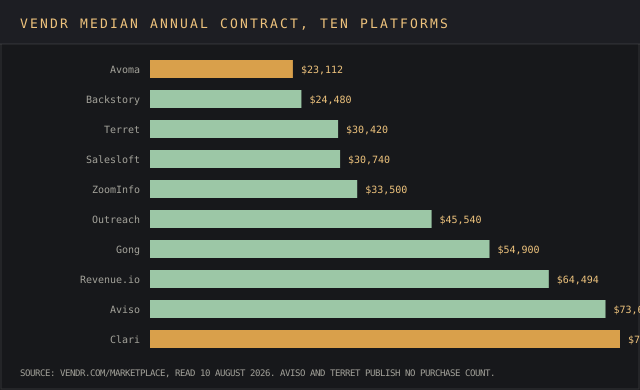
Medians marked * are anonymized buyer-reported contract values published by Vendr. Everything else is the price the vendor publishes itself.
Where these figures come from
Coverage counts are each vendor's own published figure, read on 10 August 2026. Medians marked * are Vendr's anonymized buyer-reported contract values, read on 1 October 2026 from the in-page stat block on each marketplace page, since that block and the header widget disagree on deal counts.
Aviso and Terret publish no purchase count behind their medians, so treat those two figures as less certain than the rest. Neither Clari, Salesloft, Aviso nor Terret publishes a transcription language count, so no row in the table above claims one for them.
Six of the ten platforms ranked here, Gong, Clari, Outreach, Salesloft, ZoomInfo and Aviso, also appear on our sales intelligence platforms ranking. That page judges them as prospecting and engagement tools; this one judges them on conversation capture, forecasting and contract mechanics, which produces a different order. Buy from one framing or the other.
Evaluation criteria for revenue intelligence software
Six criteria decide the shortlist, and the ranking below applies them in this order. Each one is a test a buyer can run before signing, producing a yes, a no, or a number. Vendors describe their revenue intelligence capabilities in near-identical language, so the key metrics below are the ones a vendor publishes and can be held to.
A price or contract median you can check before the demo
Either the vendor publishes per-seat pricing, or Vendr's marketplace page reports a tracked median with a purchase count behind it. Vendr's header widget and its in-page stat block disagree on deal counts for every vendor tested, so the figures used here come from the in-page block, which names the purchase count. A median backed by 1,574 purchases is evidence; a median with no count behind it isn't.
Conversation capture depth
Count the transcription languages the vendor publishes, the meeting platforms it connects to, and if recording needs a bot in the call. Gong publishes 70+ languages. Avoma publishes 70+. Clari, Salesloft, Outreach, Aviso and Terret publish no language count at all, which makes a non-English pilot an unbudgeted risk.
What feeds the forecast model, and if the accuracy claim names a method
Every vendor in this category claims its predictive analytics improve forecasting accuracy, and advertises a number for it. Almost none publishes the sample, the baseline or the measurement window behind it. Outreach claims 81% deal-outcome accuracy, Terret claims 92%+, Aviso claims 98%+. None of the three discloses how it was measured. Treat the named model inputs as the real signal & the percentage as marketing.
Native CRM coverage
Every platform ranked here integrates with Salesforce Sales Cloud. The differences start with the second CRM, so count the ones a vendor supports with a first-party integration. ZoomInfo names Salesforce, HubSpot and Microsoft Dynamics. Mediafly names six. Revenue.io names one: "Revenue.io is built exclusively for Salesforce." That single line disqualifies it for any HubSpot or Dynamics shop, whatever else it does well.
Published platform limits
API call caps, credit metering rules, storage ceilings, seat minimums and seat maximums. These are the numbers that decide if a tool survives contact with a real data volume. Outreach publishes all four by tier. Avoma publishes seat caps of 25, 100 and a 10-seat floor. Seven of the ten publish none of it.
Contract mechanics documented in public
Auto-renewal notice windows, mid-term true-ups, seat overage billing and renewal uplift. Mediafly's master services agreement puts the notice window at 30 days and bills seat overage immediately. Backstory publishes a True Forward mechanic that bills nothing retroactively. Most vendors document none of this until the redline stage, and the cancellation stories in the reviews below all trace back to that gap.
The 10 best revenue intelligence platforms, ranked
Gong
Best fit
revenue teams where what happened on the call is the thing the forecast has to explain.
Gong records, transcribes and scores sales interactions, then builds deal boards and a forecast on top of that record. Its own press office put annual recurring revenue past $500 million on 12 May 2026, growing over 55% year over year, with the customer base passing 5,000 organisations in March 2026.
The forecasting side runs on what Gong describes as 300+ unique signals predicting deal outcomes with 20% more precision than CRM-only algorithms. Gong splits the product into Forecast Essentials (deal boards, AI Deal Reviewer, win/loss insights) and full Forecast, which adds forecast submission, AI Deal Predictor and Forecast Analytics.
Key features
Transcription in 70+ languages across Zoom, Microsoft Teams, Google Meet and Webex
Gong Engage, Forecast, Enable for sales coaching, and the Revenue Graph context layer, sold as separate products
426 listings in the Gong Collective integration directory, covering Salesforce, HubSpot CRM and Microsoft Dynamics
Custom retention and redaction settings, plus bring-your-own-key encryption
ISO/IEC 42001:2023, ISO/IEC 27001:2022, SOC 2 Type 2 and PCI DSS SAQ-D certifications
Published 99.5% uptime, with customer data excluded from generative model training
Pricing
Gong publishes no price. Its pricing page states that licences are priced per user, that a platform fee applies based on the number of users supported, and that integrations are free. Vendr's marketplace page reports a median of $55,346 per year from 1,144 purchases, with a low of $11,491 and a high of $203,767, last updated March 2026.
Pros
Largest published language coverage in the category, tied with Avoma
Integration directory is an order of magnitude deeper than any competitor here
Retention and redaction are configurable by region, role and use case
50% of customers now run more than one Gong product, and AI-powered insights are being used: Gong reports Assistant use growing over 200% year over year
Cons
Platform fee sits on top of per-seat cost and neither figure is published
The Outlook add-on doesn't log emails back to the opportunity
Reviewers report forecast amounts drifting from the CRM figure
"There is a Gong Outlook add-on but it's only good for adding in templates. It does not log the emails coming from Outlook to Gong or the opportunity. You have to manually go into the CRM, find the opp, go through activity and manually associate the email."
Verified account manager in sales at a 201 to 500 employee company, TrustRadius, 30 June 2026.
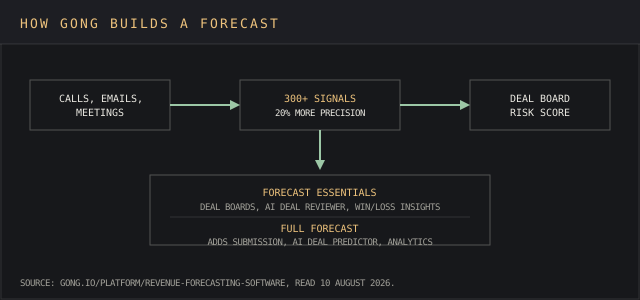
Why it's ranked #1. Gong beats Clari on conversation capture depth, the second criterion: 70+ published transcription languages against zero published by Clari, at a $55,346 median that undercuts Clari's $76,000 by $20,654 a year.
Clari
Best fit
enterprise finance and RevOps teams that own the number going to the board.
Clari started in sales forecasting and bought its way into a revenue orchestration platform. It acquired DealPoint in September 2021 (now Clari Align), Wingman in June 2022 (now Clari Copilot), Groove in August 2023, then completed a merger with Salesloft in December 2025. The platform now runs eight named modules: Capture, Inspect, Groove, Align, Copilot, Forecast, Guide & a set of Revenue AI Agents.
Scale is the argument for Clari at the top of the market. Its 2024 Deloitte Fast 500 release put the platform at 1,500 companies managing more than $4 trillion in revenue, and its Labs benchmarking report analyses 10 million opportunities. That dataset is what the forecast models train against.
Key features
Clari Forecast with week-over-week trend tracking, pipeline management and roll-up submission
Clari Copilot for real-time insights during the call, live battlecards, playbooks and Gametapes
Capture for automated activity capture into Salesforce, HubSpot or Pipedrive
Align for mutual action plans shared with the buying committee
Public APIs and data ingestion documented at developer.clari.com
Native connectors to Gong, Chorus, ZoomInfo, Outreach, Salesloft, Snowflake, Databricks and BigQuery for data analytics teams
Pricing
No published price. The old clari.com/pricing address now redirects to Salesloft's Talk to Sales page, a demo booking form without tiers, prices or fee terms. Vendr reports a median of $76,000 per year across 291 purchases, ranging from $19,065 to $415,001, last updated February 2026. That $76,000 is the highest median of the ten platforms here.
Pros
Forecast, engagement and conversation intelligence on one contract after the Salesloft merger
Largest published opportunity dataset behind the models, at 10 million
Cons
Most expensive median contract in this ranking at $76,000
CRM changes take time to appear in Clari, with users reporting waits of up to 20 minutes
Filter groups are capped at four
Microsoft Dynamics is absent from the published integrations page
"The implementation team behind Clari has been genuinely inefficient. In my opinion, expect to project manage your own implementation and have your requirements misinterpreted leading to incorrect structure."
Verified manager at a 1,001 to 5,000 employee company, rating 4 out of 10, TrustRadius, 27 October 2025. A director in sales at a 501 to 1,000 employee company, reviewing the same product in the same month, wrote: "Forecast accuracy was a prior problem and now we track 5% to forecast each quarter."
Why it's ranked #2. Clari's 10 million opportunity dataset beats Outreach's undisclosed training base on criterion three, and it loses to Gong on criterion two, publishing no transcription language count while charging $20,654 more at the median.
Outreach
Best fit
sales operations teams that want sequences, conversation intelligence and forecasting from one vendor, and that need to know the API ceiling before they build against it.
Outreach moved its whole site from outreach.io to outreach.ai and repackaged into four tiers: Amplify Essentials, Core, Plus and Pro. It's the only vendor in this ranking that publishes hard technical limits per tier. API calls run 250,000 on Essentials and Core, 500,000 on Plus and 1,000,000 on Pro. Custom objects run 5, 5, 10 and 20. Knowledge storage runs 500MB, 500MB, 750MB and 1,500MB.
Pricing combines seats with metered AI credits: 10,000 on Essentials rising to 100,000 on Pro, with an action defined as a single AI task carrying a predictable credit cost. Overage doesn't shut anything off; you buy credit packs. Forecasting, multi-currency and territory management sit on Amplify Pro only, which is the detail that decides the tier for most RevOps buyers.
Key features
Six named agents: Omni, Research, Deal, Revenue, Personalization and Meeting Prep
Forecasting with AI Projection, intraquarter modelling, scenario planner and parallel forecasting
Conversation intelligence across Zoom, Microsoft Teams, Google Meet and Cisco Webex
Outreach MCP server and client included on all four tiers
Line-item forecasting and forecast submission history on Amplify Pro
Pricing
Per-user pricing with no platform fees and support included, per the vendor's own page, but no dollar figure anywhere. Vendr reports a median of $45,600 per year from 917 purchases, with a low of $8,620 and a high of $214,450. Paid add-ons include data sharing, connectors, additional instances and listener licences.
Pros
Only vendor here publishing API call caps, custom object counts and storage per tier
AI credit metering is defined per action
Buying credit packs mid-term keeps the platform running past the cap
Cons
Forecasting is gated to the top tier
Report customisation is set at company level, so users can't reorder their own columns
Multiple reviewers describe auto-renewal enforcement and lost data access after termination
"Outreach terminated my account without any notice, warning, or communication whatsoever — despite the fact that my account was on automatic renewal and had been active for several years. One day I simply could not log in, and when I reached out, I was told the only way to get access back was to buy five licenses I don't need, at a much higher cost."
Robert P., founder and CEO at a company of 50 or fewer employees, 0.5 out of 5, G2, 4 September 2025.
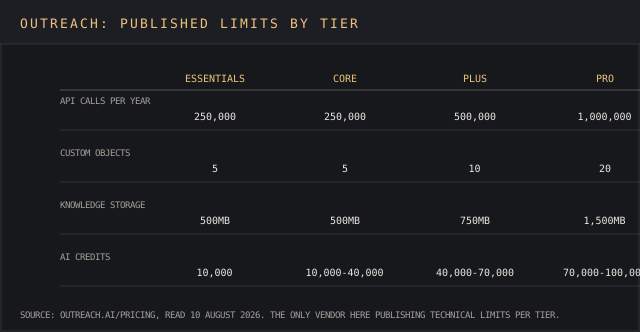
Why it's ranked #3. Outreach beats Salesloft on criterion five with four published limits per tier against Salesloft's zero, and loses to Clari on criterion three: 81% accuracy with no method disclosed, against a 10 million opportunity training set.
Salesloft
Best fit
mid-market teams already running Salesloft Cadence that want conversation intelligence without adding a second vendor.
Salesloft combines conversation intelligence with its engagement platform, which is the whole pitch: "you don't need a separate Conversation Intelligence solution, it's part of our all-in-one platform." The platform covers Cadence, Rhythm, Conversations, Deals, Analytics, Forecast, Chat Agents and an enterprise data platform, serving 4,000+ sales teams.
The AI Forecast Agent is the one place Salesloft names its model inputs. It predicts win probability inside the current quarter from deal size, deal stage and days open, trained on the customer's own historical data. There's no published accuracy percentage anywhere on the site, which is more honest than the alternative and also less useful.
Key features
Conversation intelligence with AI-assisted scorecards sales managers can grade against, summaries, action items and tracker trends
Forecast segmentation, simplified roll-ups & a weekly trend chart
Bi-directional sync with Salesforce, HubSpot and Microsoft Dynamics
Rhythm, which converts buyer signals into a ranked task list for sales reps
Drift, acquired separately, for conversational marketing
Pricing
The salesloft.com/pricing address now redirects to a Talk to Sales booking page without tiers, prices or a seat minimum. Vendr reports a median of $30,740 per year from 708 purchases, low $5,160, high $146,683, with average savings of 18%. The booking page headlines 3x faster ROI, 12+ hours saved per rep each week and 40% more selling activity, with no footnote, sample size or method attached.
Pros
Three natively supported CRMs, matching ZoomInfo and beating Revenue.io's one
Conversation intelligence included in the base platform
Second-lowest median contract of the six enterprise platforms here
Cons
Reviewers describe the forecasting module as buggy enough to trigger a switch
Auto-renewal terms are enforced strictly, per a documented renewal dispute
Call recording quality is rated below Gong by users who ran both
"The call recording feature is really basic. The forecasting module was really buggy for us and it didn't work for us in the long term. It had too many issues, which was one of the reasons we moved away from the platform. The call recording was also underwhelming compared to solutions like Gong."
Liam K., head of commercial operations at a 51 to 1,000 employee company, 2.5 out of 5, G2, 24 April 2026.
Why it's ranked #4. Salesloft's $30,740 median undercuts Outreach by $14,860 and it names its forecast inputs, but it publishes no API cap, no seat minimum and no language count, losing criterion five outright to the tier above.
ZoomInfo Copilot
Best fit
buyers who need contact data and conversation analysis from one vendor, and who will pay in credits.
ZoomInfo sells revenue intelligence as a layer on top of its sales intelligence database, with Chorus as the conversation intelligence module and Copilot as the AI tier above ZoomInfo Professional. The data underneath covers 500M+ professional profiles, 122M+ companies and 135M+ direct dial numbers, with a 60-day average refresh cycle and 15 to 20 million job change events processed monthly.
Chorus itself is backed by 14 technology patents and handles call, meeting and email capture, deal intelligence, relationship management, and competitive and customer feedback analysis. The catch is structural: Chorus is an add-on, and reviewers who ran it against Gong put its data quality second.
Key features
Copilot Advanced and Copilot Enterprise tiers with self-serve free trials
Chorus conversation intelligence, syncing contacts, communications and sales data back to the CRM
Native integrations with Salesforce, HubSpot and Microsoft Dynamics
4,500+ intent topics, with 25 included on Marketing Demand and unlimited on ABM Enterprise, wired to Marketo and Eloqua marketing automation
Website visitor resolution at 50 to 60% in the US
Privacy removal requests processed in 48 to 72 hours
Pricing
Priced on features, licence count and credit usage, where each export costs one credit, if it comes from the platform, the ReachOut extension or an API call. Pre-packaged integrations carry a base cost plus a minimum bulk credit purchase. Vendr reports a median of $33,500 per year across 1,574 purchases, low $7,220, high $155,730, with buyers saving 22% on average, the highest discount rate on this list.
Pros
Only platform here with a self-serve free trial on its paid tiers
1,574 tracked purchases, the deepest procurement dataset of the ten
Contact data and conversation intelligence resolve to the same company record
Cons
Credit metering means an integration can consume budget without a human touching it
Accuracy figures are label-unstable: 96% appears as both an email deliverability rate and a business email hit rate on the same page, with no method published for either
Uptime is stated as both 99% and 99.9%+ on that same page
Chorus users report weaker transcription and reporting than Gong
"Great tool to allow you to engage in a conversation without focusing on note-taking. Having an AI chatbot that could address follow-up questions would keep users on a Chorus platform..."
Verified manager in sales at a 501 to 1,000 employee company, in a review that listed Gong as the alternative considered, TrustRadius, 27 February 2026. Another reviewer, an account manager at a 5,001 to 10,000 employee company, listed "Better data - not as good as Gong" as the product's main con while reporting a 3% close rate improvement.
Why it's ranked #5. ZoomInfo's $33,500 median beats Aviso's $73,662 by more than half, and it loses to Salesloft on criterion three: Chorus is an add-on with no published forecast model inputs, where Salesloft names three.
Aviso
Best fit
forecast-led organisations on Microsoft Dynamics, SAP or Siebel, where Salesforce-first tools don't reach.
Aviso is the only vendor in this ranking that ever attached a method to its accuracy claim, and it did so in 2018. A press release from that year recorded WinScore averaging 92% accuracy, based on hundreds of thousands of deals analysed in Q3, alongside 91% day-one aggregate forecast accuracy across the customer base. The current site advertises 98%+ with a single New Relic case study behind it.
The mechanism is a time-series database that reads the past eight quarters of omnichannel data, with an artificial intelligence layer modelling forward regardless of CRM hierarchy. Aviso serves 450+ revenue teams and names Ivanti and Armis as customers that replaced Clari with it. Two figures on the site conflict: the agent library is described as both 50+ and 130+ agents.
Key features
Bidirectional Salesforce sync plus dedicated support for HubSpot, Dynamics, SAP CRM and Siebel
MIKI, the Machine Intelligent Knowledge Interface, plus HALO and ODYN agent layers
Conversation intelligence, relationship intelligence, coaching, sales analytics & pipeline inspection in one platform
Connections to a CRM and 200+ other revenue apps
ISO 27001, PCI DSS Service Provider Level 1 and SOC 2 Type II
Pricing
No published price; the pricing page is a lead form offering a contract buy-out, white-glove onboarding and free migration. Vendr reports a median of $73,662 per year, low $24,035, high $85,310. That range is the tightest of any enterprise platform here, spanning 3.5x. Clari's spans 21x.
Pros
Broadest non-Salesforce CRM support in the ranking
Only vendor to have published an accuracy figure with a stated sample size, even historically
Documented cases of replacing Clari at Ivanti and Armis
Cons
Second-highest median contract at $73,662, close to Clari's without Clari's scale
Integrations advertised on the site turn out to be custom API builds for some buyers
Uptime published as both 99.5% and 99.99% on different pages
Implementation has overrun the quoted six weeks by months in at least one documented case
"The Salesforce integration has been particularly painful and slow, with contact sync taking about an hour, while a real-time sync has taken several weeks to stand up and is still not live. Despite various integrations mentioned on the Aviso website, most turn out to be custom API builds with no native functionality."
Verified user in computer software, mid-market, 0.0 out of 5, G2, 29 July 2026. The same review states: "We were touted a 6 week implementation during the sales cycle which has overrun by months."
Why it's ranked #6. Aviso wins criterion four outright with five named CRMs, and loses to ZoomInfo on criterion one: a $73,662 median with no purchase count published, against $33,500 backed by 1,574 tracked purchases.
Avoma
Best fit
mid-market teams under 25 seats that want a working price before they book a demo.
Avoma publishes every tier, which no other platform in this ranking does. Recording seats cost $19 per month on Startup, $29 on Organization and $39 on Enterprise, all billed annually, with monthly billing at $29 and $39. Only users who record pay; viewers, commenters and collaborators, customer success and finance included, are free and unlimited. Startup caps at 25 paid seats, Organization at 100, and Enterprise sets a 10-seat floor.
Revenue intelligence is an add-on at $29 per seat per month, covering AI deal risks, a sales methodology tracker, AI win-loss analysis and forecasting. Conversation intelligence is a separate $29 add-on. A ten-seat Organization team wanting both pays $87 per seat per month, or $10,440 a year, against a $55,346 Gong median. The 14-day trial runs the Organization plan with every add-on enabled and takes no card.
Key features
Transcription in 70+ languages, matching Gong's published count
Bot-less native recording and bot-based recording both supported
Native CRM connections to Salesforce, HubSpot, Zoho, Pipedrive and Copper
Dialer integrations with RingCentral, Zoom, Aircall and Kixie
Unlimited transcription minutes and unlimited recording storage on every tier
Pricing
Published, as above. Vendr's tracked median is $23,112 per year, low $12,471, high $35,154, which is what larger Avoma deployments cost once add-ons stack. Pre-recorded file uploads cap at 5, 10 and 20 per user per month by tier.
Pros
Cheapest entry point in the category at $19 per recording seat per month
Free unlimited viewer seats, so managers and finance cost nothing
14-day trial with add-ons, no credit card
Documented migrations from Gong with transcripts and intelligence regenerated
Cons
Integration catalogue is narrower than Gong's 426 listings
Revenue intelligence and conversation intelligence are separate paid add-ons that triple the base seat price
All recording users must sit on the same plan tier
One customer reports being held to 87 seats while using 48
"We are paying for double the amount of seats that we need. We only have 48 active users and are paying for 87. We don't have the headcount that we did at the beginning of the year, which we let them know about, and they signed us up for another year with the same amount of people. We asked multiple times to revisist the contract and renegotiate the user count with them. Multiple times they flat out refused."
Jessica W., IT specialist at a 51 to 1,000 employee company, G2, 30 September 2022. A sales director at a company under 50 employees wrote in August 2024: "Avoma is a more cost effective solution than Gong. That was the main reason for our transition."
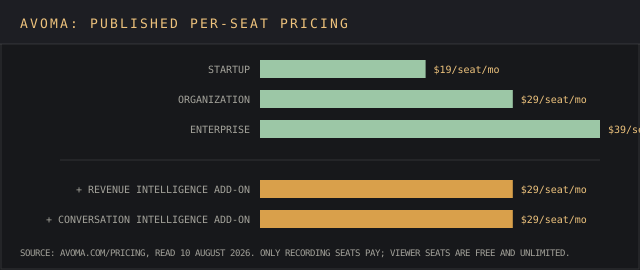
Why it's ranked #7. Avoma wins criterion one outright as the only platform with published per-seat pricing, and loses to Aviso on criterion three: forecasting is a $29 add-on with no published model inputs, against an eight-quarter time-series engine.
Revenue.io
Best fit
Salesforce-only teams of 15 or more seats running high outbound call volume.
Revenue.io, formerly ringDNA, is a dialer that grew a revenue intelligence layer. It publishes three tiers (Activate, Engage, Orchestrate), a 15-seat minimum, and a feature matrix showing exactly what each tier withholds. Transcription, talk metrics, sentiment and AI conversation summaries are all excluded from Activate. Deal health scores, won-loss analysis and the 140+ report revenue intelligence dashboards sit on Orchestrate only.
The constraint is absolute and stated plainly: "Revenue.io is built exclusively for Salesforce." Every user needs a Salesforce licence with API access using the standard Lead and Contact objects. HubSpot appears as a workflow integration, never as a supported CRM, and Dynamics doesn't appear at all. Three patents cover the Moments real-time guidance engine: US 10,440,181, 10,757,256 and 11,212,389.
Key features
Salesforce-native dialer with power, preview and auto dialing, plus local presence in 40+ countries
Moments real-time guidance with battlecards, live listen & whisper
140+ revenue intelligence reports on the Orchestrate tier
Ask Revenue AI, conversation scorecards & deal health scores
SOC 2, HIPAA business associate, GDPR, CCPA, CPRA, TCPA and CASA Tier 2
Pricing
Seat-based and quoted per org, with annual agreements and tiered packaging by feature access, AI capability and usage volume. Vendr reports a median of $64,494 per year, low $16,798, high $393,211, and notes a 2026 document listing Revenue.io Engage at $175 per user per month list price. At the 15-seat floor, that list rate is $31,500 a year.
Pros
Publishes a seat minimum, which only Avoma otherwise does
Tier matrix lists exclusions directly, without a "contact sales" gate
Patent numbers published for the real-time guidance engine
Cons
Salesforce only, which eliminates every HubSpot and Dynamics buyer
Entry tier has no transcription at all
Scale figures conflict: 350M+ conversations processed on one page, 500M+ calls on another
Support is US business hours, a problem for APAC and EMEA reps
"Guided selling was the worst sales engagement tool that I have ever used. Also task management is cumbersome. In other tools I can manage all my tasks in a singular interface, but in Revenue I need to manage salesforce tasks and guided selling tasks separately."
Verified user in information technology and services, mid-market, G2, 13 June 2025.
Why it's ranked #8. Revenue.io publishes a 15-seat floor and a $175 per-user list rate that Terret doesn't match, and it loses to Avoma on criterion four with one supported CRM against five.
Terret, formerly BoostUp
Best fit
RevOps teams replacing the Salesforce forecast tab who want pipeline visibility without a conversation intelligence rebuild.
BoostUp.ai now redirects to terret.ai, though the application still logs in at app.boostup.ai. The product splits into three modules: Terret Nexus, Terret Forecast and Terret Conversation Intelligence. The forecasting page advertises 92%+ forecast accuracy with no sample, baseline or measurement window attached, and its on-screen accuracy figures sit inside a product mockup using placeholder company names.
What Terret does publish is its input list and its connector set. The model reads deal characteristics, rep performance, customer behaviour and market conditions, and the platform connects to Salesforce and HubSpot for CRM, Gong and Chorus for conversation data, Gmail and Outlook for email, and Outreach and Apollo for engagement. Named customers include Carta, Cloudflare, Teradata, Workato and Udemy.
Key features
Terret Forecast with machine learning predictions & board-ready narratives
Terret Nexus, described by the vendor as an answer-to-action revenue engine
Conversation intelligence sourced from Gong or Chorus
A 48-hour proof of concept at no cost, delivering a closed-lost analysis with quotes from real calls
Investors named on site: Canaan, NGP Capital, Emergent Ventures and BGV
Pricing
No pricing page exists; boostup.ai/pricing redirects to the Terret homepage and the only call to action is a demo booking. Vendr reports a median of $30,420 per year, low $23,327, high $80,868. No purchase count appears anywhere on that page, and the 3.5x spread is consistent with a thin sample.
Pros
48-hour proof of concept replaces a trial and produces a real closed-lost analysis
Publishes its forecast model inputs, which Salesloft's peers mostly don't
Users report cutting Salesforce opportunity admin roughly in half
Cons
92%+ accuracy claim carries no method, no sample and no baseline
Vendr publishes no purchase count, so the $30,420 median rests on an unstated sample
No hierarchy forecasting: roll-ups stop at the individual rep, with no region-level view
Two names and two domains in play at once, which complicates procurement paperwork
"The added value is only so so for someone who knows Salesforce well enough. It is very good for managers and makes the pipeline work easier. I use it only once per week for giving the forecast..."
Verified user in computer and network security, enterprise, 3.5 out of 5, G2, 24 October 2024. A mid-market account executive rated it 5.0 in August 2023: "Boostup is very seamless when updating opportunities. There is no / limited need to update from Salesforce. This saves hours per week!"
Why it's ranked #9. Terret's published model inputs and 14 named customers beat Backstory's activity-only capture, and it loses to Revenue.io on criterion one: a $30,420 median with no purchase count behind it against a documented $175 per-user list price.
Backstory, formerly People.ai
Best fit
enterprises that want automated activity capture and deal risk scoring billed to a consumption budget, with no seat count in the price.
People.ai now trades as Backstory, with the legal entity still reading "People.ai, Inc. d/b/a Backstory". It's the only vendor here that publishes a pricing model, and the model runs on two units nobody else here bills against: you pay for the customer-facing people whose emails, calls and CRM data feed the platform, plus the answers your team consumes. Viewers are unlimited and free, there are no feature tiers, and reading a dashboard costs nothing.
The contract mechanic is called True Forward. Consumption is pre-packaged at the start of the term; exceed it and nothing shuts off and nothing gets back-billed, with the adjustment made forward at renewal. Against Mediafly's immediate seat-overage billing and the auto-renewal disputes documented at Outreach and Salesloft, that clause is the strongest contract term published by any vendor in this ranking.
Key features
Salesforce managed package, plus Oracle and Microsoft CRM connections via API
40+ platform integrations, with connections going live in under an hour
Activity capture from Google Workspace, Microsoft 365, Exchange on-premises, Zoom, Webex, Teams, Meet, Gong and Slack
Risk signals generated from conversation content, contact buying power & CRM fields
MCP server supporting Claude, ChatGPT, Microsoft Copilot, Gemini and n8n
SOC 2 Type II, GDPR and SSO/SAML
Pricing
Model published, price not. Vendr reports a median of $24,480 per year across 48 purchases, low $2,000, high $123,336, the cheapest median of the ten. Two anonymised buyer notes on that page record a flat renewal and a preserved 40% discount.
Pros
Lowest tracked median contract in the ranking at $24,480
No seat fees for managers, finance, deal desk or ops
True Forward removes mid-year true-ups from the budget cycle
Two-to-four week go-live, per the vendor
Cons
Captures activity. It doesn't record calls, so a conversation intelligence tool is still required
Doesn't pull activity from LinkedIn or Slack for some buyers, per a documented account-mapping evaluation
48 tracked purchases, the thinnest procurement sample here
Time-spent attribution has produced email figures exceeding a rep's weekly working hours
"People.ai has the ability to do well in the future, and we met with individuals at People.ai a few times to discuss the features and abilities, as we were considering using it for account mapping (an upgrade and a bigger expense for us), but it just lacks so much. For instance, it won't pull activity from LinkedIn and Slack, and we run very heavily on those applications on a daily basis."
Alysha C., director of enterprise client services at a 51 to 1,000 employee company, 3.0 out of 5, G2, 7 March 2023.
Why it's ranked #10. Backstory has the cheapest median at $24,480 and the best-documented contract terms, and it ranks last on criterion two: it ingests conversation data from Gong, so it can't replace a recorder.
What revenue intelligence software does
Revenue intelligence platforms work by sitting between the communication tools a sales team uses and the CRM they're supposed to update. They capture calls, meetings, emails & calendar events automatically, match them to the right account and opportunity, then score the resulting record for risk. The output is a forecast sales leaders can inspect deal by deal, checking the number behind each rep's commit.
Three jobs run underneath that. Automated activity capture removes manual data entry and keeps CRM hygiene from depending on rep discipline, which is where Backstory and Clari Capture concentrate. Conversation intelligence transcribes and analyses what was said, which is Gong's origin and Avoma's whole product. Forecasting models the outcome with predictive models trained on pipeline history, which is where Clari, Aviso and Terret started.
Most vendors now claim all three sets of revenue intelligence features. The published specs say otherwise: Backstory records nothing, Terret sources its conversation data from Gong or Chorus, and Revenue.io's entry tier has transcription switched off. Read the tier matrix.
The reporting layer is where these platforms diverge most. Revenue.io ships 140+ reports, all of them on the Orchestrate tier. Clari builds pipeline analytics around forecast submission and a week-over-week trend chart. Aviso bundles reports and analytics into the same platform as its conversation and relationship intelligence.
Data visualization decides if sales leaders open the tool weekly or once a quarter, and pipeline health is the view most of them open first, with sales trends across the quarter behind it.
Category subtypes and when each one fits
Conversation-first platforms are the right buy when coaching drives performance. Gong, Avoma and ZoomInfo's Chorus module record and analyse the call, and the forecast is built from what the recording revealed. Language coverage decides these deals: 70+ languages published by Gong and Avoma, nothing published by anyone else.
Forecast-first platforms are the right buy when the CRM already holds decent data and the problem is the number. Forecasting capabilities are the product here. Clari, Aviso and Terret model pipeline movement from CRM history plus whatever signals they can ingest, so they analyze data the CRM already holds and data quality issues upstream land straight in the forecast.
Aviso reads eight quarters back; Clari trained against 10 million opportunities.
Engagement-first platforms bolt intelligence onto the sequences and dialers that drive customer engagement. Outreach, Salesloft and Revenue.io fit teams whose sales process runs through the outbound workflow daily, and whose forecasting need is real but secondary. The tell is that Outreach gates forecasting to Amplify Pro and Revenue.io gates deal health scores to Orchestrate.
Where the data comes from and how collection differs
Every platform here reads the CRM, and most read the calendar and mailbox. The split appears at the recording layer. Gong, Avoma, Chorus and Revenue.io capture the call themselves. Avoma is the only one publishing that it supports both bot-based and bot-less recording, which matters where a visible meeting bot changes buyer behaviour or breaches a client's policy.
ZoomInfo adds a third source that nobody else here has: its own contact database, refreshed on a 60-day average cycle with crawlers scanning 10 million pages a day. That resolves an inbound web visitor to a person at 50 to 60% in the US, which is a different job from analysing a call, and it's why ZoomInfo appears on shortlists that started with Gong.
Backstory shows what the pure capture layer looks like on its own. It ingests from Google Workspace, Microsoft 365, Exchange on-premises, Zoom, Webex, Teams, Meet, Gong & Slack, generates risk signals from conversation content and contact buying power, and records nothing. Any dialer that logs to Salesforce with task type "Call" is supported.
What revenue intelligence software costs across the category
Tracked medians run from $23,112 at Avoma to $76,000 at Clari, a 3.3x spread for products that describe themselves in nearly identical language. The full range is wider still: Backstory's tracked purchases run from $2,000 to $123,336, and Revenue.io's from $16,798 to $393,211. A published median tells you where to open. The final price depends on where you land in the range above.
Three cost structures operate here. Per-seat with a platform fee, which is Gong's model and the reason its quoted number surprises buyers. Seat plus metered credits, which is Outreach with its 10,000 to 100,000 AI credits per tier, and ZoomInfo where every export costs one credit including API calls made by an integration. Consumption without seat fees, which so far is only Backstory.
The hidden costs cluster in three places. Add-ons: Avoma's revenue intelligence and conversation intelligence modules cost $29 per seat each, more than the $19 Startup base seat. Integration fees: ZoomInfo's pre-packaged integrations carry a base cost plus a minimum bulk credit purchase. Tier gating: forecasting on Outreach requires Amplify Pro, and transcription on Revenue.io requires Engage.
Discounting is real and documented. Vendr records average savings of 22% on ZoomInfo, 18% on Salesloft, 15% on Backstory and 12% on Outreach. One Backstory buyer kept a 40% discount at renewal with no price increase; a Mediafly buyer turned a proposed 5% uplift into a flat 12-month renewal.
Common mistakes when buying revenue intelligence tools
Buying on a forecast accuracy percentage is the first one. Outreach says 81%, Terret says 92%+, Aviso says 98%+, and none of the three publishes the sample, the baseline or the window. Those numbers can't be compared to each other because they don't measure the same thing. Ask what the model reads instead: Salesloft names deal size, deal stages and days open, and that answer is checkable.
Skipping the contract terms is the second, and it's the one that shows up in reviews as anger. An Outreach customer lost login access and years of sequence history after an auto-renewal dispute. A Salesloft customer describes renewal terms enforced with no flexibility on users or features after a missed reminder email. An Avoma customer is paying for 87 seats while using 48.
Assuming CRM support is the third. Revenue.io requires a Salesforce licence with API access for every user. Clari's published integrations page lists Salesforce, HubSpot and Pipedrive, with Dynamics absent. Aviso maintains dedicated pages for Dynamics, SAP CRM and Siebel, and is the only vendor here that does.
Underestimating the language requirement is the fourth. Only two vendors publish a transcription language count. If the pilot includes a German or Japanese team, raise that on the demo call, before the contract stage.
How to run an evaluation of revenue intelligence platforms
Start with a fixed scenario in units the vendors can all price: a seat count, a monthly call volume, a CRM, and the number of API-driven exports per month. Send the same scenario to every vendor. Because the pricing units differ (seats, credits, connected reps, consumed answers), a shared scenario is the only way the quotes become comparable.
Use the free entry points where they exist. ZoomInfo runs self-serve free trials on Professional, Copilot Advanced and Copilot Enterprise. Avoma gives 14 days on the Organization plan with every add-on enabled and no card. Terret offers a 48-hour proof of concept that returns a closed-lost analysis of last quarter with quotes from real calls. Aviso, Clari, Gong, Outreach, Salesloft, Revenue.io & Backstory offer none.
Run the pilot on one segment, a rep team working existing accounts, and test the two things demos hide. Run a non-English call through the transcriber and read the output. And ask, in writing, for the auto-renewal notice window, the seat overage policy and the renewal uplift cap before the redline stage, since those three clauses produced every cancellation story quoted on this page.
Gong versus Clari
These two are the most-compared pair in the category, and they answer different questions. Gong's record is the conversation: 70+ languages, 300+ signals feeding deal predictions, 426 integration listings. Clari's record is the pipeline: 10 million opportunities in its benchmarking set, forecast submission and roll-up built for a finance function, plus Salesloft's engagement stack after the December 2025 merger.
Cost separates them cleanly. Gong's median is $55,346 across 1,144 tracked purchases, and Clari's is $76,000 across 291. Gong charges a platform fee on top of seats and gives integrations away free, and Clari's old pricing URL now lands on a Salesloft booking form that states no fee terms. Buyers who want the calls to explain the forecast take Gong. Buyers whose CFO owns the forecast submission take Clari.
Outreach versus Salesloft
Both sell sequences plus intelligence, and buyers switch between them in both directions for the same reason: the reporting. A Salesloft user who moved to Outreach cited losing per-user report customisation, since Outreach sets columns at company level. An Outreach user who moved the other way cited the native Salesforce admin experience.
The published numbers favour Outreach on limits and Salesloft on price. Outreach names API caps of 250,000 to 1,000,000 calls, custom object counts, storage ceilings and AI credit allowances per tier. Salesloft names none of those, and comes in $14,860 cheaper at the median, $30,740 against $45,600. Forecasting is included in Salesloft's platform and gated to Outreach's top tier.
Vendor-published outcome metrics and what to measure yourself
Every vendor here publishes a table showing how its platform will improve sales performance, and every one of those tables is customer-self-reported. Salesloft's booking page, where its old pricing URL now lands, headlines 3x faster ROI, 12+ hours saved per rep each week and 40% more selling activity, with no footnote, sample size or method. Clari's August 2023 release states that enterprises running revenue on its platform win 24% more deals.
Aviso's KPI table is the most detailed and the most instructive on where revenue growth comes from. It reports net new revenue per rep rising from $150.8k to $204.8k, win rate from 33.8% to 38.0%, average deal size from $31.8k to $36.9k, sales cycle time falling from 168.6 days to 129.5, and commit accuracy from 75.3% to 80.9%, calculated across customers with at least one year on the platform.
No sample size is given, so the numbers only describe a direction.
Measure four things yourself, starting the quarter before rollout so there's a sales performance baseline. Forecast accuracy against submitted commit, week by week. Win rate on deals that went through coaching against deals that didn't. Sales cycle length, in days from stage two to close. And hours of manual data entry removed, which is the one metric an activity capture platform should move inside a month.
Lower-cost platforms outside the top 10
Revenue Grid publishes three per-user tiers: Activity Capture 360 at $30 per user per month, Knowledge Capture at $49 and Revenue Grid Ultimate at $149. Forecasting, True Pipeline, team analytics, deal guidance and sales cadences all sit on Ultimate. The two cheaper tiers are Salesforce activity capture with an AI-powered chat and search layer over the captured data, so at $30 or $49 there's no forecast to evaluate.
Salesmotion prices a single seat at $85 per month billed monthly with no annual contract, covering 100 monitored accounts, one user, verified emails and direct dials, and round-the-clock buying-signal monitoring. Salesforce and HubSpot connectors, API access and MCP access all require a custom team plan. It watches accounts for signals, which is a different job from every platform ranked above.
Teams running HubSpot Sales Hub as their CRM have three ranked options with native HubSpot support: ZoomInfo, Salesloft and Avoma, at medians of $33,500, $30,740 and $23,112.
Market size and growth rate for revenue intelligence software
The revenue intelligence market reached $3.8 billion in 2024 and is growing at a 34.6% CAGR. Market trends inside the vendor list match that rate: seven acquisitions by Mediafly, a Clari and Salesloft merger, and two rebrands inside twelve months.
Seventy-five percent of companies plan to increase investment in revenue intelligence. Companies implementing revenue intelligence see a 15% increase in sales efficiency, and sales teams report 25% to 50% revenue increases after implementation. Those are category-level figures. They explain why the budget exists; they don't predict what one platform will do to drive revenue growth.
Consolidation in the revenue intelligence market
The vendor list changes faster than the category does. Clari acquired DealPoint in September 2021, Wingman in June 2022 and Groove in August 2023, then merged with Salesloft on 3 December 2025. Mediafly made seven acquisitions in seven years: Alinean, Presentify, InsightSquared, Aptology, ExecVision, Dooly and Appinium, and folded the InsightSquared product into a 360 product family that its own site now redirects away from.
Two of the ten platforms here renamed themselves within the last year. BoostUp became Terret, keeping app.boostup.ai as its login domain. People.ai became Backstory, keeping People.ai, Inc. as the legal entity. Both changes leave procurement records, security reviews and SSO configurations pointing at names that no longer appear on the vendor's website.
Funding tells the same story of a category still being assembled. Clari raised $225 million in January 2022, more than quadrupling its valuation in two years. Mediafly raised $80 million in August 2023 led by BIP Ventures. Aviso's last published raise on its own newsroom is $8 million, in February 2017.
Frequently asked questions
How much does revenue intelligence software cost?
Tracked contract medians run from $23,112 a year at Avoma to $76,000 at Clari. Avoma is the only ranked vendor publishing a per-seat rate, at $19 to $39 per recording seat per month billed annually. Vendr's marketplace records a $55,346 median for Gong across 1,144 purchases and $45,600 for Outreach across 917. Outside the ranking, Revenue Grid publishes $30, $49 and $149 per user per month, and Salesmotion $85 per month for one seat.
What's the difference between revenue intelligence and conversation intelligence?
Conversation intelligence records, transcribes and scores customer calls. Revenue intelligence adds automated activity capture and forecasting on top of that record, so the output is a pipeline number. Avoma prices the two separately, at $29 per seat per month each, which makes the split visible.
Do these platforms work without Salesforce?
Most do. ZoomInfo, Salesloft and Avoma name HubSpot as a native CRM alongside Salesforce, and Aviso maintains dedicated integrations for Microsoft Dynamics, SAP CRM and Siebel. Revenue.io doesn't: it requires a Salesforce licence with API access for every user.
Which revenue intelligence platforms offer a free trial?
ZoomInfo runs self-serve free trials on Professional, Copilot Advanced and Copilot Enterprise. Avoma offers 14 days on the Organization plan with all add-ons enabled and no credit card. Terret's free access is a 48-hour proof of concept. The other seven ranked platforms require a demo call.
How accurate are AI sales forecasts?
Vendor claims range from 81% at Outreach to 98%+ at Aviso, and none of them publishes the sample size, baseline or measurement window. The one historical exception is Aviso's 2018 release, which put WinScore at 92% based on hundreds of thousands of deals analysed in a single quarter. Compare the named model inputs. The percentages carry no published sample size, baseline or method.
Bottom line
Gong takes the top spot on capture depth and integration breadth at a $55,346 median that runs $20,654 under Clari, and it's the right buy where the sales conversation is the thing the forecast has to explain. Clari earns the premium when the CFO owns the forecast submission and the Salesloft engagement stack comes with it.
Below the top two, the choice narrows by constraint. Salesforce-only shops with 15+ seats and heavy call volume should look at Revenue.io. Dynamics, SAP or Siebel shops have one real option in Aviso. Mid-market teams under 25 seats that want a number before a demo call have one real option in Avoma, at $19 per recording seat per month.
For everyone else, the deciding question is which vendor will tell you, in writing, what happens at renewal. Backstory's True Forward clause and Outreach's per-tier API caps are the two most useful things any vendor on this list publishes, and both are worth more at the negotiating table than another accuracy percentage with no method attached.