Bloomberg terminal pricing in 2026: what a single seat costs
 By Jan Suski. I go deep on every review, checking every number against its source and digging up details other coverage misses, a habit from six years of SEO and link building for tech companies. Bylines at Surfer, Brand24, and Senuto. How the scoring works.
· Prefer this source on Google
The numbers Bloomberg terminal pricing, checked 15 August 2026
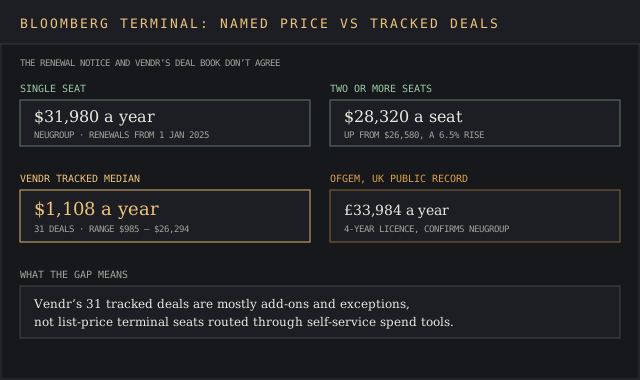
Two named publishers land within about $4,300 of each other on the single-seat renewal, and both sit above $27,000.
The multi-seat rate cuts the marginal seat by roughly 11%, the only volume discount Bloomberg discloses through a named source.
Ofgem's four-year licence is the cleanest independent confirmation available. It comes off an invoice, a record of what the firm paid. A vendor can revise a rate sheet after it leaks; an invoice already issued stays fixed.
Vendr's $1,108 median can't describe a terminal seat, so its 31 tracked purchases are add-ons and exceptions.
Vendr’s tracked contracts put the median Bloomberg deal at $1,108 a year across 31 purchases. That’s 29 times smaller than what a single terminal seat costs. Bloomberg posts no rate card for the terminal on its own site, so the real figure comes from a leaked renewal notice: $31,980 for one seat as of 1 January 2025, or $28,320 once a firm runs two or more terminals.
This page prices the base subscription, the add-ons billed outside the platform fee, what moves a quote, and how the terminal compares against FactSet, Capital IQ and Refinitiv Eikon. It’s built for anyone sizing a first terminal or checking a renewal against what other buyers pay, since the gap between $31,980 and a negotiated multi-seat rate is a hiring decision at most trading desks.
Bloomberg terminal pricing compared to the alternatives
Bloomberg is the most expensive seat in its category. It can cost an arm and a leg, and every named competitor undercuts it. The table below is what a procurement team brings to a renewal call.
| Platform | Reported annual cost | Where the figure comes from |
|---|---|---|
| Bloomberg terminal | $31,980 single seat; $28,320 a seat at two or more | Renewal rate sheet reported by NeuGroup, 9 Oct 2024 |
| FactSet | $25,160 median*, range $4,200 to $28,179 | Vendr tracked contracts |
| Refinitiv Eikon (LSEG) | No rate card; $22,000 to $24,000 a user† | Vendr |
| S&P Capital IQ | No rate card; $10,000 to $15,000 a user† | Vendr |
| Godel Terminal | $996 a year | Vendor's own pricing page |
Prices marked * are Vendr median annual contract values from anonymized buyer data. They aren't vendor list prices. Figures marked † are Vendr's own editorial bands written into its page body; on other vendor pages those bands contradict the tracked figures printed directly above them, so read them as a range and not as a quote.
FactSet leans on its analytics and risk tooling; S&P's edge is company financials and credit ratings. Both price across multiple asset classes, and neither matches Bloomberg's depth in fixed income.
The gap isn't close. A desk buying Bloomberg for intraday pricing and its counterparty network pays for functionality Capital IQ and Eikon don't replace. A research team that never trades in real time is the likelier candidate to skip the terminal and run its financial market intelligence work on a cheaper platform.
Godel Terminal markets its $996 rate as 32 times cheaper than Bloomberg's renewal. It carries neither the trading network nor the counterparty reach that number is buying at the top of the market.
Buyers name the cheaper options directly, calling a spade a spade about the price. A verified enterprise reviewer in financial services listed the whole con as "Too expensive, cheaper alternatives are available eg Koyfin" in a G2 review dated 25 January 2024.
How much does a Bloomberg terminal cost
NeuGroup's 9 October 2024 report described the notice Bloomberg sent corporate treasury clients: a terminal would renew at $31,980 a year from 1 January 2025, with firms holding two or more terminals paying $28,320 each. Bloomberg attributed the rise from the prior $26,580 rate to weighted global inflation.
That's a 6.5% jump on the two-plus-seat rate. Trackers put Bloomberg's typical annual increase at 2 to 3%, so the 2025 cycle ran roughly double the usual step.
Ofgem, the UK energy regulator, discloses its terminal spend through a public contracts notice: £135,936 over four years, or £33,984 a year. Converted, that lands within a few hundred dollars of NeuGroup's figure. It's the strongest independent check available: an award record reflects actual spend awarded through a public contracting process. A vendor rate sheet reflects only the asking price.
Wall Street Prep cites a lower figure, $27,660 a year for a single seat. The two readings disagree by about $4,300 and neither source explains the gap, and the jury's still out on why.
Bloomberg's own domain publishes nothing. The Bloomberg Terminal product page takes a demo request and returns a quote by phone. Bloomberg Professional Services, the group subscription for teams needing shared or customized data access, runs through the same custom-quote process.
What the base subscription includes
One account covers ground most desks would otherwise buy from three vendors. The breadth is the argument for the price, and our Bloomberg review walks the modules one at a time.
Market data and asset class coverage
A terminal account carries real time market data across equities, fixed income, commodities and currencies, plus company fundamentals and credit ratings. It streams from more than 350 exchanges worldwide.
The command system carries thousands of function shortcuts built up over four decades. That's one reason moving a desk off Bloomberg costs more than learning a new interface.
Bloomberg Intelligence and BVAL
Bloomberg Intelligence employs more than 350 research professionals layering proprietary research over the raw feed, leaving no stone unturned. BVAL, the evaluated pricing service, prices about 2.7 million fixed income securities, refreshed as often as every 15 seconds on the most liquid names.
Neither has a clean substitute at a lower price. That's the part of the bundle a cheaper financial data provider struggles to answer.
Instant Bloomberg and the messaging network
IB Chat connects a network Bloomberg describes as more than 350,000 decision-makers. A separate 2022 disclosure counted about 325,000 dedicated terminal accounts.
Desks that trade with each other stay on Bloomberg because the counterparty is already there. No competitor sells that, at any price.
ASKB, BQuant and portfolio tools
Two newer layers ship inside the same subscription:
- ASKB, a conversational layer sitting on top of the existing command system, so a user can query the terminal in plain language without memorizing a mnemonic.
- BQuant Desktop, a coding environment for building custom analytics without leaving the terminal.
Portfolio management, portfolio analytics, charting, screening and options analytics round out what most asset managers touch daily, the whole nine yards of it. All of it is bundled; none of it is a separate SKU. ESG Scores on more than 12,000 companies ship inside the same subscription too, and our ESG data providers ranking puts Bloomberg fifth of the ten it compares.
Bloomberg Anywhere and mobile access
The Bloomberg Professional App and Bloomberg Anywhere, a cloud service, reach the same account from a phone or an unfamiliar machine. Neither needs a second licence. They extend the terminal access a firm already pays for, which matters for a trader who needs real time market intelligence away from the desk hardware.
Costs priced outside the subscription
Three charges sit off the headline renewal number, and none of them appears until a firm asks.
Setup and installation
New installations carry a one-time fee of $500 to $1,500 per terminal by Vendr's account, covering hardware delivery and configuration. Firms buying several terminals at once can negotiate it down or have it waived.
The Bloomberg keyboard and hardware upkeep
Every terminal ships with a proprietary Bloomberg keyboard and a biometric fingerprint scanner for login. Vendr lists that hardware separately from the software subscription:
- Replacement keyboards, extra monitors and fingerprint readers, budgeted at roughly $200 to $500 a year per terminal.
- Hardware delivery and reconfiguration when a seat moves desks or offices.
Enterprise data feeds and API access
Reading Bloomberg data off the screen is covered by the base subscription. Redistributing it internally, or piping it into a trading system or a risk model, needs a separate licence. Vendr estimates $10,000 to $100,000-plus a year depending on scope and user count.
Programmatic retrieval through the API carries its own charge on top. Vendr's guidance is to iron out the details and bundle feeds and seats into one negotiation, since piecemeal purchases price out higher.
Firms that name the specific feeds they need during the sales call, ahead of signing, get a more accurate quote. Bloomberg doesn't price a feed until it knows which one.
A user holding both a terminal and a FactSet subscription described the gap on Hacker News on 25 February 2021:
"Interestingly enough, as someone with both Bloomberg terminal and FactSet subscriptions, I still don't have real-time market data for most asset classes and securities. Those are actually add-on costs that I don't need for my research (I'm not a trader)."
Commenter z2, Hacker News, 25 February 2021. Real time coverage on the seat is not automatically the full real time feed.
What drives a Bloomberg quote
Two levers move the per-seat number and everything else is noise. Seat count sets the tier; term length shaves a few points off whichever tier a firm lands in.
| Lever | Band | Effect on the per-seat price |
|---|---|---|
| One terminal | Single seat | $31,980, full list, no volume consideration |
| Two or more terminals | Named renewal rate | $28,320 a seat, about 11% off list |
| 25 to 100 terminals | Estimate† | $20,000 to $23,000 a terminal |
| Over 100 terminals | Estimate† | $18,000 to $22,000 a terminal |
| Two-year term | Negotiation data | 3 to 5% below the annual rate |
| Three-year term | Negotiation data | 5 to 8% below the annual rate |
The single-seat and two-plus-seat figures are Bloomberg's own renewal rates as reported by NeuGroup. Rows marked † are Vendr's editorial estimates, written directly into its page body. They don't come from a tracked contract value, and on other vendor pages those same estimate bands contradict the tracked figures printed above them.
Terminal count
Volume is the baseline. A single terminal pays list with no consideration, and Vendr reports discounts opening at five terminals with deeper tiers at 10, 25, 50 and 100-plus. A mid-size hedge fund negotiating five to twenty-five seats lands in the second band of that ladder.
Users describe the same structure from inside it. A venture capital associate posting as mb666 gave the thread's top-voted answer on Wall Street Oasis:
"When you work at a large firm the company gets a discount (depending on # of terminals and contract term... usually 2+ years). Unless you are super wealthy it is obviously not worth it as a retail investor. You can usually get a free trial for a month."
mb666, Wall Street Oasis, thread dated 16 July 2013. The seat-count and multi-year structure he describes still matches Vendr's current negotiation data.
Contract length
Two-year commitments run 3 to 5% below the annual rate and three-year terms run 5 to 8% below it. Bloomberg's early termination penalties, which Vendr puts at 50 to 100% of remaining contract value, turn a multi-year term into real financial exposure if a firm exits early.
Geography and firm type
Location matters less than volume. Vendr describes standard pricing in New York, London and Hong Kong against adjusted pricing in some emerging markets.
Buy-side and sell-side firms negotiate through different channels, and neither gets a published discount schedule. Bloomberg builds its offering around access level and user type. That's a different sorting logic than conventional software tiers, so two firms of similar size can hold different contracts for what looks like the same access.
Who a Bloomberg terminal is priced for
A Wall Street Oasis poster ranked Senior Baboon hit the nail on the head, compressing the whole answer into nine words: "It's worth it. Just not for the little guy."
Investment banks and asset managers
Large institutions run enterprise agreements covering dozens or hundreds of terminals, negotiated directly. At that scale the terminal is a fixed cost of running a trading desk. The negotiation covers the multi-seat discount and the contract length; buying at all was settled years ago.
Portfolio managers and treasury teams inside those firms are the primary users, and the counterparty messaging network is built around exactly this group.
Equity analysts and smaller firms
An analyst running financial analysis still needs company fundamentals and coverage across several asset classes. A boutique weighing one terminal against a FactSet seat is comparing $31,980 against $25,160 for overlapping analytics.
Smaller shops are the segment most likely to cut their losses and negotiate down to a single terminal, or to skip Bloomberg's trading tools for a research-only platform. AlphaSense and GlobalData both compete for that seat.
Individual investors and financial advisors
Anyone outside an institutional desk is priced out. Bloomberg's academic track exists for university finance programs. It's a separate subsidized product line built for classrooms; a retail user has no discounted path into the terminal at all.
Its 3.2-of-5 value-for-money score on GetApp is the lowest sub-score the product carries anywhere, and the people leaving it are the ones nearest that line.
A fund analyst in banking, reviewing on Capterra on 11 November 2025, put the objection plainly:
"Two areas where I believe Bloomberg has cons is firstly the price. Depending on how many are purchased the price can be north of £30,000 which is extortionate and unreasonable for small businesses. I also felt that the software was difficult to use at first making progress initially very slow."
Verified reviewer, fund analyst in banking, Capterra, 11 November 2025.
A portfolio manager in financial services, reviewing on Capterra six days later, landed on the same tension without resolving it, caught between a rock and a hard place: "We must say it, price is a big handicap. For a small company as ours, having a tool as Bloomberg Terminal is a MUST, but price is a big burden."
How to negotiate Bloomberg terminal pricing
Time a seat increase to land inside a renewal
Volume is the one lever that moves the price. Adding terminals, even a step from eight to ten, can trigger a better tier. A firm planning to expand a desk should fold that expansion into the renewal conversation. A mid-contract purchase misses the tier discount tied to that timing.
Trade term length for a discount
Multi-year commitments buy 3 to 8% depending on term. Vendr identifies Bloomberg's fourth quarter, October through December, as the most favorable window, tied to sales teams working year-end targets.
Bring a named competitor. Refinitiv Eikon and FactSet both price below Bloomberg, and a procurement team with a real quote in hand has something to point at.
Assume the published figure is a ceiling. A commenter posting as dan-robertson wrote on Hacker News on 21 July 2022:
"One more thing is that the sticker price may not be what people are paying: they may pay a lot more for live market data, and they may get various negotiated discounts too."
dan-robertson, Hacker News, 21 July 2022. The same comment names the roughly $24,000-a-year complaint from firms whose main use of the terminal is the chat.
Match the access level to the seat
This is the cheapest lever available and the one most firms skip. Not every seat needs the trading tools. A communications or corporate-development employee who reads Bloomberg News and pulls the occasional company snapshot doesn't need real time market data, and moving that seat off the full terminal frees budget for the desks that trade.
Is a Bloomberg terminal worth the cost
For a desk pricing fixed income or equities in real time, there's no full substitute at any price. BVAL's evaluated pricing, the depth of Bloomberg's fixed income coverage and the IB Chat network aren't things a cheaper platform reproduces.
For a research or analytics role that never trades, $31,980 is a harder number to defend against a FactSet seat covering most of the same ground for $6,820 less at the tracked median. That's the whole decision. Bite the bullet on the terminal, or bank the difference with FactSet.
The people who keep renewing describe it as a question they answer every budget cycle. A commenter posting as qsi wrote on Hacker News on 1 April 2022:
"It is expensive. Many competitors have come and gone, and the closest thing now is I think Eikon, which also have installed to access the old Datastream data, and it's a complex monstrosity. FactSet is another one but I haven't used it in a long time. Every time cost-cutting time comes, one of the first questions is, 'Do you really need Bloomberg?' Well, yes, I do."
Commenter qsi, Hacker News, 1 April 2022. Single quotation marks inside the quote are the commenter's own.
What to budget
Build the number in four parts, in this order:
- The base subscription: $31,980 for one seat, or $28,320 a seat from two up.
- Setup, $500 to $1,500 per terminal on a new installation.
- Hardware upkeep, $200 to $500 a year per terminal.
- Any enterprise data licence, from $10,000 upward, plus API charges where a system pulls the feed directly.
A single new terminal with hardware and setup lands near $33,000 in year one and near $32,300 after that. Two terminals land near $58,000 a year at the multi-seat rate before add-ons. Neither figure includes a data licence, which is where a quote stops being predictable, and money doesn't grow on trees once that line item lands.
A firm comparing that against a broader shortlist should read the wider market intelligence platform pricing picture and the alternative data providers ranking, since the terminal competes with both categories at different seats.
Frequently asked questions
How much does Bloomberg cost per month?
Dividing the $31,980 annual single-seat renewal by twelve works out to about $2,665 a month. Bloomberg has no true month-to-month plan; it bills annually or quarterly in advance.
How much does a Bloomberg terminal cost for an individual?
The same $31,980 rate applies to a one-person shop and to a line item inside a bank's enterprise agreement. A single terminal receives no volume discount, and the two-plus-seat rate of $28,320 only opens at the second seat.
Is there a cheaper version of the Bloomberg terminal?
Bloomberg publishes no discounted professional tier. The closest thing is its academic track for university finance programs, a separate product built for classroom use. It's not a stripped-down version of the trading terminal at all.
Can I get the Bloomberg terminal for free?
Bloomberg occasionally offers qualified prospects a limited trial, typically one to two weeks according to Vendr, with access granted for the trial window only. There is no ongoing free tier of the terminal itself.
What is a cheaper alternative to Bloomberg terminal?
Capital IQ and Refinitiv Eikon both undercut Bloomberg, and FactSet's tracked median of $25,160 a year runs below the $31,980 renewal for firms that don't need the trading and messaging functionality. Godel Terminal advertises $996 a year, without Bloomberg's counterparty network behind it.
Why is a Bloomberg terminal so expensive?
Two things carry the price: BVAL's evaluated pricing across about 2.7 million fixed income securities, and the IB Chat network Bloomberg puts at more than 350,000 decision-makers. A buyer leaving the terminal loses reach to counterparties who never left, burning bridges the terminal itself won't rebuild, which is why the 6.5% renewal increase for 2025 met so little resistance.
Bottom line
A single terminal renews at $31,980 a year under the rate NeuGroup reported, dropping to $28,320 a seat at two or more, and Ofgem's own contract record corroborates the order of magnitude from the buyer's side. Vendr's tracked median sits so far below both that it can only be describing something other than a terminal seat.
Budget the subscription first, then setup, hardware upkeep and any enterprise data licence separately, because none of those appear in the headline number. Confirm what real time data access each seat includes before signing; access-level mismatch is the most common way a firm overpays without negotiating badly, and the devil's in the details on this one.
For a desk that trades, Bloomberg has no full substitute regardless of price. For a research seat that doesn't, FactSet and Refinitiv Eikon are the comparisons worth running before a renewal goes through at list, and the head-to-head on FactSet versus Bloomberg is where that decision gets settled.
Sources, and the figure Bloomberg has never put in writing
Renewal pricing is read from NeuGroup's 9 October 2024 report at connect.neugroup.com, describing the notice Bloomberg sent corporate treasury clients. The competing single-seat figure is from wallstreetprep.com. The UK public-sector figure is a contracts notice on contractsfinder.service.gov.uk recording a four-year Ofgem licence at £135,936; the £33,984 annual figure is that total divided by four. The notice lists only the four-year total.
Tracked contract values, discount tiers, termination penalties, setup fees and hardware estimates are from vendr.com/marketplace/bloomberg, with FactSet, Refinitiv and S&P Global figures from the matching Vendr pages. Product and coverage detail is from bloomberg.com/professional. The value-for-money sub-score is from getapp.com. Godel Terminal's rate is from godelterminal.com/pricing.
User quotes are from capterra.com and g2.com review pages, the Wall Street Oasis thread "Why the f*** is Bloomberg subscription so expensive," and three Hacker News comment threads, each attributed inline with its platform and date. All figures checked 15 August 2026.
Bloomberg publishes no rate card, no discount schedule, no per-tier feature split and no termination terms on any page it controls. Every price on this report comes from a buyer, a regulator or a tracker, which is the whole reason the two published single-seat readings differ by about $4,300 and nobody can settle it.