Financial data providers: 9 vendors ranked for 2026
 By Jan Suski. I go deep on every review, checking every number against its source and digging up details other coverage misses, a habit from six years of SEO and link building for tech companies. Bylines at Surfer, Brand24, and Senuto. How the scoring works.
· Prefer this source on Google
Quick comparison of financial data providers
Every vendor here quotes per deal except Financial Modeling Prep and Bright Data, and exchange fees pass through on top of any market data quote.
| # | Provider | Strongest coverage | Owner | Delivery method | Pricing |
|---|---|---|---|---|---|
| 1 | LSEG | Real time market data across every asset class | Public (LON: LSEG) | Terminal, feeds, API | Quoted, per seat and per feed |
| 2 | Bloomberg | Terminal workflow, fixed income, news | Private, 88% Michael Bloomberg | Terminal, B-PIPE feed | Quoted, roughly $30,000 a seat |
| 3 | Financial Modeling Prep | US fundamentals and stock prices through a self-serve API | Private, Utradea Inc. | REST API, WebSocket, Sheets add-on, MCP | Free, then $19 to $99 a month |
| 4 | S&P Global Market Intelligence | Company fundamentals and credit ratings | Public (NYSE: SPGI) | Platform, feeds, API | Quoted, by dataset |
| 5 | FactSet | Analyst workflow and aggregated datasets | Public (NYSE: FDS) | Workstation, API, feeds | Quoted, per seat |
| 6 | Moody's Analytics | Credit risk and entity reference data | Public (NYSE: MCO) | Platform and feeds | Quoted, by module |
| 7 | MSCI | Indexes, benchmarks and risk models | Public (NYSE: MSCI) | Platform and data feeds | Quoted, index licensing separate |
| 8 | AlphaSense | Search across filings, transcripts and research | Private, $4B valuation | Platform | From around $24,000 a year per user |
| 9 | Bright Data | Web-collected financial datasets | EMK Capital | Datasets and scrapers | From $250 per 100,000 records |
Financial data providers sell four different things under one label. Real time quotes and pricing data for traders. Company fundamentals and regulatory filings for analysts. Reference data on securities and entities for operations. Alternative data for anyone hunting an edge before disclosure.
Most buyers arrive wanting one of the four and get quoted for a bundle. A Bloomberg Terminal seat and a fundamental data API solve different problems at prices two orders of magnitude apart, and the gap between them is what this ranking exists to map.
Nine financial data vendors are ranked below on coverage depth, delivery method, and how much the licence lets you do with the data. Reliability matters more than breadth here: a feed dropping during a volatile open is the costly failure mode to watch for.
Ownership sits behind most of the pricing power in this market. Six of the nine are public companies or divisions of one, Bloomberg is 88% owned by its founder, and LSEG's position rests on a $27 billion acquisition completed in 2021. Ownership, funding and pricing were verified on 27 July 2026.
How to compare financial data vendors
Latency against what you need
Lower latency costs more at every step, and most buyers pay for speed they never use. A microsecond-grade feed can cost an arm and a leg for a desk that only checks prices once an hour.
An algorithmic trading desk needs a direct feed measured in microseconds. A research team building models on historical market data can work from end-of-day files at a fraction of the price. Timeliness is what active traders are paying the premium for, and it stops mattering the moment your holding period is measured in quarters.
Data quality, reliability and corrections
Every provider restates. What separates them is how corrections reach you: a silent overwrite, a versioned record, or a notification. A backtest run against silently corrected data produces results nobody can reproduce. Ask about uptime on the feed as well, since reliability during a volatile session is when the financial markets test a vendor.
Errors here lead to real financial losses, which is why the better vendors run automated quality control that detects anomalies in real time and publishes standardized data formats across every product. The firms worth paying for are distinguished by automated data validation and low error rates, and they invest heavily in collection and quality assurance. Routine validation on your side mitigates the rest.
Compliance with GDPR and equivalent regimes is table stakes for any provider handling entity data.
Where AI changes the quality question
AI has moved from a feature claim to a processing layer in this market. Models analyse volumes of financial data no review team could read, extract figures from complex regulatory filings, and flag anomalies against expected ranges before the data reaches a customer, nipping problems in the bud before they cost a trading desk real money.
The measurable version of that shows up at the specialist end. Daloopa reports 94.2% accuracy extracting fundamentals from filings and a 50% cut in analyst model-building time. In compliance workflows the same techniques improve detection accuracy and reduce false positives, which is where the operational saving lands for a regulated buyer.
Data formats and integration
How data products reach you decides who can use them. Terminal access suits a person who reads. Feeds and APIs suit a system that has to access data on a schedule. Financial datasets delivered as flat files suit a warehouse. Paying terminal prices for data your code consumes is the most expensive mistake in this market, and it is common.
Licence scope
Financial data licences restrict redistribution, display and derived works more tightly than any other data category. Confirm what you may show clients, publish, or feed into a model before you compare price. Firms across the financial sector routinely discover the restriction after signing, since the same data costs several times more when the licence permits downstream use.
Coverage against the assets you hold
Coverage decides most shortlists before price does. A provider strong in US equities can be thin in emerging market fixed income or physical commodities, and the gap only shows up once a position moves. A vendor's coverage page rarely states the gaps outright, so reading between the lines of what it does not mention is the only way to catch a thin spot before it costs you.
Coverage also decides what analysis you can run: fundamental analysis needs deep company financials and history, technical analysis needs clean price series and historical charts, and few providers lead on both.
The four types of financial data provider
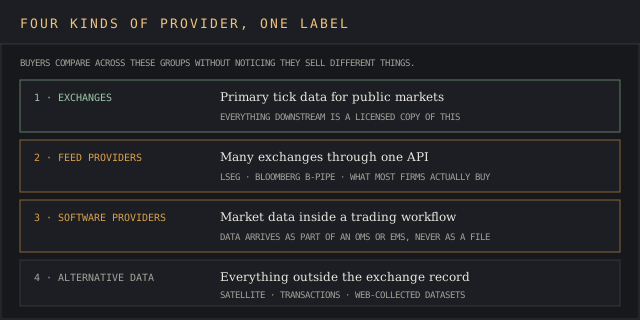
The market divides into four groups that sell different things, and buyers often compare across groups without noticing.
Exchanges. supply primary tick data for public markets. Everything downstream is a copy of this, licensed and redistributed, which is why exchange fees appear on nearly every quote.
Feed providers. aggregate many exchanges and deliver market data through a single API. This is what most firms buy, since integrating forty exchange connections directly is a project nobody wants.
Software providers. deliver market data for display trading, packaging feeds inside an order management or execution system. The data arrives as part of a workflow.
Alternative data vendors. sell everything outside the exchange record: satellite imagery, transactions, web-collected datasets.
Top financial data providers, ranked
LSEG
Best fit: institutions needing broad real time market data across equities, fixed income, FX and commodities.
LSEG, which absorbed the Refinitiv business built from Thomson Reuters, runs one of the two reference market data platforms. Workspace is the terminal; the feeds behind it are the product most firms buy, and running both under one roof gives a buyer the best of both worlds: a screen for the desk and a pipe for the systems.
The data business arrived by acquisition. LSEG completed its $27 billion all-share purchase of Refinitiv on 28 January 2021 from a consortium led by Blackstone, alongside Canada Pension Plan Investment Board and GIC, and from Thomson Reuters. Refinitiv's shareholders took roughly 37% of LSEG's economic interest and under 30% of voting rights, which makes the sellers a lasting presence on the register.
Key features
Real time quotes across global exchanges. Historical data archives spanning decades. Fixed income and FX depth few rivals match. Reference data on entities and securities. Delivery by terminal, streaming feed, API and file.
Pricing
Quoted, priced per seat for Workspace and per feed for data access. Exchange fees pass through separately.
Pros
Widest asset class coverage in the market. Delivery options for both people and systems. Reference data quality that operations teams depend on.
Cons
Enterprise contracting and long procurement. Exchange fees make the total hard to model up front. Interface trails Bloomberg on trader workflow.
Why it's ranked #1. Broadest coverage with the most delivery flexibility, which suits more of the market than any rival.
Bloomberg
Best fit: traders and investment bankers who live in the workflow.
The Bloomberg Terminal is a workflow product with data underneath, and the messaging network is a real part of what firms pay for; a seat buys the whole nine yards: screen, data and network bundled into one price.
Bloomberg L.P. has stayed private since Michael Bloomberg founded it in 1981, and he holds roughly 88% of it. Merrill Lynch took 30% at the outset and sold its remaining 20% back in 2008 for a reported $4.43 billion. The company runs more than 325,000 Terminal subscriptions as of 2026, and published revenue estimates vary widely, from about $11 billion to $15 billion depending on the source, none of them confirmed by the company.
Key features
More than 100 billion data points published daily across over 8,000 enterprise datasets. Real time data and analytics across asset classes. Fixed income depth widely treated as the market reference. News and research integrated into the terminal. B-PIPE feed for systematic consumption. The messaging layer connecting the buy and sell side.
Pricing
Quoted, with terminal seats running roughly $30,000 a year each.
Pros
Fixed income and commodities data traders trust without checking. Workflow and messaging create genuine switching costs. Support responsiveness is a real differentiator.
Cons
Per-seat pricing punishes wide deployment. Data extraction is deliberately constrained. Little value for a team that only needs files.
Why it's ranked #2. Unmatched inside its workflow, and it ranks below LSEG because that workflow is also the constraint.
Financial Modeling Prep
Best fit: developers, analysts and small fintech teams that need US fundamentals and stock prices through an API on a monthly budget.
Financial Modeling Prep sells a REST API covering 70,000+ securities and 30+ years of daily prices, run by Utradea Inc. It is the cheapest way into this ranking: a free tier, then $19 a month.
Key features
Income statements, balance sheets and cash flow statements sourced from SEC EDGAR. Quotes, analyst estimates, earnings calendars and DCF valuations. Earnings call transcripts and 13F holdings on the Ultimate plan. A no-code API Viewer and a Sheets and Excel add-on.
MCP server
FMP's MCP server turns the REST API into 27 tools that Claude, Cursor and other AI clients call directly, and it runs on the free key. In our test, all three of FMP's starter prompts returned data on a free account, including Amazon's revenue by segment back to 2011. That's more tools than FactSet's MCP server at 24 and AlphaSense's at 2, with no seat contract to sign first.
Pricing
Free for 250 calls a day. $19, $49 and $99 a month billed annually for US, US plus UK and Canada, and global coverage. Displaying the data in a product needs a separate, quoted licence.
Pros
A free key returned five years of Apple's financials matching Apple's own release in our test. Every self-serve price is public. Its data also reaches ChatGPT for Financial Services.
Cons
A non-operating income field in Apple's data carried the wrong sign in both years we checked. All sales are final, and 23% of its 98 Trustpilot reviews are one-star. The self-serve plans carry a personal-use licence.
Why it's ranked #3. The cheapest provider here to test and run, at $0 and then $19 a month, and it sits below LSEG and Bloomberg because its data needs a validation layer before anything gets published.
S&P Global Market Intelligence
Best fit: analysts working on company fundamentals, credit ratings and private company coverage.
S&P Global sells fundamental data and credit ratings alongside a research platform, with Capital IQ as the analyst-facing product. It is known across the market for credit ratings and risk analytics, and trades on the NYSE under SPGI.
Key features
Company fundamentals with deep historical data. Credit ratings and research from the ratings business. Private company financial information and ownership. Sector datasets across commodities and energy. Feeds and API for systematic access.
Pricing
Quoted by dataset and seat count. Ratings data licenses separately from fundamentals.
Pros
Fundamentals depth on both public and private companies. Ratings integration no independent vendor can replicate. Strong sector coverage outside equities.
Cons
Product line is fragmented across brands. Pricing complexity slows evaluation, and buyers need to iron out the details of which dataset sits under which brand before a quote makes sense. Real time market data is weaker than the top two.
Why it's ranked #4. The best fundamental data on this list, ranked here because it is narrower than a full market data platform.
FactSet
Best fit: research teams that want aggregated data from many sources inside one analyst workflow.
FactSet aggregates third-party content alongside its own and packages it for the analyst. It is used mainly for equity research and portfolio analysis, and trades on the NYSE under FDS.
Key features
Aggregated company fundamentals and estimates. Portfolio analytics and ownership data. More than 60 alternative data sources available through the platform. Excel and API integration analysts use daily. Supply chain and relationship datasets.
Pricing
Quoted per seat, typically annual.
Pros
Aggregation saves buying five feeds separately, and FactSet plays jack of all trades among the vendors here, aggregating company fundamentals, alternative data and portfolio analytics under a single login and avoiding five separate ones. Excel integration matches how analysts work. Alternative data access without separate contracts.
Cons
Aggregated data inherits the errors of its sources. Per-seat cost adds up on large teams. Thinner on real time data than LSEG or Bloomberg.
Why it's ranked #5. Strong analyst workflow, and it also appears in our alternative data providers ranking scored against a different job.
Moody's Analytics
Best fit: risk and credit teams needing entity reference data with ratings attached.
Moody's sells credit risk models, entity data and the ratings the market prices against, and trades on the NYSE under MCO.
Key features
Credit ratings and rating actions across issuers. Entity reference data with ownership hierarchies. Probability of default models. Commercial real estate data through the former Reis business. Regulatory reporting datasets for financial institutions.
Pricing
Quoted by module and entity coverage.
Pros
Ratings and risk models regulators and counterparties accept. Entity hierarchies that resolve corporate structures cleanly. Deep coverage of credit-specific fields.
Cons
Narrow outside credit and risk. Little use for equity research or trading. Module pricing obscures the total.
Why it's ranked #6. Definitive in credit, and irrelevant to a buyer who needs anything else.
MSCI
Best fit: asset managers benchmarking portfolios against the indexes their mandates reference.
MSCI publishes the indexes much of the asset management industry is measured against, and sells the risk models that sit alongside them. It trades on the NYSE under MSCI.
Key features
Global equity and fixed income indexes. Risk and portfolio analytics through Barra models. ESG ratings and climate data, covered against nine other raters in our ESG data providers ranking. Private asset benchmarks through the Real Assets business, built out with the $697 million Burgiss acquisition. Data feeds for systematic consumption.
Pricing
Quoted, with index licensing priced separately from analytics.
Pros
Index data mandates are written against. Risk models with a long track record; Barra knows the ropes of portfolio risk after decades in the market. ESG coverage that regulatory reporting increasingly requires. Portfolio risk and performance monitoring in one place.
Cons
Index licensing costs escalate with assets under management. Narrow outside benchmarking and risk. No real time market data.
Why it's ranked #7. Essential to one function and unnecessary to the rest, which is what places it here.
AlphaSense
Best fit: analysts searching across filings, transcripts and broker research.
AlphaSense indexes regulatory filings, earnings transcripts, expert call notes and licensed broker research, then makes the corpus searchable.
It has consolidated the expert network market. In June 2024 AlphaSense raised $650 million at a $4 billion valuation, co-led by Viking Global Investors and BDT & MSD Partners with participation from J.P. Morgan Growth Equity Partners, SoftBank Vision Fund 2, Blue Owl Capital, Alphabet's CapitalG and Goldman Sachs Alternatives, and used it to buy rival Tegus for $930 million in a deal that closed on 8 July 2024.
The combined content library is the reason the search corpus is hard to replicate.
Key features
Search across filings, transcripts and news in one corpus, built for finding the one paragraph that matters in what would otherwise be a needle in a haystack of quarterly filings. Expert call transcripts through its own network. Licensed broker research from contributing banks. Sentiment and change tracking on company performance across covered names. Alerting on document-level events.
Pricing
Seat-based, from roughly $24,000 a year per user. Buyer-reported contracts on Vendr sit at a $17,500 median across 38 purchases. Our AlphaSense pricing report breaks the packages and add-ons out in full.
Pros
Fastest path from question to primary document. Expert transcripts unavailable elsewhere without a network subscription. Search quality genuinely better than keyword tools.
Cons
Document output only, so it feeds no model. Broker research needs entitlements you may not hold. Per-seat cost limits rollout.
Why it's ranked #8. The best qualitative research tool here, ranked below the structured providers because it answers a different kind of question.
Read the AlphaSense review for the platform detail, or the AlphaSense vs FactSet comparison for the head-to-head against a structured-data vendor.
Best fit: quant teams building datasets from public web sources.
Bright Data collects public web content at scale, including company pages, listings and pricing data, delivered as ready to use datasets. It began in 2014 as Luminati Networks inside Hola VPN, was sold to London private equity firm EMK Capital in 2017 at a valuation around $200 million, and took its current name in March 2021.
Key features
Web-collected datasets across 120-plus domains. Custom collection for specific sources. Structured delivery as JSON, CSV or Parquet. Refresh subscriptions on collected data. Compliance documentation covering GDPR and CCPA.
Pricing
Financial datasets start at $250 per 100,000 records, which is $2.50 per 1,000, a fraction of what a terminal seat would run and nowhere near costing an arm and a leg. Refresh subscriptions cut the per-record rate by up to 80%. New accounts also get 5,000 free credits a month, renewing monthly, across the Web Unlocker, SERP API, Web Scraper API, and Scraper Studio, no card required. The Browser API joined that same pool in September 2026.
Pros
Published pricing in a market that hides it. Cheapest per-record option by a wide margin. Access to sources no traditional vendor covers.
Cons
Public web data only. No real time quotes or reference data. Normalization is your problem.
Why it's ranked #9. Genuinely useful for alternative data work, and a different product from the eight authoritative providers above.

Check the pricing yourself
Sign up for Bright Data
Financial datasets start at $250 per 100,000 records, the cheapest per-record rate in this ranking.
 Visit Bright Data →
May earn a commission if you sign up through this link, at no extra cost to you. Full affiliate disclosure.
Specialist and sector data vendors
Daloopa extracts fundamentals from filings with a reported 94.2% accuracy and claims a 50% cut in analyst model-building time, which suits teams rebuilding models every quarter. Dun & Bradstreet covers more than 600 million organizations across 250-plus markets, useful where entity coverage matters more than market depth, and our company data providers ranking compares that market directly. Several other providers serve one sector.
GlobalData sells industry research and company profiles across sectors. Cortellis and Evaluate cover pharmaceutical pipelines and forecasts. IQVIA holds healthcare and prescription data. All three rank in our life science intelligence tools ranking.
Enverus covers oil and gas asset, operator, trading, and market data. S&P Global Mobility covers automotive data, from vehicle history to forecasting. These sit alongside a market data provider, useful once your coverage need wanders off the beaten path of equities and fixed income into a single vertical.
Free data and low-cost options
Free data covers more ground than most buyers expect. SEC EDGAR carries every regulatory filing. FRED publishes economic indicators and economic trends from the Federal Reserve, the kind of source our guide to market intelligence sources covers in full. Exchange websites publish delayed quotes and trading volumes. Patent filings are free too, through Espacenet and Google Patents, the top two entries in our patent search tools ranking.
Low-cost API vendors including Polygon, Intrinio and EOD Historical Data are a dime a dozen at this end of the market, and they sell historical data and end-of-day pricing at rates a small firm can absorb. For research that tolerates a delay, these answer the question at a fraction of terminal cost.
Alternative data alongside the core feed
Alternative data sources sit beside traditional financial datasets, and they feed investment strategies that traditional feeds cannot support alone. Satellite imagery, card transaction panels, web traffic and shipping records reach investment decision making through the same platforms, with data delivered on the same schedules, and hedge funds have driven most of the demand.
Long term investors use it more sparingly, since a signal that decays in weeks rarely changes a multi-year position. Our alternative data providers ranking covers that market in depth, and the data providers guide places this category against the other nine.
Explore the open-web option
See Bright Data's datasets
Delivered as JSON, CSV or Parquet across 120-plus domains, with compliance documentation covering GDPR and CCPA.
Visit Bright Data →
May earn a commission if you sign up through this link, at no extra cost to you. Full affiliate disclosure.
Financial data providers FAQ
What are financial data providers?
Companies that aggregate, clean and distribute market data, company fundamentals, reference data and news to financial institutions, traders and analysts. They process complex regulatory filings so the output arrives standardized, which is what lets an investor run fundamental and technical analysis from the same source.
What is the best database for financial data?
LSEG or Bloomberg for real time market data across asset classes, S&P Global for company fundamentals and credit ratings, FactSet for analyst workflow.
What is the best website for financial data?
For free data, SEC EDGAR for filings and FRED for economic indicators. Paid platforms answer questions those two cannot, particularly anything needing real time quotes or cross-entity analysis.
Who are the biggest data providers?
Between them, Bloomberg and LSEG take the lion's share of market data revenue, while S&P Global, FactSet, Moody's and MSCI hold the fundamentals, ratings and index markets. Bloomberg alone runs more than 325,000 Terminal subscriptions.
How much does financial market data cost?
Terminal seats run roughly $30,000 a year. Feeds and datasets are quoted by scope, with exchange fees passed through on top. At the other end, Bright Data starts at $250 per 100,000 records and several API vendors sell historical data for under $100 a month, Financial Modeling Prep among them at $19 to $99.
Do these vendors offer an API?
LSEG, Financial Modeling Prep, S&P Global, FactSet, Moody's, MSCI and Bright Data all offer API or feed access. Bloomberg provides B-PIPE for systematic consumption, though terminal data extraction stays constrained by licence.
Who owns these providers?
LSEG, S&P Global, FactSet, Moody's and MSCI are all public companies. Bloomberg L.P. is private, roughly 88% owned by Michael Bloomberg. AlphaSense is private at a $4 billion valuation, and Bright Data is owned by EMK Capital.
How do I choose the right provider?
Cost, data speed, asset class coverage and how well it integrates with the tools you already run. Historical data depth matters separately if you backtest, since quantitative analysis needs a clean archive.
Compare against terminal pricing
Get started with Bright Data
$2.50 per 1,000 records to start, against roughly $30,000 a year for a single terminal seat.
Visit Bright Data →
May earn a commission if you sign up through this link, at no extra cost to you. Full affiliate disclosure.
Bottom line
Cut to the chase and decide which of the four data types your decision needs, then buy the vendor that leads on it. LSEG or Bloomberg for real time market data, S&P Global for fundamentals, Financial Modeling Prep for a self-serve fundamentals API, Moody's for credit, MSCI for benchmarks, AlphaSense for documents, Bright Data for anything collected from the open web.
Check the licence before the price. In this market the same dataset carries several prices depending on what you are permitted to do with it, and that clause decides the real cost.