Every CoStar lawsuit moving through federal court in 2026
 By Jan Suski, six years working in digital. How the scoring works.
The numbers CoStar Group litigation, checked 27 August 2026
CoStar's Zillow claim alone asks for more than its two customer antitrust suits could plausibly recover combined.
Every antitrust complaint against CoStar cites the same kind of number: a market share high enough that switching costs nothing.
The one case CoStar has already lost, at $500 million, is the number every new plaintiff's lawyer reaches for first.
Only the Delaware suit is closed. The other four cases are still open.
CoStar Group is fighting five separate lawsuits in five different courts at once, and it filed only two of them. The company is suing Zillow for more than $1 billion over roughly 47,000 copyrighted photos.
At the same time, two groups of its own customers are suing CoStar for monopolizing the data those photos sit inside. A competitor's antitrust claims against CoStar just survived a trip to the Supreme Court, and a Delaware shareholder suit over CoStar's executive pay closed on August 12, 2026, with an $800,000 fee attached.
This report walks through each live case: who filed it, in which court, what the complaint alleges, and what CoStar says back. It also covers the two matters that already ended: the 2020 FTC challenge that killed CoStar's $587.5 million bid for RentPath, and the trade-secrets suit Move Inc. dropped in 2025. Both keep showing up as precedent in the newer filings.
It's built for the brokers, landlords and other businesses that pay for CoStar's LoopNet and lease-comparables subscriptions, for competitors watching how far the courts let CoStar push its market position, and for anyone weighing CoStar as a vendor.
The five lawsuits at a glance
All five cases turn on control of commercial real estate data, and only one of them has closed.
| Case | Court | Filed | Status |
|---|---|---|---|
| CoStar Group v. Zillow | S.D.N.Y. | Jul 30, 2025 | Open, motion to dismiss pending |
| Shapiro Hospitalities (Grand & Co.) v. CoStar Group | E.D. Va. | Apr 15, 2026 | Open |
| FitFactariDC v. CoStar Group et al. | N.D. Ill. | Jun 12, 2026 | Open, first status hearing held |
| CoStar Group v. CREXi, plus CREXi's antitrust countersuit | C.D. Cal.; 9th Cir. on appeal | Sep 2020 | Liability found against CREXi, damages trial pending; CREXi's antitrust claims revived, cert denied Mar 2026 |
| Delaware stockholder suit | Del. Ch. | Feb 9, 2026 | Closed Aug 12, 2026 |
Court abbreviations: S.D.N.Y. = Southern District of New York; E.D. Va. = Eastern District of Virginia; N.D. Ill. = Northern District of Illinois; C.D. Cal. = Central District of California; Del. Ch. = Delaware Court of Chancery.
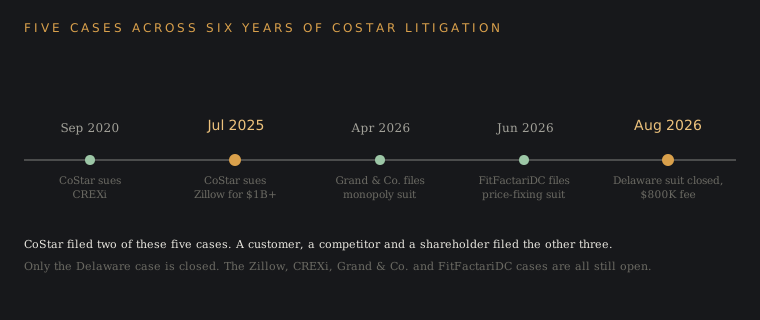
The Zillow case is CoStar's biggest lawsuit, and CoStar filed it
CoStar Group and its subsidiary CoStar Realty Information filed the litigation against Zillow in the U.S. District Court for the Southern District of New York on July 30, 2025, case number 1:25-cv-06248.
The complaint accuses Zillow of using close to 47,000 CoStar-copyrighted photographs, many still carrying CoStar's own watermark, across Zillow's listings. CoStar calls it one of the largest image-infringement lawsuits ever filed and says the exposure could top $1 billion.
The complaint ties the photos to Zillow's 2025 syndication deals with Redfin and Realtor.com, arguing Zillow paid two rivals to carry its listings while leaving CoStar's watermarks visible in the underlying images. CoStar's filing also notes that Zillow's own marketing claims its systems can identify details as fine as granite countertops in a photo, which undercuts any argument that Zillow could not have spotted a watermark.
Zillow files a motion to dismiss and a change of venue
Zillow filed a motion to dismiss instead of settling. Its response argues CoStar never pleaded that Zillow's conduct was volitional, a required element of direct copyright infringement. Zillow also says CoStar failed to show it got a direct financial benefit from the images, which vicarious infringement requires.
Zillow has asked the court to transfer the case to the U.S. District Court for the Western District of Washington, where it's headquartered, and it began removing flagged photos from its site in September 2025 while the motions are pending.
CoStar has a track record on this exact theory. It sued a former competitor, Xceligent, in December 2016 for copying its listings, and won a $500 million judgment in December 2019 covering 38,000 infringed photos, a record figure for a copyright case at the time.
Xceligent had already gone bankrupt, so CoStar collected $10.75 million from Xceligent's insurers instead of the full judgment amount. That gap is also why CoStar keeps suing over photos instead of relying on takedown notices: a nine-figure jury verdict is a bigger deterrent than a form letter.
CoStar and Zillow are fighting on more than one front
CoStar and Zillow are colliding outside the copyright suit too. In June 2026, CoStar filed an amicus brief opposing a Zillow request for a preliminary injunction against Compass and Midwestern Real Estate Data, arguing the request would favor Zillow's own competitive position.
That fight started when MRED suspended Zillow's data feed after Zillow rolled out Zillow Preview, one of several product features that keep pre-market listings off other sites. The suspension cut Zillow off from a large share of Chicago-area listings.
CoStar's own customers are suing it over the market power that makes it hard to leave
Two separate class actions accuse CoStar of monopolizing commercial real estate data, and both landed within ten weeks of each other in 2026. Grand & Co., a Brooklyn brokerage, filed first. FitFactariDC, a Florida tenant, filed second, and it named five of the country's largest brokerages as co-defendants alongside CoStar.
DiCello Levitt filed the Grand & Co. litigation on April 15, 2026, in the Eastern District of Virginia as Shapiro Hospitalities LLC d/b/a Grand & Co. v. CoStar Group, Inc., case number 1:26-cv-01027, on behalf of commercial real estate brokers and other CoStar clients nationwide.
The 79-page complaint says CoStar controls roughly 80% of the national market for commercial real estate listing and information services and uses that position to lock brokers into its platform.
The alleged lock-in includes non-negotiable restrictions on sharing listings with competitors, long-term exclusive deals with CBRE, JLL and Cushman & Wakefield, and subscriptions running $300 to $1,000 a month per broker, charged per firm regardless of how many brokers use the platform.
Grand & Co. wants the case certified as a class action and a jury to determine the damages CoStar owes. Berger Montague is running a parallel intake effort for potential clients built on the same theory, and the National Law Journal covered the emerging case law on April 21, 2026 under the headline "Commercial Real Estate Data Giant CoStar Faces New Monopolization Claims."
"We filed this case because commercial real estate brokers and firms are being squeezed by a system that leaves them with no real choice," said DiCello Levitt partner Greg Asciolla. "We believe CoStar used its dominant position to lock up customer data, shut out competition, and raise prices. This is the first class action to challenge that conduct and restore fairness and choice to the commercial real estate industry."
FitFactariDC filed the second case on June 12, 2026, in the U.S. District Court for the Northern District of Illinois, naming CBRE, JLL, Cushman & Wakefield, Colliers and Newmark alongside CoStar. CoStar offers subscription-based information services that give brokers and landlords property-level and transaction-level leasing data, market analytics and related tools.
The complaint describes a hub-and-spoke conspiracy: CoStar allegedly collected confidential, property-level lease data from the brokerages and redistributed it back to them. That let every participant see competitors' real lease terms without any of them talking to each other directly. FitFactariDC says a Denver lease it signed came in higher because of it.
An economic analysis cited in the complaint claims every 1-point increase in CoStar's market share between 2015 and 2025 corresponded to a 0.3% to 0.8% rise in rent per square foot across industrial, office and retail leases.
"Armed with near-real-time visibility into competitors' bottom-line lease terms, Defendants were able to align asking rents, reduce concessions, and resist tenant negotiations without fear of being undercut."
The theory echoes the Justice Department's 2024 case against RealPage, which accused the software company of doing something similar to apartment renters through its YieldStar algorithm. RealPage settled with the DOJ in November 2025, agreeing to stop sharing nonpublic lease data across landlords without paying a financial penalty. CoStar's case is still in its opening months; an initial status hearing was set for August 19, 2026.
CoStar sues CREXi for copying its listings, and CREXi sues CoStar for locking out competitors
CoStar filed a copyright complaint against CREXi in Los Angeles federal court in September 2020, accusing the venture-backed marketplace, then valued near $500 million, of copying listings and photos from LoopNet.
CoStar kept adding infringed images to the case as it found more of them. On June 25, 2025, the court ruled that CREXi had routinely accessed LoopNet, copied its listings, and tried to cover its tracks by screenshotting CoStar's photos and cropping out the watermark.
The court also confirmed CoStar owns the tens of thousands of photographs CREXi copied, since CoStar's own photographers took them and registered them with the Copyright Office. A trial to determine CREXi's damages is still pending.
CREXi is suing back. Its antitrust claims accuse CoStar of monopolizing the commercial real estate information market, and the Ninth Circuit revived those claims after a lower court had dismissed them, letting CREXi's case proceed toward trial.
CoStar asked the Supreme Court to review that decision. The Court declined in March 2026, leaving the Ninth Circuit's ruling in place.
A CREXi spokesperson said the allegations in the Grand & Co. case "reinforce what the CRE industry has known for years: CoStar's restrictive contracts and attempts to claim ownership over brokers' data and photos have caused damage to its customers."
What CoStar says against what the complaints allege
In a statement, CoStar General Counsel Gene Boxer answered nearly every antitrust complaint with the same two words: frivolous and embarrassment. On the Grand & Co. suit, he called it "an embarrassment" and "a scattershot complaint" that "lazily recycles debunked claims that make no sense," pointing out that the named plaintiff broker lists properties on a CoStar competitor's site despite claiming to be locked out of alternatives.
On the FitFactariDC price-fixing suit, Boxer called the claims "contrary to common sense" and "lacking in any facts," and said CoStar expects "a swift and complete victory in court."
CoStar's defense on both suits rests on one distinction: its contracts bar customers from using CoStar data to build a rival product. They don't bar a broker from listing the same properties on a rival site, CoStar says.
"That's a clause that could hardly be more common or reasonable," Boxer said of the non-compete language Grand & Co.'s complaint calls exclusionary. The plaintiffs' answer is that the restriction only matters because CoStar controls enough of the market that a broker's data has nowhere else to go.
The cases that already closed
Move Inc., the News Corp-owned operator of Realtor.com, sued CoStar and a former Move employee in July 2024, claiming CoStar used stolen trade secrets to build a news division for Homes.com.
A federal judge denied Move's request for a preliminary injunction in September 2024, citing weak evidence and Move's refusal to take basic discovery steps like deposing the employee it had accused. Move dismissed the case with prejudice in April 2025 instead of facing the sanctions CoStar had threatened to seek.
"This lawsuit was a PR stunt from the start, ridiculous, and totally devoid of merit," said CoStar founder and CEO Andy Florance. "Nine months later, after a warning from our lawyers about sanctions, Move folded. We did not settle. We didn't pay a dime."
The FTC blocked a much bigger CoStar deal in 2020. The agency sued in November 2020 to stop CoStar's proposed $587.5 million acquisition of RentPath, arguing it would concentrate the market for apartment-listing ads across 49 metro areas. CoStar and RentPath abandoned the deal on December 31, 2020, and the FTC dismissed its own complaint on January 4, 2021, closing the matter without a ruling on the merits.
The most recent closure has nothing to do with antitrust. A CoStar stockholder filed the Delaware litigation in the Delaware Court of Chancery on February 9, 2026, arguing a Change in Control clause in CoStar's Executive Severance Plan violated Delaware law.
CoStar's board amended the plan on February 13, 2026, removing the clause, and filed the amended plan with the SEC as an exhibit to a securities filing. The court dismissed the stockholder's claims as moot a week later, while retaining jurisdiction over attorneys' fees.
Without admitting wrongdoing, CoStar agreed to pay $800,000 in fees and expenses. The court closed the case on August 12, 2026, and CoStar's investor relations and communications teams announced the resolution two days later.
What it means for brokers, landlords and CoStar customers
None of the open litigation has produced an injunction against CoStar's core products, so CoStar's listing and data services, including LoopNet, CoStar Suite and lease-comparables access, work the same way today as they did before any of it was filed. That's the near-term picture for a broker paying a CoStar subscription.
The medium-term picture depends on what plaintiffs win. Grand & Co. and FitFactariDC are both asking for injunctive relief on top of damages, and DiCello Levitt's complaint specifically asks the court to restore competition to the commercial real estate data and listings markets.
That language is broad enough to cover anything from a contract rewrite to a forced separation of CoStar's listing and analytics products. Nothing in either complaint guarantees that outcome. Both cases are still in their opening months, and CoStar has denied every material allegation in both.
Brokers weighing alternatives while the cases play out can compare CoStar against other real estate data providers like Cotality, Cherre and ATTOM, or weigh CoStar inside a broader real estate market intelligence strategy instead of a single-vendor bet.
Three dates are worth watching. The FitFactariDC case had its first status hearing on August 19, 2026. CREXi's damages trial against CoStar has no set date yet, but a ruling there will set a number the antitrust plaintiffs will likely point to next. Zillow's motion to transfer venue, if granted, would move the entire $1 billion case across the country before either side argues the merits.
Frequently asked questions
What is going on with the Zillow lawsuit?
CoStar sued Zillow in the Southern District of New York on July 30, 2025, over roughly 47,000 copyrighted photos it says Zillow used without permission, seeking more than $1 billion in damages. Zillow is fighting the case in court, arguing CoStar hasn't proven the legal elements of direct or vicarious infringement, and it has asked the court to move the case to Washington state, where Zillow is based.
What are the allegations in the class-action lawsuits against CoStar Group?
Two separate 2026 class actions accuse CoStar of illegal monopolization. Grand & Co.'s suit says CoStar controls about 80% of the national commercial real estate listing market and locks brokers into exclusive contracts. FitFactariDC's suit says CoStar ran a hub-and-spoke scheme that shared confidential lease data among competing brokerages, inflating rents across 49 metro areas. CoStar denies both sets of claims.
What is Zillow's blacklist?
It has nothing to do with the CoStar case. Zillow's Listing Access Standards, which took effect in June 2025, permanently block a listing from Zillow and Trulia after a third violation of Zillow's public-marketing rules, most often an agent posting a listing on social media before it hits the MLS. Real estate outlets nicknamed the enforcement list a "blacklist"; roughly 90% of the banned listings tracked so far belong to Compass agents.
Who is the biggest competitor of Zillow?
In residential for-sale and rental listings, Realtor.com (owned by Move Inc. and News Corp) and Redfin are Zillow's closest competitors, alongside CoStar's fast-growing Homes.com. In commercial real estate, the market this report covers, Zillow isn't a factor at all; CREXi is CoStar's main competitor there.
Who owns CoStar Group?
CoStar Group is a publicly traded company on the Nasdaq under the ticker CSGP, and institutional investors hold more than 90% of its shares. Andy Florance founded the company in 1986 and still runs it as CEO; he holds a stake of roughly 1.8 million shares, per compiled ownership trackers. Louise S. Sams chairs an eight-member board, seven of whom are independent directors.
What happened to the class-action suit against realtors?
That's a different case. The National Association of Realtors and several large brokerages settled a nationwide commission lawsuit in 2024, agreeing to end standard buyer-broker commission rules. It has nothing to do with CoStar or any of the lawsuits in this report; the confusion usually comes from both disputes hitting the real estate news cycle around the same time.
Bottom line
CoStar Group is the plaintiff in one massive lawsuit and the defendant in at least three more, and every one of them turns on the same fact: how much of the commercial real estate data market CoStar controls. CoStar's filings put that number as high as it can defensibly go when it's suing Zillow, and as low as it can defensibly go when it's defending the Grand & Co. and FitFactariDC suits.
None of these cases has produced a verdict yet. The closest thing to a preview is the Xceligent judgment: a federal court once put a $500 million price on far fewer stolen photos than CoStar says Zillow used, the number every plaintiff and every defendant on this list is quietly measuring against.
Watch the CREXi damages trial and the FitFactariDC status docket before anything else. Both will produce real numbers well before the Zillow case or the Grand & Co. suit reach that stage, and those numbers will set the terms everyone else argues from next.
Sources, and who is a named party versus who is soliciting clients
Case filings and court rulings: CoStar Group's own legal-cases page (costargroup.com/press-room/legal), the FTC's case file for the RentPath matter (ftc.gov, docket 9398), and the Delaware Court of Chancery resolution announcement (costargroup.com/press-room, 14 August 2026). The Xceligent judgment is reported by Williams & Connolly LLP (wc.com), counsel in that matter.
Plaintiffs' filings and statements: DiCello Levitt (dicellolevitt.com) is lead counsel on the Grand & Co. case; Berger Montague (bergermontague.com) is running a separate, unrelated client-intake page for the same theory and is not a party of record in either case discussed here. FitFactariDC's complaint is reported by Facilities Dive (facilitiesdive.com) and The Real Deal (therealdeal.com). CREXi's antitrust case is reported by Bisnow (bisnow.com).
Zillow's response to the copyright suit is reported by Real Estate News (realestatenews.com) and Inman (inman.com); Zillow's own filings were not independently reviewed beyond what those outlets quote. Move Inc.'s dismissal is CoStar's own announcement (Business Wire, 7 April 2025). The RealPage comparison is drawn from the Department of Justice's 2024 complaint (justice.gov). All URLs accessed 27 August 2026.