LinkedIn Sales Navigator vs ZoomInfo
 By Jan Suski. I go deep on every review, checking every number against its source and digging up details other coverage misses, a habit from six years of SEO and link building for tech companies. Bylines at Surfer, Brand24, and Senuto. How the scoring works.
· Prefer this source on Google
| WHAT EACH ONE DOES | LINKEDIN SN | ZOOMINFO |
|---|---|---|
| Core job | Search & relationship layer | Contact database |
| Contact data | None, any tier | 300M emails, 135M dials |
| Search filters | 30+ facets | Boolean + technographic |
| Job-change tracking | Real-time, native | 15-20M/mo, no alerts |
| Mutual connections | TeamLink, team-wide | None |
| Intent data | LinkedIn-native behaviour | 4,500 topics, US-only |
| CRM sync | Advanced Plus, 10-seat floor | Native, all paid tiers |
| API access | SNAP, ~15 partners | API + MCP add-on |
| Skip it if | You need phone numbers | Reps know the buyer |
| WHAT YOU GET | LINKEDIN SN | ZOOMINFO |
|---|---|---|
| Published rate card | Yes, public | None, confidential §5.2 |
| Entry price | $119.99/mo, Core | Quote-only |
| Tier structure | 3 tiers, published | 6 packages, no prices |
| Seat minimum | 2 seats, Advanced | None published |
| Vendr tracked median | Not tracked | $33,500/yr |
| Free trial | Card required | 7 days + free Lite |
| Cancellation right | End of paid term | None published, §3.1 |
| Bulk export | Not offered | Credit-metered |
| G2 reviews | 4.4 from 2,209 | 4.5 from 9,105 |
StrongerWeakerNo edge
Thirty-five further documented limits sit behind the button below: search result caps, credit and view allowances, list ceilings and API rate tiers. LinkedIn's rate card is public and dated 14 December 2025; ZoomInfo's License Terms make its price confidential under §5.2, so its column reads from Vendr's tracked purchase data instead. Contract clauses trace to each vendor's own published terms. Every figure is sourced in the section its row links to.
| Sales Navigator | WHAT IT DOCUMENTS |
|---|---|
| Lead search cap | 2,500 results across 100 pages |
| Account search cap | 1,000 results across 40 pages |
| Saved lead ceiling | 10,000 total, 1,000 a list |
| Saved searches | 50 lead and 50 account searches |
| InMail accumulation | 150 maximum, unused expire in 90 days |
| Extra InMail credits | Not purchasable on any tier |
| InMail length | 200-character subject, 1,900-character body |
| Recommended Leads | Caps at 100, refreshed every Monday |
| New Executives list | CXO and VP hires, past 3 months |
| Champions Lists | Advanced Plus with CRM sync only |
| Personas | Five maximum, two shipped by default |
| Relationship Explorer | Top eight leads at an account |
| Account list upload | 1,000 accounts, 20 MB, Advanced up |
| Account post alerts | One shared post an account a day |
| Bookmarked alerts | Expire 60 days after bookmarking |
| Usage reporting | Two years back, admin seats only |
| API rate limits | Unpublished, per endpoint, daily reset |
| SNAP partner intake | Closed to new partners |
| ZoomInfo | WHAT IT DOCUMENTS |
|---|---|
| ReachOut on LinkedIn | Reveals masked email and phone inline |
| No direct dial | Falls back to the (HQ) switchboard number |
| ReachOut export targets | Five, including Outreach and SalesLoft |
| New account export | Two credits: one account, one contact |
| Records under management | Free re-pull for 1 year* after enrichment |
| Duplicate exports | Two users, same record, two credits |
| Bulk credit expiry | Ends with the contract term, no rollover |
| Monthly view allowance | Fixed a user, no transfers, monthly reset |
| Excel export ceiling | 500,000 records a file |
| Suppression uploads | 5 lists, 200 MB or 5 million rows |
| Export limits tab | Cap per company or per whole list |
| API rate tiers | 5, 25 or 35 requests a second |
| API daily ceiling | 129,600 to 907,200 requests a day |
| Search page size | 100 records a page, hard maximum |
| Batch enrichment | 25 records a call, one credit each |
| Research agents | One account or one contact a call |
| Limit increases | Applied within 24 hours |
*A marked figure is one the vendor states two ways on its own domain. ZoomInfo's Overview of Credits article says a record placed under management can be re-pulled free "for up to 1 year from the initial enrichment date," while its My Lists article sets that free window at six months. The year is used above because it's the figure attached to Records Under Management, which is what the credit terms name.
Sources, and the caps each vendor puts on a seat
Every row comes from a vendor property.
- LinkedIn: the Sales Navigator help centre on linkedin.com, plus the SNAP overview, rate limiting and Sync Services pages on learn.microsoft.com.
- ZoomInfo: zoominfo.com feature pages, help.zoominfo.com knowledge base articles, api-docs.zoominfo.com & docs.zoominfo.com.
The two sides count different things. LinkedIn caps what a seat can hold, in leads, lists, searches and alerts. ZoomInfo caps what a licence can pull, in credits, views, rows and requests a second.
Neither publishes the number that decides the bill: LinkedIn states no API rate limit outside its developer portal, and ZoomInfo states no monthly view or credit allowance for a seat, so no row claims either.
LinkedIn Sales Navigator vs ZoomInfo isn't a contest between two contact databases. LinkedIn Sales Navigator holds no verified business emails and no phone numbers at any tier; ZoomInfo holds 500 million professional profiles and won't print a price. One is a seat licence that reads a professional network in real time. The other is a data licence with a non-cancellable contract.
This page is for the person choosing between a $119.99 seat and an annual quote this quarter. It gives the published numbers, where two marketing pages would just argue past each other.
Both sales intelligence tools lock you in, in two shapes most comparisons never mention: LinkedIn deletes your saved leads the day you cancel, and ZoomInfo's own published contract says the agreement can't be cancelled at all. A three-rep startup and a 400-seat revenue organisation should not read the same recommendation here.
Two rows settle most evaluations. The contact data row and the exit row. Everything after that is preference.
↑ COMPARISONWhat it costs to leave each one
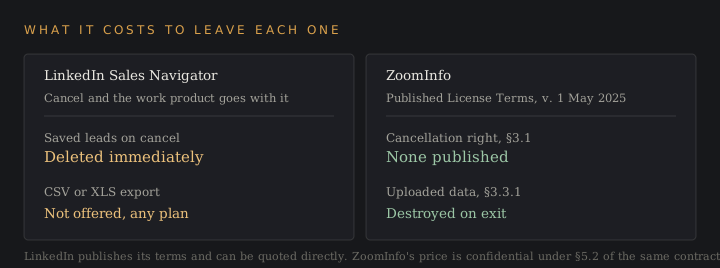
Cancel LinkedIn Sales Navigator and the work product goes with it. LinkedIn's own help page is unambiguous: "Currently you don't have the option to save critical information and data associated with the account, such as messages, saved leads, and saved accounts. This data is removed as soon as you cancel, and you won't be able to access it." Buy it again later and, in LinkedIn's words, "you'll start over with a new account."
There's no CSV escape hatch either. LinkedIn states plainly that it "doesn't offer the option to export account and lead information from Sales Navigator into a CSV or XLS file." The only sanctioned path out is CRM Sync, and that's an Advanced Plus feature with a ten-seat floor.
Two years of saved lists, notes and lead alerts on a Core seat are a rental with no deposit back.
ZoomInfo locks the other end. Its published License Terms & Conditions, version 1 May 2025, §3.1: "The Agreement is not cancellable and shall remain in effect until it expires or is earlier terminated according to its terms."
On termination, §3.3.1 requires that "all information that has been uploaded into ZoomInfo's systems by Licensee destroyed," with no export window and no retention period written anywhere. §5.2 makes the price itself confidential information, which is why nobody can tell you what an enterprise plan costs.
| Exit term | LinkedIn Sales Navigator | ZoomInfo |
|---|---|---|
| Bulk export of lead data | Not offered | Credit-metered export |
| Saved lists after cancellation | Deleted immediately | Licensed data may be kept |
| Uploaded CRM data on exit | Held in the CRM | Destroyed, §3.3.1 |
| Published cancellation right | End of paid term | None, §3.1 |
| Published notice window | None stated | None stated |
| Price confidentiality | Rate card is public | Confidential, §5.2 |
ZoomInfo's Better Business Bureau file carries 209 complaints closed in three years, 64 of them in the last twelve months, against an A+ rating and accredited status.
A complaint resolved 2 June 2026 describes a roughly $5,300 twelve-month deal signed 7 November 2025, cancellation requested a month later, and a negotiation that ran $2,650, then $1,750, then $1,000 to exit the remaining six months.
Another, resolved 30 April 2026, reads: "Service was used as a one-year and never renewed... 8 months later they are trying to bill me for something i never signed up for." ZoomInfo's reply that week thanked the complainant "for making us aware of your accounts auto-renewal."
Renewal practice is pleaded in court too. State Teachers Retirement System of Ohio v. ZoomInfo Technologies Inc., No. 3:24-cv-05739-TMC in the Western District of Washington, filed 4 September 2024, alleges ZoomInfo "had used manipulative and coercive auto-renew policies and threats of litigation to force customers into remaining with ZoomInfo for an additional contractual term even though such customers did not want to."
The §10(b) claims survived dismissal in part on 28 October 2025 against ZoomInfo, Henry Schuck, Cameron Hyzer and Joseph Christopher Hays. Claims against TA Associates, Carlyle and DO Holdings were dismissed. Nothing has been proven; the allegation is a pleading, and it's a pleading a procurement team should read before signing.
Fairness cuts both ways. ZoomInfo publishes its subscription contract, so its terms can be quoted. LinkedIn pushes its enterprise terms into an unpublished order form, so Advanced Plus can't be measured the same way. A vendor that publishes can be criticised on the record; one that doesn't, can't.
↑ COMPARISONZoomInfo's comparison page, checked against LinkedIn's own pages
Only one of these vendors attacks the other in public. ZoomInfo runs a 24-minute comparison page at pipeline.zoominfo.com, bylined by founder and CEO Henry Schuck and updated 22 May 2026. LinkedIn publishes no answering page. Note that asymmetry before reading a single claim on it.
Most of what the page says about LinkedIn Sales Navigator checks out against LinkedIn's own documentation. Two things don't.
| ZoomInfo's claim, 22 May 2026 | What LinkedIn publishes |
|---|---|
| No verified emails or direct phone numbers at any tier | Correct. No contact-lookup feature is listed |
| No CSV or XLS export "on most plans" | Correct, and stronger. No plan offers it |
| CRM sync is Advanced Plus, 10-seat minimum | Correct on both counts |
| All plans include 50 InMail credits a month | Correct. Identical across all three tiers |
| Core is "~$119.99 per seat per month" | Correct. $119.99 monthly, $1,079.88 annually |
| Advanced is "~$179.99 per seat per month" | Wrong. LinkedIn lists $159.99, or $1,799.88 a year |
| Scores "4.3/5 from 1,854 reviews" on G2 | Wrong. G2 reads 4.4 from 2,209 as of 4 August 2026 |
| 1.3 billion members, no contact detail delivery | Correct. LinkedIn publishes "+1.3B Members" |
The $20-a-seat overstatement matters at scale. Across 50 seats it inflates the annual comparison by $12,000 in ZoomInfo's favour. The G2 figure is a stale snapshot, which is what most review-score citations turn out to be.
The page also concedes things a marketing page usually won't. It states that TeamLink "provides a capability ZoomInfo does not offer," that ZoomInfo "does not replicate InMail, TeamLink warm intros, or native LinkedIn engagement signals," and that "a significant portion of ZoomInfo customers run Sales Navigator alongside ZoomInfo."
Read the whole thing and the honest conclusion is the one ZoomInfo half-admits: for many sales teams these are complements sold as substitutes.
↑ COMPARISONPricing: a published seat rate against a confidential one
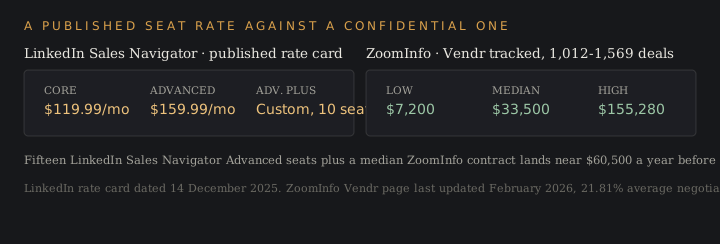
LinkedIn publishes its full rate card. LinkedIn Sales Navigator Core runs $119.99 a month per licence, or $1,079.88 billed annually. LinkedIn Sales Navigator Advanced runs $159.99 a month, or $1,799.88 a year.
Advanced Plus is quote-only, with LinkedIn stating that pricing "is customized based on your sales team's size, CRM integration, and onboarding/training needs." LinkedIn Sales Navigator plans in other currencies sit on the same page, which carries a footer date of 14 December 2025: Core is £94.99 monthly, €120.99, C$144.99, A$154.99.
Seat floors gate the tiers. Sales Navigator Advanced needs two seats and up to five can be bought self-serve online. Advanced Plus needs ten and a sales conversation. A free trial exists for Sales Navigator Core and Advanced, requires a card, and is limited to members who haven't used a LinkedIn trial in 365 days; LinkedIn no longer publishes a fixed length, stating only that "trial length may vary based on region or promotional terms."
Unlike LinkedIn Sales Navigator, ZoomInfo publishes nothing. Its pricing page names six packages, ZoomInfo Professional, Copilot Advanced, Copilot Enterprise, Marketing Demand, ABM Lite and ABM Enterprise, and carries no dollar figure anywhere. The company's own blog says it outright: "There are no published seat tiers or dollar amounts." The custom pricing depends on features, licence count and credit usage, where one credit equals one contact or company export.
The widely repeated "$14,995 / $24,995 / $32,995" ladder is not ZoomInfo's. Those figures trace only to third-party pricing blogs which contradict each other, one headlining "5 Plans from Free to $39,995/year" while others put the entry tier at "$14,995-$18,000." "Copilot Pro" isn't even a ZoomInfo package name. Anyone budgeting off that ladder is budgeting off a blog.
Vendr's tracked contracts are the closest real benchmark. Its ZoomInfo page header, last updated February 2026, reads $33,500 average contract value, 1012 deals handled, 21.81% average savings, with a $7,200 low and a $155,280 high. The same page then says "Based on data from 1,569 purchases" and labels the identical $33,500 a median.
Cite the range; either count alone overstates the picture. Vendr has no LinkedIn Sales Navigator page at all, and the LinkedIn parent page mixes Recruiter, Learning and Marketing Solutions, useless for this pair.
ZoomInfo Lite is the free tier, granting 10 reveal credits at signup, with no seat limit or expiry published on zoominfo.com. A 7-day free trial of the paid product exists, with ZoomInfo noting that "trial length and terms may vary."
↑ COMPARISONWhat each database holds
This is the whole comparison in one line. ZoomInfo sells direct contact information. LinkedIn sells access to LinkedIn.
ZoomInfo's data page claims 500 million professional profiles, 122 million company data records, 300 million verified emails, 135 million direct dials and 4,500 intent topics, over an extensive database processing 1.5 billion data points daily.
It publishes hit rates by field.
- Business email: 96%
- Mobile phone: 87%
- Direct dial: 72%
- LinkedIn URL: 94%
Those per-field numbers beat any blended data accuracy claim, because they tell a rep which lookups will fail before the sales calls start.
LinkedIn publishes "+1.3B Members" and a regional split, plus roughly 100% of the Fortune 500. It publishes no email coverage figure, no phone coverage figure, and no company count on its current about page. The often-quoted "60M+ companies" survives only in stale vendor boilerplate.
LinkedIn's positioning on data collection is explicit: "Instead of relying on scraped data, anonymous traffic, or outdated third-party sources, Sales Navigator leverages advanced AI models from LinkedIn, Microsoft, and OpenAI." LinkedIn Sales Navigator marketing cites 130 million decision makers on LinkedIn's professional network, sourced to LinkedIn data from March 2024.
The reason LinkedIn publishes no email figure is that members mostly don't publish one. A LinkedIn profile exposes an email address only where the member has chosen to show it and the viewer meets the connection-degree setting, so the share of profiles carrying a visible work address is a small minority.
Competitor blogs put that share at roughly 5% and none of them sources it. The checkable version: LinkedIn ships no email lookup, no direct dials and no bulk contact export at any price.
So the contact data question answers itself. A rep who needs mobile numbers and direct contact information before a dial buys ZoomInfo. A rep who needs to know the buyer changed job title on Tuesday reads LinkedIn's extensive network, where employment history is maintained by the person it describes.
That's the real data quality split, and it splits on method. ZoomInfo verifies at scale, LinkedIn is self-reported and therefore up to date information by construction. Neither approach produces accurate data on every record, and neither publishes an audited figure saying how often it fails.
ZoomInfo's own coverage numbers disagree with each other
Three ZoomInfo properties publish three different sets of company data for the same database. The data page says 300 million verified emails, 135 million direct dials and 122 million companies. The pipeline blog says 200 million verified business emails, 120 million direct dials and 100 million companies. The free-trial page says 110 million companies.
The data page even contradicts itself inside one screen, with a hero line reading "158M+ locations" above a stat bar reading "100M+ Locations," one of the self-contradictions tracked in our report on software pricing errors.
Several widely cited ZoomInfo statistics live only on the blog, not the data page: the 300-plus in-house researchers, the 210 million IP-to-organization pairings behind its intent product, the 38 million sources scanned daily, and the 95% accuracy headline. Ask a rep to confirm which set governs the contract, in writing.
The pricing page also displays a stale badge reading "4.5/5 9384 G2 Reviews" against a live G2 count of 9,105, which is a small thing that tells you how closely the detailed data on that page is maintained.
↑ COMPARISONIntent data: platform behaviour against a licensed panel
Both products sell buying intent and mean different things by it. ZoomInfo tracks 4,500 intent topics across 85 million weekly signals and 1.2 million accounts monitored weekly, resolving 50 to 60% of US business web traffic to a company through WebSight BuyerID.
ZoomInfo states that layer is US-only and that "GDPR markets are not in scope," which matters for any European lead generation process.
LinkedIn Sales Navigator's Buyer Intent reads LinkedIn-native behaviour: ad engagement, InMail responses, profile views, content interaction. It sees nothing on a third-party review site or a competitor's pricing page. It also sees something ZoomInfo can't, which is a named buyer's activity on the network where buying committees quietly research vendors. Both sets of intent signals are partial. Neither vendor pretends otherwise once you read past the headline.
The practical test is the shape of the sales pipeline. Outbound sales teams building lists against a target market defined by company size, technographic data and firmographics get more from ZoomInfo's intent data. Sales teams working forty named accounts get more from knowing which of five decision makers opened a post.
Sales professionals who run both use ZoomInfo for account intelligence and LinkedIn Sales Navigator for the human layer on top of it, and shape their sales strategies around which of those two intent signals arrives first.
Neither set of intent signals replaces a conversation. Both narrow which sales calls to make first, which is why sales teams treating intent data as a prioritisation input outperform sales teams treating it as a qualification gate.
↑ COMPARISONCRM integration and the ten-seat floor
CRM integration is where the LinkedIn Sales Navigator vs ZoomInfo gap gets structural. LinkedIn gates it entirely: "Integration between Sales Navigator and your CRM is only available for Sales Navigator Advanced Plus users." CRM Sync, Data Validation, lead and contact creation, embedded profiles, ROI reporting and CRM sandbox all sit behind Advanced Plus and its ten-seat minimum. The CRM Sync partners are HubSpot, Microsoft Dynamics 365, Oracle Sales and Salesforce.
ZoomInfo integrates natively with Salesforce, HubSpot and Microsoft Dynamics on the paid tiers, plus marketing systems including Marketo and Pardot, and pushes automatic CRM data updates so contact details refresh without a manual import.
That's the data management difference in practice: one product writes into the systems a revenue team already runs, the other reads beside them. ZoomInfo's GTM Context Graph fuses its own account data with a customer's CRM records and Chorus call transcripts, and API plus MCP access is sold as a third lane alongside GTM Workspace for sellers and GTM Studio for marketing and revenue teams.
LinkedIn's API is a different animal. SNAP, the Sales Navigator Application Platform, is a vetted partner programme with roughly fifteen partners including Gong, Outreach, Salesforce, Tableau and Power BI, reviewing applications quarterly on a 90-day response window. It isn't customer data access, and no amount of budget converts it into one.
Teams wiring either product into existing tools should confirm which direction the sync runs before assuming parity.
LinkedIn's User Agreement §8.2 prohibits members from using "software, devices, scripts, robots or any other means or processes... to scrape or copy the Services, including profiles and other data," and warns that violators "risk having their accounts restricted or shut down."
hiQ Labs ended in a December 2022 consent judgment including a $500,000 award and orders to destroy source code and derived algorithms. LinkedIn v. Nubela/Proxycurl, filed January 2025, ended with Proxycurl shutting down in July 2025 and agreeing to delete unauthorised LinkedIn data.
Any LinkedIn Sales Navigator alternative promising bulk exports of LinkedIn data is selling something LinkedIn has twice gone to court over.
↑ COMPARISONReview scores, with sample sizes
Neither product wins this cleanly, and the sample sizes are worth more than the stars.
| Platform | LinkedIn Sales Navigator | ZoomInfo |
|---|---|---|
| G2 | 4.4 from 2,209 reviews | 4.5 from 9,105 reviews |
| Capterra | 4.6 from 179 reviews | 4.1 from 321 reviews |
| Gartner Peer Insights | 4.5 from 756 ratings | 4.3 from 559 ratings |
| TrustRadius | 8.5 out of 10 | 8.2 out of 10 |
| Capterra ease of use | 4.4 | Not broken out |
| Capterra customer service | 4.1 | Not broken out |
The ZoomInfo G2 listing is now "GTM Workspace - Powered by ZoomInfo," which G2 describes as "the upgraded version of ZoomInfo Sales and ZoomInfo Copilot." It's a single product listing, not a seller aggregate; ZoomInfo's five G2 profiles together carry 12,887 reviews.
Gartner lists both under Revenue Data Solutions, transitioning to GTM Data Applications, which is the closest thing to a like-for-like market for these intelligence tools. Anyone running a ZoomInfo LinkedIn Sales Navigator shortlist should read both listings under that heading.
G2's tagged sentiment on LinkedIn Sales Navigator is more informative than its star rating. The ease-of-use tag appears in 96 reviews. "Missing export features" appears in 40. That second tag is the export limitation showing up in the wild. No help article documents it.
Both publish trust documentation.
- LinkedIn's compliance page lists ISO 27001, ISO 27018, ISO 22301, SOC 2 and PCI DSS, with the ISO scopes naming Sales Solutions explicitly, and runs a status page with a LinkedIn Sales Solutions component.
- ZoomInfo's trust centre lists ISO 27001, ISO 27017, ISO 27701, CSA STAR Level 1 and a SOC 2 Type II attestation, plus a Texas Data Broker Notice confirming it registers as a data broker under Texas law. Its Atlassian status page tracks sixteen components individually.
↑ COMPARISONZoomInfo's 2026: a guidance cut and 600 roles
ZoomInfo trades on Nasdaq as GTM, having changed its ticker from ZI. FY2025 GAAP revenue was $1,249.5 million, up 3% year over year.
Q1 2026 GAAP revenue was $310.2 million, up 1.5%, with net revenue retention at 90% and 1,900 customers above $100,000 in annual contract value. Full-year 2026 guidance was cut to $1.185-$1.205 billion, roughly a 4.9% reduction, on weaker late-quarter demand.
On 11 May 2026 ZoomInfo filed an 8-K disclosing a restructuring entailing "a global reduction in force of approximately 600 employees, impacting approximately 20% of the Company's ending first quarter headcount," with pre-tax charges estimated at $45 to $60 million and completion expected by the end of 2026. About a quarter of affected roles are to be reallocated or offset by hiring elsewhere.
A 20% cut lands on support and customer success as well as engineering. For a buyer signing a multi-year agreement under a contract with no published cancellation right, asking which support functions survive the reorganisation is a fair question with a real answer.
The separate Ramos et al. right-of-publicity settlement is closed. Final approval came 21 November 2024 on a $29.55 million fund across four statewide classes, $14.23 million in California, $11.69 million in Illinois, $2.3 million in Indiana and $1.33 million in Nevada. That case concerned marketing use of names and likenesses. It wasn't a breach, and conflating the two misleads a security review.
LinkedIn's corporate risk profile is Microsoft's. LinkedIn reported $19.8 billion annual revenue and 12% year-over-year growth in Q4 FY26, with 17,000 employees. The 2021 posting of 700 million scraped records was characterised by LinkedIn at the time as an aggregation of publicly viewable profile data: "this is not a data breach, and no private LinkedIn member data was exposed."
↑ COMPARISONWhich tool fits which team
Buy LinkedIn Sales Navigator when the sales process is relationship-led and the reps already know who they're selling to. Its advanced search capabilities cover job title, seniority, company size, geography and more than thirty other facets across 1.3 billion profiles, and LinkedIn Sales Navigator excels at one thing nothing else does: alerting a rep the week a buyer changes jobs.
TeamLink surfaces mutual connections across the whole team, turning a cold account into a warm one, and those mutual connections are the closest thing to a moat either product has. LinkedIn Sales Navigator Advanced adds Account IQ, Lead IQ, Buyer Intent, Smart Links and shared lists at $159.99 a seat. Our LinkedIn Sales Navigator review covers TeamLink and Buyer Intent in more depth.
Buy ZoomInfo when volume decides the quarter. Sales reps running high-volume outbound need phone numbers, verified emails and more direct contact information at export, plus Boolean advanced search and technographic filters to build a list of ten thousand.
Marketing teams get WebSights visitor identification and campaign audiences that LinkedIn Sales Navigator has no equivalent for at all. Our ZoomInfo review covers GTM Workspace and the credit system in more depth, and our ZoomInfo alternatives ranking covers the other 17 options by buyer demand.
Business development functions chasing a whole vertical are the intended buyer, and Vendr's tracked 21.81% average saving says real negotiating room exists off any first quote.
Two sales teams the same size can land on opposite answers. A team selling six-figure deals into 200 named accounts builds its sales strategies around mutual connections and job title changes; a team selling a $400-a-month product into 20,000 accounts builds them around phone numbers and export volume.
Sales professionals in the first group rarely exhaust LinkedIn Sales Navigator's advanced search filters. Sales professionals in the second exhaust ZoomInfo's credits by March.
Neither is a sales engagement platform. Neither sequences email, neither dials, and both expect Outreach, Salesloft or similar sales tools to sit underneath them. That's the most common budgeting mistake in a ZoomInfo LinkedIn Sales Navigator evaluation: costing two sales tools when the workflow needs three.
Sales and marketing teams running both should be honest about the number, because sales and marketing teams rarely budget for two contracts at once. Fifteen LinkedIn Sales Navigator Advanced seats plus a median-sized ZoomInfo contract lands near $60,500 a year before negotiation, and the average discount applies to only one half of it.
Teams that map their own lead generation efforts before the demo gain deeper insights from both trials than teams that book two demos and compare feature lists. A vendor evaluation scorecard turns that mapping into a repeatable comparison for the next tool on the list.
Ask the ZoomInfo rep which coverage figures govern the contract, the data page set or the blog set. They differ by 100 million emails. Ask the LinkedIn rep to confirm in writing what happens to saved lists if the seat count drops below the Advanced Plus floor mid-term.
Common LinkedIn Sales Navigator and ZoomInfo questions
What is the difference between LinkedIn Sales Navigator and ZoomInfo?
LinkedIn Sales Navigator is a search and relationship layer over LinkedIn's 1.3 billion member professional network, sold per seat from $119.99 a month, with no verified emails and no phone numbers at any tier. ZoomInfo is a contact database of 500 million profiles with 135 million direct dials and 300 million verified emails, sold on a quote with no published rate card. One tells you who to talk to. The other tells you how to reach them.
Does ZoomInfo pull from LinkedIn?
ZoomInfo publishes a 94% LinkedIn URL match rate, so it maps records to profiles. LinkedIn's User Agreement §8.2 prohibits scraping profiles, and LinkedIn has enforced that against hiQ Labs, ending in a December 2022 consent judgment, and against Proxycurl, which shut down in July 2025. Ask any data platform to state its data collection methods in the contract.
Is ZoomInfo worth the money?
Vendr's tracked ZoomInfo contracts run $7,200 to $155,280 with a $33,500 median and 21.81% average negotiated savings. It's worth it when sales teams dial and email at volume and the alternative is a rep spending hours a week hunting for contact details by hand. It's poor value for a small team working named accounts, where per-seat sales prospecting tools cost a fraction of it.
Is LinkedIn Sales Navigator worth it on LinkedIn?
At $119.99 a month for Core, it pays for itself if a rep uses the advanced search capabilities and lead alerts weekly. It doesn't replace a contact database, and it deletes your saved leads on cancellation, so treat the saved-list work as disposable. LinkedIn cites a Forrester study from October 2023 claiming payback inside six months and 65 hours saved a year per user; that's LinkedIn's commissioned figure.
What is better than a Sales Navigator?
Nothing replaces access to LinkedIn's professional network, since LinkedIn owns it. What LinkedIn Sales Navigator alternatives add is the contact layer it lacks. ZoomInfo and Cognism sell verified emails and mobile numbers. So does Apollo. A social selling tool cannot, because the underlying platform doesn't publish them. Most Sales Navigator alternatives solve the second problem. None of them solves the first.
Is ZoomInfo outdated?
The ZoomInfo LinkedIn Sales Navigator question is often a ZoomInfo currency question. Its packaging changed in 2026 to GTM Workspace, GTM Studio and the GTM Context Graph, and ZoomInfo Sales as a product name is gone from G2. The data platform processes a claimed 1.5 billion data points daily with 15 to 20 million job changes tracked monthly.
The pressure is commercial: 90% net revenue retention, a cut 2026 forecast, and a 20% workforce reduction disclosed in May 2026.
Does LinkedIn Sales Navigator include CRM integration?
Only on Advanced Plus, which requires ten seats and a custom quote. Core and Advanced have none. That gate is the most common surprise in a LinkedIn Sales Navigator evaluation, because a rep trialling Core sees no way to get lead data into Salesforce and assumes one exists at the next tier up.
Can you export leads from LinkedIn Sales Navigator?
No. LinkedIn states it "doesn't offer the option to export account and lead information from Sales Navigator into a CSV or XLS file," and its User Agreement prohibits third-party tools that do it anyway. The only sanctioned route is Advanced Plus CRM Sync into Salesforce, Dynamics or HubSpot.
Can sales teams use both LinkedIn Sales Navigator and ZoomInfo together?
Yes, and ZoomInfo's own comparison page concedes a significant portion of its customers do. The split most sales teams settle on: ZoomInfo supplies the contact data, company size and firmographic filters that define the list, LinkedIn Sales Navigator supplies the search capabilities and relationship context that decide the order. Sales efforts get worse when one product is asked to do both jobs, which is the usual reason a team ends up buying the second.
Which is better for reaching decision makers?
ZoomInfo, if reaching means dialling. Its 135 million direct dials and 87% mobile hit rate put a number in front of a rep in seconds. LinkedIn Sales Navigator, if reaching means being answered, since InMail lands in a decision makers' primary inbox on a platform they check daily, and 50 credits a month is the same allowance on every tier. Sales intelligence tools promising both usually license one and infer the other.
Which one has better data quality?
They measure different things. LinkedIn's job title and employment history are maintained by the person described, so the detailed information and job title history are current by construction and unverifiable at scale. ZoomInfo verifies against external sources and publishes per-field hit rates: 96% business email, 87% mobile, 72% direct dial. Neither publishes an independently audited data accuracy figure.
Numbers worth re-checking before you sign
Four figures here move faster than any page can track.
- LinkedIn's rate card carries a footer date of 14 December 2025, so confirm LinkedIn Sales Navigator Core and Advanced pricing against business.linkedin.com directly.
- ZoomInfo's tracked median comes from a Vendr page last updated February 2026 that disagrees with itself on sample size.
- ZoomInfo's coverage counts differ across three of its own properties.
- The Advanced Plus seat floor is the line item most likely to reshape a quote, because ten seats at a custom rate is a different purchase from two seats at $159.99.
Whichever way this lands, run both free tiers against the same ten target accounts for a week before committing. ZoomInfo Lite costs nothing and the LinkedIn Sales Navigator trial costs a card authorisation. Two hours of that comparison settles the decision.
Vendor sources: LinkedIn Sales Navigator help centre and business.linkedin.com pricing, footer dated 14 December 2025; ZoomInfo License Terms & Conditions, v. 1 May 2025; ZoomInfo pipeline.zoominfo.com comparison page, 22 May 2026; ZoomInfo 8-K filing, 11 May 2026.
Third-party sources: Vendr ZoomInfo marketplace data, February 2026; BBB ZoomInfo complaint file; State Teachers Retirement System of Ohio v. ZoomInfo Technologies Inc., W.D. Wash. No. 3:24-cv-05739-TMC; G2, Capterra, Gartner Peer Insights and TrustRadius listings. Accessed 7 August 2026.