ZoomInfo review
 By Jan Suski. I go deep on every review, checking every number against its source and digging up details other coverage misses, a habit from six years of SEO and link building for tech companies. Bylines at Surfer, Brand24, and Senuto. How the scoring works.
· Prefer this source on Google
Best for
Mid-market and enterprise sales and marketing teams with procurement support, buying volume that justifies a five-figure annual contract and named customer success managers.
Not for
Solo marketers and small sales teams, or European-focused sellers where records thin out; Cognism covers that ground with stronger EU data.
What it costs
No published price; entry packages run near $200 a month, Professional near $15,000 a year, and Enterprise reported above $7,000 a month, all set in a sales conversation.
- Contact records
- Over 321 million business contacts, with job titles, direct dials and verified phone numbers
- Company profiles
- More than 100 million, carrying org charts, technology usage and funding events
- Intent signals
- Over 1 trillion processed monthly across a network of B2B sites
- Search filters
- Firmographics, technographics, department, seniority and funding
- Buying scoops
- Human-sourced notes on projects, planned purchases and leadership changes at target accounts
- WebSights
- Matches anonymous visitors at company level and no lower; industry, revenue and employee-size sorting added in a 2025 update
- Workflows
- Visual builder with conditional branching, up to 10 branches per action, since a February 2025 update
- Modules
- Sales, Marketing, Talent and Operations, formerly SalesOS, MarketingOS, TalentOS and OperationsOS
- Copilot
- AI layer added in 2024: account summaries, first-touch email drafts and a recommended contact per account
- Chrome extension
- Surfaces phone numbers and emails in a side panel over LinkedIn, with bulk tagging and export
- Conversation intelligence
- Chorus records natively from Zoom, Webex and Teams, feeding coaching and deal reviews
- Integrations
- Native Salesforce, HubSpot and Outreach; over 4,000 third-party applications reported
- Form enrichment
- Cuts landing-page forms to one or two fields, filling the rest of the record on submit
- ROI dashboard
- Go-To-Market ROI view added June 2025, tying signals and interactions to CRM opportunities
- Data refresh
- Rolling re-verification by machine crawling and a human research team, against 25-40% annual contact decay across the industry
- Coverage
- Strongest for North American records; accuracy and coverage drop noticeably outside the US
- Record removal
- Privacy center lookup, identity confirmation by email, processed within days
- Free trial
- Sales-assisted, with a qualification call before access; no self-serve signup
- Free tier
- The old Community Edition traded email-signature data for access and has been wound down
- Contract term
- Annual by default, multi-year in exchange for discounts; month-to-month is rare
- Auto-renewal
- Standard, with a notice window buyers have missed
- Renewal discounts
- Reported when buyers bring a written competing quote from Apollo or Cognism
- Published prices
- None; the pricing page routes every visitor to a sales conversation
- Plan tiers
- Professional, Advanced and Elite, with credits governing exports
- Entry packages
- Around $200 a month, per third-party pricing guides
- Professional plan
- Near $15,000 a year for a typical deployment
- Enterprise
- Reported above $7,000 a month
- Quote variance
- Quotes vary widely between similar buyers; pricing is set by user count, credit volume and features
- Credits
- Exports draw down a credit balance; heavy exporters buy top-ups mid-contract
Apollo.io
Not forAn enterprise ABM team that needs ZoomInfo's account depth and intent programmes won't find them in Apollo.
Cognism
Not forA North-America-only team gains nothing from Cognism's GDPR posture and gives up the deeper US record set.
RocketReach
Not forA revenue team that runs coaching off recorded calls and intent alerts loses all three layers moving to RocketReach.
Pairs well with ZoomInfo
Which price points are third-party estimates, and which figures are ZoomInfo's own
ZoomInfo publishes no rate card, so every price above comes from third-party pricing guides: the $200 a month entry packages, the $15,000 a year professional plan, and the enterprise plans reported above $7,000 a month.
The database counts, the 1 trillion monthly intent signals and the 4,000-plus integrations are ZoomInfo's own reported numbers, as are the case-study claims of 39% of pipeline and 11.5 hours a week saved, which no independent benchmark backs.
The $29,557,612.50 Ramos v. ZoomInfo Technologies settlement and its 21 November 2024 final approval come from the court record. This page was last updated 9 August 2026.
ZoomInfo is a B2B sales intelligence platform built around a contact database of over 321 million business contacts and more than 100 million company profiles.
Sales teams buy it for one reason: reaching decision makers directly, with verified phone numbers and emails, before a competitor does.
This ZoomInfo review covers what the platform does, how it collects its data, what it costs, the class action lawsuit it settled in 2024, and if the contract is worth it for a given team size; it holds the top spot in our market intelligence tools ranking, scored against the same four-pillar methodology as every tool on this site.
It also answers the questions people ask most: how ZoomInfo got their info, how to remove it, and how trustworthy the data is.
Company History and Funding
The company began as DiscoverOrg, founded by Henry Schuck in Vancouver, Washington in 2007 as a database of IT decision makers, built from scratch with no other product to lean on.
DiscoverOrg acquired its competitor Zoom Information Inc. in February 2019 and took the ZoomInfo name for the combined business.
ZoomInfo went public on Nasdaq in June 2020 under the ticker ZI, one of the larger software IPOs of that year.
Since then the platform has expanded from a contacts list into a go-to-market suite with modules for sales, marketing, and talent acquisition, plus an AI assistant called Copilot.
↑ FACT SHEETWhat Exactly Does ZoomInfo Do?
ZoomInfo sells access to company data and contact records: names, job titles, direct-dial phone numbers, email addresses, org charts, technology usage, and funding events for target companies.
On top of that database sit advanced tools like intent signals and buying scoops, which flag when target companies are researching a product category, and real-time alerts about significant company events like leadership changes or funding rounds.
The platform can also identify anonymous website visitors interested in a company's products, matching traffic to company records the way 6sense does.
The practical use case is lead generation: a sales rep builds a filtered list of key decision makers at target companies, pushes it into a CRM, and starts outreach the same day.
Reps hit the ground running, taking that list straight into outreach.
How Does ZoomInfo Work?
The Contact Database
The core asset is the database: over 321 million business contacts with job titles, direct contact information, and verified phone numbers.
ZoomInfo data comes from public web sources, business filings, data partners, and a contributory network, then passes through verification before it reaches a search result.
Filters cover firmographics, technographics, department, seniority, and funding, so a sales rep can cut the database down to key accounts in minutes.

Intent Data and Buying Scoops
Intent data tracks which companies are consuming content about a product category across a network of B2B sites; ZoomInfo reports processing over 1 trillion intent signals monthly.
When several people at one company hit the same topic, the platform reads it as buying intent signals and pushes that account up the list, so reps prioritize high value accounts showing purchase behavior over a plain alphabetical list.
Buying scoops add human-sourced notes: projects, planned purchases, and leadership changes reported at target companies.
Website Visitor Identification
The WebSights feature matches anonymous website visitors to company records, turning unattributed traffic into named key accounts a sales team can act on.
It works at the company level and no lower, and works best for mid-sized and larger firms already in the database.
A 2025 update added industry filtering plus revenue and employee-size sorting to the visitor list, so teams can cut anonymous traffic straight down to their target verticals. Reps can zero in on the accounts that match their ICP without wading through a flat list.

Workflow Automation
The platform is recognized for its workflow automation features: triggers that route a new lead to the right sales rep, enrich it, and enroll it in an outreach sequence without manual steps.
Workflow automation is what separates ZoomInfo from a static list vendor; the data flows into sales processes automatically, skipping the export file entirely.
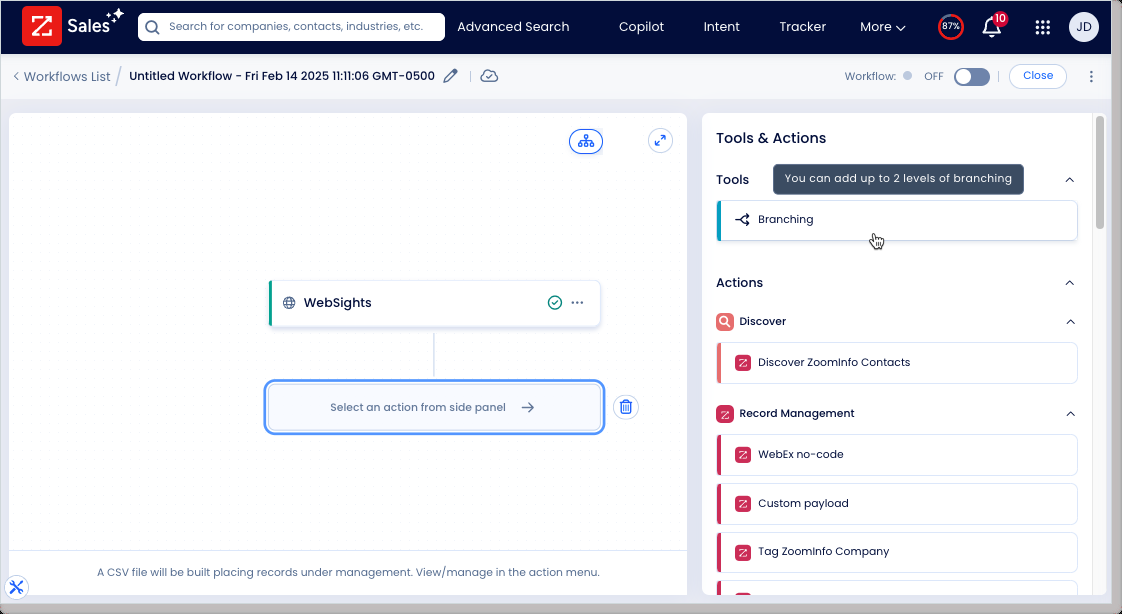
Since a February 2025 update, workflows support conditional branching in a visual builder, up to 10 branches per action, so one workflow can route enterprise leads to one sequence and mid-market leads to another.
The Platform's Modules
Sales
The sales module (formerly SalesOS) bundles the database, intent data, and sales automation tools for prospecting, and it is the entry point for most buyers.
Marketing
The marketing module (MarketingOS) adds ABM tools: audience building, cross channel advertising, and form enrichment so marketing teams work the same records as sales.
Talent
TalentOS points the same database at talent acquisition, letting recruiters search candidates by title, company, and location; recruiting teams use it the way sales teams use the prospecting side.
Operations and Copilot
OperationsOS handles data management: deduplication, enrichment of existing CRM records, and hygiene jobs that keep records up to date.
Copilot, the AI layer added in 2024, drafts outreach and summarizes account activity so a sales representative spends less time researching before a call.
Some competitor comparison pages still describe this lineup as SalesOS, MarketingOS and TalentOS. ZoomInfo renamed the lineup to Copilot, GTM Workspace and GTM Studio, a gap tracked in our report on stale software naming.
What Using ZoomInfo Looks Like Day to Day
For sales teams, the daily loop starts with a saved search: territory, industry, headcount, and seniority filters produce a list of decision makers, and the rep pushes that data directly into the CRM with one click. That one click means a rep can move at the drop of a hat once the list is built.
Intent-flagged accounts surface at the top of the queue each morning, so the first calls of the day go to companies already researching the category.
Real time data on funding rounds and executive moves feeds the alert stream; a rep who sees a new VP of Engineering land at a target account has a reason to call that beats any cold template.
Everything a rep touches feeds the sales pipeline record: exports, dials, and sequence enrollments log against the account, so managers see which lists convert and which sit untouched.
Compared with juggling separate sales tools for lists, dialing, and enrichment, the single-platform loop is the main reason sales teams renew even while complaining about the invoice.
ZoomInfo for Account Based Marketing
Marketing teams run account based marketing (ABM) campaigns from the same records the reps prospect from, which is the point: sales and marketing stop arguing about whose list is right.
An ABM audience built from firmographic and intent filters syncs to advertising and marketing platforms, so display spend concentrates on the decision makers at accounts the sales team wants meetings with.
Form enrichment shortens landing-page forms to one or two fields, with the rest of the record filled from ZoomInfo data on submit; conversion rates rise and the leads arrive with job titles and phone numbers attached. It kills two birds with one stone, lifting conversion while the missing fields fill themselves in on submit.
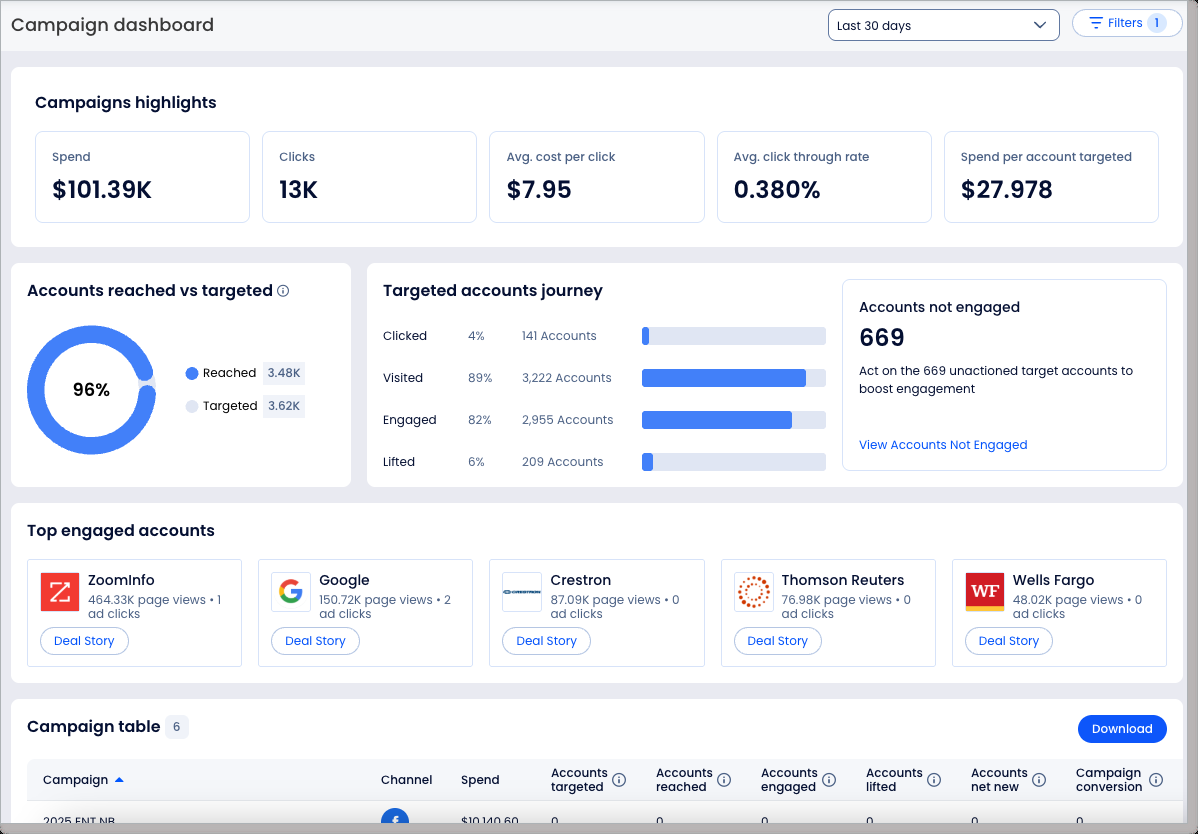
The account based marketing (ABM) reporting then closes the loop, showing which target accounts saw ads, visited the site, and turned into sales pipeline.
Teams already running ABM through a dedicated platform like 6sense or Demandbase mostly use ZoomInfo as the data layer underneath.
Key Features
- Advanced search across contact details, technology usage, department size, and funding data.
- A Chrome extension that enriches data while browsing LinkedIn or a company website, surfacing phone numbers and emails in the side panel.
- Real-time alerts on funding rounds, executive moves, and other events at key accounts.
- Automated data enrichment and lead routing into Salesforce, HubSpot, and marketing automation platforms.
- Conversation intelligence through Chorus, which records and analyzes sales calls; conversation intelligence data feeds coaching and deal reviews.
- Org charts showing reporting lines, so reps can map decision-makers and budget holders inside a target account.


ZoomInfo Compared to Other Platforms
Most buyers shortlist ZoomInfo against a handful of other sales intelligence platforms before signing, and the comparison usually comes down to database depth versus price. That trade-off leaves budget-conscious teams between a rock and a hard place, paying for depth or settling for a thinner database at a lower price.
- Apollo.io undercuts it sharply on price, with a usable no-cost tier; unlike ZoomInfo, it publishes its pricing, though its phone numbers coverage is thinner.
- Cognism leads for teams that expand internationally, with stronger European coverage and GDPR positioning; ZoomInfo's data skews North American.
- 6sense competes on intent signals and account based marketing ABM orchestration.
- Lusha and Seamless.AI serve small businesses that need contact details without an enterprise contract.
- LinkedIn Sales Navigator overlaps on prospecting but supplies no direct-dial phone numbers or emails.
- D&B Hoovers is a compliance and credit-risk research tool first, with no outbound sequencing built in, unlike ZoomInfo's Copilot and Engage.
- RocketReach posts its rates publicly from $19 a month and skips the dialer, intent data, and conversation intelligence ZoomInfo bundles in.
The pattern across comparisons: ZoomInfo wins on database depth and workflow integration for sales and marketing teams, and loses on price, contract flexibility, and international coverage.
↑ FACT SHEETHow Much Does ZoomInfo Cost?
Pricing Structure
ZoomInfo does not publicly list specific prices on its website; the pricing page routes every visitor to a sales conversation, and ZoomInfo pricing is customized based on user count, credit volume, and features.
Third-party pricing guides report that ZoomInfo's pricing starts at around $200 per month for the smallest packages, that a typical professional plan lands near $15,000 per year, and that enterprise plans can exceed $7,000 per month.
The pricing structure runs across three tiered plans, Professional, Advanced, and Elite, with credits governing exports; heavy users purchase additional credits when they run out.
The lack of pricing transparency is the single most common buyer complaint about zoominfo cost, and it makes budgeting harder for a SaaS company comparing quotes. For teams that stack seats and credits without checking the math first, the final invoice can end up costing an arm and a leg.
Is There a Free Trial?
ZoomInfo offers a free trial of the sales platform, and the free trial is the only way to test data quality against your own target list before committing.
A free trial request goes through ZoomInfo's sales team, so expect a qualification call before access.
During a free trial, run the same searches your reps would run daily: export a sample, check the contact details against LinkedIn, and dial a handful of the phone numbers.
The free Community Edition once traded access for email-signature data harvested from users' inboxes; that contributory model is the origin of several privacy complaints covered below.
Budget for the whole first year: implementation time, seat expansion mid-contract, and credit top-ups are the three costs buyers most often fail to model when comparing quotes against the sticker price. The devil's in the details on all three, and the sticker price rarely covers them.
Annual Contracts and Negotiation
ZoomInfo offers annual contracts as the default, and multi-year deals in exchange for discounts; month-to-month is rare.
Annual contracts commonly carry auto-renewal clauses with a notice window, so calendar the cancellation date at signing.
Existing customers report meaningful discounts at renewal when they bring a competing quote from Apollo or Cognism to the table.
ZoomInfo Copilot: The AI Layer
Copilot, launched in 2024, sits on top of the database as an AI layer and does the pre-call work a rep used to do manually: it summarizes an account's recent activity, drafts a first-touch email referencing the trigger event, and recommends which contact to approach first.
The recommendations draw on the same signals the rest of the platform uses, so Copilot is only as sharp as the underlying records; on a well-maintained instance reviewers describe it as a real time-saver, and on a messy one it summarizes stale facts with the same confidence.

Buyers should treat Copilot as a workflow accelerant; the database is still the product.
↑ FACT SHEETNegotiating a ZoomInfo Contract
Because nothing is list-priced, negotiation is part of the purchase, and buyers who treat the first quote as an opening position report meaningfully better outcomes. The ball is in the buyer's court from that first call onward.
- Time the signature to quarter-end, when reps have targets to hit and discounting authority loosens.
- Bring a written competing quote from Apollo or Cognism; it is the single most reported discount lever.
- Start with one module and a capped seat count; expansion is easy, contraction is not.
- Strike or cap the auto-renewal uplift clause, and calendar the cancellation notice window the day you sign.
- Ask what cleanup help and onboarding hours are bundled before paying for services separately.
↑ FACT SHEETData Accuracy: How Trustworthy Is ZoomInfo?
ZoomInfo's data accuracy is generally regarded as strong for North American records but can suffer from outdated information at times, especially for contacts who changed jobs recently.
ZoomInfo data gets re-verified on a rolling basis through machine crawling and a human research team, which is why sales teams treat it as the benchmark that other databases get measured against.
Contact data decays at 25-40% per year across the industry, so no database stays fully up to date; the question is refresh speed, and reviewers rate ZoomInfo above most rivals on it. That refresh speed keeps it ahead of the curve even as decay chips away at every vendor's database.
Users report that finding usable leads still requires significant manual filtering despite the automation, since job titles and companies drift out of date between refresh cycles.
The company's own case studies claim ZoomInfo data drives 39% of pipeline for users and saves 11.5 hours per week on lead generation; treat those as vendor-reported figures. No independent benchmark backs them.
Independent spot checks in reviews put email accuracy well above phone accuracy, and reliable data coverage drops noticeably outside the US.
How Did ZoomInfo Get My Info?
ZoomInfo builds its records from public web pages, company websites, business registrations, data partners, and a contributory network in which users of its free tools shared the contact details found in their email signatures and address books.
If your name, title, and work email appeared in a colleague's inbox signature or on a company site, that is the likely path into the database. For most people, finding their own record feels like it appeared out of the blue, even though the path into it is traceable.
The company profiles business information, never consumer information: work titles and business contacts. It does not collect home addresses or private accounts.
How Do I Get My Info Off of ZoomInfo?
ZoomInfo operates a privacy center at zoominfo.com where anyone can look up their own record and submit a removal request.
The process: search your name and work email in the privacy center, verify your identity through a confirmation email, and select removal; the company states it processes requests within days.
Residents of states with privacy statutes (California under CCPA, plus the EU under GDPR) can also file a formal data subject request, which carries legal deadlines.
What Is the Lawsuit Against ZoomInfo?
The best-known case is Ramos v. ZoomInfo Technologies, a class action filed in 2021 claiming the company used people's names and likenesses in search-engine "teaser" profiles to sell subscriptions without consent, violating state right-of-publicity laws.
ZoomInfo settled the related claims for $29,557,612.50, split across four state classes: $14.23 million for California, $11.69 million for Illinois, $2.3 million for Indiana, and $1.33 million for Nevada. Final approval came on November 13, 2024, and the settlement is not an admission of wrongdoing. Facing the music cost ZoomInfo a multi-million-dollar settlement, admission or not.
A separate class action targeted the Community Edition program, alleging the company intercepted email information from participants' inboxes without adequate consent.
For buyers, the practical takeaway is compliance diligence: if your team markets into states with publicity or biometric statutes, or into the EU, ask ZoomInfo's sales team directly how records for those regions are sourced.
Does ZoomInfo Integrate With Other Tools?
Yes. ZoomInfo integrates natively with Salesforce, HubSpot, and Outreach, and the company reports connections with over 4,000 third-party applications.
ZoomInfo allows data synchronization across sales and marketing systems, so enriched data lands in the CRM, the marketing platforms, and the outreach tool at once.
The platform supports automated data enrichment and lead routing: a form fill arrives, gets matched against the database, and reaches a sales rep with company data attached.
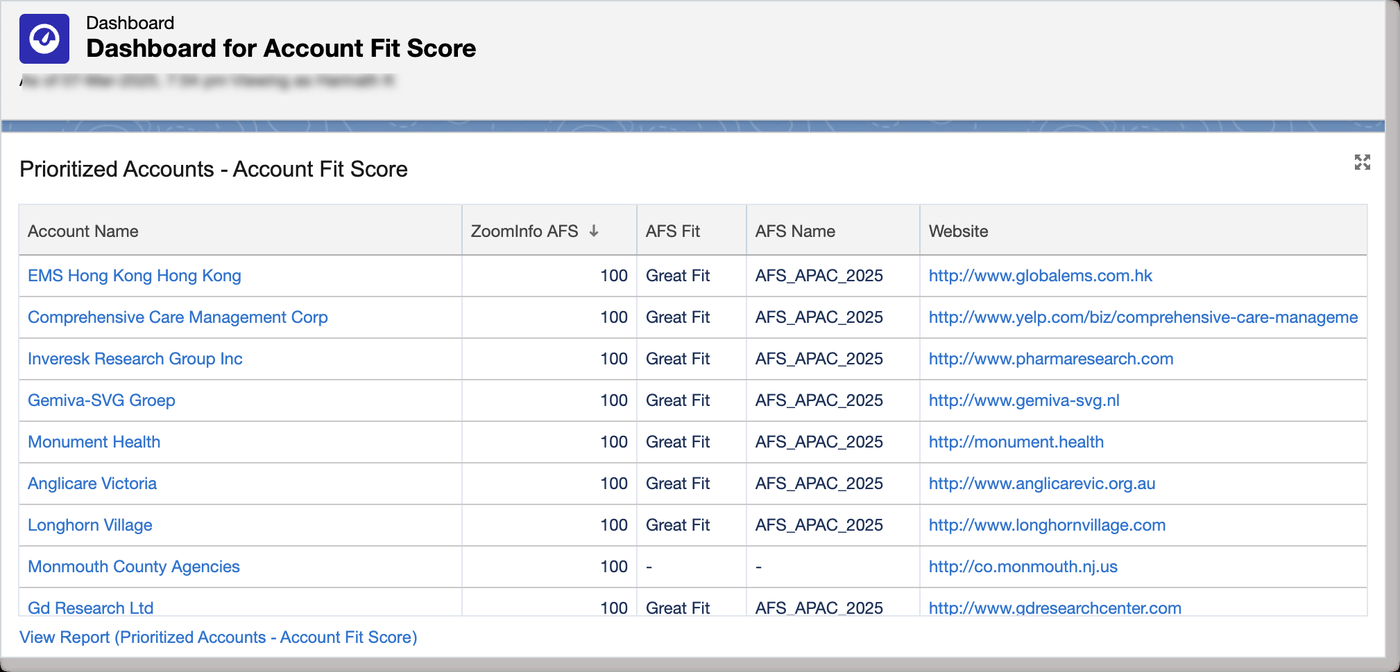
Enrichment jobs can also run on existing records, with data cleanup assistance from ZoomInfo's onboarding team for messy CRMs; that data cleanup assistance matters more than most buyers expect, because enriched data is only as good as the records it merges into. A stitch in time saves nine here, since cleaning the CRM before enrichment beats untangling it after.
Who Is ZoomInfo Best For?
ZoomInfo is primarily designed for mid-market and enterprise teams; it is best suited for enterprise-level companies running outbound sales at volume.
A B2B team with several reps, a Salesforce or HubSpot instance, and a defined target market gets compounding value: the same records feed prospecting, ABM campaigns, and reporting, and help prioritize high value accounts across the whole B2B funnel.
The platform is not typically suited for small businesses or startups due to high costs; small businesses that mainly need contact details get most of the value from Apollo or Lusha at a fraction of the price.
Try it yourself
Sign up for Lusha
Free plan available, credit-based pricing after that.
 Visit Lusha →
May earn a commission if you sign up through this link, at no extra cost to you. Full affiliate disclosure.
Teams selling into Europe should weigh Cognism first, since ZoomInfo's coverage and compliance posture are strongest in North America.
Professional services firms and recruiters fit through TalentOS, which repoints the same database at talent acquisition.
Weaknesses and Limitations
- Pricing transparency is poor: no public prices, a complex credit system, and quotes that vary widely between similar buyers.
- Some users experience issues with outdated contact information, particularly for fast-moving industries and non-US records.
- Auto-renewal terms have caught buyers who missed the notice window.
- Credits run out faster than expected for teams doing heavy exports, forcing them to purchase additional credits mid-contract.
- Email deliverability from exported lists runs below what verified-data marketing suggests, so warm up sending domains before bulk outreach.
- The full suite is more platform than a small team needs; unused modules still get priced into the quote. Small teams end up paying for the whole nine yards even when they only need one module.
User Experience and Onboarding
Steep Learning Curve
Users report a steep learning curve when using ZoomInfo, driven by the number of filters, credits, modules, and admin settings involved.
The steep learning curve mostly affects admins; a sales rep who only searches, exports, and dials gets productive in days, while the automation setup behind the scenes takes weeks.
Onboarding Process
Onboarding includes guided setup for CRM sync, enrichment rules, and routing, with an assigned contact from ZoomInfo's team.
Buyers who assign an internal owner for the rollout, and clean their CRM before enrichment, report much faster time to value in their sales workflows.
Customer Service
Support reviews skew positive for enterprise accounts, which get named customer success managers, and mixed for smaller accounts routed through ticket queues.
The most common complaints concern billing and renewals: unexpected auto-renewals and slow responses on contract questions.
Data disputes, wrong phone numbers, bounced emails, can be flagged in-app for correction, and the research team processes fixes into the live database.
Where Do People Leave Reviews of ZoomInfo?
Most product feedback lands on G2 and TrustRadius, where the platform holds high ratings for contact database depth and integrations, with recurring criticism of pricing and renewals.
Reddit threads in sales communities carry the most candid accounts of negotiations, discounts, and cancellation experiences, and they are worth reading before a first call with a sales representative. It's often information straight from the horse's mouth, more candid than any published case study.
Read the one-star and two-star reviews specifically: the pattern across them is contract friction over data complaints, which tells you where the risk in the purchase sits.
Employee reviews live on Glassdoor and cover a different question entirely; a buyer evaluating the product can skip them, while a candidate interviewing there should not.
Is ZoomInfo Worth It?
For a mid-market or enterprise sales organization with an outbound motion, the answer from most reviewers is yes: the combination of direct contact information, intent data, and CRM automation genuinely compresses sales processes and supports revenue growth targets that depend on outbound pipeline.
For a two-person team, the math rarely works; the actionable data is real, but the same budget covers a lighter tool plus a year of advertising.
The renewal decision is simpler than the purchase decision: pull the export logs, count how many closed deals started from a ZoomInfo record, and divide the contract price by that number. Teams that run this check report it settles the argument in one meeting, in either direction. That simple math hits the nail on the head more reliably than any sales pitch.
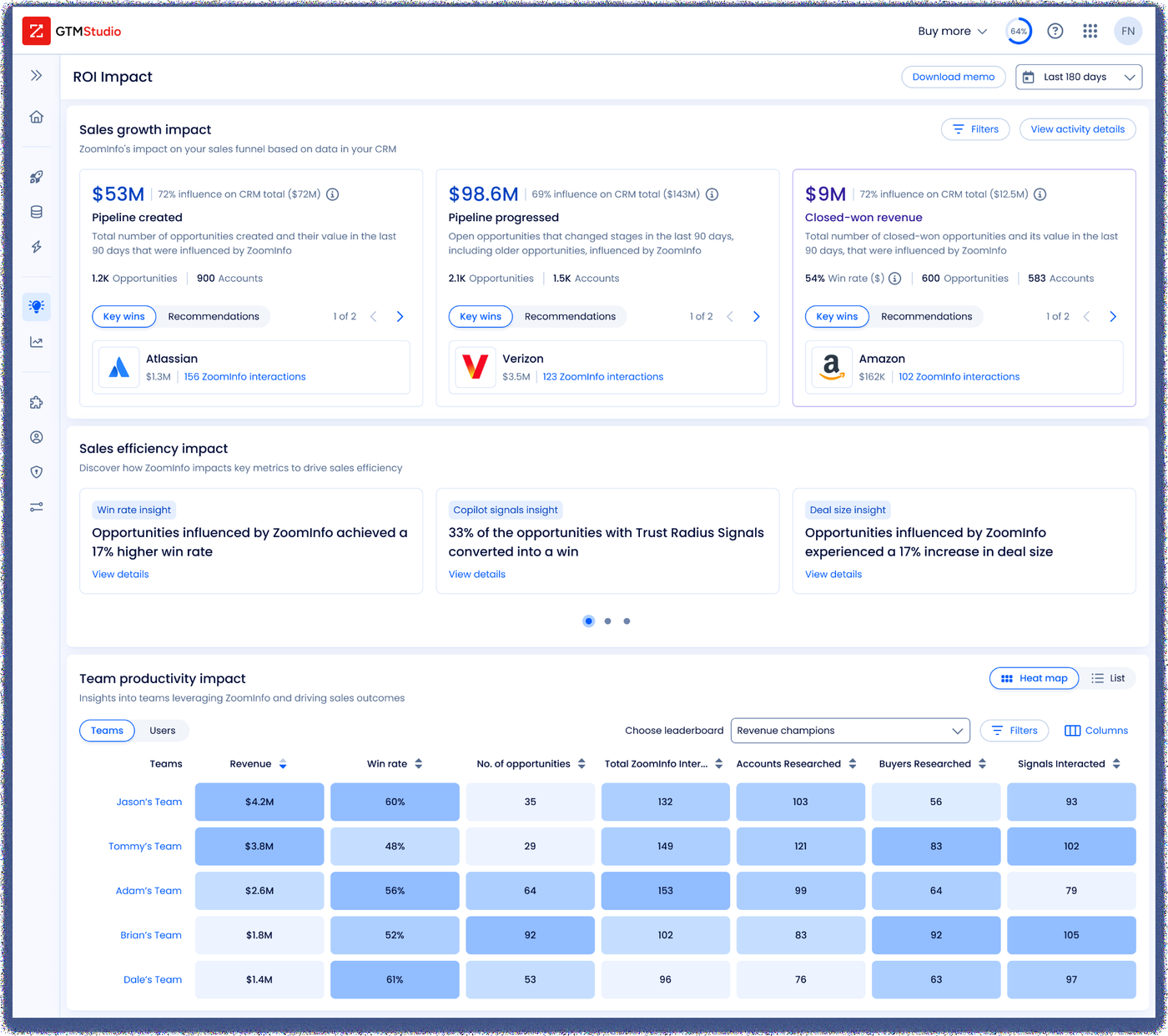
ZoomInfo now does part of that math itself: a Go-To-Market ROI dashboard added in June 2025 ties signals and interactions to opportunities in the CRM, showing which usage rolled up to closed revenue.
The deciding test is the free trial: if the database covers your target market with accurate contact information, ZoomInfo earns its price, and if your market is niche, international, or small-company, the coverage gaps will show up immediately in the trial and save you the contract.
FAQ
What exactly does ZoomInfo do?
It sells searchable business operations data on companies and professionals, direct dials, emails, org charts, tech-stack records, and intent signals, for lead generation, marketing, and recruiting.
How did ZoomInfo get my details?
From public web sources, business records, data partners, and a contributory network that shared email-signature data through its free tools.
How trustworthy is ZoomInfo?
Data accuracy rates high for US records and lower internationally; every database carries some outdated records, so verify before high-stakes outreach.
How do I get my info off of ZoomInfo?
Use the privacy center on the company's site to find your record and submit a removal request, or file a CCPA/GDPR request if you are covered by one.
What is the lawsuit against ZoomInfo?
A right-of-publicity class action over teaser profiles, settled for about $29.6 million across four states with final approval in November 2024. That figure is set in stone now that final approval has closed the case.
What does ZoomInfo cost?
Quotes only. Reports put entry packages near $200 per month, a typical professional plan near $15,000 per year, and enterprise plans above $7,000 per month.
Does ZoomInfo have a free version?
There is a sales-assisted free trial; the old free Community Edition traded inbox data for access and has been wound down.
Is ZoomInfo good for small businesses?
Usually not; the contract minimums outweigh the benefit, and lighter tools cover the need to generate quality leads at that scale. For a small team, it's easy to bite off more than you can chew on contract minimums alone.
Does ZoomInfo work outside the US?
Coverage exists but thins out; teams that expand internationally usually add a Europe-focused provider alongside it.
Is ZoomInfo legal?
Yes; aggregating business contact information from public and licensed sources is lawful in the US, though the 2024 settlement shows state publicity and privacy statutes constrain how that data can be marketed, and GDPR imposes stricter rules in Europe.
Does ZoomInfo notify people when someone views their profile?
No. Subscribers search and export records without any notification reaching the person in the record.
Bottom Line
ZoomInfo remains the reference point in B2B sales intelligence: the biggest verified contact database in the category, real intent data, and automation that moves actionable intelligence into the tools sales and marketing teams already use.
The costs are equally real: opaque pricing, strict yearly contracts, a demanding ramp for admins, and a privacy record that includes a $29.6 million settlement.
Teams with the volume to use it will find the platform focuses their reps on the right accounts and generates quality leads at a pace lighter tools cannot match; everyone else should trial it, benchmark the online behavior signals and data against the other ZoomInfo alternatives, and let the results decide. In the end, actions speak louder than words, so let the trial run make the case the sales pitch can't.
Disclaimer
This page includes one or more affiliate links. If you sign up for a product through one of them, this site may earn a commission at no extra cost to you.