
The numbers Sales intelligence software, checked 5 August 2026
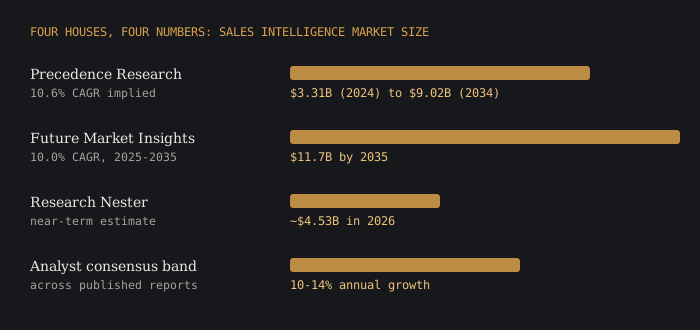
Three published models disagree on the number and agree on the direction: low single-digit billions today, roughly tripling across a ten-year forecast.
Software takes 89% of the spend, so this is a product market with a services tail.
North America holds 46% of revenue while Asia Pacific compounds at 15.2%, which is where the next share shift comes from.
Check which vendors a forecast counts before you quote its market size. The gap between houses is definitional, and one extra year of compounding explains most of the rest.
Sales intelligence vendors quote market size and adoption in every deck. Send the segment or the region and I'll source a version you own.
Sales Intelligence Market: the Key Numbers
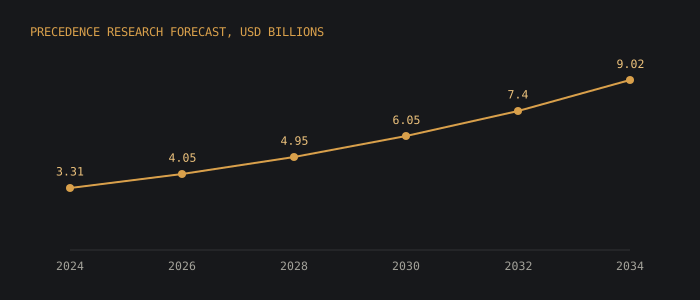
The global sales intelligence market was valued at USD 3.31 billion in 2024 and is projected to reach USD 9.02 billion by 2034, per Precedence Research. Future Market Insights models the same intelligence market at a 10.0% CAGR through 2035, landing at USD 11.7 billion. Research Nester's near-term estimate puts the sales intelligence market size at roughly USD 4.53 billion in 2026.
Growth rate estimates across the published reports cluster between 10% and 14% a year.
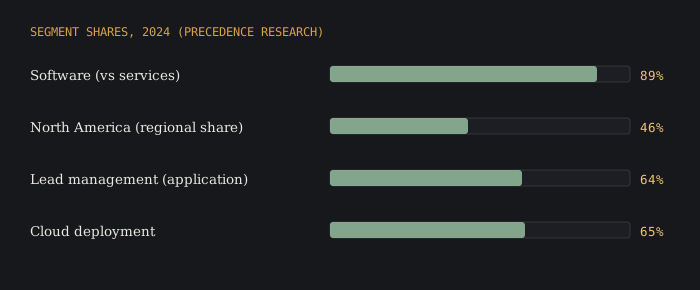
The headline shares, all from Precedence Research's 2024 data: software accounts for 89% of the market against services, lead management holds 64% of the application segment, cloud deployment carries 65%, and North America takes 46% of global revenue. Asia Pacific is the fastest-growing region at a 15.2% CAGR over the 2025 to 2034 forecast period.
What Sales Intelligence Is
Sales intelligence is the practice of collecting and applying data about prospects: who they are, what they use, when they show buying interest, and how to reach them. Sales intelligence tools automate the collection, pulling contact data, company data, and intent signals from multiple sources into a place where sales teams can act on them.
Sales intelligence tools serve the whole selling motion, and the category sits next to customer relationship management; a CRM records customer interactions your team already had, while sales intelligence software supplies the strategic data about accounts you have not touched yet. Relationship intelligence platforms sit between the two, reading the emails and meetings a CRM records to show who on the team knows whom at each account.
That boundary explains most of the market growth. Manual data entry and list-buying were the old way to gather sales intelligence; the current platforms enrich records automatically, score leads by conversion likelihood, and surface buyer intent data before a rep makes the first call.
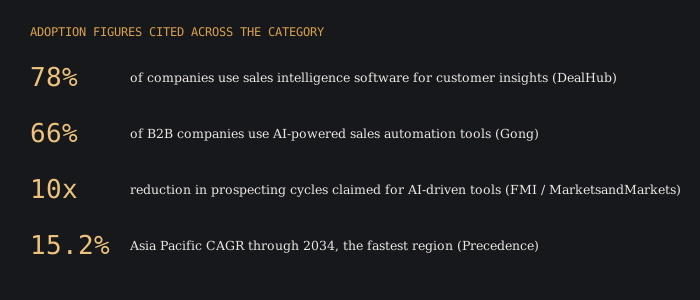
DealHub's glossary puts 78% of companies on sales intelligence software for customer and buying-committee insight, and Gong's category guide reports 66% of B2B companies using AI-powered sales automation.
Copy these lines into an email, fill them in and send. I reply with scope and a price within 2 to 3 business days.
Open the emailMarket Size and Forecast, House by House
Analyst houses disagree on the sales intelligence market size because they draw the intelligence market differently: some count only standalone sales intelligence platforms, others fold adjacent sales tools and sales intelligence services into the global market. The disagreement is informative, so the figures below stay separated by source.
Precedence Research
USD 3.31 billion in 2024, reaching USD 9.02 billion by 2034. The same report sizes the U.S. sales intelligence market at USD 2.93 billion by 2034 and gives Asia Pacific a 15.2% compound annual growth rate over the forecast period.
Future Market Insights
A 10.0% CAGR from 2025 to 2035, ending at USD 11.7 billion. FMI's report names Salesforce Einstein and LinkedIn Sales Navigator as foundational sales intelligence platforms, lists Aberdeen among established vendors, and flags Apollo.io, Clearbit, and Lusha as emerging players. Clearbit has since stopped selling new standalone subscriptions, and our Clearbit pricing report shows what HubSpot charges for its data now.
Research Nester
Approximately USD 4.53 billion in 2026. Useful mainly as a sanity check: it sits between Precedence's 2024 base and its 2034 ceiling, roughly where a 10 to 12% growth path would put the intelligence market this year.
Reading the spread
A USD 2.7 billion gap between the 2034 and 2035 endpoints sounds dramatic and is not: one extra year of compounding at 10% explains most of it. The honest summary of the global sales intelligence market: low single-digit billions today, roughly tripling over a ten-year forecast period, with every published model agreeing on direction and disagreeing on definitions. Our market intelligence reports hub covers why analyst market sizing diverges like this.
Our contract research organization market report runs the same check against ten analyst houses in a different industry, with the same result.
Segment Analysis
Want a segment-share chart like this for your category? Send the segments and the region.
Email a briefSoftware against services
The software segment accounts for 89% of the sales intelligence market. Sales intelligence services, implementation, managed data cleaning, custom research, make up the remainder and grow alongside enterprise deals, where nobody deploys a platform without integration work.
Lead management leads the applications
The lead management segment held 64% market share in 2024, which tracks with what the tools are bought for: lead generation, lead scoring, and routing. Data management is the second pillar; sales analytics and reporting trail behind, partly because CRM vendors already ship advanced analytics of their own.
Cloud against on-premise
Cloud solutions hold 65% share. The analyst argument for cloud is the usual one, no maintenance overhead and effectively unlimited storage, but on-premise deployment is not dying: it is projected to grow at a 12.8% CAGR on the strength of data security requirements in banking, healthcare, and government, where customer data cannot leave controlled infrastructure.
Verticals
Adoption concentrates where deal volume meets account complexity: technology, e-commerce, healthcare, media, and financial services. The same verticals drive demand for data enrichment, since their target markets shift faster than any static database tracks.
Regional Analysis
North America
46% of the global market, anchored by the US figure above. The concentration is supply-side too: ZoomInfo, Salesforce, LinkedIn, Gong and Apollo.io are all American vendors, and the region's sales teams adopted the entire sales process stack earliest.
Asia Pacific
The 15.2% CAGR makes Asia Pacific the growth story of the forecast period. The drivers cited across reports: expanding B2B e-commerce, cloud adoption removing the infrastructure barrier, and sales and marketing teams in India and Southeast Asia building outbound motions from scratch on modern sales tools.
What Is Driving Sales Intelligence Market Growth
AI in the sales process
Artificial intelligence moved from feature to default across the sales intelligence market, and advanced technologies that were premium tiers in 2022 now ship in entry plans. Machine learning models handle lead scoring by analyzing behavioral patterns, and predictive analytics estimates future revenue growth from current pipelines.
FMI and MarketsandMarkets both cite AI-driven sales intelligence tools reducing prospecting cycles by as much as tenfold; the claim deserves skepticism at that magnitude, but the direction matches what vendors ship. Enabling sales professionals to skip research and start conversations is the whole pitch.
Intent data and buying signals
Intent data turned prospecting from alphabetical to prioritized. Platforms monitor research activity across the web and flag accounts showing intent signals for a category, so sales reps call companies that are already looking. Our 6sense review covers the mechanics; ZoomInfo and Bombora sell competing intent feeds.
Conversation intelligence
Gong built a category out of recording sales calls and mining them: which talk tracks close, which pricing objections recur, where deals stall. Conversation intelligence data also feeds coaching and forecasting, which pulls it toward the revenue teams side of the stack.
CRM integration and the tech stack
Every serious sales intelligence platform now ships CRM integration with Salesforce and HubSpot, because sales intelligence data that lives outside the workflow does not get used by sales teams. Data integration with existing systems is the standard evaluation question; a tool that creates a second database creates manual data entry, the exact problem buyers are paying to remove.
Vendor Landscape
- The tool category, region or buyer size to cover
- Regions, years and segments
- Where it runs: blog, white-label, gated or lead magnet
- Whose byline goes on it
- Deadline
- 2,500+ words, human-written
- Every figure linked to its source
- Yours to publish, under your name or none
- Hosting here for +$200, with your sponsored links
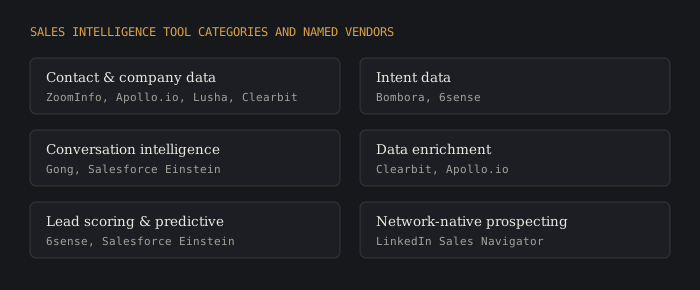
The market splits by data type more than by size. Contact and company data platforms, ZoomInfo, Apollo.io, Lusha, Clearbit, compete on database breadth and data accuracy. Intent specialists (Bombora, 6sense) sell buying signals. Conversation platforms (Gong) mine customer interactions. LinkedIn Sales Navigator is its own category, prospecting native to the network where B2B buyers maintain profiles.
Salesforce Einstein bundles predictive analytics into the CRM itself, which is the strategic threat to everyone else: if the system of record generates valuable insights natively, standalone sales intelligence vendors must beat it on data quality.
Consolidation pressure is visible at the edges. Sales intelligence is merging with revenue intelligence, forecasting, pipeline analytics, and deal risk assessments in one platform, and data quality is becoming the competitive differentiator as AI features commoditize. The sales intelligence tools ranking scores the current field; the reviews section covers individual sales intelligence vendors in depth.
Sales Intelligence Data Types
Sales intelligence data breaks into five working types, and most sales intelligence platforms sell some blend of them.
Contact data is the commodity layer: names, titles, verified emails, direct dials. Firmographic records add size, funding, tech stack, hiring. Intent data captures research behavior across the web. Historical sales data from your own CRM closes the loop, letting machine learning models compare new prospects against accounts that closed. And customer behavior data, product usage, support tickets, engagement, feeds expansion and retention plays after the sale.
The blend matters more than the volume. Advanced sales intelligence tools that combine contact records with intent signals produce actionable insights, call this account this week about this problem, where a plain database produces a list.
The distinction shows up in sales cycles. Reps working intent-flagged accounts enter conversations that customer research has already started, and shorter sales cycles follow from skipping the education phase.
How Sales Teams Use Sales Intelligence
Prospecting and lead generation
The dominant use, matching lead management's 64% application share. Sales teams define their target segments, pull matching accounts from the sales intelligence software, enrich them, and route by lead scoring. Gong's guide lists lead generation, account prioritization, and personalized engagement as the top three uses of sales intelligence tools, and DealHub's adds identifying high-value opportunities through predictive analytics.
Sales performance and forecasting
Sales analytics built on sales intelligence data grades more than individual sales performance, and sales performance reviews increasingly cite tool-sourced numbers: forecasting tools estimate future revenue growth from the current pipeline, and deal risk models flag opportunities going quiet. Conversation intelligence contributes here too, correlating talk patterns with outcomes across thousands of sales calls, which turns coaching from opinion into sales data.
Customer engagement after the close
Sales intelligence solutions increasingly track existing customer behaviors: new hires in the buying committee, funding events, customer behavior signals that precede churn or expansion. The valuable insights are timing insights; improving customer satisfaction is mostly a matter of showing up ahead of the renewal conversation, and customer engagement data tells revenue teams when that is.
Choosing Sales Intelligence Software
Data accuracy first
Every sales intelligence vendor claims accuracy. Test each claim against your own market data before you trust it. Export a sample for accounts your sales professionals already know and count the errors.
Accuracy varies sharply by region and vertical, and the sales intelligence market punishes stale records with bounce rates no discount offsets. Data enrichment quality deserves the same test: feed the engine fifty real inbound leads and grade what comes back.
Fit with existing systems
CRM integration is table stakes; the real question is depth. Does the sales intelligence platform write to your CRM bidirectionally, respect your deduplication rules, and enrich records on a schedule? Data management is where deployments fail; ask how the platform handles data management for duplicates, mergers, and departed contacts, a second database means manual data entry crept back in.
Data integration should also cover the marketing side, since sales and marketing teams sharing one enriched account view is half the argument for buying sales intelligence software at all.
Cost against the sales process
Price the tool against the entire sales process it feeds. Judging it by the license cost alone misses most of the picture. A sales intelligence platform that saves each of twenty sales reps three hours a week of account research pays for mid-tier licensing on labor alone; one that mostly duplicates LinkedIn Sales Navigator data your business growth teams already pay for does not. The ranking lists current pricing where sales intelligence vendors publish it.
Sales Intelligence Market Segmentation Reference
The published sales intelligence market reports segment the category six ways, reproduced here for anyone building a comparison model.
Analysts cut the sales intelligence market six ways.
- Component: software (89%) and services.
- Application: lead management (64%), data management, analytics and reporting, and others.
- Deployment: cloud (65%) and on-premise.
- Organization size: large enterprises hold the larger share, small businesses grow faster from a low base.
- Vertical: technology, BFSI, e-commerce, healthcare, media, and manufacturing.
- Region: North America (46%), Europe, Asia Pacific, Latin America, and the Middle East and Africa.
Two segmentation notes worth carrying into any model. The services share understates services revenue, since implementation work sold by partners lands outside the sales intelligence market size entirely. And the application split is self-reported by vendors whose products span categories; a platform sold for lead generation gets counted there even when the buyer runs it for data management.
Sales Intelligence Market Trends Through the Forecast Period
Consolidation into revenue platforms
The standalone point tool is disappearing from the sales intelligence market. ZoomInfo positions as a go-to-market platform, Gong added forecasting, 6sense added advertising. The pattern mirrors what happened to marketing automation a decade earlier, and it means today's sales intelligence market share table will not match the 2030 edition; expect the global market to concentrate around five or six revenue platforms with data marketplaces underneath.
AI agents doing the work
The current artificial intelligence wave puts agents on top of the data: software that researches an account, drafts the outreach, and updates the CRM without a rep touching it. Vendors call this enabling sales professionals; critics call it replacing them. Either way it changes the unit economics: agent-labor strategies scale with compute, and headcount stops being the constraint. Real time insights get more valuable in that world, and static databases less.
Privacy regulation as the main restraint
GDPR and its successors are the brake on the sales intelligence market growth story. Contact records are personal data in most jurisdictions, consent rules differ by market, and the fragmented regulatory picture is the reason several European sales intelligence vendors sell compliance as the product. Analyst reports list data privacy alongside integration complexity as the two named restraints on market growth over the forecast period.
Sales Intelligence Tools at a Glance
Buyer notes on the sales intelligence tools that recur across every analyst list, condensed from our full reviews of sales intelligence tools and the vendors behind them.
ZoomInfo has the largest B2B database among sales intelligence tools and prices accordingly; sales teams under ten seats usually look elsewhere. Apollo.io bundles engagement with data, which makes it the default among lower-cost sales intelligence tools for teams running the whole sales process in one product. Lusha and Clearbit compete on enrichment speed.
LinkedIn Sales Navigator is the only entry on the list whose data ages with the network itself, and Gong sits apart because conversation recording feeds a different part of the sales process than prospecting does.
Try it yourself
Sign up for Lusha
Free plan available, credit-based pricing after that.
 Visit Lusha →
May earn a commission if you sign up through this link, at no extra cost to you. Full affiliate disclosure.
Two selection notes. First, sales intelligence tools quote per-seat prices but bill for data credits, so the sales intelligence market size a vendor claims for its database matters less than the credits your sales teams burn to reach it. Second, most sales intelligence tools offer trial exports; graded against known accounts, a one-week trial answers the accuracy question better than any review, ours included.
What the Forecasts Leave Out
Three cautions before quoting any of these numbers in a deck. First, the analyst houses selling sales intelligence market reports also sell reports on every adjacent category, and category boundaries move between editions; a market that "grew" 14% may have absorbed a segment that was counted separately last year. Second, the adoption statistics come from vendors: DealHub and Gong publish useful data, and both sell into the market they measure.
Third, none of the public summaries disclose sample sizes or survey methodology, which is the same complaint we document for market intelligence reports generally.
What survives the caveats: real spending growth in the high single to low double digits across the global sales intelligence market, a decisive shift of sales efforts toward data-first prospecting, and effective sales strategies increasingly built on sales intelligence tools. Market trends this consistent across four independent forecasts of the intelligence market rarely reverse inside a forecast period.
Marketing teams follow the same curve a year or two behind, which is why the category keeps drifting toward combined sales and marketing platforms serving both.
Common Questions
How big is the sales intelligence market?
Between USD 3.31 billion and USD 4.53 billion today depending on the source and year: Precedence Research's 2024 base is 3.31, Research Nester's 2026 estimate is 4.53. The sales intelligence market size question always needs a source and a date attached, because the sales intelligence market definition moves between reports.
What is the growth rate of the sales intelligence market?
10% to 14% annually across published forecasts. Precedence Research implies roughly 10.6% through 2034; Future Market Insights models 10.0% through 2035. Sales intelligence market growth concentrates in Asia Pacific at 15.2%, with North America growing slower off the largest base.
What is the difference between CRM and sales intelligence?
A CRM stores what your business already knows: accounts, contacts, customer interactions, pipeline. Sales intelligence supplies what it does not: fresh contact data, intent signals, org charts, and real time insights about accounts before first contact. The two connect through CRM integration, and neither replaces the other; AI is changing how both work without changing which one you need.
What is sales intelligence software used for day to day?
List building with accurate contact data, lead generation against defined target markets, enriching inbound leads, prioritizing by intent, and improving customer satisfaction and customer engagement after the sale by flagging expansion signals. Sales professionals use it at the top of the funnel most, which is why lead management dominates the application mix.
How does market intelligence relate to sales intelligence?
Market intelligence in sales is the wider lens: industry trends, competitor moves, market trends across the category. Sales intelligence is account-level and transactional. A sales intelligence platform tells you which company to call today; market intelligence tells you if the segment those companies sit in is worth a territory. Effective sales strategies and marketing strategies draw on both, and the annual reports and public filings that feed one often feed the other.
Which sales intelligence solutions fit small teams?
Apollo.io and Lusha price entry tiers for small sales teams; ZoomInfo and 6sense assume enterprise budgets. The honest sizing question is data coverage in your region and vertical ahead of seat price, because cheap sales intelligence solutions with stale contact data cost more in bounced outreach than they save. Improving sales productivity starts with clean records, and gather sales intelligence from a trial export before signing anything for business growth reasons.
Sources: Precedence Research, Future Market Insights, Research Nester, MarketsandMarkets, Gong, DealHub sales intelligence publications, 2024 to 2026 editions.
Disclaimer
This page includes one or more affiliate links. If you sign up for a product through one of them, this site may earn a commission at no extra cost to you.
Data vendors, sales tech investors and RevOps agencies use reports like this one in pitch decks and analyst briefings.
A report on your topic for a blog page, gated content or a lead magnet.
Written for your client and published under their brand, with my name left off.
Your report on marketintelligencetools.com, with 2 to 3 CTAs carrying your sponsored links.
Default terms: the report is yours to publish, and I keep the right to republish it on this site behind a gate, outside Google's index.