Predictive Intelligence Software: 10 Platforms Ranked for 2026
 By Jan Suski. I go deep on every review, checking every number against its source and digging up details other coverage misses, a habit from six years of SEO and link building for tech companies. Bylines at Surfer, Brand24, and Senuto. How the scoring works.
Quick comparison of predictive analytics platforms
Ten platforms with the figure that best tells you how each is priced and built, the lowest cost a buyer can verify without a sales call, and the buyer each fits. Rows link to the full entry below.
| # | Provider | Telling figure | Entry price | Best fit |
|---|---|---|---|---|
| 1 | Databricks | $333,333/yr Vendr median, 205 purchases* | DBU pay-as-you-go | Enterprise teams training at lakehouse scale |
| 2 | DataRobot | $212,021/yr Vendr median* | Quote only | Automated model search, no engineering build |
| 3 | Dataiku | $159,648/yr Vendr median* | $0 Free Edition | Mixed coder/analyst teams, one platform |
| 4 | SAS Viya | No Vendr median found | Quote only (ELA) | Regulated industries needing an audit trail |
| 5 | Qlik | 4 published price tiers | $300/mo (10 users) | BI teams bolting prediction onto dashboards |
| 6 | Alteryx | $3,000/yr published seat price | $250/user/mo | Analysts automating data-prep-to-prediction |
| 7 | SAP Analytics Cloud | No published rate found | Quote only | SAP shops forecasting inside planning |
| 8 | Altair AI Studio | $10B Siemens acquisition, Mar 2025 | Quote only (Altair Units) | Visual model-building before IT handoff |
| 9 | H2O.ai | H2O-3 core is Apache-licensed | $0 open source | Technical teams prototyping before paying |
| 10 | Julius AI | Cheapest published entry here | $20/mo | Plain-English questions of a spreadsheet |
Medians marked * are anonymized buyer-reported contract values published by Vendr. Everything else is the price or figure the vendor publishes itself.
Where these figures come from
Pricing and feature figures are each vendor's own published pages, read 13 October 2026. Medians marked * come from the header stats on each vendor's Vendr marketplace page, read the same date. SAS Viya, SAP Analytics Cloud and Altair AI Studio publish no seat rate on their own domains and carry no Vendr listing either, so those three rows just read "quote only."
Alteryx, Dataiku, DataRobot and SAS also sit on our data mining tools ranking, alongside Altair AI Studio under its older RapidMiner name. That page scores the same four as data-prep-to-model workbenches; this one scores all ten as predictive intelligence platforms end to end, training scale and governance included.
A narrower slice of the category, scoring tools built specifically for sales pipelines, sits on the predictive sales analytics software ranking.
Predictive analytics software turns historical data into a forecast: a churn score, a demand curve, a fraud flag. IBM names the same three algorithms as the field's core toolkit: linear regression, decision trees and neural networks.
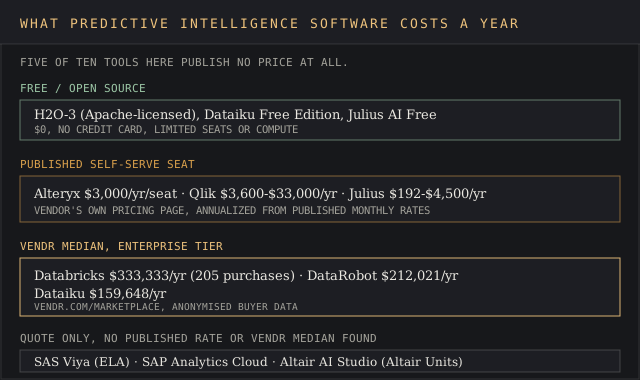
This guide ranks ten predictive analytics platforms built on that toolkit, from Databricks' lakehouse-scale training clusters down to Julius AI's $20-a-month chat interface. Five of the ten publish no price at all, so the pricing notes below do the legwork a sales call usually hides behind "contact us."
The list suits data engineers picking a predictive analytics training platform, BI leads who want a forecast inside a dashboard they already use, and analysts weighing a $3,000-a-year seat against a six-figure contract. Cut to the chase: buy on the criteria below. A vendor's claim about itself doesn't count.
Evaluation criteria for predictive analytics platforms
Five criteria decide the predictive analytics shortlist, applied in this order below. Each one resolves to a yes, a no, or a number; the devil's in the details, so a vendor's own adjective never counts as an answer.
1. Price traceability
A published seat rate, or an independent median from Vendr. Five of ten tools here fail this test and sell only by quote. Where neither exists, treat the gap itself as a data point: a vendor that won't put a number in writing is pricing to your account size, with no published tier behind it.
2. AutoML and no-code depth
Can a non-programmer build and score a model start to finish, per the vendor's own documented workflow? Run the vendor's own quickstart on a dataset you already know and time how long it takes to produce a usable score; a sales demo only shows what the vendor wants you to see.
Ask for the vendor's own documented no-code tutorial, skip the sales demo, and try to build one model from it yourself before signing. A workflow that needs a solutions engineer to finish isn't no-code.
3. Compute and data scale
Documented distributed or elastic training against big data. A fixed row-count ceiling fails this test. Ask for the largest customer dataset the vendor has trained against in production; a slide's theoretical ceiling is a different number entirely.
4. Governance and deployment maturity
A named model-versioning system, audit trail, or published support SLA, on the record. A platform with no named versioning system puts the burden of reproducing last quarter's model back on your own team, usually discovered the first time an auditor asks for it.
5. Independent review volume
How many G2, Capterra or TrustRadius reviews back the rating for a predictive AI purchase, and what they say once you read between the lines of the marketing copy. A thin review count with a perfect score is a smaller sample than it looks, and worth more scrutiny than a 4.4 from two thousand buyers.
Platforms here with no published seat rate and no Vendr median tracked: DataRobot, SAS Viya, SAP Analytics Cloud and Altair AI Studio carry no number at all, and H2O.ai's enterprise tier joins them above its free core.

Top 10 predictive intelligence platforms, ranked
Ranked on price traceability, AutoML and no-code depth, compute and data scale, governance and deployment maturity, and independent review volume, applied in that order.
Databricks
Best fit
Enterprise teams training predictive models directly against lakehouse-scale data without moving it first.
Databricks runs Spark-based distributed machine learning training over Delta Lake, with MLflow tracking every model version across AWS, Azure and GCP. Vendr puts the median annual contract at $333,333 across 205 tracked purchases, ranging $31,630 to $1,936,313.
Key features
- Delta Lake, shared by data engineering and ML
- MLflow model tracking and versioning
- Distributed, Spark-based training at any scale
- Multi-cloud: AWS, Azure, GCP
Pricing
Billed per-second on Databricks Units (DBUs), pay-as-you-go, no flat rate; committed-use contracts earn a discount, though the $333,333 Vendr median is the real budget anchor.
Pros
- Scales to arbitrary data volume
- One platform for engineering and training
- Multi-cloud procurement
Cons
- DBU billing is hard to forecast upfront
- Requires engineering skill most analysts lack
- Breadth of tools is its own learning curve
A Capterra reviewer, a data engineer in financial services, wrote:
"Can get expensive as usage scales."
Data engineer, financial services, Capterra review, 31 March 2026
Why it's ranked #1. Databricks beats DataRobot on compute and data scale: DBU-based clusters train against any data volume, where DataRobot's leaderboard works inside a bounded AutoML workflow. Its $333,333 median contract is the highest here, the price of staying ahead of the curve at that scale.
DataRobot
Best fit
Teams wanting automated predictive analytics model search and deployment without Databricks' engineering overhead.
DataRobot automates feature engineering and ranks the resulting predictive models on a leaderboard, with governance and observability modules for production use, and Vendr tracks a $212,021 median contract, ranging $24,000 to $230,400.
Key features
- Automated machine learning feature engineering and leaderboard
- AI Governance for model risk oversight
- AI Observability for drift monitoring
- One-click deployment to a scoring endpoint
Pricing
Sold entirely by quote through the Enterprise AI Suite; no published seat rate exists on datarobot.com, so the $212,021 Vendr median stands in.
Pros
- Fastest path from raw data to a scored model
- Governance tooling built for regulated use
- Leaderboard format is legible to non-specialists
Cons
- Last disclosed funding round, Nov 2020: $270 million led by Altimeter Capital, valuation above $2.7 billion, nothing newer on record
- A TrustRadius reviewer scored it 1 of 10 on March 22, 2022
- G2 lists 47 reviews, thinner than Alteryx's 908 or Qlik's 929
That TrustRadius reviewer, an engineer in manufacturing at a pharmaceutical company, wrote:
"It was oversold by their sales guy," and "the main drawback is the pricing structure."
Engineer, manufacturing, pharmaceutical company, TrustRadius review, 22 March 2022
Why it's ranked #2. DataRobot loses to Databricks on scale but beats Dataiku on AutoML depth: its leaderboard automates feature engineering by default at a $212,021 median contract, where Dataiku's AutoML is one module inside a broader platform priced lower.
Dataiku
Best fit
Mixed predictive analytics teams of coders and analysts who don't want to stitch five tools together.
Dataiku's "click or code" pitch holds, giving a mixed team the best of both worlds: visual recipes and Python or R scripts share one pipeline, with AutoML, MLOps monitoring and an LLM Mesh add-on. Vendr's median is $159,648, the lowest of the three AutoML platforms here, ranging $6,909 to $334,860.
Key features
- Visual and code recipes in one flow
- AutoML module for training
- MLOps monitoring in production
- Govern module for oversight (paid tiers)
Pricing
A free, self-installed Free Edition runs on Mac, Linux and Windows; a 14-day cloud trial gives two users 4 CPUs and 32 GiB, though paid tiers need a sales call.
Pros
- Real $0 entry with no feature cuts
- Blends code and no-code in one pipeline
- Lowest Vendr median of the three AutoML platforms
Cons
- Govern and advanced LLM Mesh excluded from the free trial
- On-premises pricing has no public figure
- Requires comfort switching between visual and code work
An engineer at a mid-sized company wrote on TrustRadius:
"Dataiku is an awesome tool for data scientists. It really makes our lives easier."
Engineer, mid-sized company, TrustRadius review, 10 November 2025
Why it's ranked #3. Dataiku loses to DataRobot on AutoML depth but beats SAS Viya on price traceability: it publishes a real free tier and a $159,648 Vendr median, where SAS Viya sells only through an Enterprise License Agreement with no public rate anywhere.
SAS Viya
Best fit
Regulated industries, banking, insurance, pharma, already running SAS and needing an audit trail.
SAS Viya layers open Python and R APIs on top of SAS's own procedures. Model Studio's champion-challenger workflow for predictive models gives risk teams an audit trail few AutoML tools document to the same depth.
Key features
- Model Studio, champion-challenger governance
- Legacy SAS 9 integration via Compute Server
- In-database scoring for production
- Open Python and R APIs alongside SAS procedures
Pricing
Sold exclusively through an Enterprise License Agreement; SAS publishes an ELA price catalogue but no itemized seat rate, and no Vendr listing for Viya specifically turned up.
Pros
- Decades of governed modeling behind every output
- Audit trail built for regulators from day one
- Runs alongside an existing SAS estate
Cons
- Licensing cost comes up repeatedly as steep for smaller teams
- Migrating off an older SAS stack is its own project
- No public number to compare against the other nine
A risk analyst in financial services reviewed it on Capterra:
"Licensing/cost can be high for smaller teams," and migration "can be complex and time-consuming."
Risk analyst, financial services, Capterra review, 19 August 2025
Why it's ranked #4. SAS Viya loses to Dataiku on price traceability but beats Qlik on governance depth: Model Studio's audit trail has no equivalent documented on Qlik's $2,750-a-month Premium tier, where its AutoML add-on lives.
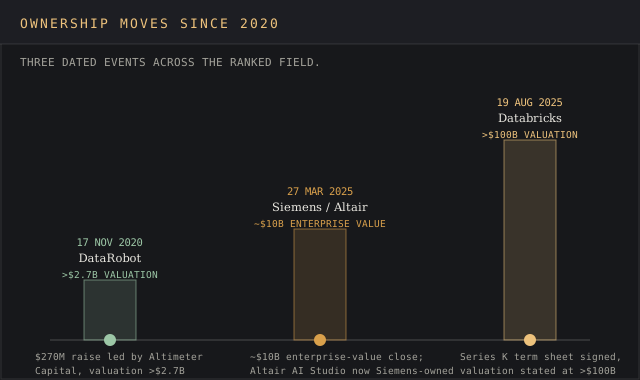
Altair AI Studio changed owners in 2025 and DataRobot hasn't disclosed a funding round since 2020. Neither fact shows up on a pricing page, and both belong in the same due-diligence pass as the quote itself.
Qlik
Best fit
BI teams bolting predictive analytics scoring onto dashboards they already have open.
Qlik Cloud Analytics publishes four tiers, more pricing transparency than any other tool here: Starter from $300/month for 10 users, Standard from $825, Premium from $2,750, and a custom Enterprise quote starting at 250 GB, though automated machine learning only unlocks at Premium.
Key features
- Associative engine for cross-filtering
- AI-powered Answers Agents, MCP Server access
- Automated ML predictive analytics (Premium+)
- Native SAP data extraction connector
Pricing
Starter $300/month (10 users, 5 GB app cap); Standard $825/month; Premium $2,750/month adds the predictive module; Enterprise custom from 250 GB.
Pros
- Four published price points across its tiers
- Prediction sits inside a BI tool analysts already use
- Starter tier is cheap enough to try right away
Cons
- Predictive ML locked behind the $2,750 Premium floor
- Starter's 5 GB app cap rules out larger datasets
- Automated ML is newer than SAS Viya's statistical depth
A project manager in IT at a large company wrote on TrustRadius:
"Qlik is critical in the business analytics domain because of its capability to collect huge amount of data."
Project manager, IT, large company, TrustRadius review, 20 November 2025
Why it's ranked #5. Qlik loses to SAS Viya on governance depth but beats Alteryx on pricing transparency: it publishes four tier prices, where Alteryx shows only a $250 Starter seat and gates the rest behind "Contact Sales."
Alteryx
Best fit
Analysts needing repeatable data-prep-to-prediction workflows without writing Python.
Alteryx extends its drag-and-drop ETL into predictive workflows without a new language. Starter publishes a real price, $250 per user per month billed annually, confirmed on alteryx.com and its own G2 listing; Professional and Enterprise both read "Contact Sales."
Key features
- Drag-and-drop canvas for machine learning prep and modeling
- Geospatial and macro tooling (Professional+)
- 100-plus data connectors (Professional+)
- Agent Studio automation (one concurrent run on Professional)
Pricing
Starter $250/user/month, billed annually ($3,000/year/seat); Professional and Enterprise both quote-only, with 50 and 15,000 automation runs included respectively.
Pros
- Cheapest published entry for a genuine predictive workflow
- No-code canvas built for an analyst's skill level
- "User friendly... low code" recurs across its reviews
Cons
- Professional's real price stays under the radar until a sales call
- A 2026 reviewer called the upfront cost "a hurdle for smaller teams"
- Advanced geospatial tools sit behind that same unpublished tier
Derrick, a Capterra reviewer in the wireless industry, wrote:
"The initial cost can be a hurdle for smaller teams."
Derrick, wireless industry, Capterra review, 7 June 2026
Why it's ranked #6. Alteryx loses to Qlik on tier-by-tier pricing but beats SAP Analytics Cloud on reviewer-validated ease of use: reviewers call its $3,000-a-year Starter tier "user friendly... low code," where SAP's reviewers need their own IT department to build a KPI view.
SAP Analytics Cloud
Best fit
Existing SAP shops wanting predictive forecasting inside their financial planning suite.
Smart Predict runs automated time-series, classification and regression models directly against SAP BW or S/4HANA data, with what-if simulation against live planning scenarios.
Key features
- Smart Predict: machine learning time-series, classification, regression
- Native SAP BW and S/4HANA access
- Embedded in SAP's planning and BI suite
- What-if simulation on live plans
Pricing
No public per-user rate on sap.com; sold through SAP's sales organization and partners by quote only.
Pros
- Prediction sits inside the finance cycle teams already run
- Native SAP access skips a separate ETL layer
- One less vendor for an SAP-heavy company
Cons
- No published price exists anywhere on sap.com
- Reviewers flag both expense and complexity directly
- One reviewer says business units can't self-serve a KPI view
John Wachira, a group IT manager, reviewed it on TrustRadius:
"SAP Analytics Cloud works well but can be expensive."
John Wachira, group IT manager, TrustRadius review, 21 May 2026
Why it's ranked #7. It loses to Alteryx on ease of use but beats Altair AI Studio on documented support: it runs inside SAP's published BTP governance structure, where Altair AI Studio's licensing has carried no equivalent documentation even after Siemens' 2025 acquisition closed at roughly $10 billion.
Altair AI Studio
Best fit
Teams wanting a visual predictive AI workbench to train and compare models before handoff to IT.
Altair AI Studio is the renamed RapidMiner Studio, now sold under Siemens after Siemens closed its roughly $10 billion acquisition of Altair, announced March 27, 2025, though the visual workflow designer underneath is unchanged.
Key features
- Visual workflow designer for models
- Broad native database connectivity
- Automated model validation in-canvas
- Tied to Altair's wider simulation and artificial intelligence portfolio
Pricing
Licensed through "Altair Units," a currency shared across Altair's products; no published seat rate exists, so cost depends on other Altair holdings.
Pros
- Reviewers call it fast at reading varied databases
- Long track record under the RapidMiner name
- Now backed by Siemens' support structure
Cons
- Altair Units licensing is opaque next to a flat rate
- Most reviews predate the Siemens acquisition
- The jury's still out on support quality under the new owner
A founder and data scientist wrote on TrustRadius:
"It is easy to use. It provides exceptional performance."
Founder and data scientist, TrustRadius review, 16 August 2018
Why it's ranked #8. Altair AI Studio loses to SAP Analytics Cloud on governance maturity but beats H2O.ai on deployment packaging: the roughly $10 billion Siemens acquisition, closed 27 March 2025, now backs it with an enterprise support structure, where H2O.ai splits between a self-supported free core and an unpriced enterprise tier.
H2O.ai
Best fit
Technical teams who already know the ropes of Python or R and want a free predictive AI engine before they pay anything.
H2O-3, the Apache-licensed open-source core, documents a real algorithm library: gradient boosting, random forest, GLM, deep learning, k-means, via Python or R, the building blocks most teams use to train predictive models, while Driverless AI and H2O-3 Secure both sell by quote.
Key features
- GBM, random forest, GLM, deep learning, k-means
- Python and R APIs for the open-source core
- Driverless AI automated feature engineering (enterprise)
- h2oGPTe for generative artificial intelligence add-ons
Pricing
H2O-3 is free, Apache-licensed; Driverless AI and H2O-3 Secure require a sales call, with no published rate found.
Pros
- A complete algorithm library, free in full
- Runs on low memory, about 2 GB, per reviewers
- Open-source license means no lock-in on the core
Cons
- A 2017 reviewer called it flatly "not user friendly"
- Driverless AI has no price to weigh against the free core
- Python or R fluency is effectively required
A Capterra reviewer in banking wrote:
"It is really fast and run on really low memory like 2 GB."
Reviewer, banking, Capterra review, 27 May 2019
Why it's ranked #9. H2O.ai loses to Altair AI Studio on deployment packaging but beats Julius AI on model-building depth: H2O-3's library documents five named algorithm families, from gradient boosting to k-means, where Julius AI writes statistical code on request and offers no dedicated training workflow.
Julius AI
Best fit
Individuals asking a plain-English question of a spreadsheet, no setup required.
Julius AI wraps frontier artificial intelligence language models in a chat interface that writes and runs its own statistical and plotting code against uploaded data. Free costs $0 with no strings attached beyond a daily credit cap, running up through Business at $450/month for 50 seats.
Key features
- Chat interface over uploaded spreadsheets and databases
- Frontier LLM backends named on its pricing page
- Unlimited chart generation on every paid tier
- Postgres, BigQuery, Snowflake connectors (Business tier)
Pricing
Free $0; Plus $20/mo ($16 annual); Pro $45/mo ($37 annual); Max $200/mo ($166 annual); Business $450/mo ($375 annual); Enterprise by quote.
Pros
- Cheapest published entry point on this list
- No setup or modeling knowledge needed for a first answer
- Scales from free up to a 50-seat team plan
Cons
- Answers questions about data; doesn't train a model
- Its own pricing page mismatches tier names, table versus cards
- Not built for an auditable, production-deployed model
A Hacker News commenter, Hansenq, wrote:
"If you're looking for a more powerful version of ChatGPT Data Analysis, I recommend julius.ai."
Hansenq, Hacker News, 16 May 2024
Why it's ranked #10. Julius AI loses to H2O.ai on model-building depth: it answers questions about data and doesn't train or deploy a named model. That's exactly why it's the pick for a fast $20-a-month answer and the one to skip for a governed, production model.
What predictive analytics software does
Every platform here runs the same basic loop on big data and small: feed it historical data and customer data, and let machine learning algorithms, usually linear regression, logistic regression, neural networks or a decision-tree variant, find patterns in structured data. The output is a generated prediction about what comes next, a forward-looking number a plain report never produces.
AtScale notes that data quality issues and missing values skew the results. Data cleaning and data preparation aren't optional steps here; they're most of the work before a model ever trains on sales data or any other input.
The use cases cluster around a short list of industries. In finance, predictive AI drives fraud detection and credit risk scoring on transaction data. In retail, it feeds demand forecasting and inventory management, tying into supply chain management upstream.
In marketing, predictive AI and the same analytics tools score customer churn and forecast campaign results from customer behavior and user behavior signals. In manufacturing, statistical analysis underpins predictive maintenance. Insurance claims management runs a version of the same fraud-detection logic.
None of this is prescriptive analytics, which recommends an action once the forecast lands, and none of it is generative AI. Large language models write new text or code; predictive models estimate a number or a category from data analytics already in hand. Business intelligence and artificial intelligence overlap here, but a BI dashboard that only reports what already happened isn't doing the same job as a model trained to anticipate what's next.
Where predictive analytics software fits inside a BI stack
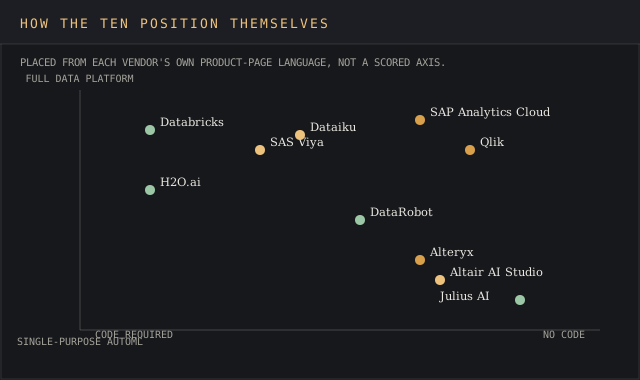
In a nutshell, the ten tools split into three real categories. Databricks, DataRobot, Dataiku, H2O.ai and SAS Viya are dedicated modeling platforms built on the algorithms IBM names as predictive AI's core: neural networks, decision trees, linear and logistic regression, k-means clustering.
Qlik and SAP Analytics Cloud are BI platforms with prediction bolted onto a dashboard teams already have open. Alteryx and Altair AI Studio sit between the two, no-code workbenches aimed at an analyst's skill level. Julius AI stands apart: a chat interface over a language model. It isn't a model-training platform at all.
What a quote-only price usually hides
SAS Viya, SAP Analytics Cloud, Altair AI Studio, DataRobot and H2O.ai's enterprise tier publish no price at all, pushing cost discovery onto the buyer. Where a Vendr median exists, it runs from $159,648 at Dataiku to $333,333 at Databricks, a gap wide enough to fund two smaller tools on this list for a year. Ask for that median before the first sales call.
A Vendr median gives a starting point for negotiation and a hard number to anchor a counteroffer to. Walking into a DataRobot or Databricks call already holding the tracked median, the purchase count behind it, and the low end of the published range turns a one-sided quote into something closer to a two-sided negotiation. A sales team that knows you've seen the range tends to open closer to it.
How to evaluate a predictive analytics platform before you buy
- Pull a dataset you already understand, 10,000 to 100,000 rows, and run it through every shortlisted platform's own no-code or AutoML workflow. Time how long it takes to reach a scored model; a demo screen measures something else.
- Price year one in full: seat or DBU cost, onboarding, and the overage pricing on credits or compute, before the first negotiation call. A Vendr median is a floor for that conversation, and usually well short of the final number.
- Ask each vendor for its largest production customer's data volume, and for the documented API rate limit on the scoring endpoint you'd call in production.
- Check the model-versioning and audit-trail story in writing. "Enterprise-grade governance" on a slide means nothing without a named feature behind it.
- Read the most recent 20 reviews on G2 or TrustRadius, skipping the oldest and the most-upvoted. Pricing and support complaints both tend to track the vendor's current ownership and product stage more than its history.
Send the same 10,000-row dataset to every platform on your shortlist and compare wall-clock time to a usable model. That one test surfaces the AutoML-depth gap between these ten faster than any sales deck.
Teams that skip the free tiers entirely end up paying for scale they haven't proven they need yet. Dataiku, H2O-3 and Julius AI all let you run that first test for $0, which is reason enough to start there even if the eventual platform costs six figures.
Free and low-cost predictive intelligence tools
Three of the ten carry a genuine $0 entry with no feature cuts that matter for a first project.
- Dataiku's Free Edition installs locally on Mac, Linux or Windows and keeps the same visual-and-code pipeline as the paid tiers, just capped on scale and the Govern module.
- H2O-3's Apache-licensed core ships the same gradient boosting, random forest, GLM, deep learning and k-means algorithms the enterprise Driverless AI tier automates, just without the automated feature engineering layer.
- Julius AI's Free plan answers a bounded number of questions a day against an uploaded spreadsheet, with no training workflow behind it at any price.
Tools here with a real, feature-complete $0 tier: Dataiku, H2O.ai and Julius AI. Alteryx's cheapest tier is $250 a month, and the other six publish no free way in at all.
None of the three free options trains against the data volume Databricks or DataRobot handle. That's exactly why they rank where they do: the right place to validate a use case before a six-figure contract, never a substitute for one at that scale.
Predictive intelligence software FAQ
What does predictive analytics aim to do?
It uses historical and real-time data, run through statistical models and machine learning, to forecast a specific outcome: customer churn, demand, fraud.
Predictive versus prescriptive analytics?
Predictive forecasts what's likely; prescriptive, a step most tools here don't fully automate, recommends what to do about it.
Is predictive analytics the same as forecasting?
Forecasting is one output, usually time-series based. Predictive analytics also covers classification and scoring, which aren't forecasts in the traditional sense.
Generative versus predictive AI?
Generative AI creates content; predictive AI estimates a future value from past data. Julius AI blurs the line by using a language model to write the code that predicts.
Will AI replace BI analysts?
None of the ten platforms here remove the analyst's job. Each still needs someone to frame the question, check the model's assumptions and act on the score it returns. The software picks up the slack on computation; judgment still belongs to a person.
How much does predictive analytics software cost?
From $0 on H2O-3's open-source core or Dataiku's Free Edition to a $333,333 Vendr median contract at Databricks, with Julius AI's $20-a-month Plus tier and Alteryx's $250-a-month Starter seat as the cheapest paid entries in between.
What's the difference between predictive analytics software and business intelligence software?
Business intelligence reports what already happened; predictive analytics software trains a model to estimate what happens next, using the same historical data a BI dashboard already shows.
Bottom line
Databricks lets a team already working at lakehouse scale hit the ground running, and it's the one to skip for a dashboard forecast; Qlik or SAP's own suite do that more cheaply. DataRobot and Dataiku both beat a from-scratch predictive AI build for AutoML without a data-engineering hire, and Dataiku's free tier makes it the safer first call.
Zero in on Alteryx or Julius AI first: Alteryx for a repeatable automation workflow at $3,000 a year, Julius AI for a single question at $20 a month. Everything quote-only here, SAS Viya, Altair AI Studio and SAP's own planning suite, earns a sales call only once the free and published-price tiers have been ruled out on their own merits.