MCP tools list: 76 AI tools with a confirmed MCP server
 By Jan Suski. I check every server against the vendor's own docs, GitHub org, or press release before it earns a place in this database, a habit from six years of SEO and link building for tech companies. Bylines at Surfer, Brand24, and Senuto.
· Prefer this source on Google
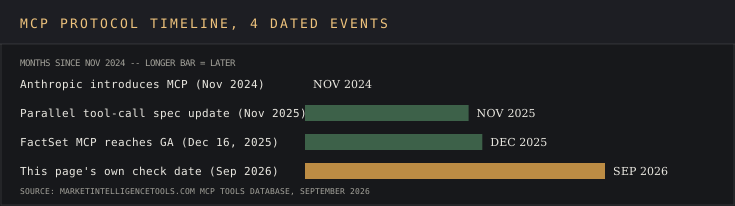
Anthropic introduced the Model Context Protocol in November 2024 as a standard way for AI applications to connect to outside data & tools. The protocol runs on a client-server architecture over JSON-RPC 2.0: an AI application (the MCP host) opens a connection through an MCP client to one or more MCP servers, & each server exposes what it can do through a documented JSON schema.
A vendor ships one MCP server once, and any compatible AI application can call it, replacing the custom integration every application/tool pair used to need on its own.
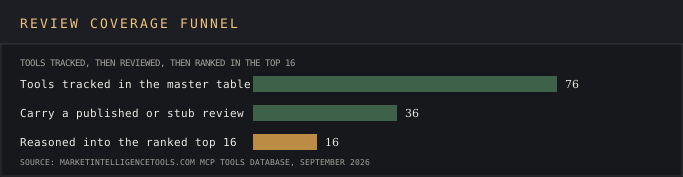
This database covers 76 tools with a vendor-published, first-party MCP server, checked one by one against the vendor's own docs, GitHub org, or press release. None of the 76 is assumed from search demand alone.
It's a moving target. A handful of these launched in the last 30 days, & at least one MCP server went GA the same day this page did. It runs in two parts: a master table you can scan or search for any tool, followed by a ranked shortlist reasoned against five testable criteria for teams deciding where to start.
It's for engineers, RevOps and GTM teams, and analysts deciding which vendor's MCP server is worth wiring into Claude, ChatGPT, or another MCP-compatible AI assistant right now, in September 2026, as adoption moves from a handful of infrastructure vendors to most of the SaaS market.
Twelve more tools already carry a stub review in progress. The remaining 40 get a database row here, with no full write-up yet & a docs link instead.
The master MCP tools database (76 confirmed servers)
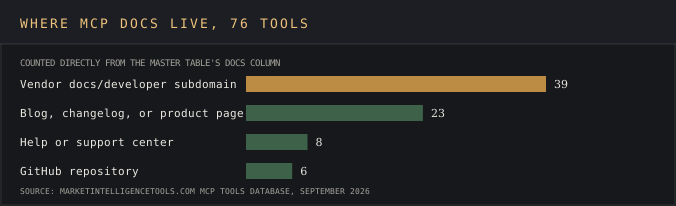
Every tool below cleared the same bar: a vendor-published, first-party MCP server, documented on the vendor's own domain, under its own GitHub org, or announced in an official press release. Ranked tools carry their position in the first column; everything else is listed for lookup.
On the live version of this page, the table opens showing all 24 tools with a published or ranked review, the top 5 in full color and the rest one click away from the top of the fold. One click past that adds the remaining 52 tracked but not yet reviewed; a second click collapses back to the 24.
A rank number in the first column means the tool made the top 16, reasoned out below. A dash there just means the tool sits outside that cut; it's still a confirmed MCP server, searchable by category or docs link either way.
| Rank | Tool | Category | Entry pricing | Review status | MCP docs |
|---|---|---|---|---|---|
| 1 | Bright Data | Web data & scraping | Free–$499/mo | Published | docs.brightdata.com |
| 2 | Surfer SEO | SEO & content optimization | $49/mo | Published | docs.surferseo.com/en/articles/12944186-surfer-mcp |
| 3 | Lusha | Contact data & prospecting | Free; Starter $37.45/mo | Published | docs.lusha.com/mcp-docs |
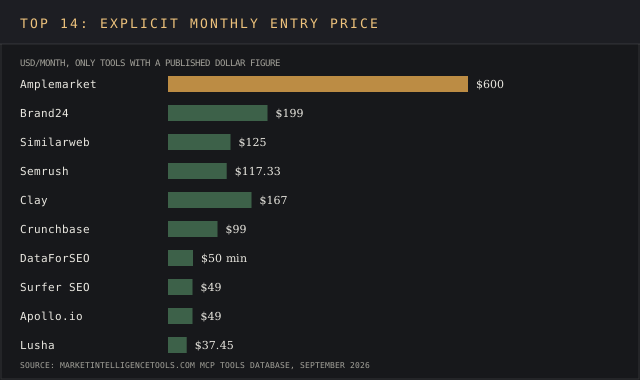
| 4 | Amplemarket | Sales engagement | $600/mo | Published | knowledge.amplemarket.com |
| 5 | Brand24 | Social listening | $199/mo (annual) | Published | help.brand24.com/en/articles/13011375-brand24-mcp |
| 6 | Semrush | SEO & content research | $117.33/mo | Published | developer.semrush.com/api/v4/introduction/semrush-mcp |
| 7 | ZoomInfo | Sales intelligence | Quote-only | Published | docs.zoominfo.com/docs/available-mcp-tools |
| 8 | Clay | GTM enrichment | $167/mo | Published | developers.clay.com |
| 9 | FactSet | Financial research | Quote-only | Published | insight.factset.com (Dec 2025 launch) |
| 10 | DataForSEO | SEO/SERP API data | $50 min | Published | github.com/dataforseo/mcp-server-typescript |
| 11 | Apollo.io | Sales prospecting | $49/user/mo | Published | github.com/apolloio/apollo-mcp-plugin |
| 12 | Similarweb | Traffic analytics | $125/mo | Published | developers.similarweb.com/docs/similarweb-mcp |
| 13 | AlphaSense | Investment research | Quote-only | Published | developer.alpha-sense.com/agent-api/mcp-server |
| 14 | Crunchbase | Funding & company data | $99/mo | Published | data.crunchbase.com/docs/tool-reference |
| 15 | lemlist | Email outreach | $55/mo | Published | developer.lemlist.com |
| 16 | Seamless.AI | Contact data | Free; Pro/Enterprise quote-only | Published | seamless.ai/customers/blog |
| — | LSEG | Market data | Quote-only | Published | lseg.com/en/insights |
| — | Ahrefs | SEO data | $129/mo | Stub | docs.ahrefs.com/en/mcp |
| — | Gong | Conversation intelligence | Quote-only | Stub | help.gong.io/docs/about-gong-mcp |
| — | Outreach.io | Sales engagement | Quote-only | Stub | support.outreach.io |
| — | SeekOut | Talent intelligence | $149/mo | Stub | seekout.com/solutions/mcp |
| — | Instantly.ai | Cold email | $47/mo | Stub | help.instantly.ai |
| — | HubSpot | CRM & marketing | $7/seat/mo | Not yet | developers.hubspot.com/ai-tools/mcp |
| — | Salesforce | CRM | $25/user/mo | Not yet | developer.salesforce.com |
| — | GitHub | Dev infrastructure | Free, open-source | Not yet | github.com/github/github-mcp-server |
| — | Slack | Team messaging | $7.25/user/mo | Not yet | slack.com/help |
| — | Pipedrive | CRM & pipeline | $14/user/mo | Not yet | support.pipedrive.com/en/article/mcp |
| — | Close.com | CRM & inside sales | $9/user/mo | Not yet | help.close.com/docs/mcp-server |
| — | Zoho CRM | CRM & pipeline | $14/user/mo | Not yet | zoho.com/crm/developer/mcp.html |
| — | Attio | CRM & relationship data | Free; $35/user/mo | Not yet | docs.attio.com/mcp/overview |
| — | folk | Relationship-based CRM | $24/member/mo | Published | folk.app/changelog/meet-folk-mcp |
| — | Capsule CRM | CRM & pipeline | Free; $18/user/mo | Published | capsulecrm.com/blog/what-if-you-could-just-ask-your-crm-introducing-capsule-mcp |
| — | SalesLoft | Sales engagement | Quote-only | Not yet | salesloft.com/company/newsroom |
| — | Reply.io | Multichannel outreach | $49/user/mo | Not yet | docs.reply.io/mcp/overview |
| — | Nutshell | CRM & pipeline | $13/user/mo | Not yet | support.nutshell.com/en/articles/12631143-mcp-server |
| — | Klaviyo | Email & SMS marketing | Free; usage-based | Not yet | developers.klaviyo.com/en/docs/klaviyo_mcp_server |
| — | Intercom | Customer messaging | $29/seat/mo | Not yet | developers.intercom.com/docs/guides/mcp |
| — | ActiveCampaign | Marketing automation | $15/mo | Not yet | developers.activecampaign.com/page/mcp |
| — | Sprinklr | Unified social & CX | Quote-only | Published | sprinklr.com/help/articles/integration-tools |
| — | Hootsuite | Social media management | $99/user/mo | Not yet | hootsuite.com/integrations/mcp |
| — | Meltwater | Media intelligence | Quote-only | Stub | developer.meltwater.com/guides/meltwater-mcp |
| — | SocialPilot | Social scheduling | $30/mo | Not yet | socialpilot.co/mcp-server |
| — | Buffer | Social scheduling | $5/mo | Not yet | developers.buffer.com/guides/integrations/mcp |
| — | SE Ranking | Keyword & rank tracking | $52/mo | Not yet | seranking.com/api/integrations/mcp |
| — | Serpstat | SEO & competitor analytics | $50/mo | Not yet | api-docs.serpstat.com/docs/serpstat-mcp |
| — | Wappalyzer | Tech-stack detection | $250/mo | Stub | wappalyzer.com/docs/integrations/mcp |
| — | BuiltWith | Tech profiling & leads | $295/mo | Published | kb.builtwith.com/data-integrations/mcp-integration |
| — | Google Analytics | Web & traffic analytics | Free; GA360 quote-only | Stub | developers.google.com/analytics/devguides/MCP |
| — | Adobe Analytics | Enterprise web analytics | Quote-only | Stub | developer.adobe.com/analytics-mcp/docs/aa |
| — | Ubersuggest | All-in-one SEO | $12/mo | Not yet | app.neilpatel.com/en/mcp |
| — | Sitebulb | Technical SEO audit | $18/mo | Not yet | support.sitebulb.com |
| — | Botify | Enterprise search visibility | Quote-only | Not yet | botify.com/platform/botify-assist |
| — | Hunter.io | Email finding & verification | $49/mo ($34 annual) | Not yet | hunter.io/mcp |
| — | Snov.io | Prospecting & verification | $39/mo | Not yet | snov.io/mcp |
| — | RocketReach | People search | $27/mo | Published | rocketreach.co/resources/products/mcp |
| — | 6sense | Intent data & scoring | Quote-only | Published | support.6sense.com/docs/6sense-model-context-protocol-mcp-1 |
| — | Demandbase | Account intelligence | Quote-only | Published | developer.demandbase.com/docs/mcp |
| — | LeadIQ | Prospecting & enrichment | Quote-only | Published | leadiq.com/leadiq-mcp |
| — | PhantomBuster | Sales & LinkedIn automation | $69/mo | Not yet | hub.phantombuster.com/docs/mcp-server |
| — | PitchBook | Private-market deal data | Quote-only | Not yet | pitchbook.com/help/getting-started-with-pitchbook-premium-connector |
| — | S&P Capital IQ | Financials & M&A data | Quote-only | Not yet | docs.kensho.com/llmreadyapi/overview |
| — | Moody's | Credit ratings & entity data | Quote-only | Stub | moodys.com/web/en/us/genai/model-context-protocol.html |
| — | YCharts | Market data & charting | Quote-only | Not yet | ycharts.com/mcp |
| — | Notion | Team wiki & docs | Free; $10/user/mo | Not yet | github.com/makenotion/notion-mcp-server |
| — | Asana | Work & project management | $13.49/user/mo | Not yet | developers.asana.com/docs/mcp-server |
| — | monday.com | Work OS & project management | $9/seat/mo | Not yet | developer.monday.com/api-reference/docs/monday-mcp-security-overview |
| — | Airtable | No-code database | Free; $20/user/mo | Not yet | airtable.com/developers/agents/mcp/getting-started |
| — | Stripe | Payments infrastructure | Usage-based (2.9%+$0.30) | Not yet | docs.stripe.com/mcp |
| — | Twilio | Communications (CPaaS) | Usage-based | Not yet | twilio.com/docs/ai/mcp |
| — | Amplitude | Product analytics | Free tier; quote-only paid | Stub | amplitude.com/docs/amplitude-ai/amplitude-mcp |
| — | Mixpanel | Product analytics | $120/mo | Stub | docs.mixpanel.com/docs/mcp |
| — | Datadog | Observability & monitoring | $15/host/mo | Not yet | docs.datadoghq.com/mcp_server |
| — | PagerDuty | Incident management | $21/user/mo | Not yet | github.com/pagerduty/pagerduty-mcp-server |
| — | Freshdesk | Customer support helpdesk | $29/agent/mo | Not yet | support.freshdesk.com |
| — | Linear | Issue tracking | Free; $10/user/mo | Not yet | linear.app/docs/mcp |
| — | Atlassian (Jira, Confluence) | Issue tracking & dev collaboration | $9/user/mo | Not yet | github.com/atlassian/atlassian-mcp-server |
Showing of 76 tools

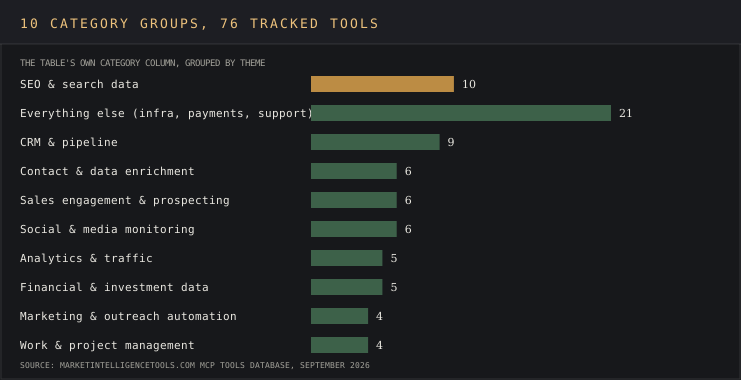
Quick comparison: the top 16 at a glance
This table opens the same way: the top 3 shown, the next 2 faded, one click for the remaining eleven.
| Rank | Provider | Setup | Entry price | Best fit | Free tier? |
|---|---|---|---|---|---|
| 1 | Bright Data | Local install, API key | Free – $499/mo | Teams that need an agent to pull live public web data without building their own scraping infrastructure. | Yes |
| 2 | Surfer SEO | Hosted, OAuth | $49/mo (MCP on Pro+) | Content and SEO teams who want an agent to draft, score, and improve against live SERP data without leaving the chat. | No |
| 3 | Lusha | Hosted, OAuth or API key | Free – $37.45/mo | Sales and RevOps teams that need verified contact data enriched mid-workflow, ahead of a spreadsheet export. | Yes |
| 4 | Amplemarket | Hosted, OAuth | $600/mo | Outbound teams running full sequences, past single-contact lookups, who want an agent to trigger and monitor the whole motion. | No |
| 5 | Brand24 | Hosted, OAuth | $199/mo | Marketing and comms teams that need real-time sentiment on a brand or launch over a weekly digest. | No |
| 6 | Semrush | Hosted, OAuth or API key | $117.33/mo | SEO and content teams already paying for Semrush who want its keyword and ranking data queryable from Claude or ChatGPT. | No |
| 7 | ZoomInfo | One-time scoped config | Quote-only | Enterprise sales orgs that need the largest available contact database queryable by an agent, and can absorb a five-figure annual contract. | — |
| 8 | Clay | Hosted | $167/mo | GTM and RevOps teams building enrichment and outreach workflows who want an agent to trigger Clay tables directly. | Yes |
| 9 | FactSet | Hosted (enterprise) | Quote-only | Equity research and investment teams that need financial fundamentals, estimates, and ownership data inside an AI workflow. | — |
| 10 | DataForSEO | Self-hosted, open source | $50 min (pay-as-you-go) | Developers and agencies who want raw SEO and SERP data at API scale, billed by usage & not a monthly seat. | No |
| 11 | Apollo.io | Hosted, registry-listed | $49/user/mo | Smaller sales teams that want a contact database and an AI-callable server without an enterprise contract. | Yes |
| 12 | Similarweb | Hosted endpoint | $125/mo | Marketing and competitive-intelligence teams tracking traffic and channel data for named competitors. | No |
| 13 | AlphaSense | Hosted | Custom (~$18,000/yr Vendr median) | Analysts who need an agent to search filings, transcripts, and broker notes over the open web. | — |
| 14 | Crunchbase | Hosted | $99/mo | Researchers tracking funding rounds and company data on a fixed, predictable monthly budget. | — |
| 15 | lemlist | Hosted, OAuth or API key | $55/mo | Outbound sales teams running multichannel sequences who want an agent drafting, launching, and monitoring campaigns directly. | No |
| 16 | Seamless.AI | Hosted, OAuth or API key | Free – quote-only | Sales teams already inside Seamless.AI's contact database who want prospecting and enrichment triggered from Claude directly. | Yes |
Showing of 16 tools
Evaluation criteria for ranking MCP servers
Five criteria run through the list below, weighed together as a set, without a mechanical stacking order, because no single number tells the whole story on its own. Each one is something a buyer can check directly, which keeps the reasoning an open book over a closed one.
Every one of the 76 servers cleared the same bar before this page counted it: a vendor-published MCP server documented on the vendor's own domain, under its own GitHub org, or announced in an official press release. A third-party wrapper or a community fork doesn't qualify, no matter how much search volume the tool pulls.
Measured search interest
Combined US monthly volume for "<tool> mcp" and "<tool> mcp server," pulled from Google Ads keyword data in September 2026. Any buyer can run the same query in Keyword Planner and get the same number. It carries real weight for tools where demand is already established, less for a server that launched too recently for search behavior to catch up.
MCP server maturity
GA or beta, tool count, and if the server is a hosted endpoint or a local install a user has to run themselves. Read against the vendor's own MCP documentation page over a press release alone.
A server already in general availability carries less deployment risk than one still in beta. FactSet's server followed a formal beta with 45 firms and 800-plus users before its December 2025 GA date, the kind of maturity signal this criterion rewards over a quieter blog-announced launch.
Data scale exposed
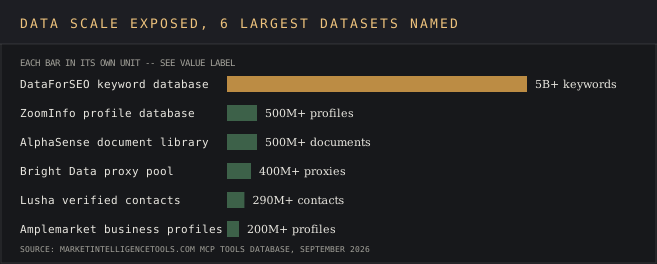
Coverage numbers count only when published on the vendor's own domain: contact count, document count, proxy pool size, keyword database size. Marketing copy without a number doesn't count.
Pricing transparency
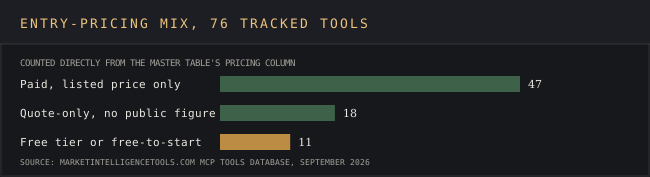
A dollar figure on the public pricing page keeps a vendor honest in a way a "contact sales" form doesn't. Where no list price exists, this list falls back to Vendr's anonymized buyer-transaction data, cited as such.

Fit for GTM and research workflows
The server needs to answer a company, contact, financial, or web-data question relevant to sales, SEO, or market research, the categories this site reviews.

The chart above covers the nine tools in this ranking with established, directly comparable search volume. The four servers slotted into positions 2 through 5 are recent enough, or serve categories narrow enough, that raw search demand undercounts them; maturity, data scale, and pricing transparency carry more of the weight for those four, as their entries below explain.
Top 16 MCP servers for market intelligence, sales, and SEO teams
Bright Data
Best fit: teams that need an agent to pull live public web data without building their own scraping infrastructure.
Bright Data's review on this site covers its residential proxy network; the MCP server sits on that same 400M-plus proxy pool across 195 countries, documented at docs.brightdata.com in a vendor-owned GitHub repo, and it's the only entry in this list with a genuinely free tier. It also shows up in this site's broader web-scraping tools ranking, measured against other extraction platforms.
A dedicated Bright Data MCP review covers the server's setup and free-tier limits in more depth. This site's Bright Data vs. Oxylabs comparison runs the two proxy networks side by side.
Key features
- An agent runs a live Google/Bing/Yandex search & returns structured results (title, URL, snippet), no manual SERP scraping required.
- An agent pulls a competitor's pricing page as clean markdown on a schedule, to catch a price change the same day it goes live.
- An agent batch-scrapes a list of URLs (a job board, a review site, a directory) in one call over one page at a time.
- An agent unlocks a page sitting behind bot detection or a CAPTCHA that a plain HTTP request can't reach.
- An agent checks session usage stats mid-run to see how much of a request budget a scraping job has burned through.
- An agent asks a built-in research assistant tool to summarize a page, skipping the raw HTML a second model call would otherwise have to parse.
Pricing
Free to 5,000 requests/month; pay-as-you-go from $1.50/1,000 requests; Scale $499/month; Enterprise custom.
Pros
- Genuinely free entry tier.
- Largest proxy footprint on this list.
- Docs and code both on the vendor's own domain.
Cons
- Browser-automation billed by the gigabyte scales unpredictably, a double-edged sword against the free tier's appeal.
- The server covers scraping and proxy data only, leaving out company or contact records.
Why it's ranked #1. Bright Data sets the pace on measured demand at 490 combined monthly searches, and it's the only entry in this list's top five with a free MCP tier; the rest gate access behind a paid plan.
Bright Data's own ranking reasoning calls out its free tier specifically: 5,000 requests a month before billing starts, no card required. It's the reason this list ranks Bright Data #1 over four rivals that all gate MCP access behind a paid plan.

Free up to 5,000 requests a month
Try Bright Data's MCP server
No card required to start; pay-as-you-go runs $1.50 per 1,000 requests once the free tier runs out.
 Visit Bright Data →
May earn a commission if you sign up through this link, at no extra cost to you. Full affiliate disclosure.
Surfer SEO
Best fit: content and SEO teams who want an agent to draft, score, and improve against live SERP data without leaving the chat.
Surfer's own MCP server, built on what the company calls the biggest API update in its history, exposes 57 individual tools across 12 categories plus 6 prebuilt "skills" that chain several tools into one command, documented at docs.surferseo.com/en/articles/12944186-surfer-mcp.
That's the widest tool count of any server in this list, covering content editors, SEO guidelines, AI Search guidelines, full article generation, Auto-Optimize, and AI visibility tracking under one roof.
Surfer SEO is the same product this site reviews under its current name, Positive Surfer; that review covers pricing, the content editor, and AI visibility tracking. A separate Surfer MCP review covers the server itself.
This site's Positive Surfer vs. Semrush comparison runs the two platforms side by side. Surfer also carries a spot in this site's competitive-intelligence SEO tools ranking.
Key features
- An agent creates a Content Editor for a target keyword, pulls the SERP-derived outline, and drafts a full article without a human opening the dashboard.
- An agent pulls a live Content Score before a post goes out, then runs Auto-Optimize to close the SEO and AI Search score gaps in one command.
- An agent checks SERP-based term and topic coverage for a keyword against ranking competitors and flags exactly which required phrases are missing.
- An agent pulls AI Tracker mention-gap data to see which ChatGPT or Gemini prompts cite a competitor over the brand.
- An agent works through Surfer's prioritized Recommendations queue and executes the highest-impact item directly. That's a finished action already completed, leaving no queued suggestion for someone else to act on.
- An agent audits an already-published post by spinning up a scoped Content Editor and reporting exactly which guideline items it's missing.
Pricing
Discovery $49/month (entry plan); MCP access ships on the Pro plan and above, $182/month, with AI Search Analytics, Peace of Mind, and Enterprise tiers also included.
Pros
- Widest tool count of any server on this list.
- Covers content, SEO, and AI-search visibility together as one connected workflow, over three separate ones.
Cons
- MCP access sits behind the Pro tier over the $49 entry plan.
- A server this broad takes longer to learn than a single-purpose one.
Why it's ranked #2. Surfer's 57-tool, 6-skill server covers more of the content workflow, end to end, than any other entry here, and it's the only server in this list built by a company whose day job is this exact category.
57 MCP tools, one workspace
Try Surfer's MCP server
MCP access ships on the Pro plan at $182/mo; every plan carries a 30-day money-back guarantee.
 Visit Surfer →
May earn a commission if you sign up through this link, at no extra cost to you. Full affiliate disclosure.
Lusha
Best fit: sales and RevOps teams that need verified contact data enriched mid-workflow, ahead of a spreadsheet export.
Lusha's review on this site covers its prospecting platform; its official MCP server, documented at docs.lusha.com/mcp-docs, exposes 23 tools across contact search, company search, buying-signal search, and lookalike expansion, backed by 290M-plus verified B2B contacts and 29M-plus companies. Lusha also carries an entry in this site's b2b data providers ranking, for a side-by-side against the other contact databases there.
A dedicated Lusha MCP review covers setup and limits in more depth. This site's Lusha vs. ZoomInfo comparison weighs the two contact databases directly. A separate pricing breakdown runs every tier in full.
Key features
- An SDR types "find marketing directors at companies using Salesforce" into Claude, and the agent runs a contact search plus enrichment call that returns real people with verified emails and phones.
- An agent enriches an inbound lead the moment a form is filled, chaining a form-fill trigger to Lusha's enrichment tool before a rep ever opens the record.
- An agent builds a target-account list from ICP filters (industry, size, location), then pulls the decision-makers at each matched company.
- An agent monitors an existing account list for buying signals & surfaces which accounts show hiring or funding activity inside a CRM-connected session.
- An agent expands a seed list of best customers into a lookalike prospect list using the same firmographic pattern.
- An agent checks remaining credit balance before kicking off a bulk enrichment job, so a run doesn't stall halfway through.
Pricing
Free, 40 credits/month, 1 seat; Starter $37.45/month (annual); Pro $52.45/month; Premium $299.95/month; Scale custom.
Pros
- Largest data scale of the four entries in this range (290M-plus contacts).
- Genuinely free tier.
- Transparent per-credit pricing.
Cons
- Free-tier credits run out fast for a team doing volume prospecting.
- Phone-number lookups cost 5x the credits of an email lookup.
- Lusha's MCP docs contradict themselves on the auth header, and its own pages give different plan-access rules and accuracy figures.
- The data it serves faces two pending US class actions and a €2 million Italian fine Lusha is contesting; the Lusha review lists every case.
- Paid plans auto-renew at the then-current price, and the terms make every payment non-refundable.
Why it's ranked #3. Lusha's contact database is the largest of any tool ranked in this range, and its pricing ladder is genuinely public down to the free tier, a level of transparency most contact-data vendors here don't match. That transparency stops at the rate card: the renewal and refund terms are strict, and the legal record behind the data runs to two pending class actions and a contested EU fine.
290M-plus verified contacts
Try Lusha's MCP server
Free plan, 40 credits a month; Starter runs $37.45/mo billed annually.
 Visit Lusha →
May earn a commission if you sign up through this link, at no extra cost to you. Full affiliate disclosure.
Amplemarket
Best fit: outbound teams running full sequences, past single-contact lookups, who want an agent to trigger and monitor the whole motion.
Amplemarket's review on this site covers its sales-engagement platform; its official MCP server, hosted at mcp.amplemarket.com and documented in Amplemarket's own knowledge base, exposes roughly 52 tools across 13 categories, drawing on a 200M-plus business-profile database with 70M-plus data updates a week. Amplemarket also ranks in this site's sales intelligence roundup, alongside the other outbound-focused platforms here.
A dedicated Amplemarket MCP review covers setup and the full tool list in more depth. A separate pricing breakdown runs every tier.
Key features
- An agent searches people and companies against an ICP filter, then enriches the matches with verified emails and phones before a list ever reaches a rep.
- An agent builds and tags a target-account list with custom fields, like funding stage, directly from a chat prompt.
- An agent creates a multichannel outreach sequence and enrolls a fresh lead list into it, covering email, phone, and social touches in one motion.
- An agent checks AI-scored buying-intent signals & prioritizes today's call list before a rep starts dialing.
- An agent screens a new list against a do-not-contact exclusion list before enrollment, to keep a sequence compliant.
- An agent answers a plain-language analytics question, like which sequence had the best reply rate this month, ahead of a pipeline review.
Pricing
Startup $600/month (annual term), 2 users, 27,000 contacts/year; Growth and Elite are both quote-only.
Pros
- Largest raw tool count of any sales-engagement server in this list (52 across 13 categories).
- Covers the full search-to-sequence motion, past contact lookup alone.
Cons
- The entry tier costs an arm and a leg next to Lusha's or Apollo's.
- Pricing above Startup is quote-only, a closed book for anyone comparing costs upfront.
Why it's ranked #4. Amplemarket's 52-tool server covers more of the outbound motion end to end, from search through sequencing to inbox triage, than any single-purpose contact tool in this range, though its $600 floor is the steepest of the four.
52 tools across 13 categories
Try Amplemarket's MCP server
Startup Plan runs $600/mo on an annual term, 2 users, 27,000 contacts a year; no free tier.
May earn a commission if you sign up through this link, at no extra cost to you. Full affiliate disclosure.
Brand24
Best fit: marketing and comms teams that need real-time sentiment on a brand or launch over a weekly digest.
Brand24's review on this site covers its monitoring platform; its official MCP server, hosted at mcp.brand24.com and documented in Brand24's help center, is one of the only social-listening tools with official status in the OpenAI App Store, & fetches live data on every query, never a cached snapshot.
A dedicated Brand24 MCP review covers pricing, setup, and alternatives in more depth. This site's Brand24 vs. Brandwatch comparison weighs the two monitoring platforms directly.
Brand24 also carries a spot in this site's social listening ranking. A separate pricing breakdown runs every tier.
Key features
- Ahead of a product launch, an agent pulls real-time sentiment across a brand's tracked keywords to gauge pre-launch buzz.
- When negative mentions spike, an agent surfaces the driving conversations & drafts a response grounded in what people are saying right now.
- An agent compiles a live competitor report by querying mentions and topics across a rival's monitored project.
- An agent identifies the week's most active influencers discussing a brand, for outreach targeting.
- An agent lists the news outlets currently covering a brand, for a PR digest.
- A marketing lead asks an agent for a plain-language summary of what happened across every monitored project, no dashboard required.
Pricing
Individual $199/month (annual), 2,000 mentions/month; Team $349/month; Pro $499/month; Business $699/month; Enterprise from $1,499/month.
Pros
- Monitors 25M-plus sources in real time across 154 countries.
- Live data on every query, never a cached snapshot.
Cons
- Narrowest category of the four entries here, social listening only.
- No free tier, and the entry price is the steepest per-seat of the five tools ranked above position 6.
Why it's ranked #5. Brand24 holds its own on real-time coverage, 25M-plus sources against 25B-plus mentions delivered, a genuine differentiator even against tools with a broader category footprint, though it's also the narrowest and priciest entry point of the four.
25M-plus sources, checked live on every query
Try Brand24's MCP server
Individual plan runs $199/mo billed annually, 2,000 mentions a month; no free tier.
 Visit Brand24 →
May earn a commission if you sign up through this link, at no extra cost to you. Full affiliate disclosure.
Semrush
Best fit: SEO and content teams already paying for Semrush who want its keyword and ranking data queryable from Claude or ChatGPT.
Semrush's own MCP page lists Claude, ChatGPT, Perplexity, and Gemini as supported clients, backed by versioned developer docs at developer.semrush.com, topping this half of the list at 460 combined monthly searches. Its review on this site covers the platform this server queries.
This site's Semrush vs. Similarweb comparison weighs the two platforms directly. Semrush also carries a spot in this site's digital marketing intelligence ranking.
A separate pricing breakdown runs every tier in full.
Key features
- An agent calls the keyword-research tool to pull search volume and difficulty for a topic cluster before a content brief goes out.
- An agent pulls domain and traffic overview data to size a prospect's organic footprint by market ahead of a sales call.
- An agent runs competitor research to find a domain's top organic rivals and its shared or missing keywords, for a gap analysis.
- An agent audits a client's backlink profile before a link-building pitch.
- An agent checks position tracking inside a saved project & flags a ranking drop for a monitored keyword.
- An agent runs a site audit and summarizes the fixes for a client over a raw crawl report.
Pricing
SEO plan $117.33/month annual ($139 monthly); Starter $165.17/mo; Pro+ $248.17/mo; Advanced $455.67/mo.
Pros
- Broadest client support of the volume-ranked entries.
- Fully public 4-tier pricing.
Cons
- No free MCP tier, $117+/month is the floor.
- G2 reviewers report friction getting refunds on auto-renewed annual plans.
Why it's ranked #6. Semrush clears ZoomInfo's 390 monthly searches by 70, helped by public API docs at a maturity level ZoomInfo's GitHub-and-documentation rollout doesn't yet match.
ZoomInfo
Best fit: enterprise sales orgs that need the largest available contact database queryable by an agent, and can absorb a five-figure annual contract.
ZoomInfo's MCP server connects its 500M-plus profile database to AI models via a documented setup on zoominfo.com, naming 16-plus individual tools including Search Companies, Search Contacts, Search Intent, and Search Scoops, plus a set of "Context Agentic" research tools. Its review on this site covers the core platform.
This site's Apollo.io vs. ZoomInfo comparison weighs the two contact databases directly. ZoomInfo also carries a spot in this site's revenue intelligence software ranking.
Key features
- An agent runs Search Companies with firmographic filters, then Enrich Companies on the top matches to build a target-account list.
- An agent runs Search Contacts to find VP-level buyers at a target account, then Enrich Contacts for verified email and phone before outreach.
- An agent runs Search Intent to surface accounts showing in-market buying signals, then Account Research to draft a pre-call briefing.
- An agent runs Search Scoops to catch a real-world trigger, like a leadership change or funding round, & times outreach around it.
- An agent runs Find Similar Companies off a closed-won account to build a lookalike prospect list.
- An agent runs Contact Research to assemble a full briefing on a specific buyer, combining ZoomInfo data with CRM context.
Pricing
No public list price; Vendr tracks a $33,500/year median across 1,571 purchases, range $7,200–$156,000.
Pros
- Largest contact & company database of any server ranked here.
- The most granularly documented tool list of any entry, down to credit cost per call.
Cons
- No published price, every buyer negotiates in the dark.
- Configuration is a one-time manual step over a zero-install hosted endpoint.
Why it's ranked #7. ZoomInfo sits 70 searches behind Semrush (390 vs. 460) but ahead of Clay's 370, and its named-tool documentation is the most granular of any server in this list.
Clay
Best fit: GTM and RevOps teams building enrichment and outreach workflows who want an agent to trigger Clay tables directly.
Clay's MCP server, documented at developers.clay.com, groups its capability into three moves: finding contacts by natural-language search, enriching leads through 200-plus data providers in one place, and pushing validated prospects into a sequencer or CRM. Its review on this site covers the enrichment platform underneath.
Clay carries a spot in this site's data enrichment tools ranking. A separate pricing breakdown runs every tier in full. The Clay MCP review covers Functions, per-rep credit budgets and which plans include the connector.
Key features
- A rep prompts an agent to search Clay's database in natural language for contacts matching an ICP, returning up to 1,000 results.
- A rep triggers a Clay enrichment "Function" to run a waterfall across 200-plus providers & attach a verified work email or phone to a shortlist.
- A rep invokes an Ops-built custom Function, like lead scoring, from inside the AI tool to prioritize a batch of leads.
- An agent checks a new contact list against the CRM through Clay MCP, filtering out duplicates before adding net-new records.
- An agent pushes validated, enriched contacts from a chat session straight into the sequencer under Ops-governed write rules.
- An agent pulls a centralized Clay Audience, combining first- and third-party signal data, to decide which accounts to work first.
Pricing
Launch plan $167/month ($134 annual), 15,000 actions and 3,000 data credits/month; free plan 500 actions/100 credits.
Pros
- Widest tool count outside Instantly and Seamless.AI.
- Free tier to test before paying.
Cons
- Data is metered separately from actions, so entry-tier credits run out fast.
- G2 reviewers note a real learning curve on the table-based workflow builder.
Why it's ranked #8. Clay edges out FactSet by 70 monthly searches (370 vs. 300) and is the only entry in this stretch of the list with fully public dollar pricing, though FactSet's server exposes nine named financial datasets against Clay's GTM-only focus.
FactSet
Best fit: equity research and investment teams that need financial fundamentals, estimates, and ownership data inside an AI workflow.
FactSet announced what it called the industry's first production-grade MCP server in a December 16, 2025 press release, after running a beta with 45 firms and more than 800 users, exposing 9 named content datasets over a plain numbered tool list. Its review on this site covers the data platform underneath.
A dedicated FactSet MCP review covers setup and limits in more depth.
This site's FactSet vs. Bloomberg comparison weighs the two platforms directly. FactSet also carries a spot in this site's financial data providers ranking.
A separate pricing breakdown covers what Vendr's buyer data shows.
Key features
- An agent pulls a company's consensus EPS or revenue estimate before drafting a pre-earnings note.
- An analyst has the agent pull a target's ownership table to flag activist or index-fund concentration ahead of a call.
- A corp-dev team has the agent screen recent global M&A deals in a sector as comparable-transaction inputs for a pitch.
- A research assistant cross-references a company's geographic revenue exposure before a tariff-impact memo.
- An agent builds a one-page company brief combining fundamentals, pricing history, and upcoming calendar events.
- A strategist has the agent map a company's supply-chain relationships to assess concentration risk.
Pricing
No public price, quote-only; Vendr tracks a $25,160/year median, range $4,200–$28,179.
Pros
- Broadest named-dataset coverage of any server ranked here.
- Ran a real beta before GA.
Cons
- Quote-only pricing, no published floor.
- A Verified User in Financial Services wrote on G2 that their bank is considering dropping FactSet over its pricing against Capital IQ, a named competitor.
Why it's ranked #9. FactSet leads DataForSEO by 60 searches (300 vs. 240) on the strength of a formal, beta-tested December 2025 launch, a maturity signal DataForSEO's blog-announced rollout doesn't carry in public documentation.
DataForSEO
Best fit: developers and agencies who want raw SEO and SERP data at API scale, billed by usage & not a monthly seat.
DataForSEO's current MCP server, an open-source TypeScript project under the vendor's own GitHub org, takes a different shape than most servers on this list. It skips dozens of named endpoints for exactly 4 tools: three for documentation lookup and one generic api_request tool that calls any DataForSEO REST endpoint by path. Its review on this site covers the API suite underneath. A dedicated DataForSEO MCP review covers the v3 redesign, setup and per-request costs in more depth.
A separate pricing breakdown runs the pay-as-you-go math in full.
Key features
- An agent searches the docs tool to find the right SERP endpoint, then calls it to pull live Google organic rankings for a target keyword.
- An agent builds a competitor backlink audit by hitting the backlinks-summary endpoint through the generic request tool.
- An agent scores a page's Core Web Vitals by calling the on-page Lighthouse endpoint before a content edit ships.
- A developer lists available API categories before wiring a new integration, no guessing which endpoint exists.
- An agent chains a docs lookup into an endpoint call to fetch search-volume data for a full keyword list in one pass.
Pricing
Pay-as-you-go, $50 minimum payment, no subscription required.
Pros
- Largest keyword database in this list.
- Open-source server code inspectable before deployment, no black box.
Cons
- Help center guides give three different server URLs, and the npm package needs Node.js 22 or newer.
- A Founder reviewing it on G2 said it stood out against Ahrefs and Semrush on price, but reviewers moving from consumer tools like Ubersuggest describe a real learning curve reaching raw API access.
Why it's ranked #10. DataForSEO outranks Apollo.io by 80 searches (240 vs. 160) and backs its server with a 5-billion-plus keyword database, though its $50 minimum only beats Apollo's per-user pricing for single-user, low-volume use.
5B-plus keyword database, one generic API tool
Try DataForSEO's MCP server
Pay-as-you-go from a $50 minimum deposit, no subscription; $1 in free credit lands on signup.
 Visit DataForSEO →
May earn a commission if you sign up through this link, at no extra cost to you. Full affiliate disclosure.
Apollo.io
Best fit: smaller sales teams that want a contact database and an AI-callable server without an enterprise contract.
Apollo.io's MCP plugin, maintained under the vendor's own GitHub org, names 12 underlying tools bundled into four callable skills covering prospecting, enrichment, sequencing, and analytics. Its review on this site covers the core prospecting platform.
Apollo.io carries a spot in this site's lead intelligence software ranking.
Key features
- An SDR agent searches for RevOps heads at 50 to 200-employee US SaaS companies in one call.
- Before outreach, an agent bulk-matches a lead list against Apollo's database to enrich it with verified emails and titles.
- An agent logs a newly qualified prospect into the Apollo workspace mid-conversation, no separate CRM step.
- A rep asks an agent to find a named sequence, then enroll a fresh batch of contacts into it.
- A manager has an agent pull a sequence-level analytics report to summarize reply and open rates for a weekly standup.
- An agent checks which sending mailbox has deliverability headroom before a send, to keep a domain out of spam folders.
Pricing
Free ($0, 900 credits/year); Basic $49/user/mo; Professional $79/user/mo; Organization $119/user/mo (3-user minimum).
Pros
- Fully public 4-tier pricing from free to $119/user, levels the playing field against enterprise-only contact tools.
- Database roughly half ZoomInfo's size at a fraction of the cost.
Cons
- Per-user pricing scales fast for a growing team.
- A G2 reviewer described replacing a separate ZoomInfo subscription after consolidating onto Apollo, evidence the two overlap enough to force that choice.
Why it's ranked #11. Apollo.io beats Similarweb by 70 searches (160 vs. 90) and publishes a full price ladder to $119/user/month. Similarweb's comparable $125/month tier covers site-traffic data; Apollo's covers a 240-million-contact GTM database.
Similarweb
Best fit: marketing and competitive-intelligence teams tracking traffic and channel data for named competitors.
Similarweb runs a hosted MCP endpoint at mcp.similarweb.com, documented at developers.similarweb.com, naming 24 discrete tools covering traffic, audience, ad spend, and app-store data. Its review on this site covers the traffic-analytics platform underneath.
A separate pricing breakdown runs every tier in full.
Key features
- An agent pulls a competitor's monthly traffic-and-engagement trend before a board deck.
- Before a paid-search pitch, an agent estimates a prospect's monthly search-ads budget through the PPC-spend tool.
- A sales rep's agent checks which ad tech or CMS a target account runs before outreach.
- A content team's agent pulls SERP players and SERP clicks for a target keyword to see which sites capture the traffic.
- An investor-research agent compares two rivals with audience overlap and similar-sites data to map competitive substitution.
- A mobile marketer's agent checks app-store rank and install penetration by country before timing a launch.
Pricing
Web Intelligence starts at $125/month; enterprise tiers are quote-only.
Pros
- Hosted endpoint, no local server to run.
- Published entry price.
- 24 named tools, one of the most granularly documented servers in this list.
Cons
- Covers web-traffic and channel data only, no company or contact records.
- Reviewers describe real onboarding time to map raw traffic numbers to a specific budget decision.
Why it's ranked #12. Similarweb leads AlphaSense by 10 searches (90 vs. 80) and undercuts AlphaSense's $18,000 Vendr median with a published $125/month floor, though AlphaSense's 500-million-document library serves equity research over web-traffic analytics.
AlphaSense
Best fit: analysts who need an agent to search filings, transcripts, and broker notes over the open web.
AlphaSense's developer docs describe a runnable MCP server with two callable tools: GenSearch, a natural-language research query with a deep-research mode, and Document Search, a keyword-based lookup with filters for date, company, and source. Its review on this site covers the platform underneath.
A dedicated AlphaSense MCP review covers setup and limits in more depth.
AlphaSense carries a spot in this site's alternative data providers ranking. A separate pricing breakdown covers what Vendr's buyer data shows.
Key features
- An analyst runs GenSearch in deep-research mode to draft an investment-memo-grade summary on a target company.
- Ahead of an earnings call, an agent uses GenSearch's fast mode for a quick factual check on one metric.
- A researcher runs Document Search with a company filter to pull every filing mentioning a specific keyword for one issuer.
- An agent restricts a search to the last two years to surface only recent expert-call transcripts on a topic.
- A due-diligence agent chains Document Search results into GenSearch to ground an answer in specific, citable sources.
Pricing
No public price, sales-only; Vendr tracks an $18,000/year median across 39 recorded purchases.
Pros
- Document library purpose-built for investment research, worth its weight in gold for the right analyst.
- Already carries a live review on this site.
Cons
- No published pricing.
- Smallest MCP tool count (2) of any server in this list, though each one punches above its weight for what it does.
Why it's ranked #13. AlphaSense ties Crunchbase at 80 monthly searches, but its 500-million-document library and existing review on this site give it the edge on the fit criterion over Crunchbase's funding-and-company focus.
Crunchbase
Best fit: researchers tracking funding rounds and company data on a fixed, predictable monthly budget.
Crunchbase's MCP server, launched via press release and documented at data.crunchbase.com/docs/tool-reference, names 14 tools across expert search, structured lookup, list-building, and usage metering. Its review on this site covers the core database.
Crunchbase carries a spot in this site's company data providers ranking. A separate pricing breakdown runs every tier in full.
Key features
- A VC associate asks an agent, in plain language, which Series B fintechs raised in the last 90 days.
- A sales-ops agent disambiguates a lead's company name against Crunchbase before enrichment, to avoid matching the wrong entity.
- An agent builds a repeatable prospect list from explicit criteria (industry, funding stage, headcount), then saves the matches to a list.
- An agent flags accounts with a high funding-likelihood score, drawn from Crunchbase's predictive-intelligence data, for an SDR to prioritize.
- A product-intelligence agent pulls full financials, leadership, and relationship data for one already-identified company.
- An agent tracks its own API usage against the metering tool before running a large batch of searches.
Pricing
Crunchbase Pro at $99/month billed monthly.
Pros
- Only entry in this range with a flat, published price and no sales process.
- A formal press-release launch over a quiet docs update.
Cons
- An Insights Analyst on G2 wrote that testing Crunchbase against PitchBook found enough overlap to drop one, and kept PitchBook.
- No document-level research library like AlphaSense's.
Why it's ranked #14. Crunchbase matches AlphaSense's 80 monthly searches and is the only tool in this range with zero-sales-call pricing at $99/month, but that transparency edge doesn't offset AlphaSense's larger document library under the fit criterion.
lemlist
Best fit: outbound sales teams running multichannel sequences who want an agent drafting, launching, and monitoring campaigns directly.
lemlist's MCP server, documented at developer.lemlist.com and built for Claude Desktop, Claude Code, Cursor, and any other MCP-compatible client, exposes 40-plus tools across campaigns, lead search, enrichment, and multichannel sequencing. Its review on this site covers the core platform.
A dedicated lemlist MCP review covers setup and limits in more depth.
Key features
- An agent searches lemlist's lead database, filtering by role, company size, and signal, for a list like SaaS founders hiring SDRs in a given country.
- An agent builds and launches a multichannel sequence, email, LinkedIn, call, SMS, or WhatsApp steps, from a natural-language brief.
- An agent reads campaign performance mid-run and rewrites an underperforming step before a rep notices the drop.
- An agent enriches a lead list with verified emails and phone numbers before a sequence starts, drawing down credits separate from the flat seat fee.
- An agent checks lemwarm deliverability signals before a send, so a campaign doesn't launch into a damaged sending reputation.
- An agent authenticates through OAuth on first use, discovery, browser-based consent, and token refresh handled automatically, with no API key to copy in by hand.
Pricing
$55/month entry, the listed price tracked in this page's own master table; lemlist's product page also cites a 14-day free trial with full Multichannel access, no card required. Enrichment actions (email finding, verification, phone lookups) draw down credits separately from the seat price.
Pros
- A genuine OAuth flow, discovery, consent, token refresh, over a hand-copied API key, per the vendor's own setup docs.
- Works across Claude Desktop, Claude Code, Cursor, and other MCP clients without a separate integration build for each.
Cons
- lemlist's own marketing cites its lead database at both 600M-plus (the MCP product page) and 450M-plus (the setup docs), no single confirmed figure.
- The vendor's own docs call the tool set "a growing set of tools that evolve regularly," so the count isn't fixed the way Crunchbase's 14 tools are.
Why it's ranked #15. lemlist pulls 60 combined monthly searches for "lemlist mcp" and "lemlist mcp server," six times Seamless.AI's 10, and backs it with a fully published $55/month price against Seamless.AI's quote-only paid tiers, but neither figure reaches Crunchbase's 80 searches or AlphaSense's document-research depth, which is what keeps both tools behind Crunchbase at #14.
Seamless.AI
Best fit: sales teams already inside Seamless.AI's contact database who want prospecting and enrichment triggered from Claude directly.
Seamless.AI's MCP server launched via a company blog post on May 6, 2026, hosted at mcp.seamless.ai and reachable from Claude Desktop, Cursor, or VS Code over OAuth or an API key. Its docs, at seamless.ai/customers/blog, split the server's 54 tools into read, write, and destructive classes, each requiring separate authorization. Its review on this site covers the core platform.
A dedicated Seamless.AI MCP review covers the server's read, write, and destructive tool split in more depth. A separate pricing breakdown covers what its free and paid tiers cost.
Key features
- An SDR asks an agent to build a prospect list by role and company size, then hand the results straight to enrichment.
- An agent enriches a CRM record's email and phone fields in place, without a rep copying data between two tabs.
- An agent pulls account research and a pre-call briefing before a rep dials, drawing on Seamless.AI's own contact and firmographic data.
- An agent scores and prioritizes a batch of leads by territory, then routes the top matches to a rep's queue.
- A manager asks an agent to draft outbound sales messaging from a contact's enriched profile, skipping the blank template.
- Write- and destructive-class tools, record updates and deletions, sit behind a separate authorization step from read-only lookups, per the vendor's own docs.
Pricing
Free tier: 1 user, 50 credits a month, no card required. Pro and Enterprise are both quote-only, sized per user and per credit package, with pricing behind a sales call and no published number.
Pros
- A genuine free tier, 50 credits a month, to test the MCP server before a sales conversation.
- Splits tools into read, write, and destructive classes with separate authorization, the same caution this page recommends for every write-capable server.
Cons
- Seamless.AI's own marketing pages disagree on contact database size, 1.3B-plus on its product pages against 500M-plus elsewhere, a contradiction this site's own Seamless.AI vs. ZoomInfo comparison flags directly.
- A 10-search-a-month combined footprint for "seamless.ai mcp" queries, the thinnest measured search interest of any tool on this page with its own profile card.
Why it's ranked #16. Seamless.AI's free tier and its read/write/destructive tool split match the caution this page asks of every write-capable server, but a 10-search combined footprint and quote-only paid tiers put it last among the tools with their own profile here; lemlist's published $55 price and six-times-larger search footprint edge it out for #15.
Try it yourself
Sign up for Seamless.AI
Free tier: 50 credits a month, no card required.
 Visit Seamless.AI →
May earn a commission if you sign up through this link, at no extra cost to you. Full affiliate disclosure.
What MCP tools are, and how AI agents use them
MCP architecture: hosts, clients, and servers
An MCP host is the AI application itself, Claude Desktop, an ai powered ide like Cursor, or a custom agent.
It runs an MCP client, one of a growing list of mcp clients & ai clients built for connecting ai assistants and connecting ai systems generally, opening a stateful connection over JSON-RPC 2.0 to one or more MCP servers; this is a client server architecture, and vendor docs often collapse Model Context Protocol MCP into one term used interchangeably with the spec itself.
The comparison nearly every vendor's own explainer reaches for: MCP works like a usb c port for AI, one standardized protocol, an open protocol anyone can implement, so a compliant server plugs into a compliant client without a proprietary connector per vendor pairing.
MCP defines three primitives: tools (executable functions), resources (read-only context, a document or a database row), and prompts (reusable templates).
MCP servers expose their tools the same way across categories: existing mcp server implementations expose tools & external tools through a tools/list call over a fixed roster.
So an ai agent handles dynamic tool discovery at runtime, lists available tools, can invoke tools by name, and reads each one's tool descriptions and json schema before calling it, the mechanism that enables ai systems & enable ai models generally to act on a live catalog over a hardcoded one.
Proper error handling matters here too: a well-built server returns a structured failure a model can act on over a raw stack trace, and every tool definition ships a human readable description alongside its schema.
Data access and external systems
Behind those tool definitions sit real data sources: relational databases, structured data warehouses, and external data pulled live from an external service or one of several external apis, all reachable through external data sources a server was built to wrap.
MCP addresses data access directly, separating read-only resources from tools that write, so an agent retrieving relevant information from a document store follows a different permission path than one invoking a tool that changes state, a line drawn in the sand deliberately.
Sensitive data, most contact and financial records among the 76 servers here, sits behind the stricter path. None of these servers feed customer queries back into the training data behind the underlying ai model; MCP is built to bring real time data into the context window without retraining anything.
Schema validation runs on every call: each server's development environments define a model controlled interface, meaning the AI model chooses which tool to call & with which arguments, constrained to a consistent interface the schema enforces over free-form text. Tool usage patterns across the 76 servers here mostly fall into search, enrich, and trigger, with business logic specific to each vendor's product living behind the tool, outside the protocol itself.
Legacy systems, internal systems, and other data systems that predate any AI integration are exactly what MCP was built to reach without a rebuild, which is why popular enterprise systems (CRMs, data warehouses, ticketing platforms) were early adopters. Reference server implementations exist in multiple programming languages, including the open TypeScript source DataForSEO publishes under its own GitHub repository.
API integrations and connected tools
Every server on this page implements the same mcp protocol, version-pinned in its docs, and exposes data through a documented json schema per tool, so an agent calls a named function, a company search or a keyword-volume lookup, and doesn't parse raw api responses by hand.
Servers with write actions need more care: Seamless.AI's own docs split its 54 tools into read, write, and destructive classes, each requiring separate authorization, a pattern Clay's table-trigger tools and lemlist's campaign-send tools follow even where the vendor doesn't publish the same explicit taxonomy, along with the ai powered tools each platform layers on top.
Most of the mcp work in a rollout is picking scopes and a unique identifier per credential over writing new tool code; a server exposing a github repository or other code repositories typically ties each call to a scoped token the same way database access against a relational system does.
Wiring a second or third connected tool into an existing agent, so it can reach multiple tools across several available mcp servers in one session, uses that same authorization pattern each time & keeps every credential accountable.
A November 2025 spec update added parallel tool calls, so an agent can query two servers in the same turn & skip waiting on each in sequence, useful for automated workflows that need a fresh answer over a stale one, though running two write-capable tools in parallel cuts both ways & needs the same scoped-token discipline as running them one at a time.
The underlying math: connecting M AI applications, chat apps, IDEs, conversational AI assistants, to N tools without a shared protocol needs M×N custom integrations; MCP needs M+N.
MCP versus RAG is a common point of confusion: retrieval-augmented generation pulls static context into a prompt ahead of time, while MCP gives an ai model a live, two-way channel it calls mid-conversation. Whichever ai systems or ai assistants a team wires in, the model still decides at runtime which tool a request needs, based on the tool descriptions each server publishes, and that decision is what drives increased ai utility over the raw tool count.
Tools with search demand but no confirmed server yet
A search-volume figure only measures curiosity, & MCP adoption changes fast: a vendor can ship a server the week after this page is checked. As of September 2026, these tools measured real demand for "<tool> mcp" but had no vendor-published server, only third-party or community wrappers.
The list: LinkedIn Sales Navigator (60 combined monthly searches), Sprout Social (60), People Data Labs, Cognism, UpLead, Clearbit, Bombora, Copper CRM, Outplay, Klenty, Zendesk, Moz, SpyFu, Majestic, Screaming Frog, Awario, Mention, BuzzSumo, and Bloomberg.
Search volume measures curiosity about a name. It doesn't confirm a server shipped. LinkedIn Sales Navigator and Sprout Social each pull 60 combined monthly searches for their own name plus "mcp," the same range as several tools confirmed in the master table above, yet neither has a vendor-published server behind it.
Bloomberg's own engineering blog describes MCP as internal AI-development infrastructure, over a customer-facing server. None of these are included in the database above; a third-party GitHub repo offers a weaker guarantee than a vendor standing behind its own integration.
What changes at enterprise scale, and what's still open
ZoomInfo and Salesforce both require a one-time scoped configuration step before their MCP server connects, a deliberate constraint over a plain hosted endpoint. FactSet's own beta ran 45 firms and 800-plus users before GA, evidence enterprise vendors test governance longer than a startup selling a $49-a-month plan needs to.
Enterprise environments
At scale, the deciding factor shifts from feature count to governance. FactSet's beta ran 45 firms and 800-plus users to test this before GA, and ZoomInfo & Salesforce both require a one-time scoped configuration step over a public hosted endpoint, a deliberate constraint on regulated data access. Quote-only pricing is par for the course once a server touches financial or regulated contact data; a public dollar figure is the exception at that tier, never the rule.
Future research directions
Semrush, FactSet, and Salesforce all shipped GA MCP support inside one 12-month window, August 2025 to August 2026. More vendors will keep shipping a server; the real test is if tools/list discovery still holds up once an agent has 76-plus servers to choose from in one session, a scaling problem the spec doesn't yet address, & one this database will keep tracking as the count grows.
Increased AI utility: measuring the payoff
The clearest evidence is the parallel-tool-call update from November 2025. Before it, an agent checking both ZoomInfo and Crunchbase for one company ran a query, waited, then ran the second. After it, both calls fire in the same turn & the agent merges the results, a measurable drop in round trips, & proof the protocol's own upgrades move the needle by themselves, beyond the vendors building on top of it.
FAQ
What are MCP tools?
MCP tools are the executable functions an MCP server exposes to an AI model, each described by a JSON schema the model reads before deciding to call it. A tool might search a database, enrich a contact record, or pull a company's funding history.
Which tools support MCP?
76 tools on this page carry a vendor-confirmed server, from Bright Data and Surfer SEO at the top of the ranked list to infrastructure vendors like GitHub, Slack, Stripe, and Notion, all listed in the master table above, which opens showing the 24 tools with a published or ranked review and expands to the complete list of 76 with one click.
Can I use MCP with ChatGPT?
Yes. Semrush's own MCP page lists ChatGPT alongside Claude, Perplexity, and Gemini as supported clients, and Ahrefs, Outreach.io, Klaviyo, and ActiveCampaign all document ChatGPT support directly too.
Client support varies by vendor. The MCP spec itself doesn't dictate which AI clients a server has to support. Semrush documents Claude, ChatGPT, Perplexity, and Gemini by name; a server that only lists Claude Desktop in its own docs may still work elsewhere, but nothing in this database confirms that without checking the vendor's own page.
What are some free MCP tools available?
Bright Data's MCP server is free up to 5,000 requests a month, Clay's free plan includes 500 actions a month, Lusha and Notion both offer a genuine free tier, and GitHub's official MCP server is free and open-source with no paid tier at all.
GitHub's official server is free and open-source with no paid tier at all, joined by Bright Data, Clay, Lusha, Notion, and Seamless.AI, each offering real free access.
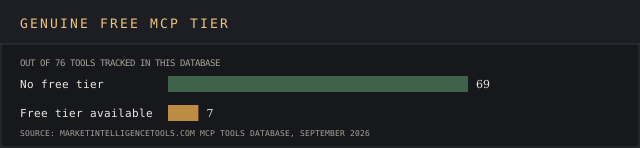
Bright Data and Lusha both start free. Amplemarket's $600-a-month Startup plan is the steepest listed price in the top 16, with ZoomInfo, FactSet, AlphaSense, and Seamless.AI's paid tiers staying quote-only above that.
How many tools should an MCP server have?
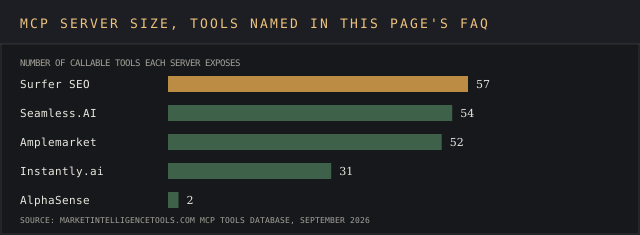
There's no fixed number in the spec. Surfer SEO ships 57, Amplemarket around 52, Instantly.ai 31, Seamless.AI 54, and AlphaSense just 2, each scoped to what the vendor's own product does.
A monthly budget favors Clay and Apollo.io, both with a full published price ladder. An annual contract favors ZoomInfo, FactSet, or AlphaSense, where the quote-only floor buys a document library or contact database none of the monthly-priced tools match in scale.
Every tracked tool, one line each
Every one of the 76 tracked tools gets a single sentence below: category, entry price, and where its MCP docs live. Use it as a scan list, then jump to the master table above for the full column set.
The 76 tools split into three groups: a published or ranked review on this site, a stub review already in progress, or tracked here by table row alone with no write-up yet. Each line below draws only on the columns already shown in the master table.
Published or ranked here (24)
- docs.surferseo.com/en/articles/12944186-surfer-mcp hosts Surfer SEO's MCP docs; this SEO & content optimization tool is priced from $49/mo.
- developer.semrush.com/api/v4/introduction/semrush-mcp hosts Semrush's MCP docs; this SEO & content research tool is priced from $117.33/mo.
- github.com/dataforseo/mcp-server-typescript hosts DataForSEO's MCP docs; this SEO/SERP API data tool is priced from $50 min.
- Priced from $125/mo, Similarweb's traffic analytics MCP server is documented at developers.similarweb.com/docs/similarweb-mcp.
- Lusha enters the database as a contact data & prospecting tool, priced from Free; Starter $37.45/mo, documented at docs.lusha.com/mcp-docs.
- Priced from $167/mo, Clay's GTM enrichment MCP server is documented at developers.clay.com.
- Seamless.AI enters the database as a contact data tool, priced from Free; Pro/Enterprise quote-only, documented at seamless.ai/customers/blog.
- Priced by quote only, with no public figure, LeadIQ's prospecting & enrichment MCP server is documented at leadiq.com/leadiq-mcp.
- Priced from $600/mo, Amplemarket's sales engagement MCP server is documented at knowledge.amplemarket.com.
- Apollo.io enters the database as a sales prospecting tool, priced from $49/user/mo, documented at github.com/apolloio/apollo-mcp-plugin.
- Brand24 (Social listening) documents its server at help.brand24.com/en/articles/13011375-brand24-mcp, priced from $199/mo (annual).
- sprinklr.com/help/articles/integration-tools hosts Sprinklr's MCP docs; this unified social & CX tool is priced by quote only, with no public figure.
- FactSet (Financial research) documents its server at insight.factset.com (Dec 2025 launch), priced by quote only, with no public figure.
- AlphaSense (Investment research) documents its server at developer.alpha-sense.com/agent-api/mcp-server, priced by quote only, with no public figure.
- Priced from $55/mo, lemlist's email outreach MCP server is documented at developer.lemlist.com.
- Bright Data (Web data & scraping) documents its server at docs.brightdata.com, priced from Free-$499/mo.
- ZoomInfo enters the database as a sales intelligence tool, priced by quote only, with no public figure, documented at docs.zoominfo.com/docs/available-mcp-tools.
- data.crunchbase.com/docs/tool-reference hosts Crunchbase's MCP docs; this funding & company data tool is priced from $99/mo.
- LSEG (Market data) documents its server at lseg.com/en/insights, priced by quote only, with no public figure.
- Priced from $295/mo, BuiltWith's tech profiling & leads MCP server is documented at kb.builtwith.com/data-integrations/mcp-integration.
- RocketReach (People search) documents its server at rocketreach.co/resources/products/mcp, priced from $27/mo.
- support.6sense.com/docs/6sense-model-context-protocol-mcp-1 hosts 6sense's MCP docs; this intent data & scoring tool is priced by quote only, with no public figure.
- Demandbase enters the database as an account intelligence tool, priced by quote only, with no public figure, documented at developer.demandbase.com/docs/mcp.
- Capsule CRM enters the database as a CRM & pipeline tool, priced from Free; $18/user/mo, documented at capsulecrm.com/blog/what-if-you-could-just-ask-your-crm-introducing-capsule-mcp.
Stub reviews in progress (12)
- docs.ahrefs.com/en/mcp hosts Ahrefs's MCP docs; this SEO data tool is priced from $129/mo.
- Priced by quote only, with no public figure, Outreach.io's sales engagement MCP server is documented at support.outreach.io.
- Meltwater enters the database as a media intelligence tool, priced by quote only, with no public figure, documented at developer.meltwater.com/guides/meltwater-mcp.
- Adobe Analytics (Enterprise web analytics) documents its server at developer.adobe.com/analytics-mcp/docs/aa, priced by quote only, with no public figure.
- amplitude.com/docs/amplitude-ai/amplitude-mcp hosts Amplitude's MCP docs; this product analytics tool is priced from Free tier; quote-only paid.
- Mixpanel enters the database as a product analytics tool, priced from $120/mo, documented at docs.mixpanel.com/docs/mcp.
- Priced from Free; GA360 quote-only, Google Analytics's web & traffic analytics MCP server is documented at developers.google.com/analytics/devguides/MCP.
- Moody's (Credit ratings & entity data) documents its server at moodys.com/web/en/us/genai/model-context-protocol.html, priced by quote only, with no public figure.
- help.instantly.ai hosts Instantly.ai's MCP docs; this cold email tool is priced from $47/mo.
- Gong enters the database as a conversation intelligence tool, priced by quote only, with no public figure, documented at help.gong.io/docs/about-gong-mcp.
- SeekOut (Talent intelligence) documents its server at seekout.com/solutions/mcp, priced from $149/mo.
- Priced from $250/mo, Wappalyzer's tech-stack detection MCP server is documented at wappalyzer.com/docs/integrations/mcp.
Tracked, not yet reviewed (40)
- SE Ranking enters the database as a keyword & rank tracking tool, priced from $52/mo, documented at seranking.com/api/integrations/mcp.
- Priced from $50/mo, Serpstat's SEO & competitor analytics MCP server is documented at api-docs.serpstat.com/docs/serpstat-mcp.
- Ubersuggest (All-in-one SEO) documents its server at app.neilpatel.com/en/mcp, priced from $12/mo.
- support.sitebulb.com hosts Sitebulb's MCP docs; this technical SEO audit tool is priced from $18/mo.
- Botify enters the database as a enterprise search visibility tool, priced by quote only, with no public figure, documented at botify.com/platform/botify-assist.
- HubSpot enters the database as a CRM & marketing tool, priced from $7/seat/mo, documented at developers.hubspot.com/ai-tools/mcp.
- Priced from $25/user/mo, Salesforce's CRM MCP server is documented at developer.salesforce.com.
- Pipedrive enters the database as a CRM & pipeline tool, priced from $14/user/mo, documented at support.pipedrive.com/en/article/mcp.
- Priced from $9/user/mo, Close.com's CRM & inside sales MCP server is documented at help.close.com/docs/mcp-server.
- Zoho CRM (CRM & pipeline) documents its server at zoho.com/crm/developer/mcp.html, priced from $14/user/mo.
- docs.attio.com/mcp/overview hosts Attio's MCP docs; this CRM & relationship data tool is priced from Free; $35/user/mo.
- folk enters the database as a relationship-based CRM tool, priced from $24/member/mo, documented at folk.app/changelog/meet-folk-mcp.
- support.nutshell.com/en/articles/12631143-mcp-server hosts Nutshell's MCP docs; this CRM & pipeline tool is priced from $13/user/mo.
- Priced from $49/mo ($34 annual), Hunter.io's email finding & verification MCP server is documented at hunter.io/mcp.
- Snov.io (Prospecting & verification) documents its server at snov.io/mcp, priced from $39/mo.
- Priced by quote only, with no public figure, SalesLoft's sales engagement MCP server is documented at salesloft.com/company/newsroom.
- Reply.io (Multichannel outreach) documents its server at docs.reply.io/mcp/overview, priced from $49/user/mo.
- hub.phantombuster.com/docs/mcp-server hosts PhantomBuster's MCP docs; this sales & linkedin automation tool is priced from $69/mo.
- Hootsuite enters the database as a social media management tool, priced from $99/user/mo, documented at hootsuite.com/integrations/mcp.
- SocialPilot (Social scheduling) documents its server at socialpilot.co/mcp-server, priced from $30/mo.
- developers.buffer.com/guides/integrations/mcp hosts Buffer's MCP docs; this social scheduling tool is priced from $5/mo.
- PitchBook enters the database as a private-market deal data tool, priced by quote only, with no public figure, documented at pitchbook.com/help/getting-started-with-pitchbook-premium-connector.
- Priced by quote only, with no public figure, S&P Capital IQ's financials & M&A data MCP server is documented at docs.kensho.com/llmreadyapi/overview.
- Klaviyo enters the database as a email & SMS marketing tool, priced from Free; usage-based, documented at developers.klaviyo.com/en/docs/klaviyo_mcp_server.
- ActiveCampaign (Marketing automation) documents its server at developers.activecampaign.com/page/mcp, priced from $15/mo.
- Notion enters the database as a team wiki & docs tool, priced from Free; $10/user/mo, documented at github.com/makenotion/notion-mcp-server.
- Priced from $13.49/user/mo, Asana's work & project management MCP server is documented at developers.asana.com/docs/mcp-server.
- monday.com (Work OS & project management) documents its server at developer.monday.com/api-reference/docs/monday-mcp-security-overview, priced from $9/seat/mo.
- airtable.com/developers/agents/mcp/getting-started hosts Airtable's MCP docs; this no-code database tool is priced from Free; $20/user/mo.
- GitHub (Dev infrastructure) documents its server at github.com/github/github-mcp-server, priced from Free, open-source.
- slack.com/help hosts Slack's MCP docs; this team messaging tool is priced from $7.25/user/mo.
- Priced from $29/seat/mo, Intercom's customer messaging MCP server is documented at developers.intercom.com/docs/guides/mcp.
- ycharts.com/mcp hosts YCharts's MCP docs; this market data & charting tool is priced by quote only, with no public figure.
- Stripe enters the database as a payments infrastructure tool, priced from Usage-based (2.9%+$0.30), documented at docs.stripe.com/mcp.
- Priced from Usage-based, Twilio's communications (cpaas) MCP server is documented at twilio.com/docs/ai/mcp.
- Datadog enters the database as a observability & monitoring tool, priced from $15/host/mo, documented at docs.datadoghq.com/mcp_server.
- Priced from $21/user/mo, PagerDuty's incident management MCP server is documented at github.com/pagerduty/pagerduty-mcp-server.
- Freshdesk (Customer support helpdesk) documents its server at support.freshdesk.com, priced from $29/agent/mo.
- linear.app/docs/mcp hosts Linear's MCP docs; this issue tracking tool is priced from Free; $10/user/mo.
- Atlassian (Jira, Confluence) enters the database as a issue tracking & dev collaboration tool, priced from $9/user/mo, documented at github.com/atlassian/atlassian-mcp-server.
Bottom line
Bright Data wins on access: it's free to start, covers the widest raw web-data footprint, and doesn't ask for a sales call. Surfer SEO covers the broadest single workflow, content and SEO together, with the deepest tool count of anything in this database. Lusha, Amplemarket, and Brand24 each bring genuine data scale to a narrower job: verified contacts, full-sequence outreach, and real-time listening, respectively.
For a GTM team on a monthly budget over an annual contract, Clay and Apollo.io are the better pick, since both publish full price ladders where ZoomInfo, FactSet, and AlphaSense stay quote-only.
For an analyst or researcher, AlphaSense and FactSet still carry the deepest domain-specific document and financial-data coverage, worth the quote-only pricing if the workflow needs filings and fundamentals over open web data. The master table above covers all 76, so the next step is picking the one job this needs solved first. The data providers hub breaks the contact and company vendors named here down by category, for a deeper compare.