Positive Surfer vs Semrush
 By Jan Suski. I go deep on every review, checking every number against its source and digging up details other coverage misses, a habit from six years of SEO and link building for tech companies. Bylines at Surfer, Brand24, and Senuto. How the scoring works.
· Prefer this source on Google
| WHAT EACH ONE DOES | POSITIVE SURFER | SEMRUSH |
|---|---|---|
| Core job | Optimise as you write | Whole SEO surface |
| Scoring model | Content Score, 0-100 | Assistant, 1 to 10 |
| Keyword research | Clusters from a keyword | 27.9bn keywords |
| Keyword gap | No equivalent | Against 3 competitors |
| Backlink analysis | None | 43 trillion links |
| Site audits | Content only | 140+ technical checks |
| AI visibility | 5 engines, 25 to 100 | 50 to 200 a day |
| Writes inside | WP, Docs, Contentful | WP, Docs, GSC, GA |
| Skip it if | You need links or audits | Content is the only job |
| WHAT YOU GET | POSITIVE SURFER | SEMRUSH |
|---|---|---|
| Entry tier, monthly | €59, Discovery | $139, SEO |
| Top self-serve tier | €999, Enterprise | $549, Advanced |
| Seat cost at 5 | €36.40 a seat | $63.80 a seat |
| Extra seat | Bundled by tier | From $45/mo |
| Daily caps | 100/day on 4 features | None published |
| Usage ceiling | 500 docs a month | None published |
| AI tracking, alone | €185, €158 yearly | Bundled in tiers |
| Seats included | 1 to 10 by tier | 1 only |
| Owner, since | Positive, Oct 2025 | Adobe, Apr 2026 |
StrongerWeakerNo edge
Thirty-five further documented limits sit behind the button below: API rate limits, crawl budgets, word quotas, version-history windows and what each tier gates. Per-seat figures divide a published price by the seats it covers: Surfer Pro is €182 for five, Semrush is $139 plus four extra users at $45 each. Euro against dollar, so read the gap as roughly two to one. Every figure is sourced in the section its row links to.
| Positive Surfer | WHAT IT DOCUMENTS |
|---|---|
| API rate limit | 10 requests a second on most calls |
| Batch endpoints | 10 a minute, AI Detector 60 |
| Quota visibility | No API call returns the balance |
| Audit quota | 100 a month, 1,200 a year |
| Humanizer words | 50,000* a month on any paid plan |
| Humanizer, no plan | 500 a month, 1,000 with an account |
| Custom Voice sample | 200 words to copy a tone |
| Custom Voices | 100 in total, fair usage cap |
| Custom Templates | 10 on Pro, 100 the ceiling |
| Brands managed | 100 domains in total |
| Version history | 1 day to 6 months by tier |
| Activity log | None, then 1 week to 12 months |
| Surfer AI languages | 18, English through Hungarian |
| Headings a draft | 30 generated, more added by hand |
| Draft floor | 2,000 words, length not settable |
| Competitors read | At least 5 URLs a query |
| Signals analysed | Over 500 web and AI signals |
| Semrush | WHAT IT DOCUMENTS |
|---|---|
| Websites monitored | 5, 15 or 40 by tier |
| Keywords tracked | 500 to 5,000 daily by tier |
| Crawl budget | 100,000 to 1 million pages a month |
| Pages per audit | 20,000, 100,000 at the top |
| Parallel audits | 2, and 5 on the top tier |
| JS rendering | Top two tiers only |
| Results per report | 10,000 to 50,000 by tier |
| Keyword metric refresh | 250 to 5,000 updates a month |
| SEO Ideas | 500 to 2,000 a month |
| Scheduled PDF reports | 3, the same on every tier |
| Deleted folders | Restorable 90 days, data isn’t |
| API units | Packs of 2 to 20 million, they expire |
| Backlinks API cost | 40 units a line returned |
| API rate cap | 10 queries a second an IP |
| Content Toolkit | $60 a month, 10,000† articles |
| SEO boosts | 5 a month, 10 more for $30 |
| Brand voices | Up to 50 saved |
| WordPress targets | 100 sites, one-click publish |
* and † mark a figure the vendor states two ways on its own domain. Surfer’s fair usage policy meters the Humanizer at 50,000 words a month and leaves the AI Detector out of the table, while the API quota page puts both tools in that one 50,000-word pool and the Humanizer article says the detector has no limit at all. The policy figure is used above because it’s the one the plans point at.
Semrush’s Content Toolkit pricing page sells 10,000 articles a month at $60; its knowledge base page for the same $60 plan calls standard articles unlimited. The plan-table number is the one a buyer is billed against.
Sources, and which numbers only exist in a help doc
Every row comes from a vendor property.
- Positive Surfer: surferseo.com/pricing, plus docs.surferseo.com for the fair usage policy, the API rate limits and quotas page, Surfer AI and the Humanizer.
- Semrush: semrush.com/pricing/seo-ai-search and semrush.com/pricing/content, plus the semrush.com/kb pages on SEO Toolkit limits, Site Audit, the API and the Content Toolkit.
The two document at different depths. Surfer puts every metered feature in one fair usage table; Semrush spreads the same kind of number across a plan comparison and one knowledge base page per tool. Its tier names are split as well, since the pricing page sells SEO, Starter, Pro+ and Advanced while the knowledge base still writes Pro, Guru and Business against the same limits.
Neither vendor publishes a support response time or how long it keeps your documents after a subscription lapses, so no row claims one.
Positive Surfer vs Semrush is a comparison between a content optimization tool and a digital marketing platform that happens to contain one. Positive Surfer works on the article you're writing. Semrush works on the entire website around it. They overlap in exactly one place, on page content optimization, and everywhere else one of them doesn't compete at all.
Most searches for this comparison come from content marketing teams already running one of the two. This page is for content teams and SEO leads picking a subscription this quarter. It matters more than usual right now because both companies changed owners inside six months, and every comparison currently ranking for Surfer SEO vs Semrush still describes them as independent.
That alone reshapes the Surfer SEO vs Semrush answer. Below is what each tool does, what it costs after both pricing pages were rebuilt, and where the two vendors' own claims about each other have gone stale.
The product has never been called Surfer SEO
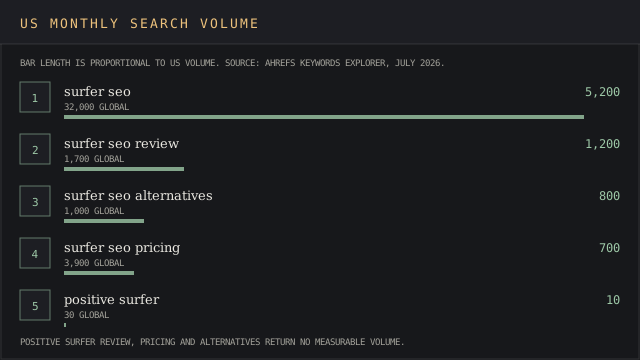
Almost everyone searching for Surfer SEO vs Semrush is typing a name the company never used. The product is Surfer, and since October 2025 it's Positive Surfer. The letters SEO come from the domain, surferseo.com, and nothing else.
The paper trail is consistent. The legal entity in the footer of every page reads Surfer Sp. z o.o., Plac Solny 14/3, Wrocław, with no SEO in it. Co-founder Lucjan Suski, describing the sale, said "every shareholder had all their net worth in a single asset: Surfer." The blog post arguing the case against Semrush is bylined by co-founder Tomasz Niezgoda and titled "Semrush vs Surfer." The product's own marketing has said Surfer throughout.
What happened is ordinary and worth naming, since it's the same trap this site writes about: a descriptive domain bought early became the brand in everyone else's mouth. Third-party review sites, comparison blogs and search suggestions all standardized on Surfer SEO because that's what the URL said.
Capterra now lists the product as Positive Surfer. Most of the pages ranking for Surfer SEO vs Semrush haven't caught up, and several still describe an independent Polish company that stopped existing in that form ten months ago.
Which name to use?
Positive Surfer is correct today. Surfer is correct historically and still how the team refers to the product. Surfer SEO is a domain artifact that no company document has ever used. This page says Positive Surfer except when quoting somebody else's wording.
↑ COMPARISONBoth tools lost their independence within six months of each other
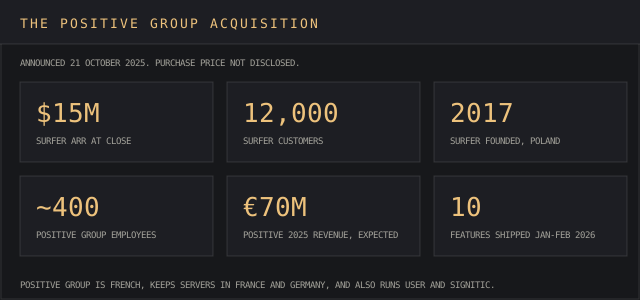
Positive Group, a French technology group in Hem, acquired Surfer on 28 October 2025. The price wasn't disclosed. The company had been bootstrapped since 2017, reached $15 million ARR with 70 employees in Wrocław, and its founders held everything. The product now brands as Positive Surfer, and Positive's other holdings include User.com, Iconosquare and noCRM.
Five people founded it: Lucjan Suski, his brother Michał, Sławomir Czajkowski, Tomasz Niezgoda & Kazimierz Piętka. Three still held it when Positive came calling. Forbes Polska reported in May 2024 that Czajkowski had been bought out by the remaining partners; Piętka left shortly before the sale.
The disagreement was about what kind of company Surfer should be. Suski has described it as a split over dividends against growth, and over how hard to reinvest profit into headcount. The partners who wanted to scale held the majority, and they used it.
Buying Czajkowski out meant taking on real debt, and that debt kept moving. On the Greg Albrecht Podcast, recorded days after the sale was announced, Suski traced the chain: first money owed to Czajkowski himself, then to a company that had looked at buying Surfer, then rolled into a bank. Three years of carrying it.
The timing was the expensive part. They bought a partner out while revenue climbed and paid him off while it fell. Headcount had run to roughly 100 before the market forced a retreat, and Suski calls two years of no growth a euphemism for dropping hard. A company that had posted 28 million złoty of net profit in 2022 still felt like it was against a wall.
Explaining why Positive suited them better than a large acquirer would have, Suski said on that same podcast that if some Adobe had bought Surfer, a year later there would be nothing left of it: it would be synergized into the group and that would be the end. He said that in October 2025.
Adobe closed its acquisition of Semrush six months later, on 28 April 2026, at $12.00 a share and roughly $1.9 billion in cash. Semrush Holdings was delisted from the NYSE the same day. Bill Wagner stayed as CEO; co-founder Oleg Shchegolev had already moved to CTO in March 2025.
Both roadmaps now answer to a parent. Neither company reports independently any more, so neither publishes the quarterly numbers that used to signal where investment was going. Positive's stated reason for the deal was AI search: managing director Paul de Fombelle said customers are "moving from optimizing their traditional SEO positioning to optimizing their brand presence in the responses provided by conversational AI assistants."
↑ COMPARISONWhere the two tools overlap
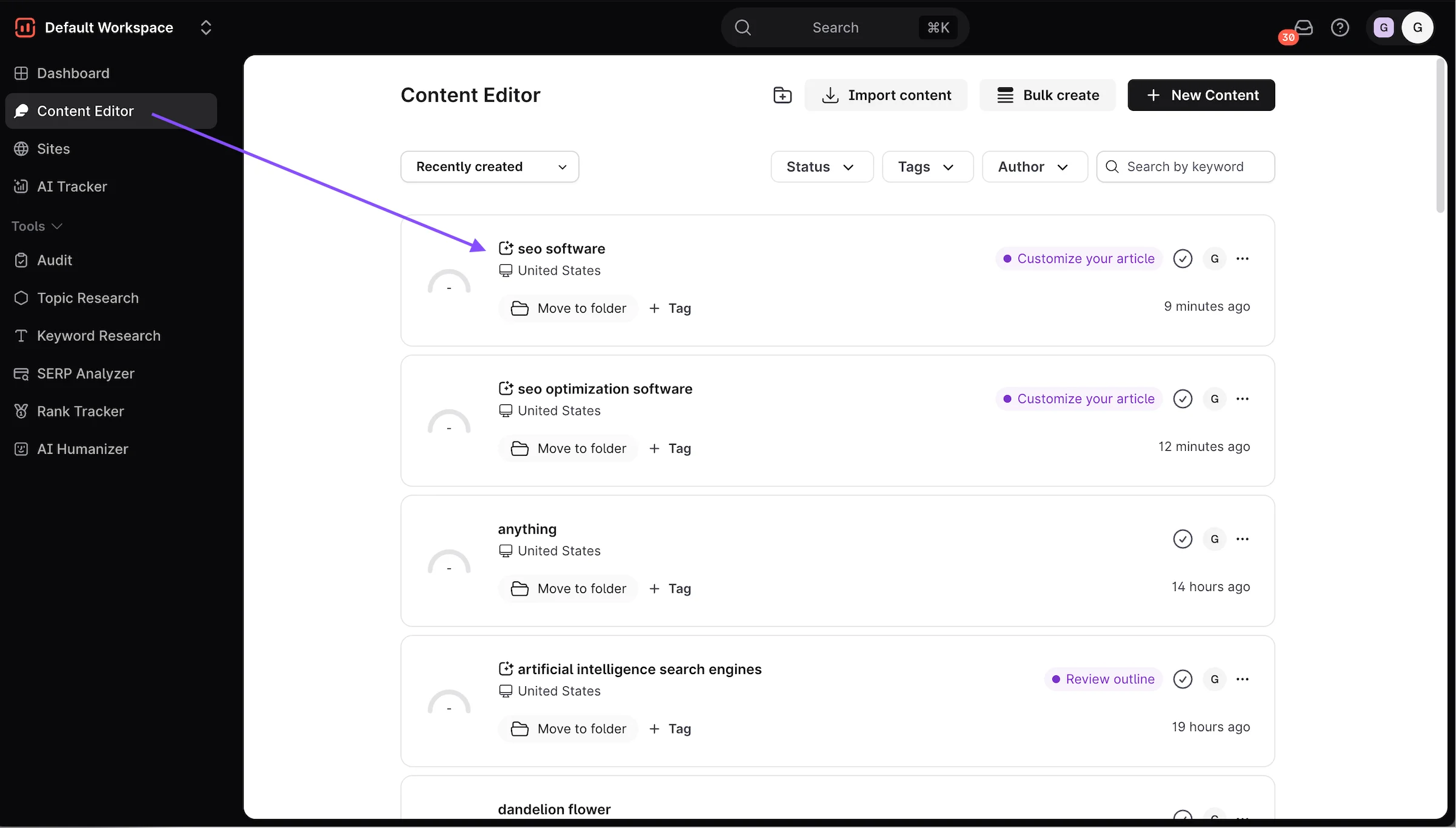
Positive Surfer is a specialized content optimization tool. Its Content Editor opens next to a target keyword, pulls the top ranking pages for that query, and returns a live brief: which terms to include, a word count band, heading structure, and a Content Score that moves as you type. It runs inside the browser or as an add on for Google Docs and WordPress, which is where most content writers work.
Semrush is a digital marketing platform, and each module answers a different question.
- Keyword research runs through the Keyword Magic Tool across a 27.9 billion keyword database, with search volume and keyword difficulty per term.
- Site Audit crawls an entire website against 140+ checks.
- Backlink Analytics tracks 43 trillion links for detailed backlink analysis, broken links, and link building opportunities.
- Advertising Research covers PPC tools and Google Ads data.
Content sits inside all of that as the Semrush Content Toolkit.
The overlap is on page content optimization, and only that. Content optimization is where both products put their scoring engine. Both score a draft against the SERP. Everything else on either side has no counterpart on the other.
What Positive Surfer can't do
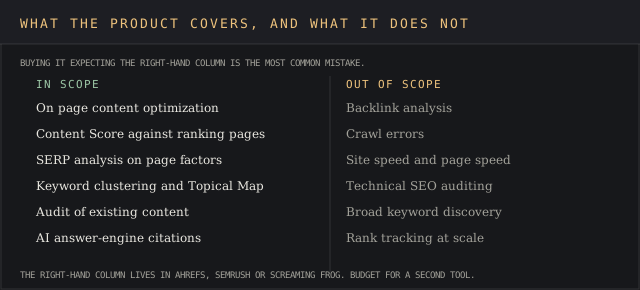
Positive Surfer has no backlink data, no backlink analysis, and no link building tools. It runs no site crawl at all, so broken links, redirect chains and crawl errors go unreported. It has no rank tracking in the Semrush sense, no PPC tools, no local SEO module, and no competitor research beyond the pages already ranking for a keyword you typed in. A content team running Positive Surfer alone is running blind on everything except the articles it publishes.
What Semrush's content tools give up
The Semrush SEO Writing Assistant scores a draft on a 1 to 10 scale with qualitative labels attached, alongside readability and tone of voice feedback that Positive Surfer's own comparison page concedes Semrush handles better. It creates an SEO content template from the top ranking pages for a target keyword.
Term-level guidance is where it stops short. Positive Surfer suggests 80 to 120 NLP terms per document with live coverage tracking, and the Content Editor is built for someone writing in it all day.
↑ COMPARISONKeyword research: two different jobs under one name
Both products list keyword research, and the phrase means something different in each. Semrush treats keyword research as market discovery; Positive Surfer treats it as the first step in on page optimization.
Positive Surfer's keyword research capabilities start from one primary keyword and build outward into keyword clusters and a topical map, so the output is a content plan. Semrush SEO research starts from a domain or a market and works down, so the output is an opportunity list.
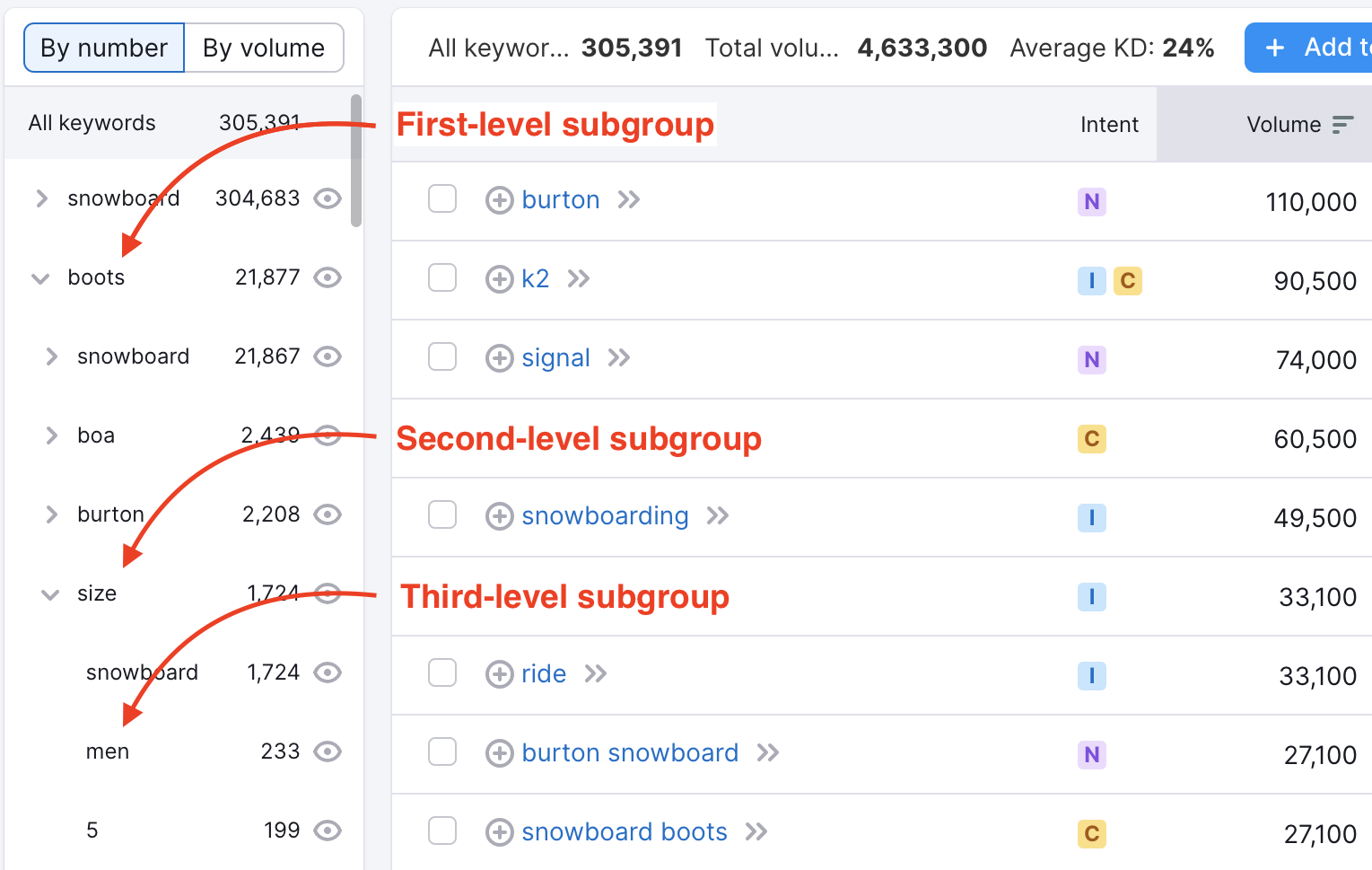
Semrush's Keyword Magic Tool returns keyword suggestions at scale from a 27.9 billion keyword database, each carrying basic metrics: search volume, keyword difficulty, intent and SERP features. Keyword gap analysis puts your domain against three competitors and shows every query they rank for and you don't, which is competitor research Positive Surfer has no equivalent for. The Keyword Magic Tool also filters by country across 142 geographic databases.
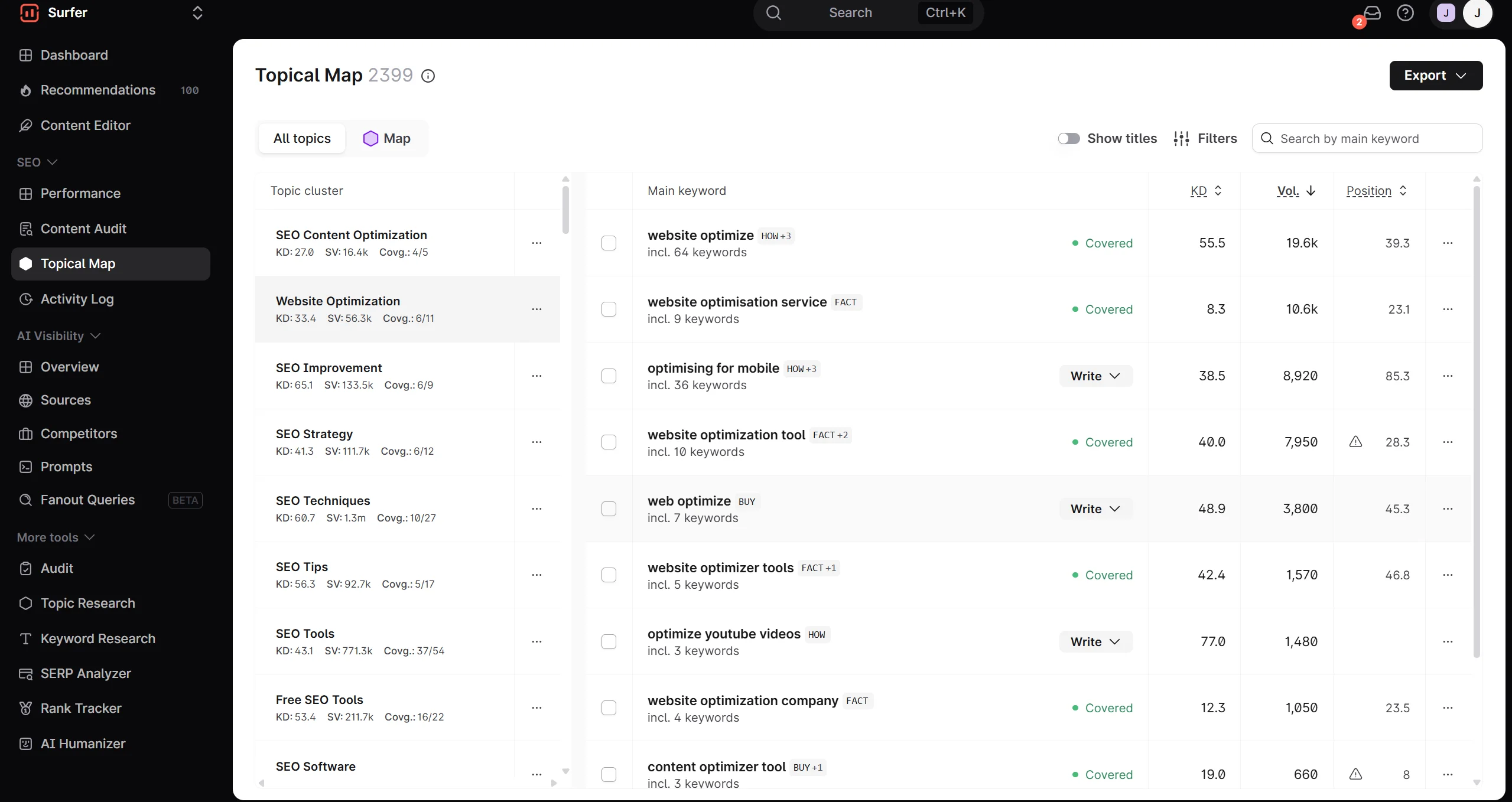
Positive Surfer's version stays closer to the writing. Enter a target keyword and it clusters related queries by intent, estimates the word count the top ranking pages are hitting, and hands the cluster straight to a Content Editor document.
There's no keyword gap view, no competitor analysis across domains, and no historical keyword difficulty trend. For a content team that already knows its topics, that's enough. For anyone building an SEO strategy from scratch, it isn't.
↑ COMPARISONContent Score against SEO Writing Assistant
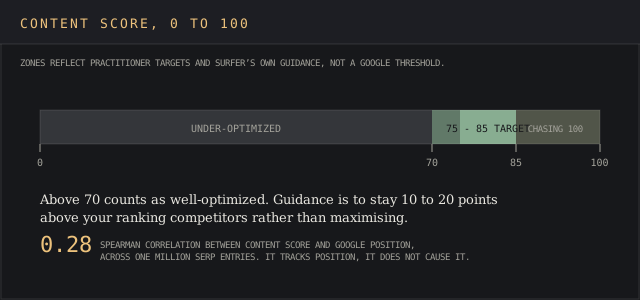
Positive Surfer's Content Score runs 0 to 100 and updates in real time as you write. Semrush's SEO Writing Assistant returns a 1 to 10 score with qualitative bands. The scales differ, but the more useful question is how well either predicts a ranking.
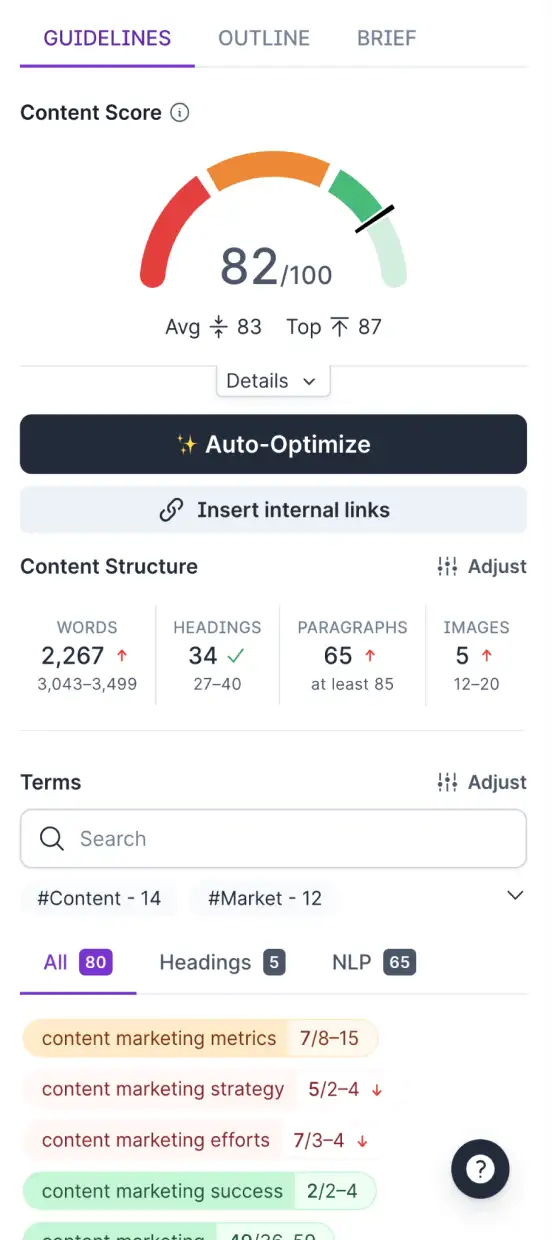
Positive Surfer published the answer for its own metric. In a study of 1,000,000 SERPs, it found a 0.28 Spearman correlation between higher content scores and higher Google rankings. Positive Surfer describes that as a strong signal, and against other published content metrics it holds up: 0.28 runs ahead of what most third-party content scores report. It's also the only published correlation figure either vendor has put its name to.
Surfer's own documentation tells you to stop short of a perfect score: aim 10 to 20 points above the competitors already ranking, and treat anything from 70 up as solid.
Pushing a document to 100 means accepting every suggested term, which is how drafts turn bloated. The score is a floor to clear, and the sensible target sits nearer 80 than 100.
Read the content score for what it measures. A Gartner reviewer running SEM at a media company put the risk plainly in October 2024, writing that "It was a game-changer when it appeared, but might mislead SEO teams into just copying competitors content and rehashing what was already said." A Capterra reviewer made the same point from the writing desk in June 2026: chasing every suggested term "can make the writing sound a bit unnatural or forced."
Facts, entities and the density Surfer asks for
Surfer split its guidance in two on 5 January 2026. The Write and Optimize step now carries an SEO box listing the entities a page needs to rank, and an AI Search box listing the specific facts an answer engine wants before it will cite you. Auto-Optimize inserts the missing ones in a click, and you can walk them one at a time instead, keeping your own phrasing.
Coverage Booster is the engine underneath. It reads top ranking pages, AI Overviews and models including ChatGPT and Perplexity, then surfaces the facts, subtopics and relationships a draft is missing, with the option to drop them straight into the text. That's the density the guidelines ask for: more checkable statements per section, over more words.
I've used Surfer since 2020 and leaned on those fact suggestions the whole time they've existed. They're right well past 90% of the time. The failure mode is staleness: a figure that was correct when it was scraped and has since moved, so the number still needs checking even when the subject is the right one to cover.
The editor's last step is Pre-Publish Review, where AI Readability analyzes the draft and returns structural changes you apply singly or all at once. Plenty of them push the answer higher up the page, the same bottom-line-up-front habit crawlers reward when they're reading under a token budget.
Surfer's blog carries a piece on exactly that, which I wrote after my brother talked me into it at my first Surfer event, six years into working in SEO and close to 10 years watching the company grow from the sidelines.
What Surfer publishes about its own ranking data
Surfer runs original SERP research and publishes the results, which is rarer in this category than the volume of SEO blogging suggests. Its ranking factors study, last updated 21 July 2025, took 1 million unique search queries, pulled the top 20 organic results for each, clustered them with Topical Map so near-identical SERPs didn't skew the sample, then ran Spearman's rank correlation across the on-page factors.
Several findings work against things Surfer could have sold instead. Keyword density showed almost no correlation, and the study states plainly that density has never been part of the Content Score. Raw word count correlated weakly, with length framed as a byproduct of covering a topic. Roughly half the pages carried signs of AI-generated content, and the correlation with position came out at zero in both directions.
Topical coverage was the strongest on-page factor, measured as the depth of related entities, facts and subtopics on a page. Surfer backs it with a check on its own blog: the top 10 performing pages covered about 74% of the facts and subtopics competitor analysis surfaced, against about 50% for the bottom 10.
Three smaller results are worth a buyer's attention. Exact-match domains still correlated strongly while keywords in the URL path correlated with almost nothing, since clean slugs are now universal. Pages carrying many schema types did worse than pages using one relevant type. Bolded keywords and variations correlated positively, which co-founder Michal Suski sums up on the same page as "Bold is gold. Costs zero. Why not?"
The study also undercuts its own headline. It reports that 10,000 and 100,000-query samples returned almost identical results, then says of the full million: "Looks better in the headline."
↑ COMPARISONPricing after both vendors rebuilt their pages
Positive Surfer pricing runs five tiers on either monthly or yearly billing, and the figures its pricing page shows by default are the yearly rates.
- Discovery: €49 a month billed yearly, or €59 monthly, for 10 documents a month, 10 tracked pages and a single seat.
- Standard: €99 billed yearly, €119 monthly, for 30 documents a month, 50 tracked pages and 3 seats.
- Pro: €182 billed yearly, €219 monthly, for 200 tracked pages, 5 brand workspaces and 5 seats.
- Peace of Mind: €299 billed yearly, €359 monthly, for 500 tracked pages, 10 seats and API access.
- Enterprise: €999 with SSO and custom limits, the one tier the yearly toggle doesn't discount.
Positive Surfer's own FAQ puts the yearly discount at up to 17%, matching the roughly 17% Semrush takes off its own annual billing. New accounts get a 7-day free trial of Pro.
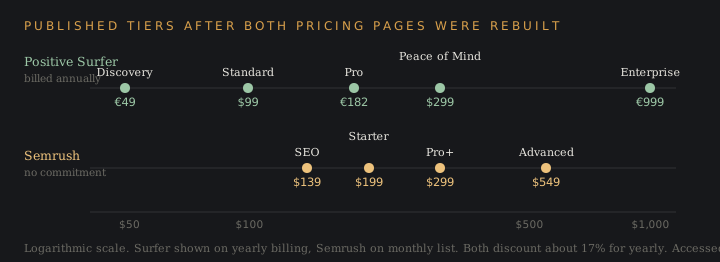
Semrush publishes four self-serve tiers, monthly or annual like Surfer: SEO at $139 a month, Starter at $199, Pro+ at $299 and Advanced at $549, each dropping about 17% on annual billing. Additional users start at $45 a month on top of any plan, which is the line that matters for a content team, since the Pro tier bundles five seats at $182.
Positive Surfer's Peace of Mind plan advertises unlimited documents. Its Fair Usage Policy caps that at 500 documents a month, or 6,000 a year on annual billing, alongside daily caps of 100 each on Auto-Optimize, internal linking, keyword research and SERP analysis.
Unused limits never roll over, upgrading forfeits whatever was left on the old plan, and cancelling means losing your old rate if you come back.
Two published numbers to ignore. Most comparisons still quote an Essential plan at $79 a month, and that Essential plan no longer appears on Positive Surfer's own pricing page. The same pages quote a Semrush "Pro plan at $139.95" from the retired Pro/Guru/Business naming.
Neither figure survives a look at either vendor's current page. That's the single most common error in this comparison, and the kind of mistake catalogued in our report on software pricing errors.
↑ COMPARISONAI visibility tracking, added on both sides
Both products now sell AI visibility as a headline feature, and they built it differently.
Positive Surfer's AI Tracker covers ChatGPT, Perplexity, Google AI Mode, Google AI Overviews and Gemini. Its FAQ states the method directly: "we are scraping real answers" from those five engines, which Positive Surfer contrasts with competitors reading an API.
What you get to ask is set by tier.
- Standard: 25 prompts, refreshed weekly.
- Pro: 50 prompts a day.
- Peace of Mind: 100 prompts a day.
- AI Search Analytics, sold standalone: €185 a month or €158 billed yearly, with a slider setting the daily prompt allowance at 50, 100, 200 or unlimited. The default of 100 carries 5 brand workspaces.
Positive Surfer says 2,800+ companies use it, a far smaller number than its overall customer base.
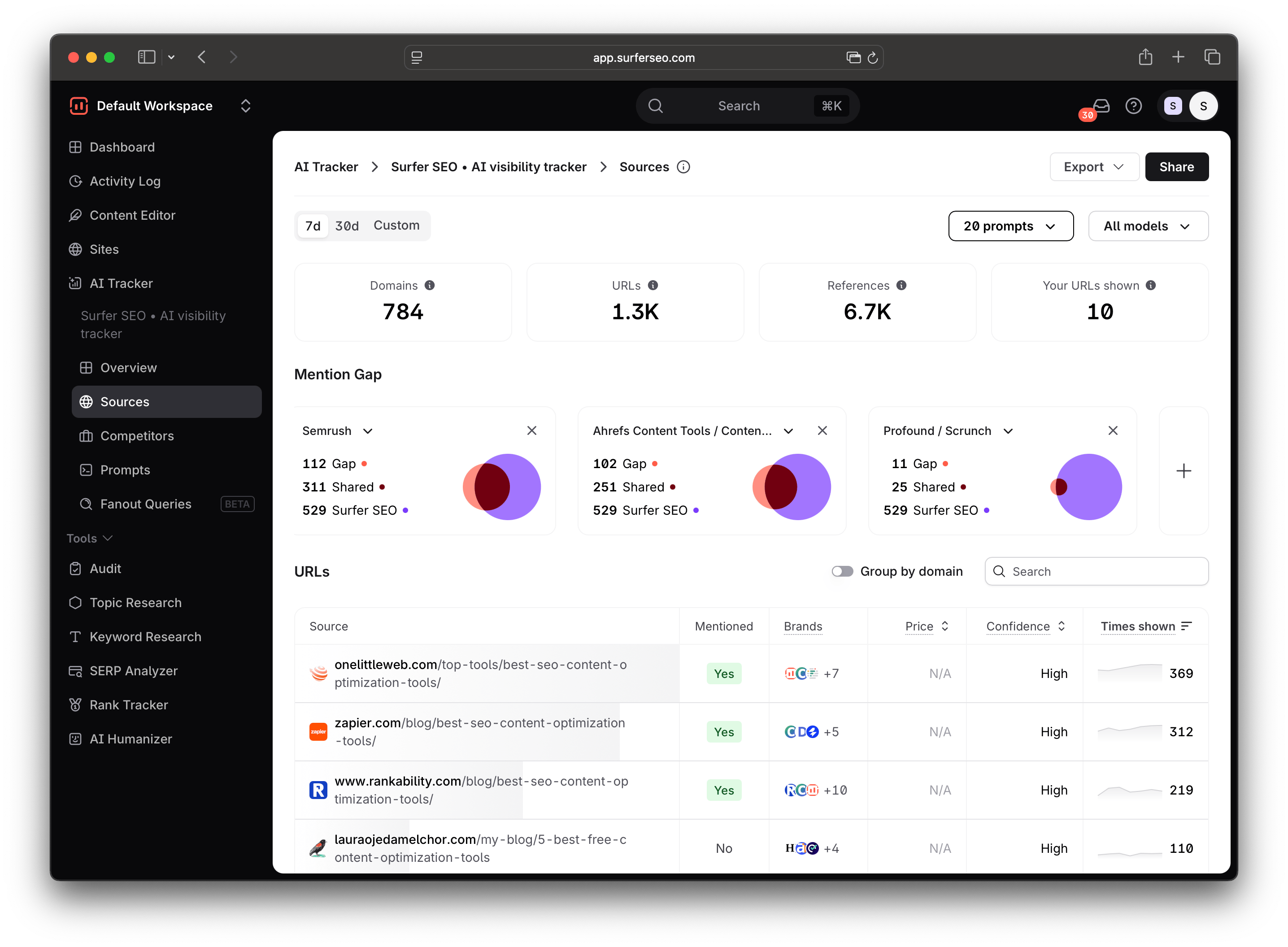
Semrush layers AI prompt tracking into its own tiers: 50 prompts a day on Starter, 100 on Pro+, 200 on Advanced, sitting alongside Site Audit and Position Tracking. Semrush also markets an AI search health score for online visibility.
The API contrast doesn't survive a look at Semrush's documentation. Its AI Visibility knowledge base states that prompt responses are "captured from real requests and not via any APIs of LLMs," drawn from a database of 289 million prompts across ChatGPT, Gemini, AI Overviews and AI Mode, refreshed daily on a rolling basis over more than 40 regional databases. Prompt Tracking runs through Position Tracking, querying your prompts on the target platform each day.
Both vendors claim the same posture, then. What survives is a difference of scope: Surfer tracks named engines at prompt level for a domain you own, while Semrush also keeps a standing prompt corpus you can query before setting up any tracking.
Surfer also ships a free tool neither the AI Tracker nor Semrush's Prompt Tracking replaces. Surfer Pulse scores daily citation turnover across the same five engines, 0-100 per engine, no account needed for ChatGPT and Google AI Overviews.
Pulse answers a narrower question than either paid tool. It measures how much citation turnover happened across all five engines today, the AI-answer equivalent of a Google SERP volatility tracker, without naming which brands won or lost. Semrush has no published equivalent for AI answer citations; its closest tool, Sensor, tracks classic Google SERP volatility instead.
↑ COMPARISONIntegrations and the everyday content workflow
Positive Surfer runs as an add on inside Google Docs and WordPress, so the Content Editor's live scoring appears in the document a writer already has open. Its Auto Internal Links feature reads Google Search Console data to suggest links between existing pages, and Auto-Optimize applies content editor recommendations to published articles in one click. Contentful comes in at Pro, Zapier at Peace of Mind. API access is Peace of Mind and Enterprise only.
Semrush connects to Google Search Console and Google Analytics across the platform, which is what lets Position Tracking reconcile ranking data with real organic traffic. The Semrush SEO Writing Assistant ships as an add on for Google Docs and WordPress too, so the writing-stage user interface is comparable; the difference is what sits behind it.
Neither user interface is the deciding factor. Positive Surfer's is cleaner and reviewers say so, scoring 4.8 on Capterra ease of use against Semrush's 4.3. Semrush's is denser because it's fronting a much larger product.
The layout has been copied, which is its own kind of review. Several content optimization tools now ship an editor arranged the way Surfer arranges one, down to the term list beside the draft and the score that moves while you type. Worth remembering when you demo an alternative: a familiar-looking editor says nothing about the data behind it.
Google Search Console is step zero
Surfer's setup documentation opens with connecting Google Search Console, and several features stay dark until you do. Auto Internal Links is the clearest case: with GSC connected it scans the site and suggests five to ten relevant internal links for the article open in front of you.
There are two modes, and the better one costs more setup. Semantic linking needs the GSC connection plus a Content Audit project for the domain, and it reads context and page relationships. Basic mode still needs GSC but falls back to keyword and URL matching. The suggestions draw on LLMs, GSC data & Surfer's own SERP insights together.
Semrush has no equivalent that writes links into the draft you're editing. It reports internal linking problems from Site Audit, which is a different job. One finds broken structure across a site; the other places a link in a paragraph while you're writing it.
Free tools on each side
Positive Surfer ships a free Keyword Surfer Chrome extension that overlays search volume onto Google results, plus a free AI Search Volatility Tracker. Semrush runs a wider set of free tools behind an account, and its free tier caps daily lookups. Neither substitutes for the paid product; both exist to get you into one.
AI writing and content creation
Positive Surfer's built-in AI writer, Surfer AI, generates a full draft against a Content Editor brief, with an AI Detector and Humanizer alongside it. Surfy is the in-editor assistant for Positive Surfer users. Custom Voices holds brand tone across content creation, and the plagiarism checker runs on the output. Content production at volume is what Positive Surfer builds for, and the credit system is where that gets expensive.
Semrush's content creation sits inside the Content Toolkit, which holds four things.
- Topic Research, for content ideas.
- The SEO Writing Assistant, for scoring a draft.
- An SEO content template generated from the top ranking pages for a target keyword.
- AI-assisted content writing, marketed inside the same toolkit.
Neither vendor's AI writer produces publishable copy unedited. Positive Surfer's own comparison page reports flagging a Semrush-generated article at 94% on its own AI checker, which is a test one vendor ran on itself.
↑ COMPARISONSite audits, SEO errors and technical work
Semrush Site Audit crawls a full domain against 140+ checks and reports SEO errors by severity: broken links, redirect chains, duplicate titles, core web vitals failures and crawl budget waste. It scores site health, tracks the trend, and feeds link building opportunities from Backlink Analytics beside it. That's the layer that turns a fault list into a working plan across search engines.
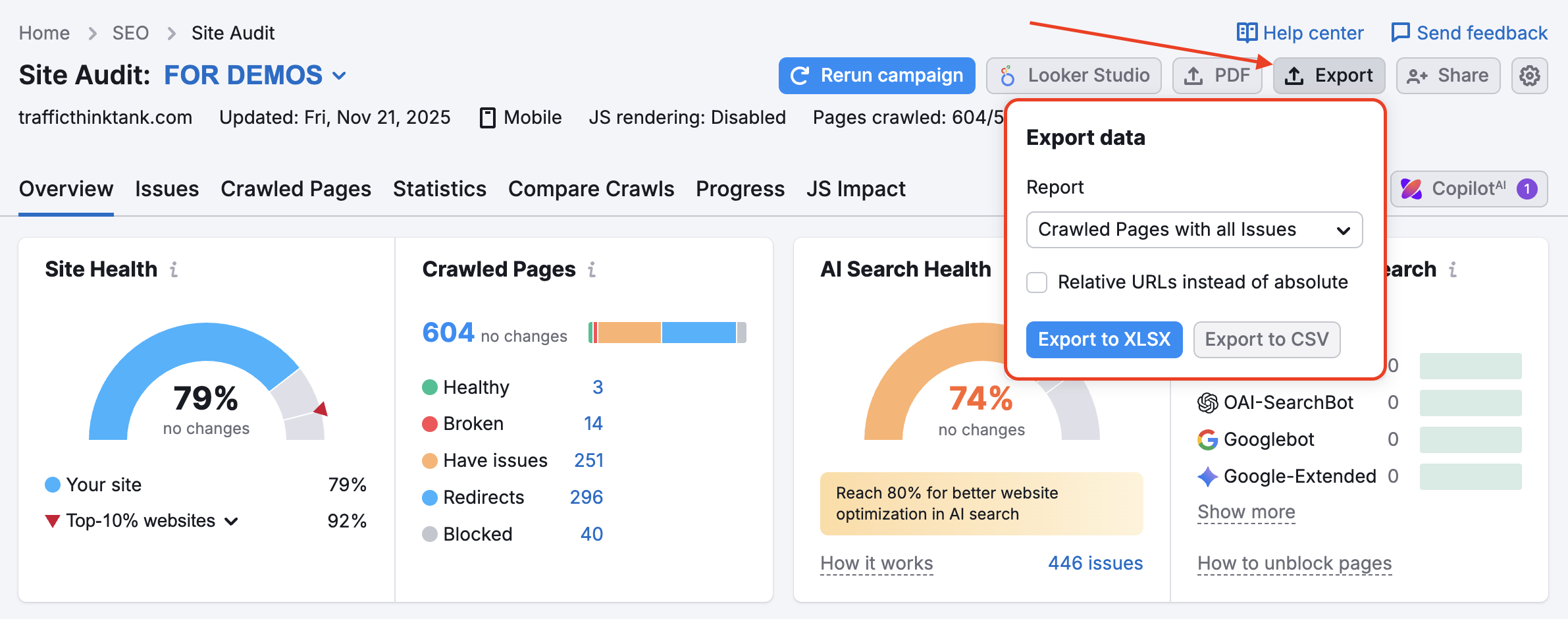
Positive Surfer's audit is a content audit. It compares one published page against the pages currently ranking and returns term gaps, word count deltas and structural suggestions. It doesn't crawl a whole site, doesn't surface broken links, and doesn't report technical SEO audits of any kind. Both improve online visibility; only one of them ever looks at your server.
Each vendor's comparison page, checked against the products
Both companies publish a page attacking the other, and both pages have gone stale in ways worth naming.
| Claim | Who says it | What checks out |
|---|---|---|
| SurferSEO has no free trial, only a "7-day money-back guarantee offer" | Semrush | Positive Surfer's own docs describe a 7-day free trial of Pro. The money-back guarantee appears on no page the company owns. |
| SurferSEO has no AI image generation, no AI chat in the editor, no custom brand voice | Semrush | All three now ship. Surfy is the in-editor assistant, Custom Voices is a paid-tier feature. |
| "Starts at $79/month" | Positive Surfer | No $79 tier exists on the current pricing page. Entry is $49. |
| Semrush content features are "still secondary, tacked on as extras in a much bigger system" | Positive Surfer | Fair as a description of scope. Semrush's own page markets the Content Toolkit to small teams as a standalone product. |
| Competitors read an LLM API, while Surfer scrapes real answers | Positive Surfer | Doesn't hold against Semrush. Its own knowledge base rules out LLM APIs as the source and describes capturing real requests instead. |
| Semrush's score "doesn't shine with any data about their correlation. I can only assume it's crazy low" | Positive Surfer | The company flags this as an assumption in its own sentence. Semrush publishes no correlation figure either way. |
One quieter finding sits behind both pages. Semrush and Surfer used to run an official integration, documented in a Semrush knowledge base article. That URL now redirects to Semrush's general partners page, and Surfer is no longer on the partner list.
Key features, side by side
A last pass on the key features that decide most evaluations, before the review scores.
- Positive Surfer: Content Editor with live scoring, 80 to 120 NLP terms per document, topical maps, content audit, Surfer AI, Surfy, AI Detector and Humanizer, Auto-Optimize, Auto Internal Links, AI Tracker across five engines, Google Docs and WordPress add on. No backlink analysis, no technical SEO audits, no PPC tools.
- Semrush: Keyword Magic Tool, keyword gap analysis, Position Tracking, Site Audit, Backlink Analytics, Advertising Research, Topic Research, SEO Writing Assistant, local SEO toolkit, AI prompt tracking. Content optimization is one module inside a digital marketing platform.
Content marketing teams tend to weigh those lists differently than SEO leads do. A content marketing manager cares about how fast a writer can create content that scores well; an SEO lead cares about on page optimization sitting next to competitor analysis and link data in one login. That split is the whole question in one sentence.
Review scores and what the sample sizes say
Capterra rates both products on one page with the same methodology, which makes it the cleanest like-for-like available.
| Metric | Positive Surfer | Semrush |
|---|---|---|
| Capterra overall | 4.9 from 422 reviews | 4.6 from 2,324 reviews |
| Ease of use | 4.8 | 4.3 |
| Customer service | 4.8 | 4.4 |
| Value for money | 4.6 | 4.2 |
| G2 | 4.8 from 546 reviews | 4.5 from about 3,434 reviews |
| Gartner Peer Insights | 4.3 from 13 ratings | 4.4 from 112 ratings |
Positive Surfer wins every average and loses every sample. Its 13 Gartner ratings against Semrush's 112 is the sharpest version of that: enterprise buyers evaluating an SEO tool are barely reviewing Positive Surfer at all. G2's own panel puts Positive Surfer's perceived cost at the top of its five-point scale and its implementation time at one month.
Capterra also quantifies the complaints. Reviews mentioning restrictive credit limits run 74% negative across 31 reviews; reviews mentioning cost run 60% negative across 47. Positive Surfer has answered those in writing, telling one reviewer in July 2025 that "for power users like yourself, the current credit limits can sometimes feel restrictive."
Reading Positive Surfer's customer count
The pricing page claims "150,000+ customers from 159+ countries." Positive Group's acquisition announcement puts Surfer at roughly 12,000 customers and 150,000 active users, so the larger figure counts seats and the smaller one counts the accounts paying for them.
The smaller number is the one that shapes a buying decision, because it sets the size of the reference pool you can ask for. Twelve thousand paying accounts is a mid-size install base, and it goes some way to explaining the 13 Gartner ratings: enterprise procurement teams aren't the people buying this.
Group scale is a separate question. Positive reports 45,000 customers and more than 800,000 users across its whole product line, holds ISO 27001, and runs its infrastructure inside Europe. A team carrying EU data-residency requirements should weigh that against Semrush, which has answered to a US parent since April 2026.
Running both, and what that costs
These tools serve complementary functions in most real content workflows, and their own marketing half admits it. The company publishes an article titled "Ahrefs vs Surfer: Why You Should Have Both," extending that framing to a research platform it doesn't compete with. It does not extend the same framing to Semrush.
The arithmetic is straightforward. Semrush at $139 covers keyword research, keyword gap analysis, site audits, backlink data and rank tracking. Adding a Positive Surfer Standard plan at €99 billed yearly buys a Content Editor with 3 seats for the writers.
That's $238 a month for research plus content production, against $299 for Semrush Pro+ alone, which adds a content toolkit that scores drafts less granularly. For a team publishing steadily, the split stack usually wins on capability per dollar.
Where it stops making sense is a solo operator. One person paying two subscriptions to write four articles a month should pick the tool matching the actual bottleneck: Semrush if you can't find the keywords, Positive Surfer if you can't get the drafts optimized.
Frequently asked questions
Is Positive Surfer the best?
It's the strongest scoring tool for on page optimization of a single article, with 80 to 120 NLP terms per document and the highest Capterra rating in this comparison at 4.9. It isn't a complete SEO tool, since it has no backlink analysis and no technical site audits.
How much does Positive Surfer cost?
Positive Surfer's pricing starts at €49 a month billed yearly for Discovery, rising through Standard at €99, Pro at €182 and Peace of Mind at €299, with Enterprise at €999. On monthly billing those become €59, €119, €219, €359 and €999. A 7-day free trial of Pro comes with new accounts.
What is the most accurate SEO tool?
Neither vendor publishes a ranking-accuracy figure except one: Positive Surfer's own study of 1,000,000 SERPs found a 0.28 Spearman correlation between its content scores and Google rankings. Semrush publishes no equivalent for the SEO Writing Assistant, so no direct accuracy comparison exists.
What is the best alternative to Semrush?
For keyword research, backlink analysis and site audits together, the alternatives are other full platforms. Positive Surfer replaces none of that; it replaces the content optimization layer only.
What is an alternative to Positive Surfer?
Semrush's Content Toolkit is the closest thing inside a larger platform, and Semrush markets it directly at small teams. Gartner lists Semrush for Enterprise as the top Positive Surfer alternative.
Does Positive Surfer work inside Google Docs?
Yes. Positive Surfer ships add on integrations for Google Docs and WordPress, so the Content Editor's live scoring runs where content writers already draft. Semrush's SEO Writing Assistant offers Google Docs and WordPress integrations too.
Can Positive Surfer replace Semrush for keyword research?
No. Positive Surfer's keyword research capabilities cover keyword clusters and topical maps built around a primary keyword. Semrush runs keyword gap analysis across competitor domains, keyword suggestions at scale from the Keyword Magic Tool, and basic metrics like search volume and keyword difficulty against a 27.9 billion keyword database.
↑ COMPARISONWhich one to buy
Every shortlist here comes down to which half of the job is already covered. Semrush is a digital marketing suite whose keyword research and competitor data feed everything downstream. Positive Surfer is the layer that turns a keyword research output into a published, optimized page.
Buy Positive Surfer if the bottleneck is content production and someone else already handles research. It's built for writers and freelance SEOs who need content ideas turned into optimized drafts, and it does that better than the Semrush content toolkit does.
Buy Semrush if you need one subscription covering keyword research, competitor analysis, technical SEO audits, backlink data and PPC tools, and you can live with content scoring that's good but not the strongest in the category. That's the right call for marketing agencies and any team where nobody owns SEO full time.
Run both when the content team is large enough that five Positive Surfer seats at €182 billed yearly costs less than the writing time it saves, and research still needs a real platform underneath it. Just recheck both price lists before you commit, since both vendors rebuilt their pricing pages in the last year and most of what's published elsewhere about their pricing is out of date.
Sources for Positive Surfer: surferseo.com/pricing/, docs.surferseo.com (pricing FAQ, fair usage policy), surferseo.com/ai-tracker/, surferseo.com/blog/semrush-vs-surferseo/, surferseo.com/blog/surfer-content-score-study/, positivegroup.com/news/positive-acquires-surfer.
Sources for Semrush: semrush.com/prices/, semrush.com/kb/997-semrush-data, semrush.com/content-hub/vs-surferseo/, news.adobe.com (28 Apr 2026 acquisition completion release).
Third-party sources: capterra.com/p/218703/Surfer/, capterra.com/p/151962/SEMrush/, G2 and Gartner Peer Insights listings for both products; Forbes Polska, Krzysztof Domaradzki, 16 May 2024, on the Czajkowski buyout and the 2022 accounts; theygotacquired.com Surfer acquisition report; Greg Albrecht Podcast interview with Lucjan Suski, youtube.com/watch?v=HxyZzjGuZu4. Accessed 6 August 2026.