Semrush vs Similarweb
 By Jan Suski. I go deep on every review, checking every number against its source and digging up details other coverage misses, a habit from six years of SEO and link building for tech companies. Bylines at Surfer, Brand24, and Senuto. How the scoring works.
· Prefer this source on Google
| WHAT EACH ONE DOES | SEMRUSH | SIMILARWEB |
|---|---|---|
| Core job | Fix the site you own | Measure sites you don’t |
| Traffic method | Inferred from rank | Panels and partnerships |
| Keyword database | 27.9bn keywords | 7bn+ keywords |
| Keyword sources | Google only | Google, Amazon, YouTube |
| Backlink index | 43 trillion links | No equivalent |
| Site audit | 140+ checks, from Pro | 300+ factors, quote only |
| App store data | None | 8m+ apps |
| Rank tracking | Daily, every plan | No equivalent |
| Skip it if | The site isn’t yours | You have to fix the site |
| WHAT YOU GET | SEMRUSH | SIMILARWEB |
|---|---|---|
| Entry tier | $139, or $117.33 yearly | $199, or $125 yearly |
| Top self-serve tier | $549, or $455.67 yearly | $649, or $542 yearly |
| Above that tier | Demo only, no price | Custom, no price |
| Tracked median | $11,999 a year | $37,800 a year |
| Tracked range | $4,755 to $57,687 | $14,220 to $96,000 |
| Seats included | 1, extras $45/mo | 1 on all three tiers |
| History depth | Back to Jan 2012 | 3 months, 37 at top |
| Free access | Free plan, 7-day trial | No free plan |
| Owner, since | Adobe, Apr 2026 | Public, NYSE SMWB |
StrongerWeakerNo edge
Thirty-six further documented limits sit behind the button below: panel sizes, minimum traffic thresholds, API row and rate caps, credit pools and what each plan gates. Tracked medians and ranges are Vendr’s own purchase data, independent of either vendor’s rate card, and neither company publishes a price above its top self-serve tier. Similarweb bills monthly and yearly at different rates, so both are shown. Every figure is sourced in the section its row links to.
| Semrush | WHAT IT DOCUMENTS |
|---|---|
| Traffic toolkit price | $289 a month, bought separately |
| Added toolkit users | Up to 3, $309 each a month |
| Daily request cap | 3,000 a day on Pro |
| Competitors tracked | Up to 100 at once |
| Panel size | 200m users, 100+ apps and extensions |
| Clickstream intake | Terabytes every one to two days |
| Traffic data history | Back to 1 January 2017 |
| Audience data start | Age and sex 2020, socio 2022 |
| Monthly data timing | Prior month ready by the 10th |
| Update archive | Kept 3 months after an update |
| Channel dashboards | 8*, one for each channel |
| AI assistants tracked | 21 named, ChatGPT to Monica |
| Traffic forecast | Four weeks ahead, on request |
| Monitoring warm-up | Up to 72 hours for first data |
| Monitoring backfill | Blogs 4 weeks, ads from day one |
| API targets | 200 domains a request |
| API rows returned | 5,000 a request, 10,000 offset cap |
| Premium API data | 16 more data types than basic |
| Similarweb | WHAT IT DOCUMENTS |
|---|---|
| Minimum traffic | No data under 5,000 visits a month |
| Desktop-only reports | Blank under 5,000 desktop visits |
| Data sources | Four: direct, panel, partners, crawl |
| Data release timing | Monthly by the 10th, daily in 72h |
| Rank refresh | Monthly, then fixed all month |
| Segment analysis floor | 15,000 visits a month worldwide |
| Custom industry | 300 websites and 10 segments |
| Custom industry history | 12 months with one segment |
| Users invited | Up to 200, package dependent |
| Product SKUs | 660m† across tracked retailers |
| Retail markets | Six Amazon markets, US to Canada |
| App coverage | 58 countries, iOS and Android |
| Ticker mapping | 60,000 tickers, 144 exchanges |
| API rate limit | 10 requests a second |
| Batch API scale | Up to 1m domains in one call |
| Export link life | Download link valid 30 days |
| Free API credits | 100 a month on DigitalRank |
| Credit pool | One cap across REST, Batch, MCP |
* and † mark a figure the vendor states two ways on its own domain. Semrush’s Traffic Distribution article counts eight main traffic channels and gives each one a dashboard, while the Traffic Analytics article for the same toolkit lists ten, adding Direct and Google AI Mode. Eight is used above because it’s the number of dashboards a subscriber opens.
Similarweb’s retail product page counts 660 million SKUs and its data page says 235 million; the product-page figure is used above because it’s the one attached to the dataset a buyer licenses.
Sources, and where each vendor’s own counts drift
Every row comes from a vendor property.
- Semrush: semrush.com/kb for the Traffic & Market toolkit, the subscriptions page, Competitor Monitoring, the AI Traffic dashboard and the clickstream article, plus developer.semrush.com for the Trends API.
- Similarweb: support.similarweb.com for data accuracy, methodology, segment analysis, custom industries, user seats and data credits, developers.similarweb.com and docs.similarweb.com for the REST and Batch APIs, and similarweb.com/corp for app, retail and stock coverage.
The two publish at different depths. Semrush keeps its traffic limits in one knowledge base and one API reference. Similarweb splits the same kind of number across a help centre, two developer sites and a set of marketing pages whose counts move.
- /corp/stocks carries both 100 million and 1 billion websites.
- /corp/sales lists 100 million contacts in one block and 470 million in another.
- /corp/retail gives 650+, 680+ and 700+ retailers on one page.
Neither vendor publishes a support response time, a contract length, or how long it keeps saved lists and dashboards after a subscription lapses, so no row claims one.
Semrush and Similarweb show up on the same shortlists because both sell website traffic numbers and keyword data. They don't solve the same problem.
Semrush is an SEO tool built for people doing SEO, content and PPC work themselves: keyword research, site audit, rank tracking, link building. Similarweb is a market-intelligence platform for people who need to size up a competitor's traffic without touching that competitor's website: analysts, investors, corp-dev teams running digital marketing due diligence.
The Similarweb vs Semrush question also lands differently than it did six months ago. Adobe closed its acquisition of Semrush on 28 April 2026, so the tool is no longer an independent public company. Similarweb is still trading on the NYSE under SMWB, mid-way through a CEO succession search its own board announced in May 2026. Below is what each tool does, what it costs, and what changed at the top of each company this year.
↑ COMPARISONSimilarweb vs Semrush: what each tool does
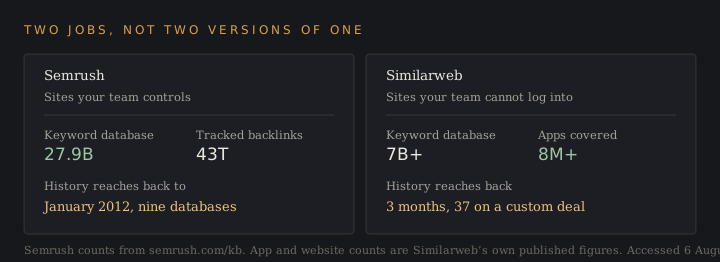
Semrush crawls search engines directly to map keyword rankings, and it builds its numbers from that crawl: a keyword database of 27.9 billion terms, 43 trillion tracked backlinks, and a crawler Semrush says combs roughly 10 billion web pages a day. Similarweb builds its traffic estimates a different way, blending direct measurement, panel data and partnerships where Semrush crawls rank positions.
Both companies' own positioning agrees on the split: Semrush as the SEO and digital marketing execution platform, Similarweb as the market-intelligence and competitive-analysis platform.
Neither platform can see inside the sites it measures. Semrush infers traffic from rank positions it crawls; Similarweb infers it from user panels & partnership feeds. Both are estimating, so any traffic figure from either one is a directional read.
Semrush's execution toolkit
Every Semrush tool exists to be acted on inside a site the buyer controls. The Keyword Magic Tool generates keyword suggestions at scale; the Keyword Overview Report shows global volume, country-level search volume, keyword difficulty and search intent for a single term; Position Tracking handles rank tracking and reports a domain's website's rankings and ranking data by device and location.
- Site Audit: 140+ technical SEO and on page SEO checks, including internal linking gaps, core web vitals, off page SEO signals, and a site health score.
- Backlink Analytics: backlink analysis, backlink analysis features for toxicity scoring, backlink profile tracking, referring domains counts and backlink opportunities.
- Content Marketing Toolkit: a Topic Research tool for content ideas, the SEO Writing Assistant, topic clustering, and Semrush's Influencer Analytics for creator partnerships. This toolkit starts at the Pro+ plan, above the two cheapest tiers.
- Advertising Research: paid search and PPC research data covering ad copy, landing pages and bid estimates.
- Local SEO and SERP tracking: local SEO toolkit, plus featured snippets and other SERP-feature ownership by keyword.
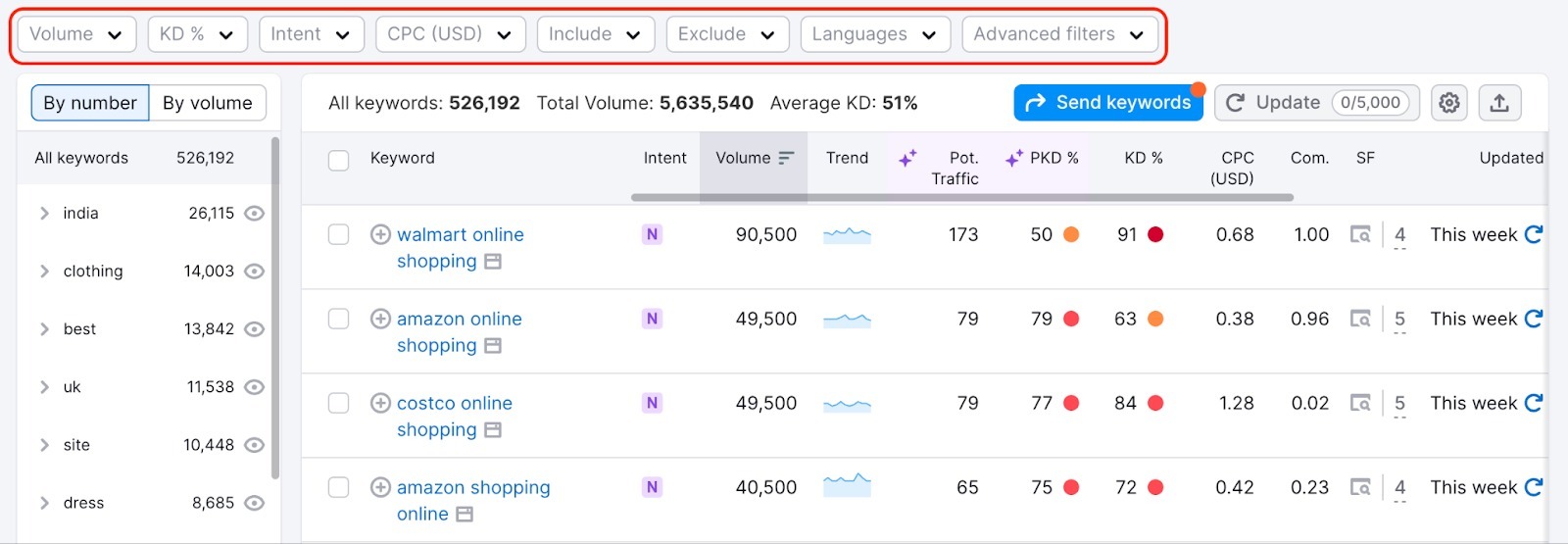
None of this is Similarweb's job. A digital marketing team running SEO strategies inside Semrush touches on page SEO edits, technical SEO fixes and outbound link building in the same login where they started their keyword research. That throughline runs across every Semrush module: input a domain you control, get a task list back.
Similarweb's intelligence toolkit
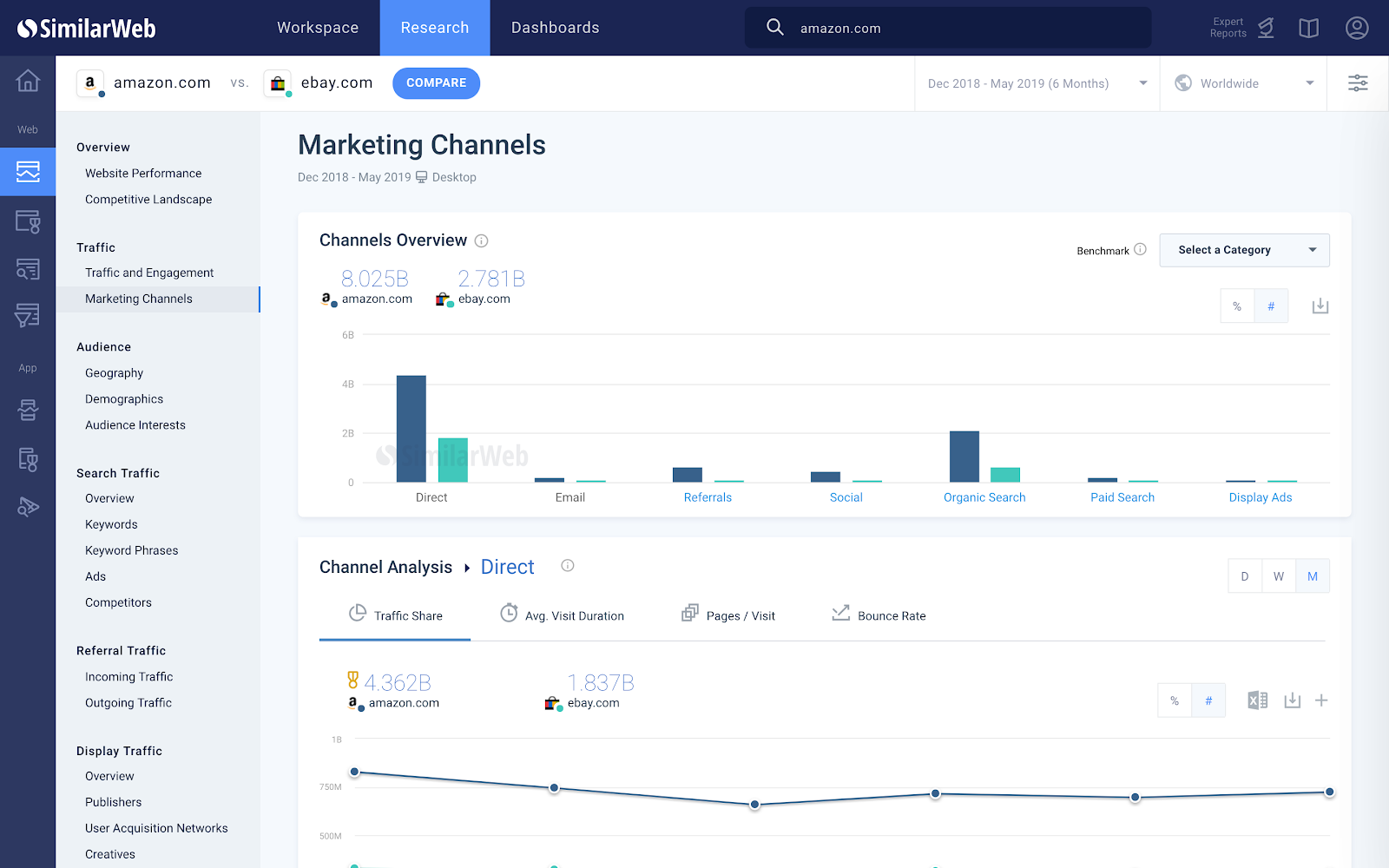
Similarweb's toolkit is built to perform domain analysis on a site the buyer doesn't control. Traffic analysis breaks down website traffic and traffic sources; competitive analysis and competitor analysis surface how a rival's organic traffic, search results visibility and search intent compare; a website performance view helps spot trends across an industry, beyond one site; a Keyword Seasonality report shows search trends building toward a term's peak months.
Unlike Similarweb, Semrush has no comparable market-sizing view built for sites outside a buyer's own domain portfolio. Unlike Semrush, Similarweb has no on-page editor, no content writing assistant and no ad-campaign builder. The two toolkits barely overlap once past the shared vocabulary of "keywords" and "traffic."
Similarweb's own comparison page argues this is a feature: a Similarweb vs Semrush search from inside its own marketing says Semrush wins on execution depth but loses on breadth, since Similarweb tracks sites a Semrush account was never set up to touch. That framing is self-serving, like most vendor comparison pages, but the underlying job split it describes is real.
↑ COMPARISONAdobe bought Semrush. Similarweb is mid-succession
Adobe announced its acquisition of Semrush on 19 November 2025 at $12.00 a share, a deal worth roughly $1.9 billion in cash. It closed on 28 April 2026, and Semrush Holdings was delisted from the NYSE the same day. The company now operates as "Semrush, an Adobe company." Bill Wagner has run Semrush as CEO since March 2025; co-founder Oleg Shchegolev moved from CEO to CTO the same month, and both stayed on through the close.
Similarweb hasn't been acquired, but its leadership is also in motion. On 13 May 2026 the board announced a formal search for a new CEO: founder Or Offer, who has run the company since he started it in 2007, plans to step down around mid-2027 after roughly twenty years in the role. Harel Beit-On, a Similarweb board member since 2017, became chairman around 26 March 2026.
The company posted 2025 revenue of $282.6 million, up 13.08% year over year, and passed $300 million in ARR by June 2026, when it also signed two multi-year enterprise contracts worth about $47 million combined, each handled through a dedicated account manager. None of them ran through a self-serve checkout.
Semrush's ownership question is settled: it's an Adobe subsidiary now, and its roadmap answers to Adobe. Similarweb's is open: it's still an independently traded, quarterly-reporting company searching for its next CEO, with the current founder staying in place for another year or more.
↑ COMPARISONSimilarweb's claims about Semrush, checked
Similarweb runs its own comparison page against Semrush, and it makes five specific, checkable claims. Semrush runs an equivalent page positioning Similarweb as narrower in scope.
| Similarweb's claim | What checks out |
|---|---|
| "Similarweb doesn't limit your competitive analysis... Semrush only has data from 808 million websites (and no apps)" | The 808 million figure matches what Semrush offers on its own published database stats exactly. Similarweb's "1B+ websites, 8M+ apps" figure comes only from Similarweb's own page. |
| "Similarweb's digital insights are powered by real user searches and real user behaviors... Semrush... bases its traffic estimations largely on rank" | Semrush does crawl search engines to build rank-based keyword data. Similarweb's "real user" claim traces to its panel-and-partnership methodology, an estimation method just like the rank-based one it criticizes Semrush for using. |
| "No waiting around for monthly updates like Semrush users" | Doesn't match what Semrush lets buyers track: daily keyword tracking runs on every plan. There's no monthly cadence to wait on. |
| "Out of 3,395 eligible products for G2's 2024 Best Software Awards, Similarweb made it into 150+ different ranking reports... Semrush didn't even make the list" | G2's award program is real and externally documented; Similarweb's placement is plausible on that basis, though Semrush's absence is only sourced to Similarweb's own page. |
| "Similarweb delivers a full marketing stack for only $399/month. Comparable Semrush plans cost over $450" | Half right. Semrush's closest multi-feature tier, Advanced, runs $549/mo month-to-month or $455.67/mo billed annually, both above $399. On Similarweb's side $399 buys the mid tier, and the full stack with ads runs $649 monthly. |
↑ COMPARISONDatabase and coverage scale
Where the two overlap most directly is raw database size, and the gap runs in both directions depending on the metric measured. Semrush holds 27.9 billion keywords against Similarweb's 7 billion, roughly four times the count. Similarweb answers with breadth of source: its keyword data covers Google, Amazon and YouTube, while Semrush's runs against Google across 142 geographic databases.
| Metric | Semrush | Similarweb |
|---|---|---|
| Keyword database | 27.9 billion | 7+ billion, across 50+ search engines |
| Backlink database | 43 trillion tracked links | Not a core product; Site Audit bundles Majestic backlink data |
| Geographic databases | 142 | 190+ countries covered for traffic data |
| Historical data depth | Back to Jan 2012 on 9 core databases (Guru/Pro+ tier and up) | Up to 37 months, per Similarweb's own comparison page |
| Site audit checks | 140+ factors, included from Pro+ | 300+ factors, account-managed customers only |
| App-store data | None | 8 million+ apps, per Similarweb |
Semrush's Site Audit is a self-serve feature that ships inside its mid-tier plans. Similarweb's is not: its own product page describes Site Audit as "an enterprise-level tool, available to all our account-managed customers, regardless of size," which means it's gated behind a sales conversation. That single line explains most of the pricing gap below.
↑ COMPARISONWhat each plan tier unlocks
Feature gating separates these two more than feature lists do. Semrush ships its research tools on every paid plan. Similarweb holds several of the same capabilities behind a sales-negotiated custom contract, so an entry-tier buyer gets a materially different product from the one the demo showed.
| Capability | Semrush | Similarweb |
|---|---|---|
| Backlink analysis | Every paid plan | Higher-tier and custom plans only |
| Country-level data filtering | Every paid plan | Custom plans only |
| Site audit crawl | Every paid plan | Account-managed customers only |
| Historical data | Back to Jan 2012 on 9 core databases, Guru/Pro+ and up | 3 months on standard plans, up to 37 months at the top |
| Keyword coverage | 142 geographic databases, filterable by country | Google, Amazon and YouTube across 50+ search engines |
| Support channels | Email, live chat and phone | Live chat and email |
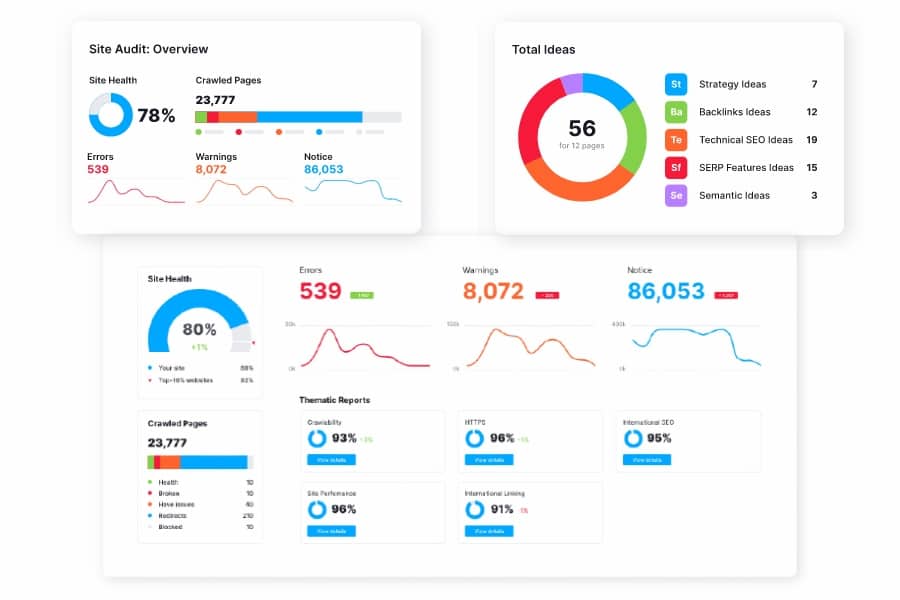
Semrush's site crawler runs technical SEO audits on any paid plan, checking 140+ factors per crawl, and its backlink index refreshes daily. Similarweb's crawler covers 300+ performance factors, which reads like the better number until you check the availability line: its own product page restricts Site Audit to account-managed customers, so nobody on an entry subscription ever opens it.
Fourteen years of historical data against three months is the other gap that changes a shortlist. Semrush's archive reaches back to January 2012 on its nine core databases, which is what makes year-over-year seasonality work. Similarweb's standard plans hold three months, and reaching the full 37-month window means a custom contract.
Similarweb's lower tiers also go without several SEO features that published reviews treat as basic, backlink analysis and country filtering among them. Price the gap before signing.
↑ COMPARISONPricing: a list price against a quote
Semrush publishes a list price for every self-serve tier, all commitment-free monthly rates.
- SEO plan, $139/mo.
- Starter plan, $199/mo.
- Pro+ plan, $299/mo.
- Advanced plan, $549/mo, or $455.67/mo billed annually, since annual billing drops each tier by roughly 17%.
- Free plan, $0/mo, holding one demo project and ten reports a day across the core tools, with no card required.
Enterprise is demo-only. Additional users start at $45/mo on top of any plan, and user seats scale linearly from there.
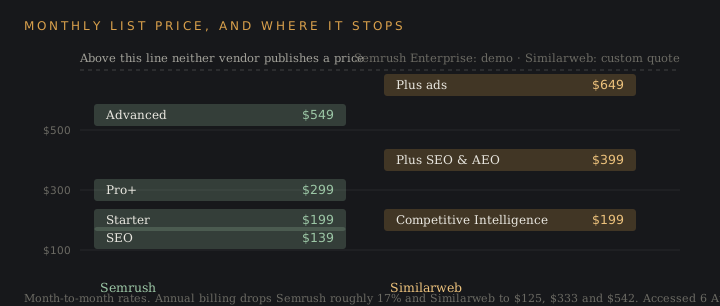
Similarweb publishes three self-serve tiers and nothing above them. Competitive Intelligence runs $125 a month billed annually or $199 monthly; adding SEO and AEO takes it to $333 or $399; adding ads takes it to $542 or $649. All three are single-seat. Above that, the plans FAQ sends business and enterprise buyers to "contact our sales team to discuss a custom package," and Similarweb publishes no starting price for those contracts.
Semrush also sells a-la-carte add-ons on top of any tier: a Base Report at $10/mo, a Pro Report at $20/mo, and a Lead Generation add-on that lists an agency in Semrush's directory for $90/mo. None of those show up in the headline plan prices, so a buyer comparing Semrush's $139 entry price against Similarweb's quote should factor in whichever add-ons the team needs before treating either number as final.
Vendr's tracked purchase data fills the gap Similarweb's own site leaves. Semrush's median tracked contract runs $11,999/year across 58 purchases, ranging $4,755 to $57,687, with 16-20% typical savings for prepaying annually. Similarweb's median tracked contract is $37,800/year, roughly three times Semrush's, ranging $14,220 to $96,000.
Vendr's own page is inconsistent about Similarweb's purchase count, stating both 111 and 157 in different places, and about average savings, citing 12.27% in one line and 15-35% in another. Treat the range as the useful number.
↑ COMPARISONWhere each tool is the better buy
The split tracks the job. It has little to do with the buyer's industry or size:
- Choose Semrush if the daily job is keyword research, on page SEO, technical site audits, link building, PPC research, rank tracking or local SEO, and someone on the team acts on every report inside your own landing pages and site structure.
- Choose Similarweb if the job is competitive analysis of sites you don't control: market sizing, spotting trends across an industry, due diligence on an acquisition target, or benchmarking a competitor's traffic sources without needing to touch their pages.
- Consider both if the team runs SEO execution and competitive strategy as separate functions; several G2 and Capterra reviewers describe running the two side by side, keeping both tools in the stack.
Both Semrush and Similarweb get pitched as an all-in-one SEO tool, but only one of them is one. Semrush's keyword research goes deeper because it has to: content marketing teams running daily SEO campaigns need historical data and backlink analysis in the same place they run competitive analysis of the SERP itself.
Similarweb's competitive analysis stays one level up, closer to traffic sources and website performance trends than to a single page's search results ranking, which is why topic clustering and other on-page SEO features live in Semrush and nowhere on Similarweb's key features list.
Key features, side by side
A last pass on SEO features worth knowing before you sign a business plan or professional plan with either vendor.
- Semrush covers keyword research depth (keyword suggestions from the Keyword Magic Tool, keyword difficulty scoring, search volume and search intent labels per term), a full site audit tool for technical and on-page SEO, backlink analysis with referring domain counts, and Google Ad campaign tracking in its advertising research module. It also offers a free 7-day trial, which fits an agency SEO team wanting that breadth in one login.
- Similarweb covers domain analysis and traffic analysis on sites the buyer can't log into, website performance benchmarking against an industry, popular keywords showing up in a rival's search traffic, and actual traffic figures broken out by channel. Its competitive analysis view is built to spot trends before a competitor's next campaign lands. Fixing a page after the fact is somebody else's job.
↑ COMPARISONReview scores, with sample sizes
| Platform | Semrush | Similarweb |
|---|---|---|
| Capterra | 4.6/5, 2,325 reviews (as of 21 Jul 2026) | 4.6/5, about 255 reviews |
| G2 | 4.5/5, about 3,434 reviews | 4.5/5, about 1,577 reviews |
| Gartner (Enterprise SEO Platforms) | 4.5/5, 106 reviews | 4.3/5, 20 reviews |
Capterra breaks each score into sub-ratings. Semrush scores 4.3 for ease of use and 4.4 for customer service. Similarweb scores higher on ease of use at 4.6, matches Semrush's 4.4 on customer service, and adds separate scores of 4.5 for features and 4.2 for value for money, the lowest sub-score either tool posts on Capterra.
The two overall ratings sit close together on paper. The sample sizes don't: Semrush carries roughly ten times the review volume Similarweb does on Capterra and Gartner, and more than double on G2, consistent with Semrush selling to a much larger base of self-serve individual buyers. Similarweb sells to a smaller pool of enterprise accounts.
Reviewers on both sites mention support team response times; Semrush states a one-business-day reply target, and named Capterra reviewers describe slower turnaround on refund disputes specifically, separate from routine support tickets.
The channels differ too. Semrush answers on email, live chat and phone. Similarweb runs live chat & email with no published phone line, so an urgent question waits for a queue. Getting into Similarweb's free trial takes longer as well: reviewers count a ten-step registration flow before the account opens, against a signup Semrush completes in one form.
What's changed for either tool recently
Beyond the ownership news, both companies moved in the last year. Similarweb acquired Admetricks for ad intelligence in March 2024, 42matters for app intelligence in July 2024, and The Search Monitor for paid search and affiliate marketing in March 2025.
Semrush's own AI product line grew from roughly $4 million to more than $38 million in ARR over the same stretch, alongside an enterprise platform business that reached $37 million ARR across 579 customers. Making Semrush's AI push land required real engineering investment on top of the core SEO toolkit. It wasn't a rebrand of existing features.
Similarweb also had a rockier 2024: a July 2024 Data Version Update changed reported traffic numbers for many sites, by Similarweb's own account, up to 5% on most metrics, and drew a Change.org petition from businesses that said the sudden shift cost them money and trust.
Neither company has disclosed a data breach or faced a GDPR enforcement action. Semrush does carry an active billing-related class action, Quinlan v. Semrush, filed December 2025 in the Eastern District of Pennsylvania; the specific allegations aren't public record yet beyond the filing itself.
Capterra reviewers have described difficulty getting refunds after Semrush's 7-day trial auto-converts to a paid plan, even when cancellation was requested within hours of the charge.
Both are chasing AI search results now
Semrush's newest plan tiers are built around AI-search tracking as much as classic SEO. Starter plans track 50 AI prompts a day across one domain for AI Brand Performance; Pro+ doubles that to 100 prompts; Advanced goes to 200, each layered on top of the existing Site Audit and Position Tracking tools.
That AI Brand Performance product is also where Semrush's most detailed customer complaint on Capterra lands: a named reviewer alleges historical data from the tool changed between two exports of the same period, and that support offered a $50 credit against a claimed $1,553.85 entitlement under Semrush's own terms of service. That's a single unverified account, but specific enough to flag before buying the AI add-on at face value.
Similarweb chose partnerships over building its own prompt-tracking product. It expanded its AI integrations with Manus in May 2026, adding data coverage aimed at AI agents, and with Perplexity in June 2026, building native AI workflows into its existing traffic and market-intelligence data. Neither move gives Similarweb a Semrush-style prompt-monitoring feature. Both extend the same underlying datasets into AI-agent contexts.
An SEO tool like Semrush earns its keyword research reputation one search volume and search intent label at a time; that's still the deciding SEO features test for most buyers. Reading a market the way Similarweb does, and using its data to spot trends before committing keyword research budget to a campaign, is a different skill from running Semrush day to day, and website performance benchmarking sits closer to that second skill than the first.
Common Similarweb and Semrush questions
Is Semrush better than Similarweb?
Depends on the job. For hands-on SEO, content and PPC work, keyword research included, Semrush wins on execution tools. For sizing up a competitor's traffic without touching their site, Similarweb's data sourcing fits better. Most Similarweb vs Semrush searches are asking which job the buyer has. Which product scores higher matters less.
Which platform is better than Similarweb?
None of the major SEO suites replace what Similarweb does. Semrush covers more ground for on-site SEO execution, keyword and content work included, but it isn't a substitute for Similarweb's competitive-traffic and market-sizing use case, and the reverse is also true.
Is Semrush still worth it?
Its core numbers haven't shrunk since the Adobe deal: a 27.9-billion-keyword database, 43 trillion tracked backlinks, and pricing that still starts at $139/mo.
The open question is roadmap direction now that Semrush answers to Adobe. It used to answer to its own public shareholders. Adobe hasn't announced any plan to fold Semrush's tools into its Creative Cloud or Experience Cloud products, but a subsidiary's roadmap priorities can shift without a public announcement the way a standalone public company's would.
What is the most accurate SEO tool?
Neither vendor claims ground-truth accuracy. Both Semrush and Similarweb build their numbers from estimation methods, crawling and rank data on one side, panels and partnerships on the other, so treat any traffic or keyword figure from either as directional.
How trustworthy is Similarweb?
Similarweb has disclosed no data breach and faces no GDPR enforcement action. The company's most public credibility hit was its July 2024 Data Version Update, which changed reported traffic figures for many sites and drew a customer petition over the sudden shift.
What is the best alternative to Semrush?
It depends on which Semrush feature the team relies on most. For competitive traffic and market intelligence specifically, Similarweb is the closer fit; for on page SEO, content marketing and paid search execution, Similarweb isn't a substitute at all, and neither is se ranking or any other rank-tracking-only tool.
Is Similarweb no longer free?
Similarweb doesn't currently publish a fully free plan. Its FAQ directs business and enterprise prospects straight to a sales conversation, with no self-serve free tier listed on its own pricing page. A trial may still be available at signup, but Similarweb's own site doesn't spell out the length or terms anywhere public.
↑ COMPARISONWhich one to buy
Neither company is standing still, and neither buying decision is permanent. Adobe's ownership of Semrush is a few months old; Similarweb's next CEO hasn't been named. Revisit the comparison in a year.
Buy Semrush if the work is SEO, content or PPC execution on sites your team controls, and the daily job means keyword research, site audits, link building and rank tracking someone acts on directly. Buy Similarweb if the work is understanding sites your team doesn't control: competitor analysis, market sizing, or due-diligence-grade estimates on a company that won't hand over its own analytics.
Running both isn't unusual for teams that split SEO execution and competitive strategy into separate functions, and for those teams the Similarweb Semrush pairing covers more ground than either tool alone.
Every Similarweb vs Semrush search boils down to two different jobs, and no Similarweb vs Semrush feature list settles that on its own. A Semrush and Similarweb shortlist for an in-house content team should default to Semrush; a Semrush and Similarweb shortlist for a corp-dev or investor-relations team should default to Similarweb.
Read enough Semrush and Similarweb reviews and the pattern holds: buyers who use both tools rarely regret it. A Similarweb vs Semrush search that skips the underlying job wastes budget either way, and a Semrush and Similarweb evaluation should start there instead.
Semrush sources: semrush.com/prices/, semrush.com/kb/997-semrush-data, semrush.com/kb/64-historical-data, semrush.com/kb/542-site-audit-issues-list.
Similarweb sources: similarweb.com/corp/search/similarweb-vs-semrush/, similarweb.com/packages/web/, similarweb.com/corp/daas/datasets/keywords/, similarweb.com/corp/search/site-audit/, support.similarweb.com data methodology article.
Third-party sources: capterra.com/p/151962/SEMrush/reviews/, news.adobe.com (28 Apr 2026 acquisition completion release), stockanalysis.com/stocks/smwb/, businesswire.com (13 May 2026 CEO succession release, 26 Mar 2026 chairman release, 15 Jun 2026 ARR release), vendr.com/marketplace/semrush, vendr.com/marketplace/similarweb, courtlistener.com (Quinlan v. Semrush docket). Accessed 6 August 2026.