Search Intelligence Platforms: 10 Tools Ranked for 2026
 By Jan Suski. I go deep on every review, checking every number against its source and digging up details other coverage misses, a habit from six years of SEO and link building for tech companies. Bylines at Surfer, Brand24, and Senuto. How the scoring works.
· Prefer this source on Google
Quick comparison of search intelligence tools
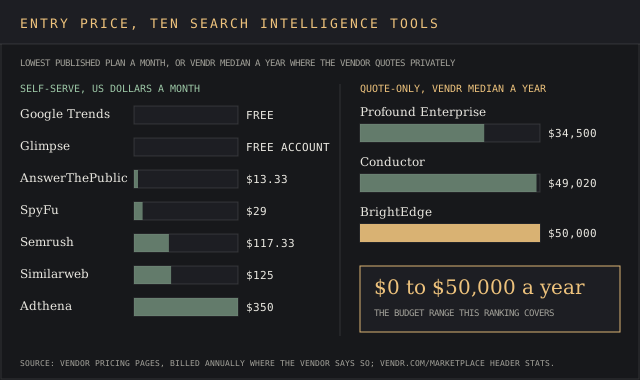
The coverage figure is the one number each vendor publishes that a buyer can check; the price is the lowest published plan, or Vendr's median where none is published.
| # | Provider | Coverage figure | Entry price | Best fit |
|---|---|---|---|---|
| 1 | Similarweb | 190 countries, 6 AI chatbots | $125/mo billed annually | Organic, paid and AI data in one contract |
| 2 | Semrush | 28 million users | $117.33/mo billed annually | SEO-led teams adding paid search for $99/mo |
| 3 | Adthena | 14+ years of CPC and CTR modelling | $350/mo | Advertisers spending $1M+ a year on Google Ads |
| 4 | SpyFu | 10+ years of history on every tier | $29/mo billed annually | Solo PPC managers and small agencies |
| 5 | BrightEdge | 4 billion data points | $50,000/yr median* | Enterprise SEO teams on large sites |
| 6 | Conductor | 2 AI engines plus organic | $49,020/yr median* | Content teams reporting AI visibility to leadership |
| 7 | Profound | 9 AI answer engines | Free 7-day trial | Brands measuring AI answers alone |
| 8 | AnswerThePublic | 1.1M+ users | $13.33/mo billed annually | Writers mapping search questions |
| 9 | Glimpse | 8 social channels | Free account | Trend scouts who want volume behind Google Trends |
| 10 | Google Trends | 8 term groups per comparison | Free | A first check of relative search interest |
Medians marked * are anonymized buyer-reported contract values published by Vendr. Everything else is the price the vendor publishes itself.
Where these figures come from
Coverage figures and entry prices are each vendor's own published figure. The two medians marked * are Vendr's anonymised buyer-reported contract values for BrightEdge and Conductor. Glimpse publishes no paid plan price, and BrightEdge and Conductor publish no list price.
Similarweb, Semrush and SpyFu also appear on the competitive intelligence tools ranking, and Similarweb and Semrush on the digital marketing intelligence ranking. Conductor and the Semrush Content Toolkit sit on the content intelligence tools ranking, Glimpse and Google Trends on the trend research tools ranking. This page ranks all ten on what they measure in search.
A search intelligence platform reads search engine data at scale and answers three questions: which competitors buy which keywords, how much demand a topic carries by country, and which brands AI engines name when a buyer asks. It covers organic results, paid ads and the newer AI answers.
This page ranks ten search tools against five criteria a buyer can test in a trial week, from search engine marketing intelligence suites to free trend checkers. Every price links to the vendor's own page, every contract figure to Vendr's anonymised buyer data, and every user quote to the review where it was posted.
It's written for the in-house marketer or agency lead with a budget anywhere from $0 to $50,000 a year. The timing matters: Gartner forecast that traditional search engine volume will drop 25% by 2026, and six of these vendors now price AI answer tracking as its own line item.
Evaluation criteria for search intelligence platforms
Five criteria decide the shortlist, and the ranking below applies them in this order.
Paid, organic and AI search data in one contract
Count the surfaces one plan measures: organic keyword rankings, competitor ads and AI answers, the three parts of competitive intelligence in search. A vendor that sells search engine marketing intelligence as a second toolkit gets scored on the combined price.
Historical data depth at the plan you'd buy
Months of history, read off the pricing page for that tier.
A seasonal business needs 13 months to compare one peak with the last.
AI answer engines tracked
The number of AI engines the vendor names on its own site. Unnamed engines count as zero.
Published entry price and Vendr median
The lowest list price for one user billed annually, plus Vendr's median where the vendor quotes privately. A public price beats a sales call because the buyer can check it first.
Data source stated by the vendor
A yes or no. Adthena says it collects from search engines directly and uses no panels; Google says Trends uses a sample of searches. Silence leaves the buyer guessing at accuracy.
The 10 best search intelligence tools
Similarweb
Best fit
A team that wants competitor traffic, keyword research, paid search and AI chatbot referrals behind one login.
Similarweb's search product page claims 6B+ keywords across 190 countries, built from what it calls real user data. It runs traffic trackers for ChatGPT, Claude, Perplexity, Grok, Gemini and DeepSeek. Our Similarweb review walks through every tier.
Key features
- Competitive intelligence suite with competitive benchmarking
- Strategic SEO Suite: keyword research, keyword gap and rank tracker
- Ads Intel Suite: paid search, display and social ads
- Gen AI Intel Suite: AI brand visibility, top landing pages, prompt analysis
Pricing
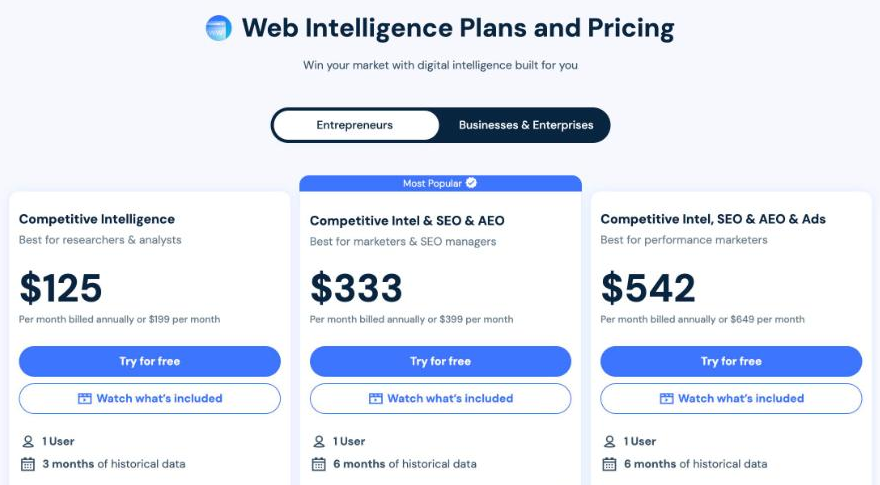
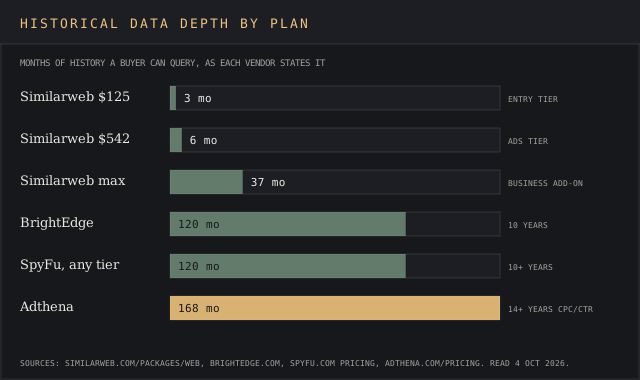
The self-serve ladder starts at $125 a month billed annually ($199 monthly) with 3 months of history. Keyword research and 150 tracked AI prompts arrive at $333; paid search needs the $542 tier. Vendr's buyer data shows a $37,800 median across 157 purchases, from $14,220 to $96,000, which makes the $125 entry plan a drop in the bucket.
Pros
- Organic, paid and AI chatbot traffic in one contract
- 190 countries for market demand by region
- API and MCP access for in-house reporting
Cons
- Paid search data costs $542 a month, 4.3 times the entry price
- 3 months of history on the cheapest plan
- Small-site estimates rest on sampled data
"The cost can be considerable, especially to access conversion rate data. It's less obvious when it is scaling sampled data and to what degree, so smaller sites can have quite erroneous data."
Martin J., Partner, G2, 29 September 2026
Why it's ranked #1. It tracks 6 named AI chatbots against the 3 Semrush shows on its pricing page, so it beats Semrush on the AI engines criterion while matching it on paid and organic coverage across 190 countries.
Semrush
Best fit
An SEO-led team adding paid search intelligence without a second vendor.
Adobe agreed to buy Semrush for about $1.9 billion in November 2025 and closed on 28 April 2026; Semrush counts over 28 million users. See our Semrush review and the Semrush vs Similarweb comparison.
Key features
- SEO plan: 5 websites, 500 keywords tracked daily, site audits
- AI Visibility for ChatGPT, Perplexity and Gemini, next to Google Search
- Advertising toolkit: competitor keyword analysis, Google Shopping ads research and a unified dashboard for Google and Meta
- AdClarity and competitor landing page views on the $220 Advertising Pro plan
Pricing
The SEO plan costs $139 a month or $117.33 billed annually, with a 7-day trial; the free plan allows 10 reports a day. Read between the lines of that headline price: the Advertising toolkit adds $99 a month billed annually. Vendr shows a $12,480 median across 61 purchases, from $4,860 to $56,695.
Pros
- Organic plus paid search for $216.33 a month billed annually
- Published prices on every self-serve tier
- API and MCP access that one reviewer uses more than the interface
Cons
- Paid search is a second subscription
- Project and keyword caps bind on the entry plan
- Prompt tracking caps at 50 to 200 a day, by plan
"I truly hope the competition that has been intensifying recently will force Semrush or Adobe to include more tracking prompts into their current plans."
Pedro M., AEO Coordinator, G2, 9 August 2026
Why it's ranked #2. Organic plus paid search costs $216.33 a month here against $542 at Similarweb, but it names 3 AI engines to Similarweb's 6; it beats Adthena because every Semrush tier publishes a price.
Adthena
Best fit
A brand spending seven figures a year on Google Ads that needs every rival in its auctions.
Adthena calls itself an AI search intelligence platform used by 400+ enterprise brands. Its Whole Market View uses machine learning to map each client's keywords from search engines directly, across Google Ads, ChatGPT and Perplexity. It promises to "dominate your competitive landscape" with "full transparency of your paid search landscape".
Seeing every rival's share of clicks is the strategic advantage it sells.
Key features
- Market Share Report: share of clicks and estimated spend per competitor
- Machine learning keyword map with competitor sizing and predictive ad groups
- Creative Insights alerts on competitor ad creatives
- Brand protection: infringement takedown, ad hijacking detection, automated brand bidding
- Google Ads and SA360 integration, with API and MCP access
Pricing
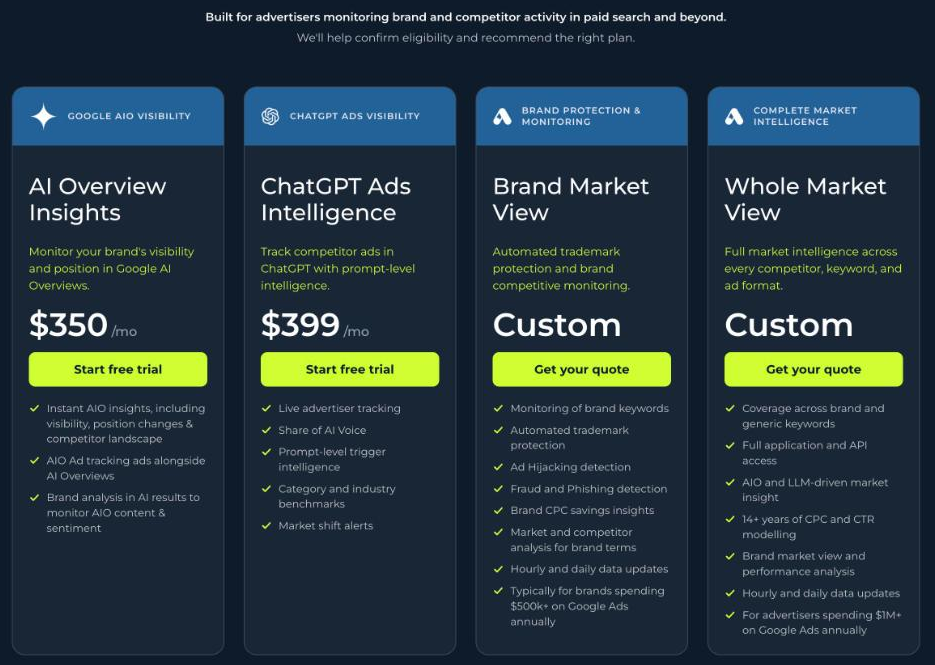
AI Overview Insights costs $350 a month and ChatGPT Ads Intelligence $399, with 200 tracked prompts. Whole Market View is quoted for advertisers spending $1M+ a year on Google Ads. Vendr's buyer data puts the median at $24,000 a year, from $15,798 to $29,997.
Pros
- 14+ years of CPC and CTR modelling, updated hourly and daily
- Collection method stated on the vendor's site
- Brand CPC savings tied to Google Ads campaigns budgets
Cons
- Full coverage is pitched at $1M+ in yearly Google Ads spend
- Organic SEO data is thinner than Semrush's
- Automated report exports need API work
"Adthena actually scrapes the Google Search Results page and extrapolates its own data/measurement (good for external validation)."
Verified user in financial services, enterprise, G2, 30 January 2023
Why it's ranked #3. Its 14+ years of paid search history beat SpyFu's 10+, and its data source is on the record; it trails Semrush because Whole Market View has no public price.
SpyFu
Best fit
A solo PPC manager or small agency that wants a competitor's Google Ads history for under $40 a month.
Every paid tier on SpyFu's pricing page includes 10+ years of historical data, Basic included, which makes it the cheapest decade of paid search history here. Our SpyFu review scores it for solo marketers and small teams.
For a solo marketer it's the best of both worlds: SEO and Google Ads history on one $29 bill.
Key features
- Competitor ad history timeline
- Pre-built Google Ads campaigns from competitor keywords
- 5,000 weekly tracked rankings on Basic, 15,000 on Pro + AI
- Site Audit crawling 50,000 pages a month on Basic
Pricing
Basic costs $39 a month or $29 billed annually. Pro + AI costs $59 for the first month, then $119. Team / Agency costs $249 a month with 5 users. A 30-day money-back guarantee covers all three.
Pros
- 10+ years of history on the $29 plan
- Unlimited searches and exports from Pro + AI upward
- Cancellation by email, live chat or phone
Cons
- Organic click estimates can run far below Google Analytics
- New ads take time to appear
- AI engines go unnamed on the pricing page
Joshua H., a small-business user on G2, found organic clicks running "about 1/10th of the actual results when compared to Google Analytics" in May 2024. Scott M. praised the ad side:
"I love the timeline feature for competitor ads, which lets me see how other advertisers are iterating over time."
Scott M., mid-market, G2, 12 February 2026
Why it's ranked #4. It sells 10+ years of competitor ad history for $29 a month, against BrightEdge's $50,000 median for a similar decade of organic data; it trails Adthena's 14+ years.
BrightEdge
Best fit
An enterprise SEO team on a site with thousands of pages and a budget above $40,000 a year.
BrightEdge says its research engine holds over 4 billion data points with 10 years of historical context. Its AI Hyper Cube reports which brand is mentioned or cited in ChatGPT and Google AI Overviews, with the sentiment of each answer.
Key features
- Data Cube X: competitor comparison across the domain space, down to page
- AI Hyper Cube for ChatGPT and Google AI Overviews
- Copilot recommendations and Autopilot on-site changes
- Instant keyword research
Pricing
Quoted only. Vendr puts the median at $50,000 a year across 46 purchases, from $42,492 to $68,936. That floor is a bitter pill to swallow for a five-person team.
Pros
- 10 years of keyword history
- Separates a ranking change from a demand change
- Executive dashboards for reporting upward
Cons
- The highest median contract of the ten
- Position tracking misses some fluctuations, per one reviewer
- Feature requests move slowly
"BrightEdge is great for large companies and large SEO teams since it's pricey but worth it if you have a large team or organization using it. For small businesses, I would use a different tool like Semrush because of the price and the variety of tools it offers."
Verified manager in marketing, 10,001+ employees, TrustRadius, 17 December 2024
Why it's ranked #5. It publishes 10 years of keyword history, a figure Conductor doesn't, at a similar median; it trails SpyFu, which sells a decade of history for $29 a month.
Conductor
Best fit
A content team that has to show leadership how AI visibility turns into traffic.
Conductor Intelligence puts AI visibility, keyword rankings and website performance in one reporting layer, and tracks mentions, citations and sentiment in ChatGPT and Perplexity. Its pitch connects search data to business decisions and argues that single-purpose AI trackers "create more data silos". That hits the nail on the head for teams whose leadership asks what AI visibility earns in revenue.
Key features
- AI Search Performance with intent and sentiment analysis
- Ask Conductor natural language questions
- 24/7 website monitoring for technical issues
- Market Share reports across AI and traditional search
Pricing
Quoted only. Vendr shows a $49,020 median, from $41,364 to $93,100.
Pros
- AI visibility next to traffic and conversion metrics
- Round-the-clock technical monitoring
- Custom-priced plans for smaller teams, per one reviewer
Cons
- The feature list leaves out competitor ads
- Vendr's range tops out at $93,100 a year
- New users describe a heavy first month
"Into our second year, they came up with a custom priced plan for our use case since we are a smaller business and the cost was getting to be a little too expensive."
Lauren Datres, Marketing Manager at RumbleUp, TrustRadius, 24 April 2025
Why it's ranked #6. It measures 2 search surfaces, organic rankings and AI answers, where Profound measures 1; it trails BrightEdge, which publishes 10 years of keyword history at a near-identical median.
Profound
Best fit
A brand team whose only question is how AI engines describe it and its rivals.
Profound tracks up to 9 answer engines on its Enterprise plan: ChatGPT, Perplexity, Google AI Mode, Gemini, Microsoft Copilot, DeepSeek, Claude, Google AI Overviews and Exa Search. It sells itself as an AI platform for marketing teams and raised a $180M Series D at a $1.8B valuation in September 2026.
On engine count it's ahead of the curve, 9 against Similarweb's 6.
Key features
- Answer Engine Insights across 9 AI search platforms
- Agent Analytics with 9 integrations, including Cloudflare and Google Analytics
- Prompt Volumes showing what users ask AI engines
- Credit-based AI Marketer agents
Pricing
The free trial runs 50 prompts daily for 7 days on 3 engines, with no history or exports. Enterprise is custom, with SSO/SAML and SOC 2. Vendr shows a $34,500 median, from $28,000 to $61,200.
Pros
- The most AI engines tracked here, at 9
- Unlimited seats on both plans
- Prompt-level citation data
Cons
- Zero organic or paid search data
- The trial keeps no history
- Country filtering gaps outside the US
"We use it to track visibility, how often our content is being cited, and which prompts we're being mentioned for."
Matthew N., Sr. Channel Manager, Organic Search, enterprise, G2, 22 May 2026
Why it's ranked #7. Its 9 AI engines beat every other tool on that criterion and outclass AnswerThePublic's autocomplete view; it sits below Conductor, which adds organic rankings to its 2 AI engines.
AnswerThePublic
Best fit
A content writer who needs the questions people type into a search bar, for under $15 a month.
AnswerThePublic, part of NP Digital, says it has over 1.1M users. It turns autocomplete suggestions into question maps and now adds AI prompt suggestions and the sentiment of AI responses, a cheap way to zero in on search intent and customer problems.
Key features
- Search volume and CPC data on every plan
- Search listening alerts: 1 on Starter, 20 on Business
- 1,000 monthly AI prompt suggestions on Starter
- Content Studio, up to 6 AI articles a month on Starter
Pricing
Starter costs $13.33 a month billed yearly for 1 user and 100 searches a month. Growth costs $66 for 3 users; Business costs $132.66 for 10 users.
Pros
- The lowest paid entry price of the ten
- Questions grouped like customer feedback
- Comparison over time from Growth upward
Cons
- 100 searches a month on Starter, about 3 a day
- Autocomplete data carries zero competitor information
- Larger SEO suites copy the question view
"A lot of other SEO tools have incorporated questions and other topic trees into their research tools which has made me visit AnswerThePublic less frequently."
David V., Lead Developer, Capterra, 17 August 2026
Why it's ranked #8. At $13.33 a month it publishes a price Glimpse doesn't and adds 1,000 AI prompt suggestions; it trails Profound, which tracks 9 AI engines against AnswerThePublic's autocomplete-led view.
Glimpse
Best fit
A trend scout who uses Google Trends and wants absolute search volume next to the curve.
Glimpse's Chrome extension has 200,000+ users at a 4.91 rating, with customers in 132+ countries. It adds absolute volume to Google Trends charts and claims 95%+ backtested accuracy for trend forecasting. Our Glimpse review is in progress.
Key features
- Absolute search volume by keyword and country
- Channel breakdown across 8 platforms, TikTok and Reddit among them
- Trend alerts on rising and falling keywords
- Forecasting with seasonality removed
Pricing
Sign-up is free. Enterprise and API access are sold through a demo, and the site publishes no plan prices.
Pros
- Search behavior across 8 social platforms next to search engines
- Forecasts with a stated backtest figure
- Works inside the Google Trends page
Cons
- Paid plan prices stay off the site
- Trend data in English only, per one reviewer
- Custom timeframes take extra steps
A non-profit reviewer on G2 liked that it "gives you actual search volume data to go along with the trends", then objected to the bill:
"It's expensive. It costs as much for the Glimpse tool as it does for some entire SEO solutions."
Verified non-profit reviewer, G2, 26 January 2024
Why it's ranked #9. It adds absolute volume and 8-channel data that Google Trends lacks, across 132+ countries; it trails AnswerThePublic, which publishes a $13.33 entry price where Glimpse publishes none.
Google Trends
Best fit
Anyone checking relative search interest before paying for anything.
Google Trends is free and needs no account. Google's FAQ says it uses a sample of Google searches, scales each point from 0 to 100 against all search queries in that place and period, and drops duplicate searches. Niche terms fly under the radar: searches from too few people show as 0. See our Google Trends review.
Key features
- Up to 8 groups of terms, 50 terms each, per comparison
- Interest by region and subregion
- Real-time data for the past 7 days
- Pairs with Google Keyword Planner for understanding search volume
Pricing
Free. Google Keyword Planner adds search volume and bid estimates but needs a Google Ads account with billing details entered.
Pros
- $0 at any volume
- Data straight from the horse's mouth, Google's own sample
- Regional breakdowns for market demand
Cons
- A 0 to 100 index with no absolute volume
- Terms with lower search volume show as 0
- Name collisions mix unrelated meanings
"You can get a long way with these 2 tools before signing up to any paid stuff."
Gustomaximus, on Google Trends plus Keyword Planner, Hacker News, 4 October 2021
Another Hacker News user, adamnemecek, warned in May 2015: "People, please stop using google trends to gauge anything."
Why it's ranked #10. It costs $0 and comes from Google's own search sample, but its 0 to 100 index carries no absolute volume, which puts it below Glimpse's volume figures for 132+ countries.
What search intelligence costs: one scenario
The scenario: one user who needs organic keyword data and competitor paid search history, billed annually.
- SpyFu covers it for $29 a month.
- Semrush needs the $117.33 SEO plan plus the $99 Advertising toolkit, $216.33 in all.
- Similarweb needs its $542 tier.
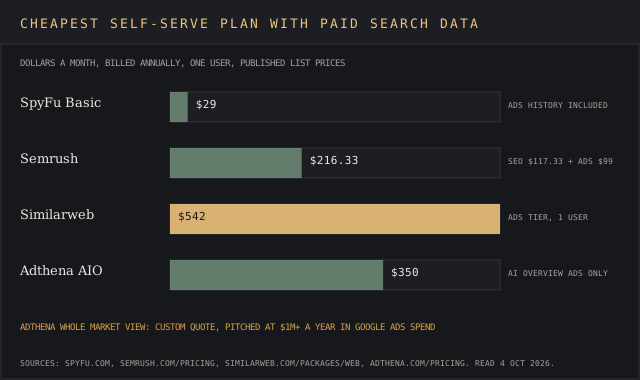
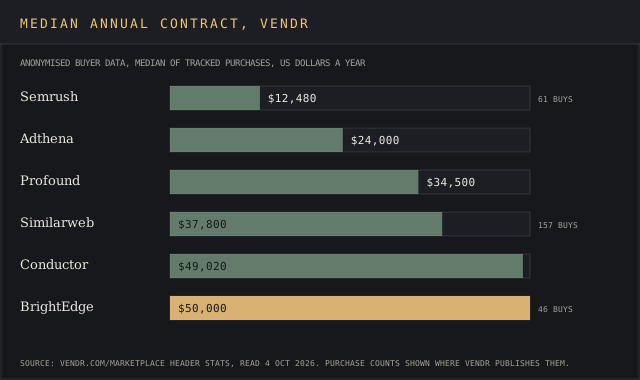
BrightEdge, Conductor and Profound don't list competitor ads, so the scenario prices them out. Quote-only pricing is par for the course at that end of the market. Negotiated contracts are another matter: Vendr's medians run from $12,480 for Semrush to $50,000 for BrightEdge, and enterprise deals cost an arm and a leg next to self-serve list prices.
Where search intelligence data comes from
Four data collection methods sit behind the ten:
- Similarweb models traffic from what it calls real user data.
- Adthena and SpyFu collect the results pages of search engines themselves.
- Google Trends samples Google's own searches.
- AnswerThePublic builds on autocomplete, which a Capterra reviewer called "not always reliable or accurate".
The method sets the error, and the devil's in the details. Panel models scale a sample, so small sites carry more guesswork. SERP collection records what a searcher sees, ad copy and position included, and stops at the click.
Position data matters because clicks concentrate at the top, so the commercial value of keyword rankings data depends on how fresh it is.
Backlinko's study of 4 million Google results found the #1 organic result averages a 27.6% click-through rate.
Search intelligence versus intelligent search software
The search results for this category mix two products under near-identical names: search intelligence and intelligent search. Search intelligence measures public search engines and AI engines from outside. Intelligent search software, sold as an enterprise search platform, answers questions about a company's own documents.
IBM's explainer says employees waste 3 hours each workday searching for information.
IBM describes intelligent search as "powered by artificial intelligence technology" that "eliminates data silos", with intelligent search applications that "understand and query digital content from multiple data sources".
IBM credits natural language processing for that last step. Intelligent search tools ingest data from document management systems, a content management system and maintenance records, then connect data sources into a single unified search index. Natural language processing, machine learning and semantic search let intelligent search recognize document types and document structure in unstructured text data.
Traditional search engines can't see a company's contracts or customer information; intelligent search can, because it runs inside the firewall.
Buyers of an enterprise search platform test:
- Result retrieval speed
- Exact matches against predefined categories
- Real-time indexing
- Big data workloads
- Extensive API driven integrations
- Retrieval augmented generation and virtual agents
Intelligent search work inside a company calls for a separate vendor and budget, and none of the ten tools above sells it.
Search engine marketing intelligence and AI search
Search engine marketing intelligence watches paid ads on search engines: competitor analysis of who bids on which specific keywords, what the ad creatives say, which landing page each ad points to, and how bidding strategies shift by season. Keyword performance across search queries in the auction is the core metric, while SEO focuses on organic rankings and content strategy.
AI search platforms add a third surface. Gartner analyst Alan Antin forecast that traditional search engine volume will drop 25% by 2026. Traditional search engines still carry the ad budget, so a team needs both views of search behavior.
Google's Prabhakar Raghavan said in 2022 that almost 40% of young people looking for lunch go to TikTok or Instagram, TechCrunch reported.
A team that puts all its eggs in one basket with an organic-only tool misses the brand mentioned in a ChatGPT answer and the paid ads a rival runs on its name. Our competitive intelligence tools for SEO ranking goes deeper on organic, and the ad intelligence software ranking covers display and social.
Search intelligence platform FAQ
What is search engine marketing intelligence?
Search engine marketing intelligence is competitor data on paid search: which advertisers appear on which search queries, their ad copy, estimated spend and impression share. Adthena, SpyFu, Semrush's Advertising toolkit and Similarweb's $542 tier sell it.
How does SEM intelligence differ from SEO data?
SEM intelligence reads auction data: advertisers, paid ads, landing page and spend. SEO data reads organic positions. Semrush prices the two at $117.33 and $99 a month billed annually, which shows the split.
Is Google site analytics free?
Yes. Google says its analytics tools are "free of charge". Google Analytics measures your own site and target audience; search intelligence tools measure competitors and consumer behavior.
Bottom line
Similarweb wins for a team that wants organic, paid and AI chatbot data in one contract and can pay $542 a month for the paid search tier. Semrush wins on price for the same mix, and Adthena wins search engine marketing intelligence for an advertiser with a seven-figure Google Ads budget.
SpyFu is the pick for a solo PPC manager, Profound for AI answers alone, and AnswerThePublic, Glimpse and Google Trends for content and trend work on a small budget. BrightEdge and Conductor earn their medians on large sites. For traffic-first work, read the website traffic analysis tools ranking next.