Competitive intelligence pricing in 2026: what 18 vendors charge
 By Jan Suski. I go deep on every review, checking every number against its source and digging up details other coverage misses, a habit from six years of SEO and link building for tech companies. Bylines at Surfer, Brand24, and Senuto. How the scoring works.
The numbers Competitive intelligence pricing, checked 30 September 2026
Seven self-serve companies publish pricing you can read without a sales call, and Klue, Crayon and AlphaSense publish none.
A $30,000 Klue or Crayon contract costs 64x Competely's Starter plan annualized ($468) and 250x Visualping's $120-a-year plan.
Four of the five pricing claims tested below overstate the low end, and the fifth can't be traced to a primary source.
Klue and Crayon both average $30,000 a year on Vendr's tracked Klue contracts and tracked Crayon contracts. Competely's Starter plan costs $39 a month. Visualping's Free plan costs $0 and still writes an AI summary of every change it spots on a competitor's page.
I checked the pricing pages of 18 companies on 30 September 2026 and split them into three buying models: self-serve plans, per-request APIs and negotiated contracts. Every price links to its source, straight from the horse's mouth where a company publishes one and from Vendr's purchase data where it doesn't.
It's written for product marketing teams, sales enablement teams and founders setting a first competitive intelligence budget for tracking the competition. The best competitive intelligence tools ranking scores the tools themselves on fit and coverage.
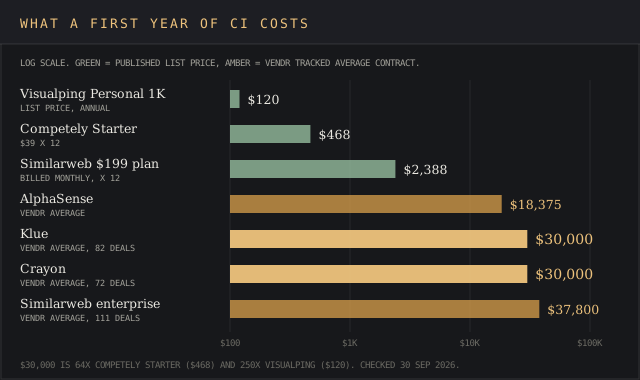
How competitive intelligence tools are priced, from a $0 plan to a $30,000 contract
Three meters run side by side. Self-serve tools charge per plan or per competitor, APIs charge per request, and each competitive intelligence platform charges per negotiated contract structured around seats, modules and services. Those map onto the tiered, usage-based and custom enterprise pricing models that industry guides such as context.dev's describe.
AI pricing splits the same way. Visualping includes AI change summaries on its $0 Free plan, Competitors App sells "Business AI" at $14.90 per competitor a month, and Similarweb charges $399 a month for the package that adds SEO plus AI search visibility, $200 more than its $199 plan.
Klue and Crayon headline AI agents in their Gartner announcements and show no AI line item on any pricing page I checked. You have to read between the lines of a Vendr average to see what their AI agents cost. Crayon pitches its AI on its blog:
"Crayon is the only competitive enablement platform that allows teams to directly improve AI outputs."
Shannon DeMarco, product and go-to-market strategy at Crayon, Crayon blog, 19 February 2026 (date from Crayon's news listing).
AlphaSense is the one incumbent reported to be moving toward metered pricing. IndustryLens reported on 11 August 2026 that its CFO "confirmed a strategic re-evaluation of packaging, signaling a pivot toward consumption-based pricing". That wording is IndustryLens's summary, and AlphaSense's own pricing page still shows no dollar figure. For research-house market intelligence, the market intelligence platform pricing report covers the other end of the same split.
Self-serve competitive intelligence tools with published plans from $0 to $649 a month
Seven of these tools publish pricing, and Visualping's cheapest paid tier costs $10 a month on annual billing. Compare them on the unit you plan to track, because the meters differ (checks, competitors, companies tracked, seats, packages). Most of these companies start you without a sales call and let automation do the monitoring.
| Tool | Entry plan | Meter | Price |
|---|---|---|---|
| Visualping | Free; Personal 1K | checks and pages | $0; $14/mo or $120/yr |
| Competitors App | Business AI (September offer) | per competitor | $14.90/mo per competitor |
| Competely | Starter, Pro, Scale | plan, 3 users included | $39 / $59 / $99 a month |
| SpyFu | Basic, Professional | plan | $39 / $79 a month (Capterra) |
| IndustryLens | 10 companies, 3 seats | per company tracked | €149/mo*, €15* per extra seat |
| Owler | starting plan | plan | from $8.25, period not stated (TrustRadius) |
| Similarweb | Competitive Intelligence package | package, billed monthly | $199 / $399 / $649 a month |
Prices from each vendor's own pricing page on 30 September 2026, except SpyFu (Capterra) and Owler (TrustRadius), whose own pages returned no price. *IndustryLens prices in euros: at the ECB reference rate of 1.1355 on 30 September 2026, €149 is about $169 and €15 about $17.
Visualping is built for watching competitor websites. Free's coverage is 150 checks across 5 pages, enough for a founder to stay ahead of three rivals' pricing pages, and Business 50K runs $350 a month or $3,000 a year for 50,000 checks. Each extra user adds $60 a year.
Competely includes 3 users and charges $20 a month for each one after that. Competitors App's per-competitor pricing carries a September limited-time label, so re-check it before you budget. Three competitors on Business AI come to $44.70 a month, a drop in the bucket next to any platform quote.
SpyFu's figures come from Capterra. The SpyFu review and the competitive intelligence SEO tools ranking cover what its search data buys small businesses. Crayon argues that a cheap AI layer and a sales program are two different purchases:
"But here's the hard truth: building an AI wrapper is not the same as building a competitive enablement engine that drives revenue outcomes."
Sheila Lahar, VP of Content Marketing at Crayon, "Before You Build: The Realities of DIY Competitive Intelligence", Crayon blog, 25 February 2026 (date from Crayon's news listing).
API pipelines and AI agents that watch 20 competitors for $0.06 a day
The cheapest route skips the platform altogether. Parallel's 26 September 2026 guide defines automated competitive intelligence as a system that "continuously collects, structures, and delivers competitor data without manual intervention", and prices daily monitoring of 20 competitors at about $0.06 on its lite processor or $0.20 on base.
A product marketer can track three competitors with desk research, the guide argues, and "at ten, coverage becomes inconsistent." Its automation pipeline has four jobs:
- Discovery finds competitor content, new market entrants and sources.
- Extraction pulls structured data from JS-rendered pages and pricing tables.
- Monitoring tracks each detected change without manual polling.
- Enrichment handles turning raw data into structured intelligence with citations.
The devil's in the details. Parallel's $0.06 covers the monitoring call only. On Parallel's pricing page, 5,000 requests a month are free, Search costs $0.001 to $0.005 per request, and each extraction or enrichment Task costs $0.005 to $2.4 per request. Engineering hours to maintain the system, or hiring an analyst to turn its output into accurate summaries, sit on top.
Visualping sits between the two models and supports a REST API and MCP access on every plan, including Free. The market intelligence API ranking and the web scraping tools list cover the building blocks and technology for teams that build their own system. User Intuition prices the market research side at $30 per AI buyer interview, with a $150 minimum per study.
Valona's product chief ties the platform price to high-stakes decision making:
"Every validated insight Valona delivers is traceable to its source. This transparency provides a level of trust that high-stakes decisions require, which general-purpose AI tools cannot provide."
Stuart Reynish, CPO at Valona Intelligence, Valona news, 20 May 2026.
Quote-only competitive intelligence platforms average $18,375 to $37,800 on Vendr
The pricing pages at crayon.co, alpha-sense.com and contify.com print no dollar figure, and that's par for the course in the CI industry. IndustryLens founder Naveed Ratansi writes that pricing rows get omitted when a company uses "sales-led custom quoting only", and adds that this covers "most of the CI category." Vendr's tracked contract data gives the numbers to quote, each one an average of deals it handled for customer companies.
| Platform | Vendr average contract | Deals | Average savings | Entry band (Vendr estimate) |
|---|---|---|---|---|
| Similarweb enterprise | $37,800 | 111 | 12.27% | $15,000 to $40,000 |
| Klue | $30,000 | 82 | 17.63% | ~$20,000 to $30,000 |
| Crayon | $30,000 | 72 | 20.19% | ~$15,000 to $25,000 |
| AlphaSense | $18,375 | not shown | not shown | 5-10 seat minimum |
| Semrush (owns Kompyte) | $12,479, all Semrush deals | 150 | not shown | Kompyte ~$10,000 to $20,000 |
Every figure in this table is Vendr's. Average contract, deal count and savings come from each marketplace header block, and the entry band is Vendr's buyer-guide estimate.
Klue and Crayon sell to sales enablement teams at larger organizations, and their contracts are structured around seats, dashboards, battlecards and onboarding. The money buys actionable insights and faster decisions inside the tools a sales team already uses, such as Salesforce and Glean.
Gartner published its first Magic Quadrant for Competitive and Market Intelligence Platforms on 21 April 2026. Northern Light's June 2026 roundup names its own SinglePoint a Leader in it and lists it first, as best for corporate strategy and product strategy. Klue, Crayon and Valona each announced Leader status on their own pages.
Klue: $30,000 average across 82 deals, with 5-10% renewal escalators
Klue meters seats, so organizations with bigger sales teams pay more. Its Klue vs Crayon page, stamped "As of May 2025" and still live, says its "pricing model scales with the number of users as your organization grows" and adds competitors "at no cost". Vendr puts small teams at about $20,000 to $30,000 a year, onboarding at "low-to-mid five figures" and renewals at 5-10% a year unless negotiated out. Deployments with 50+ users reach "mid-to-high six figures".
The red flag for renewal talks is the June 2026 security incident. Klue posted its first update on 18 June, and Salesforce and Gong integrations came back on 27 July, 39 days later (IndustryLens counts 46). Northern Light's roundup labels Klue best for sales-team CI with Salesforce integration, so that outage belongs in the security and compliance review.
"We know this incident required patience and trust from our customers, and we don't take either for granted. We're treating this as a permanent shift in how seriously we invest in security, not a box we've checked and moved past."
Jason Smith, CEO at Klue, Klue blog, 27 July 2026 (date from Klue's news listing).
The Klue review scores the product, and the win-loss analysis template covers the analysis Klue sells alongside battlecards.
Crayon: $30,000 average across 72 deals, with Essentials from about $15,000
Crayon shares Klue's $30,000 average and has the highest Vendr savings of the three platforms, at 20.19%. Vendr estimates Essentials at about $15,000 to $25,000 a year, onboarding at 5-15% of the contract, add-ons and services at 15-30% on top of the base platform, and renewal escalators at 3-7%.
Two Vendr pages disagree on what Crayon meters. The Crayon page says "priced by competitors tracked, seats, and tier", and the Klue page lists Crayon as "per-user, tiered by feature set". crayon.co/pricing points to "how many stakeholders need access to the intel", so ask the rep which meter applies and how the quote is structured. Northern Light files Crayon under sales enablement and battle cards.
Crayon's July 2026 Glean integration puts its competitive content inside Glean's AI assistant. CEO Jonah Lopin framed it on the Crayon blog (14 July 2026, date from Crayon's news listing): "Competitive advantage comes from sellers knowing what to say, at the right moment."
Wunderkind's Tim Glomb, VP of Digital, Content, and AI, said on 29 April 2026 (date from Crayon's news listing) that Crayon gives his team "accurate, high-value insights that Glean can surface across the organization". The Crayon review and the Crayon vs Klue comparison go deeper on capabilities.
AlphaSense: $18,375 average, with expert calls adding 20-40%
Sources disagree on AlphaSense by a wide margin. Vendr's tracked average is $18,375 with no deal count shown. Sacra's research estimates $10,000 to $20,000 per seat and average deals of $50,000 to $100,000+, and Vendr lists a 5-10 seat minimum. Five seats at Sacra's rate already come to $50,000 to $100,000. Northern Light's roundup lists AlphaSense as best for financial services and investment research.
Expert calls and premium research content add 20-40% of the contract for heavy users, $3,675 to $7,350 on the $18,375 average. Vendr also lists a 3-5% escalator, a 10-20% multi-year discount and a 60-90 day cancel window, and it sets AlphaSense's pricing against the Bloomberg Terminal at about $24,000 to $27,000 per terminal, the comparator it names for research tools that analyze markets.
AlphaSense raised $350 million at a $7.5 billion valuation on 3 June 2026, per Sacra, and its release that day put annual recurring revenue past $600 million. Sacra dates the $700 million ARR mark to June 2026, and IndustryLens reported it on 11 August, citing a 23 July story in The Information. Keep an eye on the packaging change, because a consumption price would reset every figure here.
"At AlphaSense, we're building a continuously learning intelligence platform that combines proprietary content, deep insights from expert interviews, and purpose-built AI to help organizations move from insight to action in real time - and make faster, higher-conviction decisions in complex environments."
Jack Kokko, founder and CEO at AlphaSense, GlobeNewswire release via The Manila Times, 3 June 2026.
The AlphaSense pricing report and the AlphaSense review break down the seat math for research teams.
Kompyte and Contify, about $10,000 to $20,000 a year to start
Both companies quote only. Vendr's Crayon page puts standalone Kompyte at about $10,000 to $20,000 a year, and Vendr's $12,479 Semrush average covers all Semrush deals, Kompyte included. Contify starts around $12,000 to $20,000 for small teams and passes $80,000 on large deployments.
Contify delivers insights on industry trends, with coverage and data from 200,000 non-English sources across 117+ languages, and Gartner's research placed it as a Visionary. See the Contify review and the Semrush pricing report. Contify's blog quotes the Gartner industry analysts on what the automation buys:
"Gartner clients frequently report in inquiry a 60%+ reduction in manual effort or time gathering and analyzing intelligence, as well as more relevant and trusted insights, using an AI-powered C&MI platform."
Rahim Kaba, Chris Meering, Dan Tolan and Ethan Budgar, analysts at Gartner, Critical Capabilities for Competitive and Market Intelligence Platforms (22 April 2026), quoted on the Contify blog.
Similarweb in both markets, from a $199 plan to a $37,800 average
Similarweb is the one company here that sells self-serve and enterprise. Its $199 package billed monthly for 12 months comes to $2,388, and Vendr's tracked enterprise average is $37,800 across 111 deals, 15.8x that. Vendr's budget bands run $15,000 to $40,000 for 1-5 users, $40,000 to $90,000 mid-market and $90,000 to $200,000+ for larger organizations.
On the self-serve card, the step from $199 to $399 a month buys "SEO Intelligence" and "AI Brand Visibility" with 150 tracked prompts as one bundle, and $649 adds Ads. That's +$200 for SEO plus AI search visibility together.
Enterprise pricing is structured per module. Vendr says each intelligence module (Sales, Shopper, Stock, App) is "typically priced separately" at $20,000 to $60,000+ a year, so one module adds about half to 1.6x the $37,800 average and takes the lion's share of the quote. Renewals often rise 10-20% unless the customer negotiates.
The Similarweb pricing report and the Semrush vs Similarweb comparison price the modules against each other, and the Similarweb review covers the web analytics data and dashboards behind them.
Five pricing claims that don't hold up
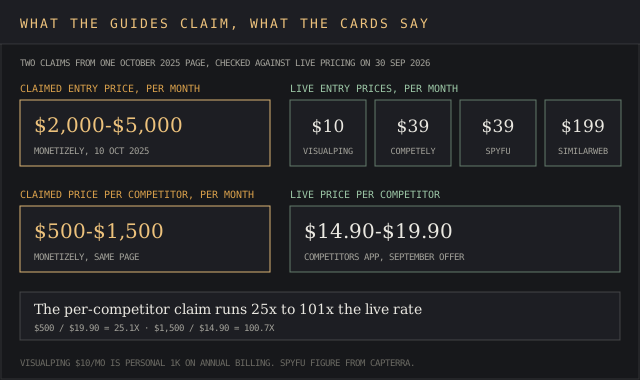
Three of these five trace to one October 2025 Monetizely page that still ranks on page one of Google US for this keyword. Each claim missed the mark on the low end.
| Claim | Where it appears | Live number, 30 Sep 2026 | Verdict |
|---|---|---|---|
| "Entry-level subscriptions typically start at $2,000-$5,000 per month" | Monetizely, 10 October 2025 | Visualping $10/mo on annual billing, Competely $39, SpyFu $39, Similarweb $199 | doesn't hold |
| "$500-$1,500 per competitor monthly" | Monetizely, same page | Competitors App $14.90 to $19.90 per competitor, so the claim runs 25x to 101x the live rate | doesn't hold |
| "$25K-$100K/year" for Crayon and Klue | User Intuition, undated | Klue and Crayon $30,000 averages, AlphaSense $18,375, Crayon Essentials ~$15,000 | floor too high |
| "$200 to $500 per month" to track a few competitors | context.dev, undated | Competely $39 to $99, three competitors on Competitors App $44.70 | low end too high |
| 0.4% to 1.2% of annual revenue on CI | Monetizely, same page | limited to "mature" programs, credited to Forrester with no link | unverifiable |
Live numbers are vendor list prices read 30 September 2026, set against Vendr's tracked averages.
Even the $30,000 averages come to $2,500 a month, and they're averages. Crayon Essentials at $15,000 to $25,000 a year works out to $1,250 to $2,083 a month, below Monetizely's claimed entry floor.
What drives the price up
Self-serve tools price by a unit you can count. Platform pricing scales with seats, modules, services and AI capabilities that only appear in the quote. Five drivers set the bill:
- Seats run from Klue's per-user meter and AlphaSense's 5-10 seat minimum to $60 a year per extra Visualping user, $20 a month on Competely, €15* on IndustryLens and $14.95 on Competitors App.
- Competitors tracked cost $14.90 to $19.90 each on Competitors App, plus $6.95 each for its LinkedIn add-on, and IndustryLens charges €149* for 10 companies.
- Check frequency sets data freshness, and Visualping's fastest interval drops from 60 minutes on Free to 15 on Personal 1K and 2 on Personal 10K and Business.
- Content and modules add the most, with AlphaSense expert calls at 20-40% of the contract and Similarweb modules at $20,000 to $60,000+ each.
- Services add onboarding at "low-to-mid five figures" (Klue) and 5-15% (Crayon), plus Crayon add-ons at 15-30%.
Scope of monitoring and depth of analysis set the tier. A self-serve alert on pricing changes, press releases, hiring trends and product launches costs $0 to $99 a month. A platform that turns those data points into insights, battlecards, dashboards and win-loss reporting for a sales team costs five figures, and its dashboards are part of the seat price.
Humans still check the output. Klue's 2026 survey data from more than 250 CI professionals and product marketers found "only 2% fully trust" AI outputs sent to sellers with no review, and 53% run a manual review before sellers get access. Valona sells curated data as the competitive edge that generic AI tools lack:
"You cannot shortcut 20 years. Most AI in this space is built on generic data. Ours is trained on two decades of curated, verified market and competitive intelligence that only comes from being the world's leading platform in this field."
Kimmo Havu, CEO at Valona Intelligence, Valona news, 20 May 2026.
Retail price monitoring for real-time competitive insights on price
Google US mixes a second product into this keyword, retail pricing intelligence tools. Price monitoring turns competitor product pages into real-time competitive insights on price, and online businesses feed it into dynamic pricing rules that hold their positioning against rivals and shape pricing strategy around market trends. The same feeds support price analysis and show pricing trends across a whole catalog for retail companies.
Prisync lists "99 per month" for up to 100 products on its entry tier, which excludes API access. Its $199 and $399 tiers (1,000 and 5,000 products) list API access at 20% on top of the monthly fee.
Actowiz sells managed price scraping "from $500/mo." and credits it, in its own case studies, with a 20% sales increase for one unnamed online retailer. Price2Spy's pricing is quote-only. The pricing intelligence tools ranking, the guide to pricing intelligence and the Prisync review cover this side of the market for retail businesses.
How to budget, from $468 a year to a $30,000 sales team platform
Small businesses and teams tracking a handful of competitors can start for $120 to $2,388 a year on published plans, before any vendor call. A platform starts around $10,000 to $30,000 before services. Vendr's data and the published cards support five first-year budgets:
| Best fit for | Option | First-year budget |
|---|---|---|
| Founder watching 3-10 rival sites | Visualping Personal 1K or Competely Starter | $120 or $468 |
| Marketing team, web and search analytics | Similarweb $199 package, billed monthly | $2,388 |
| Small competitive intelligence team, first platform | Kompyte, Contify, Crayon Essentials or Klue | ~$10,000 to $30,000 (Vendr estimates) |
| Sales team at scale | Klue or Crayon | $30,000 average, plus onboarding and 3-10% yearly escalators |
| Research and investment teams | AlphaSense | $18,375 average on Vendr, $50,000+ on Sacra's seat math |
Published-plan budgets annualize list prices. Platform budgets are Vendr averages or Vendr buyer-guide estimates, and the AlphaSense $50,000 figure is Sacra's seat math.
Total cost of running the program sits above the licence. On a $30,000 Crayon contract, Vendr's onboarding (5-15%, or $1,500 to $4,500) and add-on (15-30%, or $4,500 to $9,000) percentages put year one at $36,000 to $43,500 before staff time, by my calculation. The 3-7% escalator lifts year two's base to $30,900 to $32,100. User Intuition, a competing company, asserts that most organizations undercount true spend by 3-10x, and its undated page cites no study.
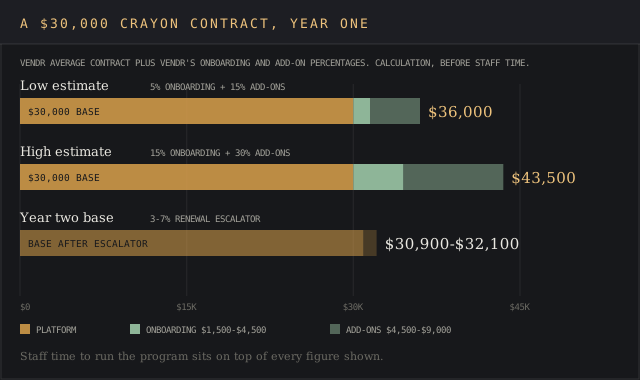
Negotiate the escalator and the cancel window before the discount. Vendr buyers saved 20.19% on Crayon, 17.63% on Klue and 12.27% on Similarweb on average, and AlphaSense's structured multi-year terms trade a 10-20% discount for a 3-5% escalator and a 60-90 day cancel window. Bite the bullet on a hard ask in the first round, since the quote grows at every renewal. That negotiation strategy works best with a rival's quote on the table.
Decision makers sign off faster when the spend maps to named, data-driven decisions. List the informed decisions the tool will feed (pricing changes, positioning, product launches, strategic direction for next year), which insights reach the sales team, and what your organization depends on to make them today. When that's a spreadsheet and a Google Alert, a $39 plan is a strong fit and will support a year of positioning work.
Customer case studies and the win-rate math
Vendor case studies are the usual evidence for the platform side, and Crayon's customer Wunderkind gave a number:
"Last year competitive win rates improved by 7 percentage points, from 52% to 59%, in the second half of the year compared to the first half, reflecting stronger positioning and faster access to competitive intelligence inside sellers' workflows,"
Daniela Cubillos, Associate Director of Strategy Consulting at Wunderkind, Crayon blog, 29 April 2026 (date from Crayon's news listing).
Run the same analysis on your own deals and weigh it against projected business value in the win rate calculator, and treat customer case studies as a ceiling, since the seller picks which case studies to publish. A free competitive analysis template or competitor battlecard template covers the self-serve start.
All 18 companies side by side
| Company | Entry price | Model | Tracked average |
|---|---|---|---|
| Similarweb | $199/mo | packages, enterprise modules | $37,800, 111 deals |
| Klue | ~$20,000 to $30,000/yr | quote, per user | $30,000, 82 deals |
| Crayon | ~$15,000 to $25,000/yr | quote, meter disputed | $30,000, 72 deals |
| AlphaSense | $10,000 to $20,000 per seat (Sacra) | quote, named seats | $18,375 |
| Semrush (Kompyte owner) | quote for Kompyte | subscription plans | $12,479, 150 deals |
| Kompyte | ~$10,000 to $20,000/yr | quote | n/a |
| Contify | ~$12,000 to $20,000/yr | quote | n/a |
| Bloomberg Terminal | ~$24,000 to $27,000 per terminal | quote, comparator | n/a |
| Visualping | $0; $120/yr | checks, frequency | n/a |
| Competitors App | $14.90 per competitor/mo | per competitor | n/a |
| Competely | $39/mo | plans plus seats | n/a |
| SpyFu | $39/mo (Capterra) | plans | n/a |
| IndustryLens | €149/mo* | per company tracked | n/a |
| Owler | from $8.25 (TrustRadius) | 3 plans | n/a |
| Parallel | 5,000 free requests/mo | per request | n/a |
| User Intuition | $30 per interview | per interview | n/a |
| Prisync | 99/mo, 100 products | per product tracked | n/a |
| Actowiz | from $500/mo | managed scraping | n/a |
Tracked averages are Vendr's. Entry prices marked ~ are Vendr buyer-guide estimates, SpyFu and Owler come from Capterra and TrustRadius, AlphaSense's seat price is Sacra's, and the rest come from each vendor's own page. *€149 is about $169 at the ECB rate of 1.1355 on 30 September 2026.
Frequently asked questions
How much does Klue cost?
Vendr tracks a $30,000 average Klue contract across 82 deals, with 17.63% average savings. Small teams start around $20,000 to $30,000 a year, onboarding costs "low-to-mid five figures", and renewals rise 5-10% a year unless negotiated out.
How much does a competitive analysis cost?
A self-serve setup costs $0 to $649 a month on published plans, from Visualping Free to Similarweb's top package. A platform averages $18,375 (AlphaSense) to $37,800 (Similarweb enterprise) a year on Vendr, and a DIY pipeline on Parallel starts near $0.06 a day for monitoring alone. Market research interviews on User Intuition cost $30 each.
What is an example of competitive pricing?
Klue and Crayon make a live example of competitive positioning on price. Both land on a $30,000 Vendr average across 82 and 72 deals, and Crayon's buyers saved 20.19% on average against 17.63% for Klue's. Bring the rival's quote to the negotiation.
What is intelligent pricing and how does it work?
In retail, businesses reprice products from competitor data feeds as part of their pricing strategy. Prisync lists 99 a month for 100 products, and its $199 and $399 tiers add API access for 20% extra.
Do AI features cost extra?
Visualping includes AI change summaries on its $0 plan and every paid plan. Similarweb bundles AI search visibility into its $399 package, and Klue, Crayon and AlphaSense show no AI line item on any page checked, so the ball is in your court to ask for it in writing.
Bottom line
$39 to $649 a month buys monitoring you can create an account for today. $30,000 a year buys a platform that puts battlecards in front of sellers, and the win-rate math has to cover that average plus onboarding.
Self-serve tools are the best fit for watching pages and pricing, and a platform strategy fits sales and research teams that need insights delivered to sellers.
Don't put all your eggs in one basket at the first quote. Price one of the self-serve tools and one API alongside the platform demo before you commit a competitive intelligence budget, and watch AlphaSense for the metered price IndustryLens reported in August 2026. The social listening pricing report prices a neighbouring category the same way.
Sources, and the prices competitive intelligence platforms don't print
Every figure and quote on this page was checked against its origin on 30 September 2026, and each links to its source on first use.
Sources in order of first use are vendr.com, visualping.io, competitors.app, similarweb.com, crayon.co, industry-lens.com, competely.ai, capterra.com, trustradius.com, parallel.ai, userintuition.ai and valonaintelligence.com.
Later sections draw on northernlight.com, klue.com, sacra.com, manilatimes.net, contify.com, getmonetizely.com, context.dev, prisync.com and actowizsolutions.com.
Tracked-contract figures are the header stat blocks on vendr.com/marketplace, which carry "Last updated: February 2026". Vendr buyer-guide ranges are labelled as estimates wherever they appear.
Klue, Crayon, AlphaSense, Kompyte and Contify publish no dollar figure, and none of the platform vendors lists its AI features as a priced line item.