Prisync review: what the $99 tier gets an SMB retailer
 By Jan Suski. I go deep on every review, checking every number against its source and digging up details other coverage misses, a habit from six years of SEO and link building for tech companies. Bylines at Surfer, Brand24, and Senuto. How the scoring works.
· Prefer this source on Google
Best for
Retailers running 100 to 5,000 SKUs who want a self-serve, published rate card and a 14-day trial with no sales call.
Not for
Retailers who've outgrown 5,000 products, or buyers who need guaranteed pricing accuracy at high volume; wrong-price complaints recur across G2, Capterra and Trustpilot.
What it costs
$99 to $799 a month across three pricing models (URL-based, channel-based, hybrid); API access adds a 20% surcharge on Premium and Platinum.
- Competitor tracking
- Unlimited competitors on every tier, URLs added one by one or in bulk
- Product coverage
- 100 products (Professional) up to 5,000 (Platinum)
- Dynamic pricing engine
- Premium tier and up, rule-based repricing against competitor moves
- Product variant tracking
- Size and color variants, documented on the Shopify App Store listing only
- Native integrations
- Shopify, Amazon, Google Shopping, Magento 1 & 2
- Seat count
- Not published on any tier
- Professional
- $99/mo, 100 products, price updates 3 times a day
- Premium
- $199/mo, 1,000 products, dynamic pricing engine
- Platinum
- $399/mo, 5,000 products, MAP monitoring, price history
- API access
- +20% surcharge on top of the Premium or Platinum fee
- Channel-based Platinum
- $599/mo, one sales channel included
- Hybrid Platinum
- $799/mo, same channel add-on structure
- Free trial
- 14 days, no credit card required
- Founded
- Istanbul, February 2013
- Acquisitions
- Spotlite (2018), CompetitorPriceWatch (2020), Marguard (2021)
- Reach
- Customers in 60 countries, per Prisync's own about page
- Latest shipped feature
- Shopify Markets pricing optimization, July 2026
- G2
- 4.7 out of 5, 170 reviews
- Capterra
- 4.8 out of 5, 129 reviews
- Trustpilot
- 4.2 out of 5, 96 reviews, the lowest of the three
- Shopify App Store
- 4.9 out of 5, 209 reviews
Price2Spy
Not forA retailer who wants repricing and API access bundled in, since Price2Spy locks both behind a custom-quoted Premium tier.
Competera
Not forA retailer under 10,000 SKUs or $500 million in revenue, since Competera's own site aims the product above that line.
Pricefx
Not forA retailer doing straightforward competitor price tracking, since Pricefx's CPQ and rebate machinery is B2B pricing infrastructure a Prisync-sized buyer doesn't need.
Pairs well with Prisync
This Prisync review works through what the product tracks, what each pricing tier gates, and where the reviews on G2, Capterra and Trustpilot disagree with the marketing copy. It's built for retail and e-commerce teams evaluating pricing intelligence software against the other tools in the category.
Prisync tracks competitor prices, stock status, and product-variant data across a set of URLs the customer adds by hand or in bulk, then feeds that data into a rule-based repricing engine. The company built the tool in Istanbul in 2013 and has since acquired three smaller pricing outfits: Spotlite, CompetitorPriceWatch, and Marguard.
It now serves customers in 60 countries, according to its own about page, competing directly with Price2Spy on the low end.
At scale, it competes with Competera, Pricefx, and DataWeave. All four sit alongside Prisync in our pricing intelligence tools ranking, and Prisync is a common shortlist name for retail teams sizing up the category.
This review covers the URL-based pricing model, the model the marketing site leads with, and cross-checks it against Prisync's Shopify App Store listing, which quotes different opening numbers.
It draws on 170 G2 reviews, 129 Capterra reviews, and 96 Trustpilot reviews, plus the vendor's own pricing and integration pages.
The tool fits a specific buyer: a retailer running 100 to 5,000 SKUs who wants competitor price feeds in a dashboard without hiring an analyst. It does not fit a retailer who needs verified marketplace data at enterprise scale, since that buyer runs into the same data-accuracy complaints this review documents, at a volume Prisync's support team hasn't kept pace with according to its lowest-rated reviews.
Prisync's own pitch is simple: connect a feed, track competitors, and skip the manual work a pricing analyst used to do by hand. Reviewers who buy that pitch describe daily reports landing within a few hours of setup, calling the process quick and easy. Reviewers who don't buy it describe a different reality, documented section by section below.
What Prisync tracks and how the dashboard works
Prisync built its name on competitor price tracking: the core product lets a retailer monitor named rivals' storefronts and see competitors prices, stock availability data, and how those figures move against its own catalog in real time. Turn on the dynamic pricing engine and those price changes execute automatically, with no one approving each one by hand.
A customer adds competitor URLs one by one or in bulk, and Prisync checks those pages on a schedule set by the tier: three times a day on Professional, more frequently on Premium and Platinum. The dashboard shows market prices, stock levels, and, where the retailer supplies its own cost data, the profit margins each price point produces.
Every Prisync tier exists to answer one question: what are competitors prices doing right now, and should the store react? A retailer who wants to track competitors prices without repricing can monitor competitors prices by hand inside the dashboard, running competitor price tracking as market intelligence. Reviewers describe that manual mode as the easiest way to build trust in the feed before turning on the dynamic pricing engine.
Product variant price tracking, covering size and color variants specifically, is documented on Prisync's Shopify App Store listing. That's a real gap in how the company documents its own product: a buyer researching only prisync.com would miss it.
"Prisync makes competitor price monitoring and rule-based repricing very easy to manage, especially when working with a large product catalog. The interface is intuitive and allows us to track competitor prices across multiple channels in one place. The automation features are particularly useful, we can define pricing rules that automatically adjust our prices based on competitor behavior. Customer support is also responsive and helpful when setting up advanced rules or resolving synchronization issues."A G2 review from a mid-market administrator, March 2026
Pricing and the limit that binds per tier
Prisync sells three pricing models: URL-based, channel-based, and hybrid, each with its own Professional, Premium, and Platinum tiers. URL-based is the cheapest path in: $99 a month for 100 products on Professional, $199 for 1,000 on Premium, $399 for 5,000 on Platinum.
Channel-based pricing bundles one sales channel into the same three tiers at $199, $399, and $599, with extra channels billed at $100 to $200 a month each. Hybrid stacks both models, running $299 to $799 across the same product-count bands. A retailer selling on three marketplaces under the channel model pays $400 to $800 a month just in channel add-ons, on top of the base tier.
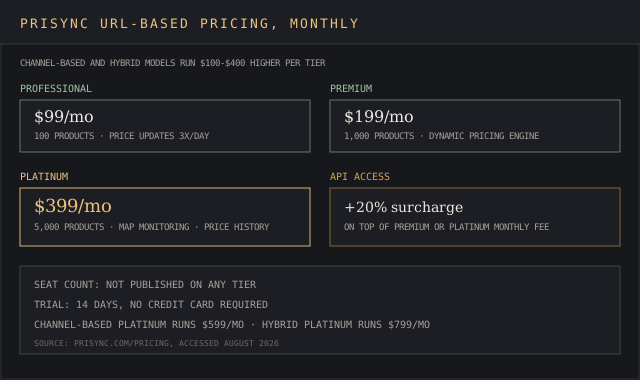
The tier that binds for most reviewers is Platinum. MAP monitoring, price history, and instant alerts all sit behind the $399 line, and Prisync's own Shopify listing shows a lower entry price of $49 a month for what it calls Professional there, a discrepancy between channels that a buyer should confirm directly before signing.
Prisync's Shopify App Store listing quotes $49/mo for Professional against $99/mo on prisync.com. Confirm the live number for your signup channel before budgeting.
The pricing page frames all three models around one idea: managing prices shouldn't require a full-time hire. A retailer comparing the tiers finds every one of them includes daily price change notifications by default, and Platinum adds a fourth option, instant notifications, on top.
A retailer selling across several sales channels should read the channel-based tiers. Prisync also sells URL-based tiers, built for a retailer tracking individual product pages one URL at a time; that retailer hits the URL-based product ceiling first when tracking competitors across a marketplace and a website at once.
The API surcharge and other costs the rate card doesn't show
API access costs an extra 20% on top of the monthly Premium or Platinum fee, a line most competitor-tracking tools bundle into the base price. On Platinum that's roughly $80 a month added to the $399 base, before any channel add-ons.
Seat count isn't published on any tier. A team of five pricing analysts and a team of one both pay the same $399 for Platinum, at least on paper; nothing in the public materials says otherwise.
Prisync's business model rests on volume: thousands of small and mid-size businesses paying $99 to $799 a month. Customers who monitor several markets and channels at once, across more tracked competitors, are the ones most likely to hit the accuracy problems this review documents next, since more feeds means more chances for one of them to break.
"You need to inform [the vendor] 30 DAYS in advance officially, you will be charged for an EXTRA month, actually 60 days instead of 30."A G2 review of Price2Spy, a Prisync competitor, from a growth strategist and SME owner, December 2022, cited here because the same cancellation-notice structure shows up across this category
Setup and onboarding: what the reviews document
The 14-day free trial requires no credit card, and Prisync's own marketing promises results within hours of connecting a catalog. The reviews from customers running larger catalogs tell a different story about onboarding time.
"The onboarding of the items was very time-consuming, and it took many months before the accounts retrieved the correct data. This required a lot of work from our side, and many issues were identified at different websites, either by how the stock information is retrieved, prices that differ, or that the URL is not retrieved at all due to technical blockers at the resellers' websites."A G2 review from a verified user in computer hardware, small business, December 2021
A separate Capterra review from the same company's global sales coordinator describes months of manual data-gathering to compensate for onboarding gaps, and a Capterra reviewer in regional sales flags the same root cause in three words:
"Set up can take time to import all data and their system doesn't always track the sites as blockers kick in."A Capterra review from a regional sales manager, computer hardware, December 2021
Blockers are anti-scraping measures on the competitor's own site. But the customer pays the onboarding cost either way, in the hours it takes support to work around each blocked URL one by one.
Data accuracy: the complaint that repeats across three platforms
Trustpilot carries the most critical reviews of the three platforms, and its complaints cluster tightly around one theme: wrong prices pulled from competitor pages, feeding directly into automated repricing.
"Worst company every support never have accurate answer and feed never works, we keep on selling at wrong price and lost tone of money."A Trustpilot review, one star, October 2024
A separate one-star Trustpilot review from 2021 describes the same failure mode at a different account, with a longer support-response complaint attached: "the price rules do n to work. After ,ore then 100 emails and message they don't do anything." Trustpilot's aggregate score for Prisync sits at 4.2 out of 5 across 96 reviews, the lowest of the three platforms this review checked.
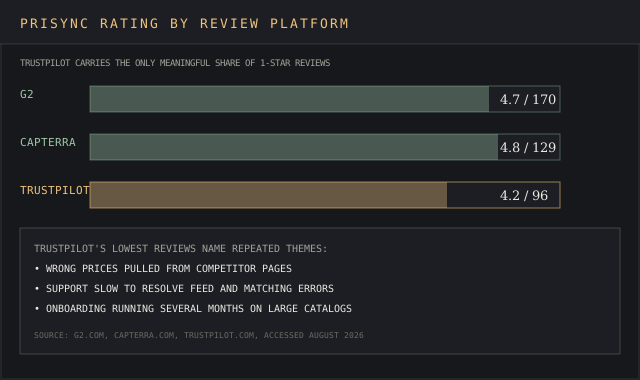
On G2, where Prisync holds 4.7 out of 5 across 170 reviews, the same complaint appears inside otherwise positive four-star write-ups:
"As I already said there are times when I get the wrong ones from the product page. Also the filters in the products tab do not work."A G2 review from a mid-market project manager, November 2022, 4 out of 5 stars
The pattern across all three platforms: accuracy issues are common enough to appear in reviews that still rate the product 4 or 5 stars overall, which suggests most customers treat the errors as a cost of doing business. The 1-star reviews are the exception where support failed to fix a specific broken feed.
What users praise most
Positive reviewers name a specific outcome after adopting the tool, a revenue number or a product count.
"Through constant monitoring we found our main competitors and managed to subdue their pricing model. Since we integrated pricing, revenue almost doubled."A Capterra review from a communications designer and project leader, internet industry, February 2022, 5 out of 5 stars
"Excellent customer service , easy to setup&use , we can able to trace more than 1,500 products daily basis , it gives ability to compare againts to competitors, and more important than this gives us to increase our profibility between 5-9 % more"A Capterra review from a food and beverage CEO, March 2018, 5 out of 5 stars
Neither revenue figure above is independently verified beyond the reviewer's own account; treat both as self-reported figures. Support responsiveness comes up by name more than once across the lower-rated reviews too.
"Prisync is laid out for easy use. I have found that some of the functionality does not work as expected but the team at Prisync and in my case Ercan has always been on hand to assist and go away and change things. Generally my needs have been understood and met and overall I would recommend, especially for the value."A Trustpilot review, March 2022, 4 out of 5 stars
"Prisync has truly revolutionized our approach. It's incredibly user-friendly, offering clear and insightful reports. Their customer support is exceptional—they guided us through setup and have remained available whenever we've encountered questions or issues."A Trustpilot review, May 2024, 5 out of 5 stars
Integrations and where the platform stops
Prisync's own site names four native integrations: Shopify, Amazon, Google Shopping, and Magento 1 and 2. Anything past that list runs through the API, at the 20% surcharge described above. WooCommerce, a common request for smaller merchants, doesn't appear on Prisync's published integrations copy.
The Shopify App Store listing carries 209 reviews at 4.9 out of 5, a narrower and more positive sample than the main review platforms, likely because Shopify merchants self-select toward simpler catalogs and the URL-based Professional tier.
A features list longer than a rival's counts for little without numbers behind it. Prisync's own testimonials offer plenty of great-sounding lines and few figures, which is a large part of why this review leans on G2, Capterra, and Trustpilot instead. AI-driven repricing is the feature Prisync's marketing leads with today, and it's also the feature every onboarding complaint in this review traces back to.
Prisync positions itself as AI-powered pricing software for an individual online seller, distinct from the enterprise pricing solutions built for companies with a dedicated analytics team. Its marketing targets a quick, self-serve setup for one retailer. A chain of stores buying at a different level of scale instead negotiates a deal with a sales rep.
Buying Prisync doesn't require a sales call: a retailer signs up on the website, picks a tier, and starts the trial the same day. That's a different experience from Competera or Pricefx, where a deal gets negotiated with a rep and the vendor sets a start date after a demo. Prisync's simpler self-serve motion suits a smaller team that wants a quick answer, the opposite of a multi-week evaluation with a panel of clients on the buying committee.
Company background: Istanbul, 2013, and three acquisitions
Prisync was founded in Istanbul in February 2013 and describes its office, in its own about-page copy, as based in the city with a small team working alongside company cats. Its acquisition history runs Spotlite in March 2018, CompetitorPriceWatch in May 2020, and Marguard in July 2021, each folded into the core pricing-monitoring product.
The most recent shipped feature the company has publicly documented is Shopify Markets pricing optimization, posted to its blog in July 2026. It lets merchants set region-specific prices across Shopify's multi-market storefronts.
Prisync's reach spans multiple markets and industries: the reviews checked for this piece span computer hardware, food and beverage, and internet companies, three different levels of catalog complexity, run from a single office. That variety is one reason the same tool draws a five-star review and a one-star pan in the same month.
Prisync's testimonials page and its email marketing both lean on the same handful of adjectives, calling the platform great, nice to use, and fast to set up, without a figure attached to any of the three. This review doesn't repeat that language on its own; every claim above ties back to a dated, sourced review instead.
Prisync vs the rest of the pricing-intelligence category
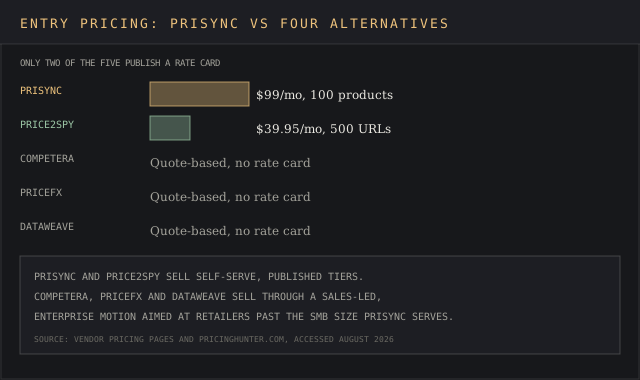
A business picking between these five tools should focus on catalog size and buying process. Prisync and Price2Spy sell self-serve solutions a single user can set up alone; Competera, Pricefx, and DataWeave sell to a business with a team spread across several markets and a budget for a negotiated contract.
Prisync competes on two different axes depending on the alternative. Against Price2Spy, it's a feature fight at similar price points. Competera, Pricefx, and DataWeave sell to a different buyer: retailers running full pricing-optimization programs on top of the raw price feed.
Price2Spy starts cheaper: $39.95 a month for 500 tracked URLs on its Starter tier, expandable to 2,000 URLs for $57.95. Its Basic tier, at $157.95 a month for 2,000 URLs, adds MAP monitoring and marketplace tracking, but repricing and API access stay locked until the custom-quoted Premium tier.
A retailer who needs monitoring only, not automated repricing, pays less on Price2Spy at every comparable product count than on Prisync. The tradeoff shows up in the same cancellation-notice terms this review already quoted: 30 days' written notice, or the customer pays for an extra month past what they intended.
Competera doesn't publish a rate card at all; pricing is quote-based, aimed at retailers with 10,000 or more SKUs and $500 million or more in revenue, per the company's own site.
Founded in 2017, it counts 50-plus retailers as customers and holds a 4.9 rating on G2 across 14 reviews, a far smaller sample than Prisync's 170. A retailer that has outgrown Prisync's 5,000-product Platinum ceiling is Competera's target buyer.
Pricefx plays in a different category again: enterprise B2B pricing and rebate optimization, integrated into ERP and CRM systems. Founded in 2011, it now manages $645 billion in annual revenue across its platform and holds Leader placement in Gartner's 2026 Magic Quadrant for B2B Pricing and Rebates Optimization.
One G2 reviewer credits Pricefx with cutting the time to execute a price change by 85%, a scale of operational change Prisync's SMB tooling isn't built to produce.
A different G2 review flags a scale problem: "simple filtering in tables with several million entries takes several minutes."
DataWeave sells digital shelf analytics alongside price monitoring, aimed at brands and retailers who need both pricing data and product-content compliance across marketplaces. It publishes no rate card either.
A G2 reviewer in the mid-market segment praised "timely delivery of insights and flexibility to accommodate business requests," while another flagged product-matching errors, items compared against the wrong peer, a single unit matched to a multi-pack in one case. That's the same category of accuracy complaint this review already documented under Prisync's own name.
The alternatives in this category all offer some version of the same core insight: watching a market closely and reacting fast beats guessing at a price and hoping it holds. The differences that matter are in how much of that reaction a company automates, how many markets and channels the software covers, and how much manual work a team still does after the tool goes live.
Making that tradeoff explicit is the point of checking sourced reviews before choosing dynamic pricing software, whichever company ends up managing the account.
Verdict
Prisync fits a retailer running 100 to 5,000 SKUs who wants a self-serve, published rate card and can tolerate a support team that takes days to resolve a broken feed. The 14-day trial and no-card signup make it cheap to test before committing.
It doesn't fit a retailer who has outgrown 5,000 products, since Platinum is the ceiling and the next step up is a quote-based enterprise tool like Competera, Pricefx, or DataWeave. It also doesn't fit a buyer who needs guaranteed data accuracy at high volume: the wrong-price complaints in this review span three separate platforms and several years of reviews.
It might suit a mid-market retailer willing to spend the first few months manually verifying feeds before trusting the automated repricing engine, the same months several reviewers describe spending on onboarding.