Retail market intelligence
 By Jan Suski. I go deep on every review, checking every number against its source and digging up details other coverage misses, a habit from six years of SEO and link building for tech companies. Bylines at Surfer, Brand24, and Senuto. How the scoring works.
· Prefer this source on Google
Retail market intelligence involves collecting and analyzing data about customers, competitors, and market trends, then converting it into decisions about pricing, inventory, marketing, and stores. In a retail market where consumer behavior shifts weekly and competitors adjust prices hourly, intelligence is now an operating function; it's the operating system of a competitive retailer.
This guide covers what retail market intelligence is, the data behind it, how competitor tracking and business intelligence fit in, and how to build a capability that changes decision making.
Searches land here from several directions. Some want retail competitive intelligence or retail competitor intelligence, others retail pricing intelligence or pricing intelligence for retailers, and a share arrive on plain retail intelligence without a category in mind. Retail competitive intelligence data answers one question in every case: what shoppers, competitors, and prices are doing this week in the categories you sell.
Retail intelligence works best when pricing, assortment, demand, and digital behavior are read together. Software selection is a later step, and the platforms are compared tool by tool, with pricing, on our retail analytics software ranking.
What Is Retail Market Intelligence?
Retail market intelligence is the continuous practice of gathering internal and external data about your market, customer behavior, competitor strategies, pricing intelligence, and market trends, and transforming it into actionable insights. It answers the questions that determine retail outcomes: What are customers buying and why? What are competitors charging? Where is demand heading? Which channels are working?
Two things distinguish it from ad hoc market research:
- It integrates multiple data sources. Retail market intelligence provides actionable insights from internal and external data sources, your own sales and CRM systems on one side, the market data and competitor signals on the other. Market intelligence integrates multiple data sources for complete insights; each feed gives partial understanding of a retail business.
- It's continuous. Continuous market intelligence supports informed decision making in retail because the market fails to hold still. A quarterly report describes a market that has already moved.
Done well, retail market intelligence transforms raw business data into actionable strategies, helps businesses make strategic decisions and run operations more efficiently, and can improve both profitability and customer satisfaction at the same time, which is the whole game in retail.
Retail intelligence vs market intelligence: the meaning
"Retail intelligence" usually refers to the retailer's own operational layer: the data driven analysis of what's happening inside your stores, site and apps. It integrates eCommerce platforms, POS and marketing analytics into one picture of business performance.
Market intelligence adds the outside world. Competitor pricing, market dynamics, consumer preferences and market movements across the retail sector.
You need both. Retail intelligence tells you what's happening. Market intelligence tells you why, and what's coming.
Buyers describe this need differently depending on where they sit. A merchandising lead asks for retail competitive intelligence; a pricing analyst wants pricing intelligence for retailers; a category manager wants retail competitive intelligence data broken out by SKU.
Others start narrower, looking for consumer intelligence tools for retail or a plain competitive intelligence retail feed before anyone has decided which department owns the work.
The components below, customer insights and market trend analysis, are what all of those searches point at.
The Core Components
1. Customer insights
Customer insights analyze demographics and purchasing behavior to tailor offerings. The raw material includes transaction data, purchase history, loyalty data, customer feedback, and behavioral signals across channels.
What this unlocks:
- Customer segmentation, grouping customers by value, behavior, and preferences so marketing strategies target real customer segments.
- Customer journey mapping, retail intelligence helps identify customer journey friction points: where shoppers abandon carts, where the store experience loses them, where channels hand off badly. Fixing customer journey friction is often the cheapest revenue a retailer can find, because the demand already exists.
- Personalization, understanding customer behavior enables targeted marketing campaigns and personalized experiences, and market intelligence improves customer experience through personalized shopping across the whole customer journey.
2. Market trend analysis
Market trend analysis tracks shifts in consumer preferences and economic conditions: category growth, channel migration, seasonal patterns and the macro forces that move baskets.
It helps retailers anticipate market changes and risks. Inflation shifting customers to value brands, a viral product draining share from a category, e commerce growth reshaping store economics. On the supplier side, brands selling into those retailers plan shelf price and promotions with revenue growth management tools.
Retailers who anticipate market trends stock, staff and price for what's coming. The rest mark down what didn't sell. Fashion shows the cost, with 4% to 9% of textiles placed on the EU market destroyed before use, per the European Commission.
Historical data plus current signals is how you tell a trend from a blip, and how you spot genuine market movements early enough to act in brick and mortar stores or digital channels.
Retail Business Intelligence: The Data Engine
Retail business intelligence (BI) is the machinery that turns raw data into decisions. Retail business intelligence transforms raw data into actionable insights, and modern retail BI operates on near-real-time data flows.
The five core data sources
Retail BI uses five core data source systems:
- POS and transaction data, what sold, where, when, at what price and margin.
- eCommerce platforms, online sales data, browsing behavior, cart and checkout analytics.
- CRM systems, customer profiles, purchase history, loyalty, and customer interactions across touchpoints.
- Inventory data, stock levels, turns, stockouts, and supply signals.
- Marketing analytics, campaign performance, traffic, and attribution.
Automated data pipelines enable real-time data collection across all five, and AI improves data collection by interpreting it at scale, classifying products, reading reviews, and flagging anomalies with automated review. Even unstructured data, reviews, support chats, social mentions, becomes usable signal once AI processes it, and incomplete data gets flagged before it can silently skew reports.
What retail BI delivers
- Demand forecasting. BI tools can improve demand forecasting accuracy to 85-90 percent, the difference between full shelves and clearance racks.
- Inventory management. Retail BI improves inventory management by tracking stockout frequency, turns, and aging stock, putting real numbers behind inventory decisions.
- Marketing ROI. Data-driven marketing uses BI to measure true campaign ROI, incremental margin over clicks, but incremental margin.
- Omnichannel visibility. Retailers can analyze customer behavior across multiple channels with BI, connecting brick and mortar stores, web, and app into one view of business performance and sales performance.
One warning from every successful implementation: data freshness is critical for operational trust in retail. The first time a dashboard shows yesterday's stockout as in-stock, store teams stop believing it, and real time data is what keeps decision making anchored to reality. Complete understanding of the business comes from fresh, connected data or it fails to come at all.
How AI Is Changing Retail Intelligence
Artificial intelligence has moved retail intelligence from descriptive to predictive to prescriptive:
- Prediction. AI in retail intelligence predicts demand and recommends actions, reorder points, markdown timing, allocation by store. Predictive analytics turns historical data and current signals into forward guidance, and machine learning models improve as data accumulates.
- Automation. Machine learning powers dynamic pricing, automatically adjusting to competitors pricing, inventory position, and demand, within rules you set.
- Interpretation at scale. AI improves competitor tracking and data collection by interpreting data at scale: reading thousands of reviews for sentiment, matching rival SKUs, and spotting market movements a human team would miss. Automated insights surface exceptions, the anomalies worth a decision, so teams aren't buried in dashboards. Advanced tools like these concentrate merchant judgment; they concentrate it where it matters, and raw data finally becomes use.
The retailers winning with AI are rarely the ones with the most models; they're the ones whose advanced tools feed decisions people make, pricing, buying, marketing, every single day. That's what data driven decisions look like in practice, and it's why retailers treat retail technology as a merchandising capability.
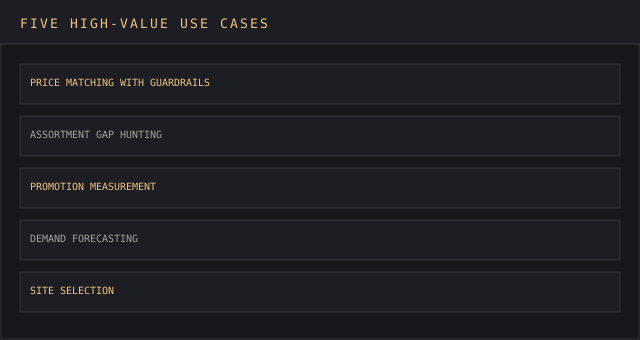
Putting It to Work: Five High-Value Use Cases
1. Pricing optimization
Retailers use market intelligence to improve pricing and inventory decisions together. With pricing intelligence feeds and rival monitoring, you adjust pricing strategies by SKU and channel, matching where price-sensitive customers compare, holding margin where you differentiate. Retailers who adjust pricing with live competitive data protect margin in both directions, and well-governed dynamic pricing does it around the clock.
2. Inventory and demand planning
Forecasts built on sales data, market trends, and local signals mean you can adjust inventory before demand arrives. Fewer stockouts, fewer markdowns, better cash.
3. Targeted marketing
Customer segmentation plus campaign analytics means marketing strategies aimed at real customer preferences and purchasing behavior, measured on true ROI.
Understanding consumer behavior at segment level is what makes personalization profitable, and it hands merchandising teams competitive insights they can act on in weekly trading meetings.
It also shows where to develop strategies for lapsing segments before they churn, and where assortment gaps sit that competitors haven't spotted yet.
4. Customer experience improvement
Journey analytics identify gaps and friction across the customer journey: site search that fails, queues that kill conversion, persistent returns.
Retail intelligence improves business performance and customer experiences at once, because the same data serves both and because customer interactions across channels connect into one picture of each shopper.
That is decision making with a complete view of the customer, which is what keeps you competitive in markets where experience is the differentiator.
5. Expansion and assortment decisions
Retail market intelligence helps businesses identify growth opportunities and market entry strategies: which locations, which categories, which price tiers. The locations question runs on location intelligence platforms such as Placer.ai, which estimates US foot traffic from a panel of tens of millions of devices. Public order forms put a year of it at $12,000 to $34,000, and our Placer.ai pricing report splits that range by credit allowance.
Market data combined with your own performance data de-risks the biggest bets in the retail sector, and shows how to stay competitive once you've entered by adapting to local market dynamics.
Evidence beats instinct on every expansion decision, and multiple sources of validation beat any single forecast.
Growth from ecommerce platforms or physical stores rewards the same thing: retailers who develop strategies from evidence, with data driven conviction. Those who copy rivals blindly get punished, and the ones who identify gaps first, in assortment, price tiers or locations, tend to keep them.
The gap between a good year and a bad one comes down to how fast raw data reaches a decision, and how quickly teams adjust when the market moves.
Retailers that integrate multiple data sources into every trading decision see the market first. In retail, seeing first is winning.
Common Pitfalls
- Dashboards separated from decisions. If intelligence fails to change pricing, buying, or marketing weekly, it's decoration. Tie every report to a decision owner and adjust strategies on a cadence.
- Stale competitive data. Competitive pricing decisions made on last month's crawl are worse than none, data freshness first, coverage second.
- Channel silos. E commerce and store teams reading different numbers end up fighting each other. One integrated view, retail intelligence that integrates multiple data sources, ends the argument.
- Ignoring unstructured signals. Reviews and social chatter flag problems months before they reach the P&L. Multiple sources beat any single metric, and incomplete data from one channel gets corrected by another.
- Tool sprawl. Analytics tools multiply; insight fails to. Standardize on a stack that serves decision making, decision making over vendor logos.
Getting Started: A Practical Sequence
- Consolidate customer data first. Connect POS, ecommerce, and customer relationship management (CRM) systems so every team works from one view of customer behavior. Customer data quality determines everything downstream.
- Add customer feedback loops. Reviews, surveys, market research, and support themes turn transactions into explanations, the "why" behind the numbers.
- Layer competitive monitoring. Start with pricing on your top SKUs and expand to promotions and assortment, where market positioning gets tested weekly.
- Wire it to decisions. Weekly trading meetings should open with the intelligence view, informed decisions on price, stock, and marketing, made on schedule.
- Measure share, market share over sales alone. Growing sales in a faster-growing market means losing market share; intelligence keeps score honestly.
Retailers that follow this sequence build a compounding competitive advantage: each cycle of data, decision, and result makes the next cycle sharper.
FAQ
What is market intelligence in marketing?
It's the external data layer marketers use to plan and position: market trends, competitor strategies and pricing, consumer preferences, and category dynamics. In retail marketing it powers segmentation, campaign timing, and promotional strategies, so marketing efforts target where demand and competitive weakness overlap, and so promotional strategies land when they'll do the most damage.
What are the 5 P's in retail?
Product, price, place, promotion, and people: what you sell, what it costs, where and how it's available, how you communicate it, and the staff and customers involved. Retail market intelligence sharpens every P, assortment analytics for product, pricing intelligence for price, location and channel data for place, campaign ROI for promotion, and customer insights for people.
What is the meaning of retail intelligence?
Retail intelligence is the data driven practice of collecting and analyzing information about a retail business, sales, customers, inventory, and operations, integrated with external market data to guide decisions. Its meaning in practice: knowing what's selling, to whom, at what margin, against which competitors, and what to do about it, in something close to real time.
What are the best 3 market intelligence tools on the market today?
By job: Similarweb for digital market and competitor traffic intelligence, a pricing and assortment intelligence platform (Competera or EDITED-class tools) for competitors pricing at SKU level, and NIQ or Circana for shopper and category measurement. The right stack depends on your channel mix, e-commerce-heavy retailers should weight pricing intelligence and digital share tools first. The ranking above covers the full comparison.
Bottom Line
Retail market intelligence is how modern retailers convert data into margin. Customer insights that make marketing precise, competitor tracking that keeps pricing sharp, trend analysis that puts inventory ahead of demand, and BI infrastructure delivering it in near-real time.
Retail punishes slow readers of the market and rewards fast ones.
Retailers who integrate multiple data sources, insist on data freshness and wire intelligence into weekly decision making compound small information advantages into share, season after season.