Pricing intelligence tools: rankings and buying guide for 2026
 By Jan Suski. I go deep on every review, checking every number against its source and digging up details other coverage misses, a habit from six years of SEO and link building for tech companies. Bylines at Surfer, Brand24, and Senuto. How the scoring works.
·
Quick comparison of the best price intelligence tools
Columns carry only the dimensions where these platforms measurably differ. Competitor monitoring, dashboards, and alerting exist on all seven.
| # | Platform | Primary capability | Published pricing | Billing unit | Refresh rate |
|---|---|---|---|---|---|
| 1 | Pricefx | Price optimization, CPQ, rebates | Yes, $100K-$3.5M/yr by RUM | Quote | Quote |
| 2 | Competera | Demand-aware price optimization | No, ~$50K-$300K/yr third-party estimate | Quote | Real-time repricing |
| 3 | Intelligence Node | Competitor matching at catalog scale | Yes, from $5K/mo | Quote | As often as every 10 seconds |
| 4 | DataWeave | Price, content, and availability together | No, no benchmark available | Quote | Quote |
| 5 | Prisync | Monitoring and rule-based repricing | Yes, $99 to $799/mo | Products | 3x daily |
| 6 | Price2Spy | MAP violation detection with evidence | Yes, from $39.95/mo | URLs | 1 to 8x daily |
| 7 | Nimble / Import.io Aperture | Web data extraction infrastructure | Yes, from $3 per thousand requests | Requests or GB | Configurable |
Pricing intelligence tools collect competitor prices, match products across retailers, and turn that feed into monitoring, MAP enforcement, or full price optimization. This guide ranks seven pricing intelligence platforms against six evaluation criteria, prices every published tier against the same catalog, and gives a full features, pricing, and limits breakdown for each.
The billing unit decides the bill. Prisync charges per product tracked, Price2Spy per URL monitored, and Nimble per thousand requests. Track 1,000 products across three competitors and that's 1,000 units on one platform and 3,000 on another, which reverses the apparent price order.
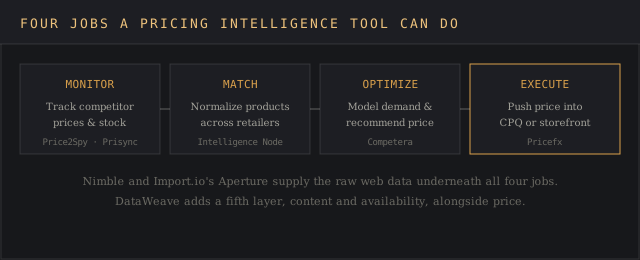
Buyers also search this category as pricing intelligence software, price intelligence tools, or price intelligence software; whichever term led here, the price intelligence solutions in this ranking do the same three jobs: monitor, match, and adjust.
Finding the right pricing intelligence software, or the right price intelligence platform, starts with naming the job: pricing strategies built around competitive pricing need different core capabilities than a team watching pricing trends for a quarterly review.
A competitive pricing intelligence software purchase pays for itself once it turns competitor data and competitive pricing data into data driven pricing decisions in place of a spreadsheet nobody trusts.
Prices, tier limits, and ownership were verified on 25 July 2026.
What tracking 1,000 products costs
Every published figure below assumes the same catalog: 1,000 products, each monitored at three competitors, refreshed daily. That's 1,000 products or 3,000 URLs depending on how the vendor counts. Nimble and Import.io share one ranking slot and price separately, so the row below carries both published figures.
| # | Platform | Billing unit | Plan that fits | Published year-one cost |
|---|---|---|---|---|
| 1 | Pricefx | Revenue Under Management | Enterprise, custom scope | $100,000 to $3,500,000 |
| 2 | Competera | Quote | Enterprise, custom scope | ~$50,000 to $300,000 (third-party estimate) |
| 3 | Intelligence Node | SKUs and competitors tracked | Enterprise, custom scope | $60,000 to $150,000-plus |
| 4 | DataWeave | Quote | Enterprise, custom scope | Not published, no benchmark available |
| 5 | Prisync | Products tracked | Premium, 1,000 products | $2,388 |
| 6 | Price2Spy | URLs monitored | Basic covers 2,000 URLs, so 3,000 needs Premium | $1,895 at Basic, Premium by quote |
| 7 | Nimble / Import.io Aperture | Requests or data volume | Pay-as-you-go from $3 per thousand requests (Nimble); self-serve (Import.io) | ~$3,240 (Nimble) to ~$3,588 (Import.io) |
Price2Spy looks cheapest on the sticker and isn't, at this catalog. Basic covers 2,000 URLs at $157.95 a month, and 1,000 products across three competitors needs 3,000, which pushes the buyer into a custom-quoted Premium plan. A team tracking the same 1,000 products at a single competitor stays inside Basic and pays less than anyone.
The Nimble figure is data only, derived from its published $3 per thousand requests against 90,000 monthly requests. It buys no dashboard, no matching engine, and no alerting, so the real comparison adds whatever engineering time turns that feed into a pricing workflow.
Pricefx is the one enterprise name here with real numbers of its own. Its published learning-center article puts subscription cost at $100,000 to $3,500,000 a year, priced against a customer's Revenue Under Management, plus a separate implementation charge that starts near $100,000 and can reach seven figures depending on workflow complexity and integration count.
Competera and Intelligence Node have third-party estimates: aggregators cite $50,000 to $300,000 a year for Competera, unverified by the company, and Intelligence Node's own site starts subscriptions at $5,000 a month, $60,000 a year, scaling to $150,000-plus depending on SKU and competitor count.
DataWeave publishes nothing and no aggregator carries a buyer-reported figure either.
Back to top ↑Why pricing intelligence matters now
A pricing tool is only as good as its product matching. Two products that look identical to a shopper, a 500ml bottle versus a 16.9oz bottle of the same brand, are common mismatches that produce a confidently wrong price recommendation, which is why every platform in this ranking is judged on matching quality first and feature count second.
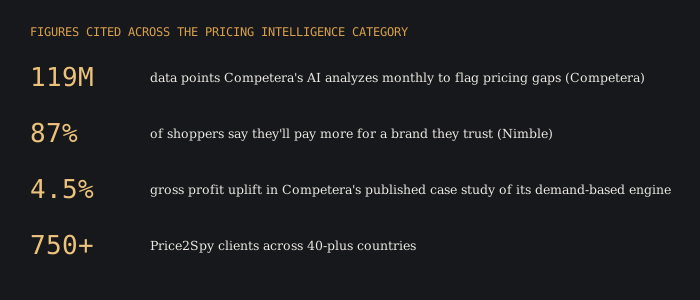
Margin protection is the business case underneath the category. Research cited by Nimble puts 87% of shoppers willing to pay more for an established brand, which is part of why a mispriced product does more damage than lost margin on a single sale, it erodes the trust premium a brand spent years building.
Vendor-reported figures illustrate the scale involved: Competera's own materials describe its AI analyzing 119 million data points a month to catch pricing gaps and competitor strategy shifts, a volume no manual pricing team could review by hand.
The upside has been measured outside vendor marketing. McKinsey puts a 1% improvement in pricing at an 8.7% increase in operating profits for B2B companies, and structured pricing optimization programmes report margin improvements in the range of 4 to 9%.
Competera's own published case study records a 4.5% gross profit uplift from its demand-based engine. Those numbers are why pricing intelligence eliminates revenue leakage, and why a 2 to 4% profit uplift is the outcome most buyers underwrite the purchase against.
Market data moves faster than a manual review cycle. Market trends, market shifts, and everyday market dynamics show up on competitor websites before they show up in a quarterly business intelligence tools report, and a team relying on manual data collection to track them is always looking at last week's prices.
AI-powered, AI-driven pricing recommendations exist specifically to close that gap: they read competitor websites and marketplace listings continuously, feed the result back as market insights, and help retailers adjust prices before a competitor's move erodes margin.
Customer demand and demand elasticity, how far a price change moves units, matter as much as what a competitor charges.
Enterprise retailers weighing a price point against shipping costs need the same structured pricing data for matching a rival's price history and for setting an optimal price on a new SKU; automated data collection turns raw structured data into a normalized data set a pricing team can trust.
Real-time visibility into market shifts is what lets that team set an ideal price position and adjust it dynamically, and the same feed flags high-demand products before they run to stockout.
Retail pricing and B2B pricing pull in different directions here, which is why pricing teams should name the motion before shortlisting: price optimization strategies built for a shelf price assume elasticity data a quote-driven seller doesn't have.
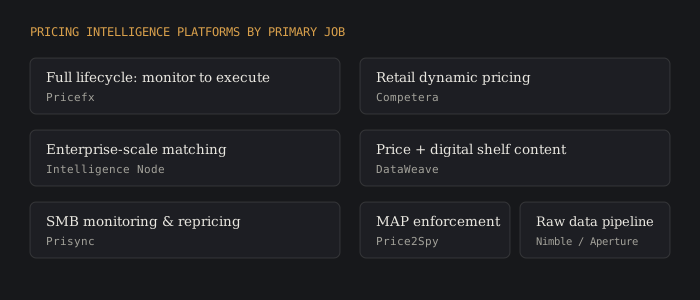
The category also splits sharply by ambition. Some vendors, Price2Spy and Prisync, stop at monitoring and alerting. Others, Pricefx and Competera, take the next step and recommend or automate the price change itself. Nimble and Import.io's Aperture sit underneath both groups, supplying the raw web data pipeline that a custom-built pricing workflow runs on.
Evaluation criteria for the best pricing intelligence tools
Six factors separate a platform a pricing team can trust from one that produces confident mistakes.
- Product matching and normalization quality. Matching your SKU to the correct competitor listing, across brand, size, and bundle variants. Normalized data is what makes a comparison accurate.
- Monitoring breadth and refresh frequency. How many competitors and marketplaces are covered, and how often prices refresh. This ranking spans one check a day to one every ten seconds.
- Price optimization and dynamic pricing depth. The platform either only reports competitor prices, or also recommends or automates a price change.
- MAP enforcement and compliance tooling. Violation detection, documented evidence (screenshots), and reporting built for brand-protection workflows across a reseller channel.
- Integrations with ERP, BI, CPQ, and storefronts. A price recommendation either lands inside the system that changes the price, or sits in a separate dashboard someone has to act on manually. Choose software that fits the pricing workflow you already run.
- Pricing transparency and billing unit. Published starting points, and if the vendor counts products, URLs, or requests, which decides what your catalog costs.
Spot-check a vendor's automated product matches against your own SKUs before trusting a recommendation at scale. A wrong match produces a confidently wrong price.
Automated alerts and real-time pricing adjustments round out the list: a platform that only reports that competitors change prices, without automating the response, still leaves someone refreshing a dashboard by hand. The best price intelligence tools support pricing optimization and pricing strategy development directly.
Top pricing intelligence tools, ranked
Seven platforms, ranked by how completely they cover the six criteria above, with the reasoning behind each position plus a full features, pricing, and limits breakdown.
Pricefx
·top pick·The only platform here that monitors, adjusts, and executes pricing in one system.
Pricefx, founded in 2011 by Christian Tratz, Marcin Cichon, and Martin Wricke, raised $130 million in total, including a $65 million Series C in 2020 led by the Apax Digital Fund with existing investor Digital+ Partners participating.
Named customers include Ahlsell, Amag, Amcor, Bosch, Danone, Michelin, Flint Group, Stahl Holdings, and MediaMarktSaturn, and Pricefx was named a Leader in the 2026 Gartner Magic Quadrant for B2B Pricing and Rebates Optimization Software.
Total funding Pricefx has raised, including a $65 million Series C in 2020 led by the Apax Digital Fund with Digital+ Partners participating.
Why it's ranked #1. Pricefx is the only platform here that covers all six criteria in one system: it monitors, adjusts, and executes pricing through native CPQ integration.
CPQ operationalizes the pricing insight during quoting and enforces approved discount rules across every transaction, which is what closes the loop between a recommendation and an actual quote. Competera matches its optimization depth for retail specifically, and Pricefx's B2B rebate and quote management scope is broader.
Features
- Price list management, rebate calculation, and margin analysis in one platform.
- AI-driven price optimization models tuned per product line and channel.
- Native CPQ (configure-price-quote) integration for B2B sales teams.
- Competitor benchmarking and cost analysis feeding the optimization engine.
Pricing and limits
Pricefx publishes its pricing logic, even without a rate card: subscription cost runs $100,000 to $3,500,000 a year, priced against a customer's Revenue Under Management. Implementation is a separate line item, starting near $100,000 for a basic analytics-only scope and running into seven figures for a full price-setting, quoting, and optimization deployment with heavy integration work.
Who should skip it
Any team that needs this running inside two quarters. G2 puts typical Pricefx implementation at six months, and reviewers describe a steep curve on advanced configurations even while praising the flexibility. A retailer doing straightforward competitor tracking is buying rebate and quote machinery it will never switch on.
Switching trigger. Teams whose pricing is retail outgrow the CPQ and rebate scope immediately, and Competera covers the optimization half without it.
Competera
A $3 million seed a decade after founding, against Pricefx's $130 million.
Competera launched in 2014, founded by Alexandr Galkin, Andrey Mikhailov, and Alexandr Sazonov, and now runs from San Mateo.
Its funding tells a different story from the enterprise names above it: a $3 million seed round closed on 30 January 2024 led by StratMinds, with Flyer One Ventures, Verras Capital, SMRK Fund, and Transform Partners participating, bringing disclosed totals to roughly $4.5 million across three rounds. That's a seed round raised a decade after founding.
Competera reports increasing enterprise clients' gross margin by 6% through real-time optimization across products and channels, and a separate published case study records a 4.5% gross profit uplift from its demand-based engine. Its own materials describe the underlying AI analyzing 119 million data points a month to surface pricing gaps and competitor strategy shifts.
Why it's ranked #2. Competera matches Pricefx's optimization depth for retail dynamic pricing specifically, since elasticity modeling and what-if simulation are purpose-built for that use case. It lacks Pricefx's B2B CPQ and rebate scope, which narrows its fit outside retail.
Features
- Demand-aware price optimization with elasticity modeling per SKU.
- What-if simulation for testing price changes before they go live.
- Promotion analytics alongside core competitive price monitoring.
- Real-time repricing across products and sales channels.
Pricing and limits
Competera doesn't publish or confirm pricing; third-party aggregators cite $50,000 to $300,000 a year for enterprise deployments, a range the company hasn't verified. The spread reflects how far a buyer goes from basic monitoring into full optimization, plus implementation, data-migration, and staff-training costs layered on top.
Who should skip it
Teams without clean ERP data and someone to own the models. G2 reviewers describe a steep learning curve, and demand-aware optimization is only as good as the cost and inventory data feeding it, so the integration work happens before any recommendation is worth acting on.
Switching trigger. A B2B seller that needs quotes and rebates is buying the wrong half of the category here.
Intelligence Node
Changed hands twice in under a year.
Founded in 2012 by Sanjeev Sulahria and Yasen Dimitrov, Intelligence Node raised $17.2 million across seven rounds before Interpublic announced its acquisition on 5 December 2024, in a deal reported at roughly $100 million with terms not officially disclosed.
Interpublic then completed its own merger into Omnicom on 26 November 2025, in a transaction valued above $13 billion that made IPG a wholly owned subsidiary. Intelligence Node's ultimate owner today is the largest marketing holding company in the world, a different position entirely from the independent vendor the product was built as.
Pro forma revenue of the combined Omnicom-IPG group that now owns Intelligence Node, following the merger's completion on 26 November 2025.
Named customers include Nestlé, Ssense, Prada, Li & Fung, Lenovo, LIDL, and LVMH, and the company reports around 100 customers and roughly $15.2 million in annual revenue as of 2026.
Why it's ranked #3. Intelligence Node ranks third for matching accuracy and refresh rate at catalog scale, the criterion it was built around, with updates running as often as every 10 seconds. It trails Pricefx and Competera on optimization depth, because it's positioned as a monitoring and matching engine.
Features
- AI-driven product matching tuned for large, high-SKU-count catalogs.
- Competitor price monitoring across global marketplaces, refreshing as often as every 10 seconds.
- Retail analytics layered on the core price-matching engine.
- Enterprise-grade refresh rates suited to fast-moving categories.
Pricing and limits
Intelligence Node's own site publishes a starting rate of $5,000 a month, $60,000 a year, scaling with the number of SKUs tracked, competitors monitored, and modules selected. Enterprise deployments run from that floor up to $150,000-plus a year depending on scope, with no self-serve tier or free trial.
Who should skip it
Smaller teams without a dedicated pricing analyst, and any buyer who needs the vendor's roadmap to stay independent. Two ownership changes in twelve months is the specific risk here, and a product absorbed into a $25 billion advertising group answers to a different roadmap than a standalone pricing vendor.
Switching trigger. Teams that need the price change automated move to Competera or Pricefx, since the matching engine stops at the recommendation.
DataWeave
The only platform here pairing pricing with digital shelf content and availability data.
DataWeave launched around 2011 to 2012, co-founded by Vikranth Ramanolla and Karthik Bettadapura. Its disclosed funding is the murkiest in this ranking: Tracxn records $1.13 million across four rounds with the most recent a Series A on 6 April 2017 backed by Brand Capital, Sato, and FreakOut, while PitchBook records $28.6 million.
Either way the last disclosed round was nine years ago. Named customers include Adidas, Costco, Home Depot, Zappos, Pernod Ricard, and Bain & Company.
Why it's ranked #4. DataWeave pairs pricing with digital shelf content and availability data in one feed, which matters when a pricing gap and a content gap need the same investigation. It ranks below the top three because its strength is breadth of data type.
Features
- Digital shelf analytics covering price, content quality, and product availability together.
- Dynamic pricing recommendations layered on the shelf data.
- Consumer-brand-focused reporting across retailer and marketplace listings.
- Availability and out-of-stock tracking alongside competitor prices.
Pricing and limits
Pricing is quote-based and scoped to catalog size and the number of retailers monitored, with no published self-serve tier. Unlike Pricefx, Competera, and Intelligence Node, no aggregator site carries a buyer-reported contract figure for DataWeave either, the least documented pricing of any platform in this ranking.
Who should skip it
Teams that only need price. Content and availability tracking is what the premium buys, and a brand that already has a separate digital shelf tool is paying twice for the same feed.
Switching trigger. Nine years without a disclosed funding round is the figure to weigh on a multi-year commitment, against Pricefx's $130 million and Intelligence Node's holding-company backing.
Prisync
Prices by product tracked, which makes it the easiest platform here to budget and the easiest to outgrow.
Prisync prices Professional at $99 a month covering 100 products with three price updates a day. Premium at $199 covers 1,000 and adds the dynamic repricing engine, marketplace tracking, product variant tracking, and API access. Platinum at $399 covers 5,000 and adds instant alerts, price history, MAP monitoring for suppliers, and a recommended price module.
Those are the URL-based rates. Channel-based monitoring runs $199, $399, and $599, and the hybrid model runs $299, $599, and $799, for nine published tiers in total.
Why it's ranked #5. Prisync wins pricing transparency outright, since its full tier structure is published while every enterprise name above it quotes. It satisfies fewer of the six criteria overall, and the MAP and recommended-price features that do exist are gated to the top tier.
Features
- Automated competitor price and stock-availability tracking.
- SmartMatch URL matching for identifying the correct competitor listing.
- Rule-based dynamic repricing tied to tracked competitor movements, from Premium up.
- Daily alerts and dashboard reporting, with instant email notifications and price history on Platinum.
- MAP monitoring and a recommended price module on Platinum.
Pricing and limits
Nine published tiers from $99 to $799 a month, with a 14-day free trial and no credit card required. The product cap is the binding constraint: 100, 1,000, and 5,000 products at the three URL-based tiers.
Who should skip it
Brands running MAP enforcement on a budget. MAP monitoring exists only on Platinum at $399 a month, so a supplier who needs violation tracking pays four times the entry price to reach it, and there's no screenshot evidence trail of the kind Price2Spy builds its product around.
Switching trigger. The product cap bites first. At 5,000 products Platinum runs out, and the next step is a quote-based enterprise platform.
Price2Spy
The MAP-enforcement specialist in this ranking, built around violation documentation.
Price2Spy, founded in 2010 in Belgrade, serves 750-plus clients across 40-plus countries, with named customers including Epson, Philips, Beko, DeLonghi Group, and Saint-Gobain.
Why it's ranked #6. Screenshot evidence and violation documentation are purpose-built for the compliance workflow a brand needs when confronting a reseller. Refresh frequency starts at one check a day and the feature scope is narrower than the monitoring and optimization platforms above it.
Features
- MAP, MSRP, and RRP violation detection with screenshot evidence.
- Configurable price-check frequency, from 1 to 8 checks per day depending on plan.
- Automatch machine-learning product matching, sold as an add-on.
- Reporting built around documenting violations for retailer or reseller enforcement conversations.
Pricing and limits
Starter runs $39.95 a month for up to 500 URLs and Basic $157.95 for 2,000, with Premium custom-quoted and including API access. A 14-day trial covers every plan.
The add-ons are where the real cost sits, and Price2Spy prices five of them separately: the repricing module at roughly $100 a month, automatch machine-learning matching at roughly $54, screenshot capture, GA4 integration for pulling Google Analytics data into reports and repricing rules, and dedicated account management.
Stealth IP traffic for monitoring bot-protected sites bills on usage, with extra users and automated reports priced separately again.
Price2Spy's published base tiers look inexpensive next to the enterprise names in this ranking, but five add-ons price separately: repricing, automatch, screenshot capture, GA4 integration, and dedicated account management. Price the full stack before comparing sticker prices.
Who should skip it
Anyone comparing sticker prices across this ranking without counting URLs. Price2Spy bills per URL, so a catalog tracked across five competitors consumes five times the quota. A $39.95 Starter plan's headline capacity is 500 products; at that five-competitor count it covers only 100.
Switching trigger. Once repricing and automatch are both switched on, the monthly total passes Prisync's Premium tier while covering fewer products.
Nimble / Import.io Aperture
Supplies the raw data layer other platforms are built on.
Import.io launched Aperture on 10 March 2026, an AI-native price intelligence platform built under its Neuralogics AI framework and positioned to replace legacy digital shelf monitoring systems.
Nimble sells the underlying layer: pay-as-you-go web data at $3 per thousand requests on the scraping API or $8 per GB on proxies, with subscription tiers at $600, $1,500, and $3,000 a month carrying lower unit rates, and up to 15% off for annual commitments.
Why it's ranked #7. Both supply the raw data layer other platforms are built on. Choosing this option is choosing to build, which is the right call only when engineering ownership already exists in-house.
Features
- Pay-as-you-go and subscription web data extraction at scale.
- Aperture's AI-native architecture aimed at replacing legacy digital shelf monitoring.
- Structured retail and CPG pricing feeds for downstream analytics or AI agents.
- API-first delivery designed for teams building their own pricing workflow.
Pricing and limits
Nimble's pay-as-you-go rate is $3 per thousand requests, with Essential at $600 a month, Advanced at $1,500, and Professional at $3,000 buying lower per-unit rates. Import.io's self-serve plans start around $299 a month, scaling with data volume and automation level. Custom enterprise plans are quoted.
Who should skip it
Any team without an engineer who owns the pipeline. There's no matching engine, no dashboard, and no alerting in the box, so the published rate buys raw pages and the pricing workflow is still yours to build and maintain.
Switching trigger. Once the internal build needs product matching and MAP logic, the engineering cost passes what Prisync or Price2Spy charge for the finished version.
Ownership and vendor stability
Two of the seven changed hands recently, and it's worth pricing into a multi-year commitment.
Intelligence Node went from independent vendor to Interpublic subsidiary in December 2024, then into Omnicom when that merger closed on 26 November 2025. The combined group carries pro forma revenue above $25 billion, and a pricing platform inside a marketing holding company competes for roadmap attention against advertising priorities.
Funding depth varies more than the ranking order suggests. Pricefx holds $130 million raised, Intelligence Node sold for a reported $100 million, and Competera's disclosed total sits near $4.5 million with its seed round closed in January 2024. DataWeave's last disclosed round was 2017. None of that predicts product quality, and all of it predicts how a vendor behaves at renewal.
How to implement price optimization and dynamic pricing
Connecting a pricing intelligence feed to an actual pricing engine works best as a staged rollout. Start by piping verified competitor and cost data into the optimization model, test recommended price changes against a small SKU subset with A/B experiments, and set margin and competitive-price guardrails before any rule runs unsupervised.
Dynamic pricing engines, as industry glossaries describe them, automatically adjust prices based on predefined rules or real-time market conditions, which is exactly why the guardrail has to exist before the rule goes live. A bad price reaching a storefront is what the guardrail exists to prevent.
Never let an automated pricing rule run unsupervised on the full catalog before it has a tested rollback path. A bad recommendation that reaches a live storefront costs more than the margin the rule was supposed to protect.
Every automated pricing rule needs a rollback plan. A guardrail that catches a bad recommendation before it reaches a live storefront matters more than the sophistication of the optimization model producing it.
Data collection and competitor price monitoring best practices
Sampling frequency should match the market and SKU tier. Fast-moving electronics need daily or more frequent checks, while stable categories run weekly without losing signal, and the platforms here span one check a day on Price2Spy Starter to one every ten seconds on Intelligence Node.
Product-matching validation deserves a manual spot-check pass before trusting a platform's automated matches at scale, since a wrong match produces a confidently wrong recommendation.
Accurate, normalized product matching, comparing the actual same item across retailers, is the single capability every price intelligence vendor's own materials point back to as the foundation the rest of the platform depends on. Tracing a wrong match back to its source vendor follows the same discipline covered in our data source attribution techniques guide.
Continuous data-quality checks and documented scraping practices matter for the same reason legal teams ask about them: a pricing program built on data collected without regard for a retailer's terms of service creates real legal and ethical exposure alongside the technical risk of a broken feed.
Structured data delivery, a clean feed, is what lets a team automate pricing decisions without re-cleaning the same export every week. Vendors that also track digital shelf performance, availability, content, and price together, help a pricing analyst identify pricing trends across a catalog faster than checking competitor pricing data one SKU at a time.
Visual dashboards over that feed are what turn pricing metrics and historical trends into something a merchandising team reads without an analyst translating. The underlying collection discipline, matching sources, checking freshness, and normalizing formats before trusting a number, is the same one covered in our guide to gathering market intelligence.
Integrations, APIs, and operational workflow
The integrations that matter most connect pricing intelligence to the systems that act on it: ERP for cost and inventory data, BI for reporting, CPQ for B2B quote generation, and the storefront platform itself for the actual price change. A platform that stops at a dashboard, without a path into at least one of those systems, pushes the last mile of the workflow back onto a person copying numbers by hand.
Integrating price intelligence with the rest of the stack is what creates a centralized data source. Vendor glossaries describe the goal as a single, centralized source of truth once pricing intelligence, ERP cost data, and CPQ quoting all read from the same feed. The alternative is three teams reconciling three separate spreadsheets.
Pricefx is the only platform in this ranking with native CPQ integration; the monitoring-focused platforms connect through API access instead, and API access itself is gated to Prisync Premium and Price2Spy's custom Premium plan.
Measuring ROI and what to track
Margin lift and win-rate change are the two numbers that prove a price intelligence investment paid for itself; a platform that only reports competitor prices without moving either number over a quarter is a research tool. Time saved on manual competitor price monitoring is a real but secondary benefit, worth tracking, and not the number that justifies the enterprise-tier spend in this ranking.
Revenue leakage, margin quietly lost to stale prices nobody caught in time, is the specific cost pricing intelligence vendors position their tools against, and it's a more concrete target than a general better-pricing-decisions claim. Set the benchmark before signing: McKinsey's 8.7% operating-profit response to a 1% pricing improvement gives a B2B team a number to test its own catalog against.
Pricing analytics and pricing performance reporting close the loop: a dashboard that shows competitive positioning against named rivals, tracks market changes, and pulls real time market data into one view helps retailers adjust prices as conditions shift. Competitive data and price points mean little without that reporting layer turning them into a decision.
Pricing intelligence for smaller catalogs and SaaS teams
A small product catalog rarely needs Pricefx's rebate management or Intelligence Node's global-marketplace matching scale.
Prisync's Professional tier at $99 for 100 products and Price2Spy's Starter at $39.95 for 500 URLs fit a smaller catalog's budget and complexity better than the quote-based enterprise names, and either is a reasonable starting point for a retail team, or a SaaS team pricing a handful of plans, before a growing catalog justifies the jump to full optimization.
Count the billing unit before picking between them. A SaaS team pricing a handful of plans will never approach either cap, while a retailer tracking 300 products across four competitors needs 1,200 URLs on Price2Spy and 300 products on Prisync.
What this category gets called
The category has no settled name, which matters when you're searching for it. Vendors sell the same thing as price intelligence software, pricing intelligence tools, a pricing intelligence platform, or a price intelligence engine, and analysts file it under pricing analytics tools or pricing analysis tools.
Retail buyers tend to say online pricing intelligence or online price intelligence software, because the use case is competitor monitoring on ecommerce listings. Enterprise buyers asking about an intelligent pricing platform or an intelligent pricing tool usually mean optimization, which is a different product.
Three groupings worth keeping straight when comparing pricing intelligence companies. Monitoring tools track competitor prices and alert on change. Pricing analytics data tools supply the feed. Optimization platforms recommend the price to set, and cost the most.
Buyers evaluating pricing intelligence solutions for the first time usually want the first group: pricing intelligence and competitor monitoring in one screen, with price intelligence services available if the team has no analyst to run it.
Pricing intelligence tools FAQ
Is it price intelligence or pricing intelligence?
Both, and vendors use them interchangeably. Pricing intelligence is the more common form in analyst coverage; price intelligence is what buyers type more often, along with price intelligence tool, price intelligence tools, price intelligence platform and the compressed priceintelligence. None of them denotes a different product.
What are top pricing tools for a retail team?
Ranked above: Competera, Prisync, Price2Spy, Pricefx and DataWeave. For a retailer the deciding factor is marketplace coverage and refresh rate, since pricing insights software is only as current as its last crawl.
What is price intelligence software?
Pricing intelligence software collects competitor prices, matches products across retailers, and turns that feed into monitoring alerts, MAP enforcement, or price-optimization recommendations, depending on how far up the stack a given platform goes. It quantifies market dynamics and gives a team real-time visibility into market shifts, so a business can set an ideal price position while staying attractive to shoppers.
How much do pricing intelligence tools cost?
Published tiers run from $39.95 a month (Price2Spy Starter, 500 URLs) to $799 a month (Prisync's top hybrid tier). Nimble sells raw data from $3 per thousand requests, and Import.io's self-serve plans start near $299 a month. Among the enterprise platforms, Pricefx publishes real numbers of its own, $100,000 to $3,500,000 a year based on Revenue Under Management, and Intelligence Node starts subscriptions at $5,000 a month.
Competera has only a third-party estimate of $50,000 to $300,000 a year, unverified by the company, and DataWeave publishes nothing with no benchmark available anywhere. Our broader market intelligence platform pricing report covers how that quote-based pattern shows up across adjacent categories, too.
What is the difference between price monitoring and price optimization?
Price monitoring tracks and alerts on competitor prices; price optimization goes further and recommends or automates the actual price change based on that data, demand modeling, and margin targets. Price2Spy is monitoring-first, Prisync adds rule-based repricing, and Pricefx and Competera build in full optimization.
Which price intelligence tool is best for small ecommerce teams?
Prisync's published tiers and 14-day free trial fit a small ecommerce team's budget and evaluation timeline better than the quote-based enterprise platforms. Professional covers 100 products at $99 a month; Price2Spy's Starter covers 500 URLs at $39.95 and suits a team tracking few competitors per product.
Can pricing intelligence tools integrate with ERP and CPQ systems?
Some can. Pricefx integrates natively with CPQ workflows for B2B quote generation; most of the monitoring-focused platforms connect through API access, and that API access is itself gated to higher tiers on Prisync and Price2Spy.
What is dynamic pricing?
Dynamic pricing means a system adjusts a product's price automatically based on rules or real-time market conditions, competitor moves, demand, or inventory levels. Competera and Pricefx build dynamic pricing into their optimization engines; Price2Spy and Prisync monitor and alert, with Prisync adding rule-based repricing from Premium up.
What is MAP enforcement?
MAP enforcement means monitoring the internet for retailers or resellers advertising a product below the manufacturer's minimum advertised price, then documenting the violation, usually with a screenshot, so the brand can act on it. Price2Spy is the MAP specialist here; Prisync includes MAP monitoring for suppliers on its Platinum tier at $399 a month, without the screenshot evidence trail.
What is CPQ in price intelligence?
CPQ stands for configure-price-quote: software that generates an accurate, approved price quote for a specific product configuration, enforcing discount rules automatically.
Pricing intelligence platforms that integrate with CPQ feed competitive pricing data straight into that quote-generation step, which is what makes the loop closed. Pricefx is the only platform in this ranking with native CPQ integration.
Bottom line
No single pricing intelligence platform in this ranking covers monitoring, MAP enforcement, and full price optimization at equal depth, which is why the right choice depends on which one of those three jobs is costing money today.
Count the billing unit before comparing prices. Prisync charges per product, Price2Spy per URL, and Nimble per thousand requests, and at 1,000 products across three competitors that difference decides which of them is cheapest. Then check the tier gate: MAP monitoring sits on Prisync's $399 Platinum, API access on Premium, and repricing on Price2Spy costs another $100 a month on top of the plan.
Start with a platform that matches your catalog size and the specific job (Pricefx or Competera for optimization, Price2Spy for MAP enforcement, Prisync for straightforward SMB monitoring, Nimble or Aperture only if engineering ownership already exists), and verify product-matching accuracy on your own SKUs before trusting any recommendation it produces.
The key features that matter are the ones turning a feed of competitor prices into actionable insights and more informed pricing decisions. Profitable pricing decisions and dynamic pricing strategies only work when the data underneath them is current and structured.