Hotel rate shopping tools: rankings and buying guide for 2026
 By Jan Suski. I go deep on every review, checking every number against its source and digging up details other coverage misses, a habit from six years of SEO and link building for tech companies. Bylines at Surfer, Brand24, and Senuto. How the scoring works.
· Prefer this source on Google
Only 23% of hoteliers adjust rates daily without rate shopping tools in place, and that gap is the entire business case for this category. Hotel rate shopping tools automate competitor rate monitoring so a revenue manager stays on the ball and sees every rate move the moment it happens. Nobody has to check rivals by hand once a week.
This guide ranks the hotel rate shopping tools and hotel rate shopping software that matter in 2026, from Lighthouse and RateGain to the free consumer aggregators travelers use on the other side of the same rate. It covers what a hotel rate shopper does, how rate parity works, and which tool fits which property.
Real-time data helps improve pricing strategies, and rate shopping tools can improve occupancy and revenue by turning a manual, once-a-week rate check into a live feed. Dynamic pricing can increase revenue by adjusting rates based on demand, and every tool in this ranking exists to feed that pricing strategy with better market data than a spreadsheet updated by hand.
Hotel Tech Report's rate shopping category, updated July 2026, draws on 2,067 verified hotelier reviews across the ten rate shopping products it ranks, scored on data accuracy and refresh frequency, market coverage and comp-set flexibility, analytical depth, reporting, integrations, automation, and customer satisfaction. That's the dataset behind the rankings below.
Hotel rate shopping tools compared on price
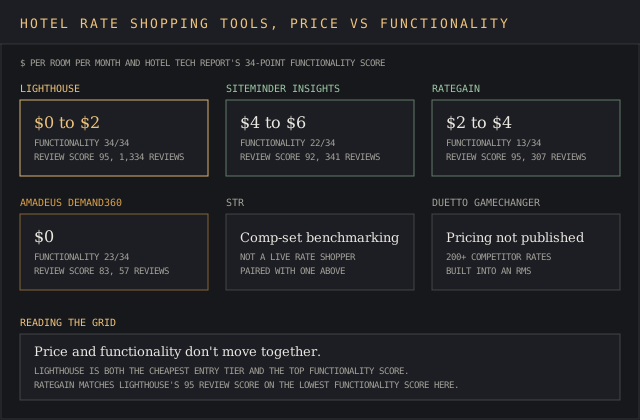
Rate shopping tool pricing runs per room per month, and the spread between the cheapest and most expensive hotel rate shopping tools on this list is wider than most hoteliers expect.
| Tool | Price per room, per month | Functionality score | Review score | Best for |
|---|---|---|---|---|
| Lighthouse | $0 to $2 | 34/34 | 95 (1,334 reviews) | Branded, luxury, city center |
| SiteMinder Insights | $4 to $6 | 22/34 | 92 (341 reviews) | Boutique, resorts, city center |
| RateGain (Navigator) | $2 to $4 | 13/34 | 95 (307 reviews) | Luxury, branded, boutique |
| Amadeus Demand360 | $0 | 23/34 | 83 (57 reviews) | Luxury, branded, airport/conference |
| eRevMax RateTiger | $0 to $2 | 25/34 | 92 (23 reviews) | City center, bed & breakfast, luxury |
| PriceLabs | $4 to $6 | 15/34 | 100 (19 reviews) | Vacation rentals, boutique, resorts |
A premium package with multiple daily 365-day reports across a full comp set can cost an arm and a leg, running over $500 a month; a starter package with a handful of comp hotels and unlimited re-shops on the major OTAs costs far less. Rate shopping tool pricing depends on refresh frequency, comp-set size, and how many distribution channels get shopped.
None of the ten hotel rate shopping tools Hotel Tech Report ranks in 2026 offer a free trial, reflecting how tightly this category ties pricing to the exact comp set and channel list a hotel wants shopped.
Quick comparison of the best hotel rate shopping tools
Six evaluation criteria separate the hotel rate shopping tools below: data accuracy and refresh frequency, market coverage and comp-set flexibility, analytical depth, reporting and decision support, integrations, and automation and alerting.
| Rank | Tool | Refresh speed | Channels monitored | Our review |
|---|---|---|---|---|
| 1 | Lighthouse | Live shopping, 365-day lookback | Primary and secondary comp set across major OTAs | Lighthouse review |
| 2 | SiteMinder Insights | Instant, unlimited parity checks | 90 days of rates refreshed in minutes | Not reviewed |
| 3 | RateGain | Under 60 seconds on Optima | 700+ OTAs, meta and partner sites across 220+ countries | Not reviewed |
| 4 | Amadeus Demand360 | Public rates reach OTAs in 5 to 10 minutes | Participating-property network | Amadeus Demand360 review |
| 5 | STR | Comp-set benchmarking only | Aggregated comp-set reporting | STR review |
| 6 | Duetto GameChanger | Automated tracking with instant alerts | 200+ competitor rates across channels | Not reviewed |
Tool profiles: the best hotel rate shopping tools
Lighthouse
·top pick·Lighthouse tops Hotel Tech Report's 2026 rate shopping category with a 95 review score across 1,334 reviews and a perfect 34-out-of-34 functionality score, the highest of any hotel rate shopper ranked, knocking it out of the park on functionality alone. Pricing runs $0 to $2 per room per month, the cheapest band on this list at the entry tier.
Lighthouse's rate shopping tool supports primary and secondary comp set setup plus rate history, live shops sortable by room type and length of stay, and a full 365-day shopping window. Hoteliers recommending it span every segment: 111 small-hotel votes, 643 mid-sized votes, 365 large-hotel votes, and 156 enterprise votes in Hotel Tech Report's 2026 data, more than any competing hotel rate shopping tool in most size bands.
Confirm how Lighthouse integrates with your existing PMS and revenue management system before signing; the platform is priced and positioned around daily commercial decisions.
Read our Lighthouse review for more on fit and workflow depth.
SiteMinder Insights
SiteMinder's Insights module prices at $4 to $6 per room per month, the highest entry band among the widely adopted hotel rate shopping tools, and scores 92 across 341 reviews with a 22-out-of-34 functionality rating. It's built into SiteMinder's channel manager, so rate shopping and distribution sit on the same login, giving hoteliers the best of both worlds without juggling a second dashboard.
SiteMinder promises instant and unlimited rate parity and competitor rate shopping, and one European reviewer reports it refreshing 90 days of rates in minutes. Boutique hoteliers are the segment most likely to ask for a longer lookback than the current one-month shopping window, a real limitation against Lighthouse's full year of history.
RateGain (Navigator and Optima)
RateGain's Navigator platform tracks rates across 1,100-plus sources, including more than 700 OTAs, meta sites and partner sites, and its rate intelligence covers 220-plus countries and multiple points of sale across desktop, mobile web and app. That is the broadest distribution-aware hotel rate shopping tool by channel count in this ranking. It scores 95 across 307 reviews, priced at $2 to $4 per room per month.
Its functionality score of 13 out of 34 is the lowest among the widely adopted tools here, which is why it sits below SiteMinder despite the wider channel reach and the matching 95 review score; on functionality, RateGain misses the mark. Reach and depth are not the same purchase.
The "Lightning Refresh" feature on RateGain's Optima rate shopper returns updated competitor rates in under 60 seconds, and a "Buzz reports" feature flags parity breaches automatically. Middle East hoteliers cite RateGain's closed user group rate shopping and mobile rate visibility as reasons it wins that region: 62 regional votes against 135 for Lighthouse, the closest gap in Hotel Tech Report's data.
Amadeus Demand360
Amadeus Demand360 is free at the base tier, the only tool on this list with a $0 price band at every level tested, scoring 83 across 57 reviews with a 23-out-of-34 functionality score. It pairs Rate 360 for compset comparison with forward-looking occupancy and booking-pace data most rate shoppers don't touch.
Coverage depends on participating-property density, so smaller or less-covered destinations see thinner comp sets than branded urban markets. Asia Pacific reviewers note public rates reach OTAs and hotel websites in 5 to 10 minutes once Demand360 registers a change.
STR (CoStar Group)
STR provides the comp-set benchmark hoteliers pair with a live rate shopper. Occupancy, ADR, and RevPAR reporting against a defined comp set let a revenue manager separate a rate shopping tool's live competitor rates from the underlying market's real performance, which is why STR shows up as the second subscription on most revenue teams' desks.
Read our STR review for comp-set benchmarking against the live rate shoppers above.
Duetto GameChanger
Duetto's GameChanger module automates tracking of more than 200 competitor rates across distribution channels with instant alerts on price changes and market shifts, built into a revenue management system. Duetto doesn't publish pricing publicly, in line with most RMS vendors in this category.
Other hotel rate shopping tools worth a shortlist mention: eRevMax's RateTiger monitors competition and manages rate parity at $0 to $2 per room per month with a 92 review score. Paraty Tech's Price Seeker adds conversion-rate context to daily competitor updates for European hoteliers. Blastness scores a clean 100 across a smaller review base. PriceLabs leans toward vacation rentals and villas, and RateMate covers the smallest independent properties.
Back to top ↑What is a rate shopper?
A rate shopper is software or a service that automates competitor rate monitoring across online travel agencies, metasearch sites, and a hotel's own distribution channels, so a revenue manager can keep an eye on rate movement without manually checking each channel. Hotel rate shopping tools automate competitor rate monitoring at a frequency ranging from a handful of checks a day to live, continuous refresh.
What is a rate shopping tool?
A rate shopping tool pulls competitor room rates from public booking channels on a schedule and surfaces them in a dashboard, alongside a hotel's own rates, so pricing decisions get made against real market data. Rate intelligence tools monitor competitor prices and improve hotel revenue by turning that raw feed into a pricing signal a revenue manager can act on same-day.
What is rate shopping?
Rate shopping is the practice of comparing a hotel's own rates against a defined comp set across every channel where both sell rooms, then adjusting based on what the market shows. It replaces a spreadsheet updated once a week; a rate gap open for even a day costs bookings to a rival five minutes down the road.
What is the rate shopping technology?
The technology behind a hotel rate shopper mixes automated scraping with direct data-partnership feeds pulling live prices from hundreds of OTAs and metasearch engines, refreshed from every few minutes to once daily. Global distribution systems feed the same technology on the travel-agency side, giving hotel rate shopping software visibility into rates a public search never touches.
How hotel rate shopping tools work
Data sources and refresh frequency
Hotel rate shopping tools pull from OTAs, metasearch engines, global distribution systems, and a property's own booking engine, refreshed on a schedule the hotel sets, daily, several times a day, or continuously on the higher tiers. Real time market data is what separates a genuine hotel rate shopper from a manual rate check: a rate posted an hour ago and already dropped again is worthless if the report only runs overnight.
Comp-set setup
Every hotel rate shopping tool needs a defined comp set, the handful of competitor properties a hotel measures itself against, configured with primary and secondary tiers so a revenue manager can widen or narrow the view by season or event. Market intelligence built on the wrong comp set gives confidently wrong pricing decisions, so the comp-set step is worth more attention than most hoteliers give it at setup.
Alerts and automation
Automated rate shopping tools push alerts the moment a competitor's rate moves outside a set band, letting revenue managers respond within the same booking window. Monitoring competitor room rates by hand across ten properties can get out of hand fast and is a full-time job on its own; automation is the reason this software category exists.
Back to top ↑Rate parity: what it means and why it's changing
Rate parity ensures consistent pricing across all distribution channels, so a room advertised at $200 on an OTA isn't quietly $180 on the hotel's own site or vice versa, keeping every channel on the same page. Maintaining rate parity avoids revenue loss and guest disillusionment: travelers who discover a cheaper rate elsewhere after booking direct lose trust in the channel they were told to prefer.
Rate shopping tools help detect pricing discrepancies automatically, flagging a parity breach the same day it appears. Rate parity monitoring is one of the most requested rate shopping features among mid-market hotels specifically, since smaller revenue teams can't manually audit parity across a full channel list.
Hotels often match or beat OTA prices when booked directly, using a small member-rate discount to win the direct booking without breaking parity terms. In 2026, EU laws restrict OTA parity clauses, increasing pricing flexibility for hotels that previously couldn't undercut an OTA's listed rate on their own site.
Dynamic pricing and revenue management
How dynamic pricing works
Dynamic pricing can increase revenue by adjusting rates based on demand: a rate rises as a high-demand date fills and falls when a shoulder-season week is running soft. Dynamic pricing strategies improve with real-time market data, since a revenue management system pricing off yesterday's occupancy is always one step behind actual demand and never gets ahead of the curve.
Revenue management and rate shoppers
A revenue management system takes rate shopper data as one input among several, alongside a hotel's own booking pace, demand forecasts, and historical data, then recommends or automatically sets rates across future dates. Only 23% of hoteliers adjust rates daily without rate shopping tools and a connected pricing system doing the recalculation in the background; the other 77% are pricing on stale information for at least part of every week.
Pricing decisions and market conditions
Good pricing decisions depend on current market trends. Last year's calendar doesn't capture a citywide event, a flight-price shift, or a competitor's sudden discount, and all three move demand faster than a fixed pricing strategy can track.
Revenue managers who read market conditions through a live hotel rate shopper make pricing decisions ahead of the market, and identify pricing gaps, a room priced below what demand data supports, before a competitor's own system catches the same gap first.
What goes wrong without it
Pricing errors compound without a rate shopper: a rate held too high during high demand periods loses bookings to a faster-moving comp set, and a rate left too low during a demand spike gives away revenue a dynamic pricing tool would have captured. Operational complexity rises too, since a revenue team manually re-pricing dozens of dates across multiple distribution channels burns hours a true rate shopping tool would save.
Our pricing intelligence ranking covers the broader competitive-pricing category dynamic pricing tools sit inside, for teams pricing something other than a hotel room.
Back to top ↑Rate shopping tools as market intelligence software
A rate feed by itself is just numbers. Hotel rate shopping tools earn the market intelligence label once they layer comp-set context, historical data, and demand forecasts on top of that feed, turning raw competitor rates into a pricing strategy a revenue team can act on the same day.
From data feed to pricing strategy
Vendors increasingly sell rate shopping as one module inside a wider intelligence software suite that also tracks market demand, positioning the rate shopper as market intelligence for a defined target market. A resort chasing leisure demand needs different competitor data than a business hotel chasing corporate room rates, so market positioning and a market intelligence solution built for one rarely fit the other.
A dashboard that compares both your rates and OTA rates side by side, refreshed on the same schedule, catches a parity breach before a guest does.
What good competitor data covers
Strong hotel rate shopper software tracks competitor pricing across the full comp set, every distribution channel, and every rate plan a rival sells, cheapest room included, the whole nine yards for a revenue manager who wants the complete picture. Monitoring competitor room rates at that depth surfaces competitor rate data a revenue manager can compare against a hotel's own occupancy rates.
Key features worth checking in any hotel rate shopper: comp-set flexibility, automatic parity-breach alerts, demand forecasts pulled from historical data, and export options that feed a hotel's own reporting stack. A shortlist missing two or more of those key features usually turns into a second dashboard nobody opens.
Turning competitor rates into pricing decisions
Real time data closes the gap between a competitor's rate move and a hotel's own response; real time market data on demand fluctuations lets a revenue manager adjust pricing hours after a shift starts. Rate shopper software that surfaces current market trends inside the same view a revenue manager already uses for direct bookings shortens that response time further, since nobody has to cross-reference two systems to make dynamic pricing decisions.
Competitive pricing strategies built on stale competitor pricing produce the opposite of informed pricing decisions: a hotel holding a rate against demand trends from two weeks ago is pricing against a market that no longer exists. Good market data closes that gap and helps a revenue team improve revenue strategies around the current week's demand.
Where this shows up in the numbers
Hotels using rate shopping tools to maximize revenue report gains on two fronts: better occupancy from catching competitor pricing swings early, and better rate integrity from automated parity alerts that protect direct bookings from undercutting.
Hotel Tech Report's reviewer base ties higher functionality scores to fewer manual re-pricing errors, less time reconciling pricing data by hand, and faster market insights when ownership asks about a specific comp set, changes that boost customer satisfaction internally as much as with guests and keep the whole revenue team up to speed without an extra meeting.
Back to top ↑The traveler side: consumer rate shopping tools
Hotel rate shopping runs on the hotel side of the transaction, but travelers run their own version of the same comparison, and the tools differ completely.
Kayak
Kayak allows users to aggregate prices across multiple online travel agencies in a single search, showing a traveler the same room's price on half a dozen booking sites at once. It works as a metasearch engine for travelers: it reads public consumer prices.
Trivago
Trivago compares rates from hundreds of booking sites for the same property, and its business model depends on the same rate volatility hotel rate shopping tools exist to manage. A traveler using Trivago does manually, for one hotel, what a hotel's own rate shopper does automatically across an entire comp set.
Google Hotels
Google Hotels aggregates pricing from online travel agencies and hotels for comparison directly inside search results, collapsing the metasearch step into the search engine itself and killing two birds with one stone for anyone who doesn't want a second tab open. For travelers, it's often the first rate comparison before a booking site is even opened.
Price tracking apps and browser extensions
Price tracking apps alert users when hotel prices drop post-booking, catching a rate cut a traveler would otherwise never see once a reservation is confirmed. Browser extensions can simplify the hotel booking process by checking rates automatically as a traveler shops, and price alerts can inform users of rate changes for flexible travel dates, useful for anyone who isn't locked into a specific weekend.
How travelers should rate shop across sites
Using multiple price comparison tools increases the likelihood of finding lower rates, since no single aggregator indexes every channel a hotel sells through; leaving no stone unturned across sites pays off. Price comparison tools help find better hotel deals and rates, but effective hotel rate shopping involves comparing results with official hotel websites too, since a hotel honoring its own member rate can beat every OTA listed on an aggregator.
Travelers should check multiple sites for complete price comparisons.
Back to top ↑Choosing a hotel rate shopping tool
Match the tool to your property size
Small independent hotels rarely need Lighthouse's full 365-day shopping window or RateGain's 700-plus OTA reach; a lighter rate shopper covering the channels that drive bookings costs less. Enterprise and branded portfolios lean the opposite way, since Lighthouse and RateGain both post their strongest recommendation counts in the large and enterprise segments.
Check the integrations
A hotel rate shopping tool that doesn't talk to your property management system, booking engine, and revenue management system creates a second dashboard nobody opens daily. Confirm the specific PMS and RMS integrations before signing, since the top-rated integrations named across this category, Cloudbeds, Mews, Duetto, and IDeaS among them, aren't universal across every rate shopper on this list.
Ask about data quality and refresh rate
Data quality varies more than vendors advertise: a tool refreshing in under a minute and one refreshing once daily aren't comparable at similar prices, so confirm refresh frequency for the channels that matter to your comp set.
Look past raw rates to hotel rate intelligence
The best hotel rate shopping tools sell hotel rate intelligence: demand fluctuations, market conditions, and comp-set context packaged alongside the rate itself so a revenue manager can compare pricing across the full comp set in one view. A shortlist heavy on key features but light on that layer of hotel rate intelligence still leaves the interpretation work to a person.
Ask each finalist how it turns competitor rates into a recommendation. A tool that only reports competitor pricing forces a revenue manager to make every pricing decision from scratch; one that scores the move against demand fluctuations and current market conditions supports faster, more data driven decisions.
Confirm the pricing data behind that scoring reflects a live comp set, and confirm the tool ties into a booking engine so it can adjust pricing across every channel a property sells through, since competitor rates change by the hour on the busiest dates.
Budget for the real cost beyond the sticker price
Rate shopping tool pricing quoted per room per month rarely reflects the final bill once comp-set size, channel count, and reporting cadence are added, a reminder that the devil's in the details with hotel rate shopping tool pricing. Ask for a quote against your actual comp set and channel list; the entry-tier number on a pricing page won't reflect it.
Implementation timeline
Hotel Tech Report's 2026 data puts average implementation at two business days from setup information to first report, across four steps: setup, data migration, verification and testing, and go live. A hotel rate shopping tool that quotes materially longer than that for a standard comp set is worth a follow-up question before signing.
Back to top ↑Common questions about hotel rate shopping tools
What is a rate shopper?
Software that automates competitor rate monitoring across OTAs, metasearch sites, and a hotel's own channels, surfacing rate movement in a single dashboard the whole team can check at a glance.
What is a rate shopping tool?
A platform that pulls competitor room rates on a schedule, from every few minutes to once daily depending on the plan, and displays them against a hotel's own rates so pricing decisions run on current market data.
What is rate shopping?
Comparing a hotel's own rates against a defined comp set across every channel both sell through, then adjusting pricing based on what the comparison shows.
What is the rate shopping technology?
A combination of automated data collection from OTAs, metasearch engines, and global distribution systems, refreshed on a schedule and delivered as alerts or dashboards.
What software do most hotels use?
Lighthouse leads hotel rate shopping tools by review volume and functionality score in Hotel Tech Report's 2026 category, with SiteMinder Insights and RateGain as the next most-recommended across mid-sized and large properties.
What is a dynamic pricing tool for hotels?
Software, usually a demand-based pricing system, that adjusts room rates automatically based on demand signals, competitor rates from a connected rate shopper, and booking pace.
What is the best website for hotel ratings?
Guest-review sites like TripAdvisor and Google-hosted reviews cover reputation and satisfaction; that's a different question from rate shopping, which tracks price. Both feed the same booking decision.
What is the 15-5 rule in hotels?
A guest-service standard. Staff make eye contact and smile at fifteen feet from a guest, and offer a verbal greeting at five. Marriott and Ritz-Carlton popularized it and it spread across hospitality from there. It has nothing to do with rate shopping, and searchers who land here looking for a pricing rule are looking for dynamic pricing bands instead.
What is the 80/20 rule in hotels?
Roughly 80% of revenue comes from 20% of guests, stay dates, or segments, so revenue managers prioritize rate shopping on the dates and channels doing most of the work.
How much do hotel mystery guests get paid?
Mystery-guest programs typically pay a modest stipend plus a comped or discounted stay, and rates vary widely by program and property. The programs sit outside hotel rate shopping software entirely; they check service quality. Rate shopping software tracks price.
How to get 50% off on hotel bookings?
Deep discounts usually come from off-peak dates, package bundles, or a hotel's own member rate; using multiple price comparison tools increases the likelihood of finding lower rates, so it pays to leave no stone unturned before booking.
What software do most hotels use for revenue management?
Duetto and IDeaS lead large-hotel revenue management system adoption, each pairing demand forecasting with a built-in or connected rate shopper so pricing and competitor monitoring run on the same data.
Back to top ↑Rate shopping needs across the hospitality industry
Across the hospitality industry, the property types buying hotel rate shopping tools split by how they compete. A branded, business-heavy hotel adjusts pricing against corporate rate agreements and checks distribution channels daily; a leisure resort adjusts pricing against weekend demand and leans on real time data and competitor pricing during flash sales. Both anchor pricing strategy to competitor rates that move in real time, keeping every segment on the same page.
Vacation rentals and boutique independents run a lighter version of the same playbook. PriceLabs-style tools pull competitor rates from a narrower comp set and feed dynamic pricing decisions without the full revenue strategies a 200-room hotel needs, but every segment shares one goal: use competitor rates and market demand to adjust pricing before a rate gap costs a booking, and protect direct bookings with the same real time data that catches a rival's move first.
Real time data also supports own pricing decisions beyond the rivalry itself. A hotel tracking its own pace against market demand can adjust pricing on shoulder dates first, checking competitor pricing across every one of its distribution channels at once.
That mix, competitor rates plus a hotel's own pace, separates rate shopper software that reports numbers from software that protects direct bookings and helps maximize revenue using competitor pricing as the constant signal underneath every decision.
What to budget for a hotel rate shopping tool
Anchor expectations on the published bands: $0 to $2 per room per month for Lighthouse's entry tier, $4 to $6 for SiteMinder Insights, $2 to $4 for RateGain, and $0 at Amadeus Demand360's base level. Then add for the comp-set size, channel count, and reporting frequency that push a real quote toward the $500-a-month premium-package range Hotel Tech Report documents.
Hotel rate shopping tools pay for themselves fastest at properties still pricing manually and help those properties maximize revenue as they move from the 23% who adjust rates daily toward continuous, automated rate shopping. Pair the tool with automated parity checks and a connected pricing system, and the pricing decisions that used to take a full morning of manual checks run in the background instead, with the automation bringing home the bacon.
For the broader hotel data stack around rate shopping, RevPAR, demand forecasting, and comp-set benchmarking, see our hotel market intelligence guide.