SERP API pricing in 2026: the same 10,000 Google searches cost $6 or $150
 By Jan Suski. I go deep on every review, checking every number against its source and digging up details other coverage misses, a habit from six years of SEO and link building for tech companies. Bylines at Surfer, Brand24, and Senuto. How the scoring works.
The numbers Google SERP API pricing, checked 6 October 2026
DataForSEO's $0.60 Standard rate is less than a sixteenth of SerpApi's $10.00 list rate for the same 10-result Google page.
ScraperAPI's 25-credit Google charge leaves its $49 Hobby plan, sold as 100,000 credits, buying 4,000 Google calls.
The 10x depth multiplier turned an $18 monthly top-100 rank check of 1,000 keywords into $180 on the same queue.
Ten thousand Google searches a month cost $6 on DataForSEO's Standard queue and $150 on SerpApi's Production plan, as of October 2026. Both return the top 10 organic results in the same structured JSON format. The 25x gap comes from the billing unit, and most SERP API pricing pages leave that unit for the buyer to decode.
This report puts 14 providers on one meter, the cost of 1,000 Google searches at 10,000 and 100,000 a month, so the SERP API cost on one rate card reads against another. It covers per-search quotas, credit multipliers, pay-per-success meters, queue versus live pricing, and what Google's September 2025 removal of num=100 did to rank tracking bills.
It's built for developers and SEO teams buying search data from Google and other search engines for rank tracking, AI agents and data extraction pipelines. The meter matters because SERP data sits under rank trackers, AI agents and price monitoring tools, and at 100,000 searches a month the published commercial plans for the same SERP API workload differ by $239 a month.
Every price comes from the vendor's own page or docs, read in October 2026, and every figure includes a link to its source.
How SERP API pricing works
A SERP API takes a search query, fetches the results page URL from Google or one of the other search engines it supports, and the API returns structured data, usually structured JSON, with some providers adding the raw HTML. SERP APIs are data extraction tools built for one page type, and the devil's in the details, because one API call is billed in one of five units:
- Per search, sold as a monthly quota. SerpApi, SearchAPI.io, Zenserp and Value SERP count one API call as one search.
- Per credit, with a multiplier. ScrapingBee, ScraperAPI, Scrapingdog and HasData sell general web scraping credits and charge 5 to 25 of them per Google call.
- Per successful request or result. Bright Data, Oxylabs and Apify drop blocked and failed requests from the bill.
- Per page of 10 results. DataForSEO bills every SERP of up to 10 results, so a top-100 request costs 10 units.
- Per queue. DataForSEO's Standard tasks return in about five minutes for $0.0006, Priority in about a minute for $0.0012, Live in about six seconds for $0.002.
The credit cost also scales with the engine and the feature. ScraperAPI's credit table charges 25 credits for a plain Google call, 35 with JavaScript rendering and 75 with ultra-premium proxies plus rendering. Scrapingdog doubles its 5-credit call to 10 when advance_search or mob_search, its mobile devices option, is on.
ScraperAPI's pricing page sets Google and Bing at 25 credits, Amazon at 5 and LinkedIn at 30, so the same credit buys different amounts across search engines and sites, and the pricing model moves the bill more than the plan price.
Free tiers are par for the course, and they make integration testing cheap: 250 searches a month on SerpApi, 2,500 one-time searches on Serper, 5,000 requests a month on Bright Data, 1,000 trial credits on ScrapingBee and 100 requests on SearchAPI.io. Most SERP API docs ship code snippets in Python and Node, so the integration into an existing data extraction workflow requires an API key and a few lines of code.
What 10,000 and 100,000 Google queries a month cost
The table prices the first page of Google organic search results, United States, no JavaScript rendering, on the cheapest published plan that covers each volume, starting from the smallest tier.
| Provider | Billing unit | 10,000 a month | Per 1,000 | 100,000 a month | Per 1,000 |
|---|---|---|---|---|---|
| DataForSEO, Standard queue | Page of 10 results, prepaid | $6 | $0.60 | $60 | $0.60 |
| Serper | Prepaid credits, valid 6 months | $10 ($50 pack) | $1.00 | $75 ($375 pack) | $0.75 |
| Bright Data | Successful request, pay as you go | $15 | $1.50 | $150 | $1.50 |
| Apify Google Search Scraper | Result page, Starter and Scale plans | $25 | $2.50 | $199 | $1.99 |
| SearchAPI.io | Monthly search quota | $40 | $4.00 | $250 | $2.50 |
| HasData | Credits, Startup and Basic plans | $49 | $4.90 | $99 | $0.99 |
| Oxylabs | Successful result, Micro and Starter plans | $49 | $4.90 | $99 | $0.99 |
| Zenserp | Monthly search quota | $49.99 | $5.00 | $149.99 | $1.50 |
| Value SERP | Monthly quota, billed annually | $50 | $5.00 | $158 | $1.58 |
| SerpApi | Monthly search quota | $150 | $15.00 | Enterprise quote | Enterprise quote |
Every price in this table is the vendor's own list price, read from its pricing page or documentation and checked 6 October 2026. No cell is a Vendr median.
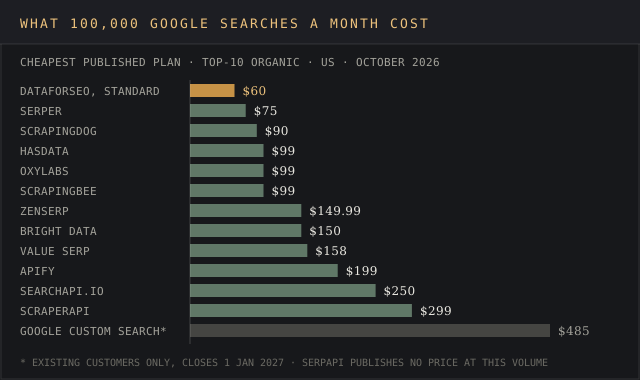
Volume discounts lower the per-1,000 rate and close most of the gap. At 10,000 searches five of the ten providers charge $40 to $50, because their smallest plan includes more than the scenario uses. At 100,000 eight of the ten land between $60 and $199, and SerpApi's published ladder tops out at 30,000 searches for $275.
SerpApi charges the most and bundles the most. Its legal terms promise a 99.95% SLA on all plans with credits up to 100% of the monthly fee. The same page limits the U.S. Legal Shield, up to $2 million of coverage for lawful collection of public search data, to Production and higher plans and to claims under U.S. law.
At $15 per 1,000 effective on Production, buyers get the whole nine yards of reliability and indemnity folded into the price. SerpApi's security page lists SOC 2 Type II and SOC 3 certification for compliance teams.
SERP API cost by provider
DataForSEO: Standard queue, Priority and Live
DataForSEO runs on a prepaid balance with a $50 minimum deposit and $1 of free credit. At 100,000 searches the Standard queue costs $60, Priority $120 and Live $200, and every rate is published, so anyone can estimate a bill without a sales call. Results come back as regular or advanced JSON data, or as HTML. Depth is billed "per each SERP containing up to 10 results," per the API documentation, so a top-100 request costs $0.006 on Standard and $0.02 Live.
Our DataForSEO pricing report breaks down its other API families, the DataForSEO review covers data quality, and the DataForSEO MCP server puts the same SERP endpoint in front of AI agents without a custom integration.
See the queue math for yourself
Run your own DataForSEO estimate
Standard SERP tasks price at $0.0006 each; $1 in free credit lands on signup against a $50 minimum deposit.
 Visit DataForSEO →
May earn a commission if you sign up through this link, at no extra cost to you. Full affiliate disclosure.
Serper
Serper sells one-time credit top-ups for its Google search API on its homepage rate card, and credits expire after six months:
- $50 for 50,000 credits, $1.00 per 1,000, 50 queries per second
- $375 for 500,000 credits, $0.75 per 1,000, 100 queries per second
- $1,250 for 2.5 million credits, $0.50 per 1,000, 200 queries per second
- $3,750 for 12.5 million credits, $0.30 per 1,000, 300 queries per second
The six-month expiry means the $0.30 rate only holds for a buyer processing millions of queries, more than 2 million a month. A buyer at 1 million a month who grabs that pack would miss the boat on 52% of the credits.
Refunds run seven days and stop once 20% of the credits are spent. Serper sells on speed and low latency, advertising fast JSON results in 1-2 seconds. A Hacker News user comparing the two cheapest providers in May 2025, four months before Google's num=100 change, laid out how depth moved the credit math:
"For serper.dev, they consider 10 results to be 1 "credit", and 20 to 100 results to be 2 "credits". They bill at $50/50,000 credits, so it becomes $1/1000 requests if you are okay with just 10 results per request, or $2/1000 requests if you want 100 results per request."
Manouchehri, Hacker News, 8 May 2025. Read the comment.
Bright Data
Bright Data, which pays this site an affiliate commission, prices its SERP API at $1.50 per 1,000 on pay as you go, with no monthly minimum and a "pay only for success" rule. Its Scale plan is $499 a month for 380,000 requests, about $1.31 per 1,000, and only beats pay as you go above roughly 333,000 a month, so smaller buyers can cross that bridge when they come to it.
Concurrency is unlimited on every tier, and asynchronous mode bills only the send. The engine menu covers four search engines, Google, Bing, DuckDuckGo and Yandex, through one API key and one integration, and the pricing page claims coverage of 195 countries with city-level targeting.
The pay-for-success promise has drawn complaints about reliability on the vendor's other products. A Capterra reviewer who left its Web Unlocker after a year wrote:
"Bright data's web unlocker and proxy products claimed to unlock hard to scrape websites... in reality this was not the case as it had a very high failure rate and I was charged for unsuccessful queries... Over time, the product's performance has degraded significantly, leading to a high error rate."
Emiliano G., founder, IT services, Capterra, September 2025. Read the review.
Our Bright Data review counts the complaints across G2, Capterra and Trustpilot, and the Bright Data MCP server runs on the same 5,000 free monthly requests.

See the rate card yourself
Check Bright Data's pricing
5,000 free requests a month with no card, then $1.50 per 1,000 on Web Unlocker pay as you go, or $1.30 on the $499 Scale plan.
 Visit Bright Data →
May earn a commission if you sign up through this link, at no extra cost to you. Full affiliate disclosure.
Oxylabs
Oxylabs folds Google into its Web Scraper API and routes every API call through premium proxies, billing per successful result of Google data: $1.00 per 1,000 Google results on the $49 Micro plan, $0.90 on the $99 Starter plan, $0.80 on the $249 Advanced plan. Rendered results run $1.25 to $1.35, the free trial covers 2,000 results, and every paid plan includes a dedicated account manager. Our Bright Data vs Oxylabs comparison sets the two proxy networks side by side.
SerpApi
SerpApi publishes a five-step ladder, with hourly throughput set at 20% of plan volume:
- Free: 250 searches a month, 50 an hour
- Starter, $25: 1,000 searches, 200 an hour
- Developer plan, $75: 5,000 searches, 1,000 an hour
- Production, $150: 15,000 searches, 3,000 an hour
- Big Data, $275: 30,000 searches, 6,000 an hour
Only successful searches count, and "Responses with 100 results or empty result sets will both cost 1 search credit," the FAQ says. Unused searches don't roll over to the next month, because the allowance resets on the first day of each billing cycle. Higher-priced tiers raise the throughput limit for concurrent API requests, from 200 searches an hour on Starter to 6,000 on Big Data.
The Google Search API parses the search results into result types including paid ads, local packs, shopping results, images, videos, the knowledge graph, related questions and answer boxes, the featured snippets and rich snippets a rank tracker reads. Responses stay in storage for 31 days.
SearchAPI.io and Zenserp
SearchAPI.io runs eight tiers for flexibility, from $40 for 10,000 searches to $5,000 for 5 million at $1.00 per 1,000, and bills only responses with a 200 status code. Zenserp starts at $49.99 for 25,000 searches and falls to $899 for 1 million, $0.89 per 1,000, with 20% off on annual billing and a free tier of 50 searches a month.
ScrapingBee, ScraperAPI and Scrapingdog: credit multipliers
These scrapers sell web scraping credits and price a Google call as a multiple of a plain page, so the multiplier sets the real cost.
| Provider | Credits per Google call | Entry plan | Google calls the entry plan buys | Cheapest plan for 100,000 calls |
|---|---|---|---|---|
| ScrapingBee | 10 light, 15 regular | $49, 250,000 credits | 25,000 | $99 |
| ScraperAPI | 25 | $49, 100,000 credits | 4,000 | $299 |
| Scrapingdog | 5 | $40, 200,000 credits | 40,000 | $90 |
Plan prices and credit weights are each vendor's list price, checked 6 October 2026, and the Google calls column divides plan credits by the credit weight. No cell is a Vendr median.
At first glance ScraperAPI's Hobby plan matches ScrapingBee's Freelance plan, $49 for six-figure credits, and it buys a sixth as many Google calls. ScrapingBee bills 200, 404 and 410 responses, its FAQ says. HasData publishes a specific Google rate, $2.46 per 1,000 on the $49 Startup plan and $0.99 on the $99 Basic plan, and refunds credits on failed requests. The same credit systems set web scraping pricing for every other target site.
Apify Google Search Scraper
Apify's Google Search Scraper works as a SERP API that charges per scraped result page, and the Actor's pricing record cuts the rate by platform plan: $4.50 per 1,000 pages on the free plan, $2.50 on the $19 Starter plan, $1.95 on the $199 Scale plan and $1.80 on the $999 Business plan. Plan fees are prepaid API usage, so 10,000 pages on Starter cost $25 in total. HasData's benchmark puts Apify's slower response times down to its browser-based approach.
Value SERP and Scale SERP
Traject Data's two SERP APIs now belong to ScraperAPI, which announced the deal on 29 April 2026. Value SERP runs from $50 a month for 25,000 searches to $9,000 for 20 million, billed annually. Scale SERP costs $66 a month for 10,000 on annual billing, and its 1,000-search plan charges $0.038 per extra search, $38 per 1,000, a red flag for anyone whose demand spikes.
Google's num=100 removal and the rank tracking bill
Google stopped honoring num=100 in September 2025. Search Engine Roundtable reported on 12 September that the parameter worked about half the time in testing before it fully stopped and broke most Google trackers. DataForSEO set default depth to 10 and, from 19 September 2025, charged for every 10 results, so a depth-100 request went from $0.0006 to $0.006.
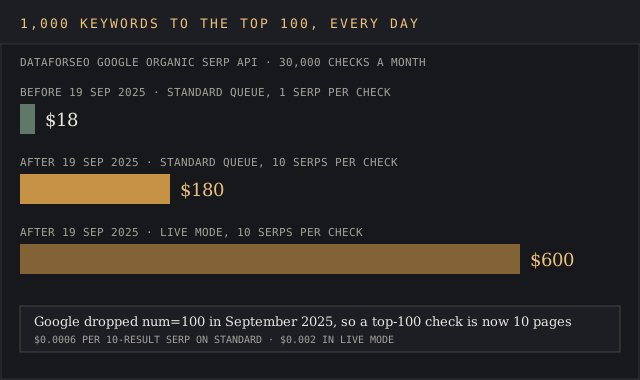
For 1,000 keywords checked daily to the top 100, that's 30,000 checks a month. They cost $18 on DataForSEO's Standard queue before the change, $180 after and $600 in Live mode. SerpApi's blog noted on 16 September 2025 that "more often than not, you'll get 10 organic_results despite attempting to get 100." A top-100 pull now takes 10 paginated searches, so a $150 plan that covered 15,000 deep checks covers 1,500.
Rank tracking vendors went back to the drawing board, choosing between paying for depth and tracking fewer positions, which our rank tracker pricing report follows plan by plan.
Google's own search API and the retired Bing Search APIs
Google's Custom Search JSON API gives existing customers 100 queries a day free, then $5 per 1,000, limited to 10,000 a day. It's closed to new customers, and existing ones keep access until 1 January 2027. For them, 10,000 queries a month costs about $35 and 100,000 about $485. Google points sites with up to 50 domains at Vertex AI Search.
Microsoft retired the Bing Search APIs on 11 August 2025 and named Grounding with Bing Search inside Azure AI Agents as the replacement. With the official APIs of both search engines closed to new buyers, commercial SERP APIs are now the main route to SERP data and search results as structured data. Our Google search statistics report covers the query volume behind that search data.
Response times and reliability in published benchmarks
Two SERP API vendors published speed tests in 2026, and each came first in its own. Scrapingdog's test of 50 queries, updated June 2026, recorded average response times of 1.83 seconds for Scrapingdog, 2.87 for Serper, 2.96 for SearchAPI, 5.49 for SerpApi, 5.58 for Bright Data, 8.2 for Apify and 33.6 for ScraperAPI.
HasData's test, updated 25 September 2026, sent 1,000 requests per API and reported median latency: HasData 2.3 seconds, SerpApi 2.5, Bright Data 2.6, Zenserp 3.9, ScraperAPI 4.1, DataForSEO 4.7, Oxylabs 5.5, Apify 13.7 and ScrapingBee 20.9. It logged no failed responses for five of the nine APIs, SerpApi and DataForSEO among them, so all five ran reliably over that run, and it rated SerpApi consistent and Oxylabs' parsing stable.
ScraperAPI moved from 33.6 seconds to 4.1 between the two tests, so both lists measure test design as much as speed and reliability. A reliable SERP API on one keyword set can stall on another, so run a free tier against your own search queries to evaluate it. Low latency matters for AI applications and real time results in a chat, while overnight data extraction jobs for a rank tracker can take the five-minute queue at a third of the Live rate.
Hidden costs in SERP API billing
Five hidden costs sit on top of the base price of SERP data:
- Credit multipliers. ScraperAPI's Google call costs 25 to 75 credits depending on proxies and rendering, on the same web scraping meter it uses for every site.
- Expiry. Serper credits lapse after six months, and SerpApi's allowance resets each billing cycle.
- Overage. Scale SERP charges $38 per 1,000 searches that exceed its smallest plan.
- Minimums. DataForSEO needs a $50 deposit, Serper a $50 pack, and Bright Data's Scale tier $499 a month.
- Parsing overhead. An API that returns raw HTML only leaves post processing of the data into JSON to the buyer.
SerpApi, SearchAPI.io, Oxylabs, HasData and Scrapingdog all say they bill successful requests only. ScrapingBee's 404 billing flies under the radar, and the Capterra reviewer above reported paying for failed queries, so a retry loop on common errors can double a bill before anyone notices.
SERP API or your own scraper: proxies, CAPTCHAs and engineering time
Building in-house data extraction from Google needs proxies and proxy infrastructure, proxy rotation, CAPTCHA solving and a parser rewrite every time Google search results pages change their markup. Residential proxies on Bright Data list at $8 per GB, $4 with the current 50% coupon. Datacenter proxies are cheaper and draw IP bans faster, so residential proxies or mobile proxies set the floor for high volume search scraping.
The proxies are a drop in the bucket next to engineering time, which takes the lion's share of a DIY budget. Proxy rotation and proxy management, rate limiting, retries and high concurrency all get handled internally, and keeping the scraper reliable is time consuming.
When Google tightened anti bot measures in September 2025, one user quoted by Search Engine Roundtable reported that their "Rank tracker using Puppeteer broke too. Very odd, random captchas," so browser automation was no escape from the IP blocks. Google's rate limiting lands on the proxies themselves, so every extra 100,000 searches at high volume means more proxies and more bandwidth.
Google's lawsuit says its SearchGuard system took "tens of thousands of person hours and millions of dollars of investment," as quoted by IPWatchdog.
A reliable managed SERP API at $0.30 to $25 per 1,000 turns proxies, proxy management, IP bans and constant maintenance into a line item, and that's the cost effective path for most companies without the extra effort of a web scraping team. Our web scraping tools ranking covers the proxies, APIs and frameworks for teams that build anyway.
How to choose the best SERP API for your query volume
The best SERP API at 10,000 searches a month is rarely the best SERP API at 1 million, so the right SERP API depends on three factors in order, monthly volume, then response times and reliability, then which search engines it covers:
- Under 2,500 a month: the free tiers listed above cover the data.
- 10,000 a month: DataForSEO Standard at $6 if a five-minute wait suits the use case, Bright Data at $15 for live results at real-time speed.
- 100,000 a month: DataForSEO at $60, Serper at $75 effective, Scrapingdog at $90, then a cluster at $99 for the same data.
- 1 million a month at scale and high volume: the most cost effective live options are Scrapingdog's $350 Premium plan, 6 million credits or 1.2 million Google calls, and Serper's 2.5-million pack at about $500 a month, against $600 on DataForSEO Standard and $899 on Zenserp.
Feature coverage is the critical difference between providers at the same price. Rank tracking needs local packs, featured snippets, rich snippets and ads parsed. Price monitoring for pricing intelligence needs shopping results in multiple languages. Lead generation from local results needs addresses and phone fields in the structured output. Check that the data required comes back as a field in the structured output, since parsing it yourself erases the cost savings.
Switching providers later means an integration rewrite, because every SERP API names its JSON fields differently, so test two before you integrate one.
Teams that want keyword data with a dashboard can kill two birds with one stone in SEO tools, where rank tracking comes bundled. Our Semrush pricing and Ahrefs pricing reports cover that route, the competitive intelligence tools for SEO ranking compares 10 platforms, and our market intelligence API ranking covers the news feeds that sit next to SERP data in market analysis.
Frequently asked questions
Is SerpApi legal to use?
Google sued SerpApi under the DMCA on 19 December 2025. On 20 July 2026 Chief Judge Yvonne Gonzalez Rogers dismissed the claims over search results with no copyrighted content without leave to amend and let Google refile the claims over Knowledge Panel images, PPC Land reported. Google amended its complaint on 10 August 2026 around licensed content, so the jury's still out on that part.
How much does an API cost?
A Google SERP API costs $0.30 to $25 per 1,000 searches on the plans in this report, each search a page of 10 results as JSON. Most teams at 100,000 a month pay $60 to $250 for a reliable data feed.
What is SerpApi?
SerpApi is a SERP API company that scrapes Google and other search engines, Baidu among them, and returns JSON data with ads, organic results and local packs parsed.
How do I get a SerpApi key?
Sign up with an email address for the free plan at serpapi.com, and the private API key appears in the account dashboard. Every call passes it as the required api_key parameter, which is the whole integration.
Does the Google Drive API cost money?
Standard use of the Drive API is free. Google says "all standard use of the Google Drive API is available at no additional cost."
Is the Google Maps API free?
Up to a cap. Google Maps Platform gives 10,000 free monthly events on Essentials services, 5,000 on Pro and 1,000 on Enterprise, then charges $7 per 1,000 Dynamic Maps loads and $5 per 1,000 geocodes.
Bottom line
SERP API pricing spans a 25x range for the same 10,000 Google searches, and the billing unit explains almost all of it. A per-page meter, a credit plan and a search quota put the same workload at $6, $49 or $150.
Start from the scenario. Count searches a month, multiply by pages of depth, check what a Google call burns in credits, and read the expiry and overage information before the headline rate. DataForSEO's Standard queue wins on raw cost, Serper and Scrapingdog on live results at volume, and SerpApi charges a premium for its SLA and legal cover. For data extraction at scale, the billing unit is the first line to read on any SERP API rate card.
Sources, and the SERP API prices nobody posts
Every rate and quote on this page was checked against its origin on 6 October 2026, and each links to its source on first use.
Sources in order of first use are dataforseo.com, serpapi.com, brightdata.com, scraperapi.com, developers.google.com, learn.microsoft.com, docs.scraperapi.com and docs.scrapingdog.com.
Later sections draw on docs.dataforseo.com, serper.dev, news.ycombinator.com, capterra.com, oxylabs.io, searchapi.io, zenserp.com and scrapingbee.com.
The closing sections cite scrapingdog.com, hasdata.com, api.apify.com, apify.com, trajectdata.com, seroundtable.com, ipwatchdog.com and ppc.land.
Dated 2025 sources are the Hacker News comment of 8 May, the Capterra review of September, Search Engine Roundtable's report of 12 September, SerpApi's blog post of 16 September, DataForSEO's depth update effective 19 September and IPWatchdog's report of 26 December.
Dated 2026 sources are ScraperAPI's acquisition post of 29 April, Scrapingdog's benchmark updated in June, Search Engine Roundtable's report on the amended complaint of 10 August and HasData's benchmark updated 25 September.
SerpApi publishes no price above its $275 Big Data plan, where an Enterprise quote takes over, and the speed tests cited here come from two of the vendors being compared, Scrapingdog and HasData.
Disclaimer
This page includes one or more affiliate links. If you sign up for a product through one of them, this site may earn a commission at no extra cost to you.