Competitive Intelligence Tools for SEO: 10 Platforms Ranked for AI Search (2026)
 By Jan Suski. I go deep on every review, checking every number against its source and digging up details other coverage misses, a habit from six years of SEO and link building for tech companies. Bylines at Surfer, Brand24, and Senuto. How the scoring works.
· Prefer this source on Google
Quick comparison of competitive intelligence tools for SEO
Ten tools ranked by entry price, AI-answer coverage and competitor caps. Every figure links to the vendor's own pricing page, or to Vendr's marketplace data, at first mention in the matching entry below.
| # | Tool | One coverage figure | Entry price | Best fit |
|---|---|---|---|---|
| 1 | Positive Surfer | AI Tracker: ChatGPT, Perplexity, AI Mode, AI Overviews and Gemini, daily from Pro | $99/mo Standard, 25 AI prompts weekly | AI-answer tracking bundled with an SEO content workflow, priced under Ahrefs or Semrush |
| 2 | Ahrefs | Brand Radar AI-prompt tracking, 5 to 20 prompts by tier | $129/mo Lite | Backlink-level competitor detail plus AI-answer tracking in one subscription |
| 3 | Semrush | AI Visibility Toolkit plus desktop and mobile Position Tracking | $139.95/mo Pro ($117.33/mo annual) | SEO, PPC and AI-answer research under a single login |
| 4 | SE Ranking | AI Overviews, AI Mode, Perplexity and ChatGPT tracking at Core | $129/mo Core ($103.20/mo annual) | AI-answer tracking in the base plan, below Ahrefs or Semrush entry price |
| 5 | Peec AI | Daily prompts across ChatGPT, Perplexity, AI Mode, AI Overviews, Copilot and Gemini | Quote-only; Starter tracks 50 prompts/mo | AI-answer competitive intelligence only, no keyword-rank platform attached |
| 6 | Similarweb | Traffic-source benchmarking plus market-share estimates by industry | $199/mo Starter (about $125/mo annual) | Market share and traffic sources across a competitive set |
| 7 | Conductor | Website Monitoring, 100,000 to unlimited pages; unlimited users at every tier | Quote-only, usage-based | Enterprise AEO and SEO reporting with unlimited users, no per-seat pricing |
| 8 | seoClarity | Unlimited tracked competitors; Clarity ArcAI citation tracking | $2,500/mo Research & Content | Enterprise SEO with a dedicated Client Success Manager bundled in |
| 9 | Sistrix | Visibility Index benchmarking plus newly added AI/LLM visibility tracking | €119/mo Start, plus tax | Organic visibility benchmarking in DACH and European markets |
| 10 | Brandwatch | Named-competitor share-of-voice tracking across social platforms | $108/mo Essentials | Social-listening signal layered onto competitive benchmarking |
Medians marked * are anonymized buyer-reported contract values published by Vendr. Everything else is the price or coverage figure the vendor publishes itself.
Where these figures come from
Coverage counts and prices are each vendor's own published figure, read 13 August 2026. Medians marked * are Vendr's anonymized buyer-reported contract values. Peec AI and Conductor publish no dollar figure for any tier, so both price cells state the pricing model.
Competitive intelligence for SEO used to mean one job: find the keywords a rival ranks for that you don't, then close the gap. That job hasn't gone away, but a second one sits next to it now. Google's AI Overviews, AI Mode, ChatGPT and Perplexity answer questions directly, and a competitor can win that citation without ever showing up in a blue-link ranking report.
Those same systems return AI-powered search results before a single blue link loads, which is why five of the ten tools ranked here track named AI platforms directly, beyond classic rank position alone.
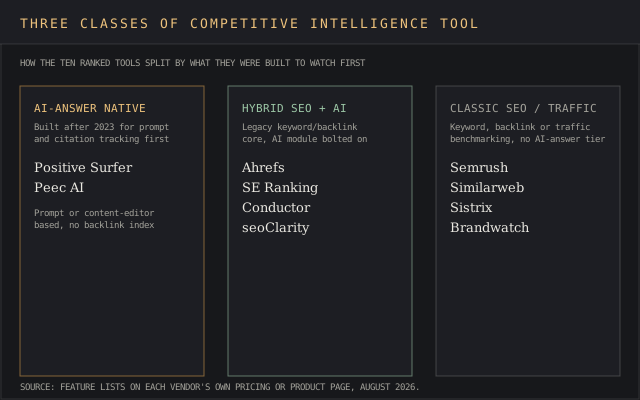
This page ranks ten tools that give SEO and marketing teams a way to watch both surfaces. Some were built for the keyword-and-backlink job and added AI-answer tracking later. Others were built for the AI-answer job first, tracking named AI platforms directly.
None of the ten is a general market intelligence or business intelligence tool built for sales teams tracking a rival's funding round or headcount; each one answers a narrower question: where does a brand show up when someone searches, or asks an AI, a question in this category.
The list covers self-serve platforms with published or vendor-quoted pricing. It excludes internal BI stacks and agency-only tools with no public entry point. Every price, tier limit and feature count here comes from the vendor's own pricing or product page, linked at first mention, so a buyer can verify a number before a sales call.
Who this is for: an in-house SEO lead justifying a tool budget with a number, an agency picking a stack for client reporting, or a content team working out if a competitor's AI-search visibility is a fluke or a pattern worth reacting to.
The table above ranks the top competitive intelligence tools by entry price, AI-answer coverage and competitor caps. Treat it as a shortlist to start from. Check a vendor's own pricing page against a team's specific stack before buying.
Positive Surfer's Standard tier price, the lowest entry rate among the ten tools ranked here that bundles AI-answer tracking with a content workflow.
This ranking sits next to two related pages. Competitive intelligence tools covers battlecards, competitor change detection and filings research beyond the SEO and AI-search question this page answers. Digital marketing intelligence tools covers a wider marketing-measurement stack that several of these ten vendors also sit in.
Buy from one framing or the other for a single job; picking both means paying twice for overlapping coverage. Trying to cover both frameworks at once is having your cake and eating it too.
Evaluation criteria for SEO competitive intelligence tools
Five criteria decide the shortlist, and the ranking below applies them in this order, based on which capabilities show up on a vendor's own pricing page. Each one is a test a buyer can run against a vendor's own pricing page and get a yes, a no, or a number back. That beats a marketing claim taken on faith.
Entry-tier monthly price
The lowest self-serve monthly rate a buyer can pay without a sales call. Eight of the ten tools here publish one; Conductor and, on dollar terms, Peec AI don't.
AI-answer surfaces named on the pricing page
Named AI platforms: Does the vendor list specific platforms it tracks, such as ChatGPT, Perplexity, Google AI Overviews or AI Mode, at the entry tier? Marketing copy that says "AI search" without naming a platform doesn't pass this test. A tool that only claims to monitor major AI platforms in general, without saying which AI responses it parses, doesn't pass either. A named platform list is a fact a buyer can check, and on this test, talk is cheap without one.
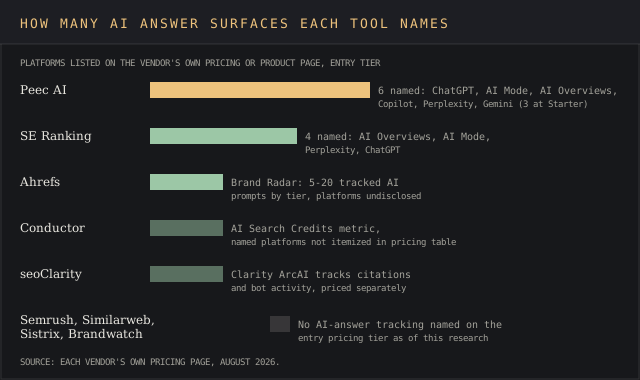
Peec AI names six AI surfaces on its own pricing page, more than any other tool ranked here, though its Starter tier only tracks three of them at once. Ahrefs and seoClarity track AI citations without itemizing which platforms feed the count on their pricing tables, which is why the chart above marks them as a partial pass.
Competitors tracked per project at entry tier
The published cap on how many rival domains or brands a buyer can benchmark against before paying for a higher tier. A vendor advertising "unlimited" is still making a testable claim, since a buyer can add competitors until told to stop.
Historical or backlink data depth
How far back a tool's own data reaches at the entry tier, since competitive analysis without history can't show if a rival's current position is new or a decade old.
API or data-export access
API and data-export access: Does the entry tier include programmatic export, and does the vendor publish a rate limit, row cap or credit allowance for it? A published limit signals real data coverage a buyer can plan around; an unpublished one means the number behind a dashboard can't be checked. The devil's in the details, since an unpublished limit is exactly the kind of detail a buyer finds out about the hard way.
The 10 best competitive intelligence tools for SEO and AI search
Positive Surfer
Best fit
Teams that want AI-answer visibility tracking bundled into the same subscription as their SEO content workflow, at a lower entry price than Ahrefs or Semrush.
Positive Surfer tracks brand visibility across five named AI surfaces, ChatGPT, Perplexity, Google AI Mode, Google AI Overviews and Gemini, starting on its Standard plan at $99 a month billed yearly, per Surfer's own pricing page. The company rebranded from SurferSEO after Positive Group's acquisition; Positive also owns User.com and Iconosquare, per the same pricing page.
Surfer's core product started as a content-optimization tool, distinct from a keyword-and-backlink database, and it still doesn't track backlinks at all, a real gap against Ahrefs or Semrush.
A separate AI Search Analytics plan starts at $158 a month for 100 daily-refreshed prompts across the same five AI platforms, sold without the content-editor bundle, for teams that want AI-answer tracking alone. Surfer markets that tier for teams that want that data feeding a reporting workflow.
Surfer holds a 4.8-of-5 rating across 546 reviews on G2 and a 4.9-of-5 rating across 422 reviews on Capterra. Consistent ratings across two review platforms suggest Surfer hits the nail on the head for teams that want AI tracking without extra software.
Key features
- AI Tracker covering ChatGPT, Perplexity, Google AI Mode, AI Overviews and Gemini, refreshed daily from the Pro tier up.
- Content Editor with a real-time Content Score built on an analysis the vendor says covers 500+ web and AI ranking signals.
- Topical Map for content-cluster planning and coverage-gap detection.
- Content Audit with ranking-drop alerts and quick-win article scoring.
- Cannibalization Report and 1-click internal linking from the Pro tier up.
- API access and unlimited brand workspaces at the Peace of Mind tier.
Pricing
Discovery is $49/mo with no AI-answer tracking, Standard $99/mo with 25 AI prompts refreshed weekly across ChatGPT, Pro $182/mo with 50 prompts refreshed daily across all five surfaces, and Peace of Mind $299/mo with 100 prompts, API access and a dedicated Customer Success Manager, all per Surfer's pricing page.
Check current pricing
See Surfer's Standard plan and pricing
Standard runs $99/mo billed yearly with 25 AI prompts refreshed weekly, one of five published tiers from Discovery to Enterprise.
 See Surfer pricing →
May earn a commission if you sign up through this link, at no extra cost to you. Full affiliate disclosure.
Pros
- AI-answer tracking across five named platforms ships at the $99 Standard tier, undercutting Ahrefs' and Semrush's entry price for a comparable bundle, putting Surfer ahead of the curve on value at that tier.
- WordPress and Google Docs integrations ship at every paid tier, including the cheapest one.
- Content Editor's live scoring is a repeated pro in Capterra reviews for cutting the guesswork out of briefing writers.
Cons
- No backlink index or keyword-rank database, so it can't replace a dedicated SEO platform for domain-level competitor research.
- Document and content-audit credits draw from one monthly pool; a Capterra reviewer said the $99 plan's 30 documents run out before the billing cycle resets.
- AI-answer tracking below the Pro tier updates weekly and covers ChatGPT only, one of the five tracked platforms.
"Surfer makes competitive intelligence research far more accessible, quicker, and comprehensive. I can see the top-ranking contents' stats to produce more relevant, comprehensive, and better content."
Riley A., Entrepreneur, Financial Services, Capterra, July 5, 2021
Why it's ranked #1. Surfer's $99-a-month Standard tier bundles AI-answer tracking across five named platforms with its content workflow, giving a team the best of both worlds on a single subscription, undercutting Ahrefs' $129 and Semrush's $139.95 entry price for a comparable AI-visibility bundle, though it carries no backlink index to match. See the full Positive Surfer vs Semrush comparison for how the two handle AI-answer tracking and pricing.
Ahrefs
Best fit
Teams that want backlink-level competitor detail plus AI-answer tracking bundled into the same subscription.
Ahrefs built its name on backlink data and has kept that lead into the AI-search era with Brand Radar, which researches any brand across a database the vendor says covers 271 million-plus organic prompts.
The Lite plan starts at $129 a month with 6 months of historical data, 750 tracked keywords and 5 tracked AI prompts updated daily. Competitive research sits inside Site Explorer, which runs content-gap and domain-comparison reports against up to 20 competitors per project.
Key features
- Site Explorer backlink and organic-keyword competitor comparison.
- Brand Radar AI-prompt tracking, 5 to 20 tracked prompts by tier.
- Content Explorer for competitor content and mention tracking.
- Rank Tracker covering 750 to 10,000+ keywords by tier.
Pricing
Lite is $129/mo, Standard $249/mo, Advanced $449/mo, and Enterprise starts at $1,499/mo with an annual commitment, all per Ahrefs' own pricing page. Additional users cost $40 to $100 a month depending on tier, and the Ahrefs pricing report adds up seats and add-ons.
Pros
- Content-gap analysis is a named strength in independent user reviews.
- AI-prompt tracking ships at every tier as a built-in feature.
Cons
- Reports consume credits fast on deep competitor backlink pulls.
- A billing dispute over blocked account access added fuel to the fire, drawing a 0-star G2 review naming Semrush as a smoother alternative.
"It's competitor Semrush provides better insights on AI search, so Ahrefs data looks polluted and does not give insights on what query a user searched or is searching around a particular topic."
Rachit S., Digital Marketing, Small-Business, G2, July 31, 2026
Why it's ranked #2. Ahrefs pairs a decade-plus web index with AI-prompt tracking at every tier for $129 a month, beating Semrush's $139.95 plan on cost and named AI coverage, though Surfer's $99 Standard tier undercuts Ahrefs' price for a comparable AI-visibility bundle.
Semrush
Best fit
Teams that want SEO, PPC and AI-answer competitive research under a single login.
Semrush runs a self-serve entry tier at $139.95 a month, with Enterprise sold on custom terms. The company also ships a dedicated AI Visibility Toolkit, a named product on its own site alongside long-standing tools like Organic Research and Keyword Gap.
Adobe agreed to acquire Semrush in a deal reported at over $1.9 billion in cash, a scale signal for a platform competitors size themselves against; buying AI-answer tracking on Semrush still means a separate subscription line.
Key features
- Organic Research and Keyword Gap for competitor keyword comparison.
- Position Tracking across desktop and mobile search results pages.
- A named AI Visibility Toolkit for AI-search tracking.
- Traffic Analytics for market-share style competitor benchmarking.
Pricing
Pro is $139.95/mo ($117.33/mo annual), Guru $249.95/mo ($165.17/mo annual), Business $499.95/mo ($455.67/mo annual), and Enterprise is custom, per Semrush's pricing page. That climb from Pro to Business can cost a growing team an arm and a leg before Enterprise pricing even enters the conversation.
Pros
- One subscription covers SEO, PPC, content and social competitor research.
- The AI Visibility Toolkit extends the same competitor list into AI-answer tracking.
Cons
- "Many features come as add-ons and each has its own price, which can add up quickly," per a G2 reviewer.
- No automatic subscription-cancellation flow, a recurring complaint in reviews.
"There are many tools, but they are spread across different subscriptions... If you wanna get AI rankings, you have to buy different subscription."
George G., AI GTM Engineer, Small-Business, G2, June 29, 2026
Why it's ranked #3. Semrush's $139.95 entry price trails Ahrefs' $129 and its AI toolkit costs extra, but its combined SEO-and-PPC scope beats SE Ranking's narrower feature set at a similar price point. See the full Semrush vs Similarweb comparison for how the two price traffic data against keyword data.
SE Ranking
Best fit
Teams that want AI-answer competitor tracking built into the base plan without paying Ahrefs or Semrush entry prices.
SE Ranking prices its Core plan at $129 a month ($103.20 on annual billing) and names four AI-answer surfaces directly on its pricing table: AI Overviews, AI Mode, Perplexity and ChatGPT, tracked at up to 100 prompts a day against 5 AI-competitor domains.
An Agency Pack add-on at $69 a month layers white-label reporting and a separate "SE Visible" dashboard for brand-mention tracking on top of that base toolkit. Bundling AI-answer tracking and keyword-rank data into that one Core plan kills two birds with one stone for a team not ready to pay Ahrefs' or Semrush's entry price.
Key features
- AI Overviews, AI Mode, Perplexity and ChatGPT competitor tracking at Core.
- 2,000 to 5,000 daily-tracked keywords by tier.
- Unlimited keyword, competitor and backlink research on both self-serve tiers.
- MCP server access included at Core.
Pricing
Core is $129/mo ($103.20/mo annual), Growth $279/mo ($223.20/mo annual), and Enterprise is custom, per SE Ranking's pricing page.
Pros
- Keyword and ranking data reads close to Ahrefs and Semrush at a lower monthly cost, per G2 reviewers.
- AI-answer competitor tracking ships at the $129 Core tier, SE Ranking's base plan.
Cons
- "Cost is always an issue with SEO tools... which always seem to increase over time," per a G2 reviewer.
- 5 AI-competitor domains at Core is a hard ceiling for agencies running more accounts.
"Keyword and ranking data feel surprisingly close to tools like Ahrefs and Semrush, but without the heavy monthly cost."
Sneha G., Community Manager, Small-Business, G2, May 11, 2026
Why it's ranked #4. SE Ranking matches Ahrefs' $129 entry price and names four AI-answer surfaces on its own pricing table, but its 100-prompts-a-day cap trails Peec AI's AI-answer-only depth, which keeps it below Semrush's broader toolkit and above Peec AI's narrower scope.
Peec AI
Best fit
Teams that need AI-answer competitive intelligence without a full keyword-rank-tracking platform.
Peec AI is built for one job: tracking how often a brand and its named competitors get recommended across ChatGPT, Perplexity, Google AI Mode, AI Overviews, Copilot and Gemini. The vendor's own site lists tiers by prompt volume: Starter tracks 50 prompts a month across 3 chosen models, Pro raises that to 150 prompts, and Advanced to 350 prompts across still 3 models.
Enterprise unlocks all listed models and unlimited prompts on custom terms. The company doesn't publish per-tier dollar pricing on its own marketing page.
Peec AI carries a G2 rating of 4.8 out of 5 across 18 reviews, filed under G2's Answer Engine Optimization category. Ahrefs, Semrush and SE Ranking sit in G2's general SEO Tools category. That separate filing puts Peec AI off the beaten path compared with the general SEO Tools bucket the other three share.
Key features
- Daily prompt tracking across ChatGPT, Perplexity, AI Mode, AI Overviews, Copilot and Gemini.
- Citation Gap Analysis and "Power Sources" domain identification per category.
- Competitor benchmarking by share of voice, sentiment and ranking position per prompt.
- MCP integration for pulling visibility data into other tools.
Pricing
Starter tracks 50 prompts/mo, Pro 150 prompts/mo, Advanced 350 prompts/mo, and Enterprise is custom with unlimited prompts and up to 11 tracked models, per Peec AI's pricing page; the vendor doesn't publish dollar figures for each tier on that page.
Pros
- The MCP integration was the deciding factor for at least one G2 reviewer over rival AEO tools.
- Setup takes minutes, according to multiple G2 reviews, letting a new team hit the ground running.
Cons
- Lower tiers cap tracked models at 3 of the 6 or more listed.
- No classic keyword-rank tracking, so it can't replace an Ahrefs or SE Ranking subscription.
"Only that I have to still rely on Semrush for Prompt volume research... Platforms such as Semrush show outdated data."
Chaitanya M., VP Growth, Small-Business, G2, July 20, 2026
Why it's ranked #5. Peec AI names 6 AI-answer surfaces against SE Ranking's 4, but its lack of any keyword-rank database drops it below SE Ranking and above Similarweb, whose $199 entry price buys traffic data Peec AI doesn't track at all.
Similarweb
Best fit
Teams that benchmark market share, traffic sources and ranking positions across competitors.
Similarweb's Starter plan is $199 a month, per the site's own pricing breakdown sourced from Similarweb's pricing page and Vendr's contract data, with Vendr's tracked median contract sitting at $37,800 across 157 purchases, a wide gap above the self-serve rate. For many buyers, that $37,800 median contract ends up costing an arm and a leg next to the advertised $199 entry rate.
Competitive benchmarking is the platform's core use case: Similarweb estimates traffic by source against named competitors, a workflow one G2 reviewer credited with cutting research time by roughly half, though another flagged estimated traffic as a recurring credibility question with company leadership. Our clickstream data providers ranking puts Similarweb first and details the 10 billion digital signals a day the company says it collects.
Key features
- Traffic-source competitive benchmarking (organic, paid, direct, referral).
- Market-share estimates by industry and competitive set.
- App-download tracking for iOS and Android competitors.
- Keyword-gap analysis layered onto traffic-source data.
Pricing
$199/mo Starter (about $125/mo billed annually), Team around $14,000/yr, Business around $35,000/yr, against a $37,800 Vendr median contract, per Similarweb's pricing page and Vendr's marketplace data.
Pros
- Cuts competitor-research time meaningfully, per a G2 reviewer citing a roughly 50% reduction.
- Covers traffic and app-download competitive data most keyword tools don't track.
Cons
- Traffic figures are estimates, and accuracy questions recur in user reviews.
- The jump from $199 Starter to five-figure Team and Business tiers is steep.
"Similarweb estimates traffic data which immediately raises questions among leadership when none of the data within Similarweb can be verified."
Louie B., Marketing Assistant, Mid-Market, G2, July 29, 2026
Why it's ranked #6. Similarweb's $199 entry price sits above Peec AI's prompt-based tiers but its traffic and app-download benchmarking covers ground none of the tools above it touch, raising the bar on traffic-and-app data ahead of Conductor's usage-based, quote-only pricing. See the full Semrush vs Similarweb comparison for how traffic-share data prices against keyword-and-AI data.
Conductor
Best fit
Enterprise teams that want AEO and SEO reporting on one platform with unlimited users.
Conductor prices by usage, splitting its platform into Essentials, Growth and Enterprise tiers with no public dollar figure on any of them. Essentials tracks 500 keywords and 5 competitors; Growth raises that to 5,000 tracked keywords, 25 tracked competitors and 2,500 AI Search Credits a year; Enterprise scales to 60,000-plus tracked keywords and 75-plus tracked competitors, per Conductor's own pricing page.
The platform pitches itself as an "AEO + SEO" suite, and every tier includes unlimited users, unlike per-seat pricing at Ahrefs or Semrush. G2 reviewers who switched from Semrush describe the transition as smoother than expected, though one flagged a workflow bug around ampersands in topic names silently returning empty results.
Key features
- Conductor Intelligence for AEO and SEO performance reporting.
- Website Monitoring covering 100,000 to unlimited pages by tier.
- Conductor Creator for AI-assisted content drafts, 60 to 600 drafts a year by tier.
- Unlimited users included at every tier.
Pricing
Essentials, Growth and Enterprise are all usage-based, priced around keyword, competitor and page volume; no tier publishes a dollar figure, per Conductor's pricing page. A buyer has to read between the lines to estimate real cost before ever reaching a sales call.
Pros
- Unlimited users at every tier removes the per-seat cost growth other tools carry.
- Named enterprise customers include Microsoft, Verizon, American Express and PayPal.
Cons
- No public pricing makes budget planning harder before a sales call.
- Entry tier's 500 tracked keywords and 5 tracked competitors is thin for larger sites.
"We're running 88+ topics across three different web properties and it stays organized."
Timmy D., SEO Manager, Enterprise, G2, October 27, 2025
Why it's ranked #7. Conductor scales from 5 to 75-plus tracked competitors across its tiers, beating Similarweb's fixed traffic-benchmarking scope, but its lack of any public price puts it behind Similarweb's published $199 entry rate and ahead of seoClarity's $2,500 floor.
seoClarity
Best fit
Enterprise SEO teams that want a dedicated Client Success Manager bundled with the platform.
seoClarity splits pricing into four custom-quoted modules, from Research & Content at $2,500 a month up to a bundled Enterprise tier from $4,500 a month, per seoClarity's own pricing page. Every package includes a dedicated Client Success Manager and unlimited users on the Rankings module, going the whole nine yards on support most tiers at this price don't bother matching.
The platform's AEO layer, Clarity ArcAI, tracks brand citations and mentions in AI search and monitors AI bot activity against a site, positioning seoClarity alongside Conductor as an enterprise-first AEO-plus-SEO platform.
Key features
- Rankings module with unlimited competitors and interactive rank tracking.
- Clarity ArcAI for AI-search citation and mention tracking.
- Research Grid keyword database with backlink, search-volume and SERP-feature data.
- Content Fusion AI writer running 25 to 50 analyses a month by tier.
Pricing
Research & Content starts at $2,500/mo, Technical SEO at $3,200/mo, and Enterprise at $4,500/mo, all custom-quoted based on domains and keywords tracked, per seoClarity's pricing page.
Pros
- Lower price and better support than Conductor or BrightEdge, per a G2 reviewer who used all three.
- Unlimited competitors on the core Rankings module, no per-competitor ceiling.
Cons
- Access is often limited to a brand's own keyword sets, weakening head-to-head competitor comparisons, per a G2 reviewer.
- Data exports need manual cleanup before they're useful, per a Senior Manager reviewer.
"Sometimes the data exports require a bit of manipulation to get them to be useful. The advanced features need a lot of fine tuning to get them to be genuinely useful."
Ash N., Senior Manager SEO & AI Discovery Lead, Enterprise, G2, February 25, 2026
Why it's ranked #8. seoClarity's unlimited-competitor Rankings module beats Conductor's tiered competitor caps, but its $2,500 monthly floor puts it below Conductor's usage-based entry point and above Sistrix's €119 self-serve rate. That $2,500 monthly floor is a reminder that money doesn't grow on trees for a team sizing up enterprise SEO budgets.
Sistrix
Best fit
Teams benchmarking organic visibility in DACH and European markets against named competitors over time.
Sistrix has run its Visibility Index for 18 years, a metric the vendor built to measure a domain's search presence based on traffic and keyword positions. The Start plan runs €119 a month, with a Plus tier at €239 a month, per Sistrix's own pricing page. The company reports adding AI and LLM visibility tracking alongside the existing Index in recent product updates.
G2 reviewers rate the platform 4.4 out of 5 across 20 reviews, with the Visibility Index repeatedly cited as the feature that makes client pitches easy to understand at a glance.
Key features
- Visibility Index for historical organic-search benchmarking.
- Competitor comparison by directory, URL segment or whole domain.
- Keyword research with search-volume data Google's own planner tends to group.
- Recently added AI and LLM visibility and entity-analysis tracking.
Pricing
Start is €119/mo plus tax, Plus is €239/mo plus tax, and Enterprise pricing is quoted, per Sistrix's pricing page.
Pros
- The Visibility Index graph is a named strength for winning new client pitches, per multiple G2 reviewers.
- Historical data goes deep enough to leave no stone unturned when explaining the impact of a specific Google core update.
Cons
- "The backlink data is sadly one thing that is not as good for example in ahrefs or majestic seo," per a CEO reviewer.
- Pricing is a stated barrier for freelancers, per a G2 review.
"Sistrix makes it easy to compare organic search visibility historically for websites, directories of websites or specific URL segments. It's great to see what keywords my own or competitor's websites drive SEO success and where a site has gaps."
Jolle L., SEO Consultant, Small-Business, G2, January 16, 2024
Why it's ranked #9. Sistrix's €119 entry price undercuts seoClarity's $2,500 floor by a wide margin, but its regional focus and thinner backlink data than Ahrefs or Majestic put it below seoClarity's enterprise scope and above Brandwatch's social-first positioning.
Brandwatch
Best fit
Teams that want social-listening signal layered onto competitive benchmarking, beyond what a keyword-rank tool alone provides.
Brandwatch's published Essentials rate is $108 a month for individuals and small teams, per the site's own Brandwatch pricing breakdown. Buyer-reported figures put a 3-seat listening-and-reporting package around $12,000 a year, and Vendr's tracked median contract across 40 purchases sits at $50,000, a gap that reflects Brandwatch's positioning as a consumer-and-competitive-intelligence suite.
Set against that $50,000 median, the $108 entry rate looks like a drop in the bucket next to what a real contract runs.
Cision acquired Brandwatch in a deal reported at $450 million, closed in 2021.
Competitive benchmarking runs through named-competitor share-of-voice tracking across social and web mentions, distinct from keyword-gap analysis but complementary to it for brands tracking how a competitor's campaigns land.
Key features
- Named-competitor share-of-voice tracking across social platforms.
- Sentiment analysis on brand and competitor mentions.
- Consumer Intelligence module for market and audience research.
- Boolean-query-based listening for advanced monitoring setups.
Pricing
Essentials starts at $108/mo; listening-and-reporting packages run toward $1,000/mo and up, with buyer-reported annual contracts from roughly $12,000 to a $50,000 median across 40 tracked purchases, per the site's Brandwatch pricing research.
Pros
- Share-of-voice tracking covers competitor campaigns keyword tools can't see.
- Both individuals and enterprise buyers can access an Essentials tier.
Cons
- A steep learning curve for advanced Boolean queries and dashboard customization, per G2 reviewers.
- "So expensive, and the initial setup was not easy or clear," per a G2 reviewer on the pricing jump above Essentials.
"One of our KPIs is views, but Brandwatch only shows impressions, which limits tracking and analysis according to our needs."
Rene M., Digital Marketing Expert, Enterprise, G2, May 12, 2026
Why it's ranked #10. Brandwatch's $108 entry price beats Sistrix's €119 rate, but its $50,000 median annual contract and social-first focus put it behind Sistrix's SEO-native scope on this list. The gap between an eye-catching entry price and a five-figure real contract is par for the course across several tools on this list.
SEO ranking data versus AI-answer visibility: two different signals
Classic SEO competitive intelligence answers a narrow question: where does a page rank, and which competitor pages outrank it, for a given keyword. Ahrefs, Semrush, SE Ranking, Similarweb and Sistrix all built their core products to answer that question, and each publishes a keyword or backlink database a buyer can inspect before paying. Our website traffic analysis tools ranking scores four of these five on a separate job: estimating a rival's traffic.
AI-answer visibility asks something different: when a user asks an AI Overview, ChatGPT or Perplexity a question in this category, does it name your brand, a competitor's, or neither. The answer sits inside a generated response the user never has to click through to a website to read, so a ranking report that only counts blue links misses that answer entirely.
Surfer and Peec AI are built primarily around that question, tracking named AI platforms directly, with Surfer layering a content-editor and keyword workflow on top. Conductor and seoClarity sit in the middle, running a classic rank-tracking core plus a named AI-visibility module (Conductor Intelligence and Clarity ArcAI) inside the same subscription.
Where the entry-price spread breaks down
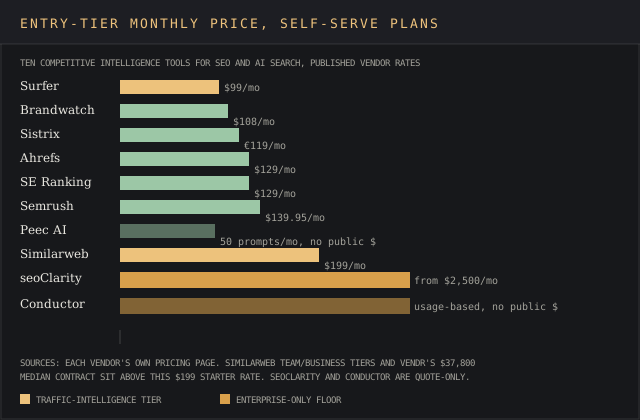
Surfer's $99 entry price and seoClarity's $2,500 floor sit at opposite ends of a real market. The self-serve cluster, Surfer through Semrush, runs $99 to $139.95 a month and targets individuals and small teams who can put a card on file without a procurement process. Similarweb's $199 rate sits just above that cluster before jumping to five-figure Team and Business tiers.
Conductor, seoClarity and Peec AI on dollar terms skip the self-serve entry point and quote by usage instead, roughly tracking company size: a three-person agency can't practically evaluate seoClarity's $2,500 floor, and a Fortune 500 team has little reason to run its intelligence through a $99 Surfer account.
That price ladder tracks a broader market trend: as AI answer engines pull query volume away from classic blue links, marketing strategies built only on keyword rank now need a tool that also reports on AI-answer citations and historical SERP positions.
Ahrefs versus Semrush: the pair buyers compare most
Ahrefs and Semrush is the comparison buyers run most before picking a tool, and the gap between the top two on classic SEO features is narrow, closer to a hair's breadth than a real lead. Ahrefs' $129 entry price undercuts Semrush's $139.95, and Brand Radar's AI-prompt tracking ships bundled at every tier, where Semrush's AI Visibility Toolkit is a separate named product.
Semrush's advantage is breadth: one login covers organic and paid search, social, content and competitive research, a scope Ahrefs doesn't match on its own pricing page, giving a team running SEO alongside PPC a real reason to prefer Semrush even at the higher price.
Turning the numbers above into a decision
None of the numbers above are information a team can act on by themselves. A screenshot of Ahrefs' Brand Radar or SE Ranking's AI Overview tracker becomes useful only once someone lines it up against the brand's own numbers and asks where the gap sits. The five criteria above turn scattered competitor data into a repeatable process: check entry price, check named AI surfaces, check the competitor cap, check the historical depth, check the export limit, then decide.
The approach works for both a $99 Surfer account and a $2,500 seoClarity subscription: pull the same prompt or keyword set on a schedule, log which domain shows up, and treat a two-week change as signal.
Dedicated tools exist so that logging step doesn't happen by hand in a spreadsheet. A prompt-by-prompt citation log or a keyword-by-keyword rank history is the part a general BI dashboard can't replicate without the same crawl or prompt-running infrastructure underneath it. Doing that work by hand turns a real signal into a needle in a haystack buried inside a spreadsheet.
Common mistakes when buying a competitive intelligence tool for SEO
The most common mistake is buying for the keyword-rank job and assuming AI-answer tracking comes along for free. Four of the ten tools ranked here name no AI-answer platform on their own pricing page. A buyer who needs both signals has to check for that explicitly; assuming it is how budgets get wasted.
Traditional SEO tools were never built to measure AI-search visibility, so a team running only classic rank data can't see that second signal moving in the opposite direction. Surfer, Peec AI, SE Ranking and Ahrefs' Brand Radar are the ones that publish a number for it; the rest still function as traditional SEO tools with an AI label added to the pricing page.
Ask a vendor to name the specific AI platforms it tracks and the refresh cadence, in writing, before signing. "AI search" without a named platform list, or a refresh cadence measured in weeks, is the gap that shows up after the contract is signed. It stays hidden until then.
The second mistake is comparing entry prices without comparing competitor caps. SE Ranking's Core tier tracks 5 AI-competitor domains for $129 a month; Conductor's Growth tier tracks 25 competitors on usage-based pricing with no published dollar figure. A raw price comparison between the two misses the point, since it skips the real unit cost per competitor tracked.
The third is skipping the data-export check. A platform without API access or a published export limit turns into a dashboard a team has to manually re-key into its own reporting.
Adjacent categories this list doesn't cover
This list stops at SEO and AI-search competitive intelligence on purpose, skipping the jack-of-all-trades approach that would try to cover sales enablement and social listening too.
Sales teams tracking a rival's headcount or funding round need a sales enablement platform built for that job, a different category from a keyword tool. Brand and social teams running social media management already have a listening queue of their own; Brandwatch, ranked tenth here for its social-listening signal, is the one tool on this list that overlaps with that category at all.
None of the ten publish seat-level admin controls as a headline feature. Role controls are a sales-enablement and social-platform staple, a category SEO buyers rarely shop on. Brand presence, in the sense this list measures it, is share of AI citations and search rankings. A social dashboard's follower counts and engagement rate measure something else entirely.
Frequently asked questions
What is competitive intelligence for SEO?
Tracking a named set of competitors across the same signals a brand tracks for itself: keyword rankings, backlink profiles, traffic share and if AI answer engines like ChatGPT or Google's AI Overviews cite the competitor over the brand.
How is AEO different from SEO competitive intelligence?
Answer engine optimization tracks if an AI system names a brand in a generated answer. Blue-link ranking position is a separate question entirely. A tool can win on classic SEO competitive intelligence and still say nothing about AI-answer visibility unless it explicitly tracks AI platforms, as Peec AI, SE Ranking, Surfer and Ahrefs' Brand Radar do.
What are the best SEO/AEO intelligence tools for a small team?
Surfer's $99 Standard tier, SE Ranking's Core plan and Ahrefs' Lite plan all bundle AI-answer tracking into a sub-$130 monthly entry price; Surfer is the cheapest of the three, while Ahrefs adds a decade-plus backlink database on top for $30 more a month.
Is there a free tool for competitor analysis?
None of the ten platforms ranked here run a fully free tier; Ahrefs offers a limited free account for verified site owners, and most vendors on this list run a short free trial instead.
How do you track which AI responses cite a competitor?
Ahrefs' Brand Radar, Peec AI's Citation Gap Analysis and Surfer's AI Tracker all handle this by running the same prompt against ChatGPT, Perplexity, Google AI Mode or AI Overviews on a schedule and logging which domains the responses name. Tracking this way needs prompts run on a recurring basis, daily on the tiers named above, since an AI response to the same question can change week to week.
Is a competitive intelligence tool for SEO the same as a market research tool?
No. General market research platforms track funding rounds, hiring and company filings across an entire market. The ten tools ranked here do a narrower job: track keyword rankings, backlinks and AI-answer citations for a specific set of competitor domains, a technical slice of competitive intelligence.
Bottom line
Surfer leads this list on price and AI-answer coverage together: $99 a month buys tracking across five named AI platforms bundled with a content workflow, undercutting Ahrefs and Semrush for that specific combination, though it can't replace either on backlink depth, since it was never built to be a jack of all trades covering backlinks too.
Ahrefs and Semrush still cover the most ground for a team that needs classic keyword-and-backlink data alongside AI-answer tracking, at $129 to $139.95 a month.
Brandwatch's Vendr-tracked median annual contract across 40 purchases, against its published $108-a-month Essentials rate. The gap between an entry price and the median contract a buyer signs affects Brandwatch and several other tools on this list.
Teams that only care about the AI-answer question and don't need keyword-rank tracking are better served by Peec AI, which tracks more named AI platforms than Surfer at low prompt volumes, without any content-editor bundle attached. Enterprise teams juggling both signals at scale should look past the self-serve cluster entirely, toward Conductor or seoClarity, where unlimited seats and dedicated support offset a five-figure annual price with no public rate card.
Entry price, named AI surfaces, competitor cap and export limits are the numbers that turn a marketing page into a decision in place of a claim to take on faith. Everyone else, from a solo consultant running Sistrix's €119 Start plan to an agency layering Brandwatch's social signal on top of a keyword tool, should pick based on which single signal, ranking position, traffic share or AI citation, drives the next client report.