SISTRIX review: the Visibility Index, a 2024 price rise and a DACH-first data set
 By Jan Suski. I go deep on every review, checking every number against its source and digging up details other coverage misses, a habit from six years of SEO and link building for tech companies. Bylines at Surfer, Brand24, and Senuto. How the scoring works.
Best for
SEO professionals and digital marketing agencies tracking Google visibility in Germany, Austria, Switzerland and the 10 other daily-updated markets, who want 18 years of German ranking history behind every chart.
Not for
Solo site owners on a tight budget, US-only teams that need deep backlink data, and anyone who wants traffic or revenue estimates. The index measures rankings, and the Start plan keeps 3 months of history.
What it costs
€119 to €799 a month plus taxes* (about $133 to $896), invoiced in euros only, after a 2024 increase of 20% on three plans and 33% on Premium.
- Start
- €119 a month, 1 user, 3 months of data history
- Plus
- €239 a month, 3 users, 5 years of history
- Professional
- €419 a month, 6 users, full history, full API
- Premium
- €799 a month, 12 users, roles and audit log
- 2024 increase
- Start rose from €99, Premium from €599
- Extra user
- €24.90 a month, Plus and above only
- Trial
- 14 days per the pricing FAQ, 7 days per the trial FAQ
- Keyword set
- 1 million keywords per country, 100 million data points
- Countries
- 52 listed, 13 updated daily on desktop and mobile
- Oldest data
- Germany since 25 February 2008, US since 31 January 2011
- Domains indexed
- more than 100 million
- Keyword database
- 450 million keywords across all countries
- Link data
- SISTRIX crawl plus Majestic data
- AI Check
- six AI systems, free during beta
- Prompt Research
- 62 million user questions in 1.4 million topics
- Crawl budget
- 30,000 URLs a month on Start, 4 million on Premium
- G2
- 4.4 out of 5 from 20 reviews
- Capterra
- 4.5 out of 5 from 14 reviews
- Trustpilot
- 3.0 out of 5 from 12 reviews, half of them one-star
Semrush
Not forDACH visibility trends on one scale back to 2008, which only SISTRIX's German index covers.
Advanced Web Ranking
Not forChecking domains you don't track yourself; SISTRIX covers 100 million with no setup.
Pairs well with SISTRIX
Sources for the facts above
Prices, plan limits, crawl budgets and the AI beta footnote come from the SISTRIX pricing page, read 16 October 2026; the 2024 prices from Wayback captures. Index figures come from the calculation page, the keyword count from a SISTRIX FAQ and the AI tools from the Q3 2026 changelog. Ratings are as listed on G2, Capterra and Trustpilot in October 2026.
SISTRIX is a German SEO software suite built around one number: the SISTRIX Visibility Index, a weighted score of how often a domain ranks in Google for a fixed set of 1 million keywords. SISTRIX GmbH runs it from Bonn, with Johannes Beus as managing director, and the company says it invented the index in 2008.
This SISTRIX SEO tool review covers the full SISTRIX toolbox as sold in October 2026: how the index is calculated, which countries get daily data, keyword research, the backlink index, the Optimizer module, content tools, the new AI visibility features and the price table.
It also covers the parts the sales page skips, and they matter now for anyone renewing or switching a seo tool this year: prices went up 20% to 33% in 2024, invoices are euro-only, and Google's September 2025 changes made rank data harder for every tool to collect.
It's written for SEO professionals choosing between the SISTRIX SEO suite and other SEO tools such as Semrush, and for agencies that already report a "visibility" number to clients. Twenty user quotes from 15 reviewers on Capterra, Trustpilot and Hacker News carry the strengths and the complaints.
The timing matters for one reason: SISTRIX is now the closest living relative of the Searchmetrics visibility score, after Searchmetrics was folded into Conductor and its product shut down in February 2023. Teams who lost that metric, and the SEO strategy built on it, are the most likely SISTRIX buyers this year, and SEO professionals running international SEO programs across Europe are the second group.
What the SISTRIX toolbox includes in 2026
The SISTRIX toolbox now groups every tool into five areas in one navigation menu, a layout SISTRIX shipped in its Q3 2026 changelog. Before that, Google, Amazon and AI/chatbot tools sat in separate views a user had to switch between.
- AI Search: AI Check, Prompt Tracking and Prompt Research
- SEO: Domain Check, Keyword Analysis, Movers & Shakers, Onpage Check and Rank Tracking
- Content: Content Assistant, Content Planner and Content Discovery
- Amazon: Products, Sellers and Brands
- Workspace: Projects, Dashboards, Reports, Lists and API
All four plans include the Visibility Index, keyword research, domain analysis, the backlink index, JavaScript and mobile crawling, the Amazon tools and a connection to Google Search Console and Google Analytics, per the SISTRIX pricing grid. SISTRIX offers the content tools from Plus up. Full API access starts at Professional.
Those are the key features on paper. In practice, SISTRIX focuses on one job above the rest: showing how a domain's Google rankings moved, against its competitors, over years. The rest of the SISTRIX SEO suite feeds that chart or sits beside it.
SISTRIX offers the same domain data to every plan, so the cheapest account can run an SEO analysis of any competitor in 52 countries. What changes between plans is history, export volume, users and the API. Each SISTRIX tool below, from the index to the SISTRIX SEO content tools, is judged on what it adds to that core visibility tracking.
How the SISTRIX Visibility Index is calculated
SISTRIX publishes its calculation method in three steps. It collects the top 100 organic Google results for 1 million keywords per country, giving 100 million data points. It weights each ranking by the keyword's search volume and the expected click-through rate at that position, adjusted for search intent. Then it sums every weighted ranking a domain holds.
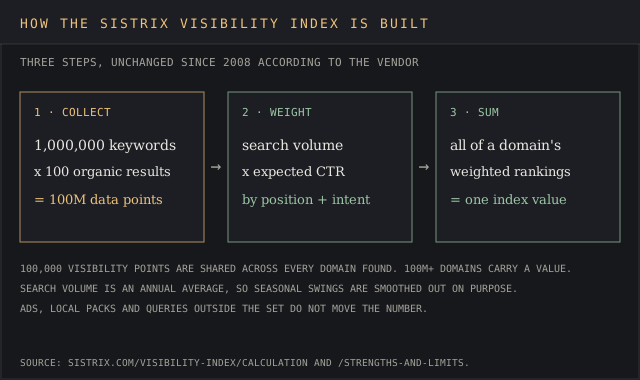
The SISTRIX Visibility Index works the same way for any domain, host, directory or single URL. The vendor states the method hasn't changed since 2008, so a German domain's 2009 value and its 2026 value sit on the same scale. That's the index's main selling point for international SEO teams who report long-run visibility trends, and it's why SISTRIX calls the Visibility Index a "gold standard".
Both claims are the vendor's own, as is the line "There are no synthesised figures in SISTRIX", which positions the index against tools that model traffic.
A few properties of the key metric decide how far you can trust it:
- It measures rankings. SISTRIX says on its strengths and limits page that the index "is not a traffic index and does not want to be one".
- Search volume is an annual average, so seasonal swings in organic traffic don't show up in the number. Seasonal trend analysis belongs in a project's own ranking history.
- Local results for generic queries are ignored, because each index covers a whole country.
- Google Ads positions aren't counted, and SISTRIX says its crawlers run mostly at night.
- Only Google is measured by default; a project index can be pointed at other search engines.
- Keywords outside the 1 million set don't move it, so small niches need a project-level index built from your own keyword groups.
That last limit is the one buyers hit first, and it shapes SEO strategy. A B2B site ranking for 400 long-tail terms can show a flat visibility index while its Google Search Console clicks double, because none of those terms sit in the representative set. The visibility index tracks website visibility in Google search results, and organic traffic is a separate number you'll still pull from Google Analytics.
Conversions and revenue sit outside SISTRIX entirely, so tying a visibility gain to sales needs the Google Analytics connection every plan includes.
For local tracking, SISTRIX points users to a project Visibility Index built from their own keywords, with targeting down to city level. That's the route for regional businesses and for any SEO strategy aimed at a market outside the 52 countries.
What the index does well: algorithm-update analysis
The index earns its keep on Google update days. SISTRIX pins confirmed Google updates to the visibility history chart when a domain's visibility moved at that date, so a drop lines up with a named update. A Capterra reviewer, a manager in the automotive sector writing in October 2022, listed this first among the tool's strengths: "A very helpful tool to perform winner/loser analysis during Google Core Updates using the visibility index."
Third-party winner and loser lists have drawn criticism from inside Google, though. When SISTRIX published its loser list for the February 2011 "Farmer" update, Google's then head of webspam Matt Cutts linked it on Hacker News with a caveat:
"Bear in mind that much of this third-party analysis compares e.g. US queries vs. queries against Google from Canada, Italy, or India, and geolocation can change the results. Also, different people are running different sets of queries and that subsampling can skew things depending on the query sets."
Matt Cutts, Hacker News, 26 February 2011
Fifteen years on, the caveat still holds for competitor analysis across search engines and countries, and for any visibility index built on a sampled keyword set. SISTRIX's answer is consistency: the same keyword set, the same weighting and the same country, measured daily. SISTRIX delivers that history to every plan as a chart, so seo measures such as a migration or a content pruning project show up as a step in the line within a day.
Country coverage, update frequency and data history
The calculation page lists 52 countries with a Visibility Index. Only 13 of them get daily updates with both desktop and mobile data: Germany, the UK, France, Italy, Spain, the USA, Austria, Switzerland, the Netherlands, Poland, Sweden, Brazil and Turkey. The other 39, added between 2018 and 2023, get a mobile-only index updated weekly.
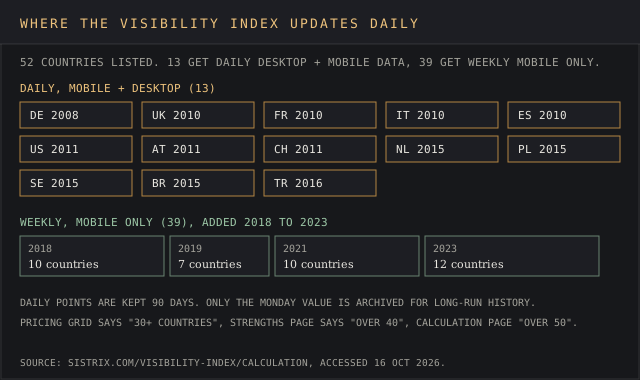
SISTRIX describes this coverage three different ways on its own site. The pricing grid says the index covers "30+ countries". The strengths and limits page says data comes from "over 40 countries". The calculation page says "over 50" and lists 52. The table is the most specific source, so this review uses 52, but the mismatch is the kind of thing a buyer should ask sales to confirm in writing.
How far back historical data goes depends on the country and on your plan, and data depth is where the SISTRIX SEO data separates from younger tools. Germany has rankings back to 25 February 2008, the UK to July 2010 and the US to January 2011. Daily values are kept for 90 days; after that, only Monday's data point is archived.
On the plan side, Start shows 3 months of data history, Plus shows 5 years, and Professional and Premium show what the pricing page labels "Full (11 Years)".
That label is worth a second look. The October 2023 and December 2024 pricing pages described Professional as "data history going back 13 years". The October 2026 page says "over 11 years", while the German index alone runs back 18 years.
The European weighting shows up in reviews. A Capterra reviewer, a digital strategist writing in June 2022, rated the tool 3 out of 5 and still singled out its home markets: "I also appreciate the data base for the countries DE, AT and CH." A German reviewer on Trustpilot called it "SUPER TOOL" and the best option for the DACH region in November 2024, per the SISTRIX Trustpilot profile.
Keyword research and competitor analysis
For keyword research, SISTRIX offers data for "over 450 million keywords" across all its countries, per a SISTRIX FAQ entry dated July 2024. Keyword research shows country-specific search volume, search intent, SERP features and the keyword positions of every domain that ranks, so a large keyword database is the base of most workflows in the tool.
Keyword tables can be filtered, and the pricing grid says a filtered table can be pushed to a live SERP update. Keyword groups can be saved as lists, and a project's own keyword set feeds a project Visibility Index, which is how SISTRIX handles keyword rankings for terms outside its index set.
Competitor analysis in SISTRIX starts from the visibility index chart in the SISTRIX tool's domain overview. Any domain, host, directory or URL can be plotted against others in one chart, so you can compare performance across several competitors in one view. For keyword gaps, the "Common Keywords" view takes your domain plus up to four competitor domains and shows which relevant keywords each one ranks for, per a SISTRIX tutorial from January 2024.
Identifying competitors works through the same overlap logic. SISTRIX builds its competitor list from "keywords in the top 100 positions" of the domain under evaluation, per its competitor tutorial, so domains that rank for the same keywords surface first. A Capterra reviewer, an SEO manager writing in March 2023, gave five stars and wrote: "Looking up competitor keywords and making lists about certain topics is very easy."
The SISTRIX SEO rankings also cross-check well against other sources of search results data. "It's a reliable tool and one of the many SEO tools we use and the data matches up with similar insights we see elsewhere," wrote a financial-services SEO manager in September 2024. That consistency is what agencies pay for when they put a SISTRIX chart in a client deck.
Result caps are the catch for keyword coverage work. Start shows 10,000 results per analysis, Plus 50,000 and Professional 100,000; only Premium is unlimited. A keyword coverage export for a large e-commerce domain hits the Start cap on the first query.
Backlink index and off page SEO
Link data is the weakest of the core modules. SISTRIX says it combines its own crawl with "data from SISTRIX, Majestic and other link partners", per the pricing grid, and SISTRIX says it lets you "Uncover the Link Sources of your competitors" and monitor your own referring domains. For off page SEO beyond a quick look, users reach for other tools.
The sharpest complaint on record comes from the same September 2024 Capterra review that praised the ranking data. Its one listed downside: "the backlink insights is very basic and looks a scrape of the GSC links information." Our own competitive intelligence SEO tools ranking puts SISTRIX at #9 partly for this reason, citing thinner backlink data than Ahrefs or Majestic.
Backlink analysis is a secondary feature here, priced into every plan. If link building drives your SEO strategy or your clients' SISTRIX SEO reporting, budget for a dedicated link tool alongside SISTRIX. Competitor analysis of link sources still works for spotting which referring domains a rival won after a visibility jump.
Onpage projects, the Optimizer module and technical SEO
The Optimizer module, now called Onpage projects, crawls your own site and reports technical SEO issues. The SISTRIX handbook sorts findings into four tabs:
- Errors: unknown pages, missing images or paths, robots.txt problems
- Warnings: titles that run too long, missing or multiple H1 tags, missing meta descriptions
- Notices: click distance, duplicate images, JavaScript data
- Resolved: issues that didn't appear in the last crawl
The Q3 2026 changelog adds that Onpage projects check "missing meta information and duplicate content to broken links and loading times". So missing meta tags, broken links and slow pages are covered. The crawler renders JavaScript and can switch to a smartphone viewport, which matters for single-page apps. SEO health is read from those four tabs; the handbook says the overview lets you "keep track of the project status".
Crawl budgets set the ceiling. Start includes 30,000 crawled URLs a month across 3 projects. Plus raises that to 500,000 URLs and 15 projects, Professional to 2 million, Premium to 4 million. A 50,000-page shop crawled weekly needs Plus at minimum.
Shopify stores hit a separate wall in 2026. Shopify began slowing unrecognised crawlers in May, and SISTRIX says Onpage projects for Shopify shops then returned "incomplete or completely empty crawls, with no error message and no explanation", per the same changelog. The fix is a custom HTTP header set in the project's expert settings.
For on page optimization at audit depth, the Optimizer tool covers the basics. Log-file analysis still needs a desktop crawler, and Core Web Vitals field data still comes from Google Search Console. For experienced users, the Optimizer works best as a monitoring layer that flags regressions in website performance and SEO health between deeper audits.
Content tools: SISTRIX Content Assistant, Planner and Discovery
Content marketing tools start on the Plus plan. The SISTRIX Content Assistant is the text editor the pricing FAQ lists "for optimizing texts", the Content Planner builds topic clusters from keyword data, and Content Discovery searches what SISTRIX calls "over one billion content examples". Plus includes 10 content projects and 20 plagiarism checks a month; Premium includes 100 and 500.
Reviewers rate the content tools below the ranking data. The March 2023 SEO manager quoted above wrote that "The old content editor can't compete with Searchmetrics, but the new 2023 beta might." The June 2022 digital strategist went further:
"Not deeply enough. It just gives me a quick overview of a domain. But if I really wanna optimize things and dive deeper, I need to use other tools. Neither the content module nor the Optimizer or the Ad module convinced me here."
Digital strategist, internet sector, Capterra, June 2022, 3 out of 5
For content optimization as a daily task, and for content optimization at scale, the SISTRIX Content Assistant is a reasonable add-on for teams already paying for Plus. Teams that write at volume compare it with dedicated editors such as Positive Surfer.
AI visibility tracking: AI Check, Prompt Tracking and Prompt Research
SISTRIX added AI visibility tracking alongside the Visibility Index, and the Q3 2026 update widened it. The AI Check now reads answers from six AI systems, ChatGPT, Google AI Overviews, Google AI Mode, Gemini, Perplexity and Microsoft Copilot, and adds sentiment, competitor perception and a "recommendation map" for each brand. It runs on any brand without a project.
- Prompt Tracking: 9,300 prompt updates a month on Start, up to 139,500 on Premium
- Prompt Research: "over 62 million user questions in more than 1.4 million topics", now available through the API and an MCP Server
- AI Deep Dives: a chat field under each finished analysis for follow-up questions
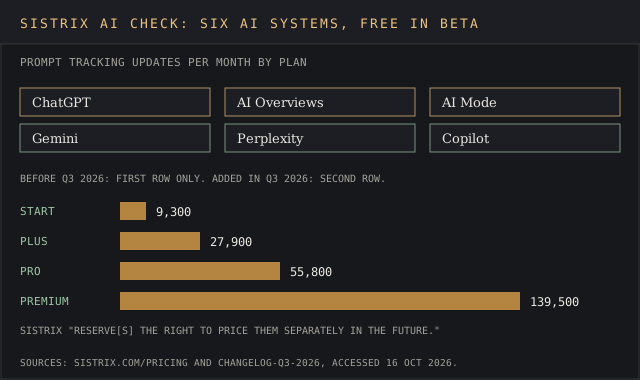
All of it is free during the beta, and that's the pricing risk. The pricing page footnote reads: "As these products are still in development, we reserve the right to price them separately in the future." A buyer signing an annual contract for the AI Check should get the current inclusion confirmed in the contract.
The measurement also sits on the same foundation as the index. SISTRIX says no statement comes from the model itself; it evaluates "real AI answers to real user questions" and extracts every evaluative statement. If your SEO visibility score reporting already runs on SISTRIX, adding AI search performance costs nothing extra today. SISTRIX offers the AI Check without a project, which means relevant data on a competitor's AI mentions is one search away.
SISTRIX pricing in 2026
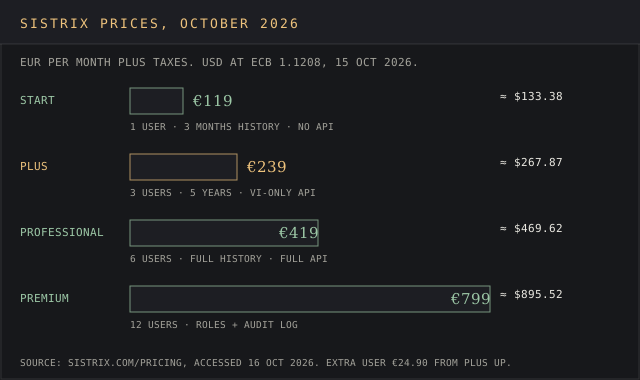
SISTRIX pricing for the SISTRIX toolbox is published in full on its pricing page, in euros only. The FAQ states that "all invoices are issued in euros (€)", and billing in US dollars, British pounds, Swiss francs or Japanese yen is limited to the Enterprise program.
| Plan | Monthly price | Users | Data history | API | Export and API credits per week |
|---|---|---|---|---|---|
| Start | €119* (~$133.38) | 1 | 3 months | None | 1,000 |
| Plus | €239* (~$267.87) | 3 | 5 years | Visibility Index only | 10,000 |
| Professional | €419* (~$469.62) | 6 | Full (11 years) | Full | 30,000 |
| Premium | €799* (~$895.52) | 12 | Full (11 years) | Full | 100,000 |
| Enterprise | Quoted | Custom | Custom | Custom | Custom |
* SISTRIX publishes prices in euros only, plus taxes. US dollar figures converted at the European Central Bank reference rate of 1 EUR = 1.1208 USD on 15 October 2026 (ECB). Your card issuer's rate will differ.
Every plan is "Cancelable Monthly". An annual contract is available and the FAQ says it lowers the monthly cost, without publishing the discount. Upgrades take effect immediately with a pro-rata refund; downgrades wait for the next billing period.
What each plan gates
The Start plan can't add users at all; extra accounts cost €24.90 a month from Plus up. Plus gets API access limited to Visibility Index data. White-label reports, phone support and full API access start at the Professional plan. Roles, rights management and the audit log are Premium-only, alongside what SISTRIX calls "Extensive export credits, projects and keyword tracking".
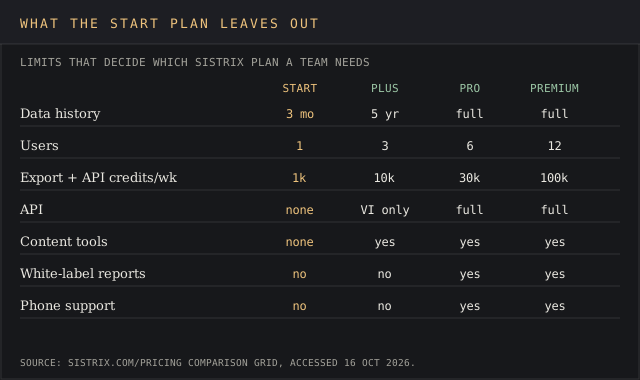
Extra capacity is metered. Additional export and API credits cost €75 per 10,000 a week, extra projects €5.99 to €9.90 each, extra SERP updates €0.02 to €0.04 each and extra page crawls €0.14 to €0.21 per 1,000 pages, depending on the plan.
Ranking tracking at scale is where users feel this. A Capterra reviewer in October 2022 listed as the first downside: "It has limited keyword tracking in the paid plan. If you want to track a bulk amount of keywords then it is expensive." A German managing partner made the same point about long-tail tracking for large sites in a November 2022 Capterra review.
The 2024 price increase
SISTRIX raised every plan in 2024. A Wayback capture from 4 October 2023 shows Start at €99, Plus at €199, Professional at €349 and Premium at €599. A capture from 3 December 2024 shows today's €119, €239, €419 and €799. A TechRadar review dated 6 June 2024 still listed the old prices.
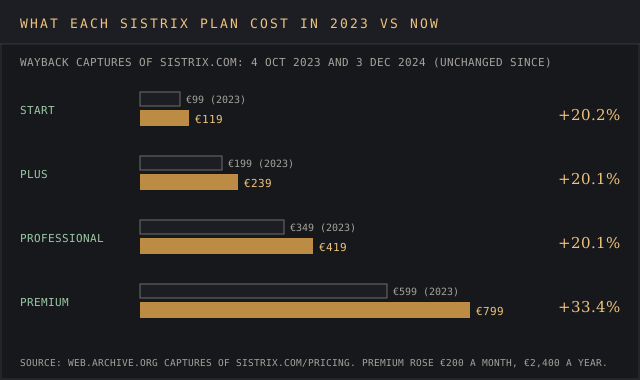
- Start: +€20 a month, +20.2%
- Plus: +€40 a month, +20.1%
- Professional: +€70 a month, +20.1%
- Premium: +€200 a month, +33.4%, or €2,400 more a year
The FAQ's stance on discounts is that "every customer gets the best price" and pays "the same price for the same service as every other customer". That's transparent, and it also means there's no published discount for startups or small sites. A Capterra reviewer from the travel sector summed up the effect for a small team before the rise, in September 2022:
"The tool (and the fees) are more agencies and middle -size companies, if you run a small website does not worth, there are no special plans that match the needs of a 1-2users enviroment"
Marketing, leisure, travel and tourism, Capterra, September 2022
For a cost comparison across the category, our SEO tools pricing report lists 16 vendors side by side, and the rank tracker pricing report prices the same 1,000 keywords across tools.
Free trial: 14 days or 7
The pricing FAQ says "you can try SISTRIX free for 14 days", and the About page promises a "Free test account for 14 days". The trial FAQ, last modified November 2024, says 14 days in its intro and "Your test with SISTRIX lasts 7 days" further down. The trial blocks exports and allows one Optimizer project with 10 keyword credits.
Only Start and Plus show a "Test for free" button. Professional and Premium show "Request a demo". So the free trial covers two of the four plans; the two with full history and the full API go through sales.
Data collection under pressure since 2025
Collecting rank data has got harder for every tool since September 2025, and SISTRIX says so in its own changelog. Google shut down the num=100 parameter in September 2025, which had let tools pull 100 search results in one request. Google later added "Goto URLs" that redirect clicks to an internal address. SISTRIX writes that Google "is currently making it considerably harder for us and all other tools to collect data reliably" and reports changes at its status page.
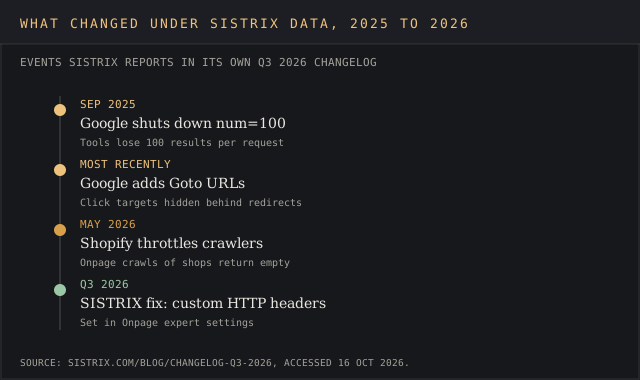
For a tool whose key metric depends on the top 100 results for 1 million keywords per country, this is the biggest operational risk on the list. SISTRIX hasn't published a change to the index method, and the vendor still describes the calculation as unchanged since 2008.
What users praise and what they complain about
The public review base is small. SISTRIX holds 4.4 out of 5 from 20 reviews on G2, 4.5 from 14 on Capterra (4.1 for ease of use, 4.2 for customer service), and 3.0 from 12 on Trustpilot, where 50% of reviews are one-star.
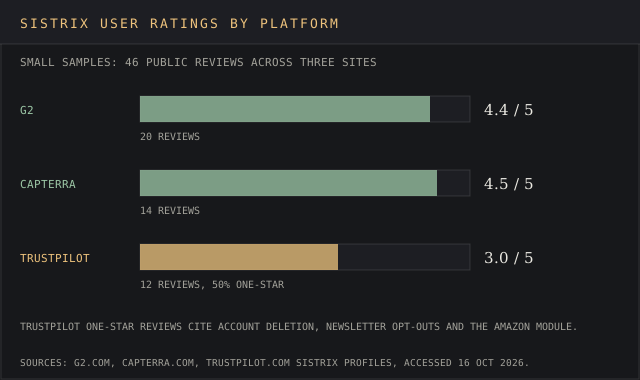
Praise centres on benchmarking and support speed. A German managing director wrote on Capterra in November 2022: "Bestes Tool zum Benchmarking und sehr schneller Support" (the best benchmarking tool, with fast support). His listed downside: "Manche Filter sind nicht überall einsetzbar" (some filters can't be used everywhere).
The same reviewer switched from Conductor and added "Searchmetrics ist viel zu teuer" (Searchmetrics is far too expensive). On customer support, SISTRIX's pricing grid says it answers requests "in less than 10 minutes" during working hours, and the Professional plan adds phone support.
Complaints split into three groups:
- Interface depth: a June 2022 developer review calls it an "unfriendly interface in some functions", and a December 2022 marketing manager writes that "Der Expertenmodus ist recht komplex und die Erklärungen sind nicht immer hilfreich" (expert mode is complex, and its explanations don't always help).
- Price: a July 2022 e-commerce manager's only downside is that "the price is higher compared with other similar services".
- Account handling: two one-star Trustpilot reviews concern leaving. An Austrian reviewer wrote in March 2026: "Account löschen über die Website nicht möglich." (account deletion isn't possible on the website). A German reviewer titled a May 2025 review "Nervige Newsletter, Abbestellen wird ignoriert, Account löschen künstlich erschwert." (annoying newsletters, unsubscribes ignored, account deletion made artificially hard).
The Amazon tools draw their own criticism. A February 2025 Trustpilot review opens: "Sistrix für Amazon ist leider überhaupt nicht zu empfehlen." (SISTRIX for Amazon unfortunately can't be recommended at all). The interface overload shows up across platforms too: the "learning curve" is the first con TechRadar lists.
Read the totals with the sample size in mind. 46 public reviews is a thin base for a tool SISTRIX says it built for everyone "from freelancer to large enterprise". Eleven of the 12 Trustpilot reviews are in German, which matches where the data is deepest.
SISTRIX vs alternatives
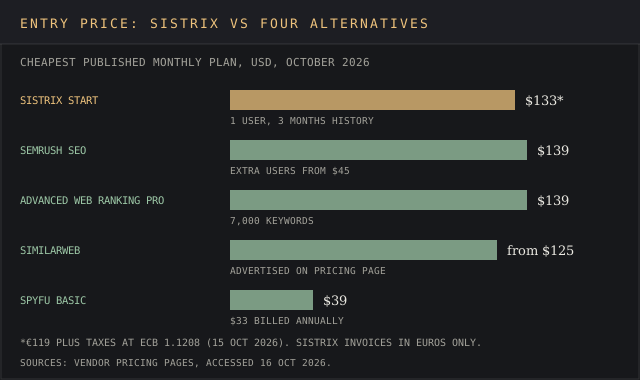
Four tools with published reviews on this site cover the same buying decisions. Each wins in a different situation, and many SEO tools overlap with SISTRIX on keyword data while measuring search engine results pages in a different way.
SISTRIX vs Semrush
Semrush wins for US-first teams that want SEO, PPC and AI search in one login, with prices in dollars. Its pricing page lists the SEO plan at $139 a month, Starter with AI search at $199 and Pro+ at $299, plus $45 a month per extra user and a 7-day free trial.
SISTRIX wins for DACH and European visibility history: the SISTRIX visibility index for Germany runs back to 2008 on one unchanged method, so seo performance before and after any Google update since then is on one scale. Our Semrush review covers the toolkit, and the visibility score report explains why a Semrush percentage and a SISTRIX points value can't be compared.
SISTRIX vs Similarweb
Similarweb answers a different question: estimated traffic and audience, where SISTRIX measures rankings. Its pricing page advertises web intelligence plans "from $125/mo", with higher tiers quoted. Pick Similarweb when the client asks how many visits a competitor gets; pick SISTRIX when the question is which Google update cost them rankings. The Similarweb review and the Semrush vs Similarweb comparison cover the traffic side.
SISTRIX vs Advanced Web Ranking
Advanced Web Ranking is the better buy for agencies whose main job is keyword rankings tracking across many countries and search engines. Its Pro plan costs $139 a month for 7,000 keywords and the Ent Plus tier tracks 50,000 for $980, with a 30-day money-back guarantee. SISTRIX wins when you need visibility for domains you don't track yourself, since its index covers 100 million domains with no setup. See the Advanced Web Ranking review.
SISTRIX vs SpyFu
SpyFu is the budget option for US paid-search research. Its pricing page lists Basic at $39 a month, or $33 billed annually, and Professional at $79. SISTRIX's Start plan costs more than three times SpyFu Basic; SpyFu's main draw, per our review, is a competitor's Google Ads history. Our SpyFu review has the detail.
SE Ranking also comes up in user comparisons. A Capterra reviewer, a CMO in the internet sector, chose SISTRIX over it in May 2022 and explained: "Sistrix gots all what we need. Se ranking is a good option for beginners." For a wider list, the search intelligence platforms ranking covers ten tools.
Frequently asked questions
Is SISTRIX free?
The SISTRIX SEO tool is paid, from €119 a month plus taxes. It offers a free trial of 14 days per its pricing FAQ (its trial FAQ also mentions 7 days) and a set of free tools that work without an account.
What is the SISTRIX Visibility Index?
A score of how visible a domain is in Google search results for one country, calculated from the top 100 organic results for 1 million keywords per country, weighted by search volume and expected click-through rate. It's updated daily in 13 countries and weekly in 39, and historical data reaches back to 2008 for Germany.
Is SISTRIX good for US websites?
The US index updates daily on desktop and mobile and runs back to January 2011. US-only teams that need deeper backlink data and dollar invoices can compare Semrush, whose SEO plan starts at $139 a month.
What are the top SEO tools?
It depends on the job, because search engines reward different work. For visibility history, the SISTRIX tool; for an all-in-one SEO and PPC suite, Semrush; for rank tracking, Advanced Web Ranking. Our SEO tools ranking scores ten of them.
Verdict
SISTRIX is for SEO professionals and agencies who report Google visibility in Germany, Austria, Switzerland and the other 10 daily-updated markets. It suits teams who need years of comparable history and quick winner and loser analysis after a Google update. SISTRIX delivers the unchanged 2008 method, daily data in 13 countries and the "Common Keywords" view, which earn that position, and Capterra reviewers praise the benchmarking and the support speed.
It isn't for solo site owners or 1-2 person teams. Start costs €119 a month after a 20% rise, keeps 3 months of history, can't add users and has no API. US-only teams that care about backlinks will find the link data thin, and anyone needing traffic estimates needs a traffic tool.
It might suit a mid-size in-house team on Plus at €239 a month, with three conditions. Confirm in writing the trial length, how many countries you'll get daily data for, and that the AI Check stays inside the plan you sign. The scores in the fact sheet at the top of this review follow from those figures: 74 for agencies, 38 for solo marketers, 80 for price transparency.