Google search statistics 2026: 5 trillion searches a year, 68% end without a click
 By Jan Suski. I go deep on every review, checking every number against its source and digging up details other coverage misses, a habit from six years of SEO and link building for tech companies. Bylines at Surfer, Brand24, and Senuto. How the scoring works.
The numbers Google search volume, share, clicks and revenue, checked 4 October 2026
Google's annual search count grew 2.5 times between its 2016 disclosure of at least 2 trillion and its 2025 disclosure of more than 5 trillion.
Search revenue rose 16.8% year over year in Q2 2026 while the share of US searches ending in a click fell to under a third.
Google's search share runs from 78.12% to 95.68% depending on the device measured, so a market share figure needs its method attached.
Google sees more than 5 trillion searches a year, according to a 3 March 2025 post by Vidhya Srinivasan, Google's vice president and general manager of Ads & Commerce. It was the first volume figure the company had put on record since 2016, and it works out to about 13.7 billion searches a day.
Fewer of those searches send anyone anywhere. Between January and April 2026, 68.01% of US Google searches ended without a click, per SparkToro's 9 June 2026 study of Similarweb panel data.
This page gathers the latest Google search statistics from the bodies that produce them: Alphabet's earnings releases, Google's own blog and Search Central posts, StatCounter Global Stats, Pew Research Center, SparkToro's clickstream studies and the court record in US v. Google. Where two publishers measure the same thing differently, the page shows both and what each one counts.
It's written for SEO leads, analysts and marketers who need a Google statistics figure they can cite with its publisher attached, and for business owners sizing their own search traffic against the market. Every number links to its source, checked on 4 October 2026.
How many Google searches happen per day
Long gaps between disclosures are par for the course: Google puts a number on its own search volume once every few years. Search Engine Land's Danny Sullivan compiled the company's figures in a May 2016 article, when Google confirmed that its "trillions" of annual searches meant at least two trillion. Here are Google's disclosures, with the daily rate each one implies:
- 1999: 1 billion searches for the year, about 2.7 million a day
- 2000: 14 billion, about 38 million a day
- 2009: more than 365 billion, about 1 billion a day
- 2012: 1.2 trillion, from a 100-billion-a-month figure given at a press briefing, about 3.3 billion a day
- 2016: at least 2 trillion, about 5.5 billion a day
- 2024: more than 5 trillion, about 13.7 billion a day
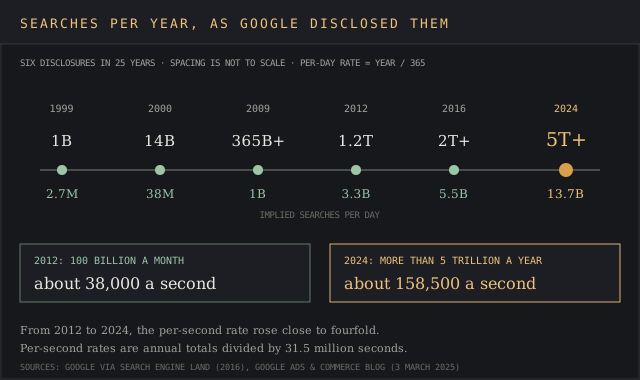
In 2012, Google handled about 38,000 searches a second: 1.2 trillion over a year's 31.5 million seconds. Five trillion works out to about 158,500 a second, close to four times that, or roughly 9.5 million a minute. Google's own 2025 figure implies about 13.7 billion searches a day.
Independent clickstream data lands in the same place. SparkToro's 10 March 2025 analysis of Datos panel data, published on its blog, counted more than 14 billion Google searches a day in 2024 and 21.64% growth in searches over 2023. Rand Fishkin put ChatGPT at 37.5 million search-like prompts a day at most, which made Google about 373 times larger.
By September 2025 Fishkin's estimate for ChatGPT had risen to about 66 million search-like prompts a day, using a Harvard and OpenAI study that classed 21.3% of prompts as search-like, per Search Engine Land. That's a drop in the bucket next to 14 billion, and Google still handled about 210 times as many searches. Our AI traffic report tracks the referral side of that gap.
Why published Google search statistics disagree
Four of the most-quoted Google statistics have a rival figure from a second publisher or a second cut of the same data, and websites that copy one without the other pass the gap along. The devil's in the details: device mix, the unit being counted and the year of the sample.
| Measure | Figure A | Figure B | What each counts |
|---|---|---|---|
| Google searches per day, 2024 | 13.7 billion, from Google's 5 trillion a year | 14 billion+, SparkToro on Datos data | Google's own count, stated as "more than", against a desktop and mobile clickstream panel |
| Google's share of search | 89.94% worldwide, StatCounter, September 2026 | 89.2% of the US market, US v. Google, 2020 | Referral page views to sites running StatCounter's code, against searches entered into general search engines, from trial evidence |
| US zero-click rate, 2024 | 58.5%, SparkToro, July 2024 | 60.45%, SparkToro, June 2026 | A Datos panel from September 2022 to May 2024, against the 2024 baseline cited in the 2026 study |
| Searches showing an AI summary | 18% of all searches, Pew, March 2025 | 53% of searches of ten words or more, Pew, March 2025 | Every search by 900 US adults, against the subset of long queries |
StatCounter records a search only when it sends a visitor to one of the websites running its tracker, so a search that ends on Google search results never reaches its count. The court counted the queries themselves. Both land near 89%, apart by a hair's breadth, yet they measure two different events.
Read the publisher and the unit before the number, and most of the gaps in the table above explain themselves. Statistics pages that skip that step recycle each other's digits, and a figure repeated by ten other sources still traces back to one publisher.
Google search engine market share by device and country
The latest data from StatCounter put Google's market share at 89.94% of worldwide search engine referrals in September 2026. Bing had 5.29%, Yahoo 1.36%, Yandex 1.30%, DuckDuckGo 0.74% and Baidu 0.44%, which leaves 0.93% for all other search engines.
Device decides the number. Google held 95.68% on mobile devices worldwide and 78.12% on desktop, where Bing reached 14.62%, per StatCounter's mobile and desktop tables. In the US, Google's share across all devices was 85.19% and Bing's was 9.89%.
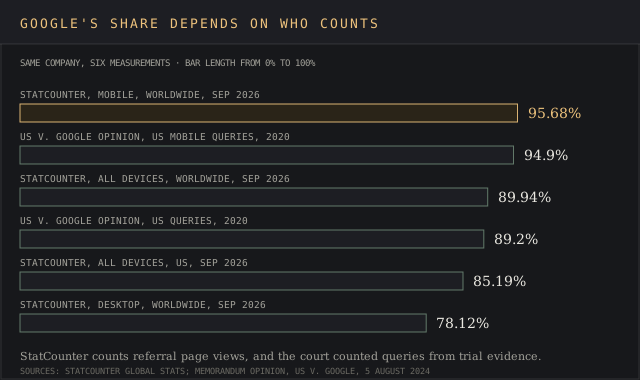
Court records give the query-level view. Judge Amit Mehta's 5 August 2024 memorandum opinion found Google's share of US general search engine use "had increased from 80% to 89.2% by 2020", and 94.9% on mobile. Bing, the next-largest search engine, saw roughly 6%.
Scale is the lion's share of the argument. The opinion found Google "receives nine times more queries each day than all of its rivals combined across all devices", and nineteen times more on mobile. About half of US general searches flowed through default placements covered by Google's distribution contracts, and Google paid to keep that business: the payments "totaled more than $26 billion" in 2021.
Zero-click searches and clicks to websites
For search engine optimization (SEO), the click is the number that matters, and it's falling. SparkToro's June 2026 study found 68.01% of US Google searches ended with no click from January to April 2026, up from 60.45% in 2024. The study weights searches two-thirds mobile and one-third desktop, and it counts browser searches only, leaving out the Google app.
The 2024 edition, which SparkToro published on 2 July 2024 using Datos data, put US zero-click searches at 58.5% and the EU rate at 59.7%. For every 1,000 US searches, 360 clicks reached a website that Google doesn't own and that isn't paying for an ad. Almost 30% of all clicks went to platforms Google owns, and paid ads took about 1%. The remaining Google search traffic went to organic results on the open web.
Pew Research Center measured the same behavior from the browser side. Tracking 68,879 searches by 900 US adults in March 2025, in an analysis of browsing data, Pew found Google users clicked a traditional link in Google search results on 8% of visits to a page with an AI summary, against 15% on pages without one.
Links inside the summary drew a click 1% of the time. Browsing sessions ended on 26% of pages with a summary and 16% without. Wikipedia, YouTube and Reddit made up 15% of the sources cited in AI summaries and 17% of standard search results, a pattern our Reddit AI visibility study measures in detail.
Ranking higher is the whole game for organic traffic and SEO, because most pages never earn a visit. Ahrefs' analysis found 96.55% of the roughly 14 billion pages in its index get zero traffic from Google, and 1.94% get one to ten visits a month, in a study updated 12 August 2026.
A page with steady Google traffic is a needle in a haystack. The SEO visibility score report explains how SEO tools credit a site for ranking higher on relevant keywords and fold its organic results positions into one number.
Google went back to the drawing board on the second page. It replaced numbered pages of search results with continuous scroll on mobile in October 2021 and on desktop in December 2022, then restored the Next button below the search results on desktop from 25 June 2024, saying "serving 10 results is faster", per 9to5Google. The second page of Google results is one click past the first page again.
Google's ranking systems "are designed to prioritize helpful, reliable information that's created to benefit people", per its Search Central guidance on high quality content. Answer units compete with organic search results on the search engine results pages, and they push organic results further down: featured snippets, in Google's documentation, are "special boxes where the format of a regular search result is reversed, showing the descriptive snippet first."
AI Overviews, AI Mode and longer questions
AI Overviews, which sit above the search results, had more than 2 billion monthly users across more than 200 countries and territories by July 2025. Sundar Pichai said they were "driving over 10% more queries globally for the types of queries that show them", in Alphabet's Q2 2025 earnings remarks.
AI Mode hit the ground running. In his 22 July 2026 remarks, Pichai said AI Mode had passed 1 billion monthly active users since its global expansion the previous October, the Gemini app had 950 million monthly active users, and Google was "sending billions of clicks to websites every week through AI features in Search."
Searches are getting longer. Google's own Think with Google business site reported on 17 June 2026 that "the average AI Mode query is triple the length of a traditional query", and that more than one in six AI Mode queries are entirely non-text.
Pew's data shows the same pattern from the other end, with AI summaries spread unevenly across topic categories. An AI summary appeared on 8% of one- and two-word searches, 53% of searches of ten words or more, and 60% of searches phrased as questions.
Google's Year in Search 2025, a review of the year's search trends written by Google Trends data editor Simon Rogers, logged searches starting "How do I" at an all-time high, up 25% on 2024, and "Tell me about" up 70%. People search the way they talk, and the search terms show it: with AI in Google Search, the Google Trends team wrote, "people asked questions in more conversational ways, like they would while talking to a friend."
The AI statistics report covers chatbot usage outside Google, and the search engine marketing statistics report measures click-through rates under AI Overviews.
Google statistics on mobile searches, Lens and voice search
Google announced on 5 May 2015 that more of its searches came from mobile devices than computers in 10 countries, the US and Japan among them, in a post on its Inside AdWords blog. StatCounter's September 2026 platform data puts mobile at 58.99% of worldwide page views, desktop at 39.26% and tablet at 1.76%, which measures all web traffic.
Pew's mobile fact sheet counts 91% of US adults as smartphone owners in its June 2025 survey. Across the world, the ITU counted 6.0 billion internet users in 2025, with 2.2 billion people still offline.
Visual search grew under the radar into the fastest-moving of the search trends Google publishes. Lens handled more than 12 billion visual searches a month in June 2023, per Google's Lou Wang, nearly 20 billion by October 2024, per VP of Search Liz Reid. By June 2026 Think with Google insights put Lens at more than 25 billion a month, with one in five of them showing commercial intent, and Circle to Search drives over 10% of queries for younger consumers.
Voice search figures are older. Pichai said at Google I/O in May 2016 that 20% of queries from users of the Google app and Android devices were voice searches, per Search Engine Land. A 2014 survey of 1,400 Americans, run by Northstar Research and commissioned by Google, found 55% of teens used voice search every day, per Google's release of 14 October 2014.
Mobile users search with a location in mind. Google's Lisa Gevelber reported in May 2018 that US mobile searches pairing "near me" with "can I buy" or "to buy" grew over 500% in two years, and "near me today/tonight" searches more than 900%, on Think with Google, the company's marketing insights site. Local businesses keep an eye on those searches through their Google Business Profile, where customers find hours and directions without visiting a website.
The Google app itself shows "10B+" downloads on its Google Play Store listing, with a 4.4 rating from 29.4 million reviews. Chrome's Google Play Store listing also shows 10B+ downloads, from 49.2 million reviews. Both Google Play Store listings were checked on 4 October 2026, and Mehta's opinion notes Android users download search apps "from the Google Play Store".
Google search revenue and Google Ads
Search is Alphabet's largest business. Google Search & other revenue reached $63.27 billion in Q2 2026, up from $54.19 billion a year earlier, per Alphabet's 22 July 2026 earnings release. That line, paid for by advertising customers, made up 77.5% of Google advertising revenue of $81.63 billion in the quarter, and 52.8% of Alphabet's total revenue of $119.80 billion.
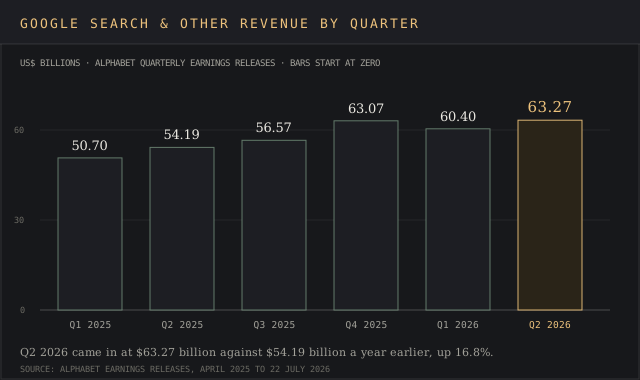
The four 2025 quarterly releases add up to $224.53 billion of Search & other revenue: $50.70 billion in Q1, $54.19 billion in Q2, $56.57 billion in Q3 and $63.07 billion in Q4, per the 4 February 2026 release. That's 55.7% of Alphabet's full-year revenue of $402.84 billion, from one business line. Q1 2026 came in at $60.40 billion, per the 29 April 2026 release.
Google Ads also sells against product searches from customers ready to buy. The Shopping Graph held more than 50 billion product listings in November 2025, with 2 billion updated every hour, per Vidhya Srinivasan. Google Shopping results and Shopping ads draw on that feed, so customers comparing prices and the business paying for the click meet on the same Google search results page.
Distribution is now under a court order. The final judgment of 5 December 2025 in US v. Google runs six years and names Google Search, Chrome, the Google Assistant and the Gemini app as covered products. Google can't condition payments, or a license for Google Play, on a phone maker or carrier refusing a rival search engine, and it has to give qualified competitors a unique ID for each document in its web search index at marginal cost.
Top Google searches and how to analyze them
The top Google searches by volume are navigational keywords: brand-name search terms people type to reach a business website they already know. The table below shows average monthly US searches from September 2025 to August 2026, from Google Ads Keyword Planner data for seven keywords pulled through the DataForSEO API on 4 October 2026 for this analysis.
| Keyword | Average monthly US searches | Lowest month | Highest month |
|---|---|---|---|
| youtube | 226,000,000 | 185,000,000 (June, July 2026) | 277,000,000 (October 2025) |
| amazon | 151,000,000 | 124,000,000 (February 2026) | 185,000,000 (December 2025) |
| weather | 124,000,000 | 83,100,000 (September 2025) | 151,000,000 (January, March to July 2026) |
| chatgpt | 124,000,000 | 101,000,000 (June, July 2026) | 124,000,000 (ten months) |
| 101,000,000 | 101,000,000 (eleven months) | 124,000,000 (January 2026) | |
| gmail | 83,100,000 | 68,000,000 (five months) | 83,100,000 (seven months) |
| 68,000,000 | 55,600,000 (July 2026) | 68,000,000 (eleven months) |
Keyword Planner reports volume in rounded bands, which is why several keywords repeat the same figure across months.
Search volume follows the calendar and the news, the same seasonal trends Google Trends charts as search interest. "Weather" drew 83.1 million searches in September 2025 and 151 million in most months of spring and summer 2026, and "chatgpt" now draws as many monthly searches as "weather". Google's Year in Search 2025 global trending list, across all categories, was led by Gemini, India vs England and Charlie Kirk.
Google Trends is the free tool for Google data on any keyword, used by marketers around the world. Google describes Google Trends as "a random sample of aggregated, anonymized, and categorized Google and YouTube searches" that lets users analyze interest "from around the globe or at city-level geography", on its Search Central page. The YouTube statistics report covers the YouTube half of that sample.
The Trending Now page in Google Trends, rebuilt in August 2024, "detects 10 times as many emerging trends as before and refreshes every 10 minutes on average", per Google. It covers 125 countries, with regional detail in 40 of them, filters by the last 4 hours, 24 hours, 48 hours or 7 days, and lets users "compare multiple trends and easily export their data".
Search Central lists five uses for Google Trends: monitoring rising trends by location, SEO keyword research to find relevant keywords, using seasonal trends to create a content calendar, benchmarking a business against its industry, and analyzing what people search about a business name. Google Trends also sorts searches into categories, which keeps search terms like "apple" relevant to the right topic.
SEO teams and business analysts who need absolute volume pair it with Keyword Planner, a Google Ads tool, or a clickstream panel. The trend research tools ranking and the website traffic analysis tools ranking compare the paid options, and the Semrush vs Similarweb comparison sets two of them side by side.
Site owners get their own Google search statistics in Search Console, the most relevant source for a single business website, which lets them zero in on the search terms behind their clicks: "See which queries bring users to your site" and analyze "impressions, clicks, and position on Google Search", per Google. Changes to Google's algorithm show up in those numbers.
Google's Search Status Dashboard logged three core updates and one spam update in 2025, and two core updates, four spam updates and a Discover update from January to September 2026.
Frequently asked questions
What share of Google searches end without a click?
In the US, 68.01% of Google searches ended without a click from January to April 2026, per SparkToro's June 2026 study of Similarweb data. The same study puts the 2024 rate at 60.45%.
What is the #1 most searched thing on Google?
Navigational keywords lead the list. "youtube" averaged 226 million US searches a month from September 2025 to August 2026 in Keyword Planner data. Gemini topped Google's Year in Search 2025 global trending list, Google Trends' annual review of search trends.
Can I tell who has googled my name?
Google publishes counts, and the identity of a searcher stays out of them. Google Trends works from aggregated, anonymized searches by Google users, and a name with enough volume shows up as a monthly estimate in Keyword Planner or a search interest line in Google Trends.
Is Google Search Analytics free?
Google Trends runs in the browser with no account, which suits a small business. Search Console asks for a verified site. Keyword Planner asks you to create a Google Ads account with billing information entered, per Google's help page.
How can I see Google search statistics?
Three Google resources cover Google search stats. Use Google Trends to analyze search interest and trends by location and date (pick a location from the world view down to a city), Search Console for your own website's queries and clicks, and Keyword Planner for monthly search volume. For a rival business's Google search traffic, the Similarweb review and the Semrush review explain what each panel measures.
What is Google's 20% rule?
It comes from the founders' letter in Google's April 2004 IPO filing: "We encourage our employees, in addition to their regular projects, to spend 20% of their time working on what they think will most benefit Google," per the S-1 on SEC EDGAR.
What percentage of search is Google?
Google's market share was 89.94% of worldwide search engine referrals in September 2026, per StatCounter, and 85.19% in the US.
How many Google searches in 1 minute?
About 9.5 million, from Google's figure of more than 5 trillion a year.
Bottom line
For volume statistics, cite Google's own figure of more than 5 trillion searches a year, straight from the horse's mouth, and convert it to 13.7 billion a day. For share, name the method: StatCounter's referral count, a device split or the court's query count all land somewhere between 78% and 96%.
Clicks are where the record changed. Searches kept growing while two-thirds of US searches ended without a click in early 2026, and AI Overviews passed 2 billion monthly users while AI Mode passed 1 billion.
For a single business, Search Console and Keyword Planner beat any roundup of Google statistics. Pair them with Google Trends for timing and seasonal trends, and treat every circulated figure as a claim until its publisher and date check out.
Where each Google figure comes from, and the counts Google keeps to itself
Volume figures are Google's own: the 3 March 2025 Ads & Commerce post on blog.google for the 5 trillion figure, and the 1999 to 2016 disclosures as compiled by Search Engine Land in May 2016. Clickstream estimates are SparkToro's, from sparktoro.com: the 2 July 2024 and 10 March 2025 studies on Datos data, and the 9 June 2026 study on Similarweb data.
Share figures are StatCounter Global Stats for September 2026, plus Judge Mehta's 5 August 2024 memorandum opinion in US v. Google and the 5 December 2025 final judgment on justice.gov. Revenue comes from Alphabet's quarterly earnings releases, Q1 2025 through the 22 July 2026 release, and the AI Overviews and AI Mode user counts from Sundar Pichai's Q2 2025 and Q2 2026 earnings remarks on blog.google.
Behavior figures are Pew Research Center's March 2025 browsing analysis, published 22 July 2025, and its mobile fact sheet from a June 2025 survey, the ITU's December 2025 update, and Think with Google's posts of May 2018 and 17 June 2026. Keyword volumes are Google Ads Keyword Planner data pulled through DataForSEO on 4 October 2026. Ahrefs' traffic study was updated 12 August 2026. Every figure was checked on 4 October 2026.
Google publishes no daily or monthly search count, no zero-click rate and no market share figure of its own, so those numbers come from its occasional disclosures, from clickstream panels and from StatCounter's tracker network. Alphabet also reports AI Overviews and AI Mode inside the Search & other line, with no revenue figure of their own.