
The numbers Visibility scoring, updated 5 August 2026
The score models potential clicks from position and search volume, a projection built on ranking and volume data. Tracked visits are a separate number, measured after the fact. The score itself moves when the results page changes even if your rankings hold.
A band only means something against a fixed keyword set. 40% across fifty easy keywords is worth less than 25% against head terms.
Never read a Semrush percentage against a Sistrix points number. Trend one tool, or the comparison is noise.
Split branded keywords out, then track the score beside Search Console clicks. Score flat and clicks falling means the SERP changed under you.
SEO agencies and rank trackers explain the same scores on every call. Send the metric and I'll source a version you own.
What an SEO Visibility Score Is
An SEO visibility score quantifies how prominently a website appears in organic search results across the search engines, expressed as the percentage of available clicks the site could capture across its tracked keywords. SEO visibility measures presence ahead of visits: a visibility score combines keyword rankings, search volume, and click through rates into one number that says how much of the search market a site is positioned to reach.
The metric exists because raw keyword rankings mislead on their own, and because the search engine results pages reward positions unevenly. Ranking first for ten keywords with no search volume is worth less than ranking fourth for one keyword with real search volume, and only a weighted score shows that.
SEO visibility refers to the weighted view; a plain rank tracker shows positions, while a search visibility score shows what the positions are worth in the search results.
What Counts as a Good SEO Visibility Score
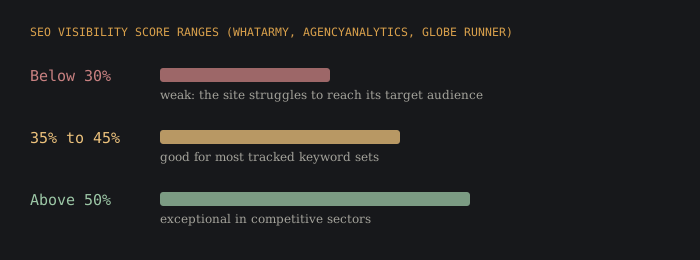
The benchmarks repeated across measurement guides from WhatArmy, AgencyAnalytics, Globe Runner, and BlueTuskr: a good SEO visibility score sits between 35% and 45%, anything above 50% is exceptional in competitive sectors, and scores below 30% signal a site struggling to reach its target audience in the search engine results pages, invisible where its buyers spend organic search time. A good visibility score is relative, though, in two directions.
It depends on the keyword set: 40% search visibility against fifty easy tracked keywords means less than 25% against the head terms of a hard market. And it depends on the niche, since low visibility against entrenched publishers can still represent the best available position.
The more useful benchmark is competitive: measure your search visibility score next to the same score for three rivals over the same target keywords. A 20% score while the market leader holds 45% is a map of the gap; a 20% score while rivals hold 12% is a lead. Visibility metrics are comparison instruments first and grades second.
How SEO Visibility Is Calculated
Copy these lines into an email, fill them in and send. I reply with scope and a price within 2 to 3 business days.
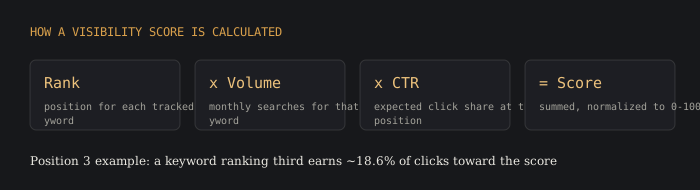
Open the emailMost search engines tools compute the SEO visibility score the same way: for every keyword in the tracked set, take the ranking position, look up the monthly search volume, multiply by the expected click through rate for that position, then sum and normalize against the maximum available.
The CTR weighting is what makes position differences count; the third organic result earns roughly 18.6% of clicks by the CTR studies the measurement guides cite, while page-two positions in the search results round to nothing. That is how SEO visibility calculated this way rewards moving from position 11 to position 5 far more than moving from 5 to 4.
Two model families produce differently shaped numbers. Percentage models (Semrush, Moz, SE Ranking) normalize to 0 to 100%, where 100% would mean ranking first for every tracked keyword. Points models, Sistrix's Visibility Index is the standard example, weight a fixed keyword universe and output an open-ended number useful for trend lines but meaningless without context.
Different SEO tools also draw the keyword universe differently, which is why the same site scores 8% in one tool and 32 points in another; compare trends within one tool, never scores across different tools.
Tools That Measure Search Visibility
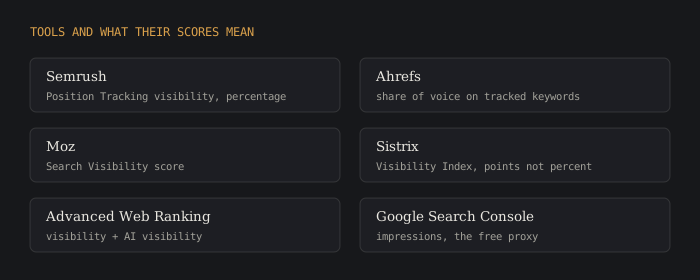
Semrush's Position Tracking reports the visibility score as a percentage of potential clicks from the tracked set; our Semrush review covers the toolkit around it. Ahrefs frames the same idea as share of voice. Moz sells a Search Visibility score, Sistrix its points-based index, and Advanced Web Ranking and SE Ranking both ship visibility tracking with AI-visibility companions.
The free proxy is Google Search Console: total impressions across search queries is a rough organic search visibility measure and the closest free read on organic visibility, and impressions trended over time in Google Search Console catch most of what paid visibility reports catch for organic search visibility, minus the competitor comparison.
The metric has history in this category: Searchmetrics built its brand on an SEO visibility score index before the platform shut down, a story we document in the Searchmetrics report. The measurement outlived the vendor, which says something about how useful the number is.
Where the Score Misleads
A visibility score is potential traffic share. Actual traffic is a separate line. Three distortions recur. Branded keywords inflate the number: a site ranking first for its own name posts a high search visibility score while its non-branded search visibility stays flat, so segment branded from non-branded organic search results before reading trends.
SERP features shrink the clicks behind the score: the same ranking position under an AI Overview or a features-heavy page yields fewer clicks than the CTR model assumes, a shift our AI traffic report quantifies from the traffic side. And volatility exaggerates weekly moves: a tracked set of a few hundred keywords swings on rank wobble alone, which is why visibility trends matter at monthly windows and mislead at daily ones.
The deeper limit: modern search engines answer many search queries in place, so a stable score can sit on top of falling organic traffic. Track the visibility score next to organic traffic sessions and click through rates from Google Search Console; when the score holds and clicks fall, the SERP changed underneath your rankings.
AI answer engines extend the same problem, which is why several SEO tools now pair the classic score with AI visibility tracking across assistants.
How to Increase SEO Visibility
The levers, ordered by how fast they move the number.
Push positions 2 through 12
The CTR curve makes near-wins the cheapest gains: keyword rankings sitting at positions 2 to 12 gain more click share per position than anything else in the set. Pull the list from your rank tracker, strengthen those web pages with updated content and internal links from related pages (internal links remain the most controllable authority signal), and match the search intent the current search results serve.
Our research guides cover the competitor side of that read.
Add long tail keywords
Long tail keywords with modest monthly search volume but clear user intent raise the search visibility base: more keywords ranking means more weighted click share, and low-difficulty terms rank without new backlinks. Questions your target audience asks, comparisons, and specific keywords with commercial intent beat generic head terms per hour of optimization efforts invested.
Fix technical SEO
Technical SEO factors gate everything above: page speed, mobile friendliness, crawlable site structure, and clean indexing decide if the search engines rank specific keywords at all, and technical SEO debt caps search engine rankings no matter the content quality. Structured data adds eligibility for rich results, which claws back some of the click share the SERP takes away.
Run the technical SEO audit before the content work; the search engines reward a fast site with thin pages over a slow site with good ones often enough to be annoying.
Earn links and cover topics fully
High quality backlinks from relevant sites remain the authority input, and link building strategies built on data, original numbers, tools, research, earn them without outreach volume.
On-page, cover a topic across multiple keywords on a single page: search engine rankings increasingly reward topical depth, and meta descriptions and titles that match the query lift click through rates on the positions you already hold; rewriting meta descriptions on high-impression pages is the fastest SEO performance win in most audits.
SEO Visibility Score vs SEO Score
The two get conflated constantly and measure different things. An SEO score from an audit tool grades a site against a technical checklist: speed, tags, crawlability, mobile friendliness. It is a health number; a perfect SEO score is achievable with zero visitors and no search visibility at all.
A visibility score measures outcomes in the search engines: where the site appears in search results and what those positions are worth in click share. The SEO score is the input side, the visibility score the output side, and overall SEO performance needs both read together.
The practical division of labor: use the SEO score to find and fix defects on your web pages, and use the visibility score to judge if the fixes plus the content work moved your position in the search results.
An improving SEO score with a flat visibility score means the bottleneck is content or authority and no fault of the site's performance; a falling visibility score with a stable SEO score means the search engines changed or a competitor moved.
Why Visibility Deserves the Dashboard Slot
Search engines are where buying research starts, and the visibility score is the one number that summarizes presence across every keyword that matters at once. Teams that track site rank keyword by keyword drown in noise; a weighted score turns hundreds of positions into a single trend line that SEO strategies can be judged against.
When the line rises, the SEO efforts are compounding; when it stalls for two quarters, the strategy needs a different lever. More of the same one moves nothing.
Low visibility is also a diagnosis, and a grade second. A site with strong content and low visibility in Google search results usually has a coverage problem, ranking for too few relevant keywords, or an authority problem, ranking too low on the ones it covers.
The score's keyword-level breakdown says which: many keywords at positions 15 to 30 points at authority and keyword optimization work, few keywords ranking at all points at content gaps. Either way the search engines are telling you where organic traffic will and will not come from next quarter.
Measuring Your Search Visibility, Step by Step
1. Pick the keyword set
The visibility score is only as honest as its tracked keywords. Build the set from target keywords and specific keywords with commercial value, add the relevant keywords rivals rank for that you don't, weight by search volume, and cap it somewhere stable, a set that changes monthly produces a score that can't be trended. Separate branded terms into their own set from day one.
2. Take the baseline
Run the set through one tool, Semrush, Ahrefs, Moz, SE Ranking, and record the visibility score, then pull impressions and average position from Google Search Console for the same date range as the free cross-check. Sites without a paid tool can trend Google Search Console impressions alone; it is a workable search visibility score proxy for a single site, and keyword rankings exported monthly fill the position side.
3. Benchmark the share of voice
Add three competitors to the same tracking and read the score as share of voice: your slice of the search results against theirs across the search engines. From there, the visibility score starts telling you what your target audience sees in the search engine results, because a rival's rising line names exactly which search engine results they are taking and which target keywords need defending.
4. Connect the traffic
Tie the score to sessions in Google Analytics so presence and results sit in one report. Google Analytics shows what the visitors did; the visibility score shows what the search engines offered. Divergence between the two is the SERP-feature and AI-answer effect, and measuring it is the point of tracking both. The trackers that count those sessions run from Google Analytics 4 to Matomo and Plausible.
5. Review monthly, act quarterly
Score monthly to catch real moves, act quarterly to avoid chasing rank wobble. To improve your SEO visibility between reviews, work the positions 2 to 12 list and the long-tail additions from the section above; to improve your SEO visibility durably, keep publishing into the topic gaps the competitor benchmark exposes. Either way, the search visibility trend, and no single reading, is the metric that deserves the meeting slide.
Reporting on Visibility
The reporting pattern that keeps the metric honest: one chart of the search visibility score over time against two named competitors, one table of the ten target keywords that moved most with their ranking position changes, and organic traffic from the search engine results next to both.
That format shows if SEO efforts and SEO strategies moved search engine visibility, if presence moved organic traffic, and where the gap opened when it didn't. Agencies gain valuable insights from the same report structure because clients read a visibility score without explanation; nobody needs the site's performance translated when the competitor line sits on the same chart.
Check the score monthly, report it quarterly, and annotate algorithm updates, because a website's visibility drop that coincides with a Google search core update is a different problem from one that doesn't.
Delivered for your site and your byline. Hosting here is optional.
Common Questions
Is 75 a good SEO score?
Different metric. A 75 from an on-page SEO score tool (Lighthouse, site auditors) grades technical health, and 75 there means fixable issues remain. A 75% SEO visibility score would be extraordinary; the measurement guides put a good SEO visibility score at 35 to 45% and exceptional above 50%. Check which number your tool reports before celebrating either.
What is the 80/20 rule in SEO?
The observation that a small share of pages and keywords produces most results: in visibility terms, a handful of valuable keywords typically carries most of the visibility score across the search engines. The practical use is focus, spend optimization strategies on the twenty percent of pages that hold your important keywords. Equal effort everywhere moves none of them.
How is search engine visibility different from organic traffic?
Search visibility is where the search engines could show you in the search results; organic search traffic is who arrived. A high visibility score with low organic traffic points at SERP features, weak titles, or mismatched search intent absorbing the clicks in the search engine results.
The two diverge more each year as the search engines answer search results in place, which makes tracking both, plus brand visibility in AI answers, the current way to measure SEO visibility properly across search engines.
Sources: WhatArmy, AgencyAnalytics, Globe Runner, BlueTuskr, and LLMrefs visibility guides, 2025 to 2026 editions; CTR figures as cited therein.
SEO agencies, rank tracking vendors and in-house teams use briefs like this one in client reports and onboarding.
A report on your topic for a blog page, gated content or a lead magnet.
Written for your client and published under their brand, with my name left off.
Your report on marketintelligencetools.com, with 2 to 3 CTAs carrying your sponsored links.
Default terms: the report is yours to publish, and I keep the right to republish it on this site behind a gate, outside Google's index.