Share of voice in AI answers: tracking which competitors ChatGPT recommends
 By Jan Suski. I go deep on every review, checking every number against its source and digging up details other coverage misses, a habit from six years of SEO and link building for tech companies. Bylines at Surfer, Brand24, and Senuto. How the scoring works. This site carries an Ahrefs Domain Rating of 29, built from 415 referring domains as of 30 August 2026.
Share of voice is the percentage of a category's total visibility a brand owns compared with its competitors, measured in ad spend, search impressions, press mentions or, now, the brands an AI assistant names when someone asks what to buy. This report is for the marketing team, PR leads and analysts who report share of voice from paid advertising, social media platforms or organic search and now get asked the same question about ChatGPT, Gemini & Perplexity.
It covers advertising share of voice and its link to market share, then spends most of its length on the newest channel, AI answers, with how to measure share of voice there and track which competitors ChatGPT recommends. If you haven't plotted your competitors yet, start with market mapping, since a share figure needs a defined competitor set before it means anything.
The numbers Share of voice in ads and AI answers, checked 22 October 2026
A mention and a cited link are two separate counts, as described by the AI engine citation tool - Rankcited.
One answer is one draw. The same brand list repeats under 1 time in 100 runs, so only visibility rate across many runs is worth reporting.
Bigger brands win AI mentions across the board, and Reddit backlinks stop predicting ChatGPT mentions once company size is held constant.
A share of voice figure only means something next to market share. A brand speaking above its share of sales is set up to grow.
I'll write a 2,500+ word report on the competitor set you name, with ChatGPT, Gemini and Perplexity mentions counted across repeat runs and every figure sourced. Yours to publish, from $200.
What share of voice measures, from ad space to AI answers
The term comes from media buying across media channels. In January 1990, John Philip Jones argued in Harvard Business Review that ad budgets should be set by comparing a brand's market share with its share of voice, its share of the total value of media exposure in the category.
Nielsen still uses that definition. Its 2025 explainer calls share of voice a brand's media spending as a percentage of all media expenditure in the category, and reports IKEA at 7.8% & La-Z-Boy at 4.5% of US furniture ad spend in 2024.
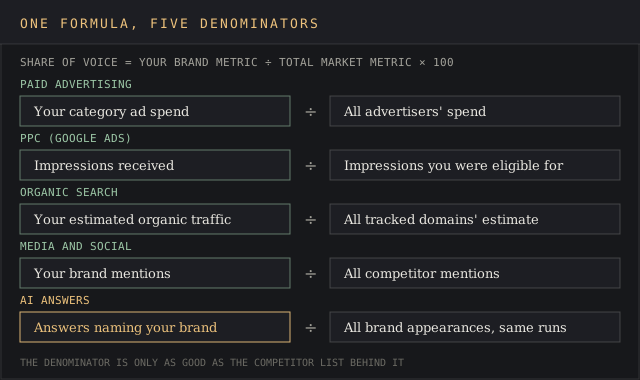
The share of voice formula works the same in every channel:
Share of voice = your brand metrics ÷ total market metrics × 100
Swap the metric and the voice formula moves to a new channel. Ad dollars give the paid advertising version. Brand mentions in news articles and on social media platforms give the PR & social media share. Impressions give PPC share and SEO share. Mentions inside AI-generated answers give the newest one, and for all of them the denominator is only as good as the competitor list behind it.
Advertising share of voice and the market share link
Voice earns its place in planning because it predicts sales share. Nielsen cites Les Binet and Peter Field, who studied 171 campaigns between 1980 and 2010. Brands whose share of voice ran above their share of market gained, on average, 0.5 points of share for every 10 points of excess.
That excess share of voice is called ESOV. A brand with 20% of category sales and 30% of the voice carries 10 points of ESOV. A brand speaking below its sales share is losing mindshare, and low share of voice shows up in the voice data well before it shows up in revenue.
Planners use the share of voice gap to set budgets. A challenger that wants to grow buys ESOV, and a leader defending its market position spends to hold voice level with sales. Binet and Field measured paid advertising over years, so expecting a one-quarter spike from a few marketing campaigns to buy share misses the mark.
How to measure share of voice across different marketing channels
Each channel's share of voice counts a different thing, so a brand's share in one says little about the others. A software vendor can hold the lion's share of Google Ads impressions on its category terms and barely register in media coverage. Measuring share across several marketing channels means keeping one row per channel:
| Channel | Brand's share counts | Divided by | Where the voice data comes from |
|---|---|---|---|
| Paid advertising | Category ad spend | All advertisers' spend | Ad-spend panels such as Nielsen |
| PPC (Google Ads) | Impressions received | Impressions you were eligible for | Impression share columns in your Google Ads account |
| Organic search | Estimated organic traffic on tracked keywords | All tracked domains' estimate | Rank trackers and SEO suites |
| Social media | Social media mentions and social media conversations | All competitor mentions | Social listening tools |
| PR and traditional media | Articles, broadcast segments and coverage of local events | All competitor media coverage | Media monitoring databases covering media outlets |
| AI answers | Times the brand appears in AI responses | All competitor appearances in the same runs | A prompt panel or an AI visibility tracker |
Copy these lines into an email, fill them in and send. I reply with scope and a price within 2 to 3 business days.
Open the emailPPC share of voice in Google Ads
Google Ads hands you the PPC share figure directly. Its help page on impression share defines Search impression share as the impressions you received divided by the estimated impressions you were eligible to receive. To add impression share columns, select the columns icon above the campaign table, open the Competitive metrics menu and tick Search impr. share.
Two companion columns, Search lost IS (budget) and Search lost IS (rank), split the missed auctions between budget and Ad Rank. As a PPC share measure, impression share covers your eligible auctions only. Google's Auction insights report is where competitors bidding on the same keywords show up.
Measuring SEO share of voice in organic search
Organic search share works from a keyword set. A rank tracker estimates the organic traffic each domain earns on a list of relevant keywords, and your SEO share is your estimate over the total. A keyword list built from your own brand's vocabulary flatters you, so build the relevant keywords from the terms buyers search. The SEO visibility score report covers how search visibility scores and website traffic estimates get calculated and where they mislead.
Media share across social platforms and the press
Media share of voice counts mentions. Social listening tools count people talking about each brand across social platforms and social media accounts, some matching brand logos in images, and the result is social media share, or social media SOV.
Media monitoring databases count news articles in traditional media, from the latest industry news to thought leadership pieces. The devil's in the details here, since one tool has to cover every competitor or the denominator shifts under you.
PR teams often weight coverage by the media outlets' reach or by message pull through, the share of articles carrying the message of the brand's marketing campaigns.
Sentiment analysis sits on top of the count, scoring the relevant conversations positive, neutral or negative. A 40% share of industry conversations made up of complaints is a reputation problem, so the PR team splits brand sentiment out of the raw share. The social listening tools ranking compares the software that does it.
What share of voice in AI answers counts
Share of voice in AI answers is the number of tracked AI responses that name your brand, divided by the total appearances of every brand in your competitor set across the same responses. It's the brand visibility count from PR, moved to a channel 34% of US adults had used by early 2025, per a Pew Research survey of 5,123 adults.
Two counts hide inside AI share of voice. A mention is the brand's name in the answer text. A citation is a link to the brand's own pages as a source. Ahrefs draws the same line in its Brand Radar methodology, tracking mentions as string matches and citations as linked URLs, and calculating AI share of voice from how often brands are mentioned or cited in ChatGPT, Perplexity and Gemini responses.
Keep the two apart in your share of voice metrics. A brand's own pages can stay under the radar while it's named in most answers and the links point to a review site, a Reddit thread or a rival's comparison page. Report mention share for name recognition and citation share for the pages the model links as proof. Vendors sell the same count as AI visibility, LLM visibility or AI voice share.
How ChatGPT decides which businesses to recommend
Straight from the horse's mouth, OpenAI's help article on shopping with ChatGPT search says product results are selected independently by ChatGPT and aren't ads or influenced by OpenAI partnerships. The inputs it lists are the user's query and context, such as Memory, structured metadata from first-party and third-party providers, and review summaries drawn from public websites.
OpenAI ranks merchants on factors like availability, price and quality. Every input on that list comes from the user or the open web, so a brand's share of voice in ChatGPT follows from what brand mentions across the open web say about it.
That ties AI share of voice back to size. In the site's Reddit and AI visibility study of nine social listening vendors, pulled on 27 August 2026, Reddit backlinks correlated with ChatGPT mention volume at a Spearman rho of 0.73. With company size held constant, the relationship dropped to r=-0.11, statistically indistinguishable from zero. Reddit still ranked among the three most-cited co-sources for 8 of the 9.
Read between the lines of those numbers. Brands with more organic traffic, more presence in industry conversations and more brand mentions get named more as a package, so a brand's presence in answers tracks its brand visibility everywhere else.
How much ChatGPT answers vary from run to run
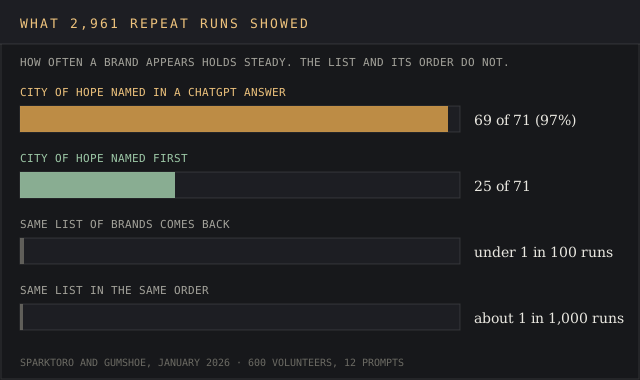
In 27 January 2026, SparkToro and Gumshoe had 600 volunteers run 12 prompts through ChatGPT, Claude and Google's AI 2,961 times. The same list of brands came back under 1 time in 100, and the same list in the same order under 1 time in 1,000.
Share of voice measured as visibility percentage held up across runs. City of Hope appeared in 69 of 71 ChatGPT answers about cancer care hospitals, a 97% visibility rate, yet it was the first name in only 25 of them. SparkToro's advice is to run each prompt at least 60 to 100 times and average the results.
Want a repeat-run chart like this for your own brand list? Send the prompts and the competitors.
Email a briefPrompt wording adds a second layer of noise. Across 142 prompts real people wrote about headphones, the study measured an average semantic similarity of 0.081, so buyers phrase one need in many ways. One prompt per topic is a drop in the bucket next to that spread.
How to measure share of voice in ChatGPT answers, step by step
To measure share of voice in AI answers, the method below turns a pile of answers into a share figure you can repeat every month. A spreadsheet handles a small competitor set, and paid share of voice tools take over once the panel grows.
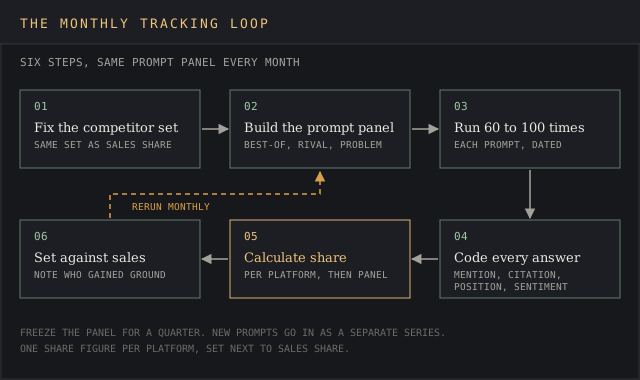
- Fix the competitor set. List the brands your buyers compare you with, the same set your market research and media share reports use.
- Build a prompt panel. Write prompts the way your target audience asks: best-of questions, alternatives to a named rival, and problem-first questions that never name a category.
- Run each prompt 60 to 100 times. Use logged-out sessions or an API, record the platform and date, and keep the wording fixed between months.
- Code every answer. For each brand, record a mention, a citation of its domain, position in the list, and a sentiment analysis score.
- Calculate share of voice. Divide your brand's appearances by all brands' appearances, per platform and for the whole panel.
- Compare and repeat. Set the figure next to sales share, note which competitors gained ground in the market conversation, and rerun the panel monthly to see if a campaign moved the share.
Step four is where voice analysis turns up the deeper insights. The coded answers show which rival the model names when you're missing, which domains it cites for each competitor, and where its account of what your brand stands for, from pricing to brand values, is wrong, which makes the list of areas to fix. An AI answer that misstates your price is misinformation and a brand reputation problem no share figure flags on its own.
- The category, platforms and competitor set to cover
- Regions, years and segments
- Where it runs: blog, white-label, gated or lead magnet
- Whose byline goes on it
- Deadline
- 2,500+ words, human-written
- Every figure linked to its source
- Yours to publish, under your name or none
- Hosting here for +$200, with your sponsored links
Keep an eye on the gaps between platforms. Brand Radar's methodology lists about 14.5 million monthly ChatGPT queries against 282 million for Google AI Overviews, so a pooled figure lets the bigger engine swamp the smaller one. Zero in on each platform's share of voice separately.
Share of voice tools for AI answers
Paid share of voice tools run the panel for you. Ahrefs Brand Radar refreshes ChatGPT, Perplexity, Gemini and Copilot data monthly over a 90-day reporting window.
In the site's August 2026 check, AIclicks started at $59 a month for 30 prompts and Brand Radar ran $199 to $699 a month. Ask any vendor which prompts it runs, how often and from which country before the number reaches a board deck. The competitive intelligence tools ranking covers the wider category.
What a good share of voice percentage looks like
A good share of voice is one above your share of sales. A 50% share of voice means your brand's share is half of all appearances in the tracked set, which is strong for a challenger with 15% of sales and merely level for one of the industry leaders holding half the category. AgencyAnalytics' KPI glossary calls 25% to 30% strong and anything below 10% limited visibility, while noting targets vary by industry.
That's why share of voice belongs next to market share in every report. A brand at 12% voice and 8% of sales carries 4 points of ESOV and, on Binet and Field's averages, is set up to grow. A brand at 12% voice and 25% of sales is losing the market conversation, and trend analysis should show it before the revenue line does.
Your market intelligence strategy sets which competitors, industry trends and questions matter, and the analysis step turns monthly share figures into a marketing strategy call on budget, content or digital marketing spend.
Mistakes that distort AI share of voice data
Most broken AI share of voice reports trace to one of five errors.
Reporting a ranking position. Order repeats less than once in 1,000 runs, so a ranked-second-in-ChatGPT claim describes one draw. The SparkToro authors called ranking-position figures from AI trackers unreliable and recommended visibility percentage across many runs.
Running each prompt once. A single run per prompt is a coin toss reported as a trend.
Matching brand names as strings. A brand called Notion or Monday matches every sentence that uses the word. Check a sample of matches by hand and match domains for citations, the way source attribution techniques trace each data point to its origin.
Mixing mentions and citations. A brand named in the text and a brand linked as a source are two different wins, and adding them inflates share of voice in answers where both happen.
Changing the panel between months. New prompts change the denominator, so a voice share gain can be an artefact of the new questions. Freeze the panel for a quarter and add prompts as a separate series. Skip any of the five and you cut corners into a number nobody can reproduce, on AI answers or when you run brand research on any other channel.
Delivered for your site and your byline. Hosting here is optional.
Frequently asked questions
What is share of voice in AI?
It's a brand visibility measure, the percentage of brand appearances in AI-generated answers that belong to your brand, across a fixed set of prompts and competitors. Mentions in the answer text and citations of your domain are counted separately.
How do you calculate AI share of voice?
Run each prompt 60 to 100 times, count how many answers name each brand, then divide your brand's count by the total for every brand in the set and multiply by 100. Calculate share per platform before combining the voice metrics.
What does 50% share of voice mean?
Your brand's share is half of all mentions, impressions or spend in the measured category. Above your sales share, it predicts growth.
What is the difference between market share and share of voice?
Market share measures sales against the category's total sales. Share of voice measures visibility, such as ad spend, impressions or mentions, against the category total.
How does ChatGPT recommend businesses?
OpenAI says product results come from the query, the user's context, structured metadata and review summaries from public websites, with ads kept separate. Merchants are ranked on factors like availability, price and quality.
What is the best software for tracking competitors in AI answers?
Ahrefs Brand Radar, SE Ranking, Search Atlas and AIclicks all sell AI visibility tracking.
Bottom line
Share of voice in AI answers is the oldest metric in advertising applied to the newest of the marketing channels. Count your brand's appearances across a fixed prompt panel, divide by every competitor's appearances, and set that share of voice next to sales share, the way Jones set media spend against sales in 1990.
The method fails when it trusts a single answer. With lists repeating under 1 time in 100 runs, a screenshot of ChatGPT recommending a competitor is one draw, and a budget moved on it is a budget moved on noise.
Calculate share of voice and ESOV in the share of voice calculator, which sets any channel's counts against your share of market.
PR agencies, SEO teams and AI visibility vendors use reports like this one in pitches, client reviews and budget calls.
A report on your topic for a blog page, gated content or a lead magnet.
Written for your client and published under their brand, with my name left off.
Your report on marketintelligencetools.com, with 2 to 3 CTAs carrying your sponsored links.
Default terms: the report is yours to publish, and I keep the right to republish it on this site behind a gate, outside Google's index.
Where each share of voice figure comes from, and what no tracker discloses
The 1990 budgeting argument is John Philip Jones in Harvard Business Review (store.hbr.org). The media-spend definition, the 2024 IKEA and La-Z-Boy figures and the Binet and Field result come from Nielsen's 2025 share of voice explainer. Impression share definitions and column names are from Google Ads Help (support.google.com). ChatGPT adoption is Pew Research Center's survey of 5,123 US adults, fielded 24 February to 2 March 2025.
Repeat-run figures are from SparkToro and Gumshoe's study published 27 January 2026 (sparktoro.com). The mention and citation split and the monthly query volumes are from Ahrefs' Brand Radar methodology (ahrefs.com). OpenAI's selection inputs are from its ChatGPT search shopping help article (help.openai.com).
The share bands are AgencyAnalytics' KPI glossary. The Reddit correlation and the AIclicks and Brand Radar prices are this site's own checks, dated in the text. Figures were checked 22 October 2026.
No AI visibility vendor publishes its full prompt list, its run count per prompt or the country it queries from, which is why the page asks for all three before a vendor's number gets reported.