Web scraping tools: 10 APIs, proxies, and frameworks ranked for 2026
 By Jan Suski. I go deep on every review, checking every number against its source and digging up details other coverage misses, a habit from six years of SEO and link building for tech companies. Bylines at Surfer, Brand24, and Senuto. How the scoring works.
· Prefer this source on Google
Quick comparison of web scraping tools
The table below orders all ten by final position. Coverage figures are each vendor's own published number, read on August 24, 2026; entry price is the smallest paid unit a vendor publishes.
| # | Provider | Coverage figure | Entry price | Best fit |
|---|---|---|---|---|
| 1 | Bright Data | 400M+ residential IPs, 195 countries | $8/GB residential ($4 promo) | Enterprise, compliance-heavy scraping at volume |
| 2 | TinyFish | 89.9% claimed Mind2Web accuracy; MCP-native | Free (Search/Fetch); Agent $0.016/step | Authenticated, multi-step scraping via AI agents |
| 3 | Oxylabs | 175M+ residential IPs, 100+ pre-built targets | $0.25/1,000 results | Recurring large-scale scraping with pre-built targets |
| 4 | ScrapingBee | 100+ country codes; dedicated Google/Amazon APIs | $49/month, 250,000 credits | Bundled JS rendering and CAPTCHA handling |
| 5 | Proxy-Seller | 47M+ residential IPs; 5 proxy types | $0.02/IP (IPv6) | Raw proxy infrastructure for an existing scraper |
| 6 | ScraperAPI | 40M+ proxies, 50+ countries | $49/month, 100,000 credits | One-call proxy, CAPTCHA, and JS rendering |
| 7 | Scrapy | 62,100 GitHub stars, 55,200 dependent repos | Free, open source | Python teams self-hosting a custom crawler |
| 8 | Crawlee | 25,200 GitHub stars, 165,462 weekly npm downloads | Free, open source | Node/TypeScript teams needing browser automation |
| 9 | Firecrawl | 166,200 GitHub stars; AGPL-3.0, self-hostable | Free (1,000 credits); $16/mo Hobby | LLM and RAG pipelines needing clean Markdown/JSON |
| 10 | Browse AI | 770,000+ users, 250+ prebuilt robots | Free (50 credits/mo); $48/mo Personal | Non-technical teams, no-code monitoring |
Coverage figures and prices above are each vendor's own published page, read August 24, 2026. Where a vendor lists more than one rate, the table states the smallest paid unit.
Where these figures come from
Every coverage and price figure above is the vendor's own published page, read August 24, 2026: Bright Data, Oxylabs, Proxy-Seller, ScraperAPI, ScrapingBee, Scrapy, Crawlee, Firecrawl, and Browse AI all state their own proxy pool size, GitHub statistics, or credit pricing directly on their own site.
TinyFish publishes no independent proxy count for its Browser API, so the table states its benchmark claim and MCP support instead. None of the ten vendors publishes a refresh cadence or a formal SLA outside its own status page, so no row claims one.
Bright Data and Oxylabs also appear in our company data providers ranking and alternative data providers ranking, ranked there for structured company records and investment-grade signals over raw scraping infrastructure.
Ten web scraping tools make this ranking, spanning a $0.002-a-minute browser API, a proxy network selling IPv6 addresses at two cents each, and an 18-year-old open-source Python framework with 62,100 GitHub stars, the whole nine yards for a category split across four different ways to buy.
What counts as one of the best web scraping tools changes with what a team already has: raw proxy infrastructure to plug into an existing scraper, a managed web scraping API that handles CAPTCHAs and JavaScript rendering, an open-source framework to self-host, or a no-code recorder for a team with no engineering budget to spend.
This guide compares all four categories side by side: published proxy pool sizes, credit pricing, GitHub activity, and real buyer complaints pulled from G2, Capterra, Trustpilot, and Hacker News threads dated through August 2026. Every price and figure below links to the page it came from.
The ranking leads with the largest published proxy network in the category, moves through an AI-native agent platform and two more proxy-and-API vendors built for volume, adds a dedicated proxy specialist and a developer-first API, then closes with two open-source frameworks, an LLM-focused crawler, and a no-code recorder for teams without a developer to spare, leaving no stone unturned across the four ways a team ends up buying a scraper.
Read the evaluation criteria below before the ranked list itself. Each of the ten placements traces to a number a buyer can check today. None of them rest on a subjective feel for polish.

Ranked #1 in this guide
See Bright Data's own numbers
400M+ residential IPs across 195 countries, from $8/GB pay as you go or $4/GB on the three-month promo, with 5,000 free monthly credits on new accounts.
 Visit Bright Data →
May earn a commission if you sign up through this link, at no extra cost to you. Full affiliate disclosure.
Evaluation criteria for web scraping tools
Six criteria decide the order below, and every one of them is a number a buyer can check without taking a vendor's word for it.
Anti-bot handling and agent-native integration
Anti-bot pass rate matters most against JavaScript-heavy, authenticated targets, so this criterion checks for a published test method and native MCP or agent tooling on AI-driven workflows, beyond a stated percentage alone.
Anti-bot blocks made up 12 of the 40 failures in TinyFish's own published benchmark, eight of them concentrated on one target site.
Proxy network size and geographic coverage
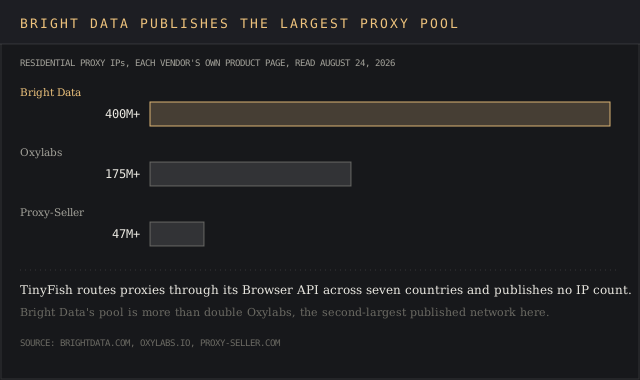
Published IP counts and country coverage set the ceiling on how many targets a tool can reach without tripping rate limits. Every proxy figure in this ranking comes from the vendor's own product page. None come from a marketing blog post, straight from the horse's mouth every time this ranking cites a number.
400M+ residential IPs, 195 countries
Check Bright Data's proxy coverage
The largest published proxy footprint in this ranking, backed by a 99.99% uptime guarantee.
Visit Bright Data →
May earn a commission if you sign up through this link, at no extra cost to you. Full affiliate disclosure.
Bundled extraction versus raw infrastructure
Some tools ship managed rendering, parsing, and CAPTCHA handling; others sell IPs alone and expect a buyer's own scraper on top. This criterion is a yes-or-no check on what comes included at the base price.
Eight of the ten tools ranked here offer a free plan or free credits, useful for testing API keys and credit limits before committing budget to a paid tier.
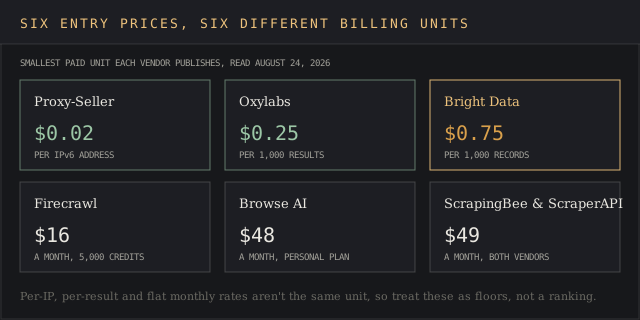
Entry price for the smallest usable unit
A per-IP or per-credit floor price shows what a single test run costs before any volume discount applies, a fairer comparison across tools that price in incompatible units.
Infrastructure model: managed versus self-hosted
A managed API comes with an uptime guarantee and no server to run; a self-hosted framework is free but puts hosting, proxies, and updates on the buyer. This criterion checks which model each tool commits to.
Scrapy ships no native JavaScript rendering and no built-in proxy handling. A JS-heavy target needs the separate scrapy-playwright add-on, and IP rotation is the team's own infrastructure to build.
Ecosystem size and independent validation
GitHub stars and dependent repositories measure the open-source frameworks; G2 and Capterra review counts and ratings measure the paid platforms. Both are countable signals a buyer can verify without emailing sales, a way to cut to the chase without waiting on a reply.
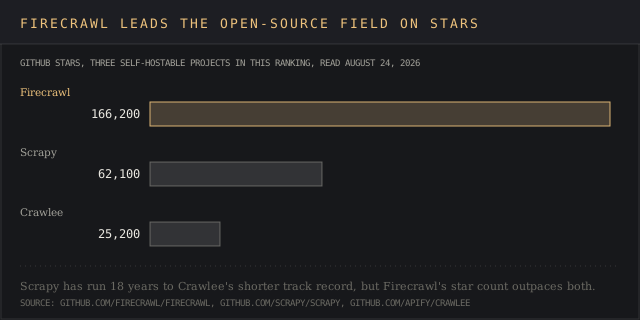
Firecrawl's GitHub star count, the largest open-source project ranked here, ahead of Scrapy's 62,100 across 18 years and Crawlee's 25,200.
Top 10 web scraping tools, ranked
Ranked on anti-bot handling, proxy network size, bundled extraction, entry price, infrastructure model, and ecosystem validation, in that order.
Bright Data
Best fit
Enterprise data teams running high-volume, compliance-sensitive scraping across hundreds of target sites. A poor fit for solo developers on a tight budget.
Bright Data runs 400M+ residential IPs, 1.3M+ ISP proxies, and 1.3M+ datacenter proxies across 195 countries (brightdata.com, accessed August 24, 2026), the largest published proxy footprint in this ranking.
Its Web Scraper APIs, SERP API, Web Unlocker, and Browser API cover structured extraction across 800+ sites, backed by a Dataset Marketplace of 600+ pre-collected domains and more than 5 billion regularly refreshed records.
Key features
- Web Scraper APIs from $0.75 per 1,000 records.
- SERP API from $1 per 1,000 requests across multiple search engines.
- Web Unlocker API from $1 per 1,000 requests for CAPTCHA and blocked-request handling.
- Browser API from $5/GB for remote stealth browser sessions.
- Dataset Marketplace covering 600+ pre-collected domains from $250 per 100,000 records.
- 5,000 free monthly credits on new accounts, renewing every month, across Web Unlocker, SERP API, Web Scraper API, and Scraper Studio, no card required. The Browser API joined that same pool in September 2026.
Pricing
Bright Data publishes these rates on brightdata.com/pricing, accessed August 24, 2026, with residential and ISP rates rechecked October 6, 2026.
- Residential proxies start at $8/GB pay as you go and fall to $5/GB on the 798GB plan, or $4 and $2.50 during the three-month RESIGB50 promo.
- Datacenter proxies run from $0.90/IP.
- ISP proxies cost $1.80/IP for 10 shared IPs, falling to $1.30/IP at 1,000.
The proxy pricing report sets those rates beside 12 other providers. Zone bandwidth limits recalculate only every 15 minutes, so usage can run over a configured cap for up to 15 minutes before enforcement catches up (docs.brightdata.com).
Pros
- The largest proxy footprint in this ranking, at 400M+ residential IPs across 195 countries.
- One vendor covers proxies, scraper APIs, unlocking, browser automation, and datasets, playing jack of all trades and cutting tool sprawl.
- A 99.99% uptime guarantee and a claimed 99.95% success rate.
Cons
- Entry-level accounts pay meaningfully higher per-unit rates than enterprise accounts, enough to cost an arm and a leg for a team just starting out, a recurring complaint on G2, though reviewers cite a limited dataset and tool range even more often.
- Dashboard spending limits are checked on a rough 15-minute cycle. An unbounded job can rack up real cost in that window before enforcement catches up.
- Corporate-tier discounts require serious volume commitments most small teams won't reach.
"A bit tricky to understand pricing as we are being provided with different information. From 0$ to 250$ or even 200 000$."
Monika V., IT Project Manager, G2, May 2026
The largest network in this ranking
Get started with Bright Data
One vendor for proxies, scraper APIs, unlocking, browser automation, and datasets, from $0.75 per 1,000 records.
Visit Bright Data →
May earn a commission if you sign up through this link, at no extra cost to you. Full affiliate disclosure.
Why it's ranked #1. Bright Data's 400M+ residential IPs, 195-country reach, and one vendor covering proxies, scraper APIs, unlocking, browser automation, and datasets beat every narrower specialist ranked below it, the breadth that puts it ahead of TinyFish's smaller, agent-only platform at #2. Its entry-level per-unit pricing still runs the highest of any tool in the top five, the tradeoff for owning the largest published footprint in the category.
TinyFish
Best fit
Data and engineering teams scraping authenticated, multi-step pages (logins, forms, dashboards) who want a managed, pay-per-step agent over building browser automation and anti-bot handling in house.
TinyFish sells four APIs: Search and Fetch are free on every plan, Browser runs $0.002 a minute, and Agent runs $0.016 a step, all funded from a wallet with no monthly minimum (tinyfish.ai/pricing, accessed August 24, 2026).
Its homepage claims 89.9% accuracy on the Mind2Web benchmark, a figure partly checked by a third party and worth reading between the lines on: analyst Mersault ran the separate WebVoyager benchmark, 641 tasks across 15 sites, and got 91.1% in May 2026 (tinyfish.ai/blog/most-accurate-ai-web-agent).
Key features
- Search API: free, 30 requests a minute on the self-serve tier.
- Fetch API: free, 150 URLs a minute, renders the page first and returns markdown, JSON, or HTML, never raw HTML.
- Browser API: a native stealth Chromium profile with residential proxy routing across seven countries bundled into every session.
- Agent API: turns a plain-language goal into a multi-step workflow, two concurrent runs on the self-serve tier.
- MCP-native support for Claude and Cursor, plus prebuilt connectors for n8n, Dify, and ChatGPT.
- Publishes all 300 execution traces behind its benchmark as a public spreadsheet for outside checking.
Pricing
Search and Fetch cost nothing, no strings attached; Browser runs $0.002 a minute and Agent $0.016 a step, wallet-funded with an $8 starting credit and no monthly minimum (tinyfish.ai/pricing). Enterprise pricing is custom.
Pros
- A free, permanent Search and Fetch tier with no card required.
- Publishes its benchmark's failure traces for outside review, unusual in this category.
- A $47M Series A led by ICONIQ Capital, with named production customers including Google, DoorDash, and Amazon.
Cons
- Zero submitted reviews on G2 or Gartner Peer Insights as of August 2026, so there's no independent buyer record to check a purchase against.
- Its own homepage (89.9%) and its own blog post (81%) currently disagree on the same Mind2Web benchmark by nine points.
- 12 of the 40 failures in its own benchmark were anti-bot blocks, eight of them concentrated on one site.
"The failure traces being public is a nice touch. Looked through a few and they're actual failures, not cherry-picked easy ones. Most companies in this space wouldn't do that."
ivywho, Hacker News, February 2026
"I assume you used your own product to hype up this post? I was excited about it till I saw this behavior. Please operate ethically next time."
pants2, Hacker News, February 2026
Why it's ranked #2. TinyFish is the only tool here with native MCP support on every plan and a free, uncapped Search and Fetch tier alongside its Agent API, an agent-integration edge nothing else in the top five matches. It ranks below Bright Data because a 400M+ IP network and five years more operating history outweigh TinyFish's zero G2 reviews and single year since founding, the proof gap that keeps an AI-native platform at #2, not #1.
Oxylabs
Best fit
Enterprise and mid-market teams running large, recurring scraping jobs (price monitoring, SERP tracking, AI training data) who can commit to real monthly volume.
Oxylabs runs 175M+ residential IPs and 20M+ mobile IPs across 195+ countries, with a claimed 99.95% average success rate on residential proxies and roughly a 0.6-second response time (oxylabs.io, accessed August 24, 2026).
Its Web Scraper API adds pre-built endpoints for Amazon, Google, ChatGPT, Gemini, Walmart, eBay, Target, and 100+ other named targets, and its OxyCopilot layer turns a URL plus a plain-language prompt into working scraping and XPath parsing code (oxylabs.io/oxycopilot-story).
Key features
- Web Scraper API from $0.25 per 1,000 results, varying by target.
- A 175M+ residential proxy pool with city-level targeting and sticky sessions up to 24 hours.
- Automatic CAPTCHA handling and JavaScript rendering, billed separately at $1.35 per 1,000 results.
- 30+ integrations including Cursor, LangChain, CrewAI, Zapier, and n8n.
- Pre-built scrapers for 100+ named sites, cutting custom parser work.
- 100 patents filed as of 2024, underpinning its XPath pattern-recognition layer.
Pricing
The Web Scraper API starts at $0.25 to $1.15 per 1,000 results with a $49/month minimum plan; residential proxies tier from $6/GB at a 5GB minimum down to $2.50/GB at a 1TB minimum (oxylabs.io/pricing, accessed August 24, 2026).
Pros
- 175M+ residential IPs and 20M+ mobile IPs across 195+ countries.
- Pre-built scrapers for 100+ named sites cut custom development work.
- A 99.95% average success rate on residential proxies, per the vendor's own published figure.
Cons
- JS rendering runs as a separate line item at $1.35 per 1,000 results, stacking on top of base pricing and adding insult to injury for anyone budgeting off the headline rate alone.
- The best corporate-rate discount needs a 1TB/month minimum to reach $2.50/GB.
- A G2 reviewer called support "one of the worst experiences I've ever encountered" (December 2025).
"It's definitely on the higher end cost-wise if you're not committing to decent volume."
Scott W., Media Specialist, G2, July 2026
Why it's ranked #3. Oxylabs' 100+ named pre-built scrapers beat ScrapingBee's smaller target list below it, but its 175M+ residential pool trails Bright Data's 400M+ above it, and its JS-rendering surcharge stacks on top of per-result pricing most rivals bundle in.
ScrapingBee
Best fit
Developers who need one API to render JavaScript-heavy pages and pull e-commerce or SERP data without maintaining headless-browser or proxy infrastructure.
ScrapingBee renders pages through headless Chrome by default for 5 credits a request, adds rotating or premium proxies for 10 to 25 credits, and runs a stealth proxy pool for the hardest sites at 75 credits a request, with geotargeting across 100+ country codes (scrapingbee.com/documentation, accessed August 24, 2026).
It also ships dedicated Google Search and Amazon APIs, the Google endpoint claiming a 99.9% success rate.
Key features
- Headless Chrome rendering with JS execution at 5 credits per request.
- A Google Search API returning organic results, knowledge graph, and ads in one call.
- An Amazon API with separate Product, Pricing, and Search endpoints.
- A stealth proxy pool at 75 credits per request for the toughest anti-bot sites.
- AI-powered extraction via ai_extract_rules and ai_query parameters.
- Native n8n, Make, Zapier, and MCP Server integrations for Claude and Cursor.
Pricing
Plans start at $49/month for 250,000 credits and 50 concurrent requests, scaling to $599/month for 8,000,000 credits, enough to cost an arm and a leg before the volume discounts kick in (scrapingbee.com/pricing, accessed August 24, 2026), plus a 1,000-credit free trial with no card required. Oxylabs' company group acquired ScrapingBee in June 2025.
Pros
- A 1,000-credit free trial with no card required.
- A 4.9/5 rating across 137 verified reviews on Capterra.
- Dedicated Google and Amazon endpoints beyond a generic HTML fetch.
Cons
- JS rendering costs 5x a plain request, and premium proxy jumps from 10 to 25 credits once JS turns on.
- The stealth proxy needed for the hardest sites runs 75 credits a request.
- The entry plan caps at 250,000 credits a month, around 50,000 JS-rendered scrapes before an upgrade, a reminder that money doesn't grow on trees once JS rendering eats credits five times as fast.
"Credits are consumed quickly when using JavaScript rendering or advanced features, making it harder to justify for smaller projects."
Nick S., Manager, Capterra, January 2026
Why it's ranked #4. ScrapingBee bundles headless rendering and a stealth proxy pool that Proxy-Seller doesn't offer below it, but its credit costs stack fastest under load of any API here, and it lists fewer pre-built targets than Oxylabs above it.
Proxy-Seller
Best fit
Teams running multi-account or multi-geo scraping workflows (SERP tracking, price monitoring, ad verification) who want raw proxy infrastructure to plug into their own scraper. A managed extraction API is the wrong shape for this buyer.
Proxy-Seller runs a 47M+ IP residential pool across 220+ locations with roughly a 0.35-second average response time, backed by ISO/IEC 27001:2022 certification and GDPR, CCPA, and DPA/SCC compliance documentation (proxy-seller.com/about-us, accessed August 24, 2026).
It plays jack of all trades on the infrastructure side, selling five proxy types under one account (residential, mobile, IPv4, ISP, IPv6), from $0.02 per IPv6 address to $10 per mobile IP, and reports 185,000+ users with 99.7% uptime.
Key features
- Five proxy types on one account: residential, mobile (Vodafone, T-Mobile, Orange, 20+ countries), IPv4, ISP (AT&T, Windstream, Frontier), and IPv6.
- HTTP, HTTPS, and SOCKS5 protocol support across IPv4, ISP, and IPv6.
- Rotation by time interval, by request, or sticky session, with session TTL control via API.
- An API with SDKs for PHP, Node.js, Python, Java, and GoLang.
- ISO/IEC 27001:2022 and ISO 9001:2015 certification, with GDPR, CCPA, and DPA/SCC compliance documentation.
- Unlimited bandwidth on IPv4 and ISP plans with channels up to 1 Gbps.
Pricing
IPv4 starts at $0.49/IP, IPv6 at $0.02/IP, ISP at $0.98/IP, and mobile at $10/IP (proxy-seller.com, accessed August 24, 2026). Residential proxies list a $1.30/GB figure in the page's meta description, but the visible pricing table runs $3.50/GB down to $2.20/GB at the 100GB tier, with a $1.99 three-day trial (proxy-seller.com/residential-proxies, accessed August 24, 2026).
Pros
- Five proxy types under one account and API, matching proxy type to target site without switching vendors.
- ISO/IEC 27001:2022 certification with published GDPR, CCPA, and DPA/SCC compliance documentation.
- A 4.8/5 rating across 154 reviews on G2.
Cons
- No bundled scraping API, parser, or unblocker layer; it sells proxy infrastructure only.
- The advertised $1.30/GB residential rate isn't the price a buyer sees on the live table; the real floor is $2.20/GB.
- Its Fair Use Policy threshold is undisclosed and dynamic, per a support exchange logged on G2, worth reading between the lines on before assuming a hard number.
"Their staff is live 24/7, not a bunch of BOTs. So I had to set up mobile proxies in an anti-detect browser. I do not have any technical experience but the customer support staff assisted me into a real quick setup."
David C., Paid Advertising Manager, G2, August 2026
Why it's ranked #5. Proxy-Seller's $0.02 IPv6 entry price undercuts every metered API ranked below it, but it ships no bundled rendering or unblocking layer the way ScrapingBee does above it, so a buyer still has to pair it with a scraper of their own.
ScraperAPI
Best fit
Developers and small-to-mid teams who want one API call to handle proxy rotation, CAPTCHAs, and JS rendering without running their own scraping infrastructure.
ScraperAPI routes requests through 40M+ proxies across 50+ countries and bundles JS rendering, premium proxies, and automatic bypass of Cloudflare, Datadome, and PerimeterX into every plan (scraperapi.com, accessed August 24, 2026). The company reports over 11 billion requests served in the trailing 30 days for 10,000+ customer companies, with a 99.9% uptime guarantee.
Key features
- Structured data endpoints for Amazon Product, Google Search, and Walmart Search.
- Bot-protection bypass for Cloudflare, Datadome, and PerimeterX at +10 credits when triggered.
- JS rendering through a single render=true parameter at +10 credits.
- Geotargeting by country code, though full global targeting needs the Business tier and above.
- An async API, a proxy port, and a DataPipeline service alongside the standard endpoint.
- Unlimited bandwidth on every tier, with no separate bandwidth bill.
Pricing
The Hobby plan starts at $49/month for 100,000 credits and 20 concurrent threads, scaling to $1,975/month for 21.5 million credits (scraperapi.com/pricing, accessed August 24, 2026). A 7-day trial includes 5,000 free credits with no card required. Credit multipliers stack: Google and Bing searches run 25 credits, LinkedIn 30, and bot-protection bypass adds 10 more on top of the base cost.
Pros
- A flat entry price with unlimited bandwidth included on every tier.
- 40M+ proxies across 50+ countries with no separate bandwidth bill.
- Over 11 billion requests served across 10,000+ customer companies in the trailing 30 days.
Cons
- Credit multipliers on SERP and social targets can turn a 1-credit scrape into 20 or more once JS and bypass both trigger, adding insult to injury on a plan already billed by the credit.
- Full global geotargeting is locked behind the $299/month Business tier.
- A Trustpilot reviewer reported an undisclosed 5-credit multiplier that shrank a 60-million-request plan to roughly 12 million usable requests.
"After paying, they applied a 5-credit multiplier without ever disclosing this upfront, which meant our 60M plan was only worth 12M requests, a massive shortfall."
verified user, Trustpilot, August 2025
Why it's ranked #6. ScraperAPI's 99.9% uptime guarantee and bundled CAPTCHA and JS handling beat Scrapy's fully self-managed setup below it, but its $49/month floor and stacking credit multipliers cost more at low volume than Proxy-Seller's $0.02-per-IP entry above it.
Scrapy
Best fit
Engineering teams comfortable writing Python who need a self-hosted, code-first framework for large or recurring crawls over a point-and-click tool.
Scrapy is a free, open-source Python crawling framework first released in August 2008, now carrying 62,100 GitHub stars, 11,600 forks, and 55,200 dependent repositories (github.com/scrapy/scrapy, accessed August 24, 2026). Its latest stable release, v2.16.0, shipped May 19, 2026 with official Python 3.14 support, and an experimental reactor-less mode landed the month before.
Key features
- Spiders: self-contained crawler classes defining how a site gets followed and parsed.
- Parsel selectors chaining CSS, XPath, and regex extraction in a single call.
- Item pipelines for post-extraction validation, cleaning, and storage hooks.
- A middleware, extension, and signal system for pluggable request and response processing.
- Built-in feed exports to JSON, CSV, and S3.
- An async engine on Twisted, with an experimental httpx-based download handler added in 2026.
Pricing
Free, under a BSD-3-Clause license (github.com/scrapy/scrapy). There's no vendor fee, but no bundled hosting or proxies either. Teams supply their own servers, their own proxy or anti-block layer such as scrapy-zyte-api, and their own JS-rendering add-on for any target that needs one.
Pros
- 62,100 GitHub stars and 55,200 dependent repositories, the largest install base of any tool in this ranking.
- 18 years of continuous development, with three releases shipped in the two months before August 2026, proof that if it ain't broke, this team keeps shipping anyway.
- Parsel selectors chain CSS, XPath, and regex extraction in a single call, without a second parsing library.
Cons
- No native JavaScript rendering; JS-heavy targets need the separate scrapy-playwright add-on.
- No built-in proxy or anti-bot handling, so IP rotation and CAPTCHA evasion are the team's own infrastructure to build.
- 437 open issues on the main repo at time of writing, the maintenance load of a widely used volunteer project.
"1,000 pages in ~8 minutes vs 2+ hours... ~$1-3 in tokens per website with Sonnet 4.5, not per page."
iranu, Hacker News, March 2026
Why it's ranked #7. Scrapy's 62,100 GitHub stars and 55,200 dependent repos beat Crawlee's smaller, younger install base below it, but it ships with no managed proxies or uptime guarantee, the gap that keeps ScraperAPI's bundled infrastructure ranked above it.
Crawlee
Best fit
Node.js and TypeScript engineering teams who want a code-first framework with built-in queueing, proxy rotation, and headless-browser support over hand-built Puppeteer or Playwright plumbing.
Crawlee is a free, open-source Node.js and TypeScript library maintained by Apify, carrying 25,200 GitHub stars, 1,600 forks, and 165,462 weekly npm downloads for the week of August 16-22, 2026, on a roll for a project still building its install base against Scrapy's head start (github.com/apify/crawlee, accessed August 24, 2026).
It ships three unified crawler classes: CheerioCrawler, PuppeteerCrawler, and PlaywrightCrawler, the last supporting Chromium, Chrome, Firefox, and WebKit in one interface.
Key features
- RequestQueue: a persistent, disk-backed URL queue supporting breadth- or depth-first crawls.
- SessionPool: rotates proxy IPs bound to cookies and headers, with retire and mark-good lifecycle controls.
- AutoscaledPool: scales concurrency automatically to available system resources.
- Three crawler classes covering plain HTTP parsing through full multi-browser automation.
- HTTP2 support with browser-like request headers via got-scraping.
- Full TypeScript typing with generics and a CLI project bootstrapper.
Pricing
Free, under the Apache License 2.0 (github.com/apify/crawlee). As with Scrapy, hosting and headless-browser compute are the user's own cost; Apify separately sells managed cloud hosting that can run Crawlee code, a fact worth knowing even though this ranking doesn't score the Apify platform itself.
Pros
- One unified API spanning plain HTTP scraping and full headless-browser automation.
- 25,200 GitHub stars and 165,462 weekly npm downloads, evidence of an active, non-abandoned project.
- Random session rotation built to avoid burning out a small proxy pool, the same logic behind not putting all your eggs in one basket, per its own session-management docs.
Cons
- Requires real Node.js and TypeScript proficiency; there's no mature Python-native path in the original package.
- A documentation gap was flagged directly by a Hacker News user the same week as the quote below.
- Its own docs concede: "Crawlee won't fix broken selectors for you (yet)"; layout changes still break scrapers same as any other tool.
"You'll want to prioritize documenting the existing features, since it's no good having a super awesome full stack web scraping platform if only you can use it."
mdaniel, Hacker News, July 2024
Why it's ranked #8. Crawlee's single API for HTTP and full multi-browser automation beats Firecrawl's hosted-first credit model below it on self-hosted flexibility, but its 25,200 GitHub stars trail Scrapy's 62,100 and 18-year track record above it.
Firecrawl
Best fit
Teams building LLM or RAG pipelines that need public pages converted into clean, structured Markdown or JSON, never raw HTML.
Firecrawl turns URLs into LLM-ready Markdown or structured JSON through /scrape, /crawl, /map, and /extract endpoints, with a core engine licensed AGPL-3.0 and MIT-licensed SDKs, carrying 166,200 GitHub stars (github.com/firecrawl/firecrawl, accessed August 24, 2026).
Hosted pricing starts at $16/month for 5,000 credits and runs to $599/month for 1,000,000 credits, with a free tier of 1,000 credits (firecrawl.dev/pricing).
Key features
- LLM-ready output in Markdown, HTML, structured JSON, and screenshots.
- An /extract endpoint for LLM-driven structured extraction from a prompt or JSON schema.
- A self-hostable core engine plus a hosted cloud version on proprietary infrastructure.
- SDKs across eight languages plus a native MCP server for Claude- and Cursor-style agent tooling.
- An /interact endpoint for click, fill, and navigate actions inside a scrape.
- Credit pricing at 1 credit per page for scrape, crawl, and map calls.
Pricing
The free plan gives 1,000 credits a month at 2 concurrent requests, no strings attached; Standard runs $83/month for 100,000 credits, Growth $333/month for 500,000, and Scale $599/month for 1,000,000 (firecrawl.dev/pricing, accessed August 24, 2026).
Pros
- Fully open source under AGPL-3.0 and self-hostable, avoiding lock-in for teams that want to run it themselves.
- 166,200 GitHub stars and 9,300 forks, among the largest open-source projects in this ranking.
- Eight-language SDK coverage plus a native MCP server for direct agent use.
Cons
- Developer and API-first, with no visual, no-code workflow builder.
- A TinyFish-run head-to-head test put Firecrawl at 1 of 6 successes against actively bot-protected sites. A competitor ran and published that test itself. No independent lab has measured it.
- Its own G2 review to date flags a real limit on anti-bot depth.
"Sometimes it's hard to get the depth right or it still hits anti bot mechanisms."
verified user, Consulting, G2, May 2026
Why it's ranked #9. Firecrawl's AGPL-3.0 self-hostable core and 166,200 GitHub stars beat Browse AI's closed, non-technical platform below it on developer control, but its /interact automation runs hosted and credit-billed over self-hosted free, the depth that keeps Crawlee ranked above it.
Browse AI
Best fit
Non-technical teams and solo operators who need point-and-click website monitoring and extraction with no engineering resource to spend.
Browse AI is a no-code scraping and monitoring platform built around a visual "robot" recorder that trains by clicking through a live page, no script required, hitting the ground running with no engineer (browse.ai, accessed August 24, 2026). It reports 770,000+ users and a marketplace of 250+ prebuilt robots for sites like Amazon, eBay, Airbnb, and LinkedIn, plus a Chrome extension with 100,000+ installs and a 3.9/5 rating from 44 raters on the Chrome Web Store.
Free plan, no card required
Try Browse AI
50 credits a month across 2 sites free, then $48/mo for the Personal plan.
May earn a commission if you sign up through this link, at no extra cost to you. Full affiliate disclosure.
Key features
- A visual, no-code robot recorder trained by clicking through the target page.
- 250+ prebuilt robot templates for common sites.
- Scheduled monitoring down to a 5-minute interval on the Professional plan, with change-detection alerts.
- Google Sheets sync plus Airtable, Zapier, Make, and 7,000+ connected apps in total.
- A REST API, webhooks, and CSV/JSON export, including Amazon S3 storage.
- A credit system where 1 credit covers 10 extracted rows or one screenshot.
Pricing
The free plan gives 50 credits a month across 2 sites; Personal runs $48/month ($19 billed annually) for 2,000 credits, Professional $87/month ($69 annually) for 5,000 credits, and Premium starts at $500/month for 600,000+ credits a year, proof money doesn't grow on trees once a workflow outgrows the free tier (browse.ai/pricing, accessed August 24, 2026). Harder, bot-protected sites carry a 2-10 credit minimum per run regardless of row count.
Pros
- A genuine no-code setup: robots train by clicking through the page, with no scripting required.
- A usable free tier (50 credits, 2 sites, 3 users) before any card is required.
- 770,000+ users and 250+ prebuilt robot templates for sites like Amazon and LinkedIn.
Cons
- Heavy JavaScript sites and bot protection need extra manual tweaking, per multiple reviewers.
- No support for two-factor-authentication-gated pages.
- Credit-based pricing scales up fast once a workflow needs more than the free tier's 50 credits.
"Websites protected by hCAPTCHA and reCAPTCHA and IFRAME doesn't work."
Feiga M., Manager, Capterra, March 2023
Why it's ranked #10. Browse AI's genuine no-code setup and 770,000+ users make it the clearest pick here for non-technical buyers, but it can't self-host, script, or convert pages to LLM-ready output the way Firecrawl does above it, the developer-facing coverage gap that puts it last.
What web scraping tools do
A web scraper sends a request to a target site, waits for the web page to load, then extracts web data from the raw HTML and turns it into structured output such as CSV or JSON. That data extraction step is what every tool on this list automates, at different points in the pipeline. Teams that scrape websites for a living rarely stop at one source, and extracting data from several sites at once is where the real complications start.
The scraping process differs by tool type: an API-based scraper like ScrapingBee runs that pipeline on someone else's servers, an open-source framework like Scrapy or Crawlee runs it on a team's own infrastructure, and a no-code solution like Browse AI replaces code with a point-and-click recorder. These web scraping applications cover most production cases, from a one-off script to a scheduled pipeline that has to retrieve data on a set interval.
Field names, date formats, and encoding rarely match across sources, so data pulled from different sources often needs extensive cleaning before it's usable downstream.
HTML parsing and structured data output
Node.js HTML parsing
Node and TypeScript teams typically pair Crawlee's CheerioCrawler with Cheerio itself for jQuery-style parsing, or PlaywrightCrawler for the best of both worlds when a page needs real browser rendering before its raw HTML becomes usable. For multi browser support, PlaywrightCrawler covers Chromium, Chrome, Firefox, and WebKit through one interface, the widest single-interface browser coverage in this ranking.
Python HTML parsing
Python teams reach for Beautiful Soup for straightforward HTML parsing, or Scrapy's own Parsel selectors, which chain CSS, XPath, and regex extraction against the raw HTML pages a target site returns. Scrapy remains the most widely adopted open-source tool for this kind of parsing at scale.
Proxy management, your own proxies, and rotation
Every tool here handles proxy management one of three ways: it bundles its own network and rotates IPs automatically, delivered as cloud services most API providers offer (Bright Data, Oxylabs, ScrapingBee, ScraperAPI), it sells raw IPs for a team to rotate itself the way an infrastructure seller does (Proxy-Seller), or it expects a team to bring its own proxies (Scrapy, Crawlee).
Frameworks with native proxy support built in, such as Crawlee, save a rotation layer many teams would otherwise build by hand, along with the retry logic and error handling that come with it.
IP blocking is the failure mode proxy and IP rotation exist to solve: a sticky session and a rotating pool answer different versions of the same problem, and most vendors above support both.
Bot protection, CAPTCHA handling, and JavaScript rendering
Bot protection on modern websites usually combines IP reputation checks, browser fingerprinting, and a CAPTCHA challenge, the whole nine yards for anything trying to look human. Static sites need none of this; dynamic sites and JavaScript heavy sites need a real browser session to load content before anything else runs, which is why JavaScript rendering and browser rendering carry a credit premium on every metered API here.
A TinyFish-run test put Firecrawl at 1 of 6 successes against actively bot-protected sites, a rival's own claim with no independent measurement behind it, and Firecrawl's own materials publish no pass rate of their own to weigh against it.
Automated CAPTCHA handling works well against common challenges but stalls against newer interactive checks, so a documented pass rate against currently protected sites beats a vendor's marketing claim. ScrapingBee's 75-credit stealth tier exists for heavy js sites that break under standard rendering.
No-code tools and the Chrome extension option
A no-code scraping solution trades scripting for a visual recorder, and Browse AI's Chrome extension is the fastest way into that model: install it, click through a target site once, and the resulting robot repeats those clicks on a schedule, ready to run again at the drop of a hat. It runs as a browser dashboard and extension. No desktop app, and setup needs no local install.
Browse AI's Chrome extension carries 100,000+ installs and a 3.9/5 rating from 44 raters on the Chrome Web Store, a useful gut check before training a robot against a site you rely on.
This fits real estate listings, social media platforms, and Google Maps results well, where the scraped data lives in a predictable, repeated layout and a user-friendly interface saves time over a code-based scraper. It fits a shifting layout poorly, since a no-code robot needs its manual setup redone every time a page changes, and teams that already run custom scrapers in Python rarely find a reason to switch.
Pricing models across the category
Every paid tool here bills one of three ways: a monthly plan with a fixed credit allotment (ScrapingBee, ScraperAPI, Firecrawl, Browse AI), metered usage billed per result or per gigabyte (Bright Data, Oxylabs, Proxy-Seller), or a wallet-funded, pay-per-step model with no monthly minimum (TinyFish).
A free plan exists on eight of the ten entries, useful for testing API keys and credit usage before committing budget, but free-tier limits (2-5 concurrent requests, 1,000-5,000 credits a month) rule out production scraping operations at real scale. Enterprise tiers on several vendors here also add dedicated account managers and custom contract terms, though none publish pricing for those.
Cost per credit keeps falling as monthly volume climbs, a pattern that holds beyond this ranking's ten tools too. ScraperAPI's Business plan runs about $0.0000997 per credit at 3,000,000 credits for $299 a month (scraperapi.com/pricing, accessed August 24, 2026).
Firecrawl's per-credit rate drops from $0.0032 on the $16 Hobby plan to $0.000599 on the $599 Scale plan, a 5.3x compression as monthly volume climbs.
ScrapingBee's Business pack lands close behind at roughly $0.000083 per credit for the same 3,000,000-credit volume at $249 a month (scrapingbee.com/pricing, accessed August 24, 2026).
Firecrawl's own tiers show the same slope, from $0.0032 a credit on the $16 Hobby plan down to $0.000599 a credit on the $599 Scale plan (firecrawl.dev/pricing, accessed August 24, 2026).
Two scraping APIs outside this top ten follow the same curve. Scrapingdog prices its Pro plan at $200 a month for 3,000,000 credits, about $0.000067 per request (searchcans.com/blog/scrapingdog-api-cost-request-pricing, accessed August 24, 2026).
Zenrows' Scale plan reaches roughly $0.0000912 per credit at 5,000,000 credits for $456 a month (zenrows.com/pricing, accessed August 24, 2026).
Legal and ethical scraping
Scraping legality depends on three things: a target website's terms of service, the data's copyright status, and the presence of personal data. Robots.txt access alone decides none of it. Robots.txt is a set of crawler instructions. It carries no legal authorization on its own, per Google's own developer documentation.
A scrape that touches personal data falls under GDPR and CCPA even when the source page was public. Reselling that data without a legal basis carries real exposure beyond a target's own terms of service, skating on thin ice long after the scrape itself is done.
Many websites publish scraping restrictions in their terms directly, and the safest data collection process respects rate limits, avoids logged-in or paywalled content without permission, and never resells personal data pulled from complex websites without a legal basis.
How to choose a web scraping tool
Cut to the chase and match the tool to the team. Self-hosted frameworks require technical skills and time that a managed API doesn't: Scrapy or Crawlee give the most control and the lowest per-record cost, but only to a team ready to run scraping operations itself. A team that wants to skip scripting entirely gets there faster with Browse AI, which exports straight to Google Sheets, or a managed API.
Budget, target site difficulty, and existing tech stack are the three key factors that should decide before price does, since the cheapest tool on paper often costs more once engineering hours go into building the retries, rotation, and error handling a managed API already includes. Teams scraping for market research or feeding an LLM pipeline with high-volume data pipelines tend to land on a managed API for exactly that reason.
A team scraping mostly js heavy pages should weight JavaScript rendering higher than proxy pool size when comparing tools. A team pulling mostly static pages can weight it lower and save on credits.
Web scraping tools FAQ
What is the best tool for scraping?
Bright Data leads this ranking on proxy network size and one-vendor coverage across proxies, scraper APIs, and datasets, but TinyFish fits a team building AI-agent workflows, Scrapy and Crawlee fit a team that already knows the ropes and wants to self-host, and Browse AI wins for a team with no developer at all.
Is web scraping illegal?
Not by itself. Legality depends on a target website's terms of service, the data's copyright or personal-data status, and the jurisdiction involved.
What are scraping tools used for?
Price tracking, SERP tracking and SEO monitoring, ad verification, lead generation, real estate listings, and building datasets for AI and LLM training are the most common uses among the tools ranked here, par for the course for a category built to feed production data pipelines.
What are the three types of scrapers?
API-based scrapers (ScrapingBee, ScraperAPI, Oxylabs), open-source frameworks (Scrapy, Crawlee), and no-code visual recorders (Browse AI) cover the three practical types a buyer chooses between, each a modern take on what the industry used to call screen scraping.
Can ChatGPT do web scraping?
Not reliably on its own. ChatGPT can write scraping code or summarize a page pasted into it, but it has no built-in proxy rotation, JavaScript rendering, or CAPTCHA handling, the reasons dedicated scraping tools exist.
Is web scraping free?
Eight of the ten tools in this ranking offer a free plan or free credits, but every free tier caps concurrency and monthly volume too low for production scraping jobs.
Which AI tool is best for web scraping?
TinyFish and Firecrawl are the two AI-native picks here: TinyFish for multi-step, authenticated agent workflows, and Firecrawl for turning a target website into clean Markdown or JSON for an LLM pipeline.
Bottom line
Bright Data wins this ranking for teams running high-volume, compliance-sensitive scraping across hundreds of targets, on the strength of the largest published proxy footprint in the category, 400M+ residential IPs across 195 countries, and one vendor covering proxies, scraper APIs, unlocking, browser automation, and datasets.
TinyFish is the pick for teams building AI-agent workflows against authenticated, multi-step targets, on a free Search and Fetch tier, native MCP support, and a benchmark a third party partly reproduced at 91.1%, though it carries a single year of operating history against Bright Data's larger, proven buyer base.
Proxy-Seller is the cheapest entry point for a team that already owns a scraper and just needs IPs, and ScrapingBee or ScraperAPI cover the middle ground, the best of both worlds: one API call, bundled JS rendering, no infrastructure to run. Scrapy and Crawlee remain the right call for engineering teams that want to self-host and pay nothing beyond compute, and Browse AI is still the fastest path in for a team with no developer at all.
The #1 pick above
Start with Bright Data
One vendor covering proxies, scraper APIs, unlocking, browser automation, and datasets, with residential traffic from $8/GB pay as you go, $4 on the three-month promo.
Visit Bright Data →
May earn a commission if you sign up through this link, at no extra cost to you. Full affiliate disclosure.