Content marketing statistics 2026: 92.4% of bloggers use AI, 13.9% report strong results
 By Jan Suski. I go deep on every review, checking every number against its source and digging up details other coverage misses, a habit from six years of SEO and link building for tech companies. Bylines at Surfer, Brand24, and Senuto. How the scoring works.
The numbers Content marketing surveys, search and budgets, checked 4 October 2026
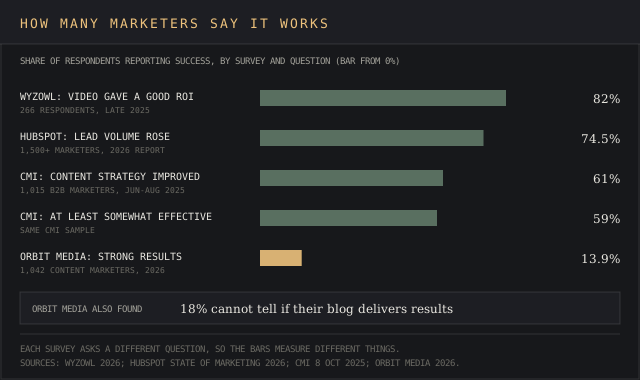
Self-reported success runs from 13.9% at Orbit Media to 82% at Wyzowl, a 68-point spread set by who each survey asks and what it counts as success.
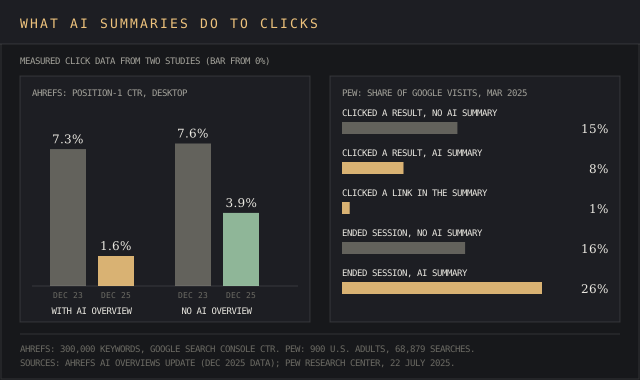
Measured click data shows the price of AI search for content marketing, with the top Google result losing 58% of its click-through rate on AI Overview keywords.
Budgets aren't rising to fund new marketing efforts, holding at 7.8% of revenue in Gartner's survey and 9.0% in The CMO Survey.
Orbit Media's 2026 survey of 1,042 content marketers found 92.4% now use AI to blog, while 13.9% say their blog delivers strong results, the lowest share since Andy Crestodina's annual blogging survey began. For the 12 years before, that figure sat between 20% and 30%.
These are the latest content marketing statistics from CMI, HubSpot, Gartner, Wyzowl, Ahrefs, Pew and Orbit Media, covering blogging, B2B content marketing statistics, AI, video, social, email, search and budgets, then why the houses disagree.
The figures matter to marketing leaders who quote content marketing statistics in budget decks, because budgets sit flat at 7.8% of revenue while AI Overviews cut top-result clicks by 58%.
Content marketing statistics on blogging: 13.9% of 1,042 marketers report strong results
Orbit Media asks 1,000-plus content marketers the same 24 questions each year, and the 2026 edition is its 13th. The headline numbers:
- The average blog post ran 1,312 words, down from a peak of 1,427 in 2023.
- Writing one took 3 hours 20 minutes, down from 4 hours 10 minutes in 2022.
- 92.4% use AI for blogging, a share Orbit says rose from virtually zero in three years.
- 18% of content marketers say they don't know if their blog delivers results, against 9% to 14% for the decade before.
Orbit calculates the average content marketer now spends 50 fewer hours a year writing than in 2022, at 57 posts a year and 50 minutes saved per post. Over the same stretch, the share reporting strong results fell from 26% to 14%.
AI users and non-users were equally likely to report strong results. The 92.4% who jumped on the bandwagon got faster blog articles and the same odds of success.
Blogging still pays for some companies. HubSpot's statistics page says small businesses are 23% more likely than average to see ROI from blog posts.
The content marketing strategies that correlate with strong results are the ones marketers dropped:
- Influencer collaboration is the best predictor in the dataset, at 2.6 times the benchmark, and fell from 25% of marketers in 2017 to 7%.
- Publishing original research raises the likelihood of strong results by 50%.
- Updating older articles peaked at 73% between 2020 and 2022.
- Publishing two to six times a week fell from 28% of marketers in 2014 to 12% by 2022.
- Keyword research, visual content, formal editing & paid promotion all declined, and replacing human editors with AI rose.
Marketers who use six or more of Orbit's eight content marketing strategies are nearly three times as likely to report strong results. None of the 1,042 goes the whole nine yards with all eight.
Keyword research still correlates with results in Orbit's data. Content marketing tools such as Positive Surfer score drafts for search engine optimization against the terms ranking pages use, and the content intelligence tools ranking compares the category.
B2B content marketing statistics: 59% of 1,015 marketers rate themselves effective
CMI's B2B Content and Marketing Trends: Insights for 2026, run with MarketingProfs and sponsored by Storyblok, was fielded from June 24 to August 14, 2025, and published on October 8. It covers 1,015 B2B marketers, mostly in North America.
12% rated their marketing highly effective and 47% somewhat effective, so 59% met most goals or better. Another 31% reported mixed results and 10% fell short.
Content marketing strategies are near universal in B2B, with 97% holding one. 61% of B2B marketers say their content marketing strategy improved over the year, 74% point to strategy refinement as a driver, and 51% credit new technology.
| Challenge (respondents picked three) | Share of B2B marketers |
|---|---|
| Creating content that prompts a desired action | 40% |
| Resource constraints: time, people, budget | 39% |
| Measuring content effectiveness | 33% |
| Creating enough quality content | 28% |
| Differentiating content from competitors | 24% |
| Aligning content with the buyer's journey | 23% |
Source: CMI and MarketingProfs, B2B Content and Marketing Trends: Insights for 2026, 1,015 B2B marketers.
Thought leadership, LinkedIn and first-party data
96% of B2B marketers say their organization creates thought leadership. B2B marketers rely on LinkedIn, rated the most effective thought-leadership channel by 76%, followed by email newsletters at 54% and webinars or speaking events at 52%, and 63% measure it by business impact such as lead generation and pipeline.
91% of B2B marketers report collecting first-party data, and 68% gather it through content such as gated assets, webinars and interactive tools. Personalization stays shallow. 89% personalize content, 59% call their approach basic, and 85% personalize email marketing campaigns, against 34% for social media content.
Buyers now read AI answers before they talk to sales. Gartner research presented on May 11, 2026, found 60% of B2B buyers and 47% of consumers consulted a GenAI tool or chatbot for a recent purchase decision, per its Marketing Symposium highlights. In Backlinko's 2019 study of 912 million posts with BuzzSumo, 93% of B2B content earned zero links from other websites.
Where B2B marketing budgets go in 2026
B2B marketers' top picks for more 2026 investment, three allowed:
- AI-powered marketing tools: 45%
- Events and experiential marketing: 33%
- Owned media such as content assets, website, blog and email: 32%
- Paid media: 25%
- Marketing technology infrastructure such as martech, analytics and CRM: 21%
- Social media and earned media: 20%
- Salaries, training and development: 9%
People sit last on that list, and CMI's Robert Rose wrote about the ranking:
"Better technology won't save mediocre teams. Without skilled, empowered marketers, all AI can do is make mediocrity faster, louder, and more efficient."
Robert Rose, Content Marketing Institute, B2B Content and Marketing Trends: Insights for 2026, October 8, 2025
B2B content marketing teams turning these figures into a marketing strategy can start from the messaging framework template, and the digital marketing intelligence ranking covers tools that track competitors' content.
AI tools in content creation: used by 86.4% to 95% of marketing teams
Every 2026 content marketing survey puts AI adoption above 85%, and the spread comes from the question wording. HubSpot found 86.4% of marketing teams use AI in at least a few areas, CMI found 95% of B2B marketers' organizations use AI-powered applications, and Orbit Media counted 92.4% of bloggers.
- Content creation: 42.5% of HubSpot's respondents use AI tools extensively and 38% occasionally, 80.5% combined.
- Media creation: 37.2% extensively and 37.7% occasionally.
- Market research on trends and consumer behavior: 35% of CMI's B2B marketers use AI tools for it.
- AI agents: 28% of B2B marketers experiment with them, and 21% of those see better customer engagement.
HubSpot's marketing statistics page adds that about 94% of marketers plan to use AI in content creation in 2026. 83.5% of marketers say they're expected to produce more content, and 35.7% much more. 69.2% say they can use customer data to create personalized experiences.
Among CMI's AI users, 87% of marketers report higher productivity, 58% saw content quality improve and 12% saw it fall. Only 39% saw content performance improve, so the jury's still out on AI copy that sells.
Edison Research's Infinite Dial 2026 found 57% of Americans 12 and older have used a generative AI assistant, and the AI statistics report tracks adoption outside marketing.
Video marketing statistics: 91% of businesses use video
Wyzowl's 2026 survey of 266 respondents, fielded in late 2025, found 91% of businesses use video as a marketing tool and 93% of video marketers call it an important part of their marketing strategy, per its annual video survey. 82% of marketers say video gave them a good ROI, down from 93% a year earlier.
- 85% of video marketers say video content helped them generate leads.
- 83% say it directly increased sales, and 93% say it helped improve brand awareness.
- 82% say video content raised their web traffic.
- 63% have used AI video tools, 41% spent money on video ads, and 92% of video marketers plan to spend the same or more in 2026.
For product education a picture is worth a thousand words, and consumers prefer video, with 63% of Wyzowl's consumers picking a short video to learn about a product, 12% a text article, and 85% convinced to buy by one.
| Media format | Share of marketers naming it a top-ROI format |
|---|---|
| Short-form video | 48.6% |
| Long-form video | 28.6% |
| Live-streaming video | 25.1% |
| User-generated content | 24% |
| Blog posts | 22.3% |
| Podcasts and audio | 0.2% |
Source: HubSpot 2026 State of Marketing report, 1,500-plus B2B and B2C marketers. Visual content holds the top three ROI slots, every one of them a video format.
Short-form video also leads usage, at 60% of marketers in 2025 on HubSpot's statistics page, ahead of long-form video and blog posts at 38% each. U.S. digital video ad revenue grew 25.4% to $78 billion in 2025, per the IAB and PwC Internet Advertising Revenue Report. YouTube, used by 82% of Wyzowl's video marketers, has its own figures in the YouTube statistics report.
Social media marketing statistics: Instagram used by 70% of brands
HubSpot's social media statistics show Instagram passed Facebook as the most popular social media platform for brands in its 2026 survey, at 70% against 69.6%. TikTok reached 54.5% of brands as a social media platform and X 55.8%.
- Organic social media content is used by 40.3% of brands and paid social media ads by 39.4%.
- Website, blog & SEO is the top ROI channel at 27%, with paid social media second at 25.9%.
- 49.4% of social media marketers reuse the same content on every social media channel, and 39.5% tailor it to each social media platform.
Emplifi CMO Susan Ganeshan advises defining the target audience on each social media platform first. Social media marketing money keeps flowing, and paid advertising on social media drew $117.7 billion of U.S. digital ad spending in 2025, up 32.6%, and search took $114.2 billion, the lion's share of the $294.6 billion total. The social media statistics and Instagram statistics reports break the platforms down.
Email marketing statistics: 22% rank email a top-ROI channel
Email marketing ties with organic social media as the second most used channel at 40%, and 22% of marketers rank it among their top ROI channels, per HubSpot, which puts the average email click-through rate across industries at 2.5%.
Litmus's 2025 State of Email survey of nearly 500 marketing professionals found 35% earn $10 to $36 for every $1 spent on email marketing, 30% earn $36 to $50 and 5% earn more than $50. 21% don't measure email marketing ROI, down from 36% in 2023, per its email ROI page.
Podcast listeners hit a record, with 58% of Americans 12 and older consuming a podcast in the past month per Edison, and the podcast industry statistics cover the ad side.
Organic search and AI Overviews: a 58% lower click-through rate for the top result
Ahrefs compared 300,000 keywords on Google's search engine using Search Console data. For keywords that show an AI Overview, the average organic search click-through rate at position one fell from 7.3% in December 2023 to 1.6% in December 2025. For informational keywords without one, it fell from 7.6% to 3.9%. The AI Overview correlates with a 58% lower rate.
Pew Research Center tracked the browsing of 900 U.S. adults in March 2025, covering 68,879 Google searches. Visits with an AI summary ended in a result click 8% of the time, against 15% without one, and 1% clicked a link inside the summary. 26% of summary visits ended the browsing session, against 16% for standard results, per Pew's July 22, 2025 analysis.
The Reddit AI visibility study and the AI traffic report measure what AI referrals send back to company websites.
Marketers are reworking SEO strategies as search rankings lose clicks. 40.6% of HubSpot's respondents are updating SEO for search changes, and 70.2% believe they can adapt their digital marketing strategy to changes in organic search. HubSpot expects buyers to reach websites later in the buying process, better informed. Orbit Media's Crestodina describes how AI-referred buyers arrive:
"If AI recommended the brand, the buyer then clicks a citation or searches for the brand or types in the domain directly. They're ready to act."
Andy Crestodina, co-founder, Orbit Media, Blogging Statistics 2026
Content marketing still leans on links for search rankings, and links are hard to earn. Backlinko found content over 3,000 words earned 77.2% more referring-domain links than content under 1,000 words, and 94% of the 912 million posts earned zero external links. The search engine marketing statistics report covers paid search.
- Search engine optimization work competes for budget, and 35.4% of HubSpot's respondents plan to raise website, blog & SEO spending.
- Voice search optimization is used by fewer than 10% of marketers, and 73.7% of marketers plan to maintain or increase that investment.
- More than 6 billion global internet users were online in Kepios's Digital 2026 report, 73.2% of the world's population, and mobile devices requested 59.14% of web pages in August 2025.
Content marketing budgets: 7.8% to 9.0% of company revenue
Gartner's 2026 CMO Spend Survey of 401 marketing leaders in North America, the U.K. and Europe, fielded January to March 2026, puts marketing budgets at 7.8% of company revenue, against 7.7% in 2025.
- CMOs give 15.3% of marketing budgets to AI initiatives, and AI-ready organizations give 21.3%.
- 56% of CMOs say they lack the budget to deliver their 2026 marketing strategy, and 54% report insufficient resources.
"CMOs are being asked to deliver growth, efficiency and transformation without meaningful budget expansion."
Ewan McIntyre, VP Analyst, Gartner, CMO Spend Survey release, May 11, 2026
The CMO Survey's 35th edition, 308 U.S. marketing leaders published on March 31, 2026, puts budgets at 9.0% of revenue and 9.6% of company budgets, its lowest share in several years, with spending up 1.7%. Managing revenue growth joined marketing's formal duties, while training fell to 3.8% of marketing spend.
Among HubSpot's respondents, 79.2% expect at least a slight budget increase in 2026 and 6% expect a cut. 73% say their budget gets more scrutiny than in the past, par for the course when the revenue share stays flat. Marketers plan to raise spending on:
- AI chatbots such as ChatGPT, Perplexity, Gemini and Claude: 37.7%
- Paid social media: 37.4%
- Video marketing: 37.1%
- Content marketing: 36.9%
Content marketing ROI is the hardest number to produce. Measuring marketing ROI is the top challenge for 33% of HubSpot's respondents, keeping up with the latest trends follows at 29.8%, and 19.5% struggle to adopt a data-driven marketing strategy. HubSpot's report lists data analysis among three must-have skills for 2026.
Paid advertising rates sit in the advertising industry statistics. A competitive analysis template helps size rivals' content marketing efforts against paid advertising.
Why the published content marketing statistics diverge
Three kinds of content marketing statistics circulate under one label. Survey figures are marketers describing their own programs. Measured figures come from click logs and browsing panels. Market-size figures depend on what each research house counts as content marketing.
Content marketing market size: $539.3 million in growth to $2.1 trillion
| Research house | Edition | Figure | Growth rate |
|---|---|---|---|
| Market Research Future | 2026-2035 | $561.46B in 2025, $631.53B in 2026, $1,927.30B in 2035 | 12.48% CAGR |
| Business Research Insights | 2026-2035 | $655.1B in 2026, $2,100.28B in 2035 | 13.82% CAGR |
| Technavio | 2025-2029 | Growth of $539.3 million from 2024 to 2029 | 13.9% CAGR |
| Technavio press release | August 17, 2022 | Growth of $487.24 billion forecast | Headline gives growth only |
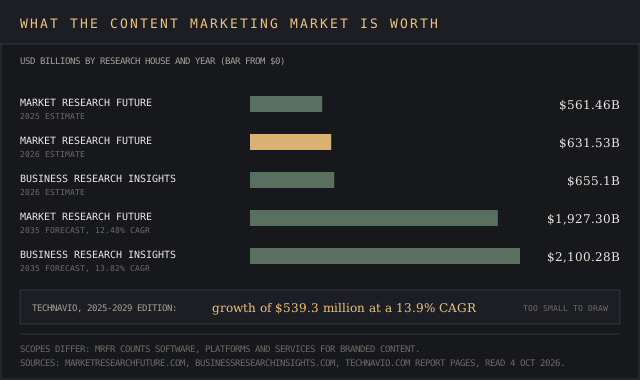
MRFR defines the market as software, platforms and services for creating, managing, distributing and measuring branded content, and puts video at $212.68 billion of its 2025 total. Technavio sizes its retail segment at $130.70 million in 2023, so its whole market is a drop in the bucket next to MRFR's $631.53 billion. MRFR's forecast passes $1,010.79 billion in 2030 and nears $2 trillion by 2035.
Technavio's own August 2022 release forecast $487.24 billion of growth, so the same house moved from billions to millions within three years. MRFR names Adobe, HubSpot, Salesforce and Semrush among the vendors it sizes, and the Adobe Semrush acquisition report covers the deal between two of them.
Survey samples behind the latest content marketing statistics: 266 to 1,500-plus respondents
| Survey | Sample | Who answered | Headline figure |
|---|---|---|---|
| Orbit Media blogging survey 2026 | 1,042 | Content marketers | 13.9% report strong results |
| CMI Insights for 2026 | 1,015 | B2B marketers, mostly North America | 59% at least somewhat effective |
| HubSpot State of Marketing 2026 | 1,500-plus | Global B2B and B2C marketers | 74.5% saw lead volume rise |
| Wyzowl video survey 2026 | 266 | Marketers and consumers, late 2025 | 82% report a good video ROI |
| Gartner CMO Spend Survey 2026 | 401 | CMOs, mostly at $1B-plus firms | 7.8% of revenue on marketing |
| The CMO Survey, 35th edition | 308 | U.S. VP-level marketing leaders | 9.0% of revenue on marketing |
Read between the lines of each sample. CMI reaches a community it puts at 215,000-plus content marketers, and Storyblok, a headless CMS vendor, sponsors the survey. HubSpot's report promotes its Marketing Hub, and Wyzowl sells video production to the marketers it surveys.
Wording moves results. HubSpot found 24.5% of marketers saw lead volume rise sharply and 50% somewhat, 74.5% combined, and over half, 55.7%, say it's easier to generate leads than a decade ago. Yet 30% still name lead generation a top challenge, and 65% say they have high-quality audience data for data-driven insights.
Talk is cheap next to click logs. Wyzowl's 82% and Orbit's 13.9% come from self-reports, while Ahrefs and Pew measured clicks with no respondent in the loop.
The surveys, click studies and research houses behind each figure
Marketer surveys, checked 4 October 2026: orbitmedia.com (Blogging Statistics 2026, the 13th annual survey), contentmarketinginstitute.com (B2B Content and Marketing Trends: Insights for 2026, 8 October 2025), blog.hubspot.com and hubspot.com (2026 State of Marketing, updated 10 April 2026, and the marketing statistics page) and wyzowl.com (Video Marketing Statistics 2026).
Budgets and email: gartner.com (CMO Spend Survey and Marketing Symposium highlights, both 11 May 2026), cmosurvey.org (35th edition, 31 March 2026) and litmus.com (2025 State of Email).
Measured data and ad spending: ahrefs.com (AI Overviews click study, December 2025 data), pewresearch.org (22 July 2025), backlinko.com (2019 content study with BuzzSumo), iab.com (IAB and PwC Internet Advertising Revenue Report, 16 April 2026), edisonresearch.com (The Infinite Dial 2026) and datareportal.com (Digital 2026).
Market size: marketresearchfuture.com and businessresearchinsights.com (2026-2035 editions), technavio.com (2025-2029 edition) and prnewswire.com (Technavio release, 17 August 2022). The six surveys draw on six samples, from 266 to 1,500-plus respondents, and the research houses count different things as the content marketing market, so no figure here converts into another.
Frequently asked questions
What are the latest marketing statistics for 2026?
Marketing budgets sit at 7.8% of company revenue in Gartner's 2026 survey, 86.4% of marketing teams use AI per HubSpot, and U.S. internet advertising revenue reached $294.6 billion in 2025, up 13.9%, per IAB.
What are some key content marketing stats?
13.9% of content marketers report strong blog results and 92.4% use AI, per Orbit Media.
What is content marketing mainly about?
Publishing material buyers want, such as articles, video, newsletters, research and events, to attract and keep customers. In CMI's survey, 97% of B2B marketers run a content marketing strategy, and the most cited challenge is creating content that prompts a desired action, at 40%.
What are some interesting statistics about video marketing?
91% of businesses use video and 85% of consumers have been convinced to buy by one, per Wyzowl.
What are the key content marketing trends for 2026?
Nearly half of HubSpot's respondents (48.57%) are exploring AI-personalized content, followed by automation (47.38%), brand-values content (46.84%), updating SEO for search changes (40.60%) and repurposing (35.08%).
Is marketing growing or declining?
Budgets are flat at 7.8% of revenue in 2026 against 7.7% in 2025, per Gartner, while U.S. internet ad revenue grew 13.9% in 2025, per IAB.
Bottom line
Content marketers adopted AI almost to a person, and the share reporting strong results fell to 13.9%, an all-time low in Orbit Media's data. CMI's B2B marketers rate themselves higher, at 59% effective, and the gap between those content marketing statistics comes from who each survey asks. The content marketing strategies that still correlate with results are the ones fewer teams use.
Measured data is harsher. AI Overviews cut organic traffic to the top result, with a 58% lower click-through rate in Ahrefs' data, and content marketing ROI stays hard to prove on budgets of 7.8% to 9.0% of revenue. Any marketing strategy built on these figures should quote the house, the sample and the date, and keep an eye on CMI's next annual report, due in October if it follows the 2025 timing.