MarketMuse review: 27 inventory metrics behind a quote-only price
 By Jan Suski. I go deep on every review, checking every number against its source and digging up details other coverage misses, a habit from six years of SEO and link building for tech companies. Bylines at Surfer, Brand24, and Senuto. How the scoring works.
Best for
A content strategist planning topic clusters across a whole site, who wants a documented inventory score for every published page before deciding what to write next.
Not for
A solo blogger or small team that wants to see a price before booking a call. Every paid tier, Optimize through Strategy, sits behind "Book a demo," with no rate card published anywhere on the site.
What it costs
Free covers 10 content intelligence queries a month for one user & nothing else. Optimize, Research & Strategy scale tracked topics from 100 to 10,000 and content briefs from 5 to 20 a month, each gated behind a sales call with no published dollar figure.
- Free
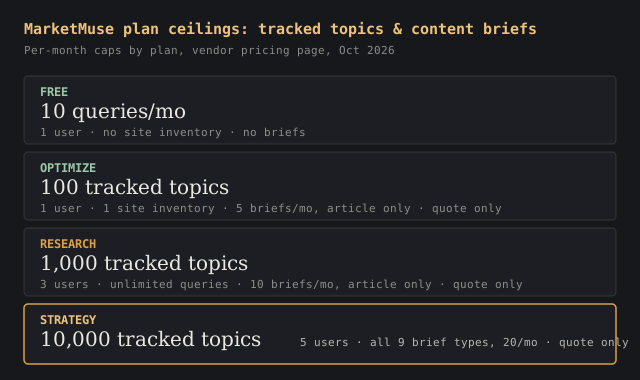
- 10 queries/mo, 1 user, no site inventory, no content briefs
- Optimize
- 1 user, 100 tracked topics, 1 site inventory, 5 article briefs/mo, quote only
- Research
- 3 users, 1,000 tracked topics, 10 briefs/mo (article only), quote only
- Strategy
- 5 users, 10,000 tracked topics, 20 briefs/mo across all 9 types, quote only
- Site inventory
- 27 scored metrics per page, including Value/Mo, Topic Authority & Potential Traffic Gain
- Content Score
- 0 to 100, built from the patented topic-modeling engine behind US Patent 10,409,875
- Topic Navigator & SERP X-ray
- Ship free, on every plan including the 10-query tier
- Content briefs
- 9 types exist; all 9 unlock only on Strategy
- Founded as
- Informite Inc., renamed MarketMuse in 2018 per its own patent record
- Acquired by
- Siteimprove, deal completed 31 October 2024
- Patent
- US 10,409,875, filed 30 Oct 2015, granted 10 Sept 2019
- Rate card
- None. Every paid tier, Optimize through Strategy, requires a sales call
- Seats by tier
- 1 on Free & Optimize, 3 on Research, 5 on Strategy
- Free tier cap
- 10 content intelligence queries a month, no site inventory
Clearscope
Not forA buyer who needs a 27-metric whole-site inventory. Single-page grading won't cover it.
NeuronWriter
Not forA team that needs API access or multi-seat collaboration below the $57 Gold tier.
Scalenut
Not forA buyer who trusts a vendor's own review-score citation without checking it first.
Which MarketMuse numbers come from the vendor, and which are third-party estimates
The 27 inventory metrics, the nine brief types & the patent number are MarketMuse's own published facts, taken from its documentation and patent record. No price for Optimize, Research or Strategy appears anywhere on the vendor's site; every figure for those tiers in this review is a seat count or a usage cap, never a dollar amount, because MarketMuse publishes none.
MarketMuse is a content intelligence platform built around a patented topic-modeling engine: it reads a whole site, scores every page on 27 inventory metrics, and tells a content strategist which topics are worth the next hour of writing.
The platform works as a keyword research and prioritization layer that sits above whatever word processor or CMS a team already uses, above the SEO tools a team runs alongside it too. A separate writing tool still produces the actual draft.
This review covers what the Free plan includes, what the three paid plans unlock once a sales call produces a number, how the site inventory and Content Score work in practice, and what users on TrustRadius say once the trial period ends. It's aimed at a content strategist or digital marketing lead deciding if a quote-only platform earns a seat at a sales call, against rivals like Clearscope and NeuronWriter that publish a price up front.
Siteimprove completed its acquisition of MarketMuse on October 31, 2024, after announcing the deal on October 8 that year. That ownership change matters for anyone evaluating the platform now: MarketMuse's roadmap sits inside a larger digital-accessibility company's product strategy, separate from an independent SEO vendor's roadmap.
↑ FACT SHEETWhat MarketMuse does: the site inventory and Content Score
MarketMuse's core product is the site inventory: a database of every page on a connected website, scored across 27 metrics. Pulled straight from MarketMuse's own documentation, the metrics include Value/Mo (per topic and per page), Topic Authority, Personalized Difficulty, Competitive Advantage, Potential Traffic Gain and 22 more, covering everything from search volume estimates to SERP feature presence.
Personalized Difficulty adjusts a generic keyword-difficulty score by a site's own authority, so two sites targeting the same topic get different numbers. Topic Authority and Competitive Advantage both compare a page against ranking competitors directly, skipping the abstract keyword-volume chart entirely. Topic Navigator, which ships free, groups related topics into clusters a strategist can drill into before committing a writer's time to any one of them.
Every page on a connected site gets scored across all 27 at once, on every paid plan from Optimize up. No competitor on this review's shortlist grades a whole site at that depth; Clearscope and NeuronWriter both grade one page at a time.
The Content Score, a separate number from 0 to 100, grades a single draft or published page against the topic model for its target term, the core of MarketMuse's content optimization loop. A strategist runs the score before publishing and again after an edit, watching the number move as missing related terms get added toward higher content quality.
The engine behind both scores is patented: US Patent 10,409,875, "Systems and methods for semantic keyword analysis," filed October 30, 2015 under MarketMuse's prior name, Informite Inc., and granted September 10, 2019. The same analysis builds the topical authority a site accumulates as more scored pages go live, page by page, across the whole domain.
Content briefs: nine types, gated by plan
Automated content briefs are the deliverable most reviewers mention first. MarketMuse generates a brief from its own content analysis: target topic, related keywords, competitor coverage gaps and a suggested outline, so a writer starts from a researched document already pointed in a direction, skipping the blank page most briefs replace, when planning new content for a site that already has plenty of existing content to measure against.
Nine brief types exist in total, but only the Strategy plan unlocks all nine. Optimize caps a team at 5 article-only briefs a month; Research raises that to 10, still article-only; Strategy is the only tier that opens briefs beyond articles, 20 a month across every type.
A manager on TrustRadius called the briefs "the icing on the cake" of the broader workflow in May 2021, and a separate reviewer paired them directly with the Content Score as the two features worth the subscription.
Connect: internal linking that draws a recurring complaint
Connect reads a site's existing content and suggests internal links from a new or edited page to pages already indexed in the inventory. It's meant to close one of the more tedious parts of on-page SEO: finding which old post should link to the new one, without a writer manually searching the whole site.
The feature draws the most consistent criticism in the user record. A Content Specialist at BitPrime wrote on TrustRadius in December 2019 that "the Connect application very rarely provides internal link suggestions that are actually relevant," and a Marketing Manager flagged the same limit in May 2021, adding that Connect "would be nice if... domain swappable" for agencies managing more than one client site.
Neither reviewer disputes that Connect surfaces suggestions; both dispute how often those suggestions are worth acting on.
MarketMuse skips both a free trial and a freemium path into the site inventory. Budget time for the demo call itself; the subscription that follows it is a second cost on top. A reviewer on TrustRadius listed the missing trial as a separate complaint from the price.
↑ FACT SHEETMarketMuse pricing: the number that never appears
Here's where MarketMuse earns its lowest score on this review. The vendor's own pricing page lists four plans, Free, Optimize, Research and Strategy, each with a feature table and a seat count. None carries a dollar figure. Every "Get Started" button on a paid tier opens a demo-booking form; no tier offers a checkout page at all. Our SEO tools pricing report covers how far that pattern runs across the category.
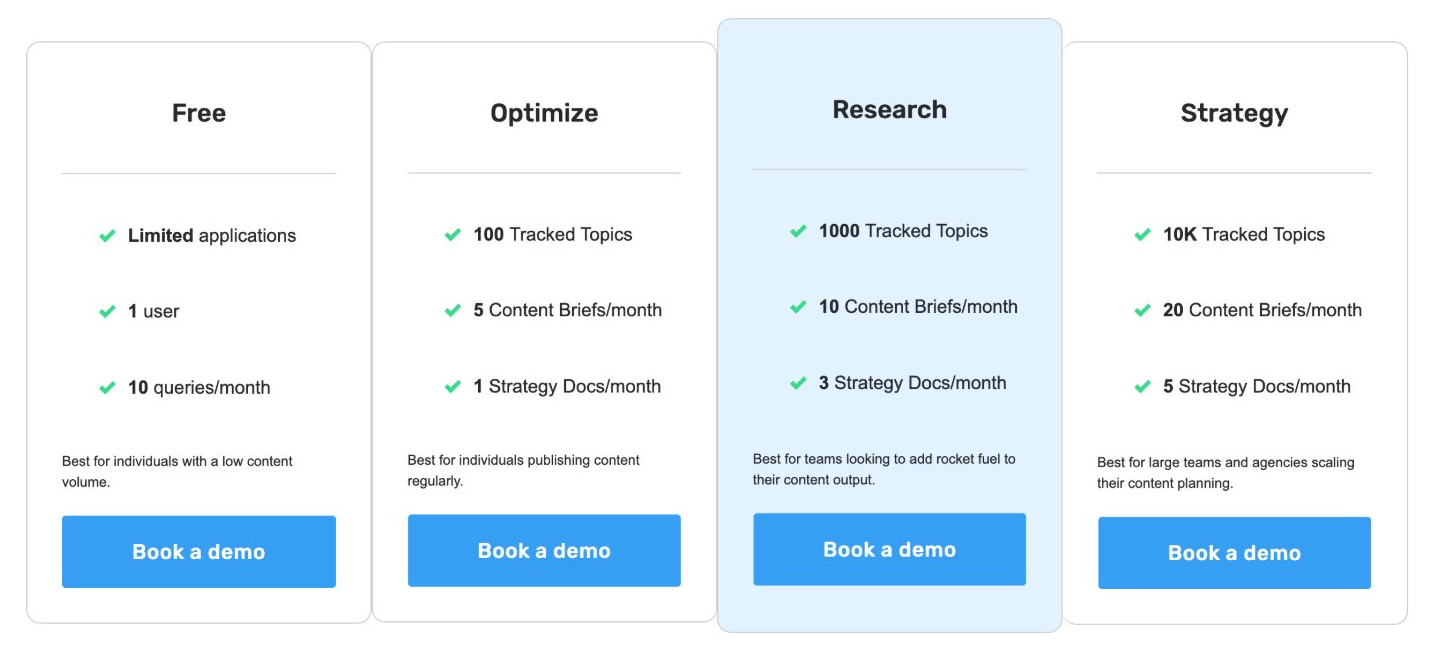
Free allows 10 content intelligence queries a month for one user, with no site inventory, no tracked topics and no content briefs at all. Optimize adds a single site inventory, 100 tracked topics and 5 article briefs a month, still for one user. Research triples the seat count to 3 and raises tracked topics to 1,000 with 10 briefs a month. Strategy tops the ladder at 5 users, 10,000 tracked topics and 20 briefs a month across all nine brief types.
Reviewers confirm the frustration directly. "Price should be more reasonable," wrote a Producer at Jamuna Television Ltd. in July 2022, and a different reviewer in Marketing called it "highly priced" the same year the acquisition closed.
A third reviewer, evaluating small business budgets specifically, listed "unavailability of free trial or freemium version to try the platform" as a separate complaint, pointing at the gap between the thin Free plan and the first paid tier's unknown cost.
Where users say MarketMuse earns its keep
Set the pricing frustration aside and the praise clusters around two things: the research depth behind the Content Score, and what happens once a team gets past the learning curve.
"Once user gets the hang of it and the software starts adding value to the content, there is no going back."
Advisor, Marketing, 51-200 employees, TrustRadius review, August 2022
A Portfolio Program Management reviewer at AbbVie echoed the sentiment the year before: "MarketMuse is highly priced, but the cost is worth the impact."
A Producer at Jamuna Television Ltd. described using MarketMuse for both internal and external link suggestions in July 2022, going beyond the Connect feature's advertised internal-linking use case. That's a workflow MarketMuse's own marketing doesn't emphasize, surfaced only by a user working the tool past its documented feature list.
The interface itself draws a milder complaint than the pricing does. "User Interface can be made more friendly," the same Advisor noted alongside the praise above, and a reviewer in Finance and Accounting flagged that filtering inside search results "may not meet the needs at all times." Neither complaint rises to the level of the Connect or pricing criticism. Both describe an interface due for an update.
↑ FACT SHEETCompany stability since the Siteimprove acquisition
MarketMuse started life as Informite Inc., renamed in 2018 per the assignee record on its own foundational patent. Siteimprove, a digital-accessibility and web-governance company, announced its acquisition of MarketMuse on October 8, 2024, and completed the deal on October 31, 2024. Siteimprove's own press release doesn't disclose the purchase price.
Siteimprove's CEO, Shane Paladin, framed the deal as validation that the market needs "a true end-to-end solution," combining MarketMuse's content research with Siteimprove's existing accessibility and analytics products.
For a buyer evaluating MarketMuse today, that means the roadmap now answers to a larger company's product strategy, one centered on accessibility compliance, with content strategy as a secondary line of business. MarketMuse's standalone pricing page still shows no sign of a post-acquisition bundle or discount.
Who should look elsewhere, and who it's built for
MarketMuse suits a content strategist managing a large site, someone who needs the whole-site inventory and its 27 metrics ahead of a plagiarism checker or a drafting assistant. It's a research and prioritization tool: the Connect and content-brief features both work best once a team already has dozens or hundreds of published pages to score. Our content marketing statistics report has the wider benchmarks a strategist would weigh this against.
It's a poor fit for anyone who wants to compare prices across competitors before a sales call. A freelancer or a one-person marketing team at one of the many small businesses evaluating a handful of tools on a spreadsheet gets nothing from MarketMuse's pricing page except seat counts and feature caps; the actual number only appears after a demo. For that comparison shopping, every rival ranked in the content intelligence tools ranking publishes a price on its own site.
How MarketMuse compares to Clearscope, NeuronWriter and Scalenut
Clearscope. Essentials runs $129 a month for 50 pages, 50 tracked prompts and 20 drafts; Business triples those caps at $399. It wins the comparison that matters most against MarketMuse's weakest score: Clearscope tracks 50 AI-search queries across ChatGPT and Gemini inside its base tier, where MarketMuse tracks zero AI engines at any price.
It loses on raw site-inventory depth; Clearscope grades individual pages one at a time, and the 27-metric whole-site model stays MarketMuse's alone on this list. Read the full Clearscope review.
NeuronWriter. Five tiers run $23 to $117 a month, or $19 to $97 annual, with every price published directly on the vendor's own page. A freelancer or small agency gets the same SERP-driven content-score loop MarketMuse offers, at a fraction of MarketMuse's unknown Optimize cost, though NeuronWriter's team features and API both stay locked behind its $57-a-month Gold tier. Read the full NeuronWriter review.

Scalenut. Starter runs $59 a month list ($24 on a current promotional annual rate), scaling to $199 for Professional. Scalenut bundles AI drafting with its content-optimization layer where MarketMuse stays research-only.
Scalenut's own site has quoted a 4.8 Trustpilot score against a real 3.2, a transparency problem of its own that sits alongside MarketMuse's quote-only pricing as a reason to verify every number independently before signing. Read the full Scalenut review.
Positive Surfer is another SEO-content rival on the same shortlist that publishes its own rate card, so a buyer ruling out quote-only platforms has more than two named alternatives to weigh.
Run the Free plan's Topic Navigator and the 10 monthly queries against a real topic cluster first. It won't show the site inventory, but it shows how the underlying topic model groups related terms, the same model the paid Content Score runs on.
Pairs well with: a dedicated writing tool (MarketMuse doesn't draft full articles the way Scalenut's Cruise Mode does) and a rank-tracking platform, since MarketMuse's own traffic figures are modeled estimates built from search volume, rank and CPC. A live tracked position comes from the rank tracker paired alongside it.
Frequently asked questions
Is MarketMuse worth the price?
There's no price to weigh against the value until a sales call produces one. The Free plan's 10 queries a month work for testing the Content Score and Topic Navigator; a strategist deciding if the paid tiers earn their keep has to book the demo first, something Clearscope and NeuronWriter never require before quoting a number.
What does MarketMuse's Content Score measure?
A 0-to-100 grade comparing a draft or published page against the topic model MarketMuse builds from top-ranking competitors for that term, covering related keywords, depth of coverage and structural gaps the patented topic-modeling engine identifies.
Does MarketMuse track AI search engines?
No. The platform scores pages against traditional search engines and competitor content; it carries no feature that monitors how a brand or page gets cited inside ChatGPT, Gemini or other AI answer engines, the gap Clearscope's $129 Essentials plan closes.
How many users can access MarketMuse on each plan?
One on Free and Optimize, three on Research, five on Strategy. Large teams beyond five seats need a custom Strategy quote, the same quote-only process that applies to every paid tier regardless of size.
Verdict
MarketMuse earns its keep for a content strategist running a large, established site who needs a documented inventory of every page's topic coverage. The platform drafts no copy and tracks no AI citations on its own. The 27-metric site inventory and the patented Content Score behind it do something no competitor on this list replicates at the same depth.
Small businesses and solo marketers comparing prices across a spreadsheet should look elsewhere first. Every paid tier hides behind a demo request, a friction point reviewers raise as often as any feature complaint, and the platform tracks zero AI search engines while rivals like Clearscope build that tracking into a published, entry-level price.
A mid-sized team that already has the content volume to justify a site inventory, but wants the number before the call, might still find Research or Strategy worth the friction, provided someone on the team pins down the actual quote and compares it line for line against NeuronWriter's or Clearscope's published rate cards first. Buy it for the research depth. Budget for the sales call it takes to find out what that depth costs.