Clearscope review: is the $129-a-month content grade worth it
 By Jan Suski. I go deep on every review, checking every number against its source and digging up details other coverage misses, a habit from six years of SEO and link building for tech companies. Bylines at Surfer, Brand24, and Senuto. How the scoring works.
· Prefer this source on Google
Best for
A content team or SEO agency publishing consistently, with enough published or planned URLs to justify tracking 50 or more of them in content inventory, and enough budget that $129 to $399 a month reads as a routine line item.
Not for
A solo blogger or early-stage freelancer chasing ten articles a month. NeuronWriter and Frase run the same core content-optimization workflow at a third of the entry price or less.
What it costs
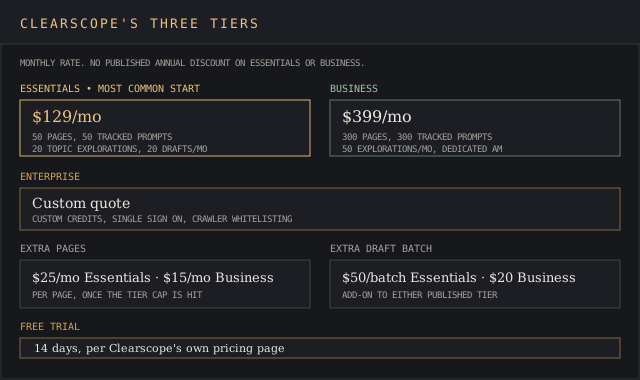
$129 a month for Essentials (50 pages, 50 tracked prompts, 20 topic explorations, 20 drafts). Business runs $399 a month and triples every ceiling. Enterprise is a custom quote.
- Essentials
- $129/mo; 50 pages, 50 tracked prompts, 20 topic explorations, 20 drafts
- Business
- $399/mo; 300 pages, 300 tracked prompts, 50 topic explorations, 20 drafts, dedicated account manager
- Enterprise
- Custom quote; single sign on, crawler whitelisting
- Extra pages
- $25/mo each on Essentials, $15/mo on Business
- Extra draft batch
- $50 on Essentials, $20 on Business
- Free trial
- 14 days
- Content grade scale
- A+ to F, recalculated live as you type
- Content reports (Drafts)
- 20/month on both published tiers
- Topic Explorations
- 20/month Essentials, 50/month Business
- Editor integrations
- Google Docs, Microsoft Word, WordPress
- Pages monitored
- 50 on Essentials, 300 on Business
- Extra pages beyond the cap
- $15 to $25/mo each
- Google Search Console
- Included on every tier
- Backlink tracking
- Not offered at any tier
Pairs well with Clearscope
- Tracked Prompts
- 50/month Essentials, 300/month Business
- AI platforms tracked
- ChatGPT and Gemini
- Methodology
- Unpublished; too new for a track record
Positive Surfer
Not forA buyer already burned by a subscription that keeps charging after cancellation, the exact complaint driving Positive Surfer's own contract-flexibility score down.
NeuronWriter
Not forA buyer who wants Clearscope's own consistently-praised interface; NeuronWriter reviewers repeatedly call its editor dated and slow on long documents.
Pairs well with Clearscope
Where Clearscope's own numbers disagree with each other
TechRadar's review said no free trial existed; the vendor's current pricing page lists 14 days, and a live signup follows the current page. Brafton's own case study reports an 83.7% average click-traffic increase on one blog network and a separate 721% increase on a German-language site; Marketer Milk's independent review cites a smaller 25% ranking improvement from its own use of the tool. None of the three figures is audited outside the publisher's own marketing.
Clearscope charges $129 a month for the Essentials tier most buyers start on, covering 50 pages, 50 tracked prompts, 20 topic explorations and 20 drafts a month. Users and projects are unlimited on every tier, the opposite of how Moz Pro and Ahrefs meter their own entry plans; the constraint here is the page count.
This review tests Clearscope's content-grading editor, its pricing tiers, the newer AI-search tracking module and what buyers say on G2, Capterra and TrustRadius after paying for it, against three cheaper rivals: Positive Surfer, NeuronWriter and Frase. Our content intelligence tools ranking scores all four, with Clearscope seventh of ten.
It's written for the content team or SEO professional weighing Clearscope's premium against a leaner setup, and for anyone comparing it inside this site's wider digital marketing intelligence tools ranking. It draws on Clearscope's own pricing and product pages, 164 reviews across G2, Capterra and TrustRadius, and the traffic claims each vendor publishes about itself. New to the category? Start with what market intelligence is.
Clearscope launched in 2016 as a single-purpose content optimization tool: type a target keyword in, get back the terms top-ranking pages use, and a grade for how well a draft covers them. A decade later the company is still bootstrapped, run out of Austin, Texas by co-founder Bernard Huang. Latka's investor-data platform puts 2025 annual revenue near $1.5 million and headcount at 14, no outside funding taken.
The product has grown past that original grade-and-go tool. Seven modules now sit under one subscription: Expand, Discover, Write, Optimize, Protect, Localize and Linking, spanning everything from the original content grade to prompt tracking across ChatGPT and Gemini.
↑ FACT SHEETWhat Clearscope's content optimization platform does
Clearscope is still a content optimization platform built around one editor. A writer enters a target keyword, Clearscope's natural language processing analyzes the current top-ranking search results, and the editor returns a ranked list of terms, a target word count, and a live content grade that updates as the draft fills in.
It's the flagship feature, the one SEO professionals cite most when explaining why they pay for the tool over a manual audit. The company frames this as producing "top-ranking optimized content with confidence," and the mechanism behind that claim is direct: the editor is reverse-engineering what already ranks across search engines. It isn't generating fresh ideas from nothing.
Two other modules sit around that editor. Discover surfaces topics with search demand the account hasn't covered yet, sized to a defined target audience. Write hands a blank page an AI-generated outline as a starting point, folding into an existing content creation process without replacing it, though outline generation itself is gated to the Business plan and up per TechRadar's review.
Both lean on the same term-extraction engine that powers the editor, and Clearscope markets the editor, Discover and Write together as one connected workflow. A seventh module, Linking, suggests internal links inside a draft, a job most other tools leave to a separate plugin.
Machine learning drives the term extraction, but the grading itself sits closer to a checklist than a model built to write the sentence for you. It counts coverage; content teams publishing daily still hit the reporting ceiling fast.
↑ FACT SHEETContent reports, content grade and the Drafts editor
Clearscope's content reports, now labeled Drafts in the current pricing structure, remain the product's original unit of work. Every report analyzes the target keyword's search results page and returns a term list sized to the topic, the same format that carried Clearscope from a single feature into today's fuller platform.
Essentials includes 20 content reports a month; Business includes the same 20, with extra batches priced $20 to $50 depending on volume, per Clearscope's own pricing page.
The content grade runs on an A+ to F scale, confirmed independently by Rankability's agency-focused review: "A or better signals your draft covers the terms and depth the SERP expects for that keyword, while lower grades flag thin coverage or missing topics to address before you publish."
Real-time feedback updates that grade as a writer types, inside a live Google Docs integration, Microsoft Word or a native WordPress plugin, so nobody has to paste a finished draft back in to see the score move. Older SEO literature would call the underlying term-matching technique latent semantic indexing; Clearscope's own documentation skips the label and calls it content grading.
"The grading system is not transparent or smart. It's possible to get an A++ just by stuffing keywords."
A Capterra review from Rainie O., an instructor, July 2019
That criticism is the most consistent complaint about the content grade across three years of reviews: a high score rewards term coverage over sentence quality, and keyword stuffing is a documented workaround for reviewers chasing the number. A related worry shows up unattributed in Clearscope's own AI-search fact set: some users fear optimizing for the grade nudges written content toward formulaic phrasing over better rankings.
Set against that is the workflow itself, which several reviewers credit for cutting research time even when they distrust the letter grade.
"I can trust the data to guide my writers to create useful content that addresses search intent."
A Capterra review from Maddy O., an SEO content strategist, March 2021
↑ FACT SHEETContent inventory: monitoring existing content and search performance
Content inventory pages are Clearscope's answer to a problem every content optimization tool eventually runs into: a graded draft that ranked well on publication can still lose search performance a year later as the results page shifts underneath it.
The Protect module connects to Google Search Console and re-scores published URLs against current top-ranking pages, flagging which of the account's own pages have drifted out of grade range. That protects the SEO value already built into a site's back catalog, value a fresh content report can't recover on its own once a page has slipped.
Essentials tracks 50 content inventory pages this way; Business tracks 300; both add extra pages at $15 to $25 a month once the ceiling is hit. That's a real cost lever for a site with more published articles than tracked pages, and it's one every Clearscope alternative below prices differently; none avoid the charge altogether.
Brafton's own case study, run on its English-language blog network, reported an 83.7% average increase in click traffic after adopting the workflow. It reported a separate 721% increase in organic clicks on a German-language site after applying the same content-grade discipline to a set of international SEO work.
Those are Brafton's own numbers from Brafton's own accounts. They aren't an independent audit, and Clearscope's own marketing repeats a related but separate claim, an average 25% ranking improvement, sourced to Marketer Milk's review of its own experience running the tool. Neither claim proves a given account will grow traffic by the same margin.
"The cost is prohibitive for a small startup at first glance, but the tool has paid dividends for us."
A G2 review from Sarah R., a product marketing manager, April 2021
↑ FACT SHEETAI-powered answer engine optimization and AI visibility tracking
The newest of the seven modules, Expand, pushes Clearscope's AI-search tracking further than the original content grade ever reached: it tracks brand citations inside ChatGPT and Gemini responses alongside traditional rankings on search engines like Google.
Clearscope's own pricing page bundles "prompt tracking across ChatGPT and Gemini" and "brand visibility monitoring" into every tier, Essentials included, at 50 Tracked Prompts a month before add-on pricing.
This is a different feature set from the content grade the product was built on, and it's early. Clearscope doesn't publish a methodology for scoring a tracked prompt against a real AI citation. None of the three review platforms in this piece carries enough post-launch reviews yet to confirm the new module holds up the way the original content grade has for a decade.
Reviewers weighing Clearscope against other AI-search tools should treat Expand as unproven. It isn't yet a reason to switch on its own, and it's the module most likely to change shape before the next comparison against these alternatives gets written. This site's own SEO visibility score report covers how that kind of tracking gets measured independently of any one vendor's dashboard.
↑ FACT SHEETClearscope's pricing: Essentials, Business and Enterprise
Two tiers are published, one isn't. Essentials starts at $129 a month for 50 Tracked Prompts, 50 monitored pages, 20 Topic Explorations and 20 Drafts. Business roughly triples every one of those ceilings for $399 a month and adds a dedicated account manager, the one feature Clearscope gates by price alone, without a usage-cap alternative.
Clearscope's pricing hasn't published an annual discount the way three of the four alternatives below have. Enterprise drops the published numbers entirely for a custom quote on top of custom credits, unlocking single sign on and crawler whitelisting, security-review tools with no bearing on day-to-day content output.
| Plan | Price | What's included |
|---|---|---|
| Essentials | $129/mo, no published annual rate | 50 Tracked Prompts, 50 Pages, 20 Topic Explorations/mo, 20 Drafts/mo |
| Business | $399/mo, no published annual rate | 300 Tracked Prompts, 300 Pages, 50 Topic Explorations/mo, 20 Drafts/mo, dedicated account manager |
| Enterprise | Custom quote | Custom credits, single sign on, crawler whitelisting, custom agreements |
| Extra pages | $15 to $25/mo each | Add-on to either published tier |
| Extra draft batch | $20 to $50 per batch | Add-on to either published tier |
Unlimited users and unlimited projects sit on every tier, Essentials included, which is unusual against the seat-priced competitors covered later in this piece. Clearscope's own pricing page lists a 14-day free trial, which contradicts an older TechRadar review claiming no trial exists; the vendor's current page governs a live signup, so the trial is real as of this review.
Clearscope cost versus what content teams and marketing teams get
The Clearscope cost question comes down to one number: $129 a month buys 20 content reports and 50 content inventory pages, a ceiling a single content marketer can hit inside a busy month. Against other content optimization tools built for the same keyword research and search-results work, that's the most expensive published entry point.
"For smaller teams or occasional users, the cost feels a bit high considering the number of credits or reports included."
A G2 review from Vishal K., a technical SEO lead, January 2026
"Cost is a little prohibitive for small teams/businesses."
A TrustRadius review from Jesse Butts, founder and principal consultant, June 2022
Set against those complaints is a smaller cluster of reviewers who priced Clearscope against its closest premium rival and came out satisfied.
"The pricing is a little high for a solopreneur, but it's still far more affordable than MarketMuse."
A G2 review from Laura P., a freelance writer, June 2021
"I haven't found anything better. (At this price point or anywhere else.)"
A TrustRadius review from Corey Young-Knutsen, senior SEO and content manager, June 2022
Clearscope's cost only clears against other SEO tools that publish a rate card, and even then it's the priciest of the four in this review. It's not alone in guarding its numbers: MarketMuse publishes no price at all, and "expensive but at least I know the number" is a genuine argument in Clearscope's favor.
That transparency is a large part of why the vendor can build a sales pitch on its traffic claims without a discount code attached, even without independently verified figures behind every one of them.
Keyword research, keyword discovery and search intent
The Discover module runs keyword research from the same term-extraction engine that powers the editor, surfacing related terms grouped by shared search intent over raw search volume.
A writer picks a target keyword, and Discover returns adjacent topics the account hasn't published on, sized by opportunity ahead of raw volume. That feeds a content strategy planned across months of publishing.
Clearscope draws its clearest line against pure rank-tracking tools here: it never surfaces a term without showing where it fits inside an existing content strategy, which cuts the odds of two articles competing for the same results page.
The tradeoff, per the Rankability review's agency-side critique, is that Clearscope "isn't an all-in-one SEO tool for everything," so a team still needs a separate rank tracker and other tools for backlink analysis. Brafton's review states the gap plainly: "Clearscope doesn't provide any features to track backlinks."
What SEO professionals, freelance writers and content teams say in reviews
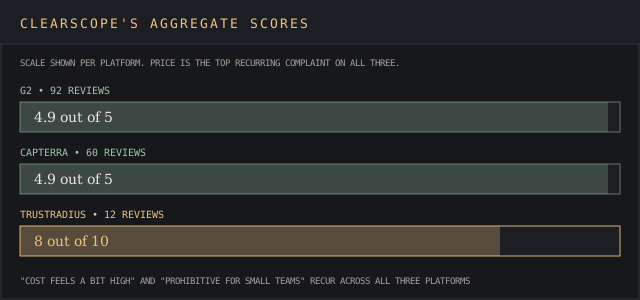
Across G2, Capterra and TrustRadius, Clearscope carries an aggregate score most content optimization tools don't reach: 4.9 out of 5 on G2 across 92 reviews, 4.9 out of 5 on Capterra across 60 reviews, and 8 out of 10 on TrustRadius across 12 reviews. The praise clusters around the same theme regardless of platform.
"I love how Clearscope automates many aspects of writing good SEO content...making it faster and easier to generate good content that also ranks."
A G2 review from Melisa A. N., a consultant, July 2024
"I love how Clearscope reverse engineers what's already ranking on Google for any given keyword."
A Capterra review from Brian S., a senior manager of content marketing, March 2018
The interface draws consistent praise for being easy to pick up, a real point of separation from NeuronWriter's dated editor, covered below, though a few reviewers flag rougher edges once a draft gets long or a batch of reports queues up.
Content-quality complaints are rarer than pricing complaints, but they surface the same way across most SEO tools: a grade that rewards coverage can still ship thin content if nobody edits after the score turns green.
"Lot of bugs in content brief, please check."
A TrustRadius review from a program manager in IT, June 2022
For niche or narrow topics, the same term engine that impresses on competitive keywords loses precision, a gap the same IT reviewer called out directly: "For niche content, the suggested keywords can be a bit removed from the actual subject matter." Marketing and editorial teams publishing broad, high-volume content see the least of this problem; freelance writers covering a narrow specialty see the most of it.
Clearscope alternatives: Positive Surfer, NeuronWriter, Frase and MarketMuse
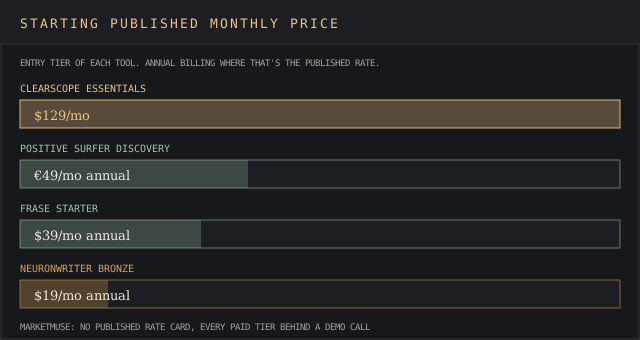
Positive Surfer, still widely searched under its former name Surfer SEO, starts at €49 a month on annual billing for its Discovery tier. It tops out at a published €999 for Enterprise, a rate card attached at every level, including the tiers above the entry two.
It wins on price transparency, scored 88 in this site's own review, identical to Clearscope's own showing here. It also bundles technical audit and internal-link tooling into one subscription, short of the full site crawl Clearscope keeps to a single Linking module. It loses on contract flexibility, scored 30 in the same review after Trustpilot reports of charges continuing past cancellation.
Check current pricing
See Positive Surfer's plans and pricing
Discovery starts at €49/mo billed yearly; Enterprise tops out at €999/mo, with a rate card published at every tier.
 See Surfer pricing →
May earn a commission if you sign up through this link, at no extra cost to you. Full affiliate disclosure.
NeuronWriter undercuts both on price. Bronze starts at $19 a month on annual billing, and even Gold, the tier that unlocks WordPress, a Google Docs integration, Google Search Console integration and API access, runs $57 a month annual, under half of Clearscope's Essentials rate.
The tradeoff shows up in the interface. The terms list holds its own: G2 and Capterra reviewers cited in this site's own NeuronWriter review repeatedly flag a dated interface that slows on longer documents, the opposite of the interface Clearscope reviewers consistently praise.
Frase combines content optimization with AI content generation in the same editor, starting at $39 a month on annual billing for a single seat and ten articles a month, roughly a third of Clearscope's entry price for a narrower ceiling.
It suits a solo blogger or a small agency that wants drafting and grading bundled into one subscription. Clearscope's own Google Docs integration assumes a separate word processor for drafting. It's a weaker fit for a team that wants Clearscope's own content-inventory monitoring, since Frase's equivalent, Content Guard, caps out at 10 tracked pages on the same Starter tier where Clearscope tracks 50.
MarketMuse is the one alternative that publishes no price at all: every paid tier, Optimize through Strategy, sits behind a demo call and a custom pricing conversation, a structural difference from Clearscope's two openly listed rates.
It's built for enterprise content planning at scale, per Brafton's comparison, which credits it with deeper topic-cluster mapping but "lacks real-time grading," the core function Clearscope reviewers name most often as the product's reason to exist.
Frequently asked questions
Is Clearscope worth it?
For a content team or agency publishing consistently, with enough URLs to fill 50 or more content-inventory slots, the letter grade and the decade-old term-extraction engine behind it justify the $129 to $399 monthly range. For a solo blogger or a small site under ten articles a month, NeuronWriter or Frase run a similar workflow at a third of the price.
How much does Clearscope cost?
$129 a month for Essentials, $399 a month for Business, and a custom quote for Enterprise. Extra pages beyond a tier's cap run $15 to $25 a month each, and extra draft batches run $20 to $50, verified on Clearscope's own pricing page 16 August 2026.
Is Clearscope better than Surfer SEO?
Neither wins outright. Positive Surfer (formerly Surfer SEO) bundles a full site crawl and internal-link tooling Clearscope keeps separate, and starts cheaper at €49 a month. Clearscope bundles AI-search tracking into every tier at no extra charge, where Positive Surfer prices that feature apart from its core plan, and its own contract-flexibility score trails Clearscope's on cancellation complaints.
Verdict
Clearscope is for a content team or SEO agency publishing consistently, with enough published or planned URLs to justify tracking 50 or more of them inside content inventory, and enough budget to treat $129 to $399 a month as a routine line item.
It's not for a solo blogger or an early-stage freelancer chasing ten articles a month. NeuronWriter and Frase both run the core content-optimization workflow, the keyword research other tools compete on, at a third of the price or less, and neither reviewer cluster shows Clearscope's grade producing better rankings once the underlying research is the same.
It might suit a mid-size marketing team weighing Clearscope against Positive Surfer specifically for AI-search tracking, since Clearscope bundles that into Essentials at no extra charge while Positive Surfer prices its own AI-visibility features separately. That's a real reason to pay the premium. It isn't a hedge.