Content Intelligence Tools: 10 Platforms Ranked for 2026
 By Jan Suski. I go deep on every review, checking every number against its source and digging up details other coverage misses, a habit from six years of SEO and link building for tech companies. Bylines at Surfer, Brand24, and Senuto. How the scoring works.
· Prefer this source on Google
Quick comparison of content intelligence tools
Ten content intelligence tools in ranked order, with each tool's score out of 10, the first-party data it reads, the entry price and the buyer it fits.
| # | Content intelligence tool | Score | Own data it reads | Entry price | Best fit |
|---|---|---|---|---|---|
| 1 | Conductor | 9/10 | Search Console, GA4, Adobe Analytics | $49,020/yr median* | Enterprise SEO and content teams |
| 2 | Frase | 8/10 | Search Console | $39/mo annual | Small teams needing an API |
| 3 | Positive Surfer | 7/10 | Search Console | $49/mo annual | Writers in Google Docs or WordPress |
| 4 | Parse.ly | 5/10 | Its own on-site tracker | Quote only | Publishers and media teams |
| 5 | PathFactory | 5/10 | CRM and ABM data, 17 integrations | $49,900/yr median* | B2B demand gen and ABM |
| 6 | NeuronWriter | 5/10 | Search Console, Gold plan up | $19/mo annual | Freelancers, small agencies |
| 7 | Clearscope | 4/10 | Search Console | $129/mo | Editorial teams with many writers |
| 8 | MarketMuse | 3/10 | None; modeled traffic | Free, then quote only | Topic-cluster planning |
| 9 | BuzzSumo | 2/10 | None; public engagement | $199/mo | Competitor content research, PR |
| 10 | Semrush Content Toolkit | 2/10 | None; Semrush keyword data | $60/mo | Solo marketers drafting from topics |
Medians marked * are anonymized buyer-reported contract values published by Vendr. Everything else is the price the vendor publishes itself.
Where these figures come from
Prices, page caps, AI engine counts and integration counts are each vendor's own published figure, as listed in September 2026. The two medians marked * are Vendr's anonymised buyer-reported contract values for Conductor and PathFactory. Parse.ly and MarketMuse publish no paid price at all, so both rows say quote only.
Positive Surfer, Semrush and Conductor also appear on the competitive intelligence for SEO ranking, judged there on keyword and backlink tracking against rivals. The digital marketing intelligence ranking covers Surfer and Semrush as competitor-tracking tools. This page ranks them on what they tell you about your own content.
Content intelligence tools read two streams of data, the search results you compete in and the performance of the pages you already publish, and turn them into a list of what to write, fix or retire. Precedence Research puts the content intelligence market at $2.68 billion in 2025, growing to $28.86 billion by 2034.
This ranking scores 10 content intelligence platforms, from AI-driven SEO editors to engagement trackers, on five tests a buyer can run inside a trial. Entry prices run from NeuronWriter's $19 a month to a $49,900 median contract for PathFactory.
It's written for content marketers and content operations teams running content marketing and a content strategy across search and digital channels. Answer engines now sit between the searcher and the page. Five of the ten tools track them.
The market content intelligence, Precedence Research estimate
The forecast has the category at 10.8 times its 2025 size by 2034, per Precedence Research.
North America held more than 40% of the market in 2024, the largest regional share in the same estimate.
Evaluation criteria for content intelligence tools
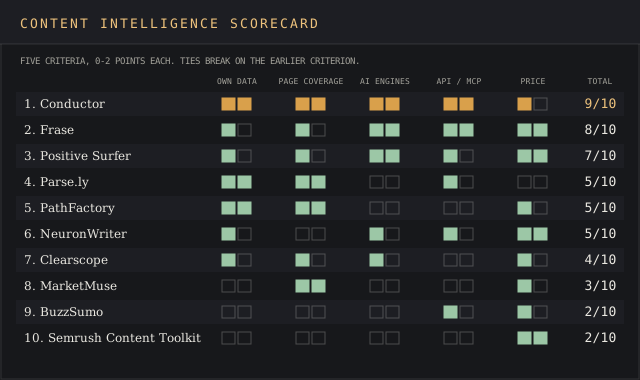
Five criteria decide the shortlist, and the ranking below applies them in this order. Each scores 0, 1 or 2, the total out of 10 sets the rank, and a tie goes to the tool with the higher score on the earlier criterion.
1. First-party performance data
Two points for web analytics, a CRM or an on-site tracker; one for Google Search Console alone; zero for SERP data only. Business data from GA4 or a CRM ties content insights to revenue; search results alone give competitor analysis.
2. Monitoring coverage of your published pages
Two points for every page on a site, one for a capped count, zero for none. Count how many of your URLs get re-scored each month on the plan you'd buy.
3. AI answer-engine tracking
Five or more tracked engines earn two points, one to four earn one, none earns zero. Each named engine or Google AI surface counts once, since content intelligence now has to cover answers written by artificial intelligence.
Pew Research Center logged 68,879 Google searches made by 900 US adults in March 2025, and the clicks thinned out wherever an AI summary appeared:
Source: Pew Research Center, 22 July 2025. 18% of the searches in the study produced an AI summary.
4. API or MCP access
An API or MCP server on every paid plan earns two points, one on an upper tier or sold separately earns one, and none published earns zero. Data teams feeding content intelligence into a warehouse need it.
5. Published entry price
Two points for a self-serve price under $100 a month; one for a higher published price, a free plan or Vendr's anonymised buyer medians; zero for a quote with no public buyer data.
Tools on this page that score 10 of 10. Conductor, at 9, drops its point on price; BuzzSumo and the Semrush Content Toolkit tie at the bottom on 2 each.
The 10 best content intelligence tools ranked
Conductor
Best fit
An enterprise team that wants rankings, AI citations and conversions for each page on one content intelligence screen.
Conductor is the only content intelligence platform here that joins search data with GA4 and Adobe Analytics, putting AI traffic next to conversions. It bought Searchmetrics in February 2023 and later wound the Searchmetrics platform down.
Key features
- AI visibility in ChatGPT, Gemini, Copilot and Claude, plus Perplexity
- Conductor Monitoring: always-on crawls with real-time alerts
- Conductor Creator for AI content creation and content strategy briefs
- API, MCP server and AgentStack
Pricing
No list price. Vendr's anonymised buyer data shows a $49,020 median a year, from $41,364 to $93,100. Quote-only pricing is par for the course here.
Pros
- Five AI engines tracked next to rankings
- Decisions rest on GA4 or Adobe conversions
- API and MCP for data teams
Cons
- Lowest Vendr contract: $41,364 a year
- Budgeting starts with a sales call
- One reviewer found the first weeks overwhelming
"We are a small business and managed to get a discount based on our lack of scope. Without this discount the monthly price is a lot."
Lauren Datres, marketing manager at RumbleUp, TrustRadius review, April 2025
Why it's ranked #1. Conductor scores 9 of 10, the top content intelligence score here, and beats Frase on criterion two: it monitors whole domains, where Frase's $39 Starter plan audits 50 pages a month. Its lost point is the $49,020 Vendr median standing in for a public price.
Frase
Best fit
A small team that wants content intelligence with Search Console audits, AI tracking and an API for under $40 a month.
Frase builds briefs from the top 20 search results, then keeps watching as a content intelligence tool for content strategy work. Its plans add a Search Console site audit, Content Guard for ranking decay, and daily tracking in ChatGPT, Perplexity, Claude, Gemini and Google AI.
Key features
- SEO Research briefs with competitor gaps
- Site Audit scored for search and AI answers
- Content Guard: 10 pages on Starter, 300 on Scale
- MCP server, CLI and API on every plan
Pricing
Starter is $39 a month billed annually, $49 monthly. Professional is $103 annual with 3 seats and 250 audit pages; Scale is $239. Extra seats cost $29.
Pros
- API and MCP at $39
- Five AI engines tracked daily
- Public prices on every self-serve tier
Cons
- 50 audit pages on Starter
- 10 articles a month on Starter
- Reviewers report interface bugs
The devil's in the details on usability:
"The user interface of Frase.io left much to be desired. It felt less intuitive, buggy, and glitchy, especially when compared to its competitors."
Kira K., CEO in marketing and advertising, Capterra review, October 2023
Why it's ranked #2. Frase scores 8, the best content intelligence result under $100, and beats Positive Surfer on criterion four, shipping API and MCP access on its $39 plan where Surfer keeps the API for its $299 tier. It trails Conductor because Starter audits 50 pages against whole-domain coverage.
Positive Surfer
Best fit
Writers who create content in Google Docs or WordPress and want AI-visibility numbers beside the score.
Surfer, sold as Positive Surfer since its change of owner, grades drafts against the ranking pages. Its pricing page claims 150,000+ users, and every plan carries a content audit with ranking drop alerts. See the Positive Surfer review and the Surfer vs Semrush comparison.
Key features
- Content Editor scored against the ranking set
- AI tracking in ChatGPT, Perplexity, AI Mode, AI Overviews and Gemini
- Tracked pages: 10 on Discovery, 50 on Standard, 500 on Peace of Mind
- Surfer MCP on Pro, API on Peace of Mind
Pricing
Billed yearly, Discovery is $49 a month, Standard $99 with 25 AI prompts and 3 seats, Pro $182, Peace of Mind $299.
Pros
- Five AI engines from Standard up
- Drop alerts keep an eye on tracked pages
- Google Docs and WordPress integrations
Cons
- API waits on the $299 plan
- 50 tracked pages on Standard
- Weaker scoring on technical topics
A June 2025 TrustRadius reviewer wrote that Surfer "can improve their algorithm to serve better for technical articles."
Why it's ranked #3. Surfer scores 7 among content intelligence tools and beats Parse.ly on criterion three, tracking five AI answer engines where Parse.ly tracks none. It loses to Frase because its API needs the $299 Peace of Mind plan.
Parse.ly
Best fit
A publisher that needs real-time, article-level engagement data on every page.
Parse.ly is content analytics for publishers, owned by WPVIP Inc. Its data analytics run on a tracker on your own site, reporting 30+ audience-centric metrics in real time with 13 months of history. It stays under the radar of most SEO teams because it collects no search data.
Key features
- Real-time dashboards and 13-month history
- Metadata extraction into structured data, plus campaign performance tracking
- Conversions, attribution and audience segmentation on Content Value
- API with 10 endpoints, including recommendations
Pricing
Quote-only on three tiers covering 1, 2 or 3 sites; the API is a separate contract line.
Pros
- First-party behavioral data on every article
- 13 months of history at entry
- Recommendations endpoint for relevant content modules
Cons
- No published price
- No AI answer-engine tracking
- Conversions start on the second tier
An August 2024 reviewer on TrustRadius named the ceiling: "The dashboard is cool but it needs to support custom queries on the fly."
Why it's ranked #4. Parse.ly scores 5 and ties PathFactory among performance-side content intelligence platforms, winning on criterion four with a 10-endpoint API sold under contract, a test PathFactory scores zero on. It loses to Surfer on AI tracking and on price.
PathFactory
Best fit
A B2B demand gen team, often paired with the ABM platforms it already runs, that wants content consumption tied to accounts.
PathFactory hosts content assets in content tracks and records what each visitor and account consumes, merging content data with customer data to transform content data into account-level reports. Its site lists 17 integrations, from Salesforce to Snowflake, plus sales tools Outreach and SalesLoft. Kaltura agreed in March 2026 to buy it for about $22 million in cash, citing 100+ enterprise customers.
Key features
- Content tracks and microsites built for binge consumption
- Consumption data per visitor and account
- ChatFactory AI buying agents
- 17 integrations across CRM, automation, ABM and analytics
Pricing
Vendr's anonymised data shows a $49,900 median across 43 purchases, from $19,250 to $69,380 a year.
Pros
- Engagement mapped to CRM accounts
- Personalized content at account level
- Vendr data gives a real budget range
Cons
- $19,250 low end
- No AI answer-engine tracking
- A 1-of-10 reviewer cites data-quality problems
One October 2025 reviewer praised "access to analytics on viewership and customer engagement." Another, rating it 1 of 10 that month, is a red flag for any reference call:
"In our experience, the overall UX is clunky and dated. To me, it's essentially a high-priced PDF hosting service with limited analytics and customer support."
Marketing employee at a 10,001+ person company, TrustRadius review, October 2025
Why it's ranked #5. PathFactory scores 5 and beats NeuronWriter on criterion one, reading CRM and ABM data through 17 integrations where NeuronWriter reads Search Console on its $57 Gold plan. It loses the tie with Parse.ly on API access.
NeuronWriter
Best fit
A freelancer or small agency that wants a budget content intelligence tool for optimized content under $60 a month.
NeuronWriter runs the same SERP-to-score loop as Surfer and Clearscope for $23 a month, or $19 billed annually. A buyer who needs Search Console data has to bite the bullet and move to Gold at $57 annual, which also unlocks WordPress and the API. The NeuronWriter review walks through each tier.
Key features
- Content analyses: 25 a month on Bronze, 150 on Diamond
- AI monitoring questions: 5 on Bronze, 20 on Diamond
- 15,000 to 75,000 AI credits by tier
- Search Console, WordPress and API from Gold
Pricing
Bronze $23 ($19 annual), Silver $45 ($37), Gold $69 ($57), Platinum $93 ($77), Diamond $117 ($97).
Pros
- Lowest entry price here
- AI monitoring from Bronze
- API at $57 on Gold
Cons
- Search Console locked below Gold
- No monitoring of published pages
- 25 analyses a month on Bronze
A Capterra reviewer who tested it against Frase and MarketMuse in July 2023 wrote: "NeuronWriter and Surfer were the standouts. After taking price into account I decided that NeuronWriter was just a no brainer."
Why it's ranked #6. NeuronWriter scores 5 on the content intelligence criteria and beats Clearscope on criteria four and five: an API from $57 and a $23 entry price, against Clearscope's $129 with no API. It loses to PathFactory, which reads CRM data where NeuronWriter reads Search Console.
Clearscope
Best fit
An editorial team with many writers that wants one content grade, unlimited seats and a steady content production process.
Clearscope's Essentials plan costs $129 a month for 50 tracked queries, 50 pages, 20 topic explorations and 20 drafts, with unlimited users. Query tracking covers ChatGPT and Gemini. The Clearscope review tests the grade.
Key features
- Content grading that updates as writers type
- Protect: Search Console-connected page monitoring
- Query Tracking in ChatGPT and Gemini
- Unlimited users and projects
Pricing
Essentials $129, Business $399 with 300 pages, Enterprise custom with SSO. Extra pages add $25 a month, extra drafts $50.
Pros
- No per-seat charges
- No contracts on any tier
- 14-day free trial
Cons
- No API on any tier
- Two AI engines tracked
- 50 pages at $129
A Capterra reviewer in March 2021 wrote: "I can trust the data to guide my writers to create useful content that addresses search intent." The price objection hasn't moved on G2:
"For smaller teams or occasional users, the cost feels a bit high considering the number of credits or reports included."
Vishal K., technical SEO lead, G2 review, January 2026
Why it's ranked #7. Clearscope scores 4 as content intelligence software and beats MarketMuse on criterion three, tracking 50 queries across ChatGPT and Gemini where MarketMuse tracks no AI engine. It loses to NeuronWriter on API access and a $129 entry price.
MarketMuse
Best fit
A strategist planning topic clusters and a content strategy across a whole site from modeled traffic.
MarketMuse inventories your whole site on every paid plan and scores it on 27 inventory metrics, from Topic Authority to Potential Traffic Gain. Its traffic figures are estimates built from search volume, rank and CPC. Siteimprove completed its acquisition on October 31, 2024.
Key features
- Site inventory on every paid plan
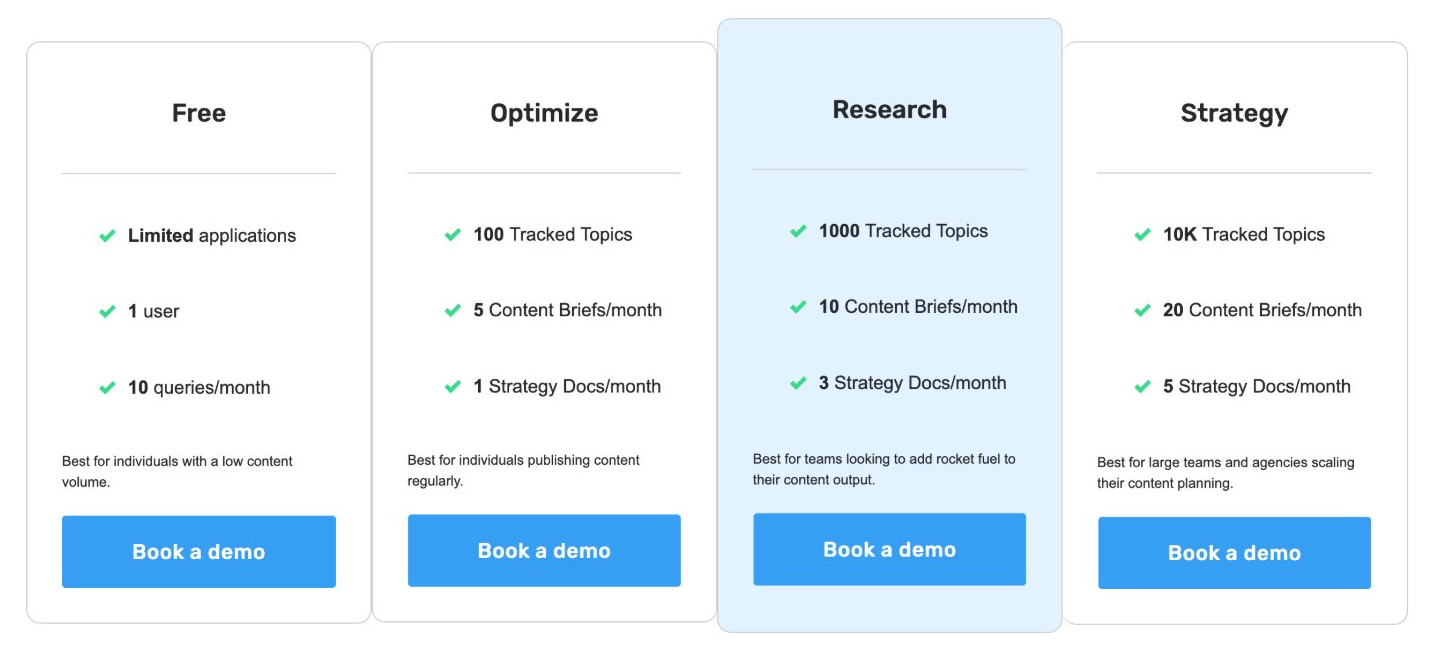
- Tracked topics: 100, 1,000 or 10,000 by plan
- Content briefs: 5, 10 or 20 a month
- Topic Navigator and SERP X-ray, including on Free
Pricing
The Free plan allows 10 content intelligence queries a month. Read between the lines on the pricing page: every paid tier sits behind "Book a demo."
Pros
- Whole-site inventory, 27 metrics
- Up to 10,000 tracked topics
- Free plan for Topic Navigator
Cons
- No link to your own analytics
- No AI answer-engine tracking
- Paid tiers are quote-only
A marketing manager wrote in May 2021 that it "really shines when revamping old content that has already been optimized with tools like yoast or rankmath." A 2019 reviewer on TrustRadius flagged the weak spot: "The Connect application very rarely provides internal link suggestions that are actually relevant."
Why it's ranked #8. MarketMuse scores 3 as a content intelligence platform and beats BuzzSumo on criterion two with a whole-site inventory scored on 27 metrics, where BuzzSumo monitors none of your pages. It loses to Clearscope, which tracks 50 AI queries and publishes a $129 price.
BuzzSumo
Best fit
A content or PR team researching what earns engagement on social channels; the social listening ranking covers brand monitoring.
BuzzSumo is content intelligence about other people's content. Its Content Analyzer searches 8 billion articles for shares, links and engagement across Facebook, X, Reddit and YouTube. That archive is its competitive advantage: it does the lion's share of competitor analysis and content discovery for content marketing, and it scores zero on first-party data for the same reason.
Key features
- Content Analyzer over 8 billion articles
- Trending feeds from the past 24 hours
- Alerts: 2 on Content Creation, 50 on Enterprise
- Journalist lists of up to 600 contacts on Suite
Pricing
Content Creation is $199 a month for 1 user; PR & Comms $299 for 5 users, Suite $499 for 10, Enterprise $999 for 30. The API is priced through sales.
Pros
- Unlimited searches and exports
- Five years of history on Suite
- Content curation from trending feeds
Cons
- Reads none of your own analytics
- One user at $199
- Two alerts on the entry plan
A social media strategist wrote on TrustRadius in June 2021: "The only thing I could complain about is the pricing. It seems to be a bit high."
Why it's ranked #9. BuzzSumo scores 2 on content intelligence and ties Semrush's Content Toolkit, winning on criterion four because its API is sold through sales. It loses to MarketMuse, which inventories your own site where BuzzSumo reads public engagement.
Semrush Content Toolkit
Best fit
A solo marketer who already uses Semrush for market research and wants topic ideas and drafts for $60 a month.
Semrush sells the Content Toolkit apart from its SEO plans at $60 a month with a seven-day trial, bundling Topic Finder, an SEO Brief Generator and 5 SEO content boosts a month. Adobe completed its purchase of Semrush on April 28, 2026; the Adobe-Semrush acquisition report covers the terms.
Key features
- Topic Finder with weekly, country-specific ideas
- SEO Brief Generator
- Up to 50 brand voices, WordPress publishing to 100 sites
- 10 extra SEO-boosted articles for $30 a month
Pricing
$60 a month; extra users $20 each. The Semrush review and the Semrush pricing report cover the SEO plans from $139.
Pros
- $60 flat price
- Topics from Semrush keyword data
- Seven-day free trial
Cons
- Reads none of your performance data
- 5 SEO content boosts a month
- No AI tracking in the toolkit
Tara Saxon, a founder reviewing Semrush on TrustRadius in April 2025, wrote: "Personally as a solopreneur, I have had to opt for a cheaper option as I feel the pricing makes it uncompetitive for a lean operation."
Why it's ranked #10. The toolkit scores 2 on content intelligence, both points from its $60 published price, and loses the tie with BuzzSumo on API access. It reads none of your own performance data, the first test in this ranking.
What is content intelligence?
Content intelligence is software that joins content data with performance data and uses artificial intelligence, mainly natural language processing and machine learning, to tell content marketing teams what to create, update or cut. PathFactory's definition adds that it "predicts which assets are more likely to trigger engagement in the future."
Optimove draws the line against content analytics, which reports opens, clicks and conversions at campaign or asset level. Content intelligence explains why, from content attributes such as topic, format and content structure, which turns content insights into business outcomes a team can repeat. Optimizely's glossary adds natural language processing that identifies style and tone of voice.
Content intelligence enables marketers to see just what content moves buyers toward business outcomes like pipeline, enabling marketers to prioritize content efforts on evidence and turn content data into actionable insights. Content intelligence systems read raw data from multiple systems, what content exists, the performance signals each page sends and the user behavior behind them, and turn it into a continuous feedback loop for the content strategy.
Benefits of content intelligence
The benefits of content intelligence show up as numbers in the tools above, for content marketers and content operations alike. Six key benefits recur across content marketing efforts:
- Visibility into performance metrics: Parse.ly reports 30+ per article in real time, actionable insights for an editor on deadline.
- Decay caught early: Content Guard and drop alerts flag high performing content that slips.
- Content gaps found early: MarketMuse's 27 metrics identify gaps and weak content attributes across a site.
- Successful content resurfaced through Parse.ly's recommendations API.
- Account-level personalization: PathFactory ties consumption to CRM records.
- Time saved in the content creation process: HubSpot's State of AI report, surveying 1,000+ marketers, found AI users saving one to two hours a workday.
Share of marketers using AI to write entire pieces of content in HubSpot's State of AI report, against 66% who use AI in their roles at all. The rest lean on it for ideas, outlines and first paragraphs, the stage the search-side editors above score.
Those benefits of content intelligence depend on data collection from existing systems. A tool that can't read your analytics tools gives valuable insights about competitors and none about the content created on your own site, the deep understanding a data driven strategy needs. Data driven insights replace guesswork about customer expectations only when the data is yours.
Search-side and performance-side content intelligence platforms
Content intelligence platforms split by data source, and the two kinds of content intelligence platforms answer different questions. Search-side tools read search engines and AI answers for keyword research and search intent: Frase, Surfer, NeuronWriter, Clearscope, MarketMuse and Semrush. Performance-side tools read engagement data from your site or CRM: Parse.ly and PathFactory, the content intelligence platforms built for enabling marketers to see what readers do.
Drop in traditional search engine volume by 2026 that Gartner forecast in February 2024, as chatbots and AI agents take over queries. Four of the six search-side tools here now sell an AI tracker next to their SERP data; MarketMuse and the Semrush toolkit don't.
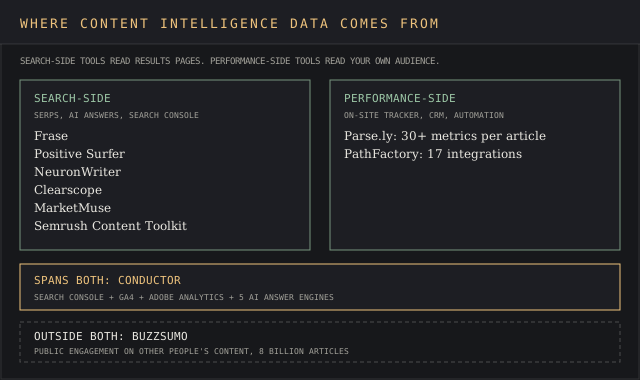
Conductor spans both, using artificial intelligence on search and analytics data alike, which is why it tops the ranking. Putting all your eggs in one basket works only at Conductor's price; a two-tool setup pairs one from each side, one for content discovery and one for content marketing reporting.
Pricing across content intelligence software
Published entry prices for content intelligence tools run from $19 to $199 a month. Quote-only content intelligence software runs from $19,250 to $93,100 a year in Vendr's data.
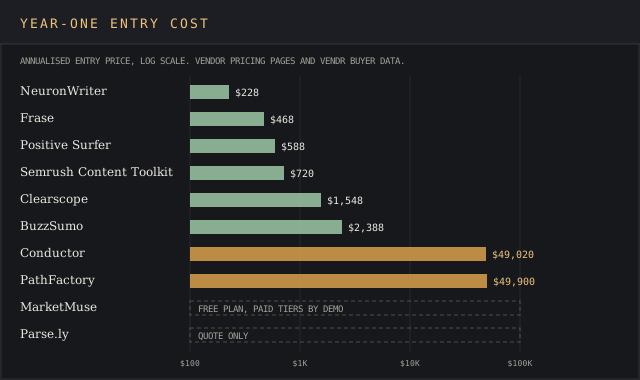
Add-ons can cost an arm and a leg at volume:
- Clearscope: $25 a month per extra page block, $50 per extra draft
- Frase: $29 a month per extra seat
- Semrush Content Toolkit: $20 per extra user
- NeuronWriter: Search Console and API from $57
- Surfer: API from $299
Content intelligence spend belongs in the content strategy budget; model the return first with the SEO ROI calculator.
How to run a content intelligence trial
Content intelligence software is easiest to judge on your own URLs. Clearscope's trial runs 14 days and Semrush's seven, so hit the ground running. Score each trial on the same sheet; the vendor evaluation scorecard template has the columns.
- Connect Search Console or analytics on day one and confirm page-level data.
- Load 20 published URLs from your website and count how many the plan monitors.
- Run the same 5 prompts in each AI tracker.
- Pull one report through the API or MCP server into your analytics tools.
- Price the tier you'd need in month six, add-ons included.
A tool that fails step 1 isn't an essential tool for marketing efforts built on your own data, however good its content creation process looks in a demo. For competitor traffic data, see the website traffic analysis tools ranking; for AI referrals, the AI traffic report.
Ownership changes among content intelligence vendors
Four of the ten ranked tools have sat on one side of an acquisition since February 2023. A buyer signing a multi-year contract signs with whoever owns the tool at renewal.
The deals 2023 to 2026
Adobe announced the $12.00-a-share deal on 19 November 2025 and counts over 28 million Semrush users.
Kaltura's $22 million cash offer covered a company with 100+ enterprise customers, including Nvidia and Cisco.
Siteimprove closed MarketMuse on 31 October 2024; Conductor announced Searchmetrics on 7 February 2023.
Content intelligence tools FAQ
What is a content intelligence platform?
A content intelligence platform reads two kinds of data, search results and the performance of your own pages, and turns them into a list of pages to write, fix or retire. Seven of the ten tools ranked here read at least one source of your own data; MarketMuse, BuzzSumo and the Semrush Content Toolkit read none.
What is AI content intelligence?
It's content intelligence that uses natural language processing to read topic, tone and structure, and that tracks how AI answer engines cite your pages. Five of the ten tools here track AI engines, and Conductor, Frase and Positive Surfer each cover five.
How much do content intelligence tools cost?
Self-serve plans run from NeuronWriter's $19 a month billed annually to BuzzSumo's $199 a month. Enterprise contracts sit far higher: Vendr's buyer data puts Conductor's median at $49,020 a year and PathFactory's at $49,900.
How is content intelligence different from content analytics?
Content analytics reports opens, clicks and conversions per campaign or asset. Content intelligence explains the result from content attributes such as topic, format and structure, the line Optimove draws. Parse.ly sits closest to analytics, with 30+ metrics per article in real time.
What is the best content AI?
For content intelligence, Conductor scores 9 of 10; under $40 a month, Frase scores 8 with API access on its $39 plan.
Bottom line
Conductor wins for an enterprise team ready to embrace content intelligence with a $41,364-plus budget, needing GA4 or Adobe data, five AI engines and an API in one contract. Frase wins under $40 a month; Positive Surfer wins for writers in Google Docs who want 25 AI prompts tracked at $99.
Publishers should shortlist Parse.ly, and B2B demand gen teams PathFactory after a reference call. NeuronWriter is the $19 budget pick, Clearscope suits large editorial teams, MarketMuse fits content marketing teams planning topic clusters, and BuzzSumo and the Semrush toolkit serve competitor research and drafting.