Tools for Market Analysis: 10 Platforms Ranked for 2026
 By Jan Suski. I go deep on every review, checking every number against its source and digging up details other coverage misses, a habit from six years of SEO and link building for tech companies. Bylines at Brand24 and Senuto. How the scoring works.
Quick comparison of tools for market analysis
Published coverage is each vendor's own figure for company count, panel size, or session volume, taken from the vendor's own data page. Entry price is what a buyer sees before a sales call, where one exists.
| # | Provider | Published coverage | Entry price | Best fit |
|---|---|---|---|---|
| 1 | PitchBook | 12.7M+ companies, 634K+ investors | Quote only | Company, deal, and investor data in one platform |
| 2 | CB Insights | 12M+ private companies, 1,600+ market maps | Quote only, 10-day trial | Market maps across 1,600+ tech sectors |
| 3 | SparkToro | 4 reports/mo on entry plan | $38/mo | Finding where a target audience already pays attention |
| 4 | BuzzSumo | 1 user, unlimited searches | $199/mo | Content and social performance research |
| 5 | Hotjar | 7,000 sessions/mo on entry plan | ~$53/mo* | On-site behavior and visitor feedback |
| 6 | Qualaroo | 10K pageviews/mo on free tier | $19.99/mo | On-site survey-based audience research |
| 7 | Tracxn | 8.4M+ companies, 55,700+ taxonomies | Quote only | Startup and company data on a smaller budget than PitchBook |
| 8 | Owler | 20M+ company profiles | Free (5 companies) | Lightweight competitive tracking |
| 9 | quantilope | 300M+ consumer panel access | Quote only, demo required | AI-run quantitative consumer research |
| 10 | Remesh | Hundreds of live participants/session | Quote only, enterprise sales | Live qualitative research at scale |
Hotjar's figure marked * is a euro price (€49/mo) converted to dollars; Hotjar itself doesn't publish a dollar rate since it sells through Contentsquare.
Where these figures come from
Coverage counts are each vendor's own published figure, read on 13 October 2026. Prices come from each vendor's own pricing page except Hotjar's, which runs through Contentsquare's billing. PitchBook, CB Insights, Tracxn, quantilope, and Remesh publish no price at all; none of those rows invents one.
Looking for survey platforms, panels, and sentiment tracking? Our market research tools ranking covers Qualtrics, Statista, Similarweb, Brandwatch, Semrush, and Google Trends, and shares almost no entries with this list.
Most lists of market analysis tools repeat the same six names: a survey platform, a social listening suite, Google Trends, and whichever analytics tool paid for placement. Those tools answer one question well — what are people saying, searching, or browsing — and leave two others untouched: who is funding and building in a market, and what happens when you put an unfinished idea in front of real respondents and watch them react live.
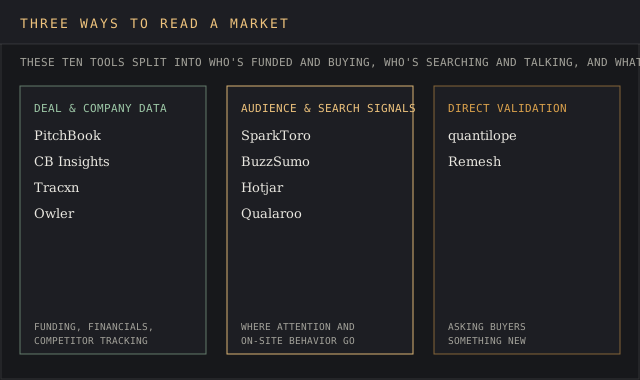
This list covers ten tools built for those three jobs. Four pull from deal, funding, and company-profile data (PitchBook, CB Insights, Tracxn, Owler) so a reader can see who else is competing for the same market before committing a budget to it.
Four track audience attention and on-site behavior (SparkToro, BuzzSumo, Hotjar, Qualaroo) so a reader can see where interest already points. Two run structured research sessions with real people (quantilope, Remesh) when the question needs a human answer and not a traffic graph.
Written for a buyer sizing a market or shortlisting one of these three jobs: a competitive-intelligence analyst checking who else is building nearby, a growth marketer locating an audience before a campaign, or a research lead who needs a respondent's answer this quarter and not next year.
Every figure below comes from a vendor's own pricing or data page, or from a Vendr listing. Every quote comes from a named reviewer on G2, Capterra, or TrustRadius, dated and attributed, pulled after the tool's own marketing copy was set aside. Where a vendor would not publish a number, that gap is stated and no figure is guessed.
Evaluation criteria for tools for market analysis
Five criteria decide the ranking below, applied in this order.
- Does a price exist without a sales call? Four of these ten publish a monthly rate on their own site. The other six require a demo before a number appears.
- How large is the underlying dataset, in the vendor's own words? Company counts, panel size, or contact records, taken straight from each vendor's own data page.
- What is the single complaint that keeps surfacing in verified reviews? The specific, repeated gripe, with a name and a date attached, outweighs a star-rating average.
- Can someone outside the research or data team get a usable answer within a day? Measured by what reviewers report about onboarding and output, set against a vendor's own "easy to use" claim.
- Does the vendor publish its own accuracy or coverage figures, or only an aggregate review score? A tool that shows its own data refresh cadence and sourcing scored higher than one that shows a star rating alone.
Pull a free trial or sample report before a contract on any of the sales-gated tools here. Six of the ten require a demo, and the fastest way to test a published claim — coverage, accuracy, refresh cadence — is against your own target list.
The 10 best tools for market analysis
Ten tools ranked on how completely they answer the three jobs above, applying the five criteria in order.
PitchBook
Best fit
Teams that need company, funding, and investor data in one place, without stitching together three separate subscriptions.
PitchBook's own data page puts its coverage at 12.7 million-plus companies, 634,000-plus investors, 3.1 million-plus recorded deals and transactions, 170,000-plus funds, and 5.1 million-plus professional profiles.
That range is why corporate development teams, VCs, and market-sizing analysts reach for it as a default platform — the same login covers who is buying, who is selling, and who just took a funding round in an adjacent market. Reviewers back the breadth up on the data-quality side, with mixed marks on the people-search layer specifically.
Key features
- Company, deal, investor, and fund profiles in a single search
- Comparable-company and valuation benchmarking by sector
- Deal and funding alerts on saved searches
- API access for pulling records into an internal model
- iOS app alongside the desktop platform
Pricing
PitchBook doesn't publish a price. Access goes through a sales conversation, and the cost scales with seat count and data modules. See our full PitchBook pricing report for buyer-reported figures.
Pros
- Deal and company coverage wide enough to replace several smaller tools
- Clean, fast interface across web and mobile, per reviewers
- No pay-per-contact pricing structure, unlike several contact-data competitors
Cons
- No published price, so budgeting requires a sales call before comparing it to alternatives
- People-level data (titles, contact records) draws more complaints than company-level data
"Excellent UI and intuitive website/iOS app... Continual sourcing of quality leads... Transparent pricing without pay-per-contact structure."Analyst, Finance and Accounting (11-50 employees), TrustRadius, August 2026
"People data is pretty much useless."Analyst, Information Technology (11-50 employees), TrustRadius, July 2026
Why it's ranked #1. PitchBook covers more of the deal-data question — companies, investors, funds, and transactions — in one login than CB Insights or Tracxn, and its 12.7 million-plus company count sits ahead of Tracxn's 8.4 million while its review record on data quality runs cleaner than Owler's.
CB Insights
Best fit
Mapping a tech sector before entering it, with a named market map in place of a raw company list.
CB Insights' Strategy Terminal tracks 12 million-plus private companies and organizes them into 1,600-plus tech market maps, refreshed on a continuing basis through the vendor's own data feeds and API. A 10-day free trial is available before a sales conversation, a step ahead of PitchBook and Tracxn on upfront access, even if the eventual contract still runs through sales.
The market maps double as a chart of a sector's competitive landscape for decision makers, and the platform's trend tracking flags where a market is heading as well as where it stands today. The market-map structure is what reviewers single out as the platform's advantage over a flat company database: the whole sector appears at once, without searching for competitors one at a time.
Key features
- Pre-built market maps across 1,600+ technology sectors
- Private company profiles with funding and patent data
- Continually refreshed data feeds and API access
- Trend and emerging-technology tracking by sector
- 10-day free trial before a sales call
Pricing
No published price. Access starts with the 10-day trial, and full pricing comes from a sales conversation.
Pros
- Market-map structure saves time over building a competitor list by hand
- 12 million-plus company coverage, with continuing data refreshes
- Trial access before any sales conversation
Cons
- No published price beyond the trial period
- Reviewers flag specific data points, including valuation and revenue estimates, as weaker than the platform's broader coverage
"Pre and post money valuation data" and "estimates on revenue and number of clients" were named the weakest fields in an otherwise useful dataset.VP of Engineering (1-10 employees), TrustRadius, February 2020
Why it's ranked #2. The market-map structure covers ground PitchBook requires more manual searching to reach, and the 10-day trial beats PitchBook's and Tracxn's sales-only access. It ranks behind PitchBook because reviewers flag specific financial estimates as weaker than PitchBook's comparable fields.
SparkToro
Best fit
Finding exactly which podcasts, publications, and social accounts a target audience already follows, without running a survey first.
SparkToro publishes its pricing outright: Free (three audience previews a month), Personal at $38/mo (four full reports), Business at $112/mo (25 reports, 10 users), and Agency at $225/mo (250 reports, 100 users, single sign-on). That transparency is rare on this list — eight of the other nine tools require a sales call before a number appears.
The reports read as audience data for a named target market: which podcasts a group listens to, which accounts it follows, and which other brands it already pays attention to. The tradeoff shows up in reviews from lighter users: at four reports a month, the Personal plan reads as expensive for occasional research.
Key features
- Audience search by website, podcast, publication, or social account
- "Also follows" and "also talks about" cross-referencing
- Audience demographic and location breakdowns
- Browser extension for pulling audience data on any page
- Trend tracking for an audience's shifting interests over time
Pricing
Free tier covers three previews a month. Personal is $38/mo for four full reports. Business is $112/mo (25 reports, 10 seats). Agency is $225/mo (250 reports, 100 seats, SSO).
Pros
- Published pricing, with no sales call required to start
- Specific, exportable audience data, not aggregate traffic estimates
- Browser extension speeds up one-off lookups
Cons
- Report limits on lower tiers can run out fast for anyone doing frequent research
- Priced per report, not per seat, which penalizes occasional use
"$40 a month just for 4 reports... overpriced" for someone who uses it only occasionally, not for weekly research.student reviewer, G2, July 2026
Why it's ranked #3. SparkToro is the first tool on this list with a published price and no demo requirement, and at $38/mo it answers a narrow question — where does an audience already pay attention — faster than PitchBook or CB Insights answer a broader one. It ranks below the top two because its scope is narrower, limited to audience discovery and excluding company or deal data.
BuzzSumo
Best fit
Finding which content and topics already earn attention in a space, before committing a content budget to a guess.
BuzzSumo's entry-level Content Creation plan is $199/mo for one user with unlimited searches and two alerts, published on the vendor's own pricing page. That is a published number five times SparkToro's entry price, which reviewers note directly when weighing it against lighter-weight alternatives.
The output feeds a content strategy built on what already works in a niche, and it doubles as a cheap read on topic-level market trends.
Key features
- Content and headline analysis by social engagement
- Influencer and journalist identification by topic
- Brand and competitor content alerts
- Question Analyzer for audience research questions
- Trending-topic tracking across a chosen niche
Pricing
Content Creation starts at $199/mo for one user. Higher tiers add seats, alerts, and API access; full details require checking current vendor pricing.
Pros
- Published entry price, same transparency advantage as SparkToro
- Unlimited searches on the entry tier, no per-query metering
- Alerts for ongoing competitor and brand content tracking
Cons
- $199/mo entry price is a step up from comparably scoped tools
- Single-user entry tier means team use requires an upgrade fast
Pricing "was a bit high" relative to the value for a smaller team's content research needs.Strategist, Social Media (11-50 employees), TrustRadius, June 2021
Why it's ranked #4. BuzzSumo publishes its price like SparkToro, but at $199/mo for one seat it costs more up front for a comparably narrow job: content and social research. It ranks above Hotjar and Qualaroo because it answers a market-facing question about what content wins, separate from an on-site one.
Hotjar
Best fit
Watching what a visitor does on a page, before and after converting.
Hotjar's free tier covers 35 sessions a day, which works out to roughly 1,050 sessions a month, per Hotjar's own help documentation. Paid access now runs through Contentsquare, which acquired Hotjar, starting around €49/mo (roughly $53) for 7,000 sessions a month. That ownership change is the single most-repeated complaint in recent reviews.
Recordings and heatmaps turn raw website traffic into a picture of visitor behavior that an analytics funnel report alone won't show, which is why it pairs alongside an analytics stack and doesn't replace one.
Key features
- Session recordings of real visitor behavior
- Heatmaps by click, scroll, and attention
- On-site surveys and feedback widgets
- Funnel and form-abandonment tracking
- Integration with common analytics and CRM platforms
Pricing
Free tier: 35 sessions/day (~1,050/month). Paid tiers, sold through Contentsquare, start around €49/mo (~$53) for 7,000 sessions/month.
Pros
- Free tier covers real usage for a small site, not only a demo
- Session recordings and heatmaps in one tool, no separate subscriptions
- Reports easy to read and share with people outside the data team
Cons
- Pricing tiers got harder to follow after the Contentsquare acquisition
- Paid price point rose following the same ownership change
"After the product was acquired the price was instantly increased while the pricing tiers became extremely hard to follow..."Senior Product Manager, Financial Services, Capterra, October 2024
"Free tier provides more than adequate reporting for most small businesses... reports are easy to read and can be shared with clients."Lucas P., Creative Director, Capterra, April 2020
Why it's ranked #5. Hotjar's free tier, at roughly 1,050 sessions a month, out-covers Qualaroo's free tier for behavior tracking specifically, and its combined heatmap-plus-recording set covers more ground than a single-purpose tool. It ranks below BuzzSumo because the post-acquisition pricing confusion is a live, recent, and repeated complaint.
Qualaroo
Best fit
Asking visitors a direct question on the page itself, where clicks alone leave intent unclear.
Qualaroo's free tier allows one set of 50 responses, capped at 10,000 monthly pageviews or 500 email sends. Paid plans start at $19.99/mo for Essentials, with Business and Enterprise tiers from $49.99/mo, per pricing Qualaroo itself provided to G2. That $19.99/mo entry point is the lowest published price on this list.
Its data collection runs lighter than a formal focus-group study, a quick read on why visitors leave.
Key features
- Targeted on-page surveys (Nudges) by URL, behavior, or segment
- Sentiment analysis on open-text survey responses
- A/B testing of survey questions and placement
- Integration with common analytics and CRM platforms
- Exit-intent and scroll-based survey triggers
Pricing
Free: one-time 50 responses, 10,000 pageviews or 500 email sends per month. Essentials: $19.99/mo. Business/Enterprise: from $49.99/mo.
Pros
- Lowest published entry price of any tool on this list
- Direct, in-context survey responses, not inferred behavior
- Sentiment analysis built into open-text responses
Cons
- Support experience draws sharp, specific complaints in reviews
- Free tier's 50-response cap is a one-time allowance, not recurring
A paid upgrade of around $200 led to a two-month wait and no refund, which the reviewer called the worst customer service experience with a software vendor.Mid-Market reviewer, G2, December 2023
Why it's ranked #6. Qualaroo's $19.99/mo entry price undercuts every other paid tool here, and direct, in-context survey responses answer a question heatmaps alone can't: why a visitor acted the way they did. It ranks below Hotjar because the support complaint on record is sharper and more specific than anything in Hotjar's review set.
Tracxn
Best fit
Startup and private-company research on a tighter budget than PitchBook or CB Insights typically require.
Tracxn tracks 8.4 million-plus companies across 55,700-plus taxonomies, pulling from 3,000-plus data feeds and adding roughly 7,800 companies a day, scanned across 1 billion-plus domains. The platform serves 1,000-plus customers across 30-plus countries, per its own data page. Reviewers who have used both Tracxn and the larger platforms describe it as a lower-cost way to reach similar startup coverage.
Key features
- Startup and company profiles organized by 55,700+ taxonomies
- Funding round and investor tracking
- Daily feed of new company additions
- Sector- and geography-based company lists
- Comparable-company search across a chosen taxonomy
Pricing
No published price. Access requires a sales conversation, though reviewers describe it as priced below PitchBook and CB Insights for comparable startup coverage.
Pros
- Broad company coverage at a cost reviewers describe as lower than larger competitors
- Taxonomy-based organization makes sector research faster than a flat search
- Daily-refreshed feed of new company additions
Cons
- No published price, so a sales call is still required to confirm the cost advantage
- AI-driven data tagging produces specific, documented errors
The platform's AI engine mis-tagged a seed funding round as a bootstrapped company and an incubator as an investor, both flagged as specific data errors.Mayan K., Product Manager, G2, August 2021
The platform "offers a very extensive database of companies from all sectors, which is consistently updated" and is "easy to use and understand."Cem K., Fintech Consultant, G2, January 2026
Why it's ranked #7. Tracxn's 8.4 million-plus company count trails PitchBook's and CB Insights', and the documented AI-tagging errors are a real data-quality gap the two larger platforms don't carry in their review record to the same degree. It still outranks Owler because its taxonomy structure and daily refresh cadence go beyond a flat company directory.
Owler
Best fit
A lightweight, no-cost first look at a handful of named competitors.
Owler's free community tier covers five companies and draws from a database of 20 million-plus company profiles, 150 million-plus verified contacts, and 45 million-plus mapped competitive relationships, built from 500,000-plus monthly community contributions and 180,000-plus weekly community-driven matches, alongside 18,000-plus monthly tracked news events. The free tier is the honest draw here; Pro pricing is sales-gated.
Key features
- Free competitive snapshots for up to five companies
- Daily news alerts on tracked competitors
- Community-sourced company data (revenue estimates, employee counts)
- Competitive rank and "estimated revenue" scoring
- Browser extension for quick company lookups
Pricing
Free community tier: five tracked companies. Pro tier: no published price, requires a sales conversation.
Pros
- No-cost entry point with real, if limited, competitive data
- Daily news alerts keep tracked companies current without manual checking
- Community contribution model keeps some fields updated between formal refreshes
Cons
- Community-sourced fields (employee count, revenue estimate) carry documented accuracy gaps
- Five-company cap on the free tier limits it to a narrow starting list
Specific figures were called inaccurate, including an employee count listed near 34 for a company the reviewer confirmed employed around 130 people at the time.Sales employee (1001-5000 employees), TrustRadius, May 2020
Why it's ranked #8. Owler's free tier and 20 million-plus profile count make it the easiest entry point on this list, but the documented accuracy gaps in its community-sourced fields sit below Tracxn's taxonomy-driven data on reliability, which is why it ranks last among the four deal-and-company-data tools.
quantilope
Best fit
Running structured, quantitative consumer research without a dedicated research team building the survey logic by hand.
quantilope automates 16 research methods and gives access to a panel the vendor describes as 300 million-plus consumers, with the platform ranked first in the Greenbook GRIT Report for the second year running as of 2025. The vendor also reports that more than 80 percent of surveyed clients say they make more consumer-driven decisions after adopting the platform.
No price is published; access starts with a demo. The automated analysis covers concept testing and brand tracking in one flow, cutting the time a traditional research team would spend building the same study by hand.
Key features
- 16 automated quantitative research methods
- Access to a 300M+-strong consumer panel
- Automated insight summaries generated from survey data
- Concept and claims testing built into the survey flow
- Brand health and tracking study templates
Pricing
No published price. Access starts with a demo and moves to a sales conversation.
Pros
- Automates research methods that otherwise require a trained analyst to design
- Large panel access without a separate panel-provider contract
- Independently ranked first in the Greenbook GRIT Report for 2025, its second year running
Cons
- No published price; reviewers flag the initial cost as a hurdle before seeing the platform's output
- Learning curve for teams without prior quantitative research experience
The platform "looked expensive at the beginning," a cost concern that eased once the reviewer saw the output quality.Andres Q., Support Engineer, Capterra, March 2023
Why it's ranked #9. quantilope answers a different question than the other eight tools on this list — what respondents will say about a concept — and that narrower, slower-to-set-up use case, combined with no published price, puts it below every tool with a self-serve entry point. It ranks above Remesh only because its research runs asynchronously, without the live-session constraint Remesh requires.
Remesh
Best fit
Live, large-group qualitative research when a room full of real reactions is needed in under an hour.
Remesh can run a single live session with hundreds of participants at once, with the vendor citing a case where Nestlé received usable insights back within 60 minutes of a session starting. The platform carries SOC 2, CCPA, and GDPR compliance attestations. No price is published; it sells through enterprise sales conversations only.
Key features
- Live sessions with hundreds of simultaneous participants
- Real-time AI-assisted theming of open-text responses
- Live polling and sentiment tracking during a session
- SOC 2, CCPA, and GDPR compliance attestations
- Session recording and post-session reporting
Pricing
No published price. Enterprise sales only; no free tier or self-serve option.
Pros
- Live, large-group format produces a usable read on reactions in under an hour per the vendor's own case example
- Compliance attestations (SOC 2, CCPA, GDPR) cover enterprise procurement requirements
- One reviewer reported a project cost around a quarter of a comparable full-service research firm's quote
Cons
- Discussion-guide building draws specific, repeated glitch complaints
- No published price or self-serve tier, the only enterprise-sales-only tool on this list without a public starting figure
Building the discussion guide in the platform and in Excel is "painful in their own ways," and editing or reordering questions is "a bit glitchy and annoying."Christina F., Senior Director, Strategy and Innovation, Marketing and Advertising, Capterra, February 2026
Why it's ranked #10. Remesh answers the narrowest question on this list — live reactions from a large group, fast — and is the only tool here with neither a published price nor a self-serve tier, which is the deciding factor against quantilope's demo-gated but asynchronous model.
What the published prices buy you
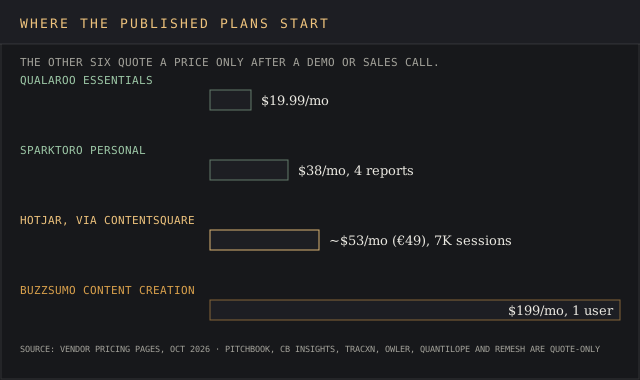
Only four of these ten tools post a number before a sales call: Qualaroo at $19.99/mo, SparkToro at $38/mo, Hotjar at roughly $53/mo through Contentsquare, and BuzzSumo at $199/mo. That spread covers a tenfold difference in entry price for four tools that all sit in the audience-and-behavior cluster, apart from the deal-data or direct-validation groups.
None of the four company-data or direct-validation tools (PitchBook, CB Insights, Tracxn, Owler's Pro tier, quantilope, Remesh) publish a number at all — budgeting for any of those six starts with a sales conversation.
Tools on this list that publish a price before a sales call. The other six, including every company-data platform, require a demo first.
How the company-data tools compare in scale, not only price
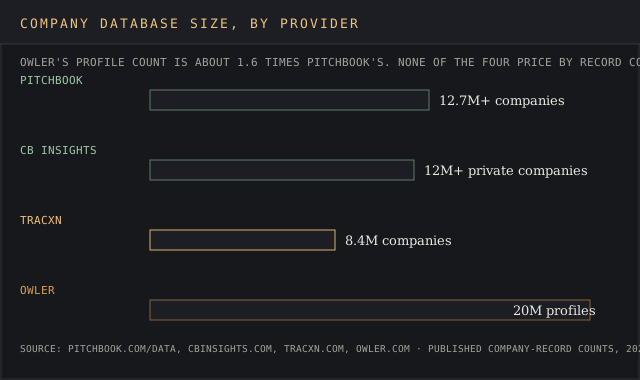
Company count alone doesn't settle which of the four deal-data tools fits a given team: Owler's 20 million-plus profiles lead the group, but that figure includes a free community tier built on crowd-sourced fields that reviewers flag for accuracy gaps.
PitchBook's 12.7 million-plus and CB Insights' 12 million-plus sit closer together and both draw from paid, sales-gated data pipelines, apart from community contributions, which is part of why reviewers rate their data quality higher despite the smaller raw counts. Tracxn's 8.4 million is the smallest of the four, paired with the lowest price reviewers report relative to the other two sales-gated platforms.
Where this differs from general market research tools
The facts search engines surface most often for "market analysis tools" center on survey platforms, social listening, and search-trend tools: Google Trends for search popularity, Similarweb for traffic analysis, Statista for industry data tables, and AI-assisted survey tools for faster turnaround on consumer feedback.
Those are real, common answers to the question, and our market research tools page covers Qualtrics, Statista, Similarweb, Brandwatch, Semrush, and Google Trends directly.
This list exists because those six tools answer "what do consumers say" well and barely touch "who else is building in this market" or "what happens when a concept meets a live audience." quantilope and BuzzSumo show up in both conversations — quantilope as an AI-run survey platform and BuzzSumo as a content-and-social research tool — and both earned their place here on company-specific data over category-wide claims.
Four of the six sales-gated tools on this list (PitchBook, CB Insights, Tracxn, Remesh) won't share a price until a demo is booked. Ask for a sandbox or sample report against your own target list before signing, since a vendor's coverage claim and a buyer's actual search results don't always match.
Tools for market analysis FAQ
What tools are commonly used in market analysis?
Teams typically combine three kinds of tools: deal and company-data platforms such as PitchBook, CB Insights, Tracxn, and Owler for competitive and funding context; audience and search-signal tools such as SparkToro, BuzzSumo, Hotjar, and Qualaroo for attention and on-site behavior; and direct-validation platforms such as quantilope and Remesh for structured research with real respondents.
What are the top market analysis tools for company and deal data?
PitchBook leads on breadth, covering 12.7 million-plus companies, 634,000-plus investors, and 3.1 million-plus recorded deals in one login. CB Insights follows with 12 million-plus private companies organized into 1,600-plus ready-made market maps. Tracxn and Owler cover similar ground at a lower published cost, with Owler's 20 million-plus profiles built partly on crowd-sourced data.
Which market analysis tool has the lowest published price?
Qualaroo's Essentials plan starts at $19.99/mo, the lowest published entry price on this list. SparkToro follows at $38/mo for its Personal plan. Six of the ten tools here, including PitchBook, CB Insights, Tracxn, quantilope, and Remesh, require a sales conversation before a buyer sees any number.
Is PitchBook or CB Insights better for market analysis?
PitchBook covers more ground in one login: company, deal, investor, and fund data together, with a 12.7 million-plus company count. CB Insights answers a narrower question faster, through pre-built market maps across 1,600-plus tech sectors and a 10-day free trial before any sales call, which PitchBook doesn't offer.
How is a tool for market analysis different from a market research tool?
A market analysis tool in this sense tracks who else is building or funding in a space, and how an audience already behaves, using company data, search signals, and on-site behavior. A market research tool, covered on our dedicated ranking, runs structured surveys, panels, and sentiment tracking to ask consumers directly what they think of a concept.
Do any of these tools offer a free plan?
Owler's free community tier tracks five companies at no cost. Hotjar's free tier covers roughly 1,050 sessions a month. SparkToro offers three audience previews a month for free. Qualaroo allows one set of 50 responses on its free tier. The other six tools, including PitchBook and CB Insights, require a sales conversation or paid plan from the start.
What should I check before buying a company-data platform like PitchBook or Tracxn?
Confirm the published company count against an independent review's description of actual search results, since vendor totals can include stale or duplicate records. Ask specifically how people-level data (titles, direct contacts) is sourced and refreshed, since reviewers across this list rate company-level data higher than people-level data.
Can a survey tool like Qualaroo replace a session-recording tool like Hotjar?
No. Qualaroo asks a visitor a direct, in-context question and returns a text answer; Hotjar records what a visitor did on the page through session recordings and heatmaps. The two answer different questions, and reviewers who use both describe them as complementary, each covering what the other misses.
Bottom line
Start with PitchBook or CB Insights if the open question is about competitors, funding, or market size — pick PitchBook for breadth across company, deal, and investor data in one login, and CB Insights if a ready-made market map matters more than raw company count. Reach for SparkToro or BuzzSumo if the question is about attention and content over deals, and pick based on published price before anything else, since both post a number upfront.
Use Hotjar or Qualaroo for on-site behavior and direct visitor feedback, with Qualaroo as the lower-cost entry point into text-based responses. Save quantilope and Remesh for the moment the decision needs a real person's answer over a dataset — quantilope when the research can run on its own schedule, Remesh when it has to happen live. Across all ten, the figures that matter come from what each vendor is willing to publish.