Hotjar review: heatmaps, recordings and feedback tools in 2026
 By Jan Suski. I go deep on every review, checking every number against its source and digging up details other coverage misses, a habit from six years of SEO and link building for tech companies. Bylines at Surfer, Brand24, and Senuto. How the scoring works.
· Prefer this source on Google
Best for
Product and marketing teams that want heatmaps, session replays and on-site surveys running alongside a quantitative analytics tool.
Not for
Teams that need form analytics, since Hotjar retired that product in December 2020 and never brought it back.
What it costs
Contentsquare Free covers 200,000 sessions a month; Growth starts at $49, Voice of Customer at $99, both billed monthly, with Pro and Enterprise quote only.
- Heatmaps
- Click, move, scroll, engagement zone and rage click maps; unlimited on paid plans
- Session recordings
- Player draws the visitor's mouse path and marks interaction events on the timeline
- Capture rules
- Sessions under 30 seconds dropped, an interaction required, HTTPS pages only
- Replay sampling
- Free captures 5%; Growth captures 100% to 20,000 sessions, then 15%
- Conversion funnels
- Retired 14 December 2020, restored 3 February 2023
- Recording filters
- Device type, rage clicks, exit intent, frustration, engagement, relevance score
- Surveys
- 100 responses a month on Free; volume capped by plan
- Feedback widget
- Five-point sentiment scale above a free-text box
- User interviews
- Recruiting tools for scheduled interviews alongside the survey layer
- Feedback polls
- Targeted questions to a subset of visitors, for testing a specific behavior hypothesis
- Contentsquare Free
- 200,000 monthly sessions, 5% replay capture to 10,000, one project, one month retention
- Hotjar Free (legacy)
- 35 sessions a day with replays held 365 days; keepable, no longer sold
- Experience Analytics Growth
- $49 a month, $39 billed annually, from 7,000 monthly sessions and scaling to 10 million
- Voice of Customer Growth
- $99 a month, $79 billed annually, 500 survey responses a month
- Pro
- Quote only; dedicated customer success manager and priority support
- Enterprise
- Quote only; replay access up to 24 months
- Growth retention
- 13 months of analytics against two months of replays
- Annual discount
- 20% off
- Second-plan discount
- A further 10% off the cheaper plan when you buy two paid Growth plans
- Privacy masking
- Keystrokes in input fields suppressed client-side before data leaves the browser
- Tracking code
- Bootstrap script about 15 KB compressed; 130 to 200 ms average CDN response
- WordPress plugin
- Version 1.0.16, 70,000+ active installations, 2.9 from 18 reviews, flagged untested
- Form analytics
- None. Forms was switched off 14 December 2020 and never came back
- Data location
- AWS eu-west-1 in Ireland; no end-user IPs at rest, processed IPs deleted within 30 days
- Certification
- SOC 2 Type II, per Hotjar's help centre
- AI usage cap
- Service Schedule 2026.2 defines excessive use as 20 queries per hour per user
- Deletion behavior
- Deleting recordings destroys the heatmaps built from them; recordings aren't backed up
- Store rating
- 4.3 from 85 Shopify App Store reviews
Microsoft Clarity
Not forA team that has to hand its legal department a signed data processing agreement, because Microsoft will not sign one.
Fullstory
Not forA buyer who needs a number before booking a call, since Business, Advanced and Enterprise all price by quote.
Pairs well with Hotjar
Where the prices come from, and which retention figure to check against your contract
Plan names, session caps and prices here are Contentsquare's, read off the pricing page that hotjar.com/pricing redirects to, as of the 9 August 2026 update.
The 5% and 15% replay capture rates, the SOC 2 Type II certification and the 20-queries-an-hour ceiling are Hotjar's and Contentsquare's own statements. Retention is the row to check against your contract. The help centre serves two contradictory variants, and both name Hotjar tiers the checkout no longer sells.
Hotjar is a behavior analytics and user feedback platform that shows how real visitors use a website through heatmaps, session recordings, surveys and feedback tools. This Hotjar review covers what it does, what it costs and where it falls short.
It's written for product managers, UX researchers and digital marketers who already track traffic in a quantitative tool and want to understand the behavior behind those numbers.
Choosing wrong here matters. Hotjar is a strong complement to quantitative analytics and a poor replacement for it, and knowing that distinction before buying avoids paying for a tool that can't answer every question on its own.
Two things to settle first. Hotjar no longer has its own pricing, signup, or company, so everything below reflects the Contentsquare plans that replaced them.
Several widely repeated facts about Hotjar are also wrong, including the ones about its form analytics, its WordPress plugin and its page weight. Each is named and corrected where it comes up.
↑ FACT SHEETWhat is Hotjar and how does Hotjar work
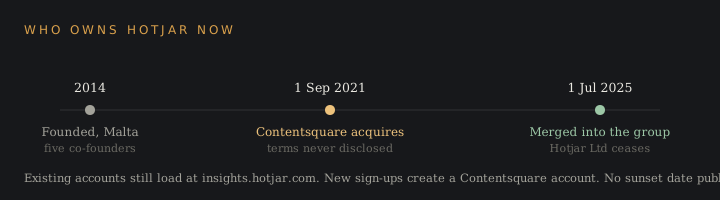
Hotjar was founded in Malta in 2014 by David Darmanin, Erik Näslund, Johan Malmberg, Marc von Brockdorff and Jonathan Vella. Contentsquare announced its acquisition on 1 September 2021, and terms were never disclosed.
On 1 July 2025 Hotjar Ltd merged into the Contentsquare Group, billing moved to Contentsquare's US and French entities, and Hotjar's terms of service were superseded by the Contentsquare master agreement.
Existing accounts still load at insights.hotjar.com, new sign-ups create a Contentsquare account, and hotjar.com/pricing redirects to contentsquare.com/pricing. There is no published sunset date. On 9 August 2026, ChatGPT and Perplexity were both asked if Hotjar still exists; both said yes and missed that redirect, a gap covered in our report on software AI engines still describe as active.
The official line is that current accounts remain unchanged. Hotjar is still running, still supported, and no longer purchasable on its own.
How does Hotjar work in practice: a short line of tracking code sits on a site, capturing mouse movements, clicks and scroll depth. Heatmaps and session recordings get built from real user sessions.
Hotjar helps teams connect observed behavior with direct user feedback, pairing quantitative data like where users click with qualitative insights from user surveys and interviews.
That combination is why it stayed popular. Analysts describe its core strength as understanding the reasoning behind user behavior, which is the same gap customer intelligence work exists to close.
Hotjar heatmaps and session recordings
Hotjar offers heatmaps to visualize user interactions, showing where users click, how far users scroll down a page and which elements draw the most mouse movements.
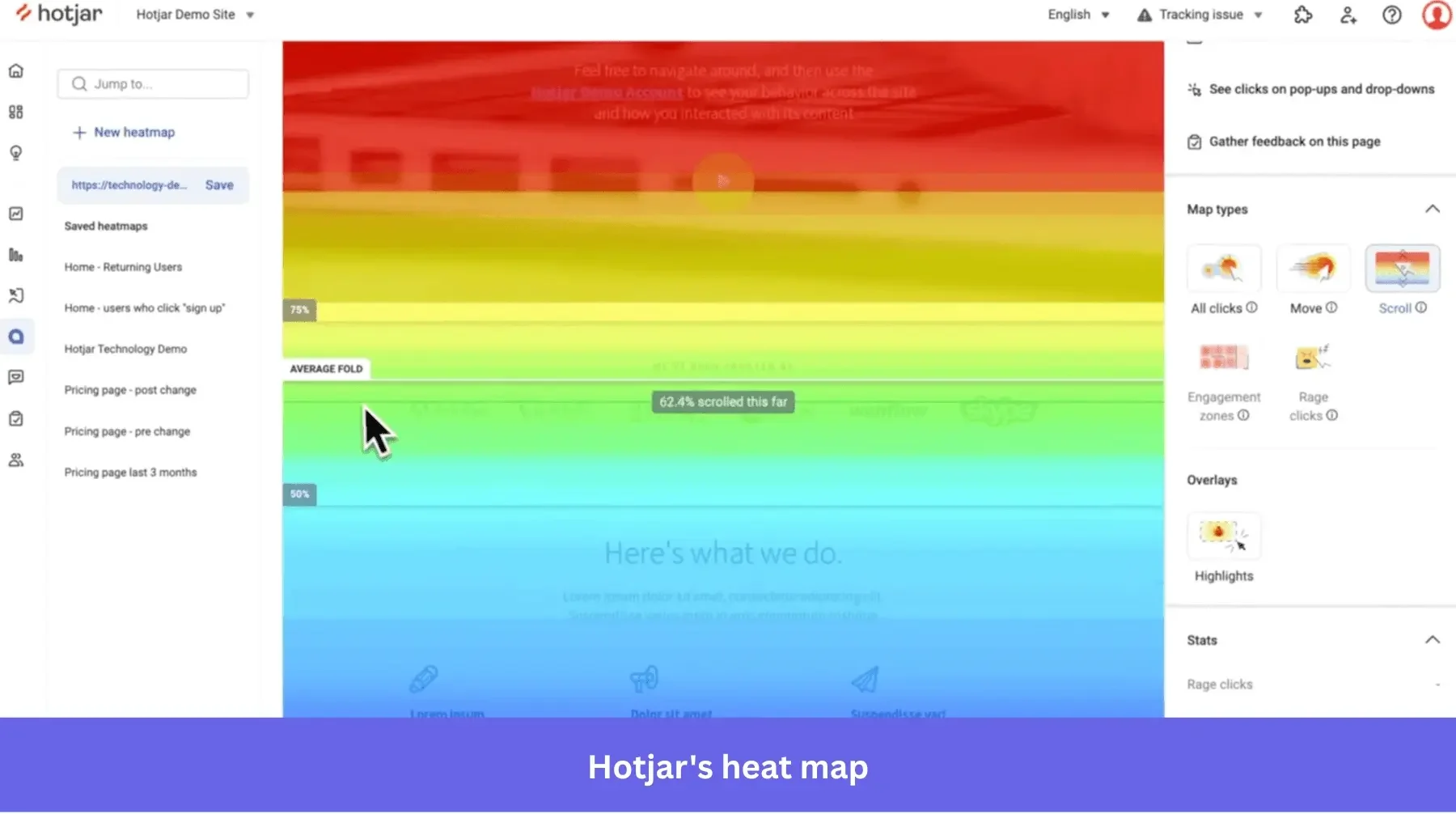
The scroll map above marks the average fold and labels how far down the page visitors reached, which is the fastest way to tell if anything below it gets read at all.
Session recordings allow viewing real user navigation on the site, letting a product manager watch an individual visitor's path click by click.
Hotjar automatically masks sensitive form fields like passwords in every recording, so a name or credit card number typed into a form does not appear in the replay. Keystroke suppression happens client-side, before the data leaves the browser.
That default matters for teams handling regulated data, since a raw session replay tool without masking can create a compliance problem before anyone reviews a single clip. Hotjar's help centre lists SOC 2 Type II certification.
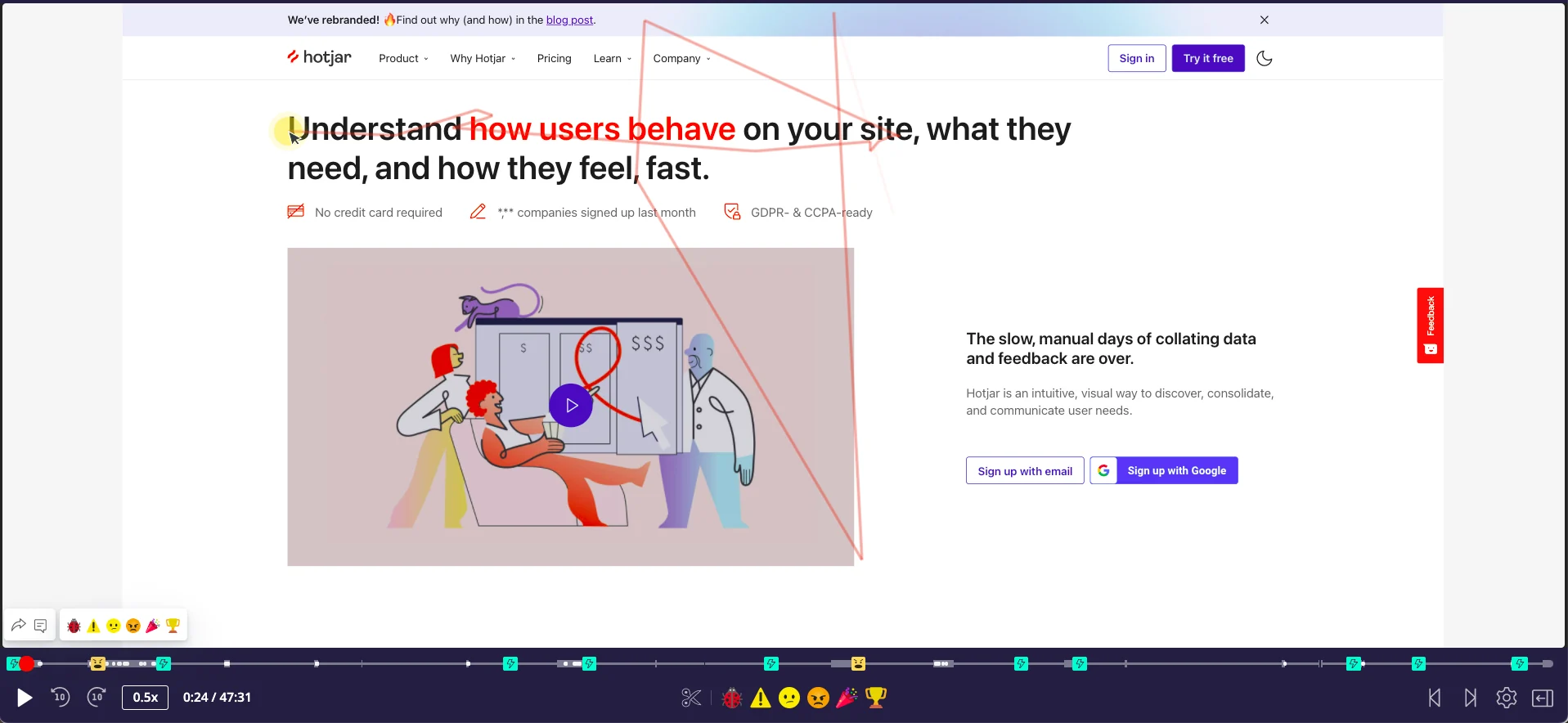
The player draws the visitor's mouse path across the page and marks interaction events along the timeline, so a reviewer can jump to the moment something went wrong.
The three capture rules nobody advertises
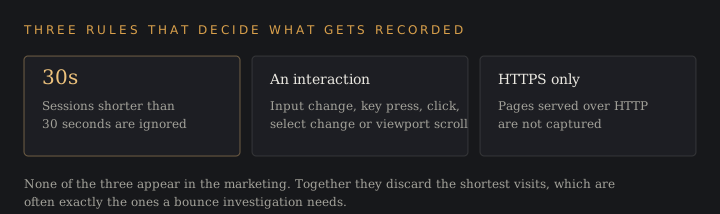
Three capture rules decide what you get, and none of them appear in the marketing. Hotjar ignores sessions shorter than 30 seconds. It keeps a recording only if the visitor did something in it: an input change, a key press, a click, a select change, or a viewport scroll. And it captures HTTPS pages only.
Recording and analyzing user sessions can be time-consuming on busy sites, since a high-traffic page can generate thousands of user sessions a day and no team can watch them all.
Hotjar's answer is filtering. Teams narrow session recordings by device type, rage clicks or exit intent to focus on the sessions most likely to explain a drop in conversions.
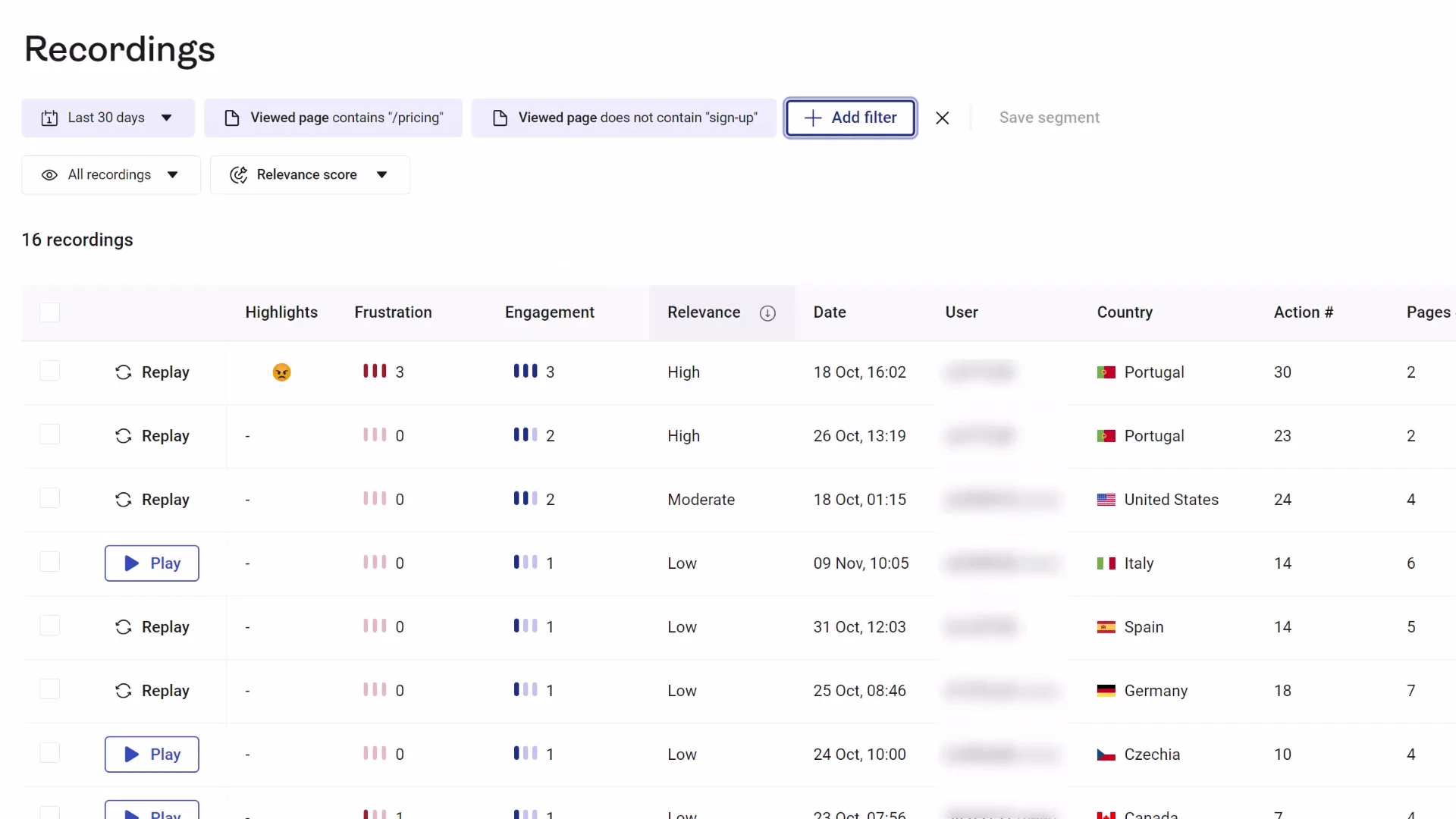
Stacked filters do the narrowing: the view above cuts 30 days of traffic down to 16 recordings by asking for pricing-page visits that never reached sign-up, then ranks what's left by relevance.
↑ FACT SHEETConversion funnels, and what happened to form analytics
Hotjar's funnels help identify user drop-off points during conversions, showing the exact step in a checkout or signup flow where users drop before completing an action. Conversion funnels turn a single conversion rate number into a visual map of where visitors give up.
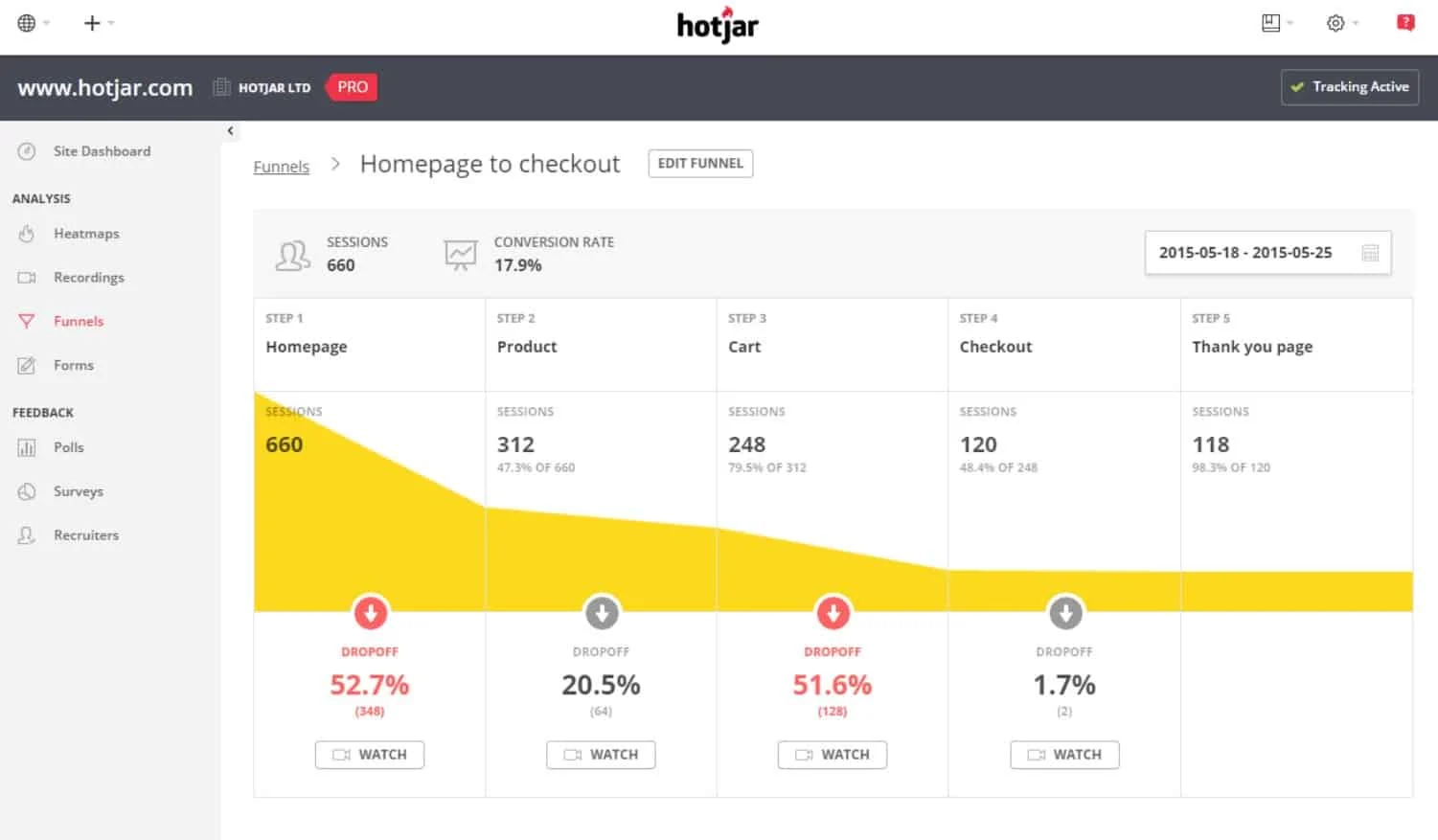
Each step carries its own drop-off percentage and a button that opens the recordings for the visitors who left there, which is the link between the aggregate number and the individual session.
That screenshot also dates itself: the left-hand navigation still lists Forms, a product Hotjar switched off in December 2020.
Form analytics is a different story, and it's the claim most competitor comparisons still get wrong. Form analytics track user interactions with website forms: which field a visitor clicks into, how long they linger, which field they correct, and where they abandon.
Comparison posts routinely state that Hotjar's form analysis tracks nine metrics against nearly 60 for Formisimo. Hotjar announced on 29 November 2020 that it was retiring Forms & Funnels and switched them off on 14 December 2020. Funnels came back on 3 February 2023. Forms never did, so Hotjar tracks no form metrics at all today.
Formisimo rebranded to Zuko in March 2019 and the legacy product stopped taking new customers, though Formisimo Ltd still trades as the Manchester-registered company behind Zuko.
A team that needs form analytics as its primary use case needs that second tool. Zuko starts at €52 a month for 5,000 monthly sessions.
Feedback tools: surveys, feedback polls and feedback widgets
Hotjar includes feedback tools like surveys and polls for user insights. A team can ask visitors direct questions, adding intent data that click tracking alone can't capture.
Surveys and feedback widgets capture qualitative user sentiment in real time, and a feedback button embedded on a page invites real users to leave feedback in the moment.
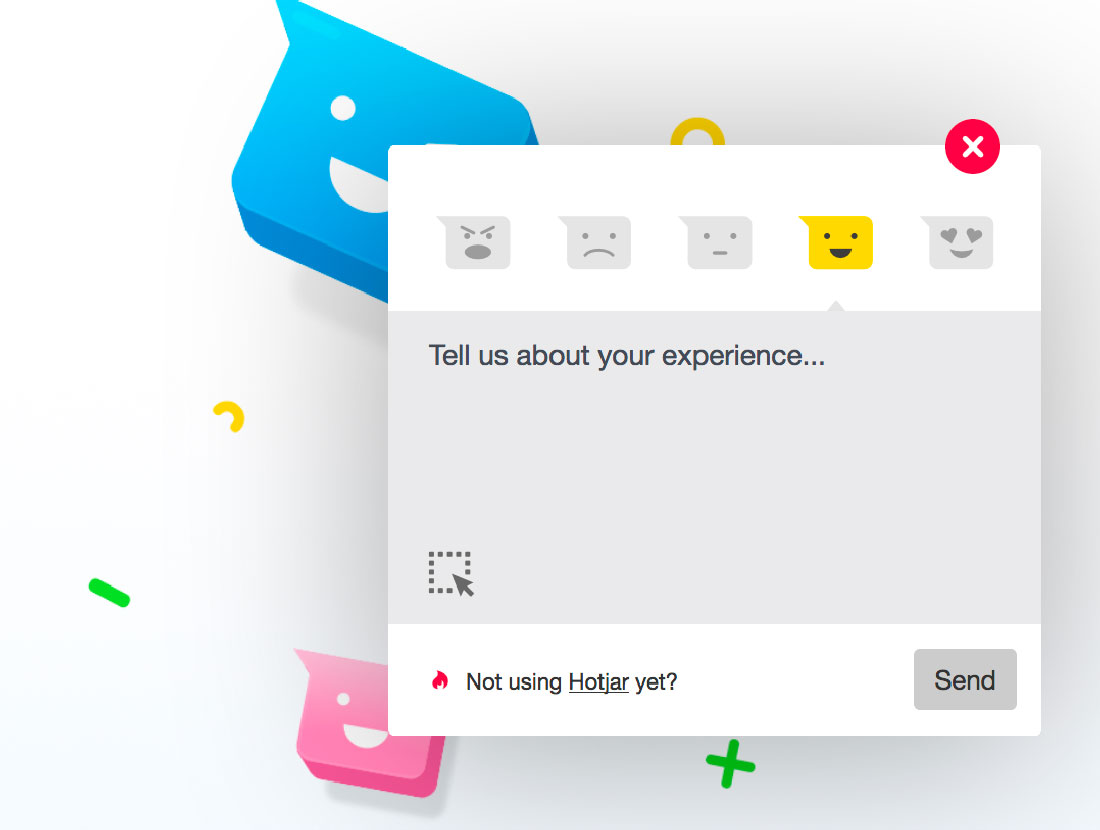
The widget pairs a five-point sentiment scale with a free-text box, so a visitor can rate the page in one click and explain the rating only if they want to.
Feedback polls prompt a targeted question to a subset of site visitors, useful for testing a specific hypothesis about why users behave a certain way on one page. Combined with user interviews scheduled through Hotjar's recruiting tools, these give a research team a fuller picture than session data alone.
A few of the most common feedback tools in a typical setup:
- Feedback polls triggered on exit intent to catch visitors before they leave
- On-page feedback widgets for ongoing, always-available comments
- Short user surveys for targeted questions about a specific flow
- Recruited user interviews for deeper qualitative research
Survey volume is now capped by plan. The Free tier allows 100 survey responses a month; Voice of Customer Growth starts at $99 a month, or $79 billed annually, for 500 monthly responses.
Teams running structured customer feedback programs at scale usually outgrow this layer and pair it with a dedicated platform such as Medallia.
How to install Hotjar and use Google Tag Manager
Hotjar installation requires adding a JavaScript tracking code to every page a team wants to track. Installing that code takes a few minutes through Google Tag Manager for teams that already manage other scripts that way, and it avoids a second manual code edit every time tracking needs change.
Installation can be challenging without coding knowledge for teams managing their own website outside a tag manager. Like any third-party script, Hotjar can slow down website loading speeds if not managed properly.
Competitor comparisons state that Hotjar's tracking code adds 150 to 250 KB of JavaScript. The bootstrap script transfers about 15 KB compressed. Hotjar's performance documentation cites a 130 to 200 millisecond average CDN response; it doesn't publish a byte total. A second modules bundle is hash-versioned and its size isn't published, so measure it on your own site.
The other repeated claim is that the Hotjar WordPress plugin was deprecated after July 2025. It wasn't. The plugin remains listed at version 1.0.16 with more than 70,000 active installations and a 2.9 rating from 18 reviews, and Hotjar's help centre still documents installing through it.
What happened in July 2025 was the corporate merger. The plugin hasn't been updated in roughly three years and WordPress.org flags it as untested against current versions, which is a good reason to prefer Google Tag Manager, though not the same thing as withdrawal.
Hotjar vs Google Analytics
Hotjar is no replacement for traditional web analytics platforms like Google Analytics, and the two tools answer different questions. Google Analytics reports how many users visited a page and where they came from; Hotjar shows what those users did once they arrived. Competitive traffic estimates come from a third category again, covered in our Similarweb review.
Teams that already understand user behavior at a high level use Hotjar to go deeper on a specific page or funnel where the aggregate numbers don't explain why users drop off.
Other analytics tools attempt to combine both jobs in one platform. Hotjar's own history, now folded into Contentsquare, shows how much specialization the behavior-analytics side alone requires.
↑ FACT SHEETHotjar pricing and the free plan
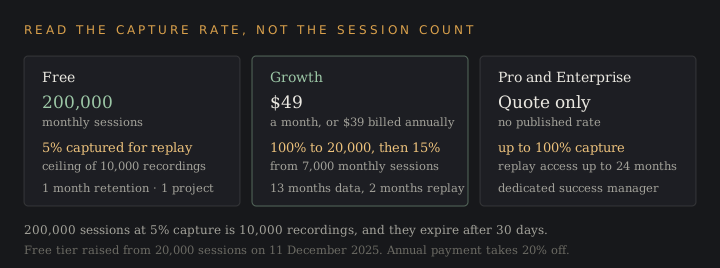
Hotjar's pricing is Contentsquare's pricing, restructured into Free, Growth, Pro and Enterprise tiers per product. The old structure of Basic, Plus, Business and Scale across Observe, Ask and Engage no longer exists, and pricing still increases with the number of daily sessions a site generates.
Hotjar offers a free forever plan with limited features. It includes 200,000 monthly sessions since Contentsquare raised it on 11 December 2025, up from 20,000, with replay captures up from 5,000 to 10,000.
That is a generous entry tier for small blogs or early-stage validation, with two limits the headline number hides: analytics data and session replays are retained for one month, and only 5% of sessions are captured for replay.
Experience Analytics Growth lists at $49 a month, or $39 billed annually, starting at 7,000 monthly sessions and scaling to 10 million. Growth captures 100% of sessions for replay up to 20,000 sessions, then drops to 15%.
Data retention for Growth is 13 months for analytics and two months for replays. Pro and Enterprise are quote-only and add a dedicated customer success manager, priority support and replay access up to 24 months.
Annual payments take 20% off, with a further 10% off the cheaper plan if you buy two paid Growth plans, a 15-day Growth trial with no card, and a 30-day money-back guarantee on new Growth accounts.
Common criticisms include limited quantitative analytics and high pricing as traffic grows, since a site scaling past its plan's monthly sessions faces a real cost jump at renewal.
↑ FACT SHEETWhere your data goes, and who can train on it
Hotjar processes data in AWS eu-west-1 in Ireland. It stores no end-user IP addresses at rest and deletes the IPs it does process within 30 calendar days, with an exception for addresses passed deliberately through the Identify API.
The same document states two retention rules: 1, 6 and 12 months by plan for the retired Basic, Plus and Business tiers, and 365 days for all accounts.
An unresolved A/B test is why. Both variants sit in the page's HTML, so one renders for you and the other renders for the next reader, and anything reading the page without JavaScript gets both.
Neither variant is the plan you buy today, because both name Hotjar tiers while the checkout sells Contentsquare ones. Check your contract. It's one of the self-contradictions catalogued in our report on software pricing errors.
The unambiguous parts: survey responses and highlights never auto-delete, Engage audio and video are deleted after two years, deleting recordings also destroys the heatmap data built from them, and recordings are not backed up.
On AI, the marketing page and the contract say different things. Contentsquare's AI capabilities page states that customer data is not used to train third party models.
The Service Schedule for Contentsquare AI Products, version 2026.2 dated July 2026, contains no clause prohibiting model training at all, and section 4 confirms that Input and Output are shared with third party providers. The no-training promise is scoped to third-party models and lives outside the agreement.
The same schedule defines excessive use as 20 queries per hour per user. One dated document is worth noting: Hotjar's privacy policy is still version 7.1, dated 17 January 2024, and was never revised for the merger. It reserves the right to use de-identified and aggregated customer data for benchmarks that may be published publicly.
Strengths and documented weaknesses
Users appreciate Hotjar for its visual clarity, and reviewers consistently point to heatmaps and session recordings for spotting usability issues that aggregate analytics alone won't show.
The interface is intuitive and requires minimal technical knowledge to set up once the tracking code is live. On the Shopify App Store it holds 4.3 from 85 reviews, and G2 carries a larger sample for cross-checking.
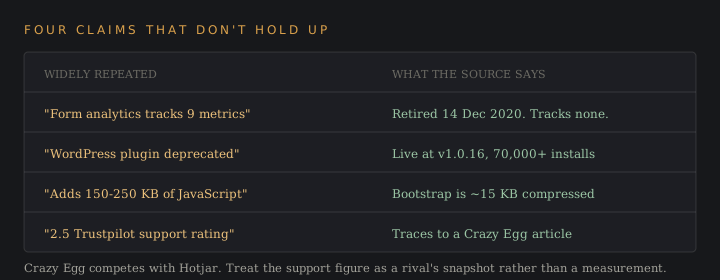
Support is the recurring complaint, and the number attached to it deserves a caveat. A 2.5 Trustpilot rating for Hotjar's customer support circulates through review roundups; it traces to a January 2025 Crazy Egg article, and Crazy Egg competes with Hotjar.
Trustpilot currently lists 59 reviews for hotjar.com and the live score conflicts with that figure, so treat 2.5 as a competitor's snapshot.
The documented weaknesses are concrete. Hotjar samples sessions on lower-tier plans, which reduces visibility for high-traffic sites: Free captures 5%, Growth captures everything to 20,000 sessions and then 15% beyond that.
A team trying to review a specific returning user's path may not have it at all. The 30-second minimum and the interaction requirement quietly discard the shortest sessions, which are often the ones a bounce investigation cares about.
Hotjar is a complementary tool, and that framing sets expectations correctly. It's most valuable for UX researchers, product managers and marketers who already have core analytics in place.
Hotjar alternatives compared

Crazy Egg offers built-in A/B testing, while Hotjar requires integration with a separate testing tool to run the same kind of split testing experiment. Glassbox provides advanced analytics for enterprise teams, though Hotjar only offers real-time data without Glassbox's deeper historical modeling.
Fullstory has more integrations than Hotjar, including Zapier, giving teams more ways to pipe session data into other tools automatically.
Roundups pair that with the claim that Fullstory has no free trial, which is out of date. Fullstory Free offers 30,000 sessions a month with 12 months of retention and up to 10 users, no card required, a longer data window than Contentsquare's Free plan gives at any volume.
Microsoft Clarity is the free alternative most teams reach for, and the price is the data posture. Clarity has no traffic limits and no sampling, recording up to 100,000 sessions per project per day, but recordings are retained 30 days and heatmap data nine months.
Microsoft's own FAQ states that under GDPR, Clarity is a controller, and that it does not execute data processing terms or joint controller terms with customers. Its consent documentation confirms that when ad storage is granted, Clarity shares data with Microsoft Ads to improve retargeting and campaign effectiveness. For a team that needs a signed DPA, that rules it out regardless of price.
Hotjar focuses on a blend of visual analytics and feedback options. Teams needing deep form analysis add Zuko, and teams needing built-in split testing add Crazy Egg alongside Hotjar.
What Hotjar shows about how users behave
Hotjar's heatmaps aggregate thousands of visitors into one visual map, so a team can see at a glance where users scroll, where users click and which parts of a page draw the least interaction.
That aggregate view turns raw clicks into a picture a stakeholder can read in seconds.
Rage clicks flag frustration automatically, marking spots where a visitor clicks again and again on something that isn't responding, often a broken button or a form field that looks clickable but isn't.
Many users never report the problem to support; the click pattern reports it for them. Reviewing rage clicks alongside session replay footage helps separate design bugs from genuine indifference.
Session recordings let a researcher watch exactly how one visitor moved through a signup flow. Visitor recordings capture device type, so a team can filter by mobile or desktop when a bug only shows up on one.
New users unfamiliar with a product behave differently than returning users who already know where to click, and Hotjar's filters let a team compare the two directly. Segmenting that way often reveals onboarding friction that aggregate traffic numbers hide completely.
Feedback data collected through polls and widgets pairs with session replay to explain both what happened and why. A rage click sitting next to feedback saying the button doesn't work turns a guess into something a team can ship against that week.
Hotjar for product, UX and research teams
Product managers use Hotjar to prioritize a backlog with actual user experience data, grounding decisions in recorded behavior. They watch session replay footage of the exact feature that support tickets keep mentioning.
An hour spent reviewing user recordings on a broken checkout step often surfaces the fix faster than a sprint of guessing.
UX researchers lean on user interviews and feedback forms to go beyond behavior data, since a heatmap shows where someone hesitated but not why. Combining the two gives a research team both the what and the why in one workflow.
Marketing teams use conversion funnels to find where a campaign landing page loses visitors, then use feedback polls to ask abandoning visitors directly what stopped them. It sits alongside the wider digital marketing intelligence stack.
Teams running deeper analysis on top of Hotjar's data often export findings into their own product analytics stack, using Hotjar as the qualitative layer. Unlimited heatmaps on paid plans support that workflow.
Who Hotjar is built for
Hotjar suits teams that already track traffic and want to understand user behavior on top of it: product managers debugging a confusing flow, UX researchers running user interviews, and digital marketers optimizing a landing page's conversion funnels.
A high-traffic site on a tight budget should model the replay capture rate, because 200,000 monthly sessions at 5% capture is 10,000 recordings, and they expire in a month.
Teams that need form analytics, a signed data processing agreement with a named controller, or support with a response-time commitment should plan on pairing Hotjar with something else.
How many users visit each month, how many of those run past the 30-second floor, and how many would still need to be readable 13 months from now. The third question is the one that decides the tier.
Getting the most out of Hotjar day to day
Teams that pair Hotjar with other tools tend to get more from both: a session replay showing where visitors hesitate feeds a backlog ticket, and a heatmap showing where they click feeds a design review.
Set retention expectations before the first review cycle. On Free, a recording you didn't watch this month is gone. On Growth, replays hold for two months while the analytics behind them hold for 13, so the chart outlives the footage that explains it.
Heatmaps and visitor recordings together give a fuller picture than either alone: heatmaps show where many users click in aggregate, while recordings show what one user experienced, mouse movement by mouse movement.
Across a typical month a team touches several groups at once: users who bounce immediately, users who convert, users who abandon a form halfway, and returning users comparing a new design against the one they remember.
Watching how each group behaves is what turns session data into a real improvement.
Frequently asked questions
What are the key features of Hotjar?
Key features include heatmaps, session recordings, conversion funnels, feedback polls, on-page feedback widgets, surveys and recruited user interviews, combining quantitative data with qualitative insights. Form analytics is not among them; Hotjar retired that product in December 2020.
What is Hotjar used for?
Hotjar is used to understand user behavior on a website through heatmaps and session replays, identify where users drop off in conversion funnels, and collect direct feedback through surveys and polls.
What are the limitations of Hotjar?
Session sampling on lower-tier plans at 5% on Free and 15% above 20,000 sessions on Growth, one-month data retention on Free, a 30-second minimum session length, no form analytics since 2020, added page weight from the tracking code, and analytics that stay limited compared to a dedicated quantitative platform.
How much does Hotjar cost?
Hotjar is sold as Contentsquare. The free plan covers 200,000 monthly sessions with one month of retention, the Growth plan starts at $49 per month for 7,000 sessions or $39 billed annually, and enterprise plans use custom pricing with a dedicated customer success manager. Annual payments take 20% off.
Is there a free version of Hotjar?
Yes, through Contentsquare: 200,000 monthly sessions, 5% of them captured for replay to a ceiling of 10,000, one project, 100 survey responses a month, and one month of data retention.
What happened to Hotjar?
Contentsquare announced the acquisition on 1 September 2021 without disclosing terms, and Hotjar Ltd merged into the Contentsquare Group on 1 July 2025. Existing accounts still work, new sign-ups create a Contentsquare account, and hotjar.com/pricing redirects to Contentsquare's pricing page.
Is Hotjar free or paid?
Both, under Contentsquare's structure: a free forever plan at 200,000 monthly sessions with heavy replay sampling and one-month retention, plus paid Growth and Enterprise tiers for higher capture rates and longer data retention.
Is Hotjar any good?
Hotjar is a strong tool for visualizing user behavior and collecting feedback, with an intuitive interface and a 4.3 rating from 85 Shopify App Store reviews. Its analytics work best alongside a primary tool, and the replay sampling rates matter more than the headline session counts.
Is there a free alternative to Hotjar?
Microsoft Clarity is a widely used free alternative offering heatmaps and session recordings without Hotjar's session caps, though recordings are kept only 30 days. The catch is legal: Microsoft states that Clarity acts as a GDPR controller and does not execute data processing terms with customers.
Who are Hotjar's competitors?
Hotjar's competitors include Crazy Egg, Glassbox, Fullstory, Microsoft Clarity and, for form analysis specifically, Zuko, the product Formisimo became in 2019.
Is Clarity better than Hotjar?
Microsoft Clarity is free and unlimited on heatmaps and recordings, while Hotjar offers more feedback tools and a processor-level data agreement. Which is better depends on what a team needs: feedback collection and a signed DPA, or free visual data.
Why is Hotjar tracking me?
A site owner installed Hotjar's tracking script to study user behavior, including mouse movements, clicks and scroll depth, generally to improve usability. Keystrokes in input fields are suppressed in the browser before transmission.
Who is Hotjar?
Hotjar is a behavior analytics and user feedback platform founded in Malta in 2014 by five co-founders, acquired by Contentsquare in 2021, and merged into the Contentsquare Group in July 2025.