Customer feedback analysis tools: rankings and buying guide for 2026
 By Jan Suski. I go deep on every review, checking every number against its source and digging up details other coverage misses, a habit from six years of SEO and link building for tech companies. Bylines at Surfer, Brand24, and Senuto. How the scoring works.
· Prefer this source on Google
Quick comparison of the best customer feedback analysis tools
Best-for job, primary signal, starting price, and primary buyer for all nine tools ranked below.
| # | Tool | Best for | Primary signal | Starting price | Primary buyer |
|---|---|---|---|---|---|
| 3 | Qualtrics XM | Enterprise experience management | Survey, feedback, and CX data at scale | $15,000-$50,000/yr+ | Enterprise customer experience and research teams |
| 1 | G2 Market Intelligence | Independent buyer sentiment in software markets | Verified user reviews, segmented | $299/mo Starter; ~$28,000/yr median* | Product marketing and competitive teams |
| 2 | Medallia | Enterprise customer experience, deep tenure | Multi-channel feedback and sentiment | $56,681-$521,520/yr, Vendr | Large enterprise CX programs |
| 4 | Chattermill | AI feedback analytics at scale | Reviews, support, surveys, social | $25,000/yr Foundation; ~$64,000/yr Vendr avg | Consumer brands and CX teams |
| 5 | Thematic | AI theme detection | Unstructured customer feedback text | ~$25,000/yr (Foundation) | Product and CX research teams |
| 6 | SentiSum | Support-ticket sentiment analysis | Support ticket tags and sentiment | ~$3,000/mo+ | Support and CX operations teams |
| 7 | CustomerGauge | B2B NPS tied to revenue | Account-level survey data | $24,000/yr+, flat platform fee | B2B account and CS teams |
| 8 | Unwrap.ai | Product-feedback prioritization | Product feedback across channels | $24,000/yr+ | Product and engineering teams |
| 9 | Zonka Feedback | SMB multichannel surveys | Survey responses plus AI tagging | $99-$999/mo | Small and mid-size CX teams |
* G2's $299 a month Starter tier is its own published rate; the ~$28,000 median is Vendr anonymized buyer data across 526 purchases, and G2 publishes no rate card for the tier it sits in.
Customer feedback analysis tools collect survey responses, support tickets, and reviews, then apply AI to surface the themes and customer sentiment buried inside that raw feedback data. This guide ranks nine customer feedback analysis tools against six evaluation criteria, explains why each landed where it did, and gives a full features, pricing, pros, and cons breakdown for each.
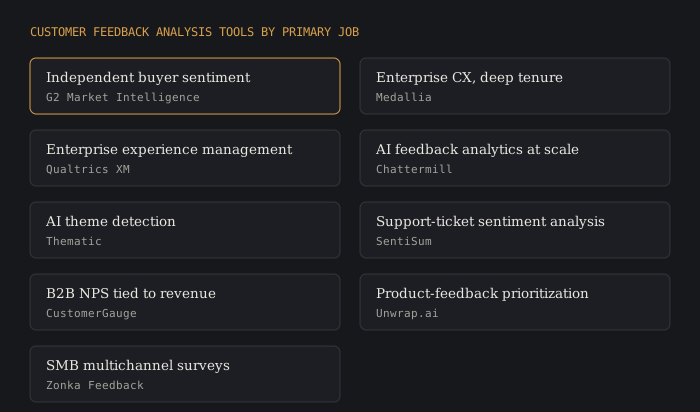
These aren't interchangeable. G2 is the only one reading feedback the vendor being measured didn't commission, Qualtrics XM covers the broadest enterprise experience-management footprint, Chattermill and Thematic specialize in AI theme detection across unstructured feedback, SentiSum focuses on support tickets specifically, and Zonka Feedback publishes tiered pricing a small team can budget against.
Matching the analysis tool to the feedback volume and team that needs to act on it is the point of this guide.
Buyers also search this category as customer feedback analysis software or a customer feedback analysis tool; whichever term led here, the platforms in this ranking do the same core job: turn scattered customer feedback into an analysis tool output a team can act on in place of a spreadsheet nobody reads twice.
What these platforms cost
None of the nine vendors here bill by seat the way a sales tool does. Medallia and Chattermill price by feedback volume and account complexity; Vendr's aggregated buyer data, drawn from actual purchases, is the most reliable third-party source for both. Qualtrics XM, Thematic, CustomerGauge, and Unwrap.ai each publish a starting figure of their own.
| # | Tool | Year-one cost | Basis |
|---|---|---|---|
| 3 | Qualtrics XM | $15,000 to $50,000-plus | Third-party benchmark, enterprise and academic deployments |
| 1 | G2 Market Intelligence | $2,999 published to ~$28,000 median | G2 published Starter rate plus Vendr aggregated data, 526 purchases |
| 2 | Medallia | $56,681 (SMB) to $521,520 (Enterprise) | Vendr aggregated data, 160 customers |
| 4 | Chattermill | $25,000 (Foundation) to ~$64,000 (Vendr average) | Published Foundation tier plus Vendr aggregated data |
| 5 | Thematic | ~$25,000 | Published Foundation plan |
| 6 | SentiSum | ~$36,000-plus | Published starting rate, ~$3,000/mo |
| 7 | CustomerGauge | $24,000-plus | Published starting price, flat platform fee |
| 8 | Unwrap.ai | $24,000-plus | Published starting price, scales with feedback volume |
| 9 | Zonka Feedback | $1,188 to $11,988 | Published, $99-$999/mo base plan |
Medallia's spread is the widest in this ranking. Vendr's aggregated data across 160 customers puts SMB buyers at an average $56,681 a year and enterprise buyers at $521,520, with implementation adding a further $50,000 to $200,000-plus in professional services and integration work on top of the license.
Chattermill publishes one real anchor point: the Foundation plan costs $25,000 a year for up to 25,000 comments across three datasets. Vendr's separate aggregated figure puts the average purchase closer to $64,000, which is what a buyer needing more than Foundation's volume cap typically lands on once negotiated.
CustomerGauge and Unwrap.ai both publish a $24,000-a-year starting price and both explicitly don't bill by seat. CustomerGauge's own pricing page frames this as a flat platform fee covering unlimited surveys, users, and integrations, scaling with account-base size and which modules get activated.
Back to top ↑Why customer feedback analysis matters now
Feedback volume outpaces what a person can read. A support team fielding thousands of tickets a month, or a product team pulling survey responses and app-store reviews at once, can't manually tag customer sentiment at that scale, which is exactly the job customer feedback analysis software exists to do.
Chattermill's own materials describe analyzing more than a billion pieces of customer feedback for its customers, scale that illustrates why manual tagging stopped being realistic for any team above a handful of feedback sources. Thematic's named customers, including lululemon, GitHub, DoorDash, JetBlue, Southwest, Lyft, and Target, span industries that generate feedback volume no spreadsheet keeps up with.
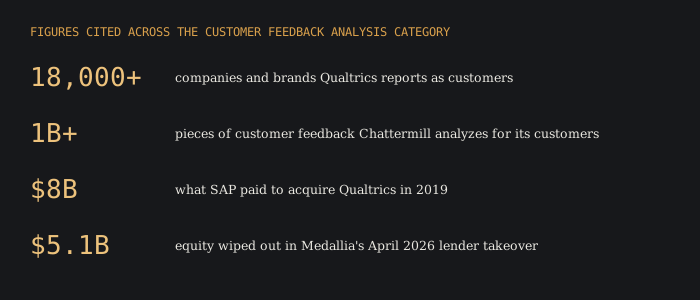
Ownership risk is worth watching in this category specifically. Medallia went private under Thoma Bravo in a $6.4 billion deal in 2021, then in April 2026 Thoma Bravo agreed to hand the company to its lender syndicate, wiping out $5.1 billion in equity in a debt-for-equity swap. A platform mid-transition like that deserves an extra pricing and roadmap conversation before a multi-year contract gets signed.
Medallia's April 2026 lender takeover is a live ownership transition. Ask directly about roadmap continuity and support-team stability before signing a multi-year contract with any platform mid-transition.
From customer sentiment to business strategies
Customer sentiment tracked over time catches a slow decline before it shows up as churn; a single snapshot score misses that pattern entirely. Feedback trends spotted early feed directly into business strategies: a product team that sees the same pain points repeated across support tickets and survey responses has a stronger case for a roadmap change than a single piece of detailed feedback ever provides.
Customer needs shift faster than an annual market research cycle can track, and customer expectations move with them. Reading customer opinions as they arrive is what separates a feedback program that supports real business growth from one that just archives complaints.
Deliver exceptional customer experiences consistently, and customer loyalty follows; miss the same pain point across enough support tickets, and customer satisfaction erodes before a formal survey ever catches it.
Improve customer satisfaction by closing the loop on unsolicited feedback. A complaint nobody asked for that shows up in a support ticket carries the same weight as a response collected through a direct feedback form.
Collecting feedback across the customer lifecycle
Collecting feedback well starts with meeting a customer where they already are: email, in-app, SMS, and web forms all reach a different slice of the customer lifecycle, and a program built around a single channel misses whatever the other channels would have surfaced. Zonka Feedback and Qualtrics both let a team create surveys once and deploy across multiple channels without rebuilding the questionnaire for each one.
Multi language support matters the moment a feedback program covers more than one region; a survey translated poorly produces structured feedback that looks clean in a dashboard but misrepresents what the customer said.
Combine feedback data from every channel and every language into one place before running sentiment analysis, or the resulting themes will skew toward whichever channel and language generated the most volume, the same normalization discipline covered in our guide to gathering market intelligence.
User feedback and customer input gathered passively, an app-store review, a support ticket aside, a social mention, count as much as a formal survey response.
Honest feedback tends to show up unprompted more often than in a structured survey, which is exactly why a customer feedback analysis tool that only ingests direct feedback forms sees a narrower slice of customer opinions than one that also analyzes feedback from support tickets and reviews, or from public review platforms like G2.
Evaluation criteria for the best customer feedback tool
Six factors separate a customer feedback tool that surfaces valuable insights from one that just stores responses.
- Feedback source breadth. The tool either combines survey data, support tickets, reviews, and social mentions into one feed, or handles only a single channel.
- Unstructured feedback analysis. How well the analysis tool turns unstructured customer feedback and qualitative feedback into named themes in place of a word cloud nobody can act on.
- Basic sentiment analysis accuracy. The platform distinguishes genuine negative feedback from sarcasm or a neutral mention, and flags critical feedback specifically.
- Multi channel feedback collection. The tool creates surveys and gathers feedback across email, in-app, SMS, and web in one workflow, without requiring a separate collection tool upstream.
- Integrations and automated workflows. Feedback data routes automatically to the team that owns the issue, avoiding a dashboard someone would otherwise have to check manually.
- Pricing transparency and flexible pricing plans. Published starting points and flexible pricing plans lower the cost of testing a platform before an enterprise contract gets signed.
Pilot any finalist against a batch of feedback data your team already read manually, support tickets or survey responses from last quarter. Compare the tool's themes and sentiment tags against what a human already knows is true before trusting it at scale.
The best customer feedback tools combine multiple feedback sources into one place and enable businesses to identify trends without a dedicated data analyst reading every ticket by hand.
Weigh these six criteria against the key features and key metrics a feedback program already tracks, since a platform that scores well on paper but ignores the metric a team reports to leadership produces actionable insights nobody upstream can use.
Feedback tools that analyze feedback against customer satisfaction benchmarks are the ones that show up in a quarterly business review; raw response counts alone rarely make that meeting agenda.
Top customer feedback analysis tools, ranked
Nine platforms, ranked by how completely they cover the six criteria above, with the reasoning behind each position plus a full features, pricing, pros, and cons breakdown.
G2 Market Intelligence
·top pick·The only platform here that reads feedback a vendor didn't collect itself: millions of verified buyer reviews, segmented and tracked per competitor.
G2 started as a software review site and sells Market Intelligence as the paid layer over that corpus, packaging it into dashboards, feature-level sentiment analysis, and competitor tracking. The dataset refreshes continuously, often in real time, against a Gartner Magic Quadrant that refreshes annually.
Median annual G2 contract across 526 purchases in Vendr's anonymized buyer data, in a range from $12,000 to $73,655, with buyers saving 18% on average.
Why it's ranked #1. It wins the source-independence criterion no other tool on this page competes for. Every platform below collects feedback on behalf of the vendor paying for it; G2 reads what buyers wrote for other buyers, which is the only feedback in this category that isn't shaped by who commissioned the survey. It loses ground on pricing transparency, since Market Intelligence sits inside the quote-only Enterprise package.
Features
- Segmentation by industry, company size, and geography, so a 50-person startup reads its own peer group.
- Feature-level sentiment analysis below product level, separating a loved core product from a hated onboarding flow.
- Deal-term metrics self-reported by reviewers: average discount rates, contract lengths, implementation time, repurchase intent.
- Market share estimates rolled up from the same review data points.
- Daily AI trend identification across thousands of reviews, plus sentiment trend lines per competitor over several quarters.
Pricing
Free sits at $0 with 3 profile admins, and Starter at $299 a month or $2,999 a year, though Starter is open only to new customers with 1 to 100 employees and fewer than 7 profiles. Professional and Enterprise are quoted. Vendr's anonymized data puts the median contract at $28,000 a year across 526 purchases, with Enterprise typically $21,300 to $28,300 and renewal uplift proposed at 7% to 12%.
Pros
- The feedback isn't commissioned by the vendor being measured, which no other platform in this ranking can say.
- Continuous refresh against an annual analyst cycle, so a positioning shift shows up in weeks.
- Competitor tracking is native to the platform.
Cons
- No free trial and no self-serve demo, so diligence happens inside a sales conversation.
- Reviews are self-reported and human-moderated, and no independent audit of the dataset exists.
- Coverage stops at software and technology categories; consumer, manufacturing and services markets sit outside it.
Medallia
Deep-tenure enterprise CX platform now navigating a major ownership transition.
Medallia, founded in 2001, went private under Thoma Bravo in a $6.4 billion all-cash deal completed in October 2021. In April 2026, Thoma Bravo agreed to hand the company to its lender syndicate, Blackstone, KKR, Apollo Global, and Antares Capital, wiping out $5.1 billion in equity in a debt-for-equity swap.
Why it's ranked #2. Medallia takes the collection-breadth criterion: survey, digital, and contact-center feedback land in one record, matching Qualtrics on core capability and beating it on closed-loop routing to a named owner. It sits below G2 because every source it reads is one the buyer commissioned, and the April 2026 lender takeover adds ownership uncertainty a multi-year enterprise contract has to account for.
Features
- Multi-channel feedback collection across survey, digital, and contact-center sources.
- AI-driven text analytics for identifying trends across unstructured customer feedback.
- Closed-loop case management that routes critical feedback to the owning team.
- Enterprise reporting built for large, multi-brand customer experience programs.
Pricing
Pricing is quote-based and not published on Medallia's own site. Vendr's aggregated data across 160 customers puts SMB buyers at an average $56,681 a year and enterprise buyers at $521,520, with implementation adding $50,000 to $200,000-plus in professional services and integration work on top of the license. Our Medallia pricing report breaks down the EDR model behind that quote and what drives it higher.
Pros
- Two decades of enterprise CX deployment experience.
- Closed-loop case management routes feedback to an owner automatically.
- Multi-channel collection matches Qualtrics on breadth.
Cons
- April 2026 lender takeover creates real ownership and roadmap uncertainty.
- No published pricing of any kind.
- Enterprise implementation timelines run longer than the AI-native names in this ranking.
Qualtrics XM
The broadest enterprise experience-management platform in this ranking, combining survey creation, feedback collection, and analysis in one system.
Qualtrics, founded in 2002, was acquired by SAP for $8 billion in 2019, then spun off in a January 2021 IPO before Silver Lake and CPP Investments took it private again in a 2023 deal valuing the company at approximately $12.5 billion. Qualtrics now reports serving more than 18,000 companies and brands, up from 10,000 at the time of the SAP acquisition.
Valuation Silver Lake and CPP Investments assigned Qualtrics in the 2023 deal that took it private again, two years after its SAP-era IPO.
Why it's ranked #3. Qualtrics XM wins the source-breadth criterion outright: survey creation, direct feedback forms, and CX analysis live in one platform used by more than 18,000 organizations. It sits below G2 and Medallia because every source it reads is one the buyer paid to collect, and because costs aren't published, with typical enterprise and academic deployments running $15,000 to $50,000-plus a year.
Features
- Survey and direct feedback forms builder spanning customer, employee, and product experience.
- AI-driven text and sentiment analysis across survey responses and open-text feedback.
- Customer path mapping tied to feedback data collected at each touchpoint.
- Enterprise-grade dashboards and role-based reporting for large organizations.
Pricing
Pricing is not published; typical deployments for a large enterprise or academic institution run $15,000 to $50,000-plus a year depending on modules and seats.
Pros
- Broadest feature footprint in this ranking, from survey design through analysis.
- Largest reported customer base, at more than 18,000 companies and brands.
- Deep customer-path mapping ties feedback to a specific touchpoint.
Cons
- No published starting price makes early budgeting hard.
- Platform depth built for enterprise programs is too much for a small team.
- Two ownership changes in five years (SAP, then Silver Lake/CPP) add contract-negotiation complexity.
Chattermill
AI-native feedback analytics built to unify reviews, support tickets, surveys, and social feedback in one platform.
Chattermill, founded in London in 2015 by Mikhail Dubov and Dmitry Isupov, has raised $40.5 million across six funding rounds, including a $26 million Series B, and its own materials describe analyzing more than a billion pieces of customer feedback for its customers.
Total funding Chattermill has raised across six rounds, including a $26 million Series B, backing its AI-native feedback analytics platform.
Why it's ranked #4. Chattermill ranks third because it combines feedback source breadth with AI-native theme and sentiment analysis at real scale, more than a billion feedback data points analyzed, without Qualtrics' or Medallia's enterprise-survey overhead. It trails the top two only on the breadth of native survey-creation tooling.
Features
- Unified feedback ingestion across reviews, support tickets, surveys, and social channels.
- AI theme and sentiment analysis tuned for high feedback volume.
- Custom dashboards built for CX, product, and support teams to share one feedback data source.
- API access for routing analyzed feedback into a team's existing workflow tools.
Pricing
The Foundation plan is published at $25,000 a year for up to 25,000 comments across three datasets, with advanced analysis tools, dashboards, and a dedicated Customer Success Manager included. Vendr's separately aggregated buyer data puts the average purchase closer to $64,000 a year, which is where a buyer needing more volume than Foundation covers typically lands once negotiated. Enterprise pricing above that is custom.
Pros
- Analyzes more than a billion pieces of customer feedback across its customer base.
- Multi-channel ingestion (reviews, tickets, surveys, social) in one platform.
- Well-funded ($40.5M raised) with a decade of AI-analysis product development.
Cons
- Foundation's $25,000-a-year, 25,000-comment cap is a real ceiling for a growing team.
- Lighter native survey-creation tooling than Qualtrics or Zonka Feedback.
- Pricing scales with channel count, which can surprise a team adding sources mid-contract.
Thematic
AI theme detection purpose-built for turning unstructured feedback text into named, trackable themes.
Thematic, founded in 2017 by Alyona Medelyan and Nathan Holmberg, raised a $2 million seed round in 2023 and counts lululemon, GitHub, Perplexity, DoorDash, Oura, JetBlue, Southwest, Lyft, and Target among its named customers.
Why it's ranked #5. Thematic ranks fourth because theme detection specifically, turning a pile of unstructured customer feedback into named, recurring themes a team can prioritize, is the criterion it's purpose-built around, and its customer list proves it at real scale. It ranks below Chattermill because it covers fewer native feedback-source integrations out of the box.
Features
- AI theme detection that groups unstructured feedback into named, recurring topics.
- Sentiment scoring layered on top of each detected theme.
- Trend tracking that shows a theme's volume rising or falling over time.
- Integrations for pulling in survey responses and support-ticket text for analysis.
Pricing
The Foundation plan is published at roughly $25,000 a year, with custom enterprise pricing above that tier.
Pros
- Named enterprise customer list (lululemon, GitHub, JetBlue, Southwest, Target) proves scale.
- Theme detection specifically tuned for unstructured, open-text feedback.
- Published starting price gives buyers a real budgeting anchor.
Cons
- Narrower funding base ($2M seed) than Chattermill's $40.5M.
- Fewer native feedback-collection tools than Qualtrics or Zonka Feedback.
- $25,000-a-year Foundation tier is still a real commitment for a small team.
SentiSum
Support-ticket-focused sentiment analysis that tags tickets by topic, sentiment, and urgency the moment they arrive.
SentiSum, founded in San Francisco in 2015 by Oleksander Bondarev and Sharad Khandelwal, has raised $700,000 in funding and prices its AI-native VoC platform starting around $3,000 a month.
Why it's ranked #6. SentiSum ranks fifth because real-time ticket tagging by topic, sentiment, and urgency is a genuinely deep specialty for support operations specifically, but its narrow funding base and single-channel focus (support tickets over broader multi-channel feedback) trail the platforms above it on source breadth.
Features
- Automated support-ticket tagging by topic, sentiment, and urgency on arrival.
- Deep-learning NLP applied specifically to support-ticket language patterns.
- Real-time reporting built for support and CX operations teams.
- Integrations with common helpdesk platforms for automated workflows.
Pricing
Published starting price runs around $3,000 a month for the AI-native VoC platform, though buyer reports describe some variation depending on ticket volume.
Pros
- Deepest support-ticket-specific tagging and urgency detection in this ranking.
- Real-time analysis fires the moment a ticket arrives, ahead of any batch schedule.
- Published starting price gives support teams a real budget anchor.
Cons
- Narrowest funding base in this ranking, at $700,000 raised.
- Support-ticket focus means less native coverage of surveys and reviews.
- Smaller team and track record than the venture-scale names above it.
CustomerGauge
B2B Net Promoter Score platform that ties survey responses directly to account-level revenue data.
CustomerGauge is built specifically for B2B companies that need to track customer experience at the account level, tying survey data directly to Annual Recurring Revenue.
Why it's ranked #7. CustomerGauge ranks sixth because account-level NPS tied to revenue is a real, narrow specialty most competitors in this ranking don't replicate, but its single-metric focus, NPS specifically, limits how much of the six-criteria evaluation it can cover compared to platforms above it.
Features
- Account-level NPS tracking tied directly to Annual Recurring Revenue data.
- Closed-loop feedback routing that assigns negative responses to an owning team with tracking.
- B2B-specific reporting built around account health.
- Benchmarking against published B2B NPS data by industry.
Pricing
CustomerGauge's own pricing page publishes a starting figure of $24,000 a year as a flat platform fee, covering unlimited surveys, users, and integrations. The fee scales with account-base size and which modules get activated, and a scoped 60-to-90-day pilot is available at a lower price before a full-program contract.
Pros
- Account-level NPS tied to revenue is a genuine B2B-specific differentiator.
- Closed-loop routing assigns a negative response to an owner with a tracked resolution.
- Published B2B NPS benchmarks help a team judge its own score in context.
Cons
- $24,000-a-year starting price is a real floor for a small B2B team's CX budget.
- NPS-first focus means less depth on broader unstructured-feedback theme detection.
- Purpose-built for B2B; a weaker fit for B2C feedback volume.
Unwrap.ai
Product-feedback prioritization built specifically for product and engineering teams, distinct from general CX operations.
Unwrap.ai, founded in 2022 by former Amazon Alexa leaders Ryan Millner and Ashwin Singhania, raised a $4 million seed round followed by a $12 million Series A led by Scale Venture Partners in 2024. Named customers include Microsoft, Oura, Lyft, JetBlue, and Perplexity, with customers reporting more than four hours saved weekly on manual feedback analysis.
Why it's ranked #8. Unwrap.ai ranks seventh because it solves a genuinely different problem, prioritizing product feedback for engineering roadmap decisions, better than any general CX tool in this ranking, but that narrower product-team focus means it covers fewer of the six broad evaluation criteria than the CX-first platforms above it.
Features
- NLP-driven feedback aggregation across support tickets, reviews, and surveys.
- Trend and sentiment tracking built specifically for product roadmap prioritization.
- Proactive alerts flagging a rising issue before it becomes a support-ticket spike.
- Integrations built for product and engineering tools.
Pricing
Unwrap.ai publishes a starting price of $24,000 a year, scaling with monthly feedback volume and the number of connected data sources. No self-serve checkout exists, but a free trial is available to test the platform against real feedback volume before signing.
Pros
- Named enterprise customers (Microsoft, Lyft, Perplexity) with reported time savings.
- Purpose-built for product and engineering teams from the ground up.
- Recent Series A funding ($12M, 2024) backs continued product investment.
Cons
- $24,000-a-year starting price still requires a real feedback-volume commitment upfront.
- Newer company (founded 2022) with a shorter track record than the category's veterans.
- Product-team focus is a narrower fit for a general CX or support operation.
Zonka Feedback
SMB-friendly multichannel survey and feedback platform with fully published, tiered pricing.
Zonka Feedback, founded by Rajiv Mehta, is used by more than 1,000 organizations worldwide and collects feedback across email, SMS, WhatsApp, web, in-app, and kiosk channels, with more than 50 integrations including Salesforce, HubSpot, Intercom, and Zendesk.
Why it's ranked #9. Zonka Feedback ranks eighth in this analysis-focused ranking because it wins outright on pricing transparency and collection-channel breadth for a small team, but its AI Intelligence tier is a separate, higher-cost add-on, which is the main reason it trails the AI-native analysis specialists ranked above it.
Zonka's AI Intelligence add-on runs roughly $999 a month on top of the base Feedback Management plan. Budget for both line items if theme detection matters to the team; the advertised entry price covers only the base plan.
Features
- Multichannel survey collection across email, SMS, WhatsApp, web, in-app, and kiosk.
- NPS, CSAT, and customer effort score tracking built into the core survey builder.
- AI Intelligence add-on for automated tagging and theme detection on top of collected responses.
- More than 50 integrations, including Salesforce, HubSpot, Intercom, and Zendesk.
Pricing
Feedback Management starts around $99 to $199 a month; the AI Intelligence add-on runs approximately $999 a month on top of the base plan, with a free trial available.
Pros
- Fully published, tiered pricing, easiest to budget for in this ranking.
- Broadest native collection-channel list (email, SMS, WhatsApp, web, in-app, kiosk).
- More than 50 integrations lower the setup cost for a team already running Salesforce or Zendesk.
Cons
- AI Intelligence analysis is a separate, higher-cost add-on billed outside the base plan.
- Analysis depth trails Chattermill and Thematic for large, unstructured feedback volumes.
- Built more for feedback collection than deep enterprise-scale analysis.
Turning customer insights into customer outcomes
Customer insights only matter once they change a customer outcome, a saved account, a shipped fix, a faster resolution. A platform that stops at a dashboard full of themes and scores, without a path to the team that owns the fix, produces valuable insights nobody acts on. This is the same feedback-to-action gap our customer intelligence guide covers in more depth.
Closing the feedback loop across customer interactions
Closing the feedback loop means telling the customer what changed because of their input. Logging the ticket internally, on its own, does not close the loop. Tracking customer interactions across support, sales, and product touchpoints together is what lets a team spot a pattern that a single channel's feedback data would miss entirely, the same cross-channel discipline that underpins a strong consumer intelligence program.
Key features and metrics that separate the best feedback tools
Key features worth checking before signing anything: source breadth, theme detection accuracy on unstructured customer feedback, and how fast a routed issue reaches the team that owns it. Key metrics worth tracking alongside those features include customer satisfaction scores, customer effort score, and Net Promoter Score, tracked together.
The best customer feedback tools enable businesses to identify trends across feedback tools that would otherwise stay siloed by department, support tracking one metric, product tracking another, with nobody comparing the two.
Gathering insights this way is what turns a dashboard full of numbers into deeper insights and customer insights a leadership team discusses.
The same pain points that show up in user feedback on a support ticket often show up again in customer input collected through a survey a month later. A tool that connects the two catches the pattern the first time it appears.
A customer feedback analysis tool that can't gather valuable insights from customer data at the account level misses feedback leads that a revenue or success team would want flagged individually; an aggregate score alone hides which specific account is at risk. Analyzing customer feedback this way, tied to a specific account, is exactly the gap CustomerGauge's account-level NPS was built to close.
The right feedback tool and the best feedback tool for a given team boil down to the same test: it analyzes feedback fast enough, and routes it precisely enough, for someone to act on before the pattern repeats. Detailed feedback that never reaches an owner does the same nothing a customer complaint that goes unread does.
Survey platforms and feedback programs
Survey platforms and dedicated analysis tools solve different halves of the same problem: a survey platform is built to gather feedback and collect survey responses efficiently, while an analysis tool is built to turn that raw feedback data, plus support tickets and reviews, into named themes and customer sentiment scores.
Feedback programs that only invest in one half tend to drown in unread survey responses or run analysis on a feedback volume too thin to spot a real trend.
Multiple feedback sources, survey data, support tickets, reviews, and social mentions, combined in one feedback program catch a pattern that a single-channel program misses. A team collecting only direct feedback forms sees a fraction of the honest feedback that shows up unsolicited in a support ticket or a public review, the same blind spot our social listening ranking covers from the public-conversation side.
How to choose the right customer feedback tool
Judged strictly on scope, Qualtrics XM and Medallia are the best customer feedback tools in this ranking for broad enterprise experience management, while Chattermill and Thematic are the right customer feedback tool for a team that needs deep AI theme detection across high feedback volume specifically.
Running the shortlist through our vendor evaluation scorecard forces a side-by-side on the six criteria above, in place of a gut call after a demo.
Match the tool to the job at hand, ahead of whatever the demo emphasizes. If support-ticket sentiment is the immediate pain point, SentiSum's real-time tagging targets that gap directly; if B2B account health tied to revenue matters more than raw response volume, CustomerGauge's ARR-linked NPS fits; if the buyer is a product or engineering team, Unwrap.ai is purpose-built for that audience.
Team size and budget change the calculus. A small marketing or CX team in SaaS rarely needs Qualtrics' or Medallia's enterprise implementation timeline; a global enterprise handling millions of feedback data points a year rarely gets by on Zonka Feedback's SMB-tier collection alone once AI Intelligence analysis becomes a real requirement.
Revenue teams evaluating the same account data from the sales side should also check our sales intelligence ranking, since the two categories increasingly share signal.
Expect a real evaluation period regardless of vendor. Every platform in this ranking benefits from a pilot against a known batch of feedback data, support tickets or survey responses your team already read manually, so the analysis tool's output can be checked against what a human already knows is true before trusting it at scale.
Comparing customer feedback analysis tools by customer experience maturity
A customer experience program in its first year needs different customer feedback analysis tools than one running its fifth. Early on, a team just needs to gather feedback and enables businesses to see, for the first time, what customer needs look like at scale; a published, low-commitment tool like Zonka Feedback fits that stage better than an enterprise contract.
Mature customer experience programs, the kind Qualtrics XM and Medallia are built for, need customer feedback analysis tools that connect feedback trends across support tickets, surveys, and reviews to a customer experience score tracked over years.
Best customer feedback tools at this stage prove their value by tying deeper insights and customer insights back to retention and expansion revenue, beyond a satisfaction score in isolation.
Collecting feedback across multiple channels only pays off once a team can analyze feedback fast enough to act inside the customer experience window that still matters: days. User feedback analyzed a quarter late produces actionable insights nobody can still use, since the customer experience it describes has already moved on.
Customer feedback analysis tools FAQ
What are customer feedback tools?
Customer feedback tools are software platforms that collect customer feedback, survey responses, support tickets, and reviews, then apply sentiment analysis and theme detection so a team can identify trends and prioritize a response without reading every comment individually.
How do you analyze customer feedback?
Analyzing customer feedback starts with combining feedback data from every channel, survey data, support tickets, reviews, and social mentions, into one place, then applying basic sentiment analysis and theme detection to group similar comments before a human reviews the patterns that surface.
How to analyze customer feedback data?
Centralize feedback data from multiple feedback sources first, then run it through a customer feedback analysis tool for sentiment scoring and theme detection, and finally route the resulting themes to the team that owns each issue so gathering insights turns into an actual fix.
What is the best CX software?
Qualtrics XM is the broadest CX software in this ranking for enterprise experience management given its scale (18,000-plus customers); Chattermill and Thematic are stronger picks specifically for AI-driven feedback analysis at high volume.
What are CSAT tools?
CSAT tools measure customer satisfaction scores immediately after a specific interaction, typically a single-question survey; Zonka Feedback and CustomerGauge both build CSAT tracking directly into their broader survey and NPS platforms.
What tools are used for customer analysis?
Teams typically pair a collection layer (survey platforms like Zonka Feedback or Qualtrics) with an AI analysis tool (Chattermill, Thematic, SentiSum, or Unwrap.ai). Few platforms do both jobs equally well.
Is there an app to review customers?
Most platforms in this ranking analyze customer feedback and reviews. None review customers directly. CustomerGauge is the closest fit for scoring individual accounts, tying survey responses to account-level revenue and health data.
How much do customer feedback analysis tools cost?
Zonka Feedback starts at $99 a month and CustomerGauge and Unwrap.ai both publish a $24,000-a-year starting price.
Chattermill and Thematic publish a $25,000-a-year Foundation tier, though Vendr's aggregated buyer data puts Chattermill's average purchase closer to $64,000. Qualtrics XM runs $15,000 to $50,000-plus a year for enterprise and academic deployments, and Medallia's Vendr-tracked average spans $56,681 for SMB buyers to $521,520 for enterprise buyers, plus $50,000 to $200,000-plus in implementation.
Bottom Line
No single customer feedback analysis tool in this ranking covers source breadth, theme detection, and pricing transparency at equal depth, which is why the right choice depends on which of those jobs is costing a team time today.
Start with Qualtrics XM or Medallia for broad enterprise experience management, Chattermill or Thematic for AI-driven theme detection at scale, SentiSum for support-ticket-specific sentiment, CustomerGauge for B2B account-level NPS, Unwrap.ai for a product team, and Zonka Feedback among small-team feedback tools that need published pricing.
Whichever tool a team picks, the goal stays the same: turn customer feedback into actionable insights before a churn risk, a product gap, or a support pattern gets expensive. Analyze feedback fast enough and the resulting actionable insights change a roadmap decision or save an account; analyze it late and the same customer sentiment shows up as a churn number instead.
A customer feedback analysis tool only earns its renewal once a team can point to a decision it changed, which is the real test that separates the best feedback tools from the rest of the field.
Position changes on this ranking
This ranking moves when the evidence does. Every position change, addition and removal is logged here with its reason, so a reader who saw a different order last month can check what changed.
| Date | Change | Reason |
|---|---|---|
| 13 Aug 2026 | G2 Market Intelligence added at #1 | The only platform here reading feedback the vendor being measured didn't commission. Its review runs 4,600-plus words against a 127-word stub for the tool it displaced. |
| 13 Aug 2026 | Qualtrics XM #1 to #3 | Still the broadest experience-management footprint, but every source it reads is one the buyer paid to collect, and G2 and Medallia both beat it on that criterion. |
| 13 Aug 2026 | Medallia held at #2 | Collection breadth and closed-loop routing unchanged. Its position is now argued against G2 above it. |
| 13 Aug 2026 | Positions 3 to 8 shifted down one | Chattermill, Thematic, SentiSum, CustomerGauge, Unwrap.ai and Zonka Feedback moved on the insertion above them. No change in assessment. |
Log opens 13 August 2026. Positions held before that date aren't reconstructed, because the records to do it accurately don't exist.