Text analytics pricing in 2026: 100,000 comments cost $3 to $100,000
 By Jan Suski. I go deep on every review, checking every number against its source and digging up details other coverage misses, a habit from six years of SEO and link building for tech companies. Bylines at Surfer, Brand24, and Senuto. How the scoring works.
The numbers Text analytics pricing, checked 6 October 2026
At list rates, Amazon Comprehend scores the full 100,000-response scenario for $30, while Thematic's Foundation plan works out to $1 per comment customers leave in surveys or reviews.
GPT-5.6 Luna runs the same job for $6.70, under a quarter of the Comprehend bill, so LLM tokens now set the floor for metered sentiment analysis tools.
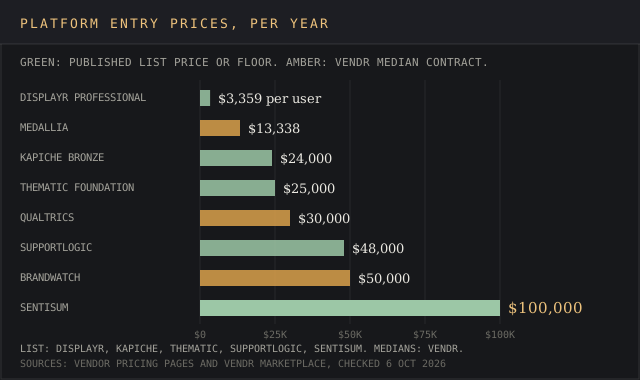
The cheapest published platform price here, a $3,359 Displayr seat, costs eleven times IBM's $300 list price for the scenario, so the platform premium pays for dashboard functionality, insights work and integrations.
Scoring 100,000 survey responses for customer sentiment costs $3.35 through OpenAI's Batch API and $100,000 at the per-comment rate of Thematic's Foundation plan. Both figures come from the vendors' price pages, reviewed on 6 October 2026, and this report explains the roughly 30,000-fold gap.
Text analytics is sold in two shapes. Cloud natural language processing APIs from Amazon, Google, Microsoft and IBM bill per unit of text, at fractions of a cent. Customer feedback tools such as Thematic, Kapiche, SentiSum, Medallia and Qualtrics bill per year, per seat or by custom quote, and wrap the sentiment analysis in a dashboard, VoC themes, alerts and connectors to the data sources where customers leave surveys, reviews and support tickets.
Every price below is tested against one scenario of 100,000 short surveys, reviews or support tickets from customers, about 300 characters each, with one sentiment analysis pass per response. Where a vendor sells by custom quote only, the report uses Vendr's purchase data and statistics and labels them as medians.
The sections below cover how text analysis tools meter text, the four cloud APIs, LLM token rates, a normalised cost table, eight platforms with list prices or Vendr purchase statistics, bundled licences, quote drivers and Capterra reviews. The spread matters because the same feedback data can cost a business $30 or $100,000 per 100,000 comments depending on which shape it buys.
It's written for CX, insights, research and customer support teams in organizations choosing between an API, an LLM prompt and a platform, and for business and finance teams holding a quote with no public benchmark.
How text analytics tools charge by unit, record, comment and seat
Metered APIs bill for text length. Amazon counts 100-character units, Google counts 1,000-character units, Microsoft counts 1,000-character text records, and IBM counts items, where one item is one feature run on up to 10,000 characters. Ask IBM to analyze sentiment and keywords on the same comment and it bills two items.
Platforms bill for an annual allowance of customer data. Thematic counts comments customers leave in surveys and reviews, Kapiche counts the rows it analyzes per project, Caplena counts credits and SentiSum agrees conversation bands each year. Displayr and Kapiche add seats on top, and Kapiche caps Creator seats by tier, so a business pays for both the data and the people who read it.
The devil's in the details of those unit definitions. A 50-character answer to one of the short surveys customers fill in after a customer support chat bills as 3 units at Amazon because of the 3-unit minimum per request, and Google's own pricing example bills a 600-character request as one unit. On short surveys, Amazon's minimum turns a $0.0001 unit into $0.0003 per response.
Metered natural language processing APIs, priced per unit of text
The four cloud tools below sell the same core capabilities and features through a REST call billed by text length, covering sentiment, entities, key phrases and language detection across multiple languages. All four publish a free monthly allowance, and Amazon's expires 12 months after first use. The APIs return scores with no dashboard functionality around them, so a business needs its own reporting tools and analysts to turn scores into actionable insights.
Amazon Comprehend
Amazon charges $0.0001 per 100-character unit for sentiment analysis, targeted sentiment, entity recognition, key phrases, language detection and syntax, with a 3-unit minimum per request, per the Comprehend pricing page. Free access gives customers 50,000 units, 5 million characters, per API per month for the first 12 months.
Custom models change the arithmetic, and the risk sits in uptime.
- Training costs $3 an hour.
- Model management costs $0.50 a month.
- Asynchronous inference costs $0.0005 per unit.
- A real-time endpoint for live interactions costs $0.0005 a second per inference unit.
One inference unit left running for 30 days costs $1,296 before it analyzes a single support ticket, which costs an arm and a leg next to the $30 the standard API charges for the whole scenario.
Google Cloud Natural Language
Google bills sentiment analysis and entity analysis at $0.001 per 1,000-character unit from 5,000 to 1 million units a month, $0.0005 up to 5 million and $0.00025 beyond, with the first 5,000 units free, per its Natural Language pricing page. Entity sentiment costs $0.002 per unit, and the annotateText method charges separately for each of the requested features.
The scenario costs $100 at the first paid tier, or $95 once the 5,000 free units come off. Google lists custom pricing for a business above 20 million units a month.
Azure AI Language
Microsoft's Azure AI Language gives customers 5,000 text records free each month across supported languages, and a text record is a 1,000-character unit. Microsoft's retail price list puts Standard text records at $1 per 1,000 up to 500,000 a month, $0.75 to 2.5 million and $0.30 to 10 million.
A commitment tier enables a lower rate for steady demand. The 1 million record monthly commitment costs $700 against $875 on pay-as-you-go pricing and overage on it bills at $0.70 per 1,000 records. Custom text classification costs $5 per 1,000 records plus $0.50 per hosted model a month, the price of customization.
IBM Watson Natural Language Understanding
IBM's Lite plan enables customers to analyze 30,000 items and one custom model a month at no charge, per the NLU pricing page. Standard pricing in IBM's documentation runs $0.003 per item for the first 250,000, $0.001 to 5 million and $0.0002 after that.
Because an item is one feature on one text unit, adding features multiplies the bill. The scenario costs $300 for sentiment analysis alone and $900 with emotion and keywords added. Custom entity and relation models need training data and cost $800 a month, and custom classification models cost $25.
MeaningCloud and the price of other languages
Languages move the bill at smaller vendors too. MeaningCloud's pricing page charges 1 credit per 500 words it analyzes for six languages, English, Spanish, French, Italian, Portuguese and Catalan, on its public API. Other alphabetic languages cost 2 credits, and Chinese, Japanese and Korean cost 2 credits per 500 characters.
LLM token pricing as the new floor for sentiment analysis tools
General-purpose LLMs now undercut every dedicated natural language processing API on price.
- OpenAI lists GPT-5.6 Luna at $0.20 per million input tokens and $1.20 per million output tokens.
- Google's Gemini API pricing lists Gemini 3.1 Flash-Lite at $0.25 input and $1.50 output.
- OpenAI's Batch API halves its rates on jobs returned within 24 hours, and Google cuts 50% in batch mode, both too slow for real-time routing of support tickets.
Batch jobs suit monthly trends reporting, and real-time routing needs the standard rate.
OpenAI's token guide puts one token at about 4 characters of English and notes that counts vary across languages, so a 300-character response from customers runs about 75 tokens. Add a 200-token instruction and a 10-token label and the scenario uses 27.5 million input tokens and 1 million output tokens.
- GPT-5.6 Luna costs $6.70, or $3.35 through the Batch API.
- Gemini 3.1 Flash-Lite costs $8.38, or $4.19 in batch mode.
- GPT-5.6 Sol, OpenAI's flagship at $5 input and $30 output, costs $167.50, more than Google's natural language API charges for the same responses.
The token bill is a drop in the bucket next to the work around it. Someone on the team owns four jobs.
- Write the taxonomy that customers' comments get sorted into.
- Build a labelled test data set.
- Check edge cases such as sarcasm, missing context and mixed reviews from customers.
- Test the prompt again when a model version changes.
Comprehend returns a confidence score per response for each of its four sentiment classes. An LLM reads the context the prompt supplies and returns the answers it asks for, which puts the training, test and accuracy risk on your team.
An NLP-adjacent academic on Hacker News compared a rule-based model with a hosted LLM on the same data in May 2025:
"I recently did an analysis on a large corpus and VADER was essentially free while the cloud costs to run a Llama based sentiment model was about $1000. I ran both because VADER costs nothing but minimal CPU time."
teruakohatu, Hacker News, 1 May 2025
What 100,000 customer feedback responses cost, normalised
The table prices 100,000 surveys from customers at 300 characters each in English, one sentiment pass per response, at list rates before free tiers.
| Tool | Billing unit | Units billed | Cost for 100,000 responses |
|---|---|---|---|
| GPT-5.6 Luna, Batch API | 1 million tokens | 27.5M input, 1M output | $3.35 |
| GPT-5.6 Luna | 1 million tokens | 27.5M input, 1M output | $6.70 |
| Gemini 3.1 Flash-Lite | 1 million tokens | 27.5M input, 1M output | $8.38 |
| Amazon Comprehend | 100 characters, 3-unit minimum | 300,000 units | $30 |
| Google Cloud Natural Language | 1,000 characters | 100,000 units | $100 |
| Azure AI Language | 1,000-character text record | 100,000 records | $100 |
| IBM Watson NLU, sentiment only | 1 feature on up to 10,000 characters | 100,000 items | $300 |
| Thematic, Foundation rate | 1 comment | 100,000 comments | $100,000 |
Costs are computed from vendor list prices read 6 October 2026, before free tiers. Thematic's row applies its Foundation per-comment rate to a volume that would move a buyer onto an Enterprise quote.
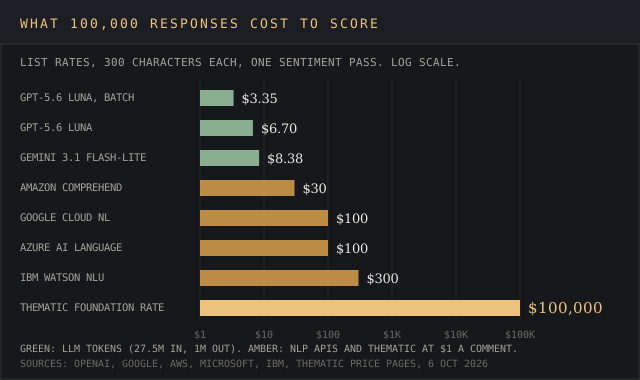
Thematic sits off that scale because its $25,000 covers 25,000 comments, and 100,000 comments moves customers to an Enterprise custom quote, par for the course above a platform's entry tier. Every other row is a data processing cost, and Thematic's price adds the dashboard, the theme analysis and the Summarizer that turn scores into insights.
What customers buy sentiment analysis for
Customer sentiment scores feed three kinds of customer insights, and vendors price each one differently.
- Aspect-level sentiment. Comprehend's targeted sentiment scores different aspects of one review, the sentiment toward each named product or brand for example, at the same $0.0001 unit rate, and Google charges $0.002 per unit for entity sentiment on the same aspects, double its document rate.
- Early warnings on negative sentiment. SentiSum's platform includes an Early Warning Agent and an Insights Agent, and Thematic lists workflows on both of its plans.
- Trends across customer interactions. Kapiche starts journey moments and cross data source analytics at Silver, and Genesys includes interaction transcription and topic detection capabilities in CX 3.
An insights team whose support strategy needs a monthly report on survey trends can analyze a survey response export with an API or an LLM and chart the trends in a spreadsheet. A contact center that wants alerts in real time during customer interactions pays for platform functionality, such as the speech and text analytics inside Genesys' $155 CX 3 seat.
Customer feedback analytics platforms and their entry prices
Platforms charge for the functionality around the score. That means topic extraction tuned to a business's own vocabulary and context, VoC themes and trends that update as customers answer new surveys, a dashboard that gives detailed insights to teams who never open a spreadsheet, and connectors to the help desks, CRMs and surveys where customer data already lives. Those insights capabilities account for the jump from a $300 API bill to a $3,359 seat.
Thematic
Thematic publishes one price. Foundation costs $25,000 a year for up to 25,000 comments and 3 datasets. Enterprise is a custom quote that adds features such as discounts on larger comment counts, tailored onboarding, country-specific rates and complete security support.
Both plans carry the same analysis features, including thematic and sentiment analysis, workflows, the Summarizer and Thematic Answers, a natural language interface that enables plain-English questions and returns answers from the data. One of Thematic's customers, a chief executive in IT services, reviewing it on Capterra on 25 March 2021, put the hidden cost in time: "It took us longer than we would have liked to 'train' the software in the initial setup phase."
Kapiche
Kapiche lists Bronze from $2,000 a month, or $24,000 a year, for 50,000 rows of data and 10 fields per project, 2 Creator seats, 5 Explorer seats and unlimited viewers, per its pricing page. Access to Silver, Gold and Custom pricing details is quote-only.
- Silver doubles the row limit to 100,000 per project and enables one extra data source.
- Gold reaches 250,000 rows with two extra data sources and custom AI enrichment functionality.
The 100,000-response scenario fits one Silver project, so Bronze's published price is close but no cigar for these customers. Emotion and reason-for-contact enrichment features cover those aspects of surveys on every tier.
Displayr
Displayr sells its functionality per seat. Professional costs $3,359 per user a year and Enterprise $4,199 with the same AI features, per Displayr's pricing page. Each licence includes an AI package of 200 million tokens sized for one user's year of data work, and extra packages cost $260. The free plan carries limited AI text analysis capabilities.
That model suits market research and insights organizations that analyze open-ended surveys, where the alternative is manual work in a spreadsheet. Insights teams pricing a whole research program can set it against our market research cost report.
SentiSum and SupportLogic, priced for customer support teams
SentiSum's pricing page lists one annual partnership from $100,000, with unlimited users and conversation counts agreed in annual bands. The price covers interactions across tickets, voice calls, chat, surveys, public reviews and bot transcripts, plus a custom taxonomy, SOC 2 Type II, EU data residency, dedicated customer success and a walk-away right in the first 90 days. Quality, Automation and MCP Server agents add functionality at extra cost.
SentiSum's own November 2025 roundup, a review of six tools, listed two tiers and told readers to reach out for details.
- Pro started at $3,000 a month for 5,000 conversations with six months of historical data, $36,000 a year.
- Enterprise was priced on the number of users, conversations and languages a buyer needs.
The roundup said its AI reads customers' tickets and survey responses in over 100 languages. Today's entry price is effectively 2.8 times that Pro tier, a bitter pill to swallow for mid-market companies.
SupportLogic publishes a floor and no per-plan details. It starts at $4,000 a month on a prepaid annual contract, $48,000 a year, and combines usage pricing on processed support case interactions, voice transcripts and chat sessions with seat licences, with discounts capped at 50%. Both tools sell to customer support leaders who want customer sentiment scored on every support ticket.
Medallia and Qualtrics
Both enterprise suites sell surveys and text analytics to organizations inside a quoted contract, which is standard at this end of the industry. Vendr's Medallia statistics show a median of $13,338 a year across 32 purchases, from $6,739 to $112,044, and our Medallia pricing report shows text analytics billed as its own line on many tracked contracts. The Medallia review covers the platform's capabilities and what it does with customers' data.
Vendr's Qualtrics data puts the median at $30,000 a year across 322 purchases, from $7,020 to $138,884. Our Qualtrics pricing report covers the $5,040 online plan, and the Medallia vs Qualtrics comparison sets the two experience platforms side by side.
Ownership changes behind the 2026 price lists
MonkeyLearn still appears in reviews and lists of the best sentiment analysis tools for its classification functionality, but monkeylearn.com returned a 302 redirect to Medallia's homepage when checked on 6 October 2026.
- SentiSum's 2025 roundup names it the pick for broad text analytics, a do-it-yourself tool where buyers upload feedback and train the AI for any application.
- The same review prices it at $299 a month for 10,000 queries.
Customers can't buy that plan, and former MonkeyLearn customers are back to square one.
Qualtrics closed its $6.75 billion purchase of Press Ganey Forsta on 18 May 2026, per Research Live, which puts more experience data, insights and customers under one owner. Customers renewing with any of the absorbed brands carry a bundling risk at renewal.
Text analytics bundled into contact center and social listening licences
Many organizations already pay for sentiment analysis inside another licence. Genesys includes speech and text analytics on customers' voice and digital interactions from CX 3 at $155 per user a month, billed annually, and sells it as an add-on on CX 1 at $75 and CX 2 at $115. Fifty support agents on CX 3 cost $93,000 a year, analytics included, which kills two birds with one stone for a customer support contact center that already needs the seats.
Genesys' own November 2024 blog post says speech and text analytics surface customer frustration points, "reduce call handling times and improve first-contact resolution rates," and show where products or services fall short when customers keep raising the same feature, a product fix list for the business.
CallRail puts call summaries and sentiment analysis of call interactions in Lead Conversion at $150 a month, with a 14-day free trial that customers start with no credit card required. Our call center software pricing report compares 11 rate cards from $15 to $360 per agent, and the conversation intelligence software ranking covers call-scoring tools for contact center teams.
Social listening tools price customer sentiment around mentions of a brand on social networks and review sites. Brandwatch's median is $50,000 a year across 40 purchases, from $19,542 to $81,200, per Vendr. Our Brandwatch pricing report and social listening pricing comparison cover how mentions drive the tiers, and the Brandwatch review covers how it tracks mentions and trends across languages and networks.
What drives a custom quote for text analytics
Eight factors decide where a quote lands, and each one shows up in a published rate card above.
- Text count across surveys and support tickets. Azure's standard rate falls from $1 to $0.30 per 1,000 records between the first and third tiers, and Google's falls from $0.001 to $0.00025 per unit.
- Features per record. IBM bills one item per feature, so sentiment plus topic extraction doubles the bill, and Google's annotateText bills each requested feature.
- Languages. MeaningCloud charges customers double credits for alphabetic languages outside its core six, SentiSum's 2025 roundup claimed over 100 languages, and Thematic's Enterprise plan lists country-specific rates.
- Customization and model training. Azure charges $5 per 1,000 records for custom classification, Comprehend charges $3 per training hour, and IBM charges $800 a month for a custom entity model.
- Real time against batch. A Comprehend real-time endpoint costs $1,296 a month per inference unit, and OpenAI and Google cut 50% for batch jobs.
- Deployment. Microsoft lists a 3 million record monthly commitment at $1,375 in its cloud and $1,100 in connected containers on the buyer's own hardware, before that hardware's cost, and prices disconnected containers on yearly commitments from $13,200.
- Security and compliance. SentiSum folds SOC 2 Type II and EU data residency into its $100,000 floor for all customers, and Thematic keeps complete security support for Enterprise.
- Seats and integration services. Kapiche adds data sources by tier, Displayr bills per user, and Caplena's Team plan includes up to 6 hours of professional services.
Standard customer support usually sits inside the licence. SentiSum includes dedicated customer success, and Thematic lists tailored onboarding on Enterprise. For API buyers the build is the bigger bill, since the $30 Comprehend scenario pays for scoring while the reporting, taxonomy and integrations get built in-house. Keep an eye on what the base price leaves out, and our customer experience intelligence ranking reviews ten platforms on what ships inside it.
What customers say about cost and setup
Reviews by Capterra customers point at two costs the rate cards skip, the training time for a taxonomy and the tier needed for usable insights. An insights executive at a 51 to 200 person organization in the hospital and health care industry reviewed Chattermill this way:
"One of the biggest parts of the service is text analytics based on themes which are applied with sentiment analysis. Unless you can afford one of their higher memberships where these themes are entirely bespoke, these are for the most part unusable."
Olivia J., Insights Executive, Capterra, 7 October 2021
A product manager in the consumer goods industry gave Chattermill a shorter con in a review on 12 October 2021, "Sometimes found that the reporting was inaccurate." A UX design manager in financial services picked Thematic in a review dated 20 November 2020 because "Other systems are way expensive and require an entire tender process to bring the whole organisation on the way."
Thematic also cuts the mustard for customers with small programs. A senior business analyst in real estate wrote in a review on 2 July 2020 that "We had a low volume of reviews and Thematic was one the few products that was able to analyze such a small data set."
How to budget for sentiment analysis tools by program size
- Under 25,000 surveys or comments from customers a year with an insights analyst team. A Displayr seat at $3,359 or Thematic Foundation at $25,000 covers it, and an LLM at batch rates costs under $1 for the analysis alone, though batch jobs aren't real time.
- 100,000 to 1 million surveys for organizations with an engineer available. Comprehend, Google, Azure, IBM or an LLM API costs $3 to $1,500 at list rates, plus the engineering resources to build and test a taxonomy.
- A customer support organization scoring interactions in real time across every ticket and call from customers. SupportLogic starts at $48,000 a year and SentiSum at $100,000, and Genesys bundles speech and text analytics features into its $155 CX 3 seat.
- An enterprise voice of the customer program pulling VoC data in several languages from surveys, reviews and the contact center. Vendr's medians put Medallia at $13,338 and Qualtrics at $30,000 a year, with tracked contracts reaching $112,044 and $138,884.
A sound negotiating strategy is to ask every platform vendor for the per-comment or per-row rate inside the quote and set it beside the $30 Comprehend bill for the same 100,000 surveys. That figure splits the contract into analysis and software, and the ball is in your court once you hold both numbers.
Frequently asked questions
What is the best software for text analysis?
Among sentiment analysis tools, customer support teams fit SentiSum or SupportLogic, which read customer support tickets where they live. Research and insights teams coding surveys fit Displayr, Thematic or Caplena, social listening teams tracking brand mentions fit Brandwatch, and developers get the lowest cost from Comprehend, Google Cloud Natural Language or an LLM API. Our customer feedback analysis tools ranking reviews and compares the tools side by side.
How much does data analytics cost?
Text analytics runs from $30 per 100,000 surveys at Amazon's list rate to $100,000 a year for SentiSum. Business intelligence software, which charts trends across company data, spans $0 to $100,000 a year across the 11 vendors in our business intelligence cost report.
What AI is best for text analysis?
On price, GPT-5.6 Luna and Gemini 3.1 Flash-Lite cost $6.70 and $8.38 for 100,000 short surveys, against $167.50 for GPT-5.6 Sol, and batch rates halve those figures for work that doesn't need real time. Run a labelled test set with known answers through two models before scaling, because accuracy on your own customers' languages decides the real cost and gives confidence in the insights.
How much does Google Analytics 4 cost?
Standard Google Analytics is free of charge, per Google's Analytics page. GA4 reports on website and app behaviour, so comments from customers still need one of the tools above.
Bottom line
Scoring customer sentiment is cheap. Amazon, Google, Microsoft and IBM price 100,000 short surveys from customers at $30 to $300, and LLM batch pricing takes the same job to $3.35 when results don't need to arrive in real time.
The money in this category pays for turning scores into insights, from real-time alerts and the taxonomy and the dashboard to the integrations and the people who keep VoC themes and trends accurate as products change.
In a nutshell, price the analysis yourself before any demo, then make each vendor show what its premium buys your business over that number.
Where every text analytics price came from, and the vendors that print none
Every figure and quote links to its origin on first use, and all of them were read on 6 October 2026.
API rates come from aws.amazon.com, cloud.google.com, azure.microsoft.com and Microsoft's retail price list at prices.azure.com, ibm.com and cloud.ibm.com, and meaningcloud.com. LLM token rates come from openai.com, help.openai.com and ai.google.dev. Platform list prices come from getthematic.com, kapiche.com, displayr.com, sentisum.com, supportlogic.com, caplena.com, genesys.com and callrail.com, and Google Analytics from marketingplatform.google.com.
Contract medians for Medallia, Qualtrics and Brandwatch come from vendr.com/marketplace. The Press Ganey Forsta close date is from research-live.com, buyer quotes are from capterra.com and news.ycombinator.com, and the MonkeyLearn redirect was tested on monkeylearn.com.
Chattermill prints no price, Medallia and InMoment sell by quote, SupportLogic prints a floor with no plan detail, Kapiche quotes Silver and up, and Thematic quotes Enterprise.