Brandwatch vs Sprinklr
 By Jan Suski. I go deep on every review, checking every number against its source and digging up details other coverage misses, a habit from six years of SEO and link building for tech companies. Bylines at Surfer, Brand24, and Senuto. How the scoring works.
· Prefer this source on Google
| WHAT EACH ONE DOES | BRANDWATCH | SPRINKLR |
|---|---|---|
| Core job | Consumer research | Front-office platform |
| Historical archive | Back to 2010 | X from 2014, no Instagram |
| Segmentation | 50,000+ ways | Not published |
| Boolean query building | AI Query Writer, automatic | GenAI, per own claim |
| Image and logo analysis | Iris, objects and logos | ViralMoment, video frames |
| Visualisations | 50+ live, Vizia screens | Configurable dashboards |
| Publishing and engagement | Separate Falcon suite | Native, 30+ channels |
| Influencer marketing | Influence, 30m+ creators | Via CreatorIQ, Mar 2026 |
| Autonomous AI agents | None | Voice, chat, email, social |
| Pre-publish compliance | None | AI engine flags posts |
| AI search visibility | Search Intelligence, bought | LLM Insights, built |
| Skip it if | Service needs the data | Research is the whole job |
| WHAT YOU GET | BRANDWATCH | SPRINKLR |
|---|---|---|
| Published pricing | None | None since 30 Apr 2026 |
| Vendr median | $50,000 a year | $127,490 a year |
| Tracked range | $19,542 to $81,200 | $28,800 to $482,884 |
| Customers disclosed | None broken out | 1,677, audited |
| Paying over $1m | Not published | 141, averaging $3m+ |
| Owner | Cision, S&P 'D' rating | Public, NYSE CXM |
| FedRAMP | Not listed at all | Low, since Sept 2022 |
| Gartner MQ 2026 | Niche Player | Leader |
| Logins required | Three portals | One platform |
| Time to implement | 1 to 2 months, G2 | 4 months, G2 |
| Free trial | None | None |
StrongerWeakerNo edge
Thirty-six further documented limits sit behind the button below: API rate limits, retention SKUs, sampling thresholds and what each contract gates. Neither vendor publishes a rate card, so both price columns carry Vendr's tracked purchase data. Sprinklr's customer figures come from its FY2026 10-K; Cision publishes no equivalent. Every figure is sourced in the section its row links to.
| Brandwatch | WHAT IT DOCUMENTS |
|---|---|
| Creator database | 30 million on plans, 65 million on Influence* |
| TikTok hashtags | 50 tracked, top 1,000 posts per 24 hours |
| Listen indexing | 2,500 mentions a day per saved search |
| Listen sampling | 5,000 a day cuts 50%, 10,000 cuts 75% |
| Listen history | 1 year saved search, 2 years paid* |
| Listen export | 5,000 a day per org, PDF capped at 100 |
| Listen content sources | 1,000 per organisation |
| Benchmark channels | 20 slots by default, more through a CSM |
| Measure retention | 2 years 3 months |
| Iris AI sample | 240 highest-impact mentions, 5 cached summaries |
| CR API rate limit | 30 calls per 10 minutes, per client |
| Mentions page size | 1 to 5,000 a page, 10,000 cap by paging |
| Analysis API window | 24-hour maximum range per query |
| Data upload batch | 1,000 documents per request |
| Upload text limits | 16k characters content, 64k raw metadata |
| Online news via API | 256-character snippet, nothing more |
| LinkedIn via API | No snippet and no full text returned |
| Chat response time | 5 to 30 minutes depending on package |
| Sprinklr | WHAT IT DOCUMENTS |
|---|---|
| API rate limit | 1,000 calls an hour, 10 a second by default |
| API overage | 403 Developer Over Rate, raised by success manager |
| API auth | OAuth 2.0: code grant, client credentials, JWT |
| API versions | v2.0 since late 2019, v1.0 still supported |
| Webhooks | Endpoint must return 200 OK inside 10 seconds |
| Retention SKUs | Silver 1 year, Gold 3, Platinum 7, Titanium 10† |
| Retention is paid | A separate entitlement; deletion is irreversible |
| Listening storage | 2x to 11x purchased mention volume a year |
| Account permissions | Six types, including publish and engage |
| Advanced Publisher | Provisioned by a success manager only |
| Seat entitlements | Gated by purchased platform packages |
| Data residency | US and EU only, fixed at contracting |
| Named integrations | 78 listed, against 100+ claimed† |
| Social channels | 30+ on most pages, 25+ on customer service† |
| Insights sources | 400,000+ media sources, 1 billion+ websites |
| AI languages | Sentiment and content in 100+ languages |
| Display widgets | 40+ on the command centre |
| Self-serve terms | Non-cancelable, non-refundable, auto-renewing |
*Brandwatch states these two ways. Its plans page sells an influencer database of over 30 million creators; its Influence product page says 65 million. Listen quick search gets one month of data in one help article and one year at 5% sampling in another.
†Sprinklr states these two ways. Its retention product page caps retention at 84 months while the help article sells a ten-year Titanium SKU. Its platform pages link to "100+ integrations" on an integrations page that lists 78. Its social customer service page says 25+ social channels four times where every other product page says 30+.
Sources, and only one side has a price
Brandwatch rows come from developers.brandwatch.com and its two help centres; Sprinklr rows from dev.sprinklr.com, sprinklr.com/help, sprinklr.com/trust and its product pages. Neither vendor publishes a seat price, a seat minimum, a contract minimum or an uptime percentage.
Sprinklr publishes no plan names at all. The only named SKU ladder anywhere on its site is Active Data Retention, and everything else is gated by purchased platform packages per user. Its /pricing/ URL returns a 404 and appears in no sitemap.
Neither company publishes a price. That single fact shapes the whole Brandwatch vs Sprinklr decision, because every other comparison you'll read is built on estimates while the two vendors negotiate every deal in private. Both sell enterprise social listening to large enterprises. Both require a sales call. What separates them is scope, and increasingly, the financial health of the two businesses behind them. Neither is a light tool.
This page is for insights teams and social media leads running a formal evaluation. It matters because Cision, the parent company, completed a debt restructuring in April 2025 that a rating agency treated as a default event, and because Sprinklr shut its self serve products on 30 April 2026. Both facts change what a contract with either company looks like, and neither appears in the comparison pages the vendors publish about each other.
↑ COMPARISONTwo quotes, no list price
Brandwatch requires custom enterprise quotes and publishes nothing. Its plans page redirects from /pricing/ and carries no dollar figure anywhere, only a demo form and the line that standard to enterprise plans exist for each product.
Sprinklr also requires custom enterprise quotes with no published pricing, and it used to be the more transparent of the two: a $249 per seat self-serve tier ran for years before Sprinklr discontinued its self serve products on 30 April 2026. Neither vendor offers a free trial.
Procurement data is the only real number available to customers comparing the two. Vendr's tracked purchases put the median annual contract at $50,000 across 40 purchases, ranging $19,542 to $81,200, with average savings of 15.29%. Sprinklr's median runs $127,490, ranging $28,800 to $482,884. That's roughly two and a half times the median above, and the Sprinklr ceiling is nearly six times higher.
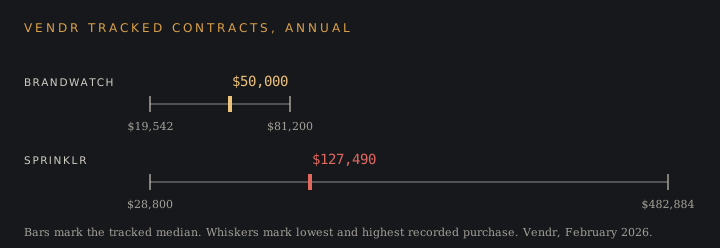
Vendr's page also writes tier estimates in prose, describing deals above six figures. Its highest tracked purchase is $81,200.
Those ranges are editorial; the stat block above them comes from closed contracts. Comparison sites repeat the prose, quoting $800 to $15,000 a month, which annualises to $9,600, under Vendr's tracked floor of $19,542.
↑ COMPARISONCision's debt is a real contract consideration
The listening business has been a Cision property since June 2021, bought for $450 million. Cision itself was taken private by Platinum Equity in January 2020 for $2.74 billion, and has carried heavy debt since.
The timeline is documented.
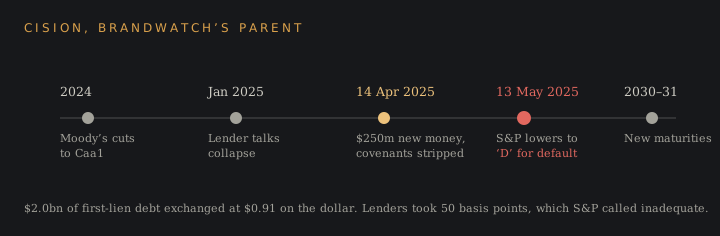
- Moody's downgraded Cision to Caa1 during 2024.
- November 2024: a new holding structure, roughly $2.5 billion in total debt, and a $1.2 billion first-lien term loan trading at 66 cents on the dollar.
- January 2025: lender talks collapsed.
- 14 April 2025: a deal closed on about $250 million in new money, existing term loans bought back at a discount, all existing notes exchanged for 10.00% senior secured notes due 2031, and maturities pushed to 2030 and 2031.
The amendments eliminated substantially all restrictive covenants.
On 13 May 2025 S&P Global Ratings lowered Castle Intermediate Holding V, the Cision borrower entity, to 'D' for default from 'CCC-', calling the exchange "tantamount to a default."
S&P's own figures on the completed transaction: roughly $2.0 billion of first-lien debt exchanged at full participation and $300 million of unsecured notes at 99.6%, both at $0.91 on the dollar. Participating lenders took a 50 basis point rate increase, which S&P judged inadequate compensation.
The restructuring bought roughly five years of runway. It cost a default designation and nearly all covenant protection.
Separately, Dow Jones sued Cision in July 2024 over an eight-year content licence valued at about $173.6 million, alleging Cision paid $8.8 million for year one and then stopped. The two sides resolved it in September 2025.
↑ COMPARISONScope: consumer intelligence against a unified front office
Consumer research aimed at understanding consumers, plus market intelligence, is the focus on one side. The product line covers Consumer Intelligence, Social Media Management, Influencer Marketing, Media Intelligence, and a Search Intelligence module added after Cision acquired Trajaan in December 2025.
The centre of gravity is analysis: it uses social data as a macro-level consumer insights layer and excels at analysing large volumes of unstructured data. Its social management side integrates consumer intelligence data directly, so the publishing tool sees what the research tool found.
Sprinklr unifies more functions under one roof
Sprinklr integrates social management and customer service in a single platform:
- publishing across 30+ social and publishing channels
- Sprinklr Insights for listening
- Sprinklr Social for publishing, engagement and social customer engagement work
- Sprinklr Copilot, the AI assistant across those modules
Sprinklr emphasises large-scale governance and compliance processes, and its AI compliance engine flags non-compliant content before posting, which is the feature regulated industries buy it for.
The practical split: one is a social listening platform with publishing attached; Sprinklr Social is a front-office platform with listening attached.
Marketing teams running competitive benchmarking and online reputation work tend to prefer the first, since listening depth is what they buy. Both platforms get used for monitoring online reputation; only one turns that into a reply. Global teams running social customer care across regulated markets tend to need the second, and those customers rarely switch back.
↑ COMPARISONData scale, and a number stated two ways
The vendor's own product page claims 1.7 trillion historical conversations back to 2010, 501 million new conversations added daily, official firehose access to X and Tumblr, conversations from 100 million unique sites, and over 50,000 ways to segment data. It also offers what it calls the best compliant Facebook and Instagram coverage available.
Both of its own Sprinklr comparison pages say 1.6 trillion instead. Sprinklr's blog cites the same vendor at 1.7 trillion. Neither figure carries a source, and the same company publishes both in the same week. The deepest historical archive claim is probably fair; the specific digit is not something to quote without checking.
Sprinklr publishes no headline archive figure, only the claim that it holds "the largest repository of publicly available unstructured data." What it does publish, buried in a help article, is a per-source backfill table, and that's the more useful document.
- X data reaches back to Q3 2014
- Blogs and news to Q2 2015
- Reddit to Q2 2017
- TV and radio to Q3 2017
- Facebook backfills only from the date a page is added
- Instagram and Sina Weibo read "Not available (API Limitations)."
A single backfill caps at 5 million mentions and draws down listening quota.
Set that against an archive running to 2010 across 100 million sources and the depth gap is real, though narrower than a trillion-conversation headline implies. Sprinklr's audited 10-K figures are the ones to trust on its own side: 450 million conversations captured daily, 8 billion AI predictions, over 150 languages, 4 billion profiles. Sprinklr's marketing says 10 billion predictions; the filing says 8.
↑ COMPARISONAI capabilities on both sides
Both platforms have invested heavily in AI capabilities for analytics and insights, and both market themselves as AI powered. Iris AI is the branding on that layer, and the piece with real day-to-day value is the AI Query Writer, which builds Boolean queries automatically from keywords, hashtags and subreddit recommendations.
That matters because Boolean query construction is the skill barrier on any listening platform. Iris also handles natural language dashboard summaries, image analysis and auto segmentation, and the vendor publishes an AI Code of Ethics alongside it.
Sprinklr's advanced AI is built for automation and governance, across four named products:
- Sprinklr AI+, the generative layer
- AI+ Studio, for model and guardrail management
- Sprinklr Copilot, the in-platform assistant
- Sprinklr AI Agents, for autonomous voice, chat, email and social handling
Agent Copilot is a separate thing again, sitting inside customer service. Sprinklr Digital Twin, launched in 2024, never reached general availability and its URL now redirects to AI Agents.
Both vendors describe delivering actionable insights faster. Neither publishes an accuracy benchmark for its own sentiment model, which leaves users to test it against their own social media data in context.
Both are chasing AI search visibility
Sprinklr announced LLM Insights on 10 June 2026, tracking how a brand appears inside AI-generated answers on ChatGPT, Gemini and Perplexity: mention rate, share of voice, sentiment and competitive position, with prompts generated from real customer conversations.
Cision's answer arrived from the other direction, acquiring Trajaan in December 2025 and folding it in as the Search Intelligence module. Same problem, two routes: one built the tracker, the other bought it.
↑ COMPARISONWhat the analysis produces
Enterprise social media management tools earn their contract on what an analyst can pull out on a Monday morning. Both platforms track brand mentions across social media and the wider web, and both sell that as enterprise social listening, then turn that raw stream into something an insights team can act on. Social listening lives or dies on that conversion, and enterprise buyers test it in the demo.
Consumer Intelligence is where the analysis happens on one side, and Consumer Research is the module analysts live in. An analyst writes a query, the platform tracks brand mentions and returns matching conversations from its historical data going back to 2010, and 50,000+ segmentation options slice those conversations by demographic, sentiment, topic or source.
Configurable dashboards and 50+ visualizations render the result, Vizia pushes it to office screens, and automated reporting delivers it on a schedule. Global coverage runs across 190+ countries and includes APAC networks like WeChat, Weibo and RedNote that most Western listening tools skip.
Sprinklr Insights performs the same social listening analysis inside a wider platform, with the analytics feeding the service and publishing modules directly.
For businesses running social customer care, that matters: a spike in negative brand mentions routes straight to the queue where agents answer, without an integration in between. Sprinklr Social users see the alert and the reply box together, which is the argument for buying Sprinklr Social over a research platform.
↑ COMPARISONWho each platform is a strong fit for
The two products sell to different buyers inside the same large enterprises, which is why so many enterprise evaluations stall.
- Insights and research teams get more from a social listening platform built around consumer insights and long historical data. Analysts writing Boolean queries all day need segmentation depth more than workflow tools.
- Social media management and customer care teams get more from Sprinklr Social software, where publishing, engagement and service run under shared governance and approval workflows.
- Global teams in regulated industries need the compliance engine and FedRAMP, which only one of the two enterprise vendors carries.
- Marketing teams at mid-size businesses often find both oversized, and neither vendor sells to those businesses any more since the self serve products closed. Sprout Social against Sprinklr is the closer comparison at that budget.
↑ COMPARISONIntegration and the surrounding stack
Integration depth is where enterprise grade software either earns its price or creates work. Sprinklr Social connects into CRM and service desks so social conversations land beside other customer records, and its AI agents can act on those records inside the same platform. The integration surface is wide because the product is trying to be the front office.
The other platform integrates outward instead: APIs, data export to Excel, PowerPoint and PDF, and a Salesforce connection that pushes consumer insights into systems the company already runs. Media Intelligence and Search Intelligence, added after the Trajaan acquisition in December 2025, extend the same data into PR and search analysis. For teams that want an intelligence layer feeding existing tools, that's the better shape.
↑ COMPARISONImplementation, learning curve and logins
The 16+ week onboarding figure attached to Sprinklr circulates widely and doesn't survive checking. G2 computes an average time to implement from its own reviewer surveys:
- Brandwatch Social Media Management, 1 month
- Brandwatch Consumer Intelligence, 2 months
- Sprinklr Insights, 4 months
Sixteen weeks is about 3.7 months, so the claim overstates it against every product measured except one, and Sprinklr Social has no published figure at all. Forrester's 2024 study of Sprinklr Social, commissioned by Sprinklr, puts deployment at one month for a composite organisation of 80,000 employees and 260 seats.
Sprinklr is still recognised for a complex platform requiring extensive training, and G2's payback figures show where that lands: 24 months for Sprinklr Insights against 12 for Brandwatch Consumer Intelligence. The other platform is known for quicker onboarding, though it still requires significant time for advanced query construction, which is why the vendor runs an academy offering structured courses in query writing.
One operational detail buyers discover late: three distinct login portals.
- Consumer Intelligence at my.brandwatch.com
- Influence on its own subdomain
- Social Media Management on app.falcon.io, labelled on its own sign-in menu as "Formerly the Falcon suite."
What got sunset in May 2022 was the Falcon.io brand, and only the brand. No end-of-life date, migration path or successor has ever been published for the platform, which shipped TikTok campaign creation, native AI-content labels and Facebook Reels boosting in its July 2026 release notes.
www.falcon.io redirects to brandwatch.com; app.falcon.io does not, and the API docs still live on a Falcon domain. Sprinklr Social runs a single login.
↑ COMPARISONSecurity and compliance
Sprinklr carries the longer certification list.
- SOC 1 Type II and SOC 2 Type II
- ISO 27001
- PCI-DSS
- FedRAMP authorization: the federal registry lists Sprinklr CXM for Government as certified since 27 September 2022 at Low impact, on the agency path, with three authorizations from the CFPB, USPTO and the Department of Agriculture
Low is the entry tier, so a Moderate or High requirement rules it out too.
The other holds ISO/IEC 27001:2022 with annual third-party audits, and makes the certificate available on request. Neither Brandwatch nor Cision appears on the FedRAMP registry in any status, so US federal work is decided before the demo.
Cision's own security statement names one attestation and scopes it to its hosting providers: "These data centers have completed a Service Organization Controls (SOC) 2 Type II audit." That's a claim about the data centres.
The Cision-owned platform publishes an information security page that's unusually candid, and worth reading before a procurement review. It commits to data breach notification within 36 hours, 30-day maximum data retention after contract termination, monthly vulnerability testing and annual penetration testing, a 24-hour RPO and a sub-one-business-day RTO for most products.
No MFA for end users. No bug bounty programme, with the page adding "nor do we expect to create one in the near future." Business continuity procedures formalised only for Consumer Research, Audiences and Vizia, with informal processes elsewhere. Most vendors would bury all three.
No breach, GDPR enforcement action or regulator decision turned up against either company. The status page showed three incidents in the six days to 5 August 2026, all touching Consumer Research, two of them query backfill delays. No uptime percentage is published.
↑ COMPARISONOne side attacks. The other doesn't answer
One side runs two separate landing pages targeting the other, at /p/sprinklr-alternative/ and /p/sprinklr-comparison/, both live simultaneously with separate canonicals. Sprinklr publishes no dedicated comparison page in return. Its /compare/ page names no competitor at all, and the only material on sprinklr.com is a listicle still titled "Top 7 Alternatives in 2024."
| The claim about Sprinklr | What checks out |
|---|---|
| "Broad coverage but limited historical access without add-ons" | Half right. Sprinklr publishes no headline archive figure, but its own backfill table shows X data to 2014 and Reddit to 2017, with Instagram unavailable. |
| "Feature-rich but can feel overwhelming, with a steep learning curve" | G2 puts Sprinklr Insights at 4 months to implement against Brandwatch's 1 to 2, so the direction holds even if the framing is loaded. Sprinklr's own listicle makes the identical charge in reverse. |
| "Premium pricing for the full CXM suite, even if you only use part of it" | Vendr's tracked medians support the direction: $127,490 against $50,000. |
| "Go live in just 4 weeks. While others take 16+ weeks" | The 16+ week figure is uncited, doesn't name Sprinklr, and is contradicted by G2's own survey averages and by Forrester's one-month deployment finding for Sprinklr Social. |
| Awarded "the highest possible score for supporting services and offerings" in Forrester's 2024 Social Suites Wave | Both claims about that report are true at once. Sprinklr was named a Leader in the same Wave. |
That G2 evidence is thinner than it looks. Both pages say users rate its offerings above Sprinklr's, but the supporting category chart on each page is an image with an empty source attribute, so no underlying scores appear in the HTML.
↑ COMPARISONReview scores and analyst placement
| Source | Brandwatch | Sprinklr |
|---|---|---|
| G2, listening product | 4.4 from 728 reviews | 4.3 from 105 reviews |
| G2, social management | 4.0 from 983 reviews | 4.1 from 1,217 reviews |
| G2 ease of setup | 8.0 and 8.2 of 10 | 7.0 of 10 on both products |
| Capterra | 4.2 from 255 reviews | 4.3 from 90 reviews |
| Capterra value for money | 3.8 | Not separately published |
| TrustRadius | 8.2 from 160 reviews | 8.7 from 175 reviews |
| 2026 Gartner Magic Quadrant | Niche Player | Leader |
Two readings worth separating. The Cision-owned listening product outscores Sprinklr's on G2, while its sibling social management product is the weaker half of that business at 4.0, which is the Falcon side. Its Capterra value-for-money score of 3.8 is the lowest figure on either vendor's page, and it belongs to the company that publishes no pricing.
Read the Gartner review counts before the scores. Of 130 Peer Insights reviews under the Cision-owned vendor page, 99 are for Falcon.io. There's no Peer Insights page for Consumer Intelligence at all, so a headline Gartner rating for this vendor is mostly rating a product acquired in 2019. Sprinklr's vendor roll-up carries 727 reviews across 10 markets.
The 2026 Gartner Magic Quadrant for Social Media Management and Listening places Sprinklr as a Leader and Brandwatch as a Niche Player, with Gartner cautioning that its identity may blur as it integrates into Cision's wider platform strategy. That placement comes from third-party coverage of the report; the document itself is paywalled. Sprinklr issued an investor release claiming Leader status within 48 hours of publication; Cision published nothing.
↑ COMPARISONCustomers, and what each vendor's base looks like
Sprinklr's 10-K for the year ended 31 January 2026 gives the numbers no comparison page has, because they're audited. Total customers: 1,677, down from 1,930, which the filing attributes partly to "a strategic refinement of our customer profile." Customers paying $1.0 million or more in trailing-twelve-month subscription revenue: 141, down from 149, and the filing adds that average subscription revenue inside that cohort "exceeded $3.0 million."
Run the arithmetic and the shape of the base appears. 141 customers averaging over $3.0 million each account for at least $423 million of the $756.3 million subscription line, so roughly 8% of customers carry more than half the revenue. The other 1,536 split under $333 million, an average below $217,000. Vendr's $127,490 median sits under that average, which is what a right-skewed enterprise base looks like, so the two sources corroborate.
Two more disclosed figures matter for a multi-year contract. Net dollar expansion ran 103.0% for FY2026 against 103.6% the year before and 117.7% the year before that. Sprinklr cut roughly 12% of its workforce in February 2025, announced at 15%, ending the year at 3,258 employees against 3,589.
Cision publishes none of this. It claims 75,000+ organisations across its whole portfolio without breaking out the listening platform, and no customer count for the specific products compared here exists on either vendor's site.
One credibility datapoint worth naming: a consortium including Blackbird.AI was selected by NATO in February 2026 to deliver an information environment assessment capability. That's a checkable public-sector reference for the research side, against Sprinklr's FedRAMP authorization on the operations side.
↑ COMPARISONSupport, services and what customers rely on
Both vendors sell services alongside software, and for enterprise grade contracts that's a real part of the price. Sprinklr Social runs 24/7 support with a documented services organisation and the longer onboarding that goes with it. The other markets 24/7 human support with a dedicated onboarding success manager, and claims Forrester awarded it the highest possible score for services and offerings in the 2024 Social Suites Wave.
Users on review sites rate support closely: 8.6 out of 10 for both listening and social products on G2, against Sprinklr's 8.1. Businesses lean on those teams more here than in most software categories, because a listening platform returns nothing useful until somebody has written the queries properly.
That's the context for Sprinklr Insights' 4-month G2 implementation average and its 24-month payback: both are long because the deployment is wide. The software isn't broken.
↑ COMPARISONTrends, tools and where each fits an enterprise stack
Social listening tools all promise the same headline: spot trends before competitors do. What separates the two platforms here is what happens once a trend surfaces. Enterprise buyers should map that path before signing, because it decides how many other tools stay in the stack.
Sprinklr Social treats social media as an operating channel. Trends detected by Sprinklr Insights feed publishing, engagement and service queues inside one enterprise platform, so social media work stays in a single system and fewer separate tools survive the consolidation. AI agents handle routine replies, and the compliance engine reviews outbound social media posts before they publish. For large enterprises consolidating vendors, that consolidation is the pitch.
The listening-first platform treats social media as evidence. Trends surface as consumer insights for analysis, and the analytics leave the platform to support decision making elsewhere: a strategy deck, a product roadmap, a category review. Teams keep their existing publishing tools and add an intelligence layer beside those tools. Businesses running that model end up with more tools overall and better research depth, and their analytics stay with the analysts.
Neither approach is wrong, and the trade-off is stable across every evaluation: consolidation buys fewer logins and simpler integration, specialisation buys depth. Consumers generate the same conversations either way, and consumers never change behaviour because of a procurement decision, so the raw social media signal is identical; only the internal path through the enterprise changes.
Frequently asked questions
Who acquired Brandwatch?
Cision acquired it for $450 million, announced February 2021 and closed June 2021. Cision has been owned by Platinum Equity since a $2.74 billion take-private in January 2020.
Is Brandwatch worth it?
For consumer research at scale, the archive back to 2010 and 50,000+ segmentation options have no direct equivalent at the price. Its own users rate value for money at 3.8 on Capterra, the weakest score either vendor posts, so negotiate against Vendr's $50,000 median. Our Brandwatch pricing report carries the tracked figures in full.
Who are Sprinklr's main competitors?
Brandwatch, Sprout Social, Hootsuite and Emplifi across social media management and listening. The 2026 Gartner Magic Quadrant names Emplifi alongside Sprinklr as the two Leaders.
Who are Brandwatch's main competitors?
Sprinklr, Meltwater, Talkwalker and Sprout Social. It competes hardest on historical depth and segmentation.
Does either offer a free trial?
No. Both require a sales conversation, and Sprinklr closed the last self-serve route on 30 April 2026.
Which one to buy
Choose the research platform when the job is exactly that: brand monitoring, competitive benchmarking, emerging trends, and analysis reaching back years. Its intelligence layer is the stronger of the two and its median contract runs less than half of Sprinklr's, which makes sense for insights teams that don't need a service desk attached.
Choose Sprinklr when social publishing, engagement and customer service have to run through a single platform under shared governance, when FedRAMP is a requirement, or when compliance review before posting is a regulatory obligation. Budget for a longer implementation than the listening-only route and for a contract running two to three years.
Weigh the ownership question honestly on both sides. Sprinklr's finances are public and readable each quarter, and it closed FY2026 with $502.5 million in cash. Brandwatch's parent restructured under distress in April 2025, drew a default rating from S&P, and holds no covenant protection worth the name until 2030. Neither fact disqualifies either vendor, and both belong in a multi-year contract decision.
Brandwatch and Cision sources: brandwatch.com/plans/; brandwatch.com/suite/consumer-intelligence/; brandwatch.com/legal/information-security/; brandwatch.com/p/sprinklr-alternative/; brandwatch.com/p/sprinklr-comparison/; status.brandwatch.com; vendr.com/marketplace/brandwatch; cision.com (14 April 2025 refinancing release); S&P Global Ratings (13 May 2025 downgrade of Castle Intermediate Holding V to 'D').
Sprinklr and shared sources: sprinklr.com/trust/; sprinklr.com/compare/; sprinklr.com help centre (historical backfills); vendr.com/marketplace/sprinklr; SEC EDGAR (Sprinklr FY2026 10-K, accession 0001569345-26-000015); fedramp.gov/marketplace; G2, Capterra, Gartner Peer Insights and TrustRadius listings for both products; Forrester Total Economic Impact of Sprinklr Social (May 2024); CX Today on the 2026 Gartner Magic Quadrant. Accessed 7 August 2026.