Sprout Social vs Sprinklr
 By Jan Suski. I go deep on every review, checking every number against its source and digging up details other coverage misses, a habit from six years of SEO and link building for tech companies. Bylines at Surfer, Brand24, and Senuto. How the scoring works.
· Prefer this source on Google
| WHAT EACH ONE DOES | SPROUT SOCIAL | SPRINKLR |
|---|---|---|
| Core job | Social media management | Customer experience |
| Built for | Small to midsize teams | Multi-brand enterprise |
| Social listening | No config project | Config project |
| Sentiment analysis | Advanced tier, in inbox | AI, global markets |
| Reporting | White-label exports | Premium analytics |
| Time to first post | 30 to 45 min training | Steep, none published |
| Support hours | 24/5, phone and chat | 24/7, no phone line |
| Enterprise CRM | Salesforce, HubSpot | Dynamics 365, Oracle |
| Skip it if | Units need governance | Five people run social |
| WHAT YOU GET | SPROUT SOCIAL | SPRINKLR |
|---|---|---|
| Entry tier, yearly | $79 a seat | Gone, 30 Apr 2026 |
| Entry tier, monthly | $99 a seat | Not published |
| Top published tier | $399, Advanced | Quote only |
| Tracked median | $18,941 a year | $127,490 a year |
| Tracked range | $6,425 to $55,000 | $28,800 to $482,884 |
| Tracked purchases | 351 | Not published |
| Free trial | 30 days, no card | None found |
| G2 support quality | 8.6 out of 10 | 7.8 out of 10 |
| Payback period | 11 months | 19 months |
StrongerWeakerNo edge
Thirty-five further documented limits sit behind the button below: publishing caps, approval gates, export ceilings, API rate limits and what each tier or retention SKU gates. Sprout Social’s tier prices are its own published rates; the medians, ranges and purchase counts are Vendr’s tracked contract data. Sprinklr retired its $249 self-serve tier on 30 April 2026 and publishes no price above it. Every figure is sourced in the section its row links to.
| Sprout Social | WHAT IT DOCUMENTS |
|---|---|
| Scheduling horizon | 13 months ahead, 10,000 messages queued |
| Bulk scheduling | 350 messages a CSV, Professional up |
| Sprout Queue | 10 slots a profile a day, 50 posts queued |
| Tag ceiling | 10,000 an account, Professional tier up |
| Tags a message | 100 in the Smart Inbox, 20 in Compose |
| External approvers | Up to 3 free, Advanced tier only |
| Approval expiry | Auto-rejected after 90 days pending |
| Custom user roles | Advanced tier only |
| Automated Rules | 1,000 active rules an account |
| API rate limit | 60 a minute, 250,000 a month, then 429* |
| API response cap | 10,000 results, 1,000 profiles a page |
| Images a post | 10 on Facebook, 9 on LinkedIn, 4 on X |
| Instagram post cap | 25 a day, a network ceiling |
| TikTok description | 150 characters in Compose |
| Report PDF delivery | 25 recipients a send, scheduled on Advanced |
| Asset library caps | 20 MB an image, 3 GB a video |
| Renewal increase | Capped at 7% in the published terms |
| Sprinklr | WHAT IT DOCUMENTS |
|---|---|
| API rate limit | 1,000 calls an hour, 10 a second by default |
| Reporting API page | 1,000 rows a request, 100M by bulk export |
| Excel export rows | 25,000 by default, lifted by a CSM |
| Daily export cap | 50,000 exports a day per environment |
| Table widget rows | 300 a page, 5,000 overall |
| Listening backfill | 5 million mentions, billed to consumption |
| Backfill depth | X reaches back to Q3 2014, varies by source |
| Topic query limits | 35 keyword lists, 15 proximity words |
| Conversation Insights | 2-year range, no sampling under 6M |
| Retention SKUs | Silver 1 year to Titanium 10 years, paid† |
| Data residency | US and EU only, fixed at contracting |
| Account permissions | Six types, including publish and engage |
| Publisher characters | 10,000 in the global editor, 2,200 Instagram |
| Bulk asset import | 1,000 assets in a single action |
| Asset bulk download | 2 GB cumulative, a hard cap |
| Agent capacity | 100 points an agent, 50 a social case |
| Password expiry | Forced every 60 days by default |
| PCI data window | 60 minutes in the segmented environment |
*A marked figure is one the vendor states two ways on its own domain. Sprout Social’s FAQ says Sprout has no public API, while api.sproutsocial.com documents one carrying the rate limits above; the documented limits are used here because they’re what a buyer can build against.
†Sprinklr’s Active Data Retention page caps retention at 84 months, seven years, while its help article sells a ten-year Titanium SKU; the SKU ladder is used because it’s the one that reaches an order form.
Sources, and the ceilings only a success manager can lift
Every row comes from a vendor property.
- Sprout Social: support.sproutsocial.com, api.sproutsocial.com and its published legal terms.
- Sprinklr: www.sprinklr.com/help, dev.sprinklr.com and sprinklr.com/trust.
Three of the Sprinklr numbers above are defaults: the 25,000-row export limit and the Advanced Publisher entitlement both move only through a success manager, and a shorter password window needs an account manager. Sprout publishes tier gates instead, so its equivalents move by upgrading a plan.
Neither vendor publishes a seat minimum, a contract length, an uptime SLA or a listening mention volume, so no row above claims one.
Sprout Social vs Sprinklr splits along a line most comparison pages blur: company size and governance need. Raw feature count matters less. Sprout Social publishes its pricing plans and built clean, fast-to-learn social media management software for marketing groups that want to be live inside a day. Sprinklr sells a much larger, quote-only enterprise system built for companies running social media across dozens of business units, brands, and service departments at once.
This page is for marketing leaders and social media managers who have to choose one of these two products this quarter and want real numbers. Two vendor blog posts arguing past each other won't settle it.
It matters because Sprinklr quietly discontinued its self-serve pricing in 2026, a change that resets how most existing comparisons describe its cost for customers researching either product. A five-person marketing group and a global enterprise running social customer care across twenty markets should not read the same recommendation, and the block above already splits them.
The pricing rows and the support row decide most Sprout Social vs Sprinklr evaluations before a demo happens: Sprinklr's move away from published self-serve pricing changes who can even trial it, and the support-quality gap tracks a real difference in how each company staffs its customer care operation for its customers.
↑ COMPARISONFeatures, reporting, and everyday functionality
Sprout Social and Sprinklr both sell publishing, social listening, and reporting tools, but the everyday functionality looks different once a marketer opens each platform.
The smart inbox unifies every social channel conversation into one queue, and Sprout Social's publishing capabilities include optimal send times calculated per network, per brand. Reporting stays close to that same simplicity: white label reports export in a few clicks, aimed at marketing agencies presenting results to clients, over an internal business intelligence unit.
Sprinklr's reporting goes further into premium analytics and social data correlation, tied to the same unified view its service teams use for social customer care. Sprinklr offers customizable dashboards built for its own business intelligence function. It isn't a quick check of last week's engagement numbers.
That's the core functionality gap: Sprout Social is built for speed to insight, Sprinklr is built for depth of analytics across a wider set of use cases, and each vendor's own social media marketing customers tend to describe the tradeoff the same way in reviews. Reporting quality and analytics depth are the two features buyers cite most in G2 comparisons of the pair.
Add-on modules separate the two further.
- Sprout: employee advocacy and premium social listening as add ons on top of its core plans, plus an add on for review management across app stores and review sites.
- Sprinklr: a wider set of add-on capabilities bundled directly into its enterprise tiers, ahead of selling them piecemeal, matching resources most Sprout Social users would buy separately.
Both companies list these features on their own comparison and insights pages.
Social listening and sentiment
Sprout Social's listening solution analyzes millions of data points and returns a query without a configuration project in front of it. Keyword and location monitoring ship inside the Standard plan, so a mid-size marketing group gets working listening without an upgrade. The Advanced plan adds sentiment analysis directly in the smart inbox, where agents already handle replies.
Sprinklr runs enterprise-grade listening with AI sentiment tracking wired into the same engagement suite its service teams use, tracking sentiment across global markets. The tradeoff shows up at setup: Sprinklr's listening features require complex configuration before they return anything worth reading, which is why its own reviews pair strong capability scores with weak ease-of-use scores.
↑ COMPARISONPricing: one platform published, one just pulled its price list
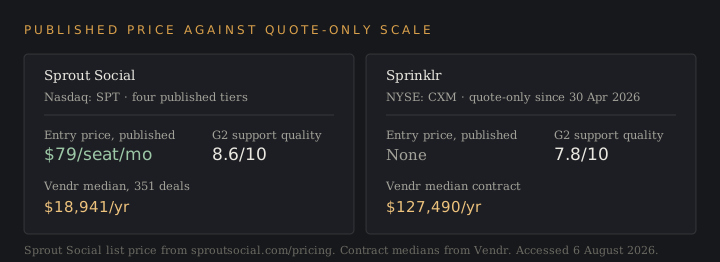
Sprout Social's pricing plans are public and simple, a form of transparent pricing few enterprise vendors match. Essentials starts at $79 a seat a month billed annually, or $99 billed monthly. Standard runs $199 a seat a month. Professional runs $299, and Advanced runs $399, with Enterprise priced on inquiry above that. A 30-day free trial with full product access requires no credit card.
Sprinklr sold a Self-Serve plan at $249 a seat a month for years. That plan was discontinued as of 30 April 2026, according to Sprinklr's own statement, leaving only a quote-based Enterprise tier. Third-party estimates place a Sprinklr minimum annual commitment somewhere between $50,000 and $100,000, though that figure comes from an independent pricing write-up, over sprinklr.com directly, so treat it as a starting reference for a sales conversation. It isn't a quote.
Several older comparison posts still list Sprinklr's Self-Serve plan at $249 a month. That plan no longer exists as of 30 April 2026. Confirm current packaging directly with a Sprinklr rep before building a budget around any published number you find elsewhere.
Vendr tracks this kind of packaging shift better than a vendor's own marketing page does, since procurement data updates as real contracts close, ahead of when a marketing group edits a page.
↑ COMPARISONWhat the Vendr numbers show
Vendr's tracked purchase data gives both a real benchmark that neither vendor's own pricing page fully replaces. Sprout Social's median annual contract runs $18,941 across 351 tracked purchases, ranging $6,425 to $55,000, with an average negotiated savings of 14.02%. Sprinklr's median annual contract runs $127,490, ranging $28,800 to $482,884, roughly 6.7 times Sprout Social's median.
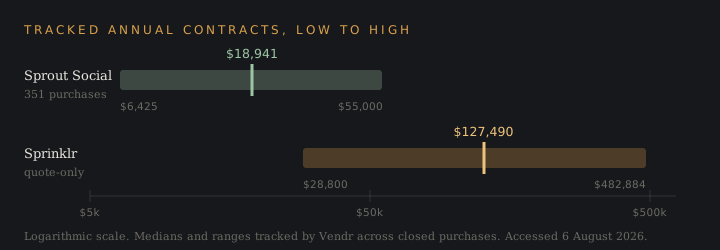
Sprinklr's $127,490 median annual contract against Sprout Social's $18,941 median, both tracked by Vendr across real negotiated purchases.
That gap tracks the buyer as much as the product. Sprinklr's contracts bundle governance, multi-brand workflow, and customer care modules a five-person marketing team never touches, while Sprout Social's median buyer is closer to that five-person shop than to a global enterprise. Agencies and marketing groups comparing the two on price alone are usually comparing different jobs, more than different software.
↑ COMPARISONSupport: 24/5 against 24/7, but the ratings tell a different story
Sprout Social offers 24/5 customer care on every plan, Monday through Friday, by phone and chat, and carries an 8.6 out of 10 support-quality score on G2 across roughly 4,500 ratings. Sprinklr's support runs 24/7 with no dedicated phone line, and its G2 support-quality score now reads 7.8, down from 8.1 not long ago. Either figure trails Sprout Social despite the longer coverage window.
Availability and quality measure different things. Sprinklr's round-the-clock coverage suits a global enterprise running service operations across time zones where a five-day window would leave gaps. Sprout Social's narrower window scores higher on quality, which fits a platform built for a smaller, more centralized marketing group that doesn't need a 2 a.m. escalation path as often.
Sprout Social also claims a customer satisfaction score above 96% sustained across five years. That number comes from its own marketing, and Sprinklr publishes no comparable CSAT figure to set beside it.
Ease of use follows a similar pattern across both platforms. Sprout Social earned 8.8 out of 10 for ease of use on G2 across roughly 5,086 ratings against Sprinklr's 8.3, plus 8.7 for ease of setup. Reviewers put a Sprout Social rollout at 30 to 45 minutes of training before a team starts publishing.
Sprinklr's learning curve is the most consistent complaint in its own reviews. Its interface draws repeated descriptions as cluttered and complicated, tied to Capterra's 3.8 out of 5 ease-of-use score and more than 130 aggregated review mentions of complex configuration. New users report a steep ramp before it pays back the setup time.
↑ COMPARISONReview scores across two platforms
Sample size changes how much weight a review score deserves.
| Platform | Sprout Social | Sprinklr |
|---|---|---|
| G2 | 4.4 from 6,957 reviews | 4.2 from 2,185 reviews (Sprinklr Social: 4.1 from 1,206) |
| Capterra | 4.4 from roughly 605 reviews | 4.3 from 90 reviews |
Sprout Social carries the larger sample on every platform measured here, which matters most on G2, where its review count runs more than three times Sprinklr's. Capterra's scores sit close together, 4.4 against 4.3, but Sprinklr's 90 reviews carry far less statistical weight than Sprout Social's roughly 605, giving users a thinner basis for comparing the two products on that platform alone.
A separate G2 metric worth checking before either demo: Sprout Social's own comparison page cites G2's Summer 2025 Enterprise Grid Report putting Sprout Social's payback period at 11 months against Sprinklr's 19 months.
That figure comes from Sprout Social citing a third-party report, over an independent pull, so confirm it directly on G2 before using it in a business case. Reviewers on both platforms cite reporting depth and ease of setup as the features that most influence renewal decisions.
Customers and market share: what the trackers measure
6sense's technology-adoption tracker shows Sprout Social at roughly 15,641 tracked customer sites against Sprinklr's roughly 2,938 customer sites, depending on the exact category measured. Those counts track websites detected running each platform's technology. They don't confirm customers under contract or revenue.
Market-share percentages built on the same tracking method vary by source and category. 6sense's head-to-head view puts Sprout Social at 0.10% share against Sprinklr's 0.02%, a five-to-one gap. Enlyft puts Sprout Social around 0.05% in a broader enterprise-marketing-management category, while 6sense elsewhere puts Sprinklr at roughly 1.46% and tenth rank inside social media management, which sits against its own 0.02% figure from a different category cut.
None of those percentages describes revenue share or seat count among either vendor's actual customers, and the trackers disagree with each other and with themselves on category boundaries. A technology-adoption percentage from any single tracker is a weak substitute for a real customer count from either vendor's own investor filings.
Sprout Social's own investor disclosures, as a company publicly traded on Nasdaq under ticker SPT, across its own social media reach and analytics tools, are the more reliable source for its customer base and growth, and the company closed a $55 million acquisition of NewsWhip, a media intelligence product serving its own set of customers, on 30 July 2025.
↑ COMPARISONIntegrations and where each fits a stack
Sprout Social integrates directly with Salesforce and holds certified HubSpot Connect Partner status with a Service Hub integration, supporting the CRM and marketing automation software a mid-size marketing group is likely already running. Its own social integrations cover Facebook, X, Instagram, LinkedIn, Threads, Pinterest, and TikTok.
Sprinklr integrates with Microsoft Dynamics 365 through a bi-directional connector and with Oracle's Fusion Cloud CX, Eloqua, and B2C Service products, reflecting the larger enterprise software stacks its customers typically run. That integration list favors depth inside enterprise systems over the breadth of consumer marketing integrations Sprout Social connects to.
Sprout Social gates API access to its higher tiers. A buyer planning custom reporting or a push into its own data warehouse should confirm which plan carries the API before signing at Standard, since that one line decides if the custom work is possible at all.
Neither vendor publishes a Zapier integration, so a smaller marketing group wanting no-code workflow automation across dozens of small products should weigh that gap against either platform's native integration list before assuming either one plugs into an existing stack without extra engineering work.
Security disclosures, and a connection worth knowing about
Sprinklr has disclosed no security breach. Sprout Social has disclosed two incidents involving third-party vendors, separate from its own platform: a Salesloft/Drift-related exposure on 12 September 2025, and unauthorized Salesforce CRM access tied to the June 2026 Klue security incident on 11 and 12 June 2026, the same breach covered in our Crayon vs Klue comparison. Sprout Social states both incidents excluded its own platform data, credentials, and API keys.
Both disclosed incidents involved third-party vendors connected to Sprout Social. Neither was a breach of Sprout Social's own systems. Sprinklr's clean record here reflects no disclosed incident found; Sprinklr also runs fewer of the small-vendor integrations that created the exposure path for Sprout Social's own customers.
Both companies publish live status pages, status.sproutsocial.com and status.sprinklr.com, and both maintain a security trust center: sproutsocial.com/trust-center and sprinklr.com/trust. Sprinklr holds SOC 1 and SOC 2 Type II, PCI-DSS, ISO 27001, and FedRAMP certifications.
↑ COMPARISONCompany stability and ownership
Sprout Social trades publicly on Nasdaq under ticker SPT, founded in 2010 and headquartered in Chicago, with roughly 1,200 to 1,360 employees. A Reuters report in 2026 sparked speculation about a going-private process; Sprout Social's board described review of unsolicited inquiries as normal course business, over confirming an active sale process.
Sprinklr trades publicly on the New York Stock Exchange under ticker CXM, founded in 2009 by Ragy Thomas and headquartered in New York City, with roughly 3,161 employees as of December 2025. Rory Read serves as CEO as of 2026. Sprinklr is roughly two and a half times Sprout Social's headcount, consistent with its larger, enterprise-focused customer base and its higher Vendr contract median.
↑ COMPARISONSprout Social vs Sprinklr: reading each company's own positioning
Sprinklr's positioning describes itself as an AI-powered unified customer experience management solution built for enterprise organizations with evolving needs across marketing, service, and social. Sprout Social's own positioning stays narrower and more direct: a product built to get a marketing group's social media marketing live fast, with social listening and reporting built into the same product as standard features.
Unlike Sprinklr, Sprout Social markets directly to marketing agencies and mid-size businesses over enterprise buying committees, and its own sprout social integrations page leads with Salesforce and HubSpot over the Oracle and Microsoft Dynamics depth Sprinklr leads with. That's a real difference in target audience. It goes beyond a marginal one: two different buyer types shopping for two differently shaped businesses.
There's no clear choice between Sprout Social and Sprinklr in the abstract, only a clear choice once company size, budget, and governance need are on the table. Growth-stage marketing organizations get the most value from Sprout Social's resources and support quality; large enterprise organizations with dedicated business-intelligence and service-operations staff get more value from Sprinklr's deeper analytics and unified view across brands, clients, and businesses.
Users comparing the Sprout Social Sprinklr matchup for the first time should map their own company's shape against these two profiles before either demo, and should read a handful of recent reviews from customers their own size, past the aggregate score alone.
↑ COMPARISONWhich social software fits which company
Choose Sprout Social when the marketing group is small to mid-size, the budget owner wants published pricing plans over a sales call, and a short learning curve matters more than governance depth. Marketing agencies and growing businesses get the most from Sprout Social's model: a clean smart inbox, fast publishing, and social listening tools that don't require a dedicated administrator.
Choose Sprinklr when the company runs social media across many business units, brands, or service departments that need shared governance and approval workflows, and when 24/7 support coverage across time zones outweighs a steeper learning curve. Enterprises already running Microsoft Dynamics or Oracle get more value from Sprinklr's native depth in those systems than from Sprout Social's broader consumer-integration list.
Marketers evaluating both should also check our social listening tools ranking for how each compares against the wider field of social media management and social listening software.
FAQ
Is Sprinklr the same as Sprout Social?
No. Sprout Social is a social media management tool built for small-to-midsize marketing groups, priced from $79 a seat a month. Sprinklr is a much larger, quote-only customer experience management system built for enterprises, with a Vendr-tracked median contract of $127,490 a year against Sprout Social's $18,941.
What is better than Sprout Social?
For an enterprise running social media management across many business units with heavy governance needs, Sprinklr covers more ground. For a smaller marketing group, Sprout Social's own reviews and support-quality scores outperform Sprinklr's on G2, so which is better depends on company size.
Who competes with Sprinklr?
Sprout Social is one of Sprinklr's most-searched comparisons, alongside other social platforms and customer-experience platforms built for the same category. Sprinklr competes across a broader customer experience management category than Sprout Social's narrower social media focus.
What are the cons of Sprout Social?
Sprout Social's smart inbox and publishing software suit small-to-midsize businesses better than large multi-brand enterprises needing Sprinklr-level governance and approval workflows. Sprout Social also carries fewer native enterprise-system integrations, such as Dynamics 365 or Oracle, than Sprinklr.
How much does Sprinklr cost compared to Sprout Social?
Sprinklr no longer publishes a self-serve price; its Self-Serve plan was discontinued 30 April 2026, and Vendr's tracked median annual contract runs $127,490. Sprout Social publishes pricing plans from $79 a seat a month, with a Vendr-tracked median annual contract of $18,941.
Do Sprout Social and Sprinklr offer a free trial?
Sprout Social offers a 30-day free trial with full product access and no credit card required. Sprinklr does not publish an equivalent trial; access runs through a sales consultation.
Sprout Social vs Sprinklr: a few numbers worth re-checking
Every Sprout Social vs Sprinklr search this year runs into the same handful of numbers: pricing, support quality, and customer count. Confirm each directly before signing, since a Sprout Social vs Sprinklr shortlist built on stale figures costs more to fix later than it does to verify now. The team running either evaluation should pull current screenshots of both pricing pages ahead of trusting last year's blog post.
Social media coverage is one area where both products overlap almost completely: both cover the major social media networks a marketing team needs day to day, and both publish social media marketing case studies featuring named customers. Where they diverge is publishing depth, analytics depth, and the insights each surfaces from that social media activity.
Sprout Social's publishing tools and reporting stay closer to the surface, built for users who need answers fast; Sprinklr's publishing and analytics stack runs deeper, built for users managing social media across more brands than one dashboard can show at a glance.
Four reporting features are worth lining up side by side.
- White labeling for agency clients.
- Employee advocacy, one of the add ons on each platform.
- Reporting tools built for social media at scale.
- How many customers each vendor names publicly in its own case studies.
A team that lines these up before the demo spends less time in the sales process and more time testing the product against its own social media workflows. The Sprout Social Sprinklr comparison comes down to which team of users these features were built for in the first place.
Where can I find a detailed Sprout Social vs Sprinklr breakdown?
This Sprout Social vs Sprinklr comparison traces every number to Vendr and G2, bypassing either vendor's own marketing. Search Sprout Social Sprinklr or Sprinklr Sprout Social and compare what each source verifies before trusting a set of insights, since a Sprout Social Sprinklr search can surface either vendor's own page first.
The two companies' social media tools generate customers and reviews at different volumes, so weigh the Sprout Social Sprinklr analytics and customers counts above against your own team's needs before the marketing copy either vendor publishes.
Sources: sproutsocial.com/pricing; sproutsocial.com/insights/sprout-social-vs-sprinklr; vendr.com/marketplace/sprout-social; vendr.com/marketplace/sprinklr; G2 and Capterra listings for both products; 6sense and Enlyft technology-adoption trackers; sproutsocial.com/trust-center; sprinklr.com/trust; SEC filings for Sprout Social (Nasdaq: SPT) and Sprinklr (NYSE: CXM). Accessed 6 August 2026.