Brandwatch vs Sprout Social
 By Jan Suski. I go deep on every review, checking every number against its source and digging up details other coverage misses, a habit from six years of SEO and link building for tech companies. Bylines at Surfer, Brand24, and Senuto. How the scoring works.
· Prefer this source on Google
| WHAT EACH ONE DOES | BRANDWATCH | SPROUT SOCIAL |
|---|---|---|
| Core job | Market research | Publishing and replies |
| Population measured | A whole market | Your own accounts |
| Reporting answers | What a market thinks | How campaigns did |
| Learning curve | A fortnight of queries | Hand it over Monday |
| Query limits | 150 wildcards a query | Not offered |
| Unified inbox | Separate suite | Every connected profile |
| Comparison page | Names no claim | Publishes none |
| Skip it if | Nobody writes queries | Research is the job |
| WHAT YOU GET | BRANDWATCH | SPROUT SOCIAL |
|---|---|---|
| Published pricing | None at all | Four of five tiers |
| Entry price | Quote only | $79 per seat/month |
| Annual cost | $50,000 Vendr median | $10,764, three seats |
| Listening add-on | Included | Not published |
| Price protection | 15.29% off, Vendr | 7% renewal cap |
| Owner | Cision, via Platinum | Independent, Nasdaq |
| Latest disclosure | Nothing since Dec 2024 | Q2 2026, 6 Aug 2026 |
| Exit terms | Not published | 30 days, then deleted |
StrongerWeakerNo edge
Thirty-four further documented limits sit behind the button below: seat prices, API rate limits, listening caps, report history and what each tier gates. Sprout Social's figures come from its published rate card and its SEC filings. Brandwatch publishes neither a price nor public terms, so its price column carries Vendr's tracked purchase data and its exit column stays empty. Every figure is sourced in the section its row links to.
| Brandwatch | WHAT IT DOCUMENTS |
|---|---|
| Listen indexing | 2,500 mentions a day per saved search |
| Listen sampling | 5,000 a day cuts 50%, 10,000 cuts 75% |
| Listen history | 1 year saved search, 2 years paid* |
| Listen export | 5,000 a day per org, PDF capped at 100 |
| Listen content sources | 1,000 per organisation |
| TikTok hashtags | 50 tracked, top 1,000 posts per 24 hours |
| Benchmark channels | 20 slots by default, more through a CSM |
| Measure retention | 2 years 3 months |
| Iris AI sample | 240 highest-impact mentions, 5 cached summaries |
| Creator database | 30 million on plans, 65 million on Influence* |
| Reddit and news depth | Reddit from 2011, news and forums from 2010 |
| CR API rate limit | 30 calls per 10 minutes, per client |
| Mentions page size | 1 to 5,000 a page, 10,000 cap by paging |
| Analysis API window | 24-hour maximum range per query |
| Online news via API | 256-character snippet, nothing more |
| Chat response time | 5 to 30 minutes depending on package |
| Sprout Social | WHAT IT DOCUMENTS |
|---|---|
| Seat ladder | $79, $199, $299, $399 a seat billed annually |
| API rate limit | 60 a minute, 250,000 a month, then 429† |
| API response cap | 10,000 results, 1,000 profiles a page |
| Bulk scheduling | 350 messages a CSV, 50 on trial, Professional up |
| Sprout Queue | 10 slots a profile a day, 50 posts queued |
| External approvers | Up to 3 free, Advanced tier only |
| Approval expiry | Auto-rejected after 90 days pending |
| Automated Rules | 1,000 active rules, 20 tags a message |
| Custom user roles | Advanced tier only |
| Listening query cap | 2,037-character Boolean limit, every plan |
| Listening backfill | X 30 days automatic, manual back to March 2006 |
| Listening export | CSV capped at 10,000 messages |
| Listening topic caps | 250 Facebook Pages, 50 themes |
| Report history | Instagram 90 days, X 1 year, Facebook 2 years |
| Report PDF delivery | 25 recipients a send, scheduled on Advanced |
| Asset library caps | 20 MB an image, 3 GB a video |
| Renewal increase | Capped at 7% in the published terms |
| Nonprofit discount | 20% Professional, 25% Advanced† |
*Brandwatch states these two ways. Listen quick search gets one month of data in one help article and one year at 5% sampling in another; the plans page sells 30 million creators against 65 million on the Influence page.
†Sprout Social states these two ways. Its FAQ says Sprout has no public API, while api.sproutsocial.com documents one with published rate limits, an FAQ-versus-docs gap covered in our report on software still marketed inconsistently with its own documentation. Its nonprofit page advertises up to 40% off in its own meta description, then lists $239 against $299 and $299 against $399 on the same page.
Sources, and the gap between one rate card and none
Every row comes from a vendor property.
- Sprout Social: sproutsocial.com/pricing, its legal terms, support.sproutsocial.com and api.sproutsocial.com.
- Brandwatch: developers.brandwatch.com and its two help centres.
Sprout publishes a per-seat rate card for four tiers. Brandwatch publishes no price for any product and no named tiers, gating instead through per-contract variables set by a customer success manager.
Both leave gaps. Sprout publishes no Listening mention volume, no Employee Advocacy seat price and no uptime SLA; Brandwatch publishes no seat counts. No row above claims any of them.
Buy Sprout Social if the job is publishing, scheduling posts and replying across a set of social media accounts on a cost you can put in a budget line today. Buy Brandwatch if the job is market research: building a Boolean query against 1.7 trillion online conversations going back to 2010 and getting an answer no dashboard already shows you.
This page covers what each platform charges, what each one counts, how the review scores split, what shape both companies are in, and what leaving costs. It's for the person holding a Sprout Social quote and a Brandwatch demo booking, deciding which to sign this quarter.
The usual framing misleads. Every Brandwatch Sprout Social comparison on page one of Google says one vendor publishes prices and the other doesn't. True for publishing & engagement. Sprout Social sells Listening as a paid add-on to the Standard plan and up and publishes no price for it, so anyone comparing social listening capabilities ends up holding two quotes and no list price on either side.
↑ COMPARISONWhat Brandwatch and Sprout Social are each built to do
Sprout Social is an operational social media management suite for social media managers and marketers who schedule posts, respond and report on campaigns every day.
The Smart Inbox pulls messages from every connected profile into one platform queue; the publishing side handles content calendars, approval workflows and scheduling content across the major social platforms. Its engagement tools are built around customer engagement & the relationships behind it, which is why agencies run it across clients.
Brandwatch Consumer Intelligence is a market research platform with a query language in front of it. Its public guide documents quotation marks, AND, OR, NOT, NEAR/x, the wildcard and brackets.
The operator reference for the Listen module, dated 10 December 2025, adds source operators (site, url, subreddit, author), location operators, and filters on authorFollowers, engagementType and imageType, with published limits: 150 short wildcards per query, curly-bracket terms under five characters, case-sensitive operators.
The learning curve follows. One tool you hand to a social media manager on Monday. The other you hand to data analysts who'll spend a fortnight finding out what a badly written query costs them in a report.
Brandwatch also runs Image Analysis, described on its Consumer Research feature page as detecting "objects, actions, scenes and logos in images", though the developer docs gate it behind a module your CSM has to enable. Sprout Social offers no equivalent. Brandwatch's dataset carries official firehose access to Twitter and Tumblr, which matters to anyone reconstructing a conversation the platforms have since throttled.
↑ COMPARISONSprout Social's rate card, and the line where it stops
| Plan | Per seat/month, billed annually | Social profiles | Brand keywords per group |
|---|---|---|---|
| Essentials | $79 | 5 | Not included |
| Standard | $199 | 5 | 10 |
| Professional | $299 | Unlimited | 10 |
| Advanced | $399 | Unlimited | 20 |
| Enterprise | Custom | Custom | Custom |
Sprout Social pricing page, accessed 7 August 2026. Essentials is the only tier with a published monthly rate, $99 per seat. No additional-seat rate appears anywhere; Sprout Social's billing article names users as a cost component and says the cost "varies depending on your chosen plan level" with no figure attached. Sprout's own plan-details.pdf carries a third, older set of prices for the same tiers, detailed in our report on software pricing errors.
Four of the five tiers on the Sprout Social rate card carry a number. What sits outside all five is the reason most people open a Brandwatch vs Sprout Social page at all. The pricing page states it plainly: "Premium Analytics and Listening are each available as individual add-ons to the Standard plan and up."
Neither carries a price, and the button beside both reads Schedule a demo. Employee Advocacy and Professional Services sit in the same bucket. Influencer Marketing, the Tagger product line, sells standalone with no Sprout Social plan required, covering discovery across 10M+ social profiles.
Get the Listening and Premium Analytics quotes in writing before you sign Standard. The 30-day trial provisions Professional and hands you neither, so the first time either price appears is after the plan is already bought.
The free trial runs 30 days with no credit card and provisions Sprout Professional, priced at $299 per seat/month billed annually once it ends. Listening is an add-on to Standard and up, so it sits outside what the trial hands you. Small businesses on Essentials never meet the listening upsell at all, because that tier carries no brand keywords.
↑ COMPARISONWhat Brandwatch contracts have cost
Brandwatch publishes no price anywhere on its own site. Its plans page lists three product lines, Consumer Intelligence, Social Media Management and Influencer Marketing, names no tier, quotes no figure, and routes every button to a demo form. Capterra's vendor-supplied block reads "Custom Quote Available" and "Free trial not available".
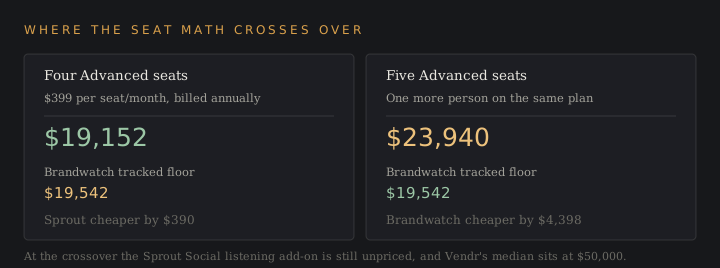
Vendr, which tracks what its own buyers signed, puts the median Brandwatch contract at $50,000 a year across 40 tracked purchases, with a low of $19,542, a high of $81,200 and average negotiated savings of 15.29%. Those are Vendr's anonymized buyer figures, updated February 2026, and they're the closest thing to a rate card Brandwatch has.
The spread runs better than four to one, and Brandwatch names no pricing variable publicly, so whatever moves a quote from $19,542 to $81,200 is visible only inside a sales conversation.
The gap between four Sprout Advanced seats at $19,152 a year and Vendr's tracked Brandwatch floor of $19,542. Five seats come to $23,940 and cross it. On published seat prices alone the crossover lands at about five people, and at that point the Sprout Social listening add-on is still unpriced.
↑ COMPARISONSources against keywords: what each vendor publishes
| What's counted | Brandwatch | Sprout Social |
|---|---|---|
| Historical archive | 1.7 trillion conversations, back to 2010 | Not published |
| Collected per day | 501 million new conversations | Not published |
| Sources indexed | 100 million unique sites | Not published |
| Brand keywords in a plan | Not published | 10 per group, 20 on Advanced |
| Social profiles in a plan | Not published | 5, unlimited from Professional |
| Influencer database | 30m+ creators | 10M+ profiles via Tagger |
| Live visualizations | 50+ | Not published |
Brandwatch Consumer Intelligence suite page and Sprout Social pricing page, both accessed 7 August 2026.
Each vendor publishes exactly what the other hides. Brandwatch will tell you it collects 501 million conversations a day and won't say what a seat costs. Sprout Social will tell you a seat costs $399 and won't say how much of the web its social data covers.
A buyer holding both pages has one number from each side and no common unit to divide by. One caution on the Brandwatch figures: its Sprout Social alternative page says "a million data sources", two orders of magnitude below the 100 million on its own product page.
↑ COMPARISONReporting, alerts and everyday workflow
| Capability | Brandwatch | Sprout Social |
|---|---|---|
| Publishing and content calendars | Social Media Management line | All plans |
| Approval workflows | Social Media Management line | Standard and up |
| Web-wide social listening | Consumer Intelligence, included | Paid add-on, Standard and up |
| Sentiment on inbound messages | Consumer Intelligence, included | Advanced plan |
| Image analysis | Objects, actions, scenes, logos | Not offered |
| Boolean query operators | Documented, with published limits | Not offered |
| API access | Six named APIs, no published limits | Advanced plan and up |
| Free trial | None | 30 days, no card, Professional tier |
The split shows up most sharply in reporting tools. Sprout Social's reporting answers how campaigns performed on your own accounts, and Premium Analytics is the paid tier of that. Brandwatch's reporting answers what a market thinks, with 50+ live visualizations and advanced analytics aimed at brand health, share of voice and emerging trends nobody on your team has noticed.
Both platforms send real-time alerts on brand mentions and both track sentiment; the gap is the population being measured. Sprout Social measures social engagement with your accounts. Brandwatch measures an audience that has never touched them.
↑ COMPARISONBrandwatch's Sprout Social comparison page, checked
Brandwatch runs a landing page at /p/sprout-social-alternative, last touched 27 April 2026 by its own metadata, under the heading "Why businesses choose Brandwatch over Sprout Social". It names Sprout Social in the page title and that heading. Nowhere else.
No claim about Sprout Social appears on it: no price, no missing feature, no review score, nothing a Sprout Social customer could contest. What the page claims is about Brandwatch.
It says the platform helps you "uncover actionable insights and optimize your strategies", calls Brandwatch "the world's premier social suite, empowering over 5,000 of the world's most admired companies", and carries the standing marketing line that many of the world's biggest brands use Brandwatch every day.
Its testimonial names a source, Adam Mills at British Telecom, and rests on "the ability to put the customer at the heart". The trust badges carry 2024 dates in their filenames.
Sprout Social publishes no attack page in return. Its only Brandwatch content is a listicle, "12 Brandwatch Alternatives You Need to Know in 2026", published 20 November 2025 and updated 30 July 2026 under Ronnie Gomez's byline. It names Brandwatch fifteen times and makes no checkable claim about it.
The closest thing to a dig sits in Sprout Social's own entry and never names Brandwatch: "These tools are built on a single code-base, so you don't have to worry about changing partnerships or acquisitions impacting the way you work." So there's nothing here to adjudicate, which is worth knowing before either page goes into a business case.
↑ COMPARISONReview scores, and the listing that gets left out
| Source | Brandwatch | Sprout Social |
|---|---|---|
| G2, listening product | 4.4 from 728 reviews | No separate listing |
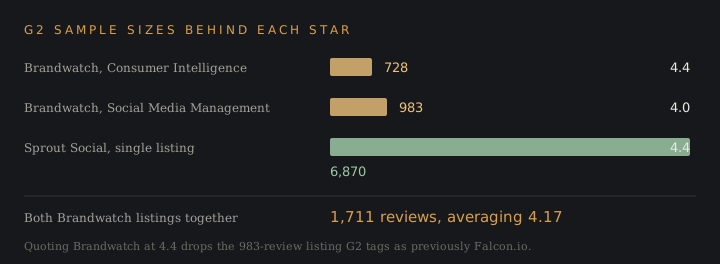
| G2, social suite | 4.0 from 983 reviews | 4.4 from 6,870 reviews |
| Capterra overall | 4.2 from 255 reviews | 4.4 from 608 reviews |
| Capterra features | 3.9 from 248 | 4.2 from 594 |
| Capterra value for money | 3.8 from 187 | 3.9 from 470 |
| Capterra customer service | 4.4 from 219 | 4.3 from 446 |
G2 and Capterra listings, accessed 7 August 2026. Capterra last updated its Brandwatch page 3 August 2026 and its Sprout Social page 21 July 2026.
Brandwatch carries two G2 listings and they disagree by four tenths of a star. The lower one holds the bigger sample: Brandwatch Social Media Management, 4.0 from 983 reviews, tagged by G2 as "previously Falcon.io". Any sentence reading "Brandwatch scores 4.4 on G2" quotes the 728-review listening product and drops 983 reviews of the other. Across both, 1,711 reviews average roughly 4.17. Sprout Social's single listing carries 6,870.
Value for money is the weakest sub-score on both Capterra listings, 3.8 and 3.9 against overalls of 4.2 and 4.4. A fairness note in both directions: every one of the ten most recent Capterra reviews on each vendor carries the disclosure "Vendor Referred - Incentive Offered". On Brandwatch, 54% of Capterra reviewers come from small companies, for a platform sold to large enterprises.
↑ COMPARISONCorporate condition on both sides
Cision announced its acquisition of Brandwatch on 26 February 2021 for $450 million and closed it on 1 June 2021. Platinum Equity had taken Cision private on 31 January 2020 in an all-cash deal valued at about $2.7 billion.
Cision's refinancing closed on 29 April 2025 with roughly $250 million of new-money first-out term loans, the existing loans exchanged on a cashless basis for about $1,300 million and €430 million of second-out loans, and roughly $294 million of notes swapped for about $268 million of 10.00% senior secured notes due 2031. The amendment eliminated substantially all restrictive covenants in the 2028 indenture.
S&P cut the borrower to 'D' in May 2025 on the completed distressed exchange and later raised it to CCC+ with a negative outlook; Moody's had already moved to Caa2 in November 2024. Brandwatch's own press page has published nothing since December 2024, and announcements now issue under cision.com.
Sprout Social trades on Nasdaq as SPT and remains independent, with FY2025 revenue of $457.5 million, up 13%, and Q2 2026 revenue of $123.8 million, up 11%. Two other numbers matter more to a buyer signing for three years. Dollar-based net retention was 100% for 2025, down from 104%, and 102% excluding customers with fewer than 50 employees, down from 108%.
On 8 July 2026 the board approved a workforce reduction of about 20%, roughly 260 people, with $18.0 million to $20.0 million of pre-tax charges. Support headcount and customer success resources sit inside that number.
Sprout Social also retired its "customers above $10,000 in ARR" disclosure in Q4 2025, replacing it with $30,000+ and $50,000+ cohorts; the last $10,000+ reading was 9,756 customers at 30 September 2025. At 30 June 2026 it reported 3,926 customers above $30,000 and 2,127 above $50,000, the larger group supplying 61.4% of subscription revenue.
For installed-base context, the 6sense tracker credits Sprout Social with 15,641 customers and 7.71% of the brand management category against Brandwatch's 1,821 and 0.90%. Those come from technology detection across websites, so treat them as a directional share signal.
↑ COMPARISONWhat leaving costs
Sprout Social's terms of service, effective 9 May 2025, auto-renew annual plans. Three clauses set what that costs.
- Invoiced plans and annual plans paid monthly need written cancellation at least 30 days before the term ends, sent by the current Account Owner to a CSM or to successteam@sproutsocial.com.
- Renewal increases are capped at 7% over the prior term unless Sprout Social gives 60 days' notice of different pricing.
- No refunds or credits are given for prepaid, unused fees on a mid-term cancellation.
Section 6.3 is the one to read before signing. Sprout Social "shall have the right to remove your Account information, Account settings, and Content within thirty (30) days" of termination, and "Once your Account information, Account settings, and Content are deleted, you will not be able to recover them." Pull your reporting history before the last day.
The contract set grants no post-termination export window, and section 3.6 states that interruptions "shall not serve as a basis to terminate your subscription or entitle you to a full or partial refund or credit of subscription fees".
Brandwatch publishes no comparable public terms, so that column stays empty. It does publish a status page monitoring 24 components, with no rolling uptime percentage enabled on any of them. Three Consumer Research incidents landed in the eight days to 5 August 2026: 1 hour 9 minutes on 31 July, 44 minutes on 4 August, 1 hour 57 minutes on 5 August.
Sprout Social's status page monitors two components and shows one incident in that window, a 22-minute outage on 6 August 2026. Twenty-four monitored components will always generate more incidents than two, so the raw counts don't compare. Both vendors publish an incident history and neither publishes an uptime figure. That's the fair way to say it.
↑ COMPARISONSprout Social vs Brandwatch: which social media management tools fit which team
Take Sprout Social when three to ten people share the work of publishing and responding, finance needs the number before the demo, and onboarding has to finish inside a week. Three Professional seats run $10,764 a year with unlimited profiles, and every figure in that sentence sits on a public page.
Take Brandwatch when the question is a market research question: brand health over three years, share of voice against named competitors, image analysis on campaign photos, a Boolean query nobody else on the team can build. Vendr's tracked median puts that at $50,000 a year, and the work needs an analyst who stays focused on it.
Plenty of large enterprises run both, because the social team and the insights team are different teams with different business goals, and the two tools occupy different space in the stack. The two platforms overlap on monitoring brand mentions and diverge everywhere else, which is why the overlap rarely settles a Sprout Social vs Brandwatch decision on its own.
↑ COMPARISONCommon questions about Brandwatch and Sprout Social
Does Sprout Social include social listening?
No. Sprout Social's pricing page sells Listening as an individual add-on to the Standard plan and up, alongside Premium Analytics, with no published price and a demo booking as the only route to one. The Advanced plan does include Sentiment in the Smart Inbox and Reviews, which scores messages already reaching your own accounts.
Is Brandwatch worth it?
It depends on having someone to run it. Vendr's tracked median of $50,000 a year is roughly two and a half times what four Sprout Advanced seats cost, and the insights come back only as fast as an analyst writes queries. Brandwatch offers no free trial, so the evaluation runs through a demo and a paid pilot.
How credible is Sprout Social?
It files audited accounts with the SEC, reported $457.5 million of FY2025 revenue, and carries 6,870 G2 reviews at 4.4. The counterweights sit in the same filings: dollar-based net retention at 100% for 2025, and a 20% workforce reduction approved on 8 July 2026.
Who are Brandwatch's competitors?
Sprout Social, Sprinklr, Meltwater, Talkwalker, Brand24 and Signal AI all sell into the same evaluations. Two comparison points from the same G2 pages: Meltwater sits at 4.1 from 2,637 reviews and Hootsuite at 4.3 from 7,368.
What is better than Sprout Social?
For publishing, scheduling and team collaboration at a published price, little else in the space does that job more cheaply per seat with unlimited profiles from $299. For historical data analysis and market insights across online conversations going back sixteen years, Sprout Social doesn't compete. The advanced features that decide it, Boolean querying and image analysis, exist on one side only.
↑ COMPARISONWhich one to buy
Sprout Social wins on a budget you can defend before the first sales call, a 30-day trial with no card, and 6,870 reviews at 4.4 saying the interface works. It loses on the exact thing you came to compare: listening carries no published price, so the transparency ends at the feature boundary.
Brandwatch wins on depth with no equivalent on the Sprout Social side, 1.7 trillion conversations back to 2010 across 100 million sites, image analysis, and a documented query language. It loses on price opacity, a $19,542-to-$81,200 tracked spread, a 4.0 rating on its larger G2 listing, and a parent company that completed a distressed exchange in April 2025.
If you can fund only one and the team publishes daily, take Sprout Social and buy the listening add-on when the quote arrives. If the team's output is a slide deck answering a question the business has never been able to answer, take Brandwatch and budget for the analyst alongside the licence.
Sources: sproutsocial.com/pricing; sproutsocial.com/trial; sproutsocial.com/legal/terms (effective 9 May 2025); sproutsocial.com/legal/sprout-product-terms; support.sproutsocial.com billing article; sproutsocial.com/insights/brandwatch-alternatives; sproutsocialstatus.com; SEC EDGAR CIK 0001517375 (FY2025 Form 10-K filed 27 February 2026, Q2 2026 earnings release 6 August 2026, Form 8-K filed 15 July 2026, Q3 2025 earnings release 5 November 2025).
On the Brandwatch side: brandwatch.com/plans; brandwatch.com/suite/consumer-intelligence; brandwatch.com/products/consumer-research/features; brandwatch.com/p/sprout-social-alternative; brandwatch.com/blog/how-to-write-a-good-query; social-media-management-help.brandwatch.com operator reference dated 10 December 2025; developers.brandwatch.com; status.brandwatch.com.
Third-party sources: vendr.com/marketplace/brandwatch; platinumequity.com; cision.com financing release dated 29 April 2025; S&P Global Ratings and Moody's actions on Castle US Holding; G2 and Capterra listings for both vendors; 6sense technology tracker. Accessed 7 August 2026.