Best Market Research Tools in 2026: 10 Platforms Ranked on Data, Panels and Price
 By Jan Suski. I go deep on every review, checking every number against its source and digging up details other coverage misses, a habit from six years of SEO and link building for tech companies. Bylines at Surfer, Brand24, and Senuto. How the scoring works.
· Prefer this source on Google
Best market research tools compared
One row per ranked tool, in ranking order. Entry price is the cheapest published list price; where a vendor lists none, the figure is Vendr's median annual contract. Use it to shortlist market research tools before reading the entries.
| # | Provider | Data behind the answers | Entry price | Best fit |
|---|---|---|---|---|
| 1 | Qualtrics | 30+ panel partners, 200+ markets | $420/mo for 1,000 responses | Research teams running conjoint and MaxDiff |
| 2 | SurveyMonkey | 335M+ panelists, 130+ countries | $30/user/mo (3 users); panel from $1/response | Marketing teams surveying every month |
| 3 | Attest | 150M+ consumers, 59 markets | Credit plans; $30,100/yr median* | Consumer brands tracking several markets |
| 4 | Pollfish | 250M+ consumers | $0.95 per response | One-off studies on a small budget |
| 5 | GWI | Almost 1M internet users surveyed a year, 50+ markets | Free; Plus $150/user/mo | Agencies profiling audiences |
| 6 | Statista | 80,000+ topics, 170 industries | Free; Starter $199/mo, billed annually | Desk research and market sizing |
| 7 | Similarweb | 100M websites, 190 countries | $125/mo, billed annually | Digital market share |
| 8 | Brandwatch | 1.7 trillion conversations since 2010 | $50,000/yr median* | Social listening and brand tracking |
| 9 | Semrush Traffic & Market | Clickstream from 200M+ users, data from 2017 | $289/mo | Competitor traffic on a small budget |
| 10 | Google Trends | Sample of Google searches since 2004 | Free | Spotting demand shifts |
Medians marked * are Vendr's anonymized buyer-reported contract values. Everything else is the price the vendor publishes itself.
Where these figures come from
Panel sizes, coverage counts, certifications and list prices are each vendor's own published figure, read on 24 September 2026. Medians marked * come from the header stats on each vendor's page in Vendr's marketplace, separate from any list price. Attest and Brandwatch publish no dollar price of their own, and Pollfish and Google Trends carry no Vendr median, so no row states one for them.
Statista also leads our market database ranking, which scores it against Euromonitor, IBISWorld and Mintel on country coverage, published price and research headcount. This page scores the same vendor on how its data gets collected, next to survey and traffic tools.
Market research tools answer three questions a spreadsheet can't: who sits in your target market, what they think, and how big the opportunity is. The ten platforms below cover that job from four angles: surveys you field yourself, syndicated consumer panels, compiled statistics, and behavioral data from web traffic, social posts and search. Together they track various market trends, from search interest in a product to a competitor's share of web traffic.
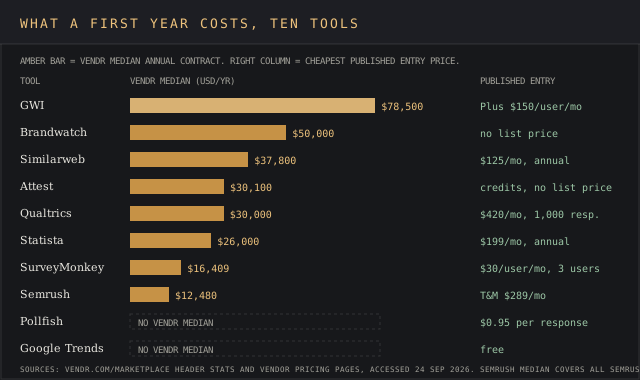
Prices run from $0 for Google Trends to a $78,500 median annual contract for GWI, per Vendr's anonymised buyer data. That spread is why this page sets testable criteria before it ranks anything.
It's written for teams picking a first platform or replacing one at renewal. Two deals reshaped the category this year: Qualtrics closed its $6.75 billion purchase of Press Ganey Forsta on May 18, 2026, and Adobe completed its Semrush acquisition on April 28.
Skipping research has a documented price. SurveyMonkey's guide to market research tools cites Inc. magazine, which quotes Harvard Business School professor Clayton Christensen: over 300,000 new products launch each year, and 95% fail. Market research data is the standard check against joining that 95%.
Evaluation criteria for market research tools
Five criteria decide the shortlist of market research tools, and the ranking below applies them in this order of weight. Each is a test a buyer can run, ending in a yes, a no or a number.
Data origin: can you field your own question
The first test is a yes or no. Can you put your own question in front of respondents the tool supplies? Qualtrics, SurveyMonkey, Attest and Pollfish pass, which makes each a market research platform in the full sense: you control data collection from the question to the export. GWI runs its own syndicated survey, Statista compiles third-party sources, and the other four model behavior from traffic, posts or searches.
Sample size and market coverage
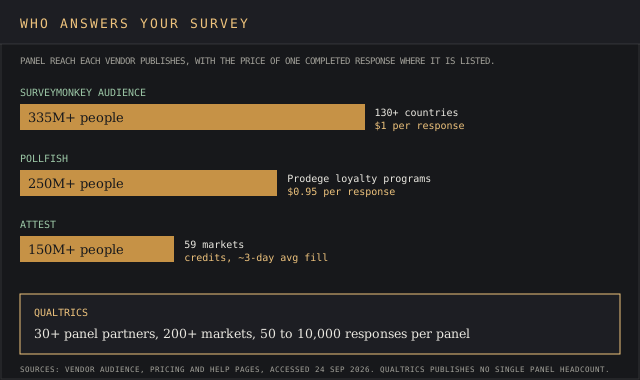
The second test is a number: how many people or records sit behind an answer, how many match your target audience, and in how many countries. SurveyMonkey publishes 335M+ panelists in 130+ countries; Statista publishes 80,000+ topics across 170 industries. A vendor that states reach only as a logo wall fails this one.
Security attestations on the vendor's own domain
Market research tools store personal data from research participants, so the third test asks for SOC 2 Type II and ISO 27001, stated on the vendor's own security page.
Vendors here that publish both SOC 2 Type II and ISO 27001 on their own domain: Qualtrics and Similarweb. SurveyMonkey, Attest and Brandwatch publish ISO 27001.
First-year cost
The fourth test is the price of year one for one seat or 1,000 survey responses: the published list price where it exists, the Vendr median with its purchase count where it doesn't.
Pollfish's base price per completed response, the lowest published unit price on this page. Paid plans climb from there to a $78,500 median contract on GWI.
Refresh cadence and API access
The last test is two numbers: days between data updates, and the cheapest plan that unlocks an API. GWI refreshes its Core survey every quarter, Similarweb releases monthly data by the 10th of the following month, and the free search index ranked #10 covers the past week in near real time.
The 10 best market research tools, ranked
The order below applies those criteria to ten market research tools across six research jobs, each entry in the same shape.
Qualtrics
Best fit
Research teams that run conjoint, MaxDiff and concept tests and need a security file procurement will sign.
Qualtrics sells its market research software as Strategic Research, covered in our Qualtrics XM review. The $420-a-month tier carries 23 question types, conjoint, MaxDiff and StatsIQ for regression and clustering, all at the entry price. A team that already knows conjoint can hit the ground running.
Silver Lake and CPP Investments took the company private in June 2023 at $18.15 a share. Qualtrics' own articles from 2020 to 2022 put its volume at more than 1 billion surveys a year.
Key features
- Strategic Research with 20+ guided solutions, including Video Diaries, Conjoint, MaxDiff and Concept Testing.
- Panels from 30+ global panel partners with 84+ pre-built segments to define a target audience, bought in-platform at 50 to 10,000 responses per panel.
- Research Agent for plain-language exploration, plus AI sentiment analysis on open-text answers.
- SOC 2 Type 2, ISO 27001 and FedRAMP High, listed on its security page.
Pricing
Strategic Research costs $420 a month, or $5,040 billed annually, for 1,000 responses shared across unlimited users; 5,000+ responses move to a custom quote. Vendr's buyer data puts the median at $30,000 a year across 321 purchases, from $7,000 to $139,920.
Pros
- Conjoint, MaxDiff and crosstabs sit in the cheapest paid tier.
- Unlimited users on paid plans, so seats never gate collaboration.
- The widest security file here: SOC 2 Type 2, ISO 27001, ISO 42001, FedRAMP High and HITRUST.
Cons
- The self-serve tier caps at 1,000 responses; the next step is a sales quote.
- API access is a separately purchased feature.
- Panel prices show only inside the platform, and online panel orders stop at $15,000.
"When we are in fieldwork, it does not let us update the quota counts with the quality removals we make during fieldwork."
TrustRadius review by an R&D analyst at a 501-1,000-employee market research firm, July 2026
Why it's ranked #1. Qualtrics holds SOC 2 Type 2 and ISO 27001 where SurveyMonkey's SOC 2 claim covers only its data centers, which decides criterion 3, and its $420 tier includes conjoint and MaxDiff. The number it concedes is SurveyMonkey's 335M+ panel reach.
SurveyMonkey
Best fit
Marketing teams of three or more that create surveys every month and want a panel on tap at a listed price.
SurveyMonkey counts 260K+ organizations as users, and its Audience panel reaches 335M+ people in 130+ countries with 200+ targeting options. That's the largest published reach among the four survey platforms ranked here, and the response price sits on the same page: from $1.
A market research survey on that panel returns insights from your target market in as little as an hour, per SurveyMonkey. Survey builders are a dime a dozen; a listed panel price is what sets this one apart.
An STG-led group took the company private in May 2023 in a deal valued at about $1.5 billion.
Key features
- Audience panel, with Express delivery for an extra $1 per response.
- Analyze with AI, a chat tool that answers questions about your survey responses.
- 200+ integrations; Salesforce, Power BI, Tableau and Marketo on Enterprise only.
- Connectors for Claude and ChatGPT on all plans.
Pricing
SurveyMonkey pitches Team Advantage as the plan to get actionable insights, at $30 per user a month, billed annually with a 3-user minimum, so $1,080 for a first year. Individual Advantage is $468 a year for 15,000 responses, and each extra response costs $0.15. Vendr's buyer data puts the median at $16,409 a year over 198 purchases, from $6,497 to $40,713.
Pros
- Panel price listed per response, starting at $1.
- Team pricing published: $30 per user a month.
- Free Basic plan with unlimited surveys.
Cons
- Basic caps each survey at 10 questions.
- Each user can register 2 devices at a time.
- Unused responses don't roll over, and deleted responses still count toward overage.
"Now I've learned that with the standard account, you can only login from 2 devices without paying even more for an upgrade."
TrustRadius review by Kay Haven, Director in Marketing at TRES LLC, July 2022
Why it's ranked #2. SurveyMonkey's panel reaches 335M+ people against Attest's 150M+, at a listed $1 per response Attest doesn't publish. It loses to Qualtrics on security: ISO 27001, with SOC 2 claimed only for its data centers.
Attest
Best fit
Consumer brands running brand tracking and concept tests across several countries under one flat audience fee.
Attest reaches 150M+ consumers in 59 markets, drawn from dozens of panel suppliers, loyalty schemes and online communities. Its surveys fill in around three days on average. Founded in East London in 2015, it has raised $85M+, including a $60 million Series B in October 2021.
Pricing runs on credits. One credit is one answer to one question from one person, so a 10-question survey sent to 500 people costs 5,000 credits. Unlimited seats & a research expert on every tier give brand teams the best of both worlds: self-serve speed and a second pair of eyes.
Key features
- Compass co-pilot, which creates, edits and analyzes surveys.
- AI-moderated interviews for qualitative research at survey speed.
- Crosstab view with automatic significance highlighting and an adjustable confidence level.
- A Results API and MCP server, both with an early-access cohort.
Pricing
Plans are credit tiers: Basic up to 50,000 credits, Standard up to 100,000, Elite up to 200,000 and Custom from 400,000. Vendr's buyer data puts the median at $30,100 a year, from $26,600 to $36,820.
Pros
- One audience fee, whichever market you target.
- Unlimited seats on every plan.
- ISO 27001 certified, with data stored on AWS in Dublin.
Cons
- Credits come off at purchase, even for a survey scheduled weeks ahead, which stings teams that schedule recurring surveys.
- A narrow target audience or stacked quotas slow fielding past the three-day average.
- Results API still limited to early access.
"Attest is a consumer research platform that stands out for its ability to provide continuous insights quickly and with high quality."
Capterra review by Benjamin T., Head of Marketing, March 2024. His listed con: "The limitation is cost, which can be high for smaller companies or startups."
Why it's ranked #3. Attest names ISO 27001 and covers 59 markets, while Pollfish's quality page says only "ISO-certified". It loses to SurveyMonkey on reach, 150M+ against 335M+, and on a published response price.
Pollfish
Best fit
Startups, freelancers and agencies testing an idea on 500 to 1,000 potential customers this week, paying per study.
Pollfish charges from $0.95 per completed response with no subscription, and its pricing page lists access to 250M+ global consumers. Prodege, which runs loyalty programs such as Swagbucks, bought Pollfish in 2022; new members of its communities pass a 30-day evaluation period before they answer client surveys.
The pricing calculator itemizes every surcharge. That's where the devil's in the details: MaxDiff or conjoint adds $1.00 per response, and six screening questions add $5.75.
Key features
- 16 question types, including net promoter score (NPS), MaxDiff, conjoint and Van Westendorp price sensitivity.
- Quality checks for speeding, trap questions, VPNs, straight-lining and duplicate respondents.
- Results in color-coded charts, tables and pie charts, with exports to PDF, Excel, crosstabs and SPSS.
- Insights Builder for cross-tabs, filters, new variables and stat testing, on the Elite plan.
Pricing
DIY starts at $0.95 per response. Screening questions add $0.50 to $5.75, and each quota or advanced demographic adds $0.55. Full Service projects start at $5k and Enterprise packages at $10k a year. A 1,000-response general-population study at the base rate costs $950; add three screeners and two quotas and the rate climbs to $3.80 a response.
Pros
- Pay per response at the DIY level, cheap enough to gain insights on a hunch.
- Every surcharge priced in public, and each screening question that narrows the target audience has its own line.
- Most surveys complete within two days.
Cons
- Insights Builder and Crosstab Designer 2.0 sit on an Elite plan the pricing page doesn't name.
- Niche B2B audiences are hard to target, per its own reviewers.
- Surcharges stack fast on any study with screeners and quotas.
A market research manager at a 501-1,000-person agency put the B2B limit plainly.
"We often need to field surveys with niche B2B audiences and we are concerned with the ability to accurately target those respondents."
TrustRadius review by Maggie Thomas, Market Research Manager at Mod Op, June 2026
Speed is the counterweight. Alberto Oliva Portillo, Strategy Director at Wieden+Kennedy Mexico, wrote in January 2026: "Obtain quick results. Most of the times in only one day, even with specific segmentations."
Why it's ranked #4. Pollfish lets you field your own questions from $0.95 a response, while GWI's plans query questions GWI already asked, at a $78,500 median. It loses to Attest on security, naming no specific ISO standard.
GWI
Best fit
Agencies and media planners building marketing strategies around audiences in 50+ markets without fielding a survey.
GWI surveys almost a million internet users a year through its own online surveys, across 50+ markets and 4 waves a year, for 35 billion data points annually. Its access page says the data represents over 2 billion internet users worldwide.
Its free account shows how target consumers use social media, discover brands and spend time on mobile: the consumer behavior patterns most audience research starts with. Founded in 2009, GWI raised over $180 million in a February 2022 Series B led by Permira. In January 2026 it launched Agent Spark, an insights agent that runs inside ChatGPT, Claude and Microsoft Copilot.
Key features
- GWI Core, refreshed every quarter, with 53 markets to compare side by side.
- GWI Pulse, a free weekly dataset built on a 12k+ sample.
- Crosstabs, custom charts and shared dashboards.
- Agent Spark in ChatGPT, Claude and Copilot, plus an API and MCP server.
Pricing
Free gives 10 Agent Spark prompts a month and the previous quarter's data. Plus costs $150 per user a month with four quarters of history; Teams and Pro are quoted, and Pro unlocks 15+ years of trended data for deeper insights. Vendr's buyer data puts the median at $78,500 a year, from $58,130 to $142,500, the highest on this page. For a team that needs one market, that can cost an arm and a leg.
Pros
- Answers come from its own survey, collected quarterly.
- A free tier carrying the previous quarter's survey data.
- Audience data reachable from inside the major LLM assistants.
Cons
- Niche datasets return small samples once you filter to a target group.
- Trended history beyond four quarters is locked to Pro.
- The highest median contract of the ten.
"A significant problem is the too small sample sizes in the secondary datasets. For example, when we use GWI Luxury or Auto and want to create and analyze a target group, we do not get sufficiently robust sample sizes."
G2 review by Laçin Serra A., Marketing Intern at an enterprise company, June 2026
Why it's ranked #5. GWI's answers come from its own survey of almost a million people a year, refreshed quarterly, where Statista compiles 50,000+ outside sources. It loses to Pollfish on criterion 1: its plans query questions GWI already asked.
Statista
Best fit
Analysts, consultants and students who need a sourced statistic for a deck or a market sizing by this afternoon.
Statista covers over 80,000 topics from 50,000+ sources in 170 industries, with 1M+ statistics across 200+ regions and countries. Founded in Germany in 2007, it employs almost 1,200 people.
Each chart names its publisher, which builds market knowledge fast and gives a claim in a board deck its credibility. The Personal tier adds Statista's market research reports and automated citations, and Research AI answers questions in 100 languages against the same library. When a figure carries a decision, click through and get it straight from the horse's mouth.
Key features
- Statistics library with PNG, PDF, XLS and PPT downloads from Starter up.
- Research AI, unlimited on paid plans and capped at 5 queries on Basic.
- Market Insights with market sizes and forecasts for up to 152 countries, on Professional.
- Statista Connect, an API and MCP service for enterprise systems.
Pricing
Basic is free, with free statistics and 5 Research AI queries. Starter costs $199 a month billed annually, or $2,388 a year for one seat; Personal is $649 a month. Professional, up to 99 seats, is quoted, and contracts renew after a year at the regular list price. Vendr's buyer data puts the median at $26,000 a year across 32 deals, from $8,272 to $51,400.
Pros
- Every statistic traces to a named source.
- Published prices for the first three tiers.
- Free Basic tier for spot checks, with the valuable data in premium statistics one tier up.
Cons
- The age of a statistic depends on its source, and some are years old.
- Market Insights and publication rights are Professional-only.
- Renewal jumps to list price after year one.
"Sometimes the statistics are old. Some data is harder to download into a usable format than others, but the new AI tool helps to resolve that."
G2 review by Stephen F., Group Director, Knowledge Bar, enterprise company, February 2025
Wells D., a VP of Strategy, said in November 2025 that "This unique data has been instrumental in my work over the past four years".
Why it's ranked #6. Statista's Starter tier costs $2,388 a year and names a source for each chart, against Similarweb's modeled estimates and $37,800 median. It loses to GWI on data origin, because GWI collects its survey data itself.
Similarweb
Best fit
Strategy and digital marketing teams sizing online market share across a set of competitors.
Similarweb estimates traffic for any domain by blending four sources: first-party analytics from connected sites, a contributors network on millions of devices, public data, and partner data from ISPs and measurement firms. Its data covers 100 million websites and 4 million apps across 190 countries. Our Similarweb review covers the platform in depth.
The company trades on the NYSE as SMWB and reported $77.2 million in Q2 2026 revenue. Monthly data lands by the 10th of the following month, daily data about 72 hours after the day ends. For small sites, read between the lines of the trend; the absolute visit count is the weakest figure on the page.
Key features
- Market analysis of size, growth, competitiveness and entry barriers, on business packages.
- Data credits spent across Data Exporter, REST and Batch APIs, and MCP.
- SOC 2 Type 2 and ISO/IEC 27001:2022 in its trust center.
Pricing
Competitive Intelligence costs $125 a month billed annually, or $199 month to month, for 1 user and 3 months of history. Market Analysis, Custom Industry and country-level data sit only in quoted business packages, with up to 37 months of history. Vendr's buyer data puts the median at $37,800 a year over 157 purchases; our Similarweb pricing report breaks the tiers down.
Pros
- Four data sources, including ISP partner data.
- SOC 2 Type 2 and ISO 27001 both published.
- API sold standalone, without a platform seat.
Cons
- The market research module isn't in any self-serve tier.
- Estimates diverge from first-party analytics, per 2026 G2 reviews.
- Three months of history at the entry price.
"We often see Similarweb data differ directionally from our internal data, which makes it difficult to know how accurately it reflects competitor trends where we don't have first-party data to validate against."
G2 review by a verified user in leisure and travel, small business, September 2026
Why it's ranked #7. Similarweb holds SOC 2 Type 2 and ISO 27001 and sells a $125-a-month entry tier, where Brandwatch lists no price and a $50,000 median. It loses to Statista on first-year cost: a $37,800 median against $2,388 list.
Brandwatch
Best fit
Brand and insights teams tracking sentiment and competitor conversation across social media sites, forums and news.
Brandwatch's archive holds 1.7 trillion historical conversations back to 2010 and adds 501 million a day from 100 million unique sites, with official firehose access to X. Cision closed its acquisition on June 1, 2021. Our Brandwatch review covers the Consumer Research product in depth.
Sentiment analysis and topic analysis run in 44 languages. Iris, its AI assistant, writes Boolean queries and answers plain-language questions against the archive.
Key features
- Iris AI query writer and Ask Iris for conversational exploration.
- 50+ live visualizations and Vizia for shared screens.
- Exports to Excel, PPT and PDF, plus an API with a default limit of 30 requests every 10 minutes.
Pricing
The pricing page offers a demo and no figures. Vendr's buyer data puts the median at $50,000 a year across 40 purchases, from $19,542 to $81,200; our Brandwatch pricing report tracks what buyers pay.
Pros
- Full mention volume, where sampled rivals estimate it.
- History back to 2010 for news, blogs and forums.
- ISO 27001:2022 across all products.
Cons
- No public price at any tier.
- A steep learning curve; one G2 reviewer's team took courses to learn the basic functions.
- Sentiment labels need manual checks.
"It's valuable as it gives us certainty about the volume of conversation around a specific topic, so we're not guessing the size of it."
G2 review by Jose C., Data Analyst, mid-market company, May 2026
Reviewers split on the same feature, which is par for the course with automated sentiment. Weiqing H., a marketing analyst, wrote in April 2026 that "the emotion/sentiment classification isn’t always accurate and can occasionally be misleading, so I often need to manually validate the results".
Why it's ranked #8. Brandwatch holds 1.7 trillion conversations back to 2010, against Semrush traffic data that starts in 2017, and carries ISO 27001:2022. It loses to Similarweb on price: no public list and a $50,000 median against $125 a month.
Semrush Traffic & Market
Best fit
Small marketing teams that want competitor traffic estimates and market sizing without a Similarweb contract.
Semrush's Traffic & Market toolkit models traffic from clickstream data covering over 200 million real internet users and 100+ apps and browser extensions. Traffic data runs from 2017 and SEO data from 2012, across 140+ countries. Our Semrush review covers the SEO side.
Adobe paid $12.00 a share, about $1.9 billion, and closed the deal on April 28, 2026. Market Overview reports TAM and SAM, and its Growth Quadrant plots competitors by traffic volume and growth rate.
Key features
- Market Overview with TAM and SAM estimates.
- Growth Quadrant sorting competitors into market leaders, game changers, niche players and established players.
- Up to 100 competitors per analysis, with competitor alerts.
- A keyword research database of 28.9 billion keywords on the base SEO plans.
Pricing
Traffic & Market Pro costs $289 a month on both billing toggles; extra users and API access are on request. Vendr's buyer data puts the median across all Semrush contracts at $12,480 a year over 61 purchases. Our Semrush pricing report covers the SEO plans.
Pros
- A listed price for competitor traffic data.
- Traffic and SEO data under one login.
- Up to 100 competitors in one view.
Cons
- Estimates diverge from rival tools for the same site.
- API access on request only.
- Its security page names PCI DSS Level 1 only.
A Hacker News user compared two tools on one domain and got two answers, a red flag for anyone quoting absolute numbers.
"Ahrefs: 230k organic traffic valued at $124k SEMRush: 558k organic traffic valued at $355k These are estimates and can be widely under or overestimated"
Hacker News comment by weird-eye-issue, July 2021
Why it's ranked #9. Semrush gives absolute visit estimates for up to 100 competitors at $289 a month, where the #10 tool offers only a 0-100 relative index. It loses to Brandwatch on history depth: 2017 against 2010.
Google Trends
Best fit
Anyone checking market trends in search interest for a product or brand before paying for a study.
It indexes a largely unfiltered sample of Google searches from 2004 to a few minutes ago, scaled 0 to 100 for the chosen time and place. Real-time data covers the past week, down to the minute. Our Google Trends review walks through the interface.
Every value is relative. Each point is divided by total searches for its geography and time range, low-volume terms show as 0, and Google adds statistical noise for privacy. Use it to identify trends, and to zero in on which of three product names people search for, then pay for the study.
Key features
- Compare up to five terms or topics in Explore.
- Interest by country, region, city and, in some countries, metro area.
- A Trends API in alpha, with a rolling five-year window.
Pricing
Free.
Pros
- Costs nothing.
- Search data back to 2004.
- City-level geography, which can surface interesting insights for a local launch.
Cons
- Shows relative interest on a 0-100 scale, with no search volume.
- Sampling shifts results for niche terms between refreshes.
- Low-volume queries read as zero.
"every time window is re-normalized so the max becomes 100. That means a “100” in May and a “100” in June aren’t necessarily comparable unless they’re in the same query window."
Reddit post by u/EvilWrks in r/learndatascience, February 2026
A marketing employee at an 11-50-person firm summed up the case for it on TrustRadius in February 2026: "The best part remains that it's free and the ROI is very high."
Why it's ranked #10. It's free with search data back to 2004, the lowest cost and longest history here. It sits below Semrush because its 0-100 index never shows an absolute count of searches or visits.
Types of market research tools and the six research jobs
Market research tools fall into six jobs, and most teams combine two or three of them for audience analysis and competitor studies. Running every question through one data type puts all your eggs in one basket.
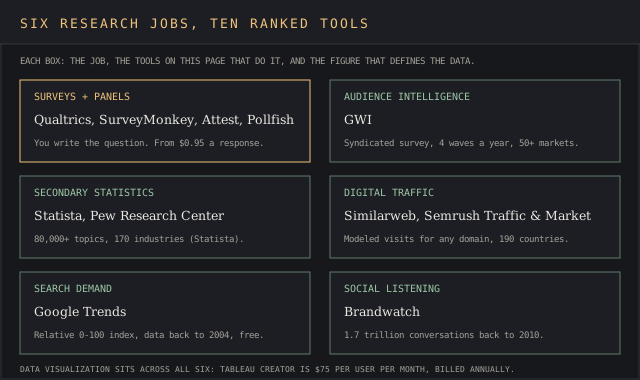
- Survey platforms collect structured feedback from defined audiences: Qualtrics, SurveyMonkey, Attest, Pollfish.
- Audience intelligence sells access to large consumer panels: GWI.
- Secondary statistics compile other publishers' numbers: Statista, Pew Research Center.
- Digital traffic tools estimate competitor visits: Similarweb, Semrush.
- Search demand shows search interest by time and place: Google Trends.
- Social listening and social media monitoring track mentions and sentiment: Brandwatch, and the rest of our social listening tools ranking.
Data visualization cuts across all six, and it gets its own section below.
A seventh neighbour, competitive intelligence software, tracks rival pricing, launches and messaging; our competitive intelligence tools ranking covers it.
Consumer research and consumer insights panels
Consumer research and consumer insights split between panels you rent per question and panels you query later. Renting (Qualtrics, SurveyMonkey, Attest, Pollfish) gives targeted insights on your exact question within days; GWI answers in seconds from a question list fixed a quarter ago.
Primary and secondary market research data
Businesses combine primary research with secondary data, and most market research tools on this list sell one or the other. Secondary data is cheap and fast; primary data answers the question nobody else asked.
The Pew Research Center publishes free secondary data on US adults. Our guide to market research methods covers when each route fits.
Randomly selected US adults in Pew's American Trends Panel. Pew releases the full datasets behind its reports for free, mostly as SPSS files, to anyone with a Pew account.
Market research answers a defined question at a point in time; market intelligence tracks competitors and demand continuously. Our explainer on market intelligence vs market research draws the line between the two.
What market research tools cost in a first year
The spread runs from free to a $78,500 median, and seven of the ten vendors keep at least one tier behind a sales call.
The hidden costs sit in usage rules, renewal terms and modules sold separately:
- SurveyMonkey bills $0.15 for each response over the plan limit, deleted responses included.
- Statista renews after one year at the regular list price.
- Qualtrics panel credits expire after 12 months.
- Similarweb keeps Market Analysis out of all three self-serve tiers.
Money doesn't grow on trees: ask each vendor for the year-two price in writing before signing year one.
Qualitative research, focus groups and AI-moderated interviews
Qualitative research asks why, and the market research tools on this list now run it without a viewing room. Traditional market research methods such as focus groups and in-depth interviews still come from third-party platforms and agencies.
Qualtrics sells Video Diaries inside Strategic Research, with minutes of video feedback counted toward its pricing. Attest runs AI-moderated interviews with a push-to-talk format, and Pollfish added conversational AI interviews in May 2025. AI now handles part of the data collection, and focus groups still suit concept work where respondents react to each other.
Open-text answers are unstructured data, and finding one theme across thousands of them by hand is looking for a needle in a haystack. SurveyMonkey's Thematic Analysis groups open-ended responses with a self-hosted Anthropic model and OpenAI.
Data visualization and business intelligence for research teams
Data visualization turns survey responses and traffic estimates into data-driven insights, as charts that show patterns and trends to decision-makers. Teams that join research to CRM data for data-driven decision making export it to a business intelligence tool.
Tableau is the visual analytics platform named in both Qualtrics' and SurveyMonkey's integration lists. Tableau Cloud Standard costs $75 per user a month for Creator, $42 for Explorer and $15 for Viewer, all billed annually, and every deployment needs at least one Creator licence. Salesforce acquired Tableau in 2019.
Data analysis inside survey tools
Most teams run data analysis with the visualization tools inside the survey tool. Crosstabs sit in Qualtrics' $420 tier and SurveyMonkey's Premier plans, Attest highlights statistically significant differences automatically, and Pollfish handles data visualization with color-coded charts, shading significance in darker green as it rises.
Competitor research tools for digital marketing teams
Among market research tools, competitor research on the web runs on modeled traffic, and the two ranked tools that do it disagree by design. Similarweb blends first-party analytics, a device panel and ISP data; Semrush models clickstream from 200 million users and cross-checks it against its SERP database. Our Semrush vs Similarweb comparison measures the gap.
For your own online business, Google Analytics is free and measures your own visitors directly. Its Demographic details report, covered in our Google Analytics 4 review, shows the demographic data of your visitors (language, interests, location, age, gender) for users who consent.
Competitor analysis on a small budget
Ahrefs' Starter plan costs $29 a month and covers keyword research and competitor lookups, enough to find content ideas a rival ranks for. Pair it with Trends and the free Similarweb browser extension, and a solo marketer can run a quick and dirty competitive analysis for under $30 a month.
The website traffic analysis tools ranking covers eleven traffic tools in more depth.
Free market research tools and their limits
Free tools for market research are real data with a ceiling.
- Google Trends: free, relative 0-100 index, data back to 2004.
- GWI Free: 10 Agent Spark prompts a month and the previous quarter's data.
- Statista Basic: free statistics and 5 Research AI queries, with no premium statistics.
- Qualtrics free account: 500 total responses, 3 active surveys, 30 questions per survey.
- SurveyMonkey Basic: unlimited surveys at 10 questions each.
- Pew Research Center: full survey datasets after registration.
Once the question is yours, you pay per response: $0.95 on Pollfish, $1 on SurveyMonkey Audience.
For paid trend spotting, our trend research tools ranking covers more options, including Exploding Topics.
How to conduct market research with these tools
To conduct market research with these tools, the entire research process fits in six steps. Jumping the gun on a panel survey before the desk research is done spends paid responses on research objectives a free dataset already answers.
- Write two or three research objectives, each phrased as a question a number can answer.
- Define the target audience and target market: country, age, role, purchase behavior.
- Pull secondary data first from Statista, Pew and GWI's free tier.
- Check search demand and competitor traffic with the tools ranked #7, #9 and #10.
- Run data collection on a panel with a market research survey for the questions nobody else has answered.
- Analyze data, visualize data in charts, and share it with the teams that set marketing strategies.
Map consumer behavior before you write questions
Consumer behavior data from GWI or Pew tells you which questions are worth paying for. If a syndicated study already asks your question of your target market, buying the answer again is money spent twice.
Market research tools FAQ
What are the top 10 market research tools?
Ranked on data origin, sample size, security, first-year cost and refresh cadence, the top 10 market research tools are Qualtrics, SurveyMonkey, Attest, Pollfish, GWI, Statista, Similarweb, Brandwatch, Semrush Traffic & Market and Google Trends.
What is the best free tool for market research?
Google Trends, for search demand back to 2004 at no cost. For survey data, Qualtrics' free account allows 500 responses, and Pew publishes full datasets from a panel of roughly 10,000 US adults.
Which AI tool is best for market research and analysis?
The best AI for market research is the one attached to the data you need. Qualtrics' Research Agent explores your own survey data, GWI's Agent Spark queries its panel of almost a million respondents, Statista's Research AI searches 1M+ statistics, and Attest's Compass builds and analyzes surveys.
Can ChatGPT do market research?
It can run market research queries when connected to a data source. GWI's Agent Spark runs inside ChatGPT, and SurveyMonkey connects to ChatGPT and Claude on all plans. Without a connected dataset, it drafts questionnaires and summaries with no respondents behind them.
How much do market research tools cost?
Published entry prices run from free (Google Trends, GWI Free, Statista Basic) and $0.95 a survey response on Pollfish up to Vendr-tracked medians of $30,000 a year for Qualtrics and $78,500 for GWI.
What tools are used for market research?
Six kinds: survey platforms, audience panels, secondary statistics, traffic tools, search demand and social listening, plus visualization tools such as Tableau.
Bottom line
Of the market research tools here, Qualtrics wins for insights teams running advanced methods with SOC 2 Type 2 on file. SurveyMonkey wins for marketing teams surveying often on a budget, Attest for consumer brands tracking several markets.
Pollfish fits a single study at $0.95 a response. GWI and Statista win when the answer already exists: GWI for audience profiles, Statista for a sourced figure.
For market dynamics online, Similarweb leads on data and Semrush on price; Brandwatch covers social sentiment analysis, and a free search check comes first. Most teams pair paid tools for market research from the survey group with one from the rest, and the valuable insights come from comparing the two.