Cognism review: B2B data, pricing and data coverage in 2026
 By Jan Suski. I go deep on every review, checking every number against its source and digging up details other coverage misses, a habit from six years of SEO and link building for tech companies. Bylines at Surfer, Brand24, and Senuto. How the scoring works.
· Prefer this source on Google
Best for
Outbound sales teams in the UK and EU needing phone-verified mobile numbers and do-not-call screening across 15 countries.
Not for
Teams wanting built-in sequencing or dialing, or a self-serve trial; Cognism supplies data only and gates everything behind a demo.
What it costs
Cognism publishes no rate. Third-party estimates put it at $1,500 to $25,000 a year, sold as annual Standard or Pro packages on a credits model.
- Contact search
- Decision makers with verified mobile numbers and email addresses per account or industry
- Diamond Data
- More than 10 million phone-verified contacts globally, framed as the right contact roughly every eight dials
- Verification method
- Researchers call the mobile numbers to verify them individually
- Connect rate
- 1,000 numbers called: 45 percent of verified ones reached the right person against 18 percent of standard ones
- Accuracy claim
- 85 percent on current comparison pages, published with no methodology or sample
- Enrichment
- Job titles, company data, hiring trends and firmographics, synced to Salesforce and HubSpot
- Intent data
- Bombora partnership layered over Cognism's own contact and firmographic records
- Chrome extension
- Verified mobiles and emails surfaced on any LinkedIn profile or company website
- Sales Navigator
- Enriched contacts pulled into a saved lead list
- Visitor tracking
- Anonymous site traffic converted into contact lists a rep can qualify
- Do-not-call screening
- 15 lists globally, including the UK's TPS and CTPS, the US, Australia, New Zealand, Germany, France, Ireland, Spain, Portugal, Croatia, Sweden and Belgium
- Integrations
- Salesforce, HubSpot, Pipedrive and Microsoft Dynamics, plus Outreach and Salesloft
- Sales engagement
- None native: no sequencing, cadences, email sending or dialler
- Published rates
- None; Cognism does not publish pricing online
- Sales Prospecting
- Two packages, Standard and Pro, each including five seats
- Other products
- CRM Enrichment and Data-as-a-Service, priced separately
- Credits
- One credit reveals one contact; re-viewing a revealed contact is free; credits pool across platform, enrichment and API
- Third-party estimates
- $1,500 to $25,000 a year depending on seats, data volume and tier
- Competing claim
- Other articles put the start near $15,000 a year plus a one-time platform fee, under plan names Cognism doesn't use
- Platform fee
- Cognism publishes no platform fee, no per-seat rate and no minimum
- Database size
- Cognism publishes none; third-party reviews credit it with more than 440 million records
- Regional coverage
- Deepest in the UK and EU; US and APAC records trail, thinnest in niche industries
- Data sources
- First-party collection, third-party licensing and internal phone verification
- Refresh
- Records update on an ongoing basis after purchase
- Certifications
- ISO 27001, ISO 27701 and SOC 2 Type II, gated behind a trust centre access request
- Support score
- G2 rates quality of support 9.1 out of 10 across 993 reviews; Capterra puts customer service at 4.6 out of 5 across 227
- Overall rating
- 4.5 from 1,350 G2 reviews, 4.7 from 263 on Capterra, 8.3 out of 10 on TrustRadius, 4.3 on Gartner Peer Insights
- 24/7 support claim
- Widely repeated in review roundups and vendor-supplied metadata; unverified on Cognism's current site
- Contract term
- Annual contracts, with no ongoing free plan
- Free trial
- No self-serve trial; a demo and a sales rep come first
- Renewal terms
- Whatever the signed order form says; no master subscription agreement is published
ZoomInfo
Not forA seller working the UK and EU, where Cognism's researchers call the mobile numbers by hand and screen against 15 do-not-call lists, and where this site's own ZoomInfo review scores EU coverage 35 out of 100.
Apollo.io
Not forA team buying Cognism for European mobile accuracy, since this site's Apollo review scores its EU and international coverage 35 out of 100 and reviewers report manual cleanup on European and Asian accounts.
Demandbase
Not forA team that picked Cognism for phone-verified EU mobile numbers, since Demandbase ships no contact database of its own: it scores and advertises to accounts using whatever contact source is already in the stack.
Pairs well with Cognism
Which Cognism figures come from Cognism, and which come from its competitors
None of the prices here are Cognism's. The company publishes no rate, and the $1,500 to $25,000 range and the $15,000 starting point both come from third-party articles, a large share of them published by companies selling against it.
Cognism's own published figures are the 85 percent accuracy rate, the 10 million phone-verified Diamond Data contacts, the more than 4,000 revenue teams and the 20 to 40 percent pipeline increase. The ratings come from G2, Capterra, TrustRadius and Gartner Peer Insights, and the CNIL fine, the Kis v. Cognism settlement and the Garante action against Lusha are regulator and court records. Updated 9 August 2026.
Cognism is a sales intelligence platform that sells phone-verified contact data, intent signals and a Chrome extension built for outbound prospecting. This Cognism review covers what the platform does, what it costs and where its data holds up against rivals.
It's written for sales reps, RevOps teams and marketing leaders who need decision maker contact details and company data without building lists by hand.
Cognism says more than 4,000 revenue teams use its platform, and it claims an average pipeline increase of 20 to 40 percent for customers who switch to it.
Getting B2B data wrong wastes a sales team's calling hours on disconnected numbers and bounced emails, so understanding what Cognism's data covers, and where its coverage thins out, matters before a business signs an annual contract.
The plan names, the accuracy rate and the database size all circulate in versions Cognism no longer publishes. Each one is named and corrected below against what the company states today.
What Cognism is and how its data works
Cognism was incorporated as Cognism Limited on 16 January 2015 and is headquartered in London. It markets itself as one of Europe's largest providers of sales intelligence for B2B teams building pipeline across regulated markets like the UK and the EU.
James Isilay co-founded the company and served as CEO for most of that history. Pete Daffern took over as interim CEO on 24 February 2025, and Dominic Allon, previously CEO of Pipedrive, was appointed permanent CEO on 9 September 2025 with Chris Evans joining as CRO the same day. Daffern remains on the board and Isilay is still a serving director.
Investors include Viking Global, Blue Cloud Ventures, AXA Venture Partners and Swisscom Ventures. The largest round was an $87.5 million Series C announced on 13 January 2022 led by Viking Global, following $12.5 million in March 2021 and $12 million in March 2020, both led by AXA Venture Partners.
Cognism has bought twice: Mailtastic in May 2020 and the French prospecting tool Kaspr in May 2022. No valuation has been published for any round.
Its data comes from a mix of first-party collection, third-party licensing and phone-verified records the company calls Diamond Data. Records refresh on an ongoing basis after purchase, which is why it positions itself as data as a service.
↑ FACT SHEETData coverage across Europe, the US and APAC
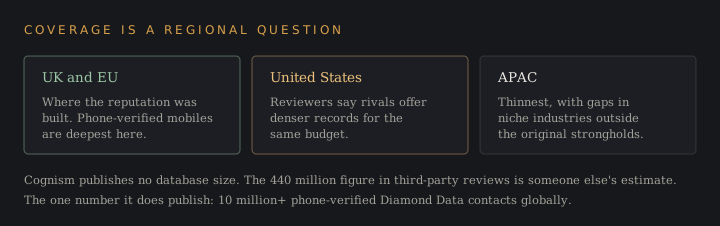
Cognism built its reputation on European coverage, and phone-verified mobile numbers for UK and EU contacts are where reviewers say it performs best.
It has since expanded into the US and APAC, though several reviewers note coverage in both trails what Cognism offers for European accounts, with thinner records in niche industries outside its original strongholds.
Third-party reviews routinely credit Cognism with more than 440 million contact records globally. Cognism itself declines to publish that number or any other: its FAQ says the database holds hundreds of millions of company and contact profiles and adds that the company doesn't usually make general coverage claims.
Treat any specific database size you read as someone else's estimate. The one volume figure Cognism does publish is narrower and more useful: Diamond Data covers more than 10 million phone-verified contacts globally, which the company frames as connecting with the right contact roughly every eight dials.
Data enrichment and B2B data quality
Enrichment pulls in job titles, company data, hiring trends and firmographic details a sales team uses to prioritize target accounts. Reviewers describe it as fast: a rep searches a company by name and gets contacts with verified mobile numbers back in seconds.
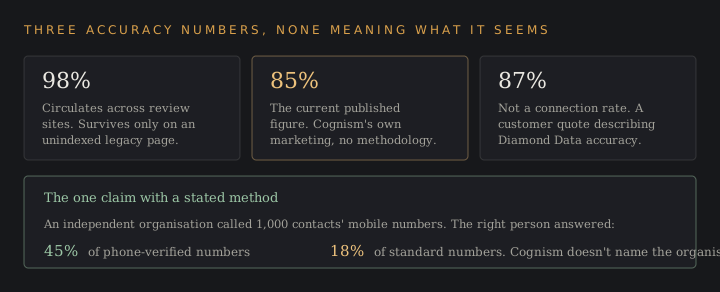
The accuracy claims need untangling, because three different numbers circulate and none means what it appears to.
A 98 percent accuracy rate for Diamond Data appears across review sites. On Cognism's own site it survives only on an unindexed legacy landing page, and the current comparison pages state 85 percent instead.
That 85 percent is also frequently reported as a user-measured figure, which it isn't. It's Cognism's own marketing number, published without methodology or sample.
The 87 percent that circulates as a connection rate is neither. It comes from a customer quote by Richard Caldicott, IT director at Henderson Scott, describing Diamond Data as "phone-verified mobile data with 87% accuracy."
The one Cognism claim with a stated method is the connect-rate comparison. An independent organisation called 1,000 contacts' mobile numbers, and the right person answered 45 percent of verified numbers against 18 percent of standard ones. Cognism doesn't name the organisation.
Data quality complaints exist and they are the single most common criticism. Some reviewers report stale or missing records outside the core European market, and a smaller number describe contacts that were out of date at the time of purchase.
Inaccurate data is the most-applied negative tag on Cognism's G2 profile, appearing in 91 reviews. CRM sync keeps enriched data flowing into Salesforce and HubSpot automatically, which limits manual cleanup once bad records get flagged.
↑ FACT SHEETContact data, intent signals and the Chrome extension
Cognism's core product is B2B contact search: a rep enters a target account or industry and gets back decision makers with verified mobile numbers and email addresses attached.
Phone verification here is literal: Cognism runs a team of researchers who validate mobile numbers by calling them, which is the process that produces Diamond Data and the reason it prices above a scraped list.
Intent data comes through a partnership with Bombora, layering intent signals on top of Cognism's own contact and firmographic data so a team can see which accounts are researching a category before a rep calls. The wider category sits on our intent data providers ranking.
Nothing in the published feature comparison covers sequencing, cadences, email sending or a dialler. Cognism's own integrations page files Salesloft and Outreach under sales engagement, with Cognism supplying enriched data into them. Multi-channel outreach happens in the tool you already run.
The Chrome extension is where most reps interact with Cognism day to day, surfacing verified mobile numbers and email addresses directly on a LinkedIn profile or company website. It also powers the LinkedIn Sales Navigator integration, pulling enriched contacts into a saved lead list.
Cognism connects to Salesforce, HubSpot, Pipedrive and Microsoft Dynamics, plus Outreach and Salesloft on the engagement side.
Key features worth knowing before a demo
- A browser extension that pulls verified mobile numbers and email addresses onto any LinkedIn profile or company website
- A credits model where one credit reveals one contact, with no charge for viewing a contact already revealed, and credits shared across the platform, enrichment and the API
- Visitor tracking that converts anonymous site traffic into contact lists a rep can qualify directly
- Screening against 15 do-not-call lists globally, covering the UK's TPS and CTPS, the US, Australia, New Zealand, Germany, France, Ireland, Spain, Portugal, Croatia, Sweden and Belgium
- AI company research, an AI persona builder, AI search, CSV enrichment and SSO on the advanced end
↑ FACT SHEETCognism pricing
Cognism does not publish pricing online. What it publishes is the shape of the deal: Sales Prospecting comes in two packages, Standard and Pro, each including five seats, alongside separately priced CRM Enrichment and Data-as-a-Service products.
Almost every number attached to Cognism's pricing comes from competitors' content marketing. Reviewers estimate anywhere between $1,500 and $25,000 a year depending on seats, data volume and tier; a separate set of articles claims pricing starts around $15,000 annually with a one-time platform fee on top.
Cognism publishes no platform fee, no per-seat rate and no minimum. The plan names those articles attach figures to, Grow and Elevate, don't appear anywhere in Cognism's current packaging, and neither do the list-size caps quoted alongside them. A large share of the Cognism pricing articles that rank are published by companies selling against it.
What is documented is the credits model. One credit reveals one contact, previously revealed contacts cost nothing to view again, credits pool across the prospecting platform, enrichment and the API, and additional credits can be bought.
Pricing is built around annual contracts, and there's no ongoing free plan. No master subscription agreement is published either: the public end user licence agreement contains no term, renewal or billing clauses and defers to a customer agreement that isn't public.
Renewal and notice windows are therefore whatever the signed order form says, which makes that document the one worth reading closely.
Support, and what the ratings show
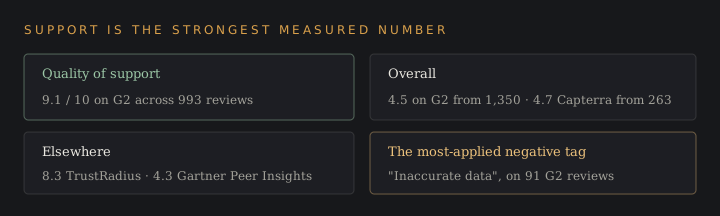
Cognism's support scores are its strongest independently measured numbers. G2 rates quality of support at 9.1 out of 10 across 993 reviews, and Capterra puts customer service at 4.6 out of 5 across 227.
Overall ratings sit at 4.5 from 1,350 G2 reviews, 4.7 from 263 on Capterra, 8.3 out of 10 on TrustRadius and 4.3 on Gartner Peer Insights.
The claim that Cognism provides 24/7 live customer support is worth qualifying. It appears widely in review roundups and in vendor-supplied metadata on Capterra and GetApp, and on Cognism's own site it survives only on the same unindexed legacy page that still carries the retired 98 percent figure.
The current pricing page lists two support entries for both packages: live chat and an account manager, with no hours and no response-time commitment. No review on any platform describes out-of-hours contact.
Capterra's own summary of its 63 support reviews adds the counterweight: occasional bugs, limited follow-up from customer success, and frustration around renewals and account administration.
Compliance, and the action against Cognism's own subsidiary
Cognism's data is compliant with GDPR and CCPA by its own account, and compliance positioning is central to how it sells against US-first competitors. It holds ISO 27001, ISO 27701 and SOC 2 Type II, though no auditor or certification date is published and the trust centre gates the documents behind an access request.
No regulator has fined or publicly investigated Cognism itself. Its French subsidiary is a different matter.
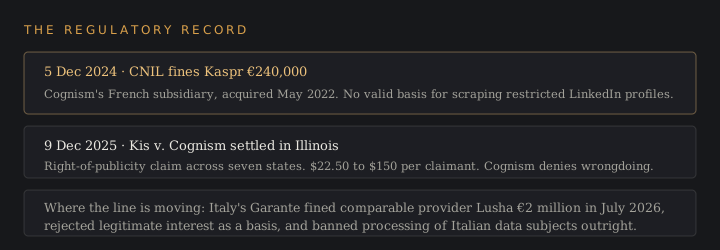
On 5 December 2024 France's CNIL fined Kaspr, which Cognism acquired in May 2022 and lists among its affiliates in its own privacy policy, €240,000. The findings were that Kaspr had no valid legal basis for scraping LinkedIn contact details of users who had restricted their visibility.
The regulator also found retention disproportionate at five years reset on every profile update, and a failed Article 14 transparency duty: Kaspr waited four years to begin notifying people, then did so by email written in English. The injunction closed on 4 March 2026.
That last finding matters for reading Cognism's own notification promise. Its compliance page states that it notifies business contacts of their inclusion within GDPR timeframes; its help centre puts it more carefully, saying it notifies data subjects where required under Article 14.
No timeframe, channel, language or coverage scope is published, and its January 2026 privacy policy contains no Article 14 section.
Cognism has also settled a US class action. Kis v. Cognism, filed in LaSalle County, Illinois, alleged right-of-publicity violations from showing individual contact details to free-trial users across seven states, with settlement payments of $22.50 to $150 per claimant and a final approval hearing on 9 December 2025. Cognism denies wrongdoing.
For context on where the regulatory line is moving, Italy's Garante fined the comparable provider Lusha €2 million in July 2026, rejected legitimate interest as a basis, and banned processing of Italian data subjects outright.
Try it yourself
Sign up for Lusha
Free plan available, credit-based pricing after that.
 Visit Lusha →
May earn a commission if you sign up through this link, at no extra cost to you. Full affiliate disclosure.
Alternatives worth comparing
ZoomInfo is the alternative most reviewers compare directly, and it generally offers deeper US coverage while Cognism holds an edge in European mobile number accuracy and GDPR-focused compliance.
Apollo.io is a lower-cost option aimed at smaller teams that want AI-powered search and outreach bundled with contact data.
Others mentioned alongside Cognism include Seamless.AI and Demandbase, each trading some combination of price, US coverage and intent depth against Cognism's European strength. The full category sits on our B2B data providers ranking.
A business evaluating an alternative should compare data samples for the actual accounts it wants to reach.
Who Cognism is built for
Cognism fits revenue teams running high-volume outbound across European markets, where phone-verified mobile numbers and GDPR-aware compliance matter most. Enterprise teams with dedicated RevOps functions get the most from the CRM integrations, since automated enrichment removes manual list-building at scale.
Smaller teams testing outbound for the first time, or businesses focused primarily on US accounts, may find a lower-cost option delivers comparable value. Teams that want prospecting and sequencing on one bill should budget for Outreach or Salesloft alongside it, or a lighter cold-email specialist like Woodpecker for a narrower email and LinkedIn sequence.
Request a data sample against your own target account list before signing. Coverage quality varies enough by region that no review score, including this one, tells you what your list will look like.
Frequently asked questions
Does Cognism have a free trial?
Cognism does not offer a self-serve free trial. Prospective customers request a demo and work with a sales rep to scope pricing before getting platform access.
How expensive is Cognism?
No published price list exists. Third-party estimates put Cognism between $1,500 and $25,000 annually depending on seat count, data volume and package, with other articles claiming a $15,000 starting point plus a platform fee. Those figures come from competitors, and Cognism itself sells two packages, Standard and Pro, each including five seats, on a credits model.
How accurate is Cognism's data?
Cognism currently publishes 85 percent accuracy on its comparison pages, a figure with no published methodology. The 98 percent rate that circulates in reviews survives only on an unindexed legacy page, and the 87 percent often quoted as a connection rate is a customer's description of Diamond Data accuracy. Inaccurate data is the most common complaint tag on its G2 profile.
Does Cognism have sales engagement tools?
No. Cognism supplies data into sales engagement platforms, integrating with Outreach and Salesloft for that step.
Where did Cognism get my data?
Cognism sources contact data from first-party collection, third-party licensing and internal phone verification, under GDPR and CCPA requirements, including screening against 15 do-not-call lists globally.
How do I opt out of Cognism?
Cognism provides a data subject request process under GDPR and CCPA rules, routed through a hosted privacy centre that requires email verification before a removal request is actioned.
Who is the CEO of Cognism?
Dominic Allon has been CEO since 9 September 2025. He succeeded Pete Daffern, who served as interim CEO from 24 February 2025 and remains on the board, after co-founder James Isilay stepped back from the role.
Who owns Cognism?
Cognism is privately held, backed by investors including Viking Global, Blue Cloud Ventures, AXA Venture Partners and Swisscom Ventures, with Viking Global leading an $87.5 million Series C in January 2022.
What is the difference between ZoomInfo and Cognism?
ZoomInfo offers broader US coverage and a wider platform footprint, while Cognism holds a data quality edge in European mobile numbers and positions itself more directly around GDPR compliance.
What is the difference between Apollo and Cognism?
Apollo bundles contact data with built-in outreach automation at a lower price point aimed at smaller teams, while Cognism focuses on phone-verified European data and charges enterprise-level pricing for that accuracy without native sequencing.
What is the difference between Cognism and Demandbase?
Demandbase is built primarily around account-based marketing and intent data for enterprise marketing teams, while Cognism centers on contact-level data and direct dials for sales reps.
What does Cognism do?
Cognism provides B2B contact data, enrichment, intent signals through its Bombora partnership, and a Chrome extension that surfaces verified mobile numbers on LinkedIn and company websites.
Disclaimer
This page includes one or more affiliate links. If you sign up for a product through one of them, this site may earn a commission at no extra cost to you.