B2B market intelligence
 By Jan Suski. I go deep on every review, checking every number against its source and digging up details other coverage misses, a habit from six years of SEO and link building for tech companies. Bylines at Surfer, Brand24, and Senuto. How the scoring works.
· Prefer this source on Google
B2B market intelligence is the continuous collection, analysis, and distribution of data about your customers, competitors, and industry, turned into insights that sales teams, marketing teams, and executives can act on. B2B buying decisions pull in economic buyers, technical evaluators, and procurement. The companies that see shifts first, in a process that stretches across months and hinges on evidence, win the deals the others miss.
This guide covers what B2B market intelligence is, the key components that make it work, where the data comes from, how to gather it, and how to turn it into revenue.
Some readers arrive here for B2B marketing intelligence specifically, others for a straight B2B market analysis or hands-on B2B insights before choosing a B2B market intelligence platform; this guide covers all four angles, the whole nine yards from definitions to a 90-day rollout plan.
Best B2B market intelligence tools
| Rank | Tool | Best fit | Signals | Watch-outs | Review |
|---|---|---|---|---|---|
| 1 | ZoomInfo | B2B account and contact intelligence | Firmographics, contacts, technographics, buyer intent | Validate coverage by region and target segment | ZoomInfo review |
| 2 | G2 Market Intelligence | Software buyer and review intelligence | Reviews, satisfaction, category standing, feature comparisons | Software-category specific | G2 review |
| 3 | Semrush | Digital demand and competitor search intelligence | Keywords, traffic, backlinks, paid search, content performance | Digital signals over account intelligence | Semrush review |
| 4 | 6sense | Account intent and ABM orchestration | Intent, account stage, predictive scoring, campaign signals | Requires mature ABM motion | 6sense review |
| 5 | Demandbase | Account-based go-to-market intelligence | Account identification, intent, ads, engagement, sales insights | Best when sales and marketing operate together | Demandbase review |
Tool profiles
ZoomInfo
Best for: B2B teams that need account data, contacts, firmographics, technographics, and buyer intent. Why it fits: it connects intelligence to sales and marketing execution. Buyer check: test match quality in your ideal customer profile before signing a long contract.
G2 Market Intelligence
Best for: SaaS and software companies tracking buyer perception. Why it fits: review data reveals strengths, gaps, category position, and competitor sentiment. Buyer check: confirm category coverage and review volume.
Semrush
Best for: digital demand and competitor search intelligence. Why it fits: B2B buyers leave demand signals in search, content, backlinks, and paid campaigns. Buyer check: pair it with account data if sales targeting matters.
6sense
Best for: ABM teams running intent data and predictive scoring across multi-threaded buying groups. Why it fits: it helps prioritize accounts and reach buyers before they raise their hand, while the deal is still winnable. Buyer check: make sure sales trusts the stages and that marketing can activate them.
Demandbase
Best for: account-based marketing and sales teams that want account identification, engagement, advertising, and intent in one operating layer. Why it fits: it bridges account intelligence and GTM workflows, so marketing, sales, and the account team work off one record. Buyer check: confirm integration quality with CRM and marketing automation.
How B2B teams should choose
Choose ZoomInfo when the gap is account and contact intelligence. Choose G2 when buyer review intelligence matters. Choose Semrush when digital demand is the question. Choose 6sense or Demandbase when the gap is ABM prioritization. Treat today's pick as set in stone for one renewal cycle, then revisit the stack as the go-to-market motion matures.
The best B2B intelligence stack is usually layered: who to target, why now, what competitors are saying, and what buyers are already signaling.
What Is B2B Market Intelligence?
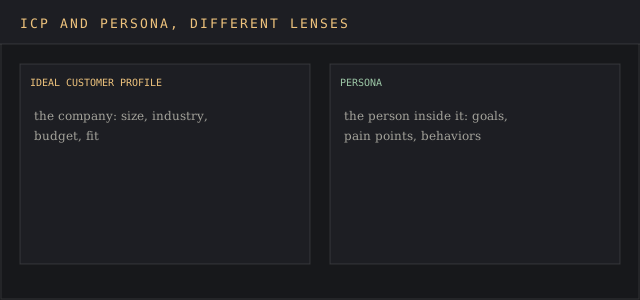
B2B market intelligence is the systematic practice of gathering and analyzing information about a business-to-business market, the customers who buy, the competitors who sell, and the industry trends reshaping both. It transforms raw market data into actionable insights that guide strategy, positioning, and day-to-day execution.
Three characteristics separate it from casual research:
- It's continuous. Effective B2B market intelligence requires continuous monitoring, because markets change on a schedule a vendor's product roadmap does not set.
- It's multi-source. B2B market intelligence uses primary research, secondary sources, and big data analytics, each data point tells part of the story.
- It's actionable. The output is battlecards for sales teams, campaign triggers for marketing teams, and evidence for strategic decisions.
Done well, B2B market intelligence improves strategic decision-making by providing evidence-based insights, promotes data-driven decisions for resource allocation, and provides a competitive advantage by enabling companies to understand industry shifts before rivals do.
Why the B2B market is different
The B2B market has structural features that make intelligence more valuable, and harder, than in consumer markets:
- Buyers research alone. Modern B2B buyers conduct 60-70% of their research independently before contacting sales. By the time a prospect talks to your team, opinions are largely formed, which means your market positioning and content did the early selling, shaped by intelligence quality. Reps who read the room in that first call recover the ground the buyer's own research already gave away.
- Purchases involve committees. B2B purchases involve multiple roles with distinct priorities: economic buyers, technical evaluators, end users, and procurement.
- Decisions are rational and slow. B2B buying decisions are typically rational and evidence-based, the buying process often takes several months, and B2B buyers prioritize long-term value and ROI over novelty.
- Transactions are large. B2B market intelligence focuses on complex, high-value transactions, where a single insight about a competitor's weakness or a customer's pain point can swing six- or seven-figure deals.
- The stakes keep growing. The B2B e-commerce sector is projected to reach $47.77 trillion by 2030, making the cost of flying blind higher every year.
B2B Market Intelligence vs Market Research
The two disciplines get conflated constantly, and the distinction matters for budgets and staffing.
Market research is project-based: a defined question, a methodology, a final report. A market research study might size a new segment, test pricing with your target audience, or validate messaging before launch. It's rigorous, slow, and episodic, you commission market research when a specific decision needs evidence.
Market intelligence focuses on continuous awareness. Where market research answers "should we do X?", market intelligence answers "what's changing, and what should we do about it?", every week, forever. It draws on primary and secondary sources simultaneously and keeps producing new deliverables, because the B2B market keeps changing state. Market intelligence is the one discipline on the team that never gets to call it a day.
The practical differences:
- Cadence. Market research runs in projects lasting weeks or months; market intelligence runs as an always-on function.
- Scope. Market research goes deep on one question; market intelligence covers the full sweep of market dynamics, competitors, customers, regulation, and emerging trends at once.
- Data. Market research usually creates new primary data; market intelligence mostly harvests and interprets data that already exists, layering business intelligence from internal systems on top.
- Output. Research produces reports; intelligence produces alerts, battlecards, and briefings tied to live decisions.
Mature organizations run both: market intelligence to detect shifts and generate hypotheses, market research to test the hypotheses that carry real money. Treating one as a substitute for the other is how companies end up either perpetually surprised (research only) or perpetually shallow (intelligence only).
The Key Components of B2B Market Intelligence
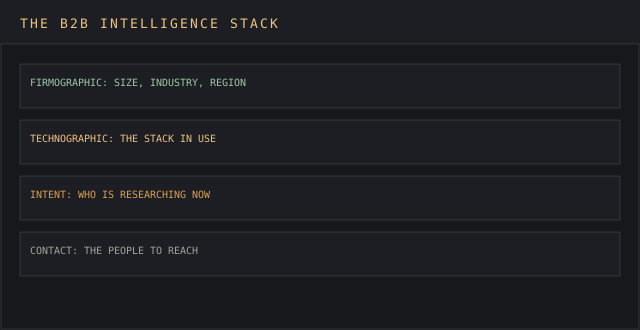
Key components of B2B market intelligence include customer insights and market trends. Strong programs run both in parallel.
1. Customer intelligence
Customer intelligence reveals buying patterns and decision-making processes across your target market. Customer insights analyze client pain points, procurement processes, and long-term goals, the raw material for relevance. Read between the lines of a support ticket or a lost deal and the real priority usually shows up before anyone says it out loud.
What it covers:
- Behavioral data from your product, website, and campaigns showing what prospects and customers do.
- Customer feedback from reviews, support tickets, win-loss interviews, and NPS programs.
- Customer sentiment across communities, social channels, and analyst commentary.
- Buying-committee dynamics: who signs, who influences, who blocks, and who just needs the budget conversation closed.
Why it pays: understanding customer behavior improves marketing strategies and sales outcomes; effective customer intelligence improves personalized marketing campaigns; and understanding customer pain points is important for B2B success. It also protects the roadmap, effective market intelligence informs product development based on customer feedback.
2. Market trend analysis
Market trends track regulatory changes, technological shifts, and industry shifts that change what buyers need and what they'll pay. Market trend analysis identifies shifts influencing demand before they hit the pipeline.
The classic tool is the PESTLE framework, which examines six macro-environmental dimensions: political, economic, social, technological, legal, and environmental. Layer onto it:
- Emerging technologies that could reshape your category or your customers' economics.
- Economic factors, rates, budgets, sector health, that govern spending appetite.
- Regulatory movement that creates urgency (and budget) overnight.
Why it pays: companies that spot trends early can adjust messaging effectively, tracking market trends ensures offerings remain relevant, and B2B market intelligence helps anticipate shifts before they occur. Trend work is how you avoid competing brilliantly in a shrinking market. Spot the shift six months before competitors do and the program stays ahead of the curve while rivals scramble to react.
Data Sources for B2B Market Intelligence
Effective B2B market intelligence requires both primary and secondary data, plus the real-time digital layer that modern platforms unlock. Think of data sources in five groups.
Primary data sources
Primary data sources include surveys and interviews, original data you collect directly:
- Customer and prospect interviews, especially win-loss interviews with deals you lost.
- Surveys of your target audience on needs, priorities, satisfaction, and the one feature they would pay extra for.
- Focus groups and advisory sessions for deeper qualitative exploration.
- Field intelligence from sales calls, often the freshest primary research a company owns, if anyone captures it.
Establishing customer advisory boards can provide valuable first-party data: a standing group of customers who preview plans and share unvarnished feedback quarterly.
Secondary data sources
Secondary data sources include industry reports and market analyses produced by others:
- Industry reports from analyst and research firms sizing markets and naming leaders.
- Industry benchmarks for conversion, pricing, and growth comparisons.
- Trade press and specialist media covering your category.
Monitoring secondary sources such as financial filings and earnings calls helps understand industry trends straight from competitors' own executives, public companies must disclose strategy, risks, and performance every quarter.
Competitor-related sources
Competitor-related data sources track rivals' strategies and performance: websites and pricing pages, product release notes, job postings (an early signal of roadmap direction), patents, press releases, and review-site profiles. Competitor analysis synthesizes these into a living map of the competitive field, and competitor tracking platforms keep the map current automatically.
Keep an eye on the rivals who move your win rate most, and let automation cover the rest.
Real-time digital data
Real-time digital data reveals current customer and competitor behaviors as they happen:
- Intent data showing which companies are actively researching your category across the web.
- Website and content engagement from your own properties.
- Social media monitoring for mentions, sentiment shifts, and tracking brand perception over time.
Publicly available data
Publicly available data includes government databases and trade publications: census and labor statistics, regulatory filings, import/export records, and procurement databases. Free, credible, and underused.
The craft is in collecting relevant data, a focused program built on collecting relevant data your team will use beats a data lake few people open. Sound data governance keeps the pipeline trustworthy: clear ownership, clear definitions, clear retention rules.
Intent Data and Intent Signals: Finding In-Market Buyers
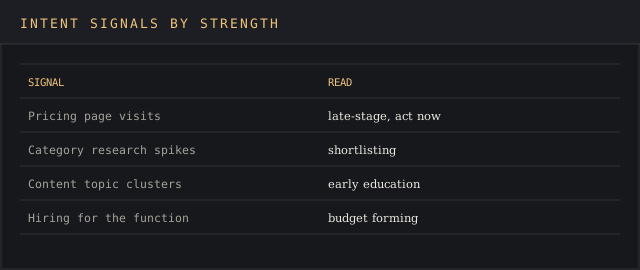
The highest-use development in B2B market intelligence over the past decade is intent data, behavioral evidence that an organization is researching a problem you solve. Before it existed, finding accounts that were in-market meant hunting for a needle in a haystack across a territory of thousands of companies.
Using intent and behavioral signals helps identify organizations entering an active buying cycle. Intent signals include surges in topic research across publisher networks, repeated visits to comparison and pricing content, review-site activity, and technology installs or removals.
Why intent signals matter so much in a B2B market: because buyers do most research before talking to sales, the vendor who detects intent signals first gets into the deal earliest, and shapes the evaluation criteria everyone else is judged against.
Market intelligence enables targeted marketing campaigns based on buyer intent. Marketing teams concentrate spend on the accounts already showing live interest, and sales teams prioritize outreach by readiness.
Handled well, intent data shortens the path from unknown prospect to qualified conversation. Companies using market intelligence this way can reduce deal cycles, the conversation starts closer to the decision.
Understanding Decision Makers in the B2B Buying Committee
Intelligence about companies covers only part of the job; you need intelligence about the people inside them. B2B purchases often involve multiple stakeholders in decision-making, each with distinct priorities:
- Decision makers have final authority to approve or reject deals, typically economic buyers who own the budget.
- Influencers shape opinions of decision makers, technical evaluators, consultants, and respected end users.
- Champions sell internally on your behalf when another team member is in the room.
- Blockers and procurement control risk, compliance, and price.
Stakeholder mapping helps identify decision makers and influencers for each account: who they are, what each cares about, and where your case is weak. Understanding decision-making dynamics improves sales strategies directly, the pitch that wins the technical influencer (depth, integration, security) differs from the pitch that wins the CFO (ROI, risk, total cost). Pitch ROI to the security lead and you're barking up the wrong tree no matter how sharp the deck looks.
Key decision makers should each get evidence matched to their priorities, and your sales strategy should assign owners to each relationship.
How to Gather B2B Market Intelligence: 6 Effective Strategies
Effective strategies for gathering B2B market intelligence include direct primary research and AI-driven intelligence tools, layered so each strategy covers the others' blind spots. Gathering market intelligence systematically beats heroic one-off research every time.
1. Run continuous win-loss analysis
Interview buyers after every significant win and loss. This data collection method produces more honest insight into your market positioning, pricing strategies, and competitor strengths. Feed findings to product, marketing, and sales teams monthly.
2. Establish customer advisory boards
A standing panel of customers provides first-party primary data on pain points, priorities, and roadmap reactions, and doubles as an early-warning system when their needs shift. It's the cheapest reliable window into customer behavior you can build.
3. Automate competitor monitoring
Use monitoring tools to track rival websites, pricing, releases, and news automatically. Automation turns competitor analysis from a quarterly scramble into a daily feed of relevant data, and frees analysts for interpretation. It keeps the whole team on the ball without anyone burning a weekend refreshing a spreadsheet by hand.
4. Buy or build intent coverage
Subscribe to intent data providers, or one of the broader B2B data providers, or instrument your own content to detect in-market accounts. Route intent signals directly into CRM so sales teams see readiness scores next to every account. Market intelligence tools earn their budget fastest at this step, and revenue operations teams typically own the plumbing.
5. Mine secondary sources on a schedule
Assign owners to earnings calls, industry reports, regulatory trackers, and government databases. A one-page monthly digest of market trends and economic factors keeps the whole company oriented while keeping the signal tight.
6. Capture field intelligence
Your sales data and call recordings already contain competitor mentions, objection patterns, and emerging customer pain points. Analyzing data from calls at scale, increasingly an AI task, converts internal knowledge that evaporates into internal knowledge that compounds. Combining qualitative and quantitative research this way improves the effectiveness of market intelligence overall.
Applying B2B Market Intelligence: From Insight to Revenue
Intelligence only counts when it changes what the business does. The highest-value applications:
Identify and enter new markets
B2B market intelligence helps identify new market opportunities and untapped growth opportunities, adjacent segments, underserved regions, emerging use cases. Before committing to a new market, intelligence sizes demand, maps incumbents, and tests how far your competitive edge travels.
Market analysis at this stage, before market entry, is far cheaper than a failed launch, and a business plan built on evidence survives contact with reality far better than one built on hope. Skip that legwork and a company can bite off more than it can chew in a market it barely understands.
Sharpen product development
Effective market intelligence informs product development based on customer feedback and competitive gaps, so the roadmap reflects market demand. Customer segments with distinct needs get distinct treatment: each segment gets features, messaging, and pricing built for its own use case and its own buying speed.
Focus marketing efforts
Market intelligence enables targeted marketing campaigns based on buyer intent and refined segmentation. Marketing teams use it to pick segments, time launches, and position against rivals, concentrating marketing efforts where win probability is highest. The payoff shows up as pipeline quality, quality over volume.
Accelerate sales
Sales teams armed with current battlecards, intent signals, and stakeholder maps enter conversations prepared. Companies using market intelligence can reduce deal cycles, and a sales strategy grounded in evidence converts better at every stage. When customer sentiment shifts or a rival stumbles, prepared sales teams capitalize within days.
Allocate resources with evidence
B2B market intelligence promotes data-driven decision-making for resource allocation, which segments get headcount, which products get investment, which regions get expansion budget. Strategic decisions made with evidence beat strategic decisions made by seniority, and operational efficiency improves when spend follows insight. Evidence like that works as its own green light: the numbers clear a budget request faster than a title on an org chart ever could.
Key Metrics to Monitor
Key metrics to monitor in B2B market intelligence include market penetration rates and customer satisfaction scores, plus a working dashboard of:
- Market share movement in your segments, yours and rivals'.
- Win rate by competitor, the cleanest read on competitive positioning and competitive advantage success in real deals.
- Deal cycle length and how it responds to intelligence-fed plays.
- Intent coverage, the share of your pipeline showing third-party intent signals.
- Customer satisfaction and retention trends against industry benchmarks.
- Share of voice and customer sentiment versus the competitive set.
Review monthly; investigate anomalies immediately. A two-point win-rate drop against one rival is a data point; three consecutive drops is a market conditions story your program should have already explained.
Tools for B2B Market Intelligence
Market intelligence tools cluster into three groups, and mature programs combine them:
- Intent and account data providers (Bombora, 6sense, ZoomInfo), intent data, firmographics, and contact coverage for decision makers.
- Research and financial intelligence (AlphaSense, analyst subscriptions), deep secondary data, filings, earnings calls, and industry reports.
- Business intelligence and analytics (Tableau, Looker), the layer where external market data meets internal data like sales data and product usage, and where analyzing data becomes shareable dashboards.
Selection criteria that matter in practice: data freshness, integration with your CRM and workflow tools, coverage of your specific B2B market, and delivery of insights to sales teams and marketing teams where they already work. The best market intelligence tools disappear into the workflow; the worst become another tab few people open. (For rankings and reviews, see our tested comparisons of market intelligence tools.)
A tool earns its keep only once sales, marketing, and revenue operations are on the same page about what its output means.
Building Your Program: A 90-Day Roadmap
Days 1-30: Foundations. Define the questions that matter (target market, top three competitors, key customer segments). Audit existing internal knowledge, call recordings, lost-deal notes, support themes. Stand up automated competitor monitoring and a weekly digest.
Days 31-60: Data collection at scale. Launch win-loss interviews. Add intent data coverage for your target accounts. Assign owners for earnings calls and industry reports. Establish data governance basics so every data point has a home and a definition, and so unstructured data from calls and reviews gets processed, processed into a usable record.
Days 61-90: Distribution and action. Ship battlecards to sales teams. Wire intent signals into CRM routing. Publish a monthly market trends briefing for executives covering market dynamics, market conditions, and emerging technologies. Measure the first key insights against pipeline outcomes, and iterate on your market intelligence efforts based on what gets used.
Scale what the revenue teams pull for; kill what they ignore. Market intelligence efforts survive on usefulness, and the programs that thrive are the ones where actionable insights show up inside existing workflows. Even modest gathering market intelligence habits, one hour weekly reviewing relevant data as a team, compound into durable market understanding and a real competitive edge within two quarters.
It's not rocket science, just an hour a week, kept up without fail.
Industry experts consistently find the same pattern: strong programs get their competitive edge from consistency, operating discipline; the supply chain of insight, from raw data to decision, is what matters, and the same discipline that fixes a physical supply chain fixes an insight one: clear owners, measured flow, only live inventory. Potential customers are researching you right now. The only question is how much of it you can see.
Common Challenges (and How to Fix Them)
Most B2B market intelligence programs fail the same four ways:
Collection separated from distribution
Teams build impressive monitoring and then let valuable insights die in a dashboard few people open. Fix: deliver intelligence inside existing workflows, CRM, Slack, sales enablement tools, and measure usage, usage over volume. A single insight that changes a sales strategy is worth more than a hundred that decorate a report nobody reopens.
Competitive tunnel vision
Programs that only do competitive analysis miss the bigger forces: buyer behavior shifts, regulatory movement, and emerging trends that reshape demand for everyone. Fix: balance coverage across the three components, competitors, customers, and industry trends, and review market share movement quarterly to test your picture against reality. Losing market share while winning every known deal means your intelligence is missing whole segments of the market.
That combination, share slipping while the win column looks fine, is a red flag worth escalating the same week.
Stale data masquerading as intelligence
An annual market research report fails weekly decisions, and last quarter's battlecard loses this quarter's deals. Fix: set freshness standards by asset, battlecards updated within days of a competitor launch, benchmarks refreshed quarterly, trend briefings monthly.
Disconnected internal data
External market intelligence divorced from your own business intelligence, sales data, win rates, product usage, produces context with weak consequence. Fix: join the two. When market dynamics data sits next to your pipeline data, every shift in the market maps to a number your CFO cares about.
That join is also what makes intelligence credible with a skeptical target audience of executives: it stops being industry commentary and becomes an explanation of your own results.
Avoid those four failure modes and even a small program compounds: better market intelligence feeds better decisions, better decisions grow market share, and growing market share buys the program more investment.
FAQ
What is B2B intelligence?
B2B intelligence (short for B2B market intelligence) is the continuous collection and analysis of data about business customers, competitors, and industry trends, transformed into actionable insights for strategy, marketing, and sales. It combines primary research, secondary data, competitor tracking, and behavioral data to help companies understand customers, competitors, and industry trends, and act on that understanding faster than rivals.
Done consistently, it puts your team in position to call the shots on category narrative before rivals do.
What are the 4 types of B2B markets?
Producers (companies that buy inputs to make other goods and services), resellers (wholesalers and retailers who buy to sell on), governments (federal, state, and local public-sector buyers), and institutions (hospitals, universities, nonprofits). Each type has distinct procurement processes and decision-making dynamics, so intelligence programs should treat them as separate customer segments.
What is the 95-5 rule for B2B?
The 95-5 rule, popularized by the LinkedIn B2B Institute and Ehrenberg-Bass research, holds that only about 5% of your target market is actively in-market to buy at any given time, the other 95% are future buyers. The implication: use intent data to convert the 5% now, while building brand memory with the 95% so you're on the shortlist when they enter a buying cycle.
What are the 7 P's of B2B marketing?
Product, price, place, promotion, people, process, and physical evidence. The extended marketing mix adapts to B2B by emphasizing people (buying committees and relationships), process (long, multi-stage purchases), and evidence (case studies, ROI proof, and references that rational, risk-averse B2B buyers require).
Bottom Line
B2B market intelligence is a continuous data collection process that transforms raw market data into decisions, a standing process. The formula is stable: cover the two key components (customer insights, market trends), blend primary and secondary data sources, use intent signals to find in-market buyers, map the decision makers, and deliver insights inside the tools your revenue teams already use.
In a B2B market this large and this contested, the intelligence gap between you and your competitors is measurable in win rate, and it compounds in whichever direction you let it.