Recruitment market intelligence
 By Jan Suski. I go deep on every review, checking every number against its source and digging up details other coverage misses, a habit from six years of SEO and link building for tech companies. Bylines at Surfer, Brand24, and Senuto. How the scoring works.
· Prefer this source on Google
The short version 10 points · 45 seconds
- 01Talent market intelligence answers four questionsSupply, price, competition, and trajectory, sourced from BLS JOLTS and commercial data
- 02Compensation benchmarking closes a gap stale salary surveys leave openSHRM: $5,475 per non-executive hire, $35,879 per executive hire
- 03Proactive workforce planning starts before the resignation, not after itTalent availability and job demand signal a shortage early
- 04Competitive hiring intelligence reads a rival's hiring as a leading indicatorA hiring freeze or reorg shows up before it reaches headlines
- 05Faster sourcing and better retention draw on the same dataPredictive analytics scores fit against what already predicted tenure
- 06Employer brand work targets what each talent segment values mostComp headline first for one segment, growth story first for another
- 07Job description optimization pulls more applicants from the same posting budgetOutdated jargon loses candidates a plainly worded listing keeps
- 08AI compresses recruitment analysis from weeks to minutesScreening, targeting, and prediction now run on demand
- 09Building the capability takes four steps, not a new departmentStart with the decisions that hurt most when wrong
- 10The talent market rewards whoever reads the data firstSix use cases, one shared foundation: current market data
Market intelligence for recruitment is the continuous analysis of labor market data, talent supply, compensation trends, competitor hiring behaviors, and emerging skills, used to inform hiring strategies. It replaces assumption-driven recruiting ("post and pray") with a proactive approach based on what the talent market is doing.
This sits inside the broader talent acquisition function, the business function that competes for people the same way sales competes for customers.
The shift is already mainstream: annual market intelligence budgets have increased by about 24% since 2021, seventy-five percent of world-class companies value market intelligence investments, and over 40% of HR roles now require analytics as a core skill, which is why the market intelligence analyst role matters to talent teams. Recruiting has become a data discipline, and the teams that stay ahead of the curve build it into the recruiting budget from day one.
External data has one job here, and that is to change the hiring plan: location, compensation, target companies, skill requirements, sourcing strategy, or timeline. Everything below is about producing that change. Platforms are ranked head-to-head, with pricing and per-tool breakdowns, on our talent intelligence tools page.
What is talent market intelligence?
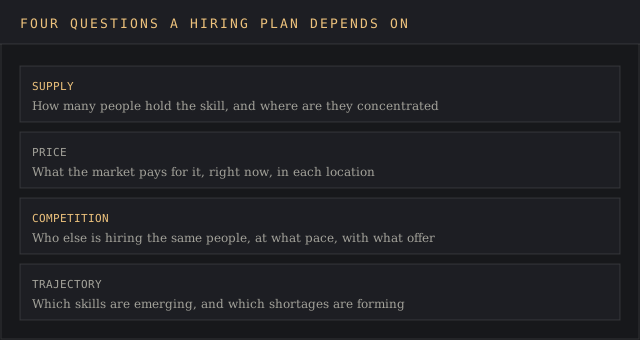
Talent market intelligence involves analyzing labor markets and competitor hiring behaviors through the market intelligence process to answer the questions every hiring plan depends on:
- Supply, how many people hold the skills you need, and where are those skills geographically concentrated?
- Price, what does the market pay for them, right now, in each location?
- Competition, who else is hiring them, at what pace, with what offer?
- Trajectory, which skills are emerging, and which future talent shortages are forming?
Organizations should combine various data sources to build this picture: job posting analytics, compensation databases, professional-network data such as LinkedIn Talent Insights, workforce surveys, and their own ATS history.
Sharing insights from market intelligence across departments, recruiting, HR, finance, and business leadership, is what turns labor data into workforce strategy.
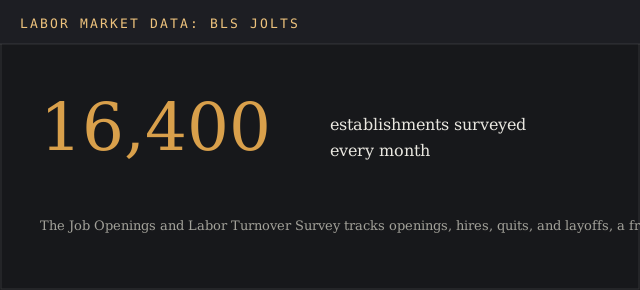
Public and commercial sources fill in what an ATS can't see on its own. The Bureau of Labor Statistics runs its Job Openings and Labor Turnover Survey across roughly 16,400 establishments every month, tracking openings, hires, quits, and layoffs as a free read on labor market trends.
Commercial providers go narrower and deeper. Lightcast, formed from the 2021 merger of Burning Glass and Emsi, now pulls hiring and vacancy data from more than 165 countries. Revelio Labs builds its workforce dataset from hundreds of millions of standardized employment records drawn from public postings and professional profiles.
Neither replaces a talent strategy; both feed one. The market insights only pay off once a recruiting team turns them into a headcount plan, a comp band, or a sourcing list. The insight is worthless without a decision behind it.
What it changes: six core use cases
1. Compensation benchmarking in real time
Market intelligence helps benchmark compensation in real time. An annual salary survey is stale before it ships. Data-driven hiring increases alignment of compensation with market rates, which shortens negotiations and reduces declined offers.
SHRM's 2025 Recruiting Benchmarking report, drawn from employers across every industry, puts non-executive cost per hire at $5,475 by comparison, the executive figure up 21% from 2022.

Salary benchmarks pulled the week an offer goes out put the recruiter in the driver's seat. Wait for the counteroffer, and the candidate is already gone. Predictive analytics adds the next layer, flagging which finalists likely already hold a competing offer.
2. Proactive workforce planning
Real-time market data helps organizations plan for workforce needs ahead of the resignations that would otherwise force the decision. Market intelligence identifies emerging skills and future talent shortages, enabling strategic decisions about future hiring needs: build the skill internally, hire ahead of the shortage, or relocate the role to where the talent is.
Remote work has widened that last option considerably: a role once relocated to a city now often relocates to a time zone instead.
Talent availability and job demand both point the same direction before a resignation shows up on paper, and labor market trends spotted early are the difference between building a bench and going back to square one on a search. Hiring trends visible in job listings today show up in headcount reports two quarters later.
3. Competitive hiring intelligence
Competitive hiring intelligence tracks competitors' hiring activities in real time: which roles they're opening, where, and what those moves reveal about strategy.
Tracking competitor hiring lets you adjust talent acquisition strategies: timing offers around a rival's hiring freeze, targeting teams affected by their reorganization, or countering their expansion into your talent pool.
It also informs strategic workforce planning: a competitor hiring 50 ML engineers is telling you their roadmap, and enables proactive hiring strategies by anticipating talent demand before it hits the whole market at once.
MPG Talent Solutions and JobsPikr both report fewer hiring mismatches among teams that track competitor strategies this closely, because an offer built against a real competitive landscape survives the first counter. Two competitors chasing the same ten engineers turn a quiet market into a bidding war overnight.
4. Faster sourcing and better retention
Companies using talent market intelligence fill roles faster and improve retention, the data guides both where to look and what makes people stay.
Recruiters reduce sourcing times by targeting the right pools, channels, and messages from day one. Predictive analytics increases the probability of candidate success by weighting the factors that historically predicted performance and tenure in your organization.
Recruiters who know the ropes narrow to the pools where top talent sits and skill shortages run thinnest, turning a stack of resumes into a shortlist of the right candidates. A talent pool that looked deep last quarter can dry up fast once two competitors start hiring the same skill.
5. Employer brand and offer design
Using market intelligence strengthens the employer brand by tailoring value propositions to what each talent segment values, comp for some, flexibility or growth for others. You stop guessing what candidates want and start responding to evidence.
Employer brand work draws on the same talent landscape data and is reading the room at the segment level: pay, flexibility, and growth, matched to what moves a candidate's decision in that segment.
The right talent for one segment reads a comp headline first and a growth story second; the right talent for another segment reads them in the opposite order. Employer brand work is what keeps top talent from second-guessing an accepted offer.
6. Job description and posting optimization
Talent market intelligence helps tailor job descriptions to what candidates are searching for. Outdated jargon in a listing pulls fewer applicants than the same role described in plain, current language, and analyzing competitors' job postings shows which job titles and skill phrases are pulling candidates toward a rival's listing.
Better job descriptions built from trending keywords and current job market trends produce higher application rates on the same posting budget. A posting asking for five years of experience in a role the market typically fills with two years gets ignored, no matter how well it's worded.
Where AI fits
AI has compressed the analytical work of recruitment intelligence from weeks to minutes:
- Speed. AI tools can generate insights in seconds, and AI reduces recruitment tasks from weeks to minutes, compensation analyses, market scans, and talent-pool sizing that once required an analyst now run on demand.
- Prediction. AI improves recruitment by predicting hiring trends and automating repetitive tasks, giving recruiters more time with candidates and less time on spreadsheets.
- Targeting. AI helps recruiters target passive candidates effectively, identifying who has the skills, who's statistically likely to move, and what message fits.
- Screening. AI also automates resume parsing, the highest-volume, lowest-judgment task in the funnel. Findem reports that recruiters pairing AI screening with market intelligence see improved candidate quality and retention, because the model weighs live market pricing and skills data more heavily than resume keywords alone.
The caution: AI output is only as good as the labor data beneath it, and comp or availability numbers hallucinated by an ungrounded model are worse than none. Keep a human on the ball for judgment calls, especially anything affecting fairness in hiring, and treat AI as the analyst, a support layer for the decision-maker.
Building the capability: 4 steps
- Start with the decisions. Pick the calls that hurt most when wrong, comp bands, location strategy, hard-to-fill roles, and aim intelligence there first to get the ball rolling.
- Combine sources. Each feed covers part of the picture: blend job-posting analytics, compensation data, network data, and your own ATS history. Continuous monitoring of labor market data is necessary to stay competitive; one-off reports age in months.
- Make it shared infrastructure. Sharing insights across recruiting, HR, and finance gets everyone on the same page, improves recruitment strategies, and aligns headcount plans with reality. Intelligence trapped in the sourcing team changes nothing upstream.
- Measure the delta. Track time-to-fill, offer-acceptance rate, sourcing time, and first-year retention before and after. Companies using market intelligence fill roles faster and improve retention, your own metrics should show it within two or three quarters.
Bottom line
The talent market doesn't wait for a hiring freeze on your side to end.
Market intelligence for recruitment turns hiring from a reactive scramble into a strategic function: compensation benchmarked in real time, workforce plans built on where the skills are, competitor hiring read as the strategic signal it is, and AI compressing analysis from weeks to minutes.
The talent market is a market, and like any market, the participants who see the data first get the better trades; that same logic appears in B2B market intelligence and SaaS market intelligence.
The ones with the numbers call the shots when an offer goes out; the ones without them find out after the candidate has already accepted somewhere else.
It enables strategic decision-making for future hiring needs based on market trends, and that's the entire difference between recruiting ahead of a shortage and explaining one.