G2 Market Intelligence Review: Pricing, Data Sources, Features, and Fit
 By Jan Suski. I go deep on every review, checking every number against its source and digging up details other coverage misses, a habit from six years of SEO and link building for tech companies. Bylines at Surfer, Brand24, and Senuto. How the scoring works.
· Prefer this source on Google
Best for
Product, marketing and sales teams tracking how a software market perceives them against named competitors.
Not for
Anyone who needs competitor web traffic, filings or formal analyst rigour. Gartner and Similarweb answer those.
What it costs
$0 Free and $299 a month Starter are published. Market Intelligence sits in quote-only Enterprise, median $28,000 a year.
- Segmentation
- Industry, company size and geography, so a 50-person startup reads its own peer group
- Sentiment analysis
- Feature level, below product level: customers can love the core product and hate onboarding
- Churn analysis
- Review responses parsed into structured customer churn reasons
- Deal-term metrics
- Average discount rates and contract lengths, self-reported by review respondents
- Per-review data points
- Star ratings by feature category, deal size, contract length, implementation time, repurchase intent
- Category metrics
- Satisfaction scores, renewal likelihood, ease of setup, quality of support, feature-level ratings
- Market share estimates
- Rolled up from the same review data points, not from vendor briefings
- Buyer intent
- Accounts researching a category before they fill out a contact form
- Visualization
- Dashboards, charts and heat maps, built to skip the raw-review spreadsheet export
- AI insights
- Daily trend identification across thousands of reviews
- Historical trends
- Sentiment trend lines per competitor over several quarters
- Underlying dataset
- Millions of verified user reviews across thousands of software categories
- Refresh cadence
- Frequently, often real-time, against a Gartner Magic Quadrant that refreshes annually
- Verification
- Human moderation; reviewers typically confirm product usage before a review publishes
- Data limits
- Self-reported by reviewers and moderated by people, not audited financial or usage data
- Not covered
- No competitor web traffic, no filings or transcripts, no commissioned custom research
- Public rate card
- Yes; G2's external pricing guide, updated February 2026, prices Free and Starter and quotes the two tiers above them
- Where Market Intelligence sits
- A feature inside the Enterprise package, not a separately priced product
- Free
- $0, 3 profile admins, basic profile
- Starter
- $299 a month or $2,999 a year; the monthly plan is no-contract, cancel any time
- Starter eligibility
- New G2 customers with 1 to 100 employees and fewer than 7 profiles only
- Professional
- Quote only; 10 users, $500 gift-card review credit, Premium Seller Pages, Profile Visitor Data
- Enterprise
- Quote only; unlimited users, $1,000 gift-card credit, Solutions Pages, Multi-Product Review Collection, Market Intelligence
- Buyer Intent
- Separate paid add-on, Professional and Enterprise only
- Implementation
- Configuration only: categories, competitors and metrics; no data pipeline to build
- Nearest comparisons
- Gartner Peer Insights and Crozdesk, both on the same crowdsourced-review model
- Median contract
- $28,000 a year across 526 purchases in Vendr's anonymised buyer data
- Contract range
- $12,000 at the low end, $73,655 at the high
- Enterprise deals observed
- $21,300 to $28,300 typical, $17,500 to $21,300 best negotiated, across the 96 purchases Vendr verifies separately
- Negotiated saving
- 18% on average; renewal uplift proposed at 7% to 12%
- Free trial
- None
- Self-serve demo
- None; nothing to test hands-on before talking to sales
- Buying process
- A sales conversation comes before any apples-to-apples comparison
- What replaces a trial
- A scoping call defining categories and competitors, then dashboard setup
Gartner Peer Insights
Not forA product marketing team that wants a live, self-serve competitor dashboard. Peer Insights functions as a review directory for browsing individual write-ups.
Crozdesk
Not forAn enterprise buyer needing deep analyst-grade coverage. Crozdesk is built for SMB and startup software shortlisting, a narrower job.
Pairs well with G2
Where these details come from, and what review data can't tell you
Every row here comes from G2's own description of the product and its published review policies; no independent audit of the dataset exists. The reviews are self-reported by buyers and moderated by people, so the market share estimates and the average discount rates read as sentiment-weighted.
The $0 Free rate, the $299 a month Starter rate, the tier contents and the Starter eligibility rule are G2's own published rates, taken from its external pricing guide updated February 2026; Professional and Enterprise carry no published price, and Market Intelligence is a feature inside Enterprise, with no rate of its own.
The $28,000 median, the $12,000 to $73,655 range, the 18% average saving and the per-tier bands are anonymised buyer data from Vendr, which brokers software purchases and publishes what its buyers paid: the median across 526 purchases, the per-tier bands across the 96 it verifies separately.
This G2 Market Intelligence review works through what the product is, where its data comes from, what it costs, and who it's built for.
G2's product turns the review platform's core asset, millions of verified user reviews, into a paid market intelligence product for product, marketing, and sales teams who need to understand a software category from the buyer's side.
What Kind of Company Is G2?
G2 started as a software review site: buyers write verified reviews of the tools they use, and G2 aggregates data from millions of verified user reviews across thousands of software categories.
G2 Market Intelligence is the paid layer built on top of that review data, packaging the same underlying dataset into dashboards, sentiment analysis, and competitor tracking for teams that need structured review data beyond a public star rating.
That distinction matters for anyone comparing G2 to a traditional market research firm. G2's market intelligence isn't built from custom market research commissioned for one client; it's built from the same review data every visitor to G2.com can browse, refined into a product with deeper segmentation and more current data.
What Is G2 in Marketing?
In a marketing context, G2 functions as both a lead-generation channel (vendors buy placement and respond to reviews to influence buyer decisions) and, through the platform, a research tool marketing teams use to track how competitors are perceived.
A marketing team can use G2's product to see how customer sentiment for its own product compares to a competitor's, without commissioning custom market research to ask the same question.
What Does Market Intelligence Do?
Market intelligence analyzes data about competitors and market conditions, then turns that analysis into something a team can act on: where to position a product, which competitor is gaining ground, and which customer complaints are turning into churn.
It helps businesses identify opportunities and mitigate risks by giving them continuous visibility into market trends.
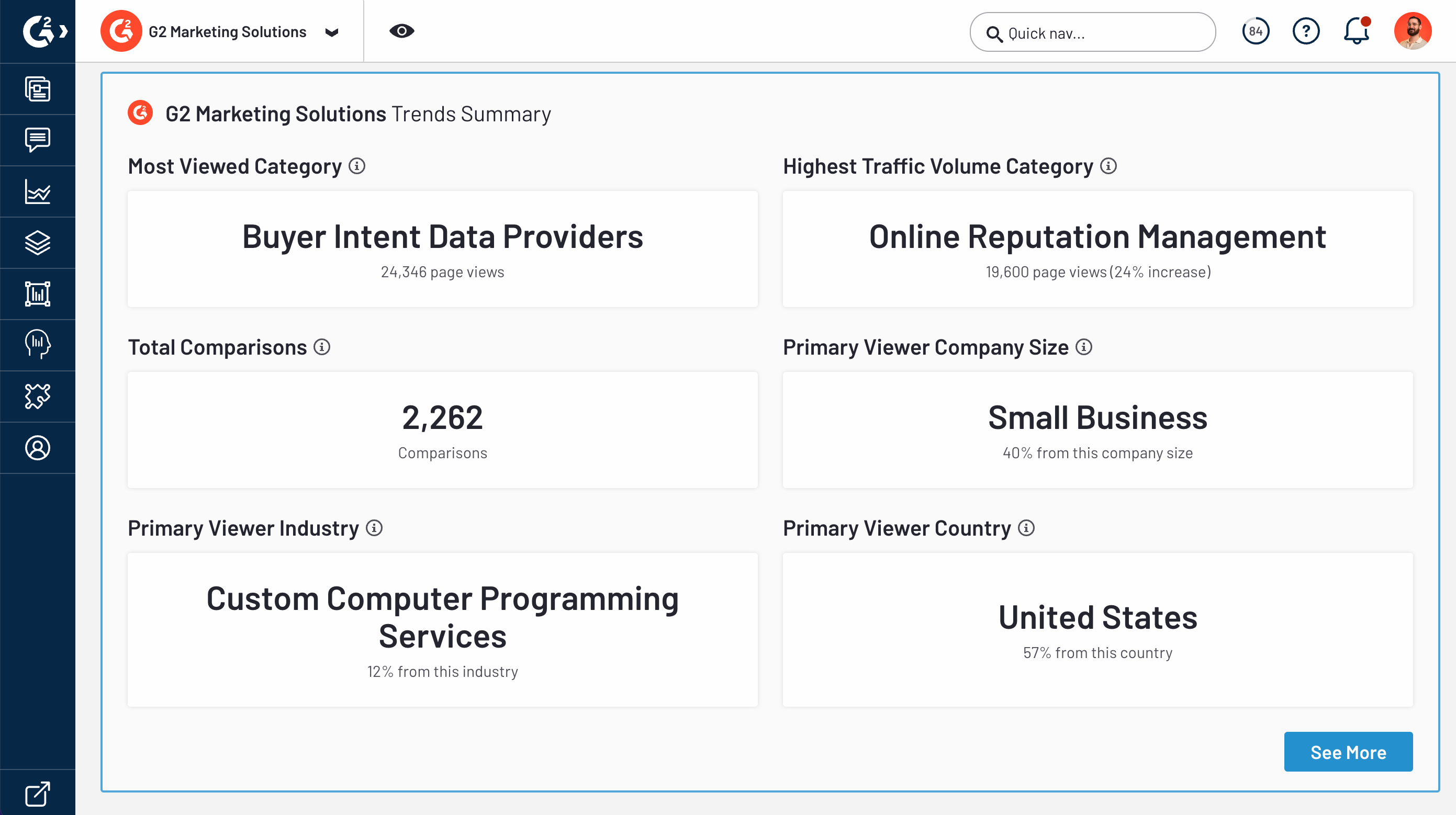
Market intelligence supports strategic decision-making with actionable insights, and it's distinct from market research in its scope. Market research answers specific business questions through a defined project; market intelligence provides continuous visibility into market changes as they happen, which is the model G2 Market Intelligence follows using review data as its continuous feed.
↑ FACT SHEETG2 Market Intelligence Pricing
Market Intelligence has no price of its own. It's a feature inside the Enterprise package of G2's Brand product, and Enterprise is quoted, so nothing G2 publishes covers it directly.
G2 does publish a rate card for the tiers underneath. Its own external pricing guide, updated February 2026, lists Free at $0 with 3 profile admins, and Starter at $299 a month or $2,999 a year, then quotes Professional and Enterprise on request. The monthly Starter plan carries no contract and cancels any time. Our G2 pricing report breaks down what the quoted tiers and add-ons like Buyer Intent cost, using Vendr's tracked contract data.
Starter isn't a floor a mid-market buyer can reach. G2 restricts it to new customers with 1 to 100 employees and fewer than 7 profiles.
- Professional adds 10 users, a $500 gift-card review credit, Premium Seller Pages and Profile Visitor Data.
- Enterprise adds unlimited users, a $1,000 gift-card credit, Solutions Pages, Multi-Product Review Collection and Market Intelligence.
- Buyer Intent is a separate paid add-on, available on Professional and Enterprise only.
For the two quoted tiers, the only public anchor is buyer data. Vendr, which publishes anonymised contract data from the purchases it brokers, puts the median G2 contract at $28,000 a year across 526 purchases, in a range from $12,000 to $73,655, with buyers saving 18% on average.
Across the 96 purchases it verifies separately:
- Enterprise deals typically land at $21,300 to $28,300, and the best negotiated ones at $17,500 to $21,300.
- Professional runs $13,500 to $17,700 before add-ons.
- Renewal uplift gets proposed at 7% to 12%.
Vendr's observed Starter deals, $2,700 to $3,000, sit either side of G2's published $2,999 annual rate, so the published card describes what buyers pay at the tier where a published number exists.
Anyone who wants Market Intelligence still has a sales conversation ahead of them. A team comparing it against a market intelligence product with a published per-seat price has to budget scoping time before it can build an apples-to-apples comparison.
↑ FACT SHEETHow G2 Gathers Data
G2 aggregates data from millions of verified user reviews, refreshed frequently, often in real-time. Traditional analyst reports run on a quarterly or annual cadence. G2's review system incorporates human moderation to verify content, which is what lets G2 call its reviews verified.
G2 uses user feedback to perform sentiment analysis, and market insights are segmented by industry, company size, and geography so a buyer can filter for relevant peers. G2 analyzes review responses to identify customer churn reasons, turning free-text complaints into a structured signal product teams can act on.
The Data Points Behind G2 Market Intelligence
The volume of data points collected is what separates the product from a handful of case studies or a single analyst's opinion. Every verified review contributes structured data points on top of the written text: star ratings by feature category, deal size, contract length, implementation time, and if the reviewer would buy the software again.
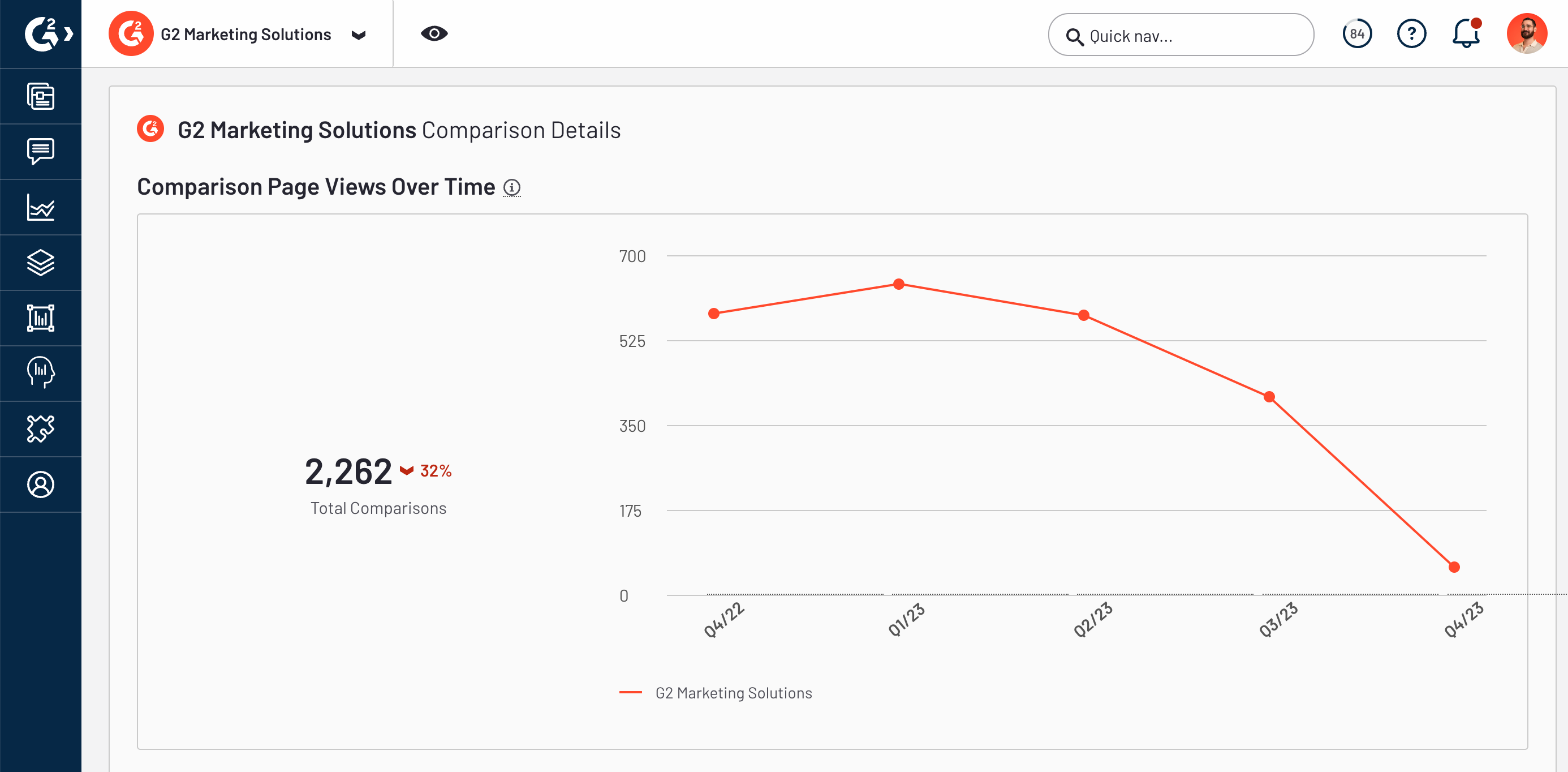
Those data points get rolled up into market share estimates, category-level satisfaction benchmarks, and the average discount rate benchmarks described above. A vendor that wants to know if its own discount rate is unusually generous compared to software market norms in its category can check that against G2's aggregate.
Key metrics tracked across most software categories:
- Net promoter-style satisfaction scores.
- Renewal likelihood.
- Ease of setup.
- Quality of support.
- Feature-level ratings.
None of these individually replace a full market research study, but together they give strategy teams a continuously updated baseline they can check a new competitor or a new category against without commissioning fresh custom market research every quarter.
Go-to-Market Use Cases
Different teams inside a software company pull different value out of the same underlying review dataset, and G2 Market Intelligence is built to serve several of them from one data source.
Product Teams
Product teams use G2's product to prioritize a roadmap against what reviewers complain about. Sales leaders and executives often assume something different matters most.
A chief product officer comparing five competitors' feature-level ratings can see exactly which capability gap is costing the most points in customer sentiment, then weigh that against internal engineering estimates before committing a quarter of roadmap capacity to it.
Marketing Teams
Marketing teams use the same review data to shape marketing campaigns and messaging: which claims customers validate in their own words, and which competitor weaknesses show up often enough in reviews to be worth calling out directly.
Go-to-market messaging built on verbatim customer feedback tends to test better than messaging built purely on what a product team believes differentiates the software.
Sales Teams
Sales and marketing teams both draw on G2's buyer intent data, but sales teams use it more tactically: spotting accounts actively comparing vendors in a category, then prioritizing outreach before a competitor closes the deal.
A rep who can reference a specific, common complaint about a competitor, sourced from real reviews, closes a different kind of conversation than a generic pitch.
Customer Success and Strategy Teams
Strategy teams use the product at a longer time horizon: tracking market shifts across an entire category over several quarters to decide where to expand, which adjacent category to enter, and which competitors are gaining or losing ground.
Customer success teams use the churn-reason analysis to see if their own product's weak points match the reasons customers are leaving competitors, or if the category as a whole is churning for structural reasons no single vendor controls.
How G2 Market Intelligence Differs From Traffic Analytics and Analyst Tools
It's worth being precise about what kind of market intelligence software G2 is, because the category includes several different data sources.
- Traffic analytics platforms like Similarweb estimate market intelligence from website visits and app usage.
- Financial-research tools like AlphaSense mine filings and transcripts.
- G2 Market Intelligence's data points come from something none of those sources have: buyers describing, in their own words, what it's like to use the software after they've bought it.
That distinction matters when picking tools. A team that needs to understand competitor web traffic should reach for a traffic analytics platform. G2 has none of that data. A team that needs to understand why customers are switching software, or which features drive renewal, is asking a question the platform is built to answer & a traffic tool isn't.
↑ FACT SHEETCore Features of G2 Market Intelligence
G2's product analyzes millions of verified user reviews and turns them into a handful of concrete product surfaces, described below.
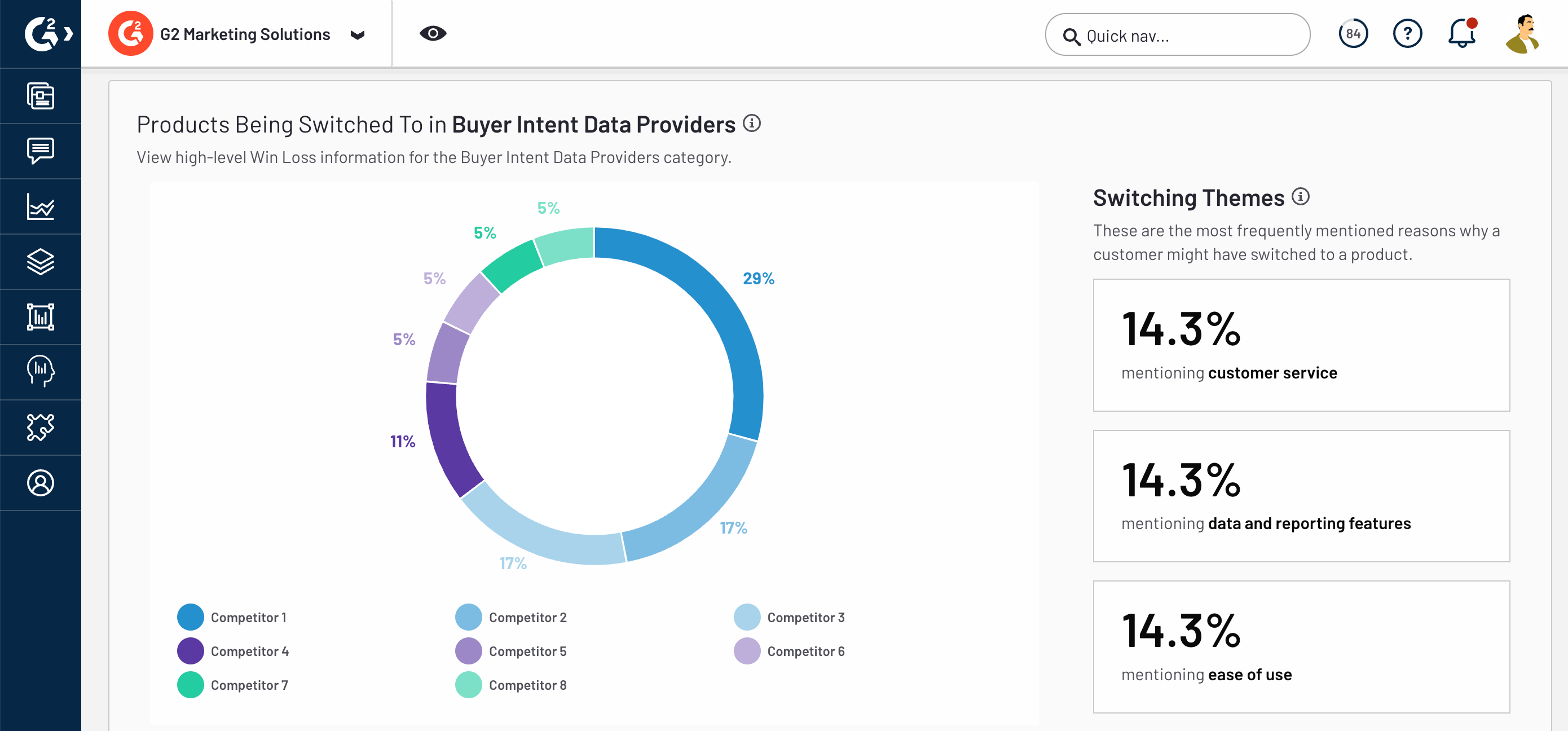
Data Visualization Tools
Data visualization tools include dashboards, charts, and heat maps built to help teams visualize data without exporting raw review text into a spreadsheet. A product team can look at one interactive dashboard and see sentiment trends across a dozen competitors, without reading review threads one at a time.
Sentiment Analysis
Sentiment analysis highlights positive and negative trends in user feedback, surfacing customer sentiment shifts before they show up in a quarterly churn report. Sentiment analysis highlights user satisfaction trends at the feature level, below the product level, so a team can see that customers love the core product but hate onboarding.
Unique Competitive Metrics
The platform provides unique metrics such as average discount rates and contract lengths, data points collected from review respondents who report their own deal terms. That's a data point most traditional analyst reports don't have access to, since it comes from actual buyers.
Buyer Intent Signals
The platform allows analysis of buyer intent data and historical sentiment trends, letting sales and marketing teams see which accounts are actively researching a category before those accounts ever fill out a contact form.
Turning Data Into Action
Market intelligence lets a company set strategy ahead of a competitor's move, and G2 Market Intelligence is built around that shift. AI-generated insights help identify market trends daily.
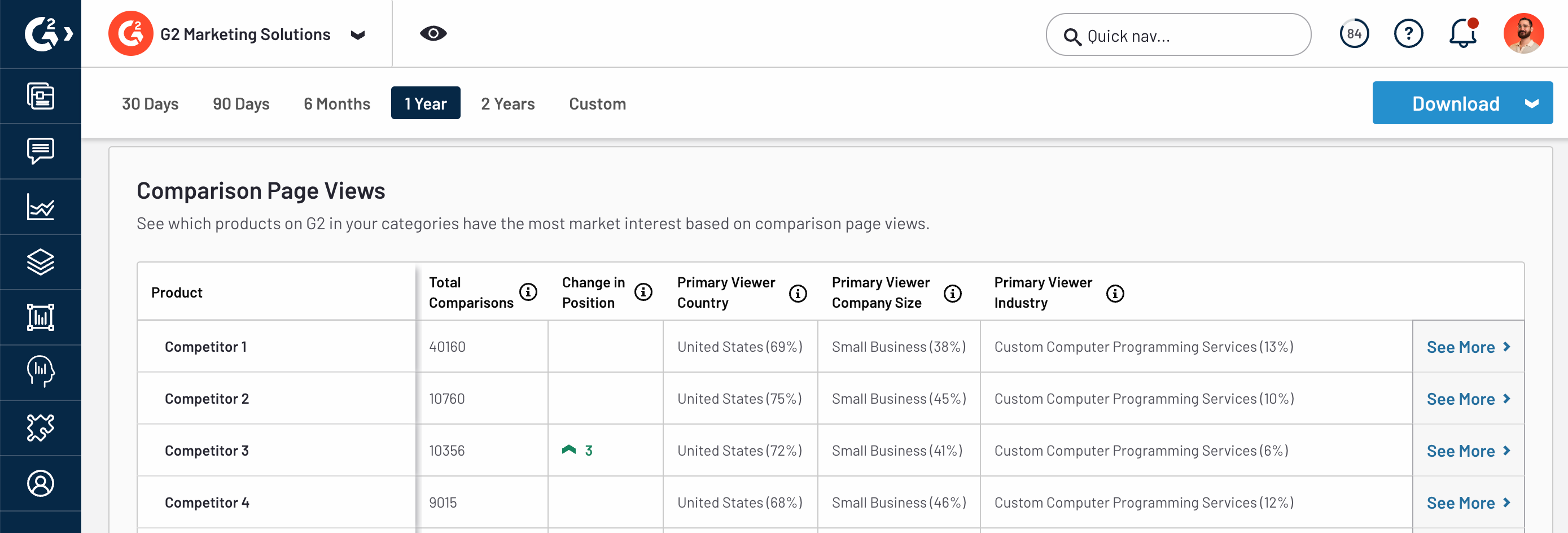
Data visualization tools simplify complex datasets interpretation for teams without a dedicated data science function, and market intelligence supports strategic decision-making with real-time data. A quarterly report is already stale by the time it reaches a decision-maker.
Market Research vs Market Intelligence
Market research answers specific business questions: should we launch this feature, what should we charge, does this market segment want our product. It's used to validate assumptions or solve problems, typically through a defined project with a start & end date.
Market intelligence provides continuous visibility into market changes. Market intelligence complements market research for broader context: G2's review-based data feed is a market intelligence source, and a team that wants to test a specific hypothesis about its own customers would still need to commission custom market research on top of it.
Types of Market Intelligence G2 Covers
G2's product spans several recognized types of market intelligence, each pulling from the same underlying review dataset.
Product Intelligence
Product intelligence improves product performance and features by surfacing which capabilities reviewers mention most often in negative reviews, effectively crowdsourcing a product roadmap from real usage complaints, the kind internal guesswork alone never surfaces.
Customer Intelligence
Customer intelligence focuses on understanding user experiences: what customers were trying to accomplish, where the product helped, and where it fell short. G2's verbatim customer feedback is the raw material for this type of analysis.
Market Understanding
Market understanding identifies consumer demands and growth areas by tracking which software categories are drawing more reviews & more vendors over time, a proxy for where buyer demand is heading next.
Benefits of G2 Market Intelligence
Users report time savings when accessing large volumes of verified customer feedback compared to manually reading through review pages one at a time. The platform provides actionable insights on product perception and competitive positioning, segmented by industry and company size so the insight applies to a buyer's actual market.
G2 Market Intelligence helps identify emerging technology trends by tracking which new categories and vendors start accumulating reviews fastest. The platform offers real-time review analytics for informed decisions, and the product supports competitive analysis through user feedback that would otherwise take a research team weeks to collect manually.
G2 vs Gartner: What's the Difference?
Gartner builds market intelligence from analyst research, briefings, and proprietary methodology; G2 builds it from millions of verified user reviews left by actual buyers. Gartner's version comes as a paid seat, and our Gartner pricing report puts an IT Leaders Advisor license at $49,576 a year.
G2 is often preferred for its crowdsourced data and real-time updates over traditional analyst reports, since a Gartner Magic Quadrant refreshes on an annual cycle while G2's review data updates continuously as new reviews are submitted.
The tradeoff runs the other way too. Gartner's analyst methodology brings structured, expert-vetted comparison criteria that a crowdsourced review platform doesn't have; G2 brings volume, currency, and buyer-side sentiment that a slower analyst cycle can't match. Teams comparing G2 and Gartner in market intelligence generally use both.
Is G2 a Legit Review Site?
G2's review system incorporates human moderation to verify content, which is the mechanism behind its "verified reviews" claim. Reviewers typically confirm product usage before a review is published, and G2 states that reviews go through a moderation process designed to catch fake or incentivized submissions that don't reflect real product usage.
Does G2 Pay for Reviews?
Software vendors commonly run review-generation campaigns, sometimes offering small gift cards for verified reviews, a practice common across the review-site industry. G2's public content policy prohibits vendors from paying for positive reviews specifically or editing review content, though incentivizing review volume generally is a disclosed and widespread practice.
Who Is G2 Market Intelligence For?
G2 Market Intelligence is primarily targeted toward product, marketing, and sales teams at software companies who need ongoing visibility into competitor positioning and customer sentiment. Chief product officer-level buyers use it to track feature gaps against competitors; go-to-market and strategy teams use the same data to shape marketing campaigns and sales messaging.
Software sellers competing in a crowded, fast-moving software market are the clearest fit: G2's product provides high growth companies a way to monitor market shifts without spending hours manually digging through hundreds of individual reviews across multiple categories.
What Are the Best 3 Market Intelligence Tools?
Depends on the job. For go-to-market and sales-intelligence use cases, ZoomInfo leads on contact data and buyer intent; for financial and document-heavy research, AlphaSense leads on source coverage; for digital marketing and SEO-adjacent competitive analysis, Semrush leads on traffic and keyword data.
G2 Market Intelligence sits alongside these as the strongest option specifically for review-based buyer sentiment and product perception data, a category none of the other three cover as their primary job. Our full market intelligence tools ranking breaks down all fifteen platforms side by side, and G2 also leads our buyer feedback intelligence ranking.
Building a Competitive Advantage With Review Data
The review data behind G2 Market Intelligence is public: competitors can read the same G2 pages anyone can.
The advantage comes from the segmentation, the sentiment analysis at feature level, and the historical trend lines that turn thousands of individual reviews into a pattern a strategy team can act on before a competitor's product team notices the same pattern in its own support tickets.
A company that treats the platform as a live data hub, checked monthly against a fixed set of key metrics, gets more out of it than a company that pulls a report once a year. Market intelligence loses value the staler it gets, and G2's real-time review flow is the whole argument for paying for competitive intelligence past the free public reviewss.
↑ FACT SHEETImplementation: What to Expect After You Buy
Because Market Intelligence ships on the quote-only Enterprise tier with no trial or demo, most of the implementation groundwork happens during the sales process itself.
Expect a scoping call to define which software categories and competitors to track, followed by dashboard setup mapped to the specific data points a team cares about, say market share trend lines, average discount rate benchmarking, or churn-reason analysis.
Onboarding for a market intelligence software product like this is lighter than onboarding a full business intelligence platform: there's no data pipeline to build, since G2 already owns the underlying review dataset. The main setup work is configuration, deciding which categories, competitors, and metrics matter.
Buyer Caution
Three things to weigh before buying G2 Market Intelligence:
- The published $0 and $299 rates don't reach it, because it sits inside the quote-only Enterprise package.
- There's no free trial or demo to test the product hands-on.
- The underlying data, while described as verified, still originates from self-reported reviewers.
None of these are disqualifying, but each one shifts real diligence work onto the sales conversation. There's no self-serve trial to do that work instead.
Segmentation: Industry, Company Size, and Geography
Market insights are segmented by industry, company size, and geography, which is what keeps G2 useful for a 50-person startup and a 5,000-person enterprise evaluating the same software category.
Reading an aggregate satisfaction score across every company size hides real differences: enterprise buyers weight implementation support and security review heavily, while smaller software companies weight price and time-to-value.
A strategy team segmenting by geography can also see if a competitor's customer sentiment differs meaningfully between North America and EMEA, a signal worth checking before a company assumes its product messaging travels unchanged across markets.
None of that segmentation existed in a pre-digital analyst report built from a fixed panel of a few dozen reference customers; the platform can slice a dataset built from a much larger and more current base of software companies & reviewers.
Alternatives Worth Evaluating Alongside G2
G2 Market Intelligence rarely gets evaluated in isolation. Teams comparing market intelligence software typically shortlist it against Gartner Peer Insights and Crozdesk for review-based data, since both draw on a similar crowdsourced-review model.
The deciding factor is usually the underlying data source, seldom the dashboard.
A platform built on crowdsourced software reviews will always answer "what do real buyers think" better than a platform built on scraped competitor websites, and a platform built on scraped websites will always answer "what changed on a competitor's pricing page this week" faster than a review platform that depends on someone bothering to write a review about it.
Is G2 a Good Company to Work For?
This review focuses on the G2 Market Intelligence product. It doesn't cover G2 as an employer, and it doesn't include verified employee-satisfaction data. Readers researching G2 as a workplace should check a dedicated employee-review platform directly.
Back to the product itself, scored dimension by dimension.
G2 Market Intelligence FAQ
What kind of company is G2?
G2 is a software review platform that aggregates data from millions of verified user reviews, and G2 Market Intelligence is its paid product that packages that review data into dashboards, sentiment analysis, and competitor tracking.
What is G2 in marketing?
G2 functions as both a lead-generation channel for software vendors and a market intelligence source marketing teams use to track competitor sentiment, feature perception, and market share signals.
Is G2 a legit review site?
Yes. G2's review system incorporates human moderation to verify content, and its public policies prohibit vendors from paying for or editing positive reviews, though industry-wide review-generation incentives do exist.
Does G2 pay for reviews?
G2 itself doesn't pay reviewers; software vendors sometimes offer small incentives to encourage customers to leave verified reviews, a common and disclosed practice across the review-site industry.
How does G2 compare to Gartner?
G2 builds market intelligence from millions of crowdsourced, verified user reviews updated in real time; Gartner builds it from analyst research and briefings on an annual cycle. Most enterprise teams use both.
What are the best 3 market intelligence tools on the market today?
It depends on the job: ZoomInfo for go-to-market and buyer intent, AlphaSense for document-heavy financial research, and G2 Market Intelligence for review-based buyer sentiment and product perception.
What is the difference between G2 and Gartner?
G2's market intelligence comes from millions of crowdsourced, verified user reviews updated continuously; Gartner's comes from paid analyst research and vendor briefings published on a slower, structured cycle. G2 tends to be faster and more current; Gartner tends to bring more formal, expert-vetted comparison criteria.
Is G2 a good company to work for?
This review doesn't cover G2 as an employer. It's scoped to the G2 Market Intelligence product, its pricing, data sources, and fit for product, marketing, and sales teams evaluating market intelligence software.
Bottom Line
G2 Market Intelligence turns G2's core asset, millions of verified user reviews, into a genuinely different market intelligence source: buyer-side sentiment and competitive positioning data that a traditional analyst report or an internally commissioned market research project can't easily replicate.
A quote-only Enterprise tier and the lack of a free trial are real buyer cautions, but for product, marketing, and sales teams that need continuous visibility into how a software market perceives them and their competitors, G2 Market Intelligence covers ground no other tool in this category covers the same way.
Weigh it against Gartner based on what question needs answering first: perception and sentiment point to G2; formal analyst rigor points to Gartner. Most teams serious about market intelligence eventually run more than one of these together.
The fastest way to decide is to write down the one question this quarter's roadmap or campaign depends on, then ask which data source answers it with evidence. If that question is "what do our buyers say about us versus a named competitor, in their own words," G2 Market Intelligence answers it faster & cheaper than commissioning a fresh round of custom market research.