Semrush review
 By Jan Suski. I go deep on every review, checking every number against its source and digging up details other coverage misses, a habit from six years of SEO and link building for tech companies. Bylines at Surfer, Brand24, and Senuto. How the scoring works.
· Prefer this source on Google
Best for
Teams whose revenue depends on search, in Google or AI engines, that want SEO, PPC, content and AI-visibility tracking under one login that replaces several point tools.
Not for
Teams that need more than one seat included at each tier, or a tool that's usable on day one. Semrush needs a ramp-up before new users get productive.
What it costs
Published pricing runs $139 to $549 a month per single seat, plus $45 for each extra user; Enterprise pricing is quoted through a demo request.
- Tool count
- Over 55 tools under one login, from keyword research to social media management
- Keyword Magic
- One seed expands into hundreds of thousands of suggestions; 305,391 in the example shown
- Keyword Gap
- Up to five domains compared, split into missing, weak and untapped terms
- Backlink Gap
- Backlink profiles compared across up to five competitors
- Competitor cap
- 4 sites in comparison views, against 10 in Ahrefs
- Position tracking
- Daily across Google, Bing and other engines, per device and per location
- AI prompt tracking
- Bundled into every tier: 50 prompts a day on Starter, 100 on Pro+, 200 on Advanced
- Integrations
- Google Analytics, Search Console, Looker Studio, Trello, Google Docs and a Chrome extension
- .Trends
- Separate add-on for industry traffic trends, market share by domain and audience overlap
- Keyword database
- 25 billion keywords
- Backlink index
- 43 trillion backlinks across 808 million domains, crawled by Semrush's own bot
- Paying customers
- Around 117,000 businesses as of Q3 2025
- Keyword difficulty
- 0 to 100, personalized to your domain; the same term reads 61% for one site and 29% for another
- AI Visibility Index
- 126 million US AI search prompts analysed January to April 2026, up from 2,500 in the first edition
- Citation counts
- ChatGPT cites an average of 15 sources per response, Gemini an average of 3
- SEO
- $139 a month, $117.33 annual; 5 sites, 500 keywords tracked daily
- Starter
- $199 a month, $165.17 annual; 5 sites, 500 keywords, 50 AI prompts a day
- Pro+
- $299 a month, $248.17 annual; 15 sites, 1,500 keywords, 100 AI prompts a day
- Advanced
- $549 a month, $455.67 annual; 40 sites, 5,000 keywords, 200 AI prompts a day
- Enterprise
- Custom, quoted through a demo request
- Annual saving
- Up to 17% against monthly billing
- Seats
- One user per plan; Additional Users from $45 a month
- Local toolkit
- Listings management and map rank tracking, sold as its own subscription
AI search tools
- Site audit
- Over 140 SEO issue checks, rolled into a 0 to 100 Site Health score benchmarked against the top 10% of sites
- AI Search Health
- Scored separately, flagging which AI bots (ChatGPT-User, OAI-SearchBot, Google-Extended) the site blocks
- Free trial
- 7 days, credit card required, converting to a paid plan automatically unless cancelled
- Free account
- Permanent, capped at 10 requests a day and one project
- Money-back guarantee
- 7 days, and only on an initial subscription of twelve months or longer, or an initial add-on
- Monthly plans
- "refunds are not available for month-to-month subscriptions"
Support and add-ons
- Agency listing
- $90 a month for a Lead Generation listing on the Agency Partners platform
- Base Report
- $10 a month
- Pro Report
- $20 a month, adding white-labelling, external integrations and scheduled delivery
- Support channels
- Chat replies cluster around hours, email around a business day; phone on higher tiers
Ahrefs
Not forA team that buys one subscription to cover paid search as well as organic, which this page names as the wider feature set Semrush counters with.
Similarweb
Not forAn SEO team whose week is keyword research, rank tracking and site audits, since this page puts Similarweb's keyword tooling well behind.
Pairs well with Semrush
Which prices come from the rate card, and which figures are unverified allegations
Plan prices, site and keyword quotas, seat counts and the daily AI prompt caps come from semrush.com/pricing/, checked 6 August 2026. The refund limits are quoted from Semrush's Cancellation and Refund Policy, last updated 20 August 2025.
The 55 BBB complaints and the four charge amounts in the table below are unverified consumer allegations, and Quinlan v. Semrush, case 2:25-cv-06924, is pending. The 25 billion keywords, 43 trillion backlinks, 808 million domains and 117,000 paying businesses are Semrush's own published numbers.
Semrush is a digital marketing intelligence platform that consolidates SEO, PPC, content marketing, and competitive intelligence features into one subscription.
It tracks 25 billion keywords and 43 trillion backlinks across 808 million domains, and around 117,000 businesses paid for it as of Q3 2025.
This Semrush review covers the keyword research tools, site audit, backlink data, the AI visibility toolkit, current pricing after the Adobe acquisition, and where the platform falls short; it ranks #6 on our digital marketing intelligence ranking, and no longer appears in the market intelligence tools top 15, on the contract terms and complaint record set out below.
Like every Semrush review published since late 2025, it also has to answer a newer question: what the Adobe era changes for subscribers, and if the AI visibility push is substance or packaging.
It draws on the tool's own documentation, current interface, and the recurring points in thousands of user reviews.
Company History: From 2008 Startup to Adobe Company
Semrush was founded in 2008 by Oleg Shchegolev and Dmitry Melnikov, initially as a small SEO tool called SeoQuake Company.
The founders built it out of an earlier browser plugin project, SEOquake, before the standalone platform took over; the company passed $100 million in annual recurring revenue in 2020 and listed on the NYSE in March 2021 under the ticker SEMR.
In November 2025, Adobe announced an agreement to acquire Semrush for $12.00 per share, roughly $1.9 billion in cash, and Semrush now operates as an Adobe company.
The acquisition matters for buyers: Adobe is folding Semrush's search and brand-visibility data into its marketing stack, and the 2026 product releases already lean toward AI search measurement over classic rank tracking alone.
↑ FACT SHEETWhat Exactly Does Semrush Do?
Semrush sells over 55 tools for digital marketing under one login: keyword research, rank tracking, site auditing, backlink analysis, advertising research, social media management, and content optimization. Its separate Content Toolkit, $60 a month, ranks tenth of ten on our content intelligence tools ranking.
The practical job it does: show which search results a site wins, which ones competitors win, and what it would take to close the gap.
It is widely considered the industry standard for enterprise-level marketing teams, and it is equally common in one-person consultancies; SEO professionals treat a Semrush subscription roughly the way accountants treat Excel.
Unlike a single-purpose SEO tool, it spans paid search, social, and content, which is why many teams run it as their only tool for online marketing research.
The Keyword Research Tools
Keyword research is the core of the platform, and three tools carry most of the weight.
Keyword Magic Tool
The Semrush Keyword Magic Tool takes a seed keyword and expands it into related keywords, questions, and phrase variations from a database of over 25 billion terms. SpyFu, a cheaper rival, claims 13.1 billion keywords on its homepage and 73 billion on its own blog.
A single seed keyword like "snowboard" returns hundreds of thousands of keyword suggestions, grouped into subgroups you can drill through like folders.
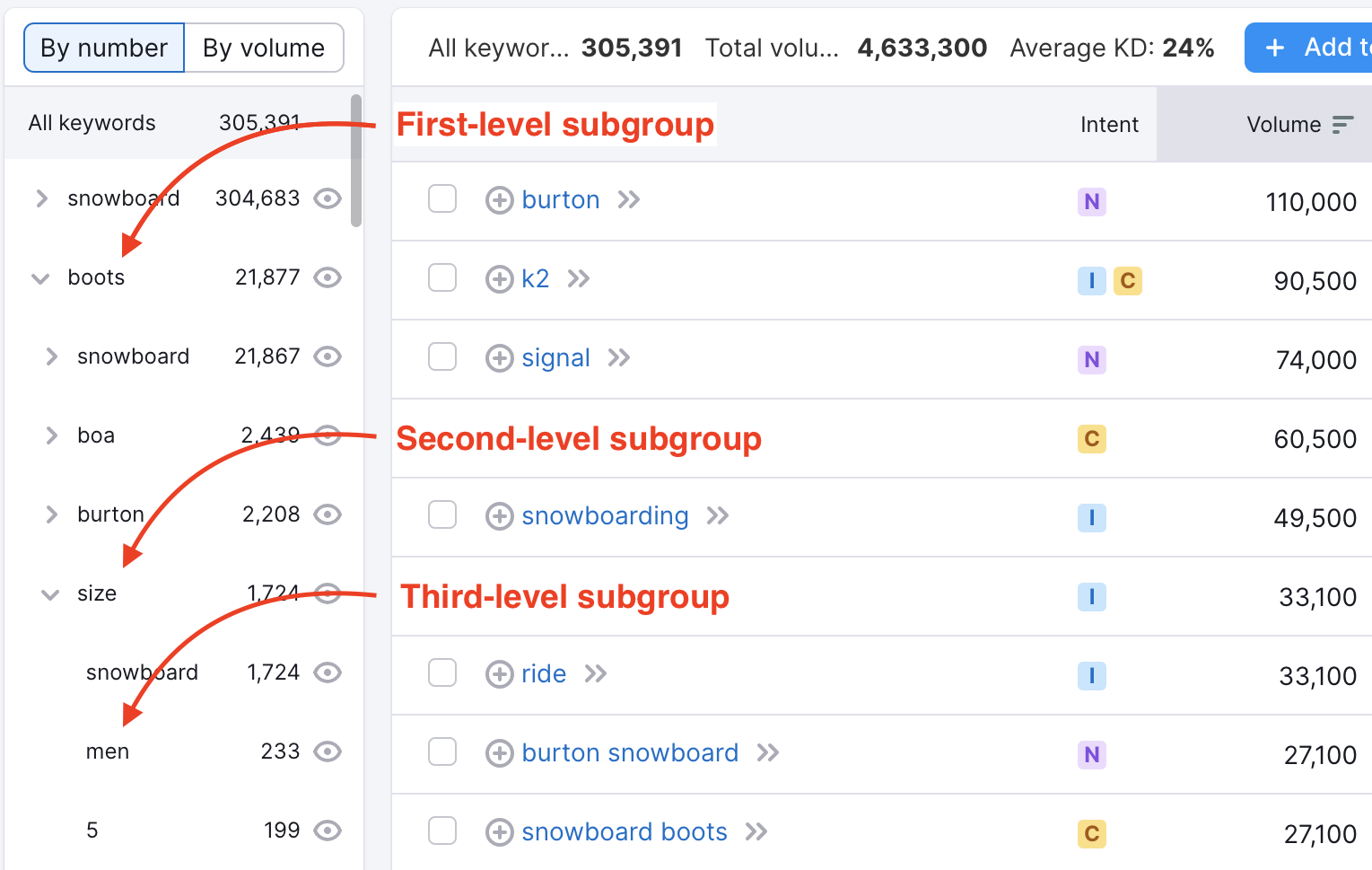
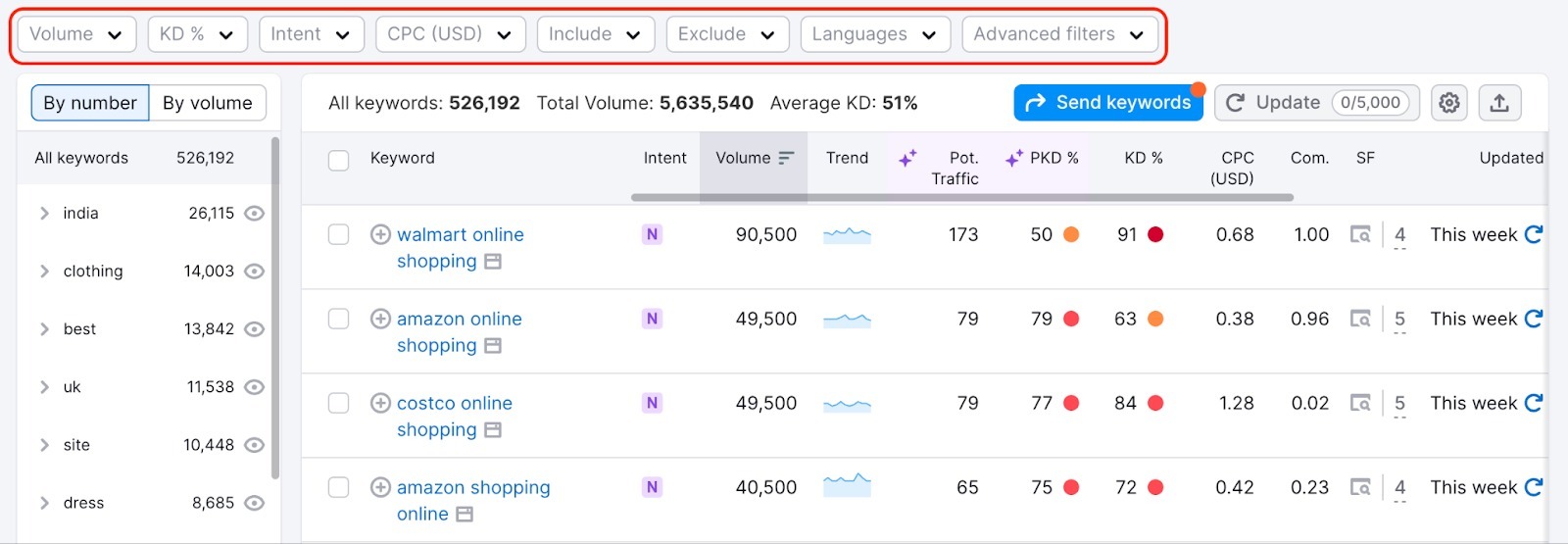
Each keyword row shows search volume, intent classification, trend, cost per click, and a keyword difficulty score, so keyword analytics and prioritization happen in the same table.
Semrush claims the tool provides over 891,000 related queries for popular seed terms, and in practice the grouping is what saves time: you prune whole subgroups of irrelevant terms at once, without scrolling a flat list.
Keyword Overview and Keyword Difficulty
The keyword overview report shows a target keyword's volume, global spread, trend, and SERP features in one screen.
Keyword difficulty scores indicate ranking challenges as a percentage from 0 to 100, and Semrush now personalizes them: personal keyword difficulty scores adjust to your site's authority and topical relevance, so the same target keyword can read 61% for one domain and 29% for another.
That personalization matters for smaller sites, because a generic keyword difficulty score treats every domain as average, and no domain is.
Keyword Gap
The Keyword Gap tool runs keyword gap analysis across up to five domains: it shows keywords competitors rank for that you don't, split into missing, weak, and untapped terms. See how that stacks up against nine other tools in our competitive intelligence for SEO ranking.
Combined with the Backlink Gap, this is the fastest competitor research loop in the platform: find the terms, find the links, and assign both as tasks.
Competitive Research and Traffic Analytics
Domain Overview
The domain overview tool profiles any domain: authority score, organic search traffic estimate, paid keywords, backlink counts, and traffic share against competitors.
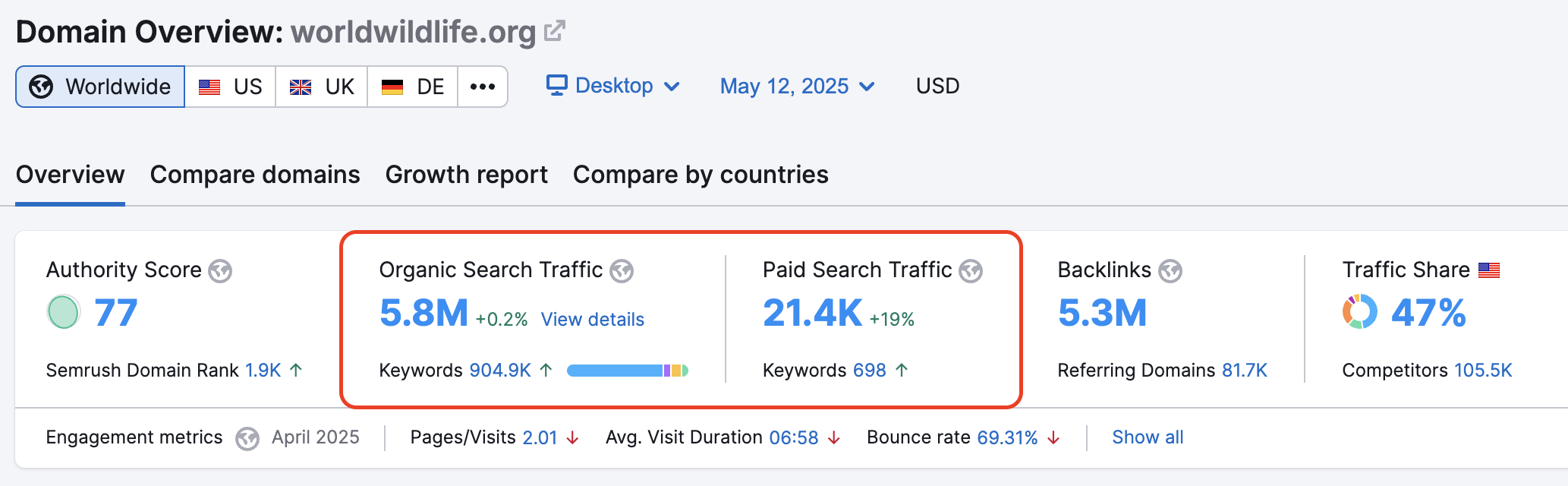
This is the report to open first when sizing up a particular site: thirty seconds tells you if a competitor earns its traffic from organic search results, paid search, or brand demand.
Organic Research and Historical Data
Organic Research lists every keyword a domain ranks for, the pages that capture the traffic, and position changes over time.
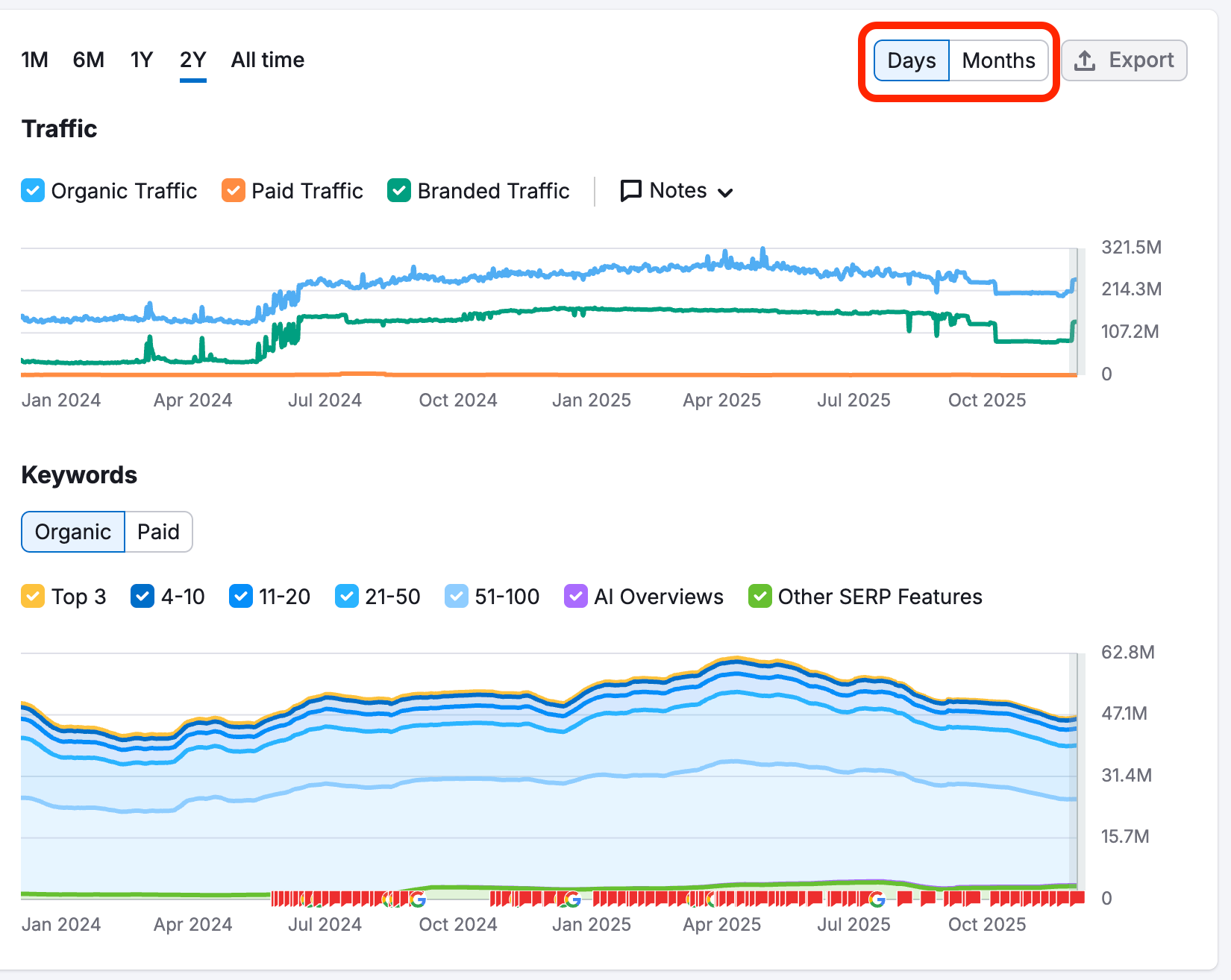
Historical data reaches back years on higher plans, which is how you catch a competitor's algorithm-update damage or content-pruning wins; the two-year view below also breaks out AI Overviews as a SERP feature layer.
Traffic Analytics
Traffic Analytics estimates any site's visits by channel: direct, referral, organic, paid search, social, email, and display. Our market research tools ranking scores the Traffic & Market toolkit ninth of ten.

Estimates are modeled, never measured, so treat them as directional; for pure traffic benchmarking at scale, Similarweb runs deeper panels, and the two tools disagree most on smaller sites.
Advertising Research
Advertising research shows the search ads a competitor runs, the copy they test, and the keywords they bid on, with Google Shopping campaign visibility for retailers.
For a team weighing paid search spend, seeing a rival's ad history answers the expensive question early: which keywords kept earning their budget month after month.
Position Tracking
Semrush's position tracking tool monitors keyword rankings daily across Google, Bing, and other search engines, per device and per location.
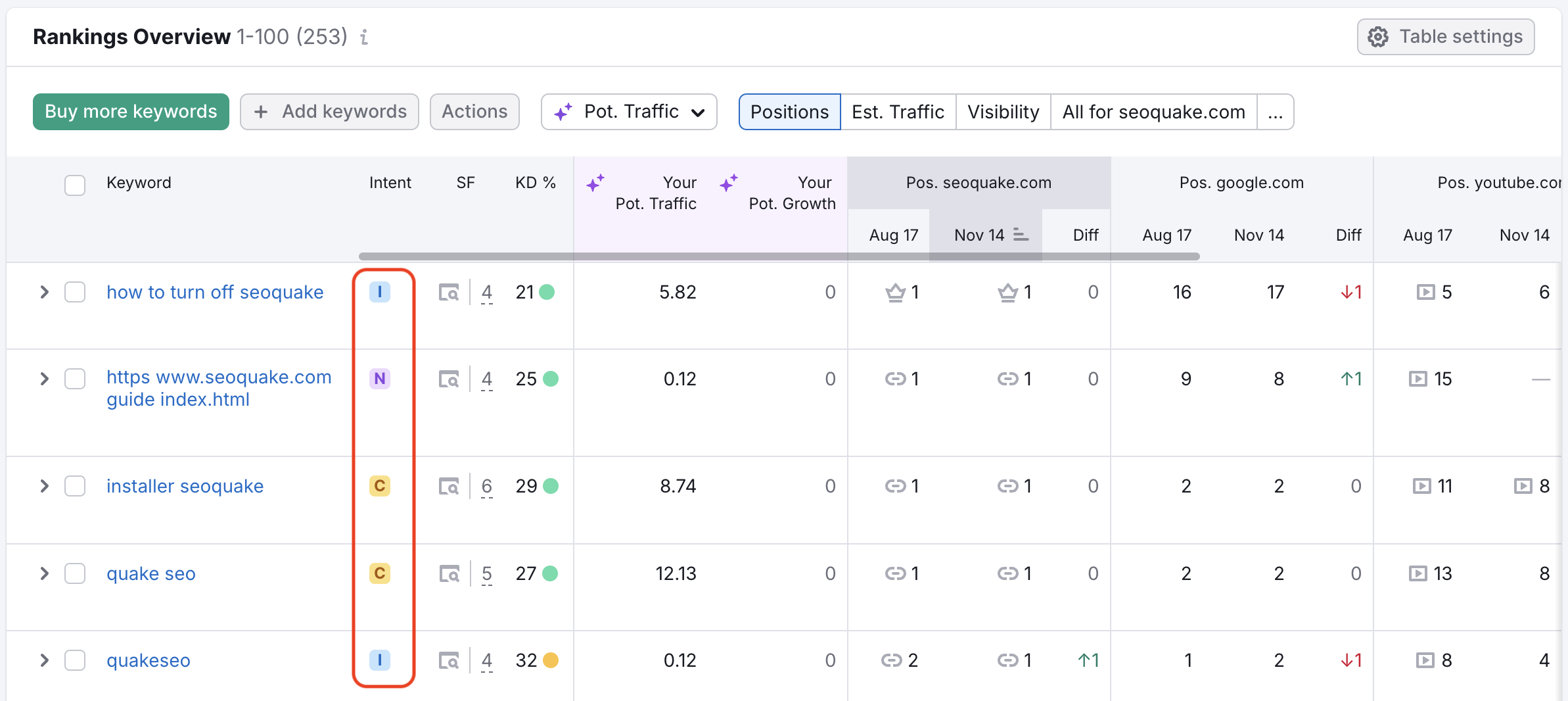
Position Tracker shows daily rank changes for tracked keywords, flags SERP features like featured snippets, and reports share of voice against named competitors.

A Potential Growth view forecasts where average position could land if top-opportunity pages get improved, which turns rank data into a prioritized to-do list.
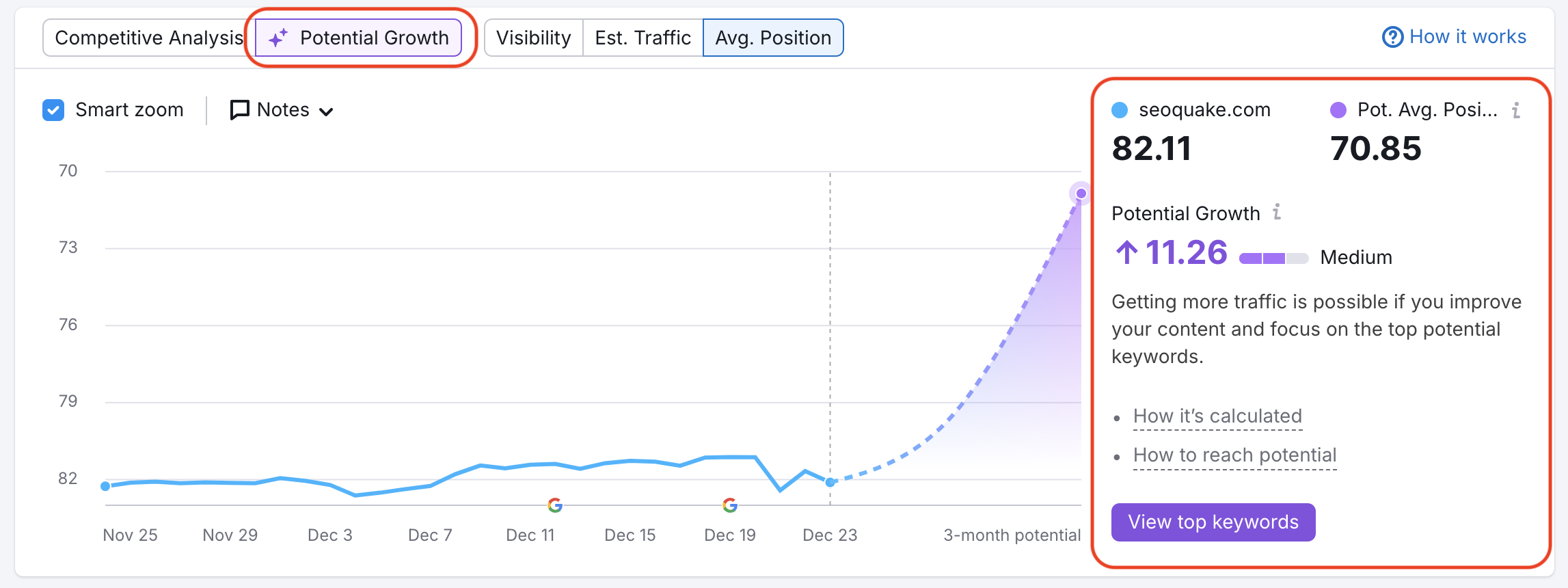
The basic plan tracks up to 500 keywords, refreshed daily; that quota covers one project comfortably and disappears fast for a consultant tracking search rankings across several clients.

Site Audit
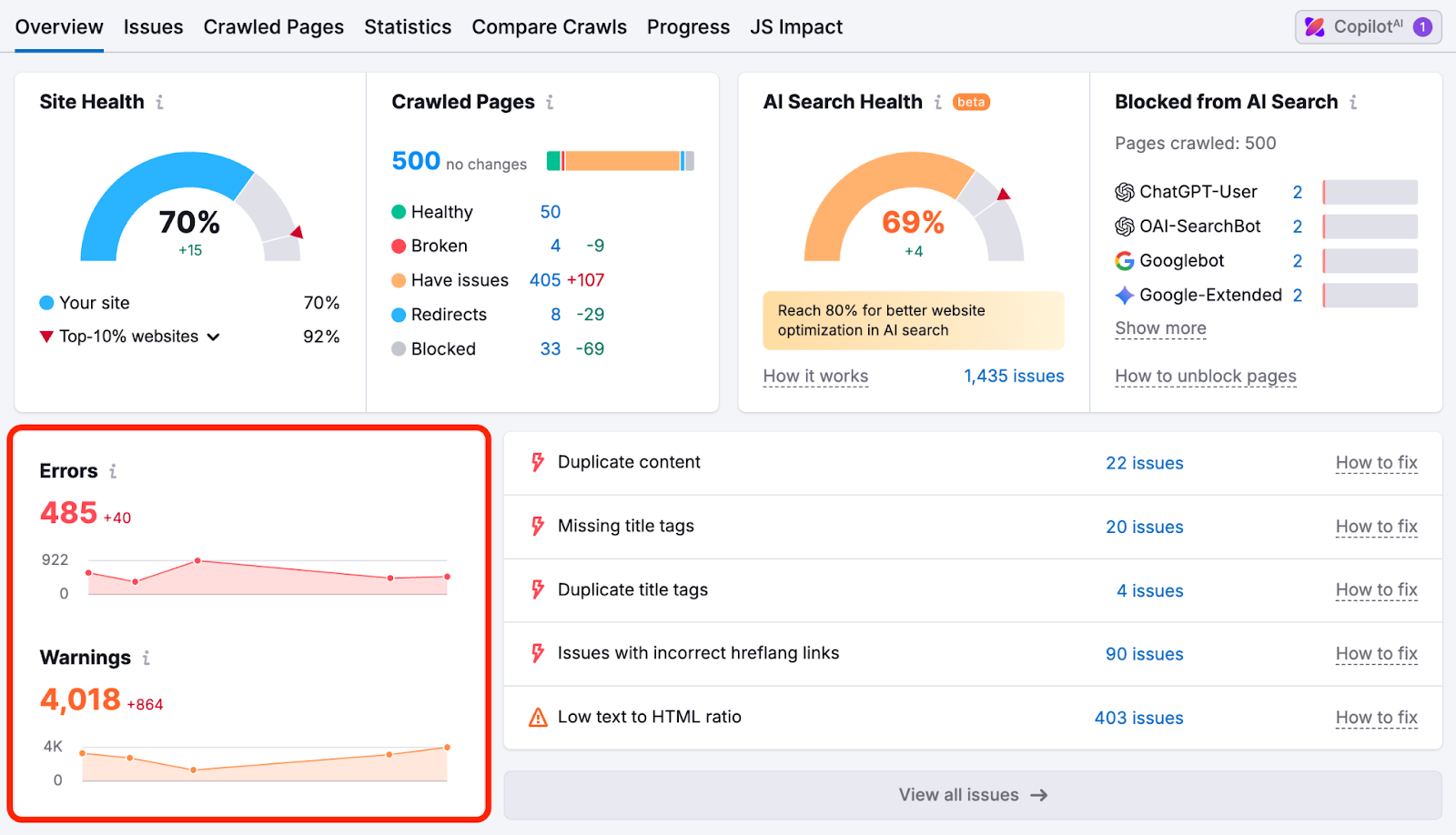
The site audit crawls a site and checks over 140 SEO issues: broken links, redirect chains, duplicate content, missing tags, hreflang errors, and Core Web Vitals problems.
Results roll up into a Site Health score from 0 to 100, benchmarked against the top 10% of websites, with issues ranked as errors, warnings, and notices.
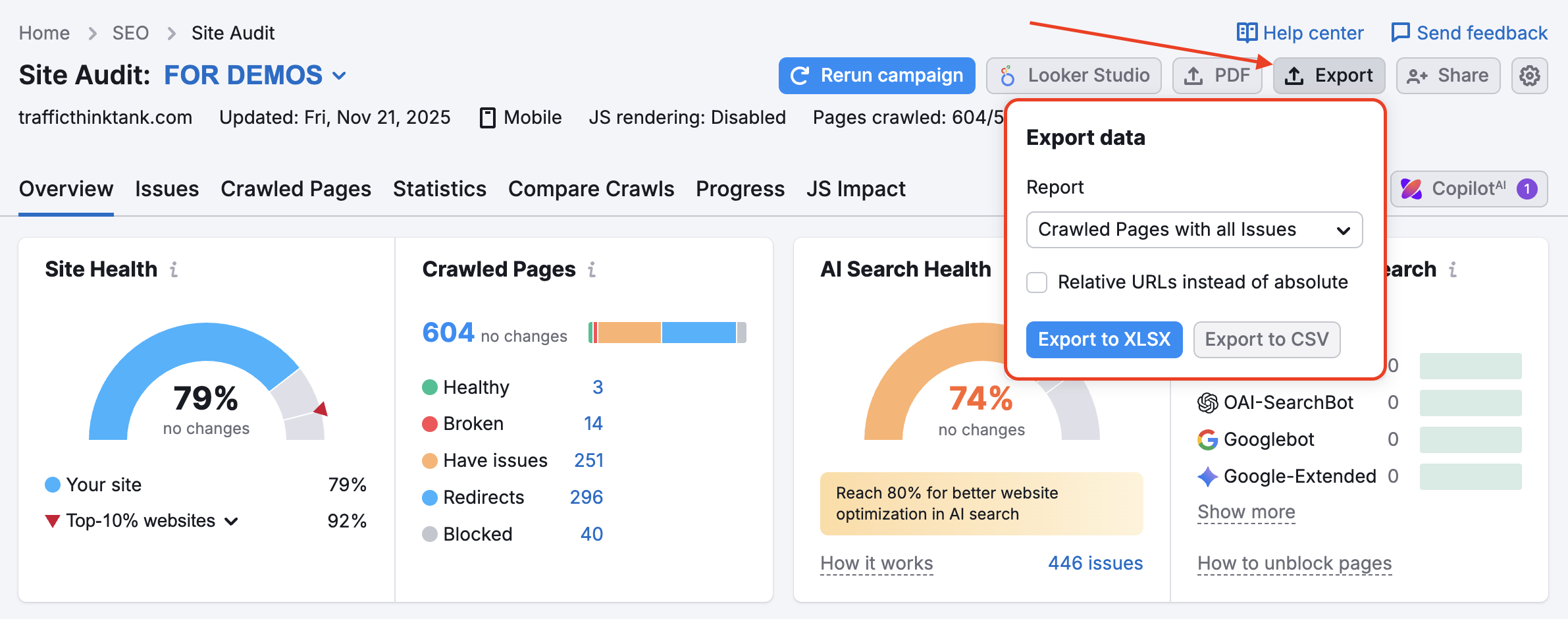
The newest addition is AI search auditing: the crawler now reports which AI bots (ChatGPT-User, OAI-SearchBot, Google-Extended) are blocked from the site and scores AI Search Health separately from classic technical health.
An SEO audit here exports cleanly: issues can be sent as tasks to Trello, and the audit tool integrates with Google Analytics and Search Console so crawl data and behavioral data sit in one report.
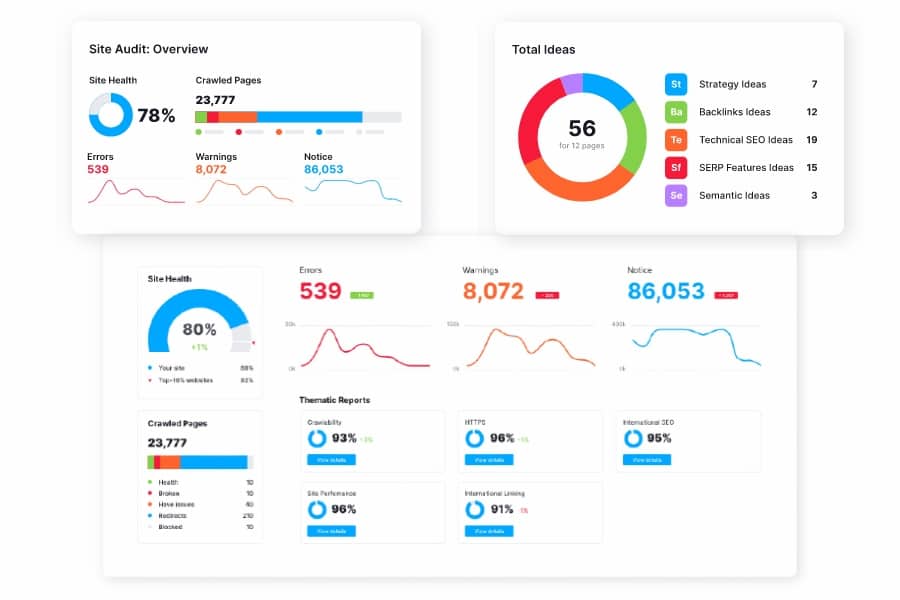
For teams managing crawls across many clients, audits run per project with separate schedules and quotas.
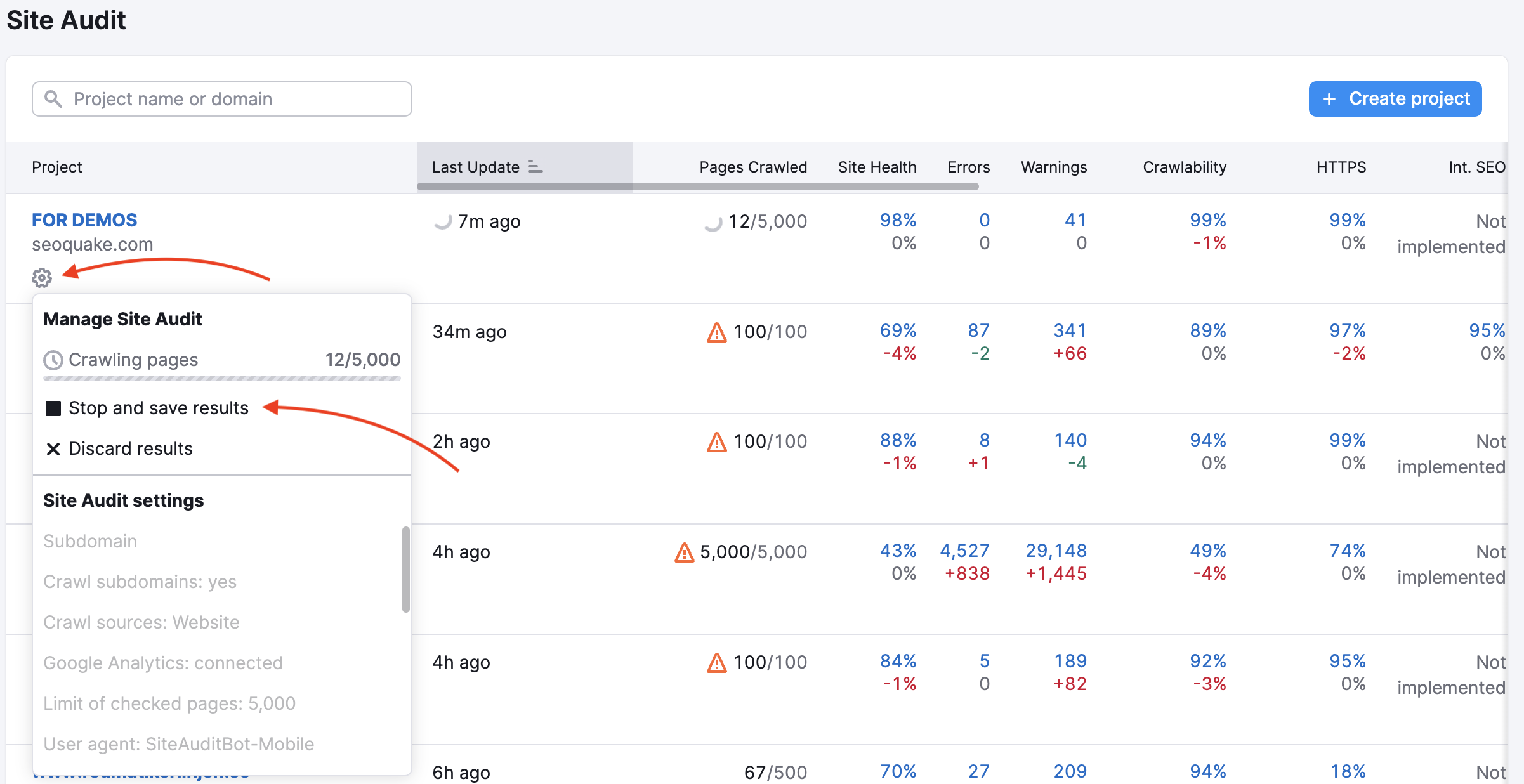
Backlink Analysis and Link Building
Semrush has over 43 trillion backlinks indexed, which the company positions as the largest link index on the market.
Backlink analysis shows when a domain gains or loses backlinks, the authority of the linking pages, and anchor-text distribution across backlink profiles.
The Backlink Gap tool identifies missed backlink opportunities by comparing backlink profiles across up to five competitors, and the backlink audit identifies toxic links for disavowal.
The Link Building Tool turns that backlink data into an outreach queue: it finds prospects, connects a mailbox, and tracks which targets replied, turning link building into a managed pipeline that replaces the spreadsheet most teams start with.
Two honest caveats: toxic-link scoring runs aggressive, and disavowing everything it flags can hurt more than help; and link counts from any vendor's index differ from what Google Search Console shows, because each crawler sees a different web.
Content Marketing Tools
Content marketing tools here cover topic research, brief creation, and optimization scoring. The Semrush SEO Writing Assistant scores drafts for readability, originality, tone, and keyword usage; the SEO Writing Assistant runs in the browser and inside Google Docs, so writers get scoring without leaving their draft.
The SEO Content Template generates a brief from the top-ranking pages for a target keyword: recommended length, related keywords to include, backlink data on who links to competitors, and readability targets.
The On Page SEO Checker aggregates SEO ideas for existing pages: strategy ideas, backlinks ideas, technical SEO ideas, SERP feature ideas, and semantic ideas, ranked by which pages have the most to gain.
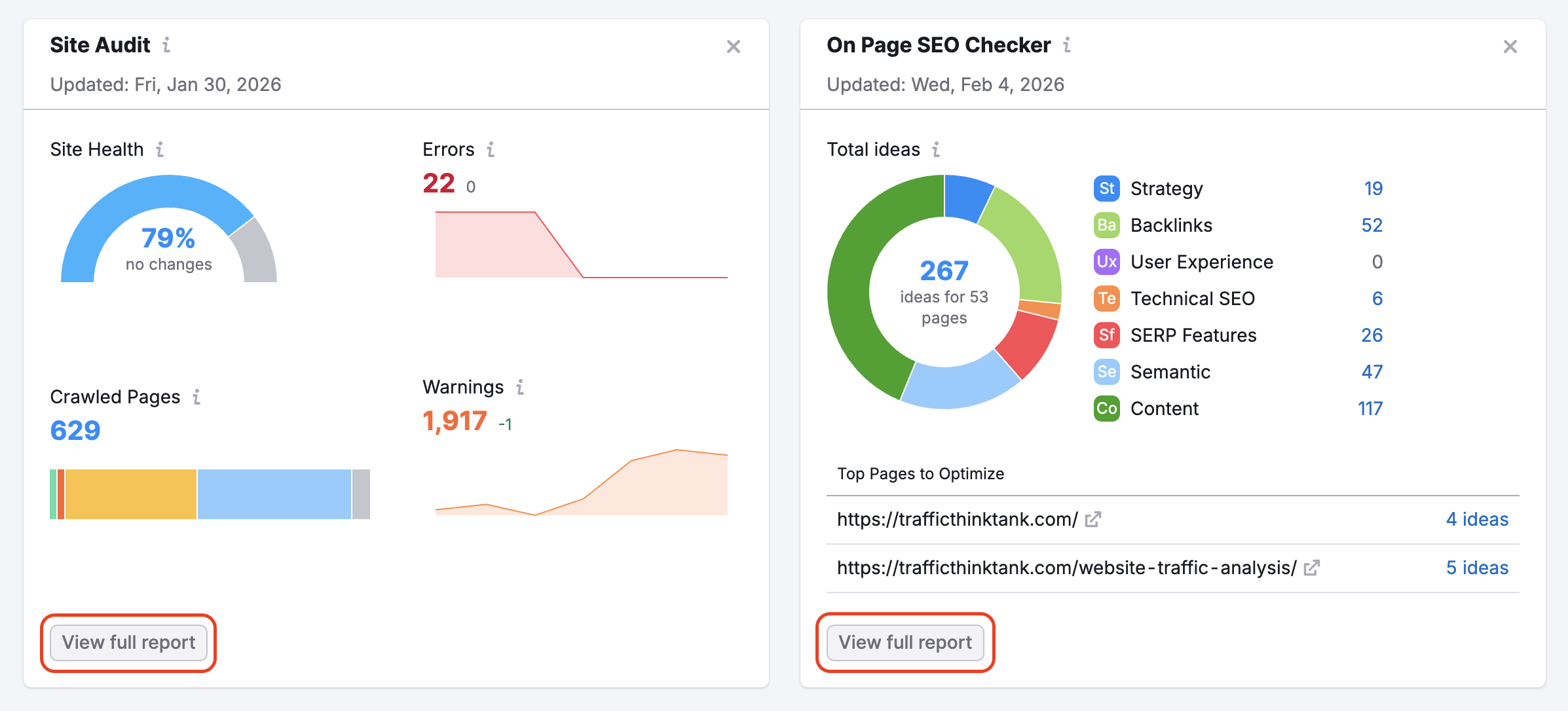
On page SEO work benefits most from the idea ranking: the tool orders pages by potential traffic gain, which is the correct order to work in.
AI Visibility: The 2026 Toolkit
Semrush tracks AI visibility across platforms like ChatGPT, Gemini, Google AI Overviews, and Google AI Mode: how often a brand gets mentioned, which pages get cited, and how the brand gets described.
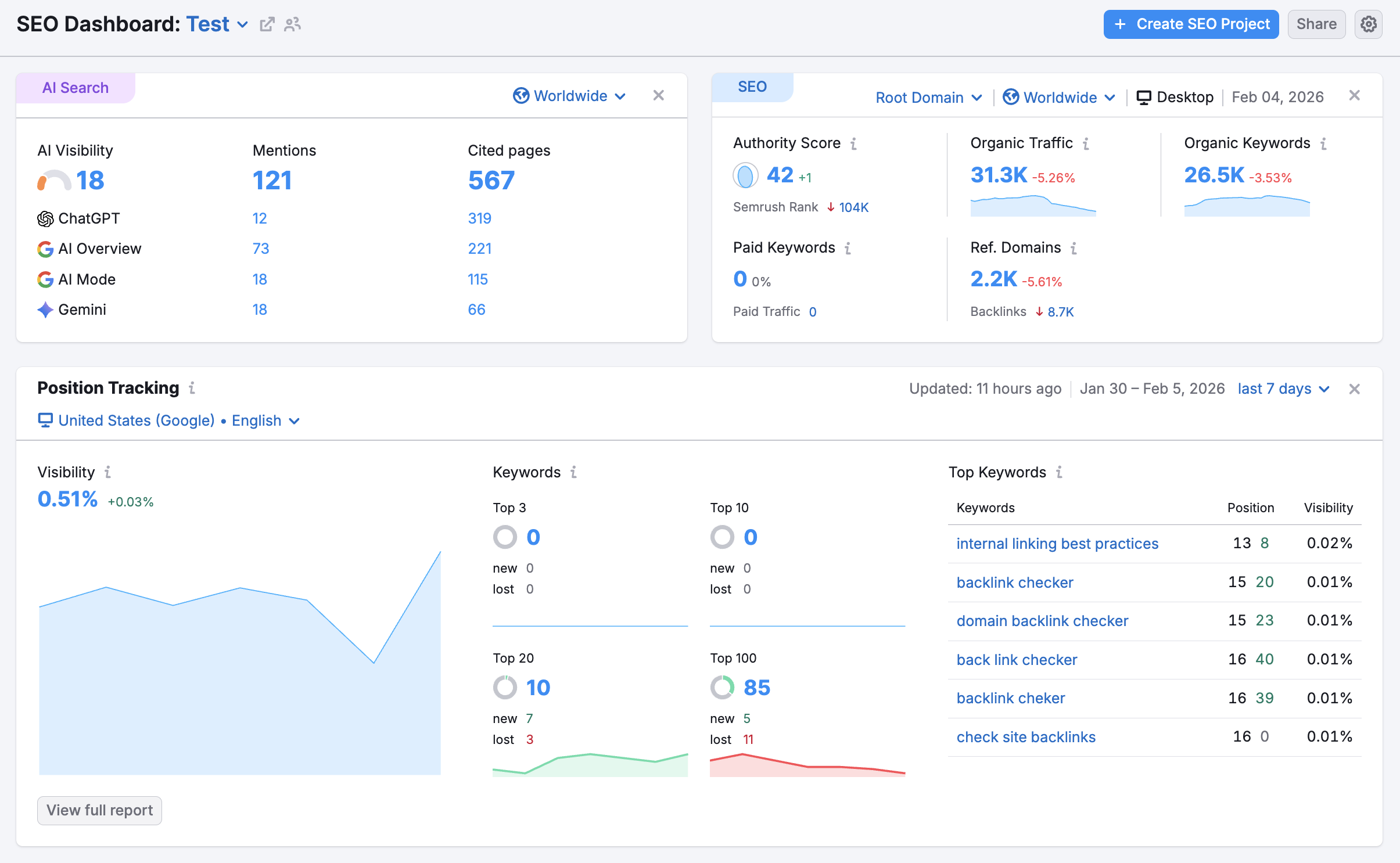
The AI visibility score indicates brand performance in AI-powered search and updates daily based on tracked prompts; prompt tracking is now bundled into every self-serve tier, at 50 prompts a day on Starter, 100 on Pro+ and 200 on Advanced.
The underlying research is substantial: the 2026 AI Visibility Index analyzed 126 million US AI search prompts from January through April 2026, scaled up from 2,500 prompts in the study's first edition.
Two findings from that index explain why platform-by-platform tracking matters: ChatGPT cites an average of 15 sources per response, leaning on Reddit and Wikipedia, while Gemini cites an average of 3, so the same brand can dominate one engine and barely exist in another.
Is SEO Dead or Evolving in 2026?
Evolving, and the data in this platform documents exactly how. Adobe's own measurement puts AI traffic to US retail sites up 1,324% between October 2024 and May 2026, and up 2,215% for travel sites, while classic organic search traffic still dwarfs AI referrals in absolute volume for most sites.
The practical read: search engines still send most of the visits, but a growing share of buying decisions form inside AI answers before anyone clicks a search result.
That is why the SEO strategy conversation moved from rankings alone to visibility: the same crawlable, well-linked, well-structured content that ranks in organic search results is also what AI engines cite.
Semrush found that 45% of marketing leaders cannot accurately measure their brand visibility in AI-generated answers, and only 9% have tools tracking all relevant metrics across platforms; the vendors racing to close that gap are the same popular SEO tools that measured rankings, which is precisely why Adobe paid $1.9 billion for this one.
For practitioners, the working conclusion is neither panic nor complacency: keep winning classic rankings, because they still deliver the volume, and start measuring AI citations now, because the benchmarks in the 22-industry index show visibility varies wildly between platforms even for identical brands.
The Project Dashboard
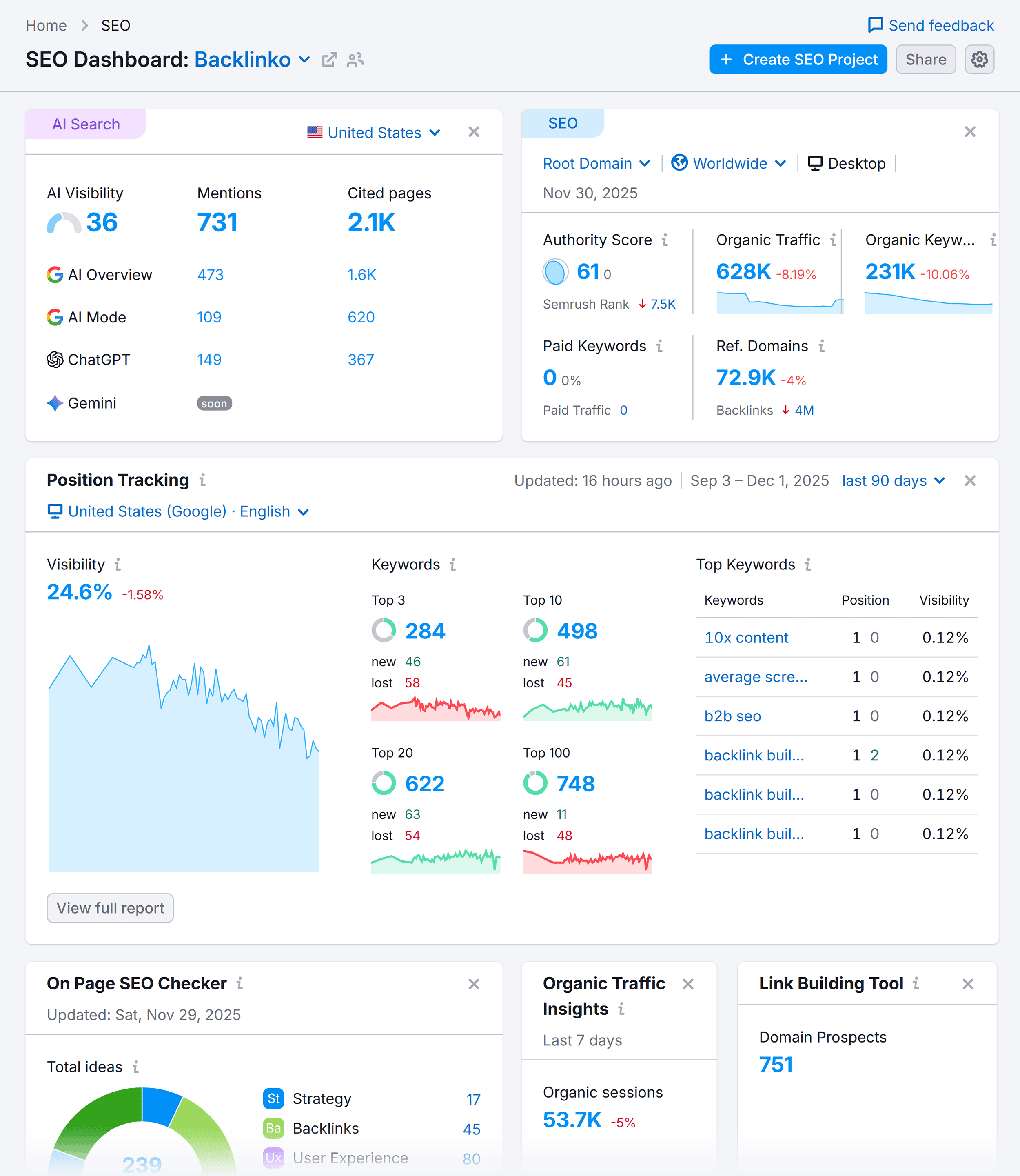
Every domain you manage becomes a project, and the project dashboard assembles domain analytics, position tracking, site audit, backlink audit, and on page SEO checker into one screen.

Semrush is designed for professionals managing multiple sites, and the dashboard is where that shows: an agency analyst can review a client's search traffic, crawl health, and keyword rankings in five minutes before a call.
What Using Semrush Looks Like Week to Week
A working routine makes the subscription pay, and users who've logged months on the platform converge on some version of the same loop.
Monday starts on the project dashboard: position tracking first, checking which keywords moved and if a Google update marker explains it, then the domain overview of the two closest competitors to see if their curves moved the same way.
Midweek is production: pull the next content piece from the keyword research backlog, build the brief, and work through SEO ideas the On Page SEO Checker queued for existing pages, starting with the highest-traffic candidates.
One block goes to link building outreach from the prospect queue, and one to audit fixes, clearing the errors before the warnings.
Friday is reporting: SEO metrics into the client or stakeholder report, wins annotated, next week's targets set.
The Semrush features that earn daily use are a short list, tracking, audits, keyword tools, and the checker, and this Semrush review would summarize the rest of the 55+ as useful monthly.
The point of the routine is that the Semrush SEO toolkit stops being a lookup service and becomes the production line; that shift is where subscribers report the tool paying for itself.
Semrush for Agencies and Consultants
Agencies are the platform's natural habitat, and the plan structure shows it: sites, keyword quotas and multi-location tracking scale with the Pro+ and Advanced tiers, while white-labelled PDF reporting sits in the $20 Pro Report add-on.
SEO consultants live in the reporting layer: scheduled client reports pull search rankings, traffic estimates, and audit deltas automatically, which turns a half-day of screenshot assembly into a template.
Digital marketing agencies also lean on the lead-qualification angle: running a prospect's domain through the audit and domain overview produces a sales-ready gap analysis in under an hour.
The constraint to price in: tracked-keyword quotas are shared across the account, so an agency tracking 100 terms per client hits the 1,500-keyword Pro+ ceiling at 15 clients and has to move up to Advanced.
For pitching, the Potential Growth forecasts give consultants a defensible number to put in proposals, defensible because it is scoped to specific keywords.
From Seed Keyword to Published Page
The content workflow is the clearest demonstration of how the pieces connect, so here it is end to end.
Start in the Keyword Magic Tool with one seed keyword; filter the keyword suggestions by intent and volume, prune the subgroups that don't fit, and shortlist the relevant keywords with a keyword difficulty your site can realistically win.
Check search volume trends on the shortlist to avoid writing for a declining query, and run the target keyword through keyword overview for the SERP features you'd be competing with.
Generate an SEO Content Template for the winner: it reads the top ten search results and returns recommended length, semantically related terms, and target readability.
Draft in Google Docs with the Semrush SEO Writing Assistant scoring the text live, publish, then add the page to position tracking the same day.
Keyword research done this way closes its own loop: the tracking data shows within weeks if the brief was right, and the next brief gets better.
Advertising Research and PPC
The advertising side gets less press than the SEO features but carries real depth for online marketing teams.
Advertising research shows competitors' search ads history: the copy variants they ran, how long each survived, and which landing pages they sent traffic to; ad copy that runs unchanged for months is copy that converts.
PLA research covers Google Shopping: which products competitors promote, at what price points, and with what copy, useful for retailers calibrating their own feeds.
Keyword-level CPC data sits in the same tables as organic difficulty, so a team can weigh paid search against organic investment per target keyword and route budget to whichever is cheaper for that query.
.Trends: The Market Intelligence Layer
The .Trends add-on extends the platform from a particular site's SEO into market-level analysis: industry traffic trends, market share by domain, audience overlap, and demand shifts by category.
This is the module that pushes Semrush into market intelligence territory: keyword analytics across a whole category reads as a demand curve, and competitor analysis at the traffic-share level reads as market share movement.
For most marketing teams the core plans cover the need, but strategy and insights teams comparing category players will find .Trends closer to a lightweight Similarweb than to the rest of Semrush.
Semrush also owns Exploding Topics, the trend research tool it acquired from Brian Dean and Josh Howarth, which covers the demand-side signal .Trends doesn't: topics growing before they show meaningful search volume.
Integrations
You can connect Semrush to Google Analytics and Google Search Console, which upgrades several reports: organic traffic insights merges your real behavioral data with keyword data, and the site audit cross-references crawl findings with actual sessions.
Beyond Google, you can connect Semrush to other tools as well: Looker Studio for reporting, Trello for task export, Google Docs for the writing tools, and a Chrome extension for on-the-fly checks.
Reporting supports white-label PDFs on higher tiers, the standard agency deliverable, and scheduled email reports for clients who never log in.
↑ FACT SHEETWhere the Numbers Come From
Understanding the data sources prevents most misreadings of the reports.
Keyword and volume figures come from clickstream panels, search-suggestion mining, and Google Ads data, modeled into monthly estimates; they update on rolling cycles, with popular terms refreshed more often than obscure ones.
The link index comes from Semrush's own crawler working through those 808 million domains; index size and freshness trade off, which is why the largest index is not automatically the most current one.
Traffic estimates blend panel behavior with modeled distributions, which is why they hold up well for large consumer sites and wobble for small B2B ones.
None of this is unusual; every vendor in the category models the same way. The difference is disclosure, and Semrush documents its methodology in more detail than most rivals.
Setting Up Semrush Properly
A surprising share of negative reviews trace to setup shortcuts, so a first-week checklist is worth writing down.
- Create one project per domain, connect Google Analytics and Google Search Console immediately, and let the integrations backfill before judging any report.
- Load position tracking with the keywords that already drive revenue; the baseline matters more than the wish list.
- Set the site audit crawl budget to cover the whole site once, then throttle to weekly scheduled crawls.
- Configure competitors in tracking and in the gap tools on day one, since every comparative report keys off that list.
- Turn off email digests you won't read, and keep the weekly rank-change alert; signal beats volume.
Set up this way, the first month produces a defensible before/after baseline; set up casually, the same subscription produces four dashboards nobody trusts.
↑ FACT SHEETSemrush Pricing: How Much Does It Cost Per Month?
The Current Plans
The Pro, Guru and Business names most comparison articles still quote are gone. Semrush rebuilt its price list around four self-serve tiers plus Enterprise, and the AI-search features that used to sell as a $99 add-on are now bundled into every tier.
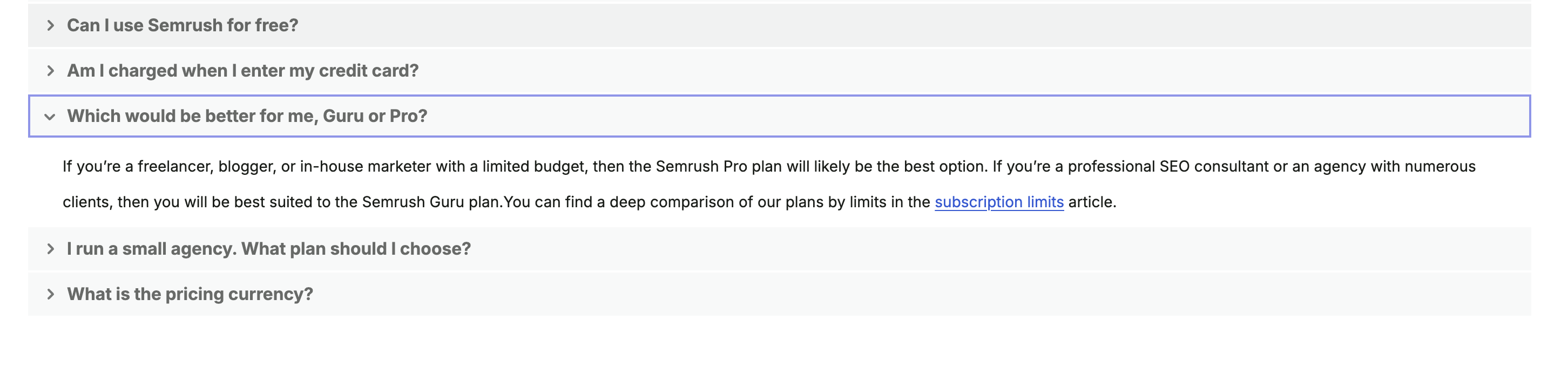
How recently that happened shows in Semrush's own FAQ. At the bottom of the pricing page, a question still asks "Which would be better for me, Guru or Pro?" and the answer still routes buyers toward plans the page no longer sells: freelancers and in-house marketers to "the Semrush Pro plan," agencies with numerous clients to "the Semrush Guru plan."
Neither tier appears anywhere above it, and the linked subscription-limits article compares a lineup that no longer exists.
| Plan | Monthly | Billed annually | Sites | Keywords tracked daily | AI prompts tracked daily |
|---|---|---|---|---|---|
| SEO | $139 | $117.33/mo | 5 | 500 | Custom prompt monitoring |
| Starter | $199 | $165.17/mo | 5 | 500 | 50 |
| Pro+ | $299 | $248.17/mo | 15 | 1,500 | 100 |
| Advanced | $549 | $455.67/mo | 40 | 5,000 | 200 |
| Enterprise | Custom, quoted through a demo request | ||||
Prices from semrush.com/pricing/, checked 6 August 2026. Annual billing saves up to 17%.
SEO is the base tier and the only one not branded "SEO + AI Search", though it still carries AI-search performance tracking, AI sentiment monitoring and AI visibility reports for any domain. Starter adds keyword optimization tools, competitor insights, MCP access and 50 tracked prompts a day against one domain.
Pro+ is where the tier jump earns its money for most teams: historical SEO data, content optimization, keyword cannibalization analysis and multi-location tracking arrive together, alongside triple the sites and triple the keywords. Advanced adds SEO Share of Voice and API data integration, and it's the only tier without a free-trial button on the pricing page.
Add-Ons
Four add-ons bill separately on top of any plan: Additional Users from $45 a month, a Lead Generation listing on the Agency Partners platform at $90, a Base Report at $10, and a Pro Report at $20 that adds white-labelling, external integrations and scheduled delivery.
Every plan still includes one user seat, so a three-person team pays the sticker plus $90 a month before touching reports. That's the line item that surprises teams comparing quotes.
Getting the Price Down
Discount levers exist beyond the 17% annual saving: seasonal promotions run several times a year, exam-passing Academy users occasionally receive offers, and downgrade threats at renewal reliably produce retention pricing on annual contracts.
Teams should also audit add-ons quarterly; extra seats, report tiers, .Trends and the agency listing each bill separately, and stale add-ons are the most common source of invoice creep reported by long-term subscribers.
The most reliable saving remains structural: buy the tier your quotas require, since the jump from Starter to Pro+ only pays for itself once historical data, content optimization or cannibalization analysis enters weekly use.
Free Trial and Free Tier
Semrush offers a 7-day free trial, stated as such across its own site and in its refund policy, plus a permanently free account limited to 10 requests per day and one project. A credit card is required, and the trial converts to a paid plan automatically unless cancelled first.
The free trial is enough to run one real project: connect a site, run a full site audit, load your keyword list into position tracking, and judge the keyword data against what Google Search Console shows before paying.
From an SEO point of view, the trial's most useful test is coverage: check that your niche's search volume numbers and related keywords look sane, because database quality varies by market and language.
What Is Better Than Semrush?
Nothing is better across the board; several other SEO tools are better at one thing.
- Ahrefs is the closest rival, preferred by many for link index freshness; Ahrefs also allows tracking of up to 10 competing sites in its comparison views where Semrush caps at 4. Semrush counters with a wider feature set, paid search depth, and the AI toolkit.
- Moz Pro is considered more user-friendly than Semrush, and its simpler interface suits beginners, at the cost of shallower data.
- Similarweb beats it for traffic estimation and market share work, with far weaker keyword tooling.
- Google Search Console and Google Analytics are free and measure your own site precisely, but say nothing about competitors; every serious stack runs them alongside a paid platform. Neither replaces the other.
- Surfer, Clearscope, and similar single-purpose apps go deeper on content scoring than the writing tools here.
When Semrush compares against these rivals in published head-to-heads, the summary repeats: best breadth, best ad-research data, largest link index on paper; not always the freshest crawl, and rarely the cheapest.
So is it the best SEO tool? By breadth, yes; it is the best tool for a team that wants one subscription covering everything, while a specialist wanting the single deepest link index or the friendliest interface will pick differently.
The "best SEO tool" question resolves to workload: teams replace three or four other tools with it, and that consolidation, and no single report, is the winning argument.
Who Is Semrush Best For?
Semrush is suitable for individual consultants through to enterprise marketing teams, and the plan tiers map to that range.
The best fit is anyone responsible for organic growth across one or more sites: agencies, in-house SEO teams, content leads, and SEO consultants juggling client reporting.
Local SEO work is covered through a separate Local toolkit (listings management, map rank tracking) sold as its own subscription, so a purely local business should price that bundle.
Affiliate publishers and anyone running a monetized site get direct value from the intent data: filtering keyword research to commercial intent is how a monetized site finds pages that pay for the subscription.
A business that only wants contact lists for outbound sales is in the wrong aisle; Semrush is not a lead generation tool in the sales-database sense, and ZoomInfo covers that job.
Weaknesses and Limitations
- Semrush has a steep learning curve due to its extensive feature set; new users report weeks before the deeper reports feel navigable.
- Single-seat plans make team use expensive; the effective price for a three-person team is far above the sticker.
- Traffic and volume figures are estimates, and accuracy drops for small sites and non-English markets.
- Quotas (tracked keywords, crawl pages, reports per day) bind faster than expected for agencies, forcing plan upgrades.
- The toxic-link audit over-flags, and acting on it uncritically can disavow links that were helping.
- Feature sprawl: most subscribers use a fraction of the Semrush features while paying for all of them.
Is Semrush Trustworthy?
As a company, yes by ordinary measures: a public company since 2021, now Adobe-owned, with transparent methodology documentation for its databases and indexes.
As a data source, trust it the way you trust any model: its keyword and traffic numbers are estimates built from clickstream panels and crawls, good for comparisons and trends. Audited absolutes they are not.
The correct workflow treats Semrush numbers as relative signals, verified against Google Search Console for your own properties, and that combination is reliable enough that most of the industry runs on it.
User Experience and Onboarding
The interface is dense, and the first week is mostly learning which of the 55+ entry points matter for your job; the SEO features you need daily fit on the project dashboard once configured.
Onboarding help includes guided tours, a large knowledge base, the Semrush Academy course library, and webinars; the Academy certifications are free and double as team training.
Most users settle into a stable loop within a month: dashboard check, position tracking review, audit fixes, keyword research for new content, repeat.
Semrush Academy and Certifications
The Academy deserves its own mention because it changes the adoption math for teams.
It offers free structured courses with exams and certificates, covering the platform's own reports as well as general search-marketing fundamentals, taught in short video modules.
For a manager onboarding juniors, assigning two or three Academy certifications in week one is cheaper than shadow-training and produces a shared vocabulary for the reports everyone will read.
The certificates also circulate on LinkedIn as hiring signals; treat them as proof of familiarity, the same way a driving licence proves competence and stops there.
The Enterprise Tier
Above the listed plans sits a separate enterprise platform, quoted through sales, with its own infrastructure: larger crawl budgets, API-first access, automated executive reporting, and account management.
It targets brands managing thousands of pages and dozens of markets, where quota mathematics on the standard tiers stops working entirely.
Buyers at that scale should run the same evaluation as mid-market buyers, just with sharper questions: crawl capacity against the real page count, seat counts against the real team, and data export rights against the internal BI stack the reports must feed.
Customer Service
Support runs through chat and email, with response quality generally rated well in user reviews; phone support exists for higher tiers, and enterprise accounts get named contacts.
Response times reported by users cluster around hours for chat and a business day for email, faster than most data vendors at comparable price points.
The recurring service complaint sits on the billing side. It is the single most documented problem with this company, and it deserves its own section.
↑ FACT SHEETBilling, Cancellation and the Refund Policy
Semrush advertises a 7-day free trial and, separately, a 7-day money-back guarantee. Those are two different promises, and the gap between them produces most of the complaints filed against the company.
The Cancellation and Refund Policy, last updated 20 August 2025, limits the money-back guarantee to two situations: an initial subscription "where the subscription term committed to is twelve months or greater in duration" and an initial add-on purchase. It then states the consequence directly:
For clarity, refunds are not available for month-to-month subscriptions.
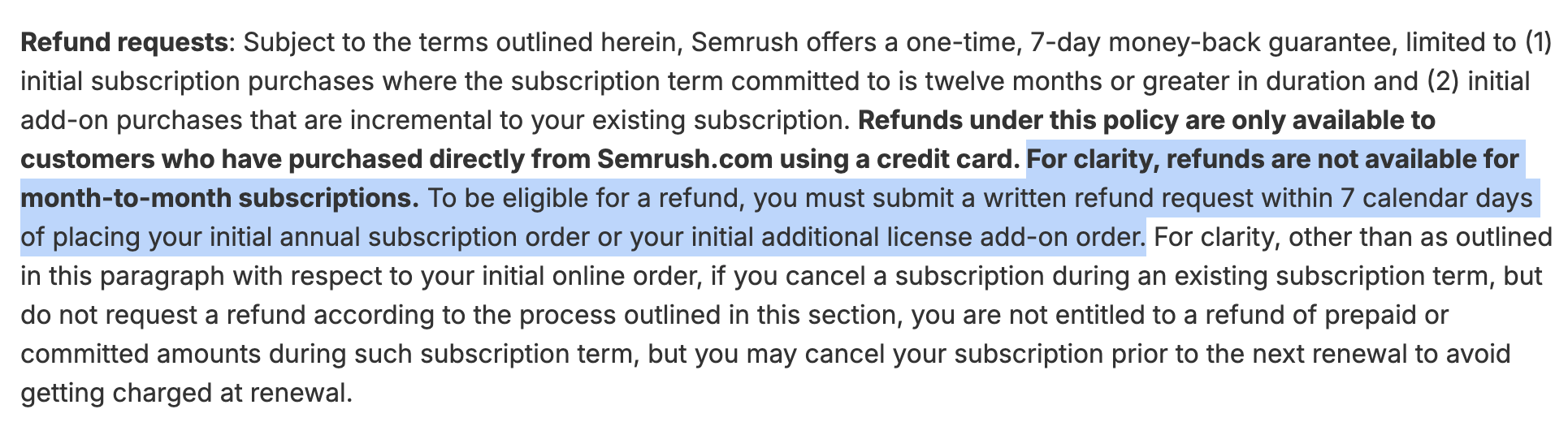
A free trial that converts to a monthly plan therefore carries no refund right at all. The same policy confirms the conversion is automatic: "your first payment will be charged automatically at the end of the trial period unless you cancel beforehand."
Two procedural clauses tighten it further, and both appear in that same document. Cancellation runs through a logged-in form, and failure to answer every question on it "may result in the denial of your cancellation request." A refund is a separate act from a cancellation: you "must explicitly state your refund request in the additional comment field." Cancel correctly and omit that sentence, and the charge stands.
Before starting the trial. If you intend to test Semrush and stop, the monthly plan gives you no refund rights under the published policy. Cancel through the account form several days before the trial ends, answer every field, and type the refund request into the comment box even if you think you are inside the window.
What the Complaint Record Shows
Semrush, Inc. is not BBB accredited and carries 55 complaints over three years, 38 of them closed in the last twelve months. Of those 55, the bureau records 51 as unanswered and 4 as resolved. The unanswered count is the number worth weighing, since it measures the company's own response rate.
Filed accounts from 2026 describe one pattern repeatedly.
| Charge | Filed | What the complainant states | Stated reason for refusal |
|---|---|---|---|
| $199.95 | Apr 2026 | Cancelled the same day the charge landed | The cancellation came after payment processed |
| $216.91 | Apr 2026 | Trial converted; refund asked for within three hours, no usage | The monthly toolkit is non-refundable |
| $289.00 | Apr 2026 | Refund requested inside the advertised 7-day window | Same monthly-plan rule |
| $1,399.50 | Apr 2026 | Cancellation confirmed by email March 2025; billing resumed that May at $139.95 a month for ten months | No response to the complaint, or to Discover |
Four of the 55 complaints on file, selected as the clearest statements of the pattern. Unverified consumer allegations.
The last row is the one worth pausing on. Provisional credits issued by Discover were reversed because Semrush didn't answer the bank, and the complainant then found the account disabled. Every row describes the published policy working as written.
Trustpilot reviews carry the same themes: denied refunds, a multi-step cancellation involving a form, an email confirmation, a verification link and a processing delay, and add-on toolkits activating after a trial without a separate opt-in. Practitioner threads on r/SEO report the same experience, including charges landing before the advertised seven days elapsed.
A billing class action, Quinlan v. Semrush, Inc., case 2:25-cv-06924, was filed on 10 December 2025 in the U.S. District Court for the Eastern District of Pennsylvania. The docket is public; the specific allegations are not yet reported, so treat the case as pending.
This Predates Adobe
The common explanation online blames Adobe, which completed its acquisition on 28 April 2026. The timeline doesn't support it. The refund policy carries a last-updated date of 20 August 2025, eight months before the deal closed, and the complaints summarised above were filed between March and April 2026, also before completion. The billing terms are Semrush's own, and they were in force well before the change of owner.
Where Do People Leave Reviews of Semrush?
G2, Capterra, and TrustRadius carry the bulk of buyer reviews, with consistently high overall ratings driven by feature breadth, offset by recurring complaints about price and complexity.
Reddit's SEO communities carry the unfiltered version: practitioners comparing quota limits, index freshness against Ahrefs, and renewal negotiations.
Is Semrush Worth It?
For anyone whose job includes competitive analysis of search results, yes, and the math is simple: one ranking win on a commercial target keyword typically pays for months of subscription.
Every honest Semrush review lands on the same qualifier, though: worth it is conditional on usage, and the digital marketing teams who complain about price are usually the ones using two tools out of fifty-five.
The subscription earns its price when it is used as a workflow, keyword research feeding content, audits feeding fixes, tracking feeding reporting.
For a hobby site or a team that only publishes occasionally, the free tier plus Google Search Console covers the need, and the paid plan will sit idle.
The strongest argument for it in 2026 is consolidation: an SEO toolkit, advertising research, competitive analysis, and AI visibility measurement in one bill, at a moment when the AI side is becoming mandatory to measure.
FAQ
What does Semrush do?
It measures search visibility: which keywords and search results any site wins, how its backlinks and technical health compare, what competitors spend on ads, and how often AI engines mention a brand.
How much does Semrush cost a month?
Four self-serve tiers: SEO at $139, Starter at $199, Pro+ at $299 and Advanced at $549 a month, with Enterprise quoted through a demo. Annual billing takes up to 17% off, bringing the entry tier to $117.33 a month.
Is there a free version?
Yes, a limited free account (10 requests per day, one project), plus a 7-day free trial on the SEO, Starter and Pro+ tiers. Advanced has no trial button on the pricing page.
Is Semrush trustworthy?
Yes for methodology and business legitimacy; its metrics are modeled estimates, so verify against your own analytics where possible.
What is better than Semrush?
Ahrefs for backlink work, Moz for beginners, Similarweb for traffic estimation, dedicated apps for content scoring; nothing matches its breadth in one subscription.
Who owns Semrush now?
Adobe, following an acquisition agreement announced in November 2025 at $12.00 per share, roughly $1.9 billion.
Does Semrush work for local businesses?
Yes, through a separate Local toolkit for listings and map rankings, priced independently of the main plans; local SEO buyers should quote that bundle specifically.
Can Semrush track AI search?
Yes; it tracks mentions and cited pages across ChatGPT, Gemini, AI Overviews, and AI Mode, with a daily-updated visibility score.
Does Semrush integrate with Google tools?
Yes: Google Analytics, Google Search Console, Google Docs, Looker Studio, and Google Ads data all connect into its reports.
How accurate is Semrush search volume data?
Accurate enough for prioritization in major English-language markets, looser in small niches and other languages; check a handful of known keywords in your niche during the free trial before trusting the rest.
Can I use it just for keyword research?
Yes; the Keyword Magic Tool alone justifies the Pro tier for content-heavy teams, though at that point the free tier's 10 daily requests may cover a light publishing schedule.
Does Semrush do social media management?
Yes, a social toolkit handles scheduling, monitoring, and analytics across major networks; it is serviceable, and dedicated social tools go deeper.
What changed after the Adobe acquisition?
Product direction tilted toward brand visibility measurement across AI platforms, and the Semrush One bundles launched; existing classic-plan subscribers kept their tiers, and the near-term risk to watch is price movement at renewal.
Bottom Line
Semrush remains the widest SEO tool on the market: 25 billion keywords, 43 trillion backlinks, 808 million domains, one subscription, and now the most developed AI visibility measurement of the major platforms.
The costs are a real learning curve, single-seat pricing that penalizes teams, and estimate-grade data that needs verification for high-stakes calls.
If search, in any engine, human or AI, drives your revenue, this is the default tool to trial first; run the 7-day free trial against your own site's numbers and let the data quality in your niche make the decision. Cancel it through the account form before day seven if you don't intend to keep it, since a monthly plan carries no refund right.