AI statistics for 2026: OpenAI has the users, Anthropic has the money
 By Jan Suski. I go deep on every review, checking every number against its source and digging up details other coverage misses, a habit from six years of SEO and link building for tech companies. Bylines at Surfer, Brand24, and Senuto. How the scoring works.
The numbers AI usage, spending and sentiment, February to September 2026
Nearly half of US adults and over half of US workers are now using generative AI tools.
Worry rises with use: 52% of Americans are more concerned than excited.
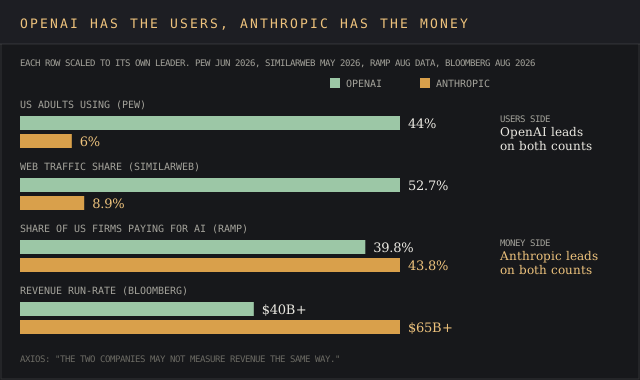
ChatGPT passed 1 billion weekly users in July, and Anthropic still books more revenue. Bloomberg puts Anthropic's run-rate at $65B+ against OpenAI's $40B+, with a caveat from Axios that travels with both numbers on this page: "The two companies may not measure revenue the same way."
These AI statistics use data published in 2026, each figure dated and linked. The set leans American because Pew, Gallup and the Census Bureau run the deepest artificial intelligence (AI) surveys, and it's built for analysts and business buyers who have to defend an AI usage number.
- Jun 17: Pew counts 49% of US adults on AI chatbots.
- Jul 29 to Aug 11: 30M+ Copilot seats, then 1B+ users each for ChatGPT and Gemini.
- Aug 13 to 17: OpenAI's run-rate tops $40B, Anthropic's $65B+. The two companies may not measure revenue the same way (Axios).
- Aug 26: Nvidia posts $96.2B in quarterly revenue.
- Sep 13: a bubble call, as top-1% AI spend falls 9.7%.
- Sep 17: a median 46% across 25 countries expect AI to cut jobs.
AI adoption statistics: 49% of US adults, 52% of workers, 19.8% of firms
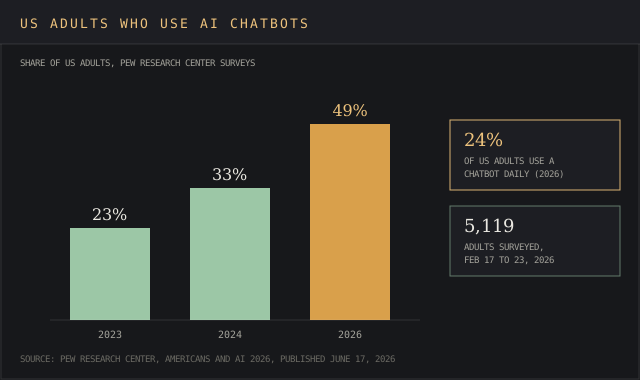
Pew found 49% of US adults using AI chatbots, up from 33% in 2024 and 23% in 2023. 24% use one daily, so generative AI is now part of everyday life for a quarter of the country.
AI now sits in daily tasks for many Americans. Pew's companion report found 96% of US adults know at least something about AI, 48% have heard a lot (26% in 2022), and nearly four in ten are using AI several times a day.
Gallup found 50% of US employees using AI at work in Q1 2026 and 52% in Q2, against 21% in Q2 2023. Only 13% are using AI every day, though non-users are now a minority at work.
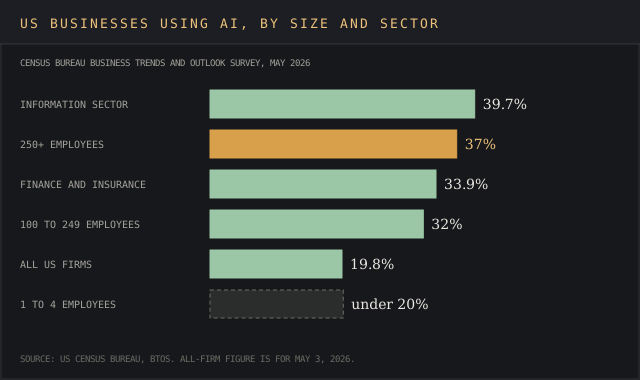
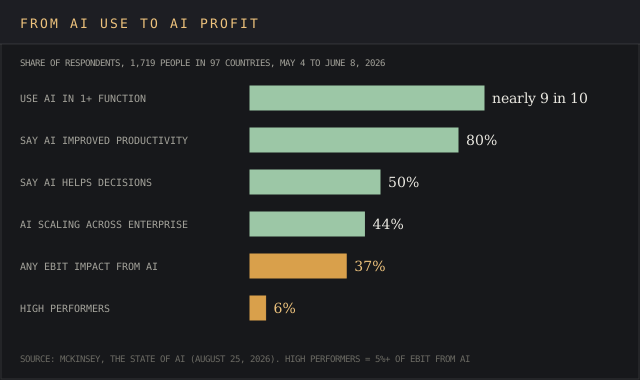
Businesses trail people on AI. The Census Bureau counted 19.8% of US businesses using AI on May 3, 2026; a worker can use ChatGPT at a business with no formal AI in its business operations. Larger business surveys read higher: in McKinsey's State of AI, nearly nine in ten respondents report regular use of AI in at least one business function, and 44% say it's scaling across the enterprise.
AI adoption by business size: 37% of large firms, under 20% of the smallest
| Business size or sector (Census, May 2026) | Share using AI |
|---|---|
| 250+ employees | 37% |
| 100 to 249 employees | 32% |
| 1 to 4 employees | under 20% |
| Information sector | 39.7% |
| Finance and insurance | 33.9% |
Small firms are catching up fast. The JPMorgan Chase Institute puts adoption at 17.7% of small businesses by end-2025, 26.1% for employer businesses against 15.3% for sole operators. Its 2025 cohort hit 10% adoption in six months, a mark the 2019 cohort took over six years to reach.
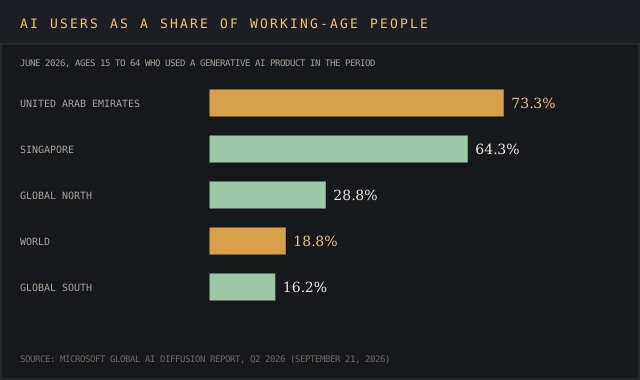
AI adoption by country: UAE 73.3%, Singapore 64.3%, the US 24th
Microsoft's Global AI Diffusion Report counts AI users at 18.8% of the world's working-age population in June 2026. The UAE (73.3%) and Singapore (64.3%) lead, and the gap is widening: 28.8% in the Global North against 16.2% in the Global South.
Stanford's 2026 AI Index uses a different measure and agrees. Generative AI reached 53% population adoption within three years, faster than the PC or the internet. Singapore sits at 61% and the UAE at 54%, while the US ranks 24th at 28.3%.
China counts its users differently. Its AI-native apps reached 499M monthly users in May 2026, per QuestMobile: Doubao 382M, Qwen 167M and DeepSeek 130M. China also took about 41% of Hugging Face Hub downloads over the trailing year. That pull on open AI development and model technology flies under the radar in US-centric numbers, though not for Nvidia's CEO:
"These Chinese models are excellent," ... "Open-source models that are excellent should be used."
Jensen Huang, founder and CEO, Nvidia, Axios, July 22, 2026
AI usage statistics: over a third of people across the OECD use generative AI, with a 53.6-point age gap
People take up AI faster than firms across the OECD as well. Its January 2026 release counts more than one-third of individuals using generative AI tools in 2025, against 20.2% of firms, up from 8.7% in 2023. Age splits usage hardest, a 53.6-percentage-point gap between groups. Gaps by education level and income run near 21 points, and the gap between men and women is 4.2 points.
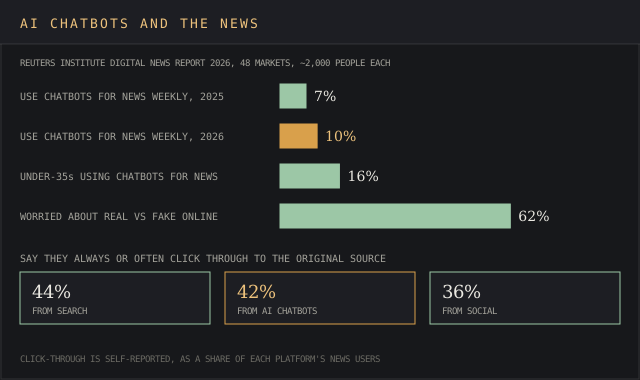
Three-quarters of students aged 16 and over use generative AI, against 12.5% of retired and inactive people, and 41.1% of employed people do, per the same OECD data. Weekly news use through chatbots reaches 17% of 18 to 24s, the Reuters Institute found.
| Firm group (OECD, 2025 data) | Share using AI |
|---|---|
| Swedish ICT firms | 87.9% |
| ICT firms, OECD | 57.3% |
| Large firms, OECD | 52.0% |
| Firms in Denmark, Finland and Sweden | above 35% |
| All firms, OECD | 20.2% |
| Small firms, OECD | 17.4% |
Source: OECD, January 28, 2026. Small firms sit under 20% here and in the Census count above.
At work, the number depends on the question asked. Pew finds 38% of employed US adults using AI chatbots for work, Gallup counts 52% of employees using AI at work, and the Census Bureau's firm count has held in a 17% to 20% band since December 2025. In McKinsey's survey, 47% of mid-level managers and individual contributors report negative consequences from AI use.
Microsoft's Work Trend Index 2026 classes 16% of AI users as "Frontier Professionals", and 58% say they produce work they couldn't a year ago.
ChatGPT's billion weekly users arrived about seven months behind OpenAI's own target, The Next Web notes. Google's AI Mode in Search passed 1 billion monthly users a year after launch, per TechCrunch. Pew puts Grok at 8% of US adults, and Google still holds 91.02% of search, per StatCounter.
After ChatGPT made brand names clickable on May 7, homepage referrals rose from about 26% to 29% of its referral traffic to about 62% to 63%, Similarweb found. Among open models, about 40% of new LLM derivatives build on Qwen, per Hugging Face.
"This year, Azure revenue surpassed $100 billion for the first time, and Microsoft 365 Copilot reached over 30 million paid seats, reflecting the confidence customers are placing in us to power their AI transformation."
Satya Nadella, chairman and CEO, Microsoft, FY26 Q4 release, July 29, 2026
AI market size: $2.7 trillion in spending, $539.5 billion in revenue, and the first crack
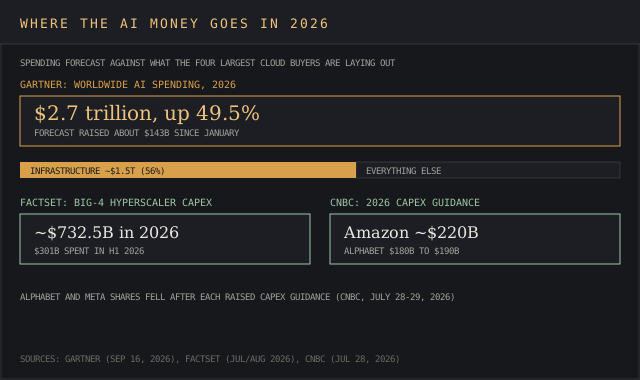
Gartner forecasts $2.7T in worldwide artificial intelligence spending for 2026, up 49.5%, with about $1.5T (56%) in infrastructure. It raised the number by about $143B since January, and that rapid growth is the clearest read on AI's weight in the global economy.
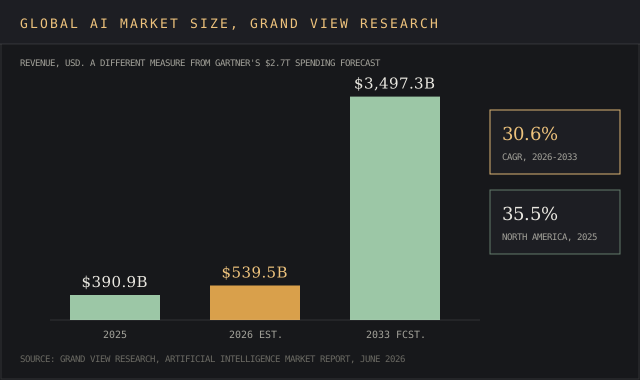
Revenue estimates run smaller because they count what AI businesses sell. Grand View Research values the AI market at $390.9B in 2025 and $539.5B in 2026, reaching $3,497.3B by 2033 at a 30.6% CAGR. North America held 35.5% in 2025, with Europe, Asia Pacific, Latin America and the Middle East and Africa sized separately.
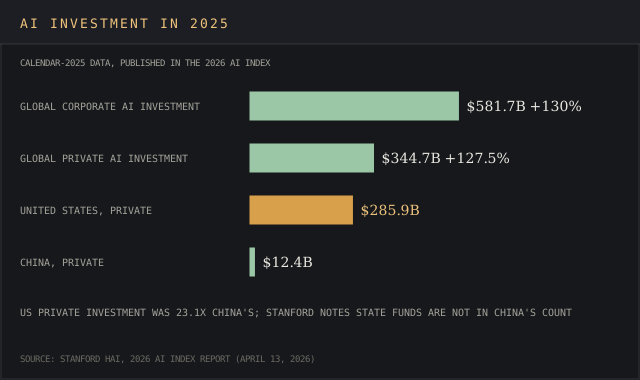
Investment ran ahead of revenue. Stanford's AI Index counts $581.7B in global corporate AI investment in 2025, up 130%, and $344.7B in private investment. US private investment reached $285.9B, 23.1x China's $12.4B, though Stanford notes China's state guidance funds sit outside that count.
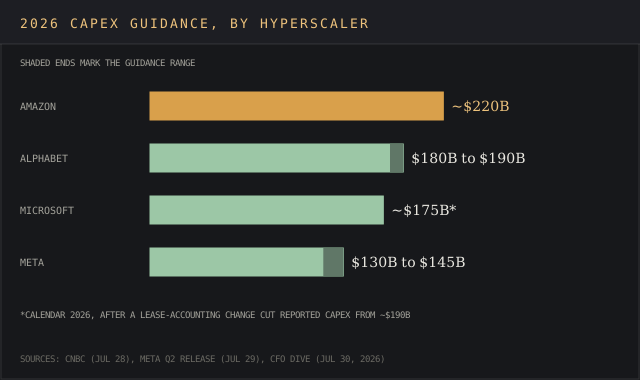
Cloud buyers take the lion's share of AI technology spending. The big-4 hyperscalers spent $301B on capex in H1 2026, and FactSet's read of guidance implies about $732.5B for the year. Amazon guides about $220B and Alphabet $180B to $190B, Meta $130B to $145B, and Microsoft about $175B for calendar 2026, cut from $190B by a lease-accounting change.
Alphabet and Meta shares fell after both raised guidance. Nvidia's CEO holds the positive outlook, while Capital Economics forecasts the S&P 500 falling 21% to 6,500 by end-2027.
"AI has reached its inflection point. It's doing useful work. Its tokens are productive and profitable. Now, compute is revenue," ... "And demand is accelerating."
Jensen Huang, founder and CEO, Nvidia, Q2 FY27 results, August 26, 2026
"On balance, we think the data look consistent with a late-stage bubble," ... "Most of the factors we consider are at, or close to, levels that have preceded past stock market peaks."
James Reilly, senior markets economist, Capital Economics, Fortune, September 13, 2026
Ramp's card data shows the first crack. AI spend per employee at the top 1% of businesses fell 9.7% in August, from $7,976 to $7,205 a month, and Ramp flags a possible summer effect. Token prices fell 41%, from $1.15 per 1M in March to $0.68. One month is thin evidence.
AI's influence now reaches GDP. ING counts data-center, software and information-processing investment at 50.2% of US GDP growth in Q2 2026, about half, or 36% net of imports. The Federal Reserve puts AI investment at 1.4% of GDP in Q1, up from 0.7%, so a spending slowdown would hit growth as well as tech stocks.
For 2030, Anthropic, a vendor with a stake in the answer, models three scenarios: US GDP up 1.6%, 8.3% or 32.4%.
Revenue run-rates: Anthropic $65B+, OpenAI $40B+
OpenAI's run-rate passed $40B on August 13, roughly double end-2025, with ads at about $1B annualized. Four days later Axios, citing Bloomberg, put Anthropic at $65B+ at the end of July, sevenfold since end-2025. Axios adds: "The two companies may not measure revenue the same way."
"By its latest reported revenue run rates, Anthropic has pulled ahead of rival OpenAI."
Madison Mills, Axios, August 17, 2026
AI technology and AI systems: Nvidia's data-center sales run 13x AMD's
A model answers a prompt in any artificial intelligence technology stack. AI systems built as agents chain many calls into one task, so token volume climbs, and so does the chip bill for AI training and inference. Google's Gemini API handled 22B tokens per minute in Q2, up from 16B+ a quarter earlier. AI technology revenue follows that volume, and Stanford counts AI data-center power capacity at 29.6 GW.
| Metric | Nvidia | AMD | Broadcom |
|---|---|---|---|
| AI or data-center revenue | $89.0B (Q2 FY27) | $6.7B (Q2 2026) | $16.7B (Q3 FY26) |
| Year-on-year growth | +117% | +107% | +221% |
| Total revenue | $96.2B (+106%) | $11.5B (+50%) | n/a |
| Next-quarter guide | $108.0B, no China data-center revenue | n/a | $21.7B AI semis (+236%) |
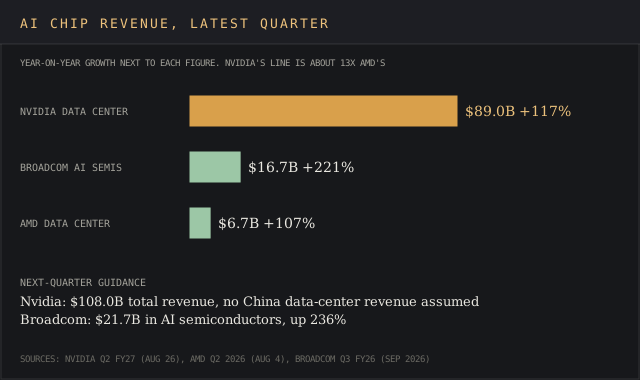
Nvidia takes most of the money for AI training on advanced AI models, and Broadcom's custom AI accelerators grow fastest.
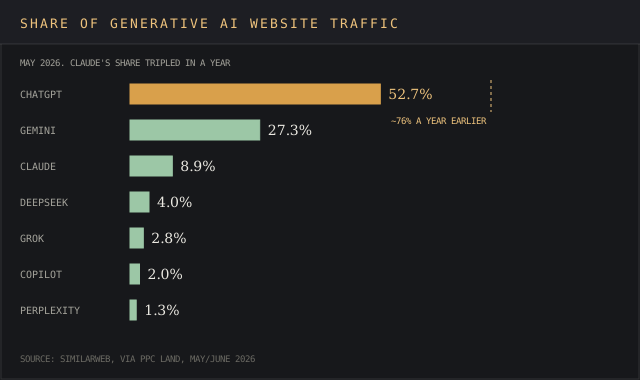
Generative AI tools: ChatGPT's share of website traffic fell from 76% to 52.7%
ChatGPT hit 1B+ weekly users in July, up from 900M in February. Gemini went from 950M monthly at Q2 earnings to 1B+ on August 11. It hit the ground running as Google's 14th product past 1B, and its fastest.
Similarweb puts ChatGPT at 52.7% of generative AI website traffic in May 2026, down from about 76% a year earlier. Gemini holds 27.3%, Claude tripled to 8.9%, and DeepSeek, Grok, Copilot and Perplexity sit at 4.0%, 2.8%, 2.0% and 1.3%.
| Tool | US adults using (Pew) | Web share (May) | Vendor-reported scale | Business spend signal |
|---|---|---|---|---|
| ChatGPT | 44% | 52.7% | 1B+ weekly users | 39.8% of paying US firms |
| Gemini | 24% | 27.3% | 1B+ monthly users | Google Cloud +82% |
| Microsoft 365 Copilot | 17% | 2.0% | 30M+ paid seats | Up from 15M in two quarters |
| Claude | 6% | 8.9% | $65B+ run-rate | 43.8% of paying US firms |
| Meta AI | 14% | not listed | 1.2B monthly users | Bundled into Meta apps |
Sources: Pew, June 2026; Similarweb via PPC Land; Ramp, August data; 9to5Google; Microsoft FY26 Q4; Meta Q2 2026. On the run-rates, Axios notes: "The two companies may not measure revenue the same way."
- Seats vs people: Microsoft sells 30M+ Copilot seats, yet Pew finds 17% of US adults on Copilot against 44% on ChatGPT.
- Weekly vs monthly: ChatGPT's billion is weekly, Gemini's monthly, and Meta AI's counts passive answers. None of the three lines up with the others.
AI agents and business models: Anthropic's flagship takes 11.4% of spend on 6% of tokens
AI agents plan and run multi-step tasks, calling a model many times per job. They're getting better fast: Stanford reports agent success on Terminal-Bench's real-world tasks rose from 20% in 2025 to 77.3%, and McKinsey finds 40% of large organisations scaling AI agents, up from 27% a year earlier.
Businesses using AI pay a premium for advanced AI models. Ramp found Fable 5 took 6% of Anthropic tokens and 11.4% of its spend in its first month, while GPT-5.6 Sol took 25% of OpenAI tokens and 23% of spend. Ramp reads that as a ceiling on what businesses believe AI performance is worth:
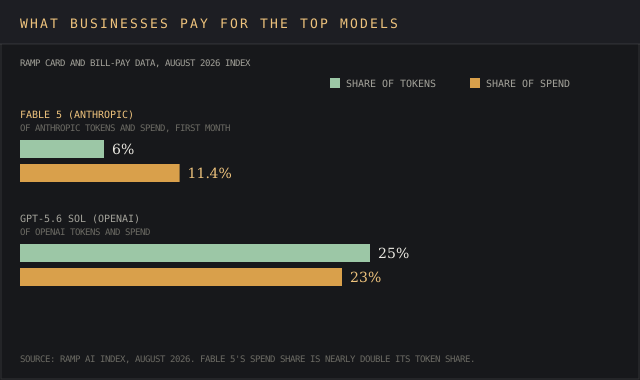
"So with Fable 5, we've found a new upper bound for how much businesses are willing to spend on AI. Here, more performance is not worth the price tag."
Ara Kharazian, lead economist, Ramp, Ramp AI Index, August 2026
ChatGPT Enterprise output tokens rose 7x from June 2025 to March 2026, yet the same OpenAI paper finds "no correlation between AI use and revenue per employee", per Fortune. New business models fill that gap: OpenAI's ads run at about $1B annualized, a drop in the bucket next to $40B, and 6.4% of AI-spending businesses route prompts through open-source routing platforms.
Using AI at work and at home: 52% use it, 52% are more concerned than excited
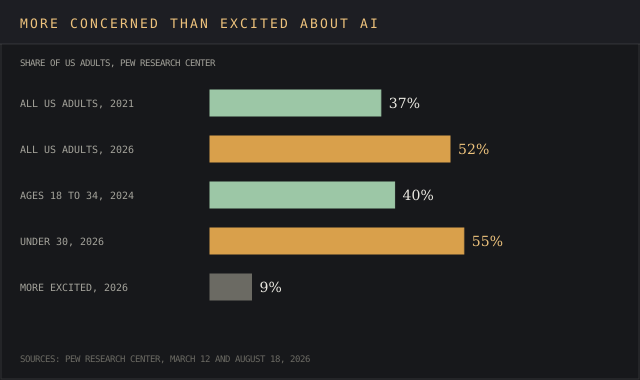
AI use and worry climb together across US society. Pew found 52% of Americans more concerned than excited about artificial intelligence in daily life, up from 37% in 2021. Only 9% are more excited, so few believe the gains from generative AI outweigh the risks yet.
49% of US adults use AI chatbots. 52% are more concerned than excited. AI trust hasn't kept pace with AI use.
AI trust by age group and country: 55% of under-30s are more concerned than excited
Young adults are using AI the most and now worry the most. Pew found 55% of US adults under 30 more concerned than excited, a first majority for that group, against 40% of 18 to 34s in 2024. Job security is the thread: they're concerned AI will take jobs.
Americans are gloomier about the technology than the world. In the global survey Stanford cites, 59% feel optimistic about AI's benefits, up from 52%, while 52% feel nervous. Only 33% of Americans expect AI to make their jobs better, against 40% globally, and 31% trust their government to regulate AI, the lowest of any country surveyed.
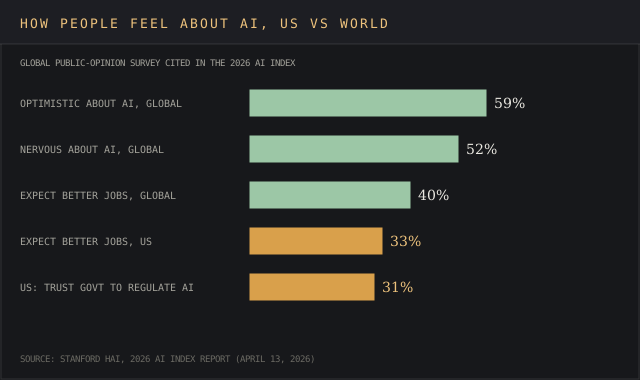
Pew's 25-country survey of 42,151 respondents found a median 46% expect AI to cut jobs for the global workforce, against 9% expecting more. High-income countries expect negative consequences more often (55%) than middle-income ones (36%).
Jobs and productivity: 112,713 AI-cited layoffs, and a 19% gap for young workers
AI was the most common reason given for US job cuts five months running. Challenger counted 112,713 cuts citing AI through July 2026, about 24% of all cuts, against 54,836 in all of 2025. May's 38,579 was a record.
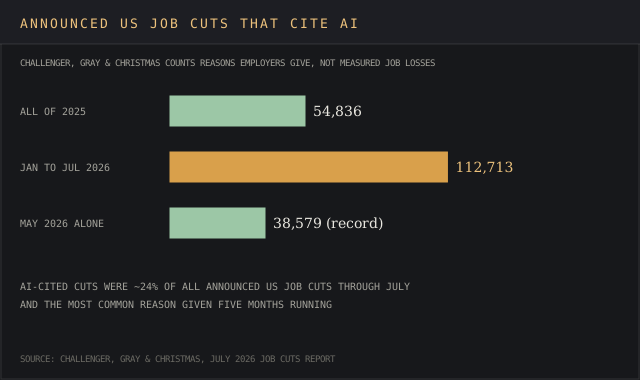
Stanford's Digital Economy Lab, on ADP payroll data, found the employment gap for 22 to 25-year-olds in AI-exposed jobs widened to 19% by June 2026, from about 13% in 2025. The AI Index adds that employment among software developers aged 22 to 25 fell nearly 20% since 2024.
Turning use into profit is easier said than done. In McKinsey's survey, 80% report a positive effect on productivity, but only 37% see any contribution to earnings before interest and taxes (EBIT), and about 6% qualify as high performers. 39% expect AI-related declines in total headcount, and 14% say AI already cut their workforce last year.
Microsoft's Work Trend Index credits organisational factors with two thirds (67%) of AI impact.
The AI experts split on what it means:
"there is zero evidence of job losses because of AI."
Torsten Sløk, chief economist, Apollo Global Management, Fortune, June 1, 2026
"If you automate 90% of the job," ... "then everyone does the 10% of the job. And the 10% kind of expands to be 100% of what people do and kind of 10xs their productivity."
Dario Amodei, CEO and co-founder, Anthropic, Fortune, May 5, 2026
AI use in various industries: 81% of physicians, 1,451 FDA-cleared AI devices, 393% more retail AI traffic
Across various industries, business AI use runs highest where the work is information-heavy: paperwork, documentation and data analysis. The American Medical Association found 81% of physicians using AI professionally, up from 38% in 2023. In medical technology, the FDA had authorised 1,451 AI-enabled medical devices by end-2025, 1,104 of them (76%) in radiology, per The Imaging Wire.
Finance and insurance businesses sit at 33.9% on the Census count, behind the information sector's 39.7%. See our healthcare market intelligence and financial market intelligence guides.
Adobe measured AI referral traffic to US retail sites up 393% in Q1 2026, and those visitors convert 42% better, which puts AI inside the retail customer experience. Our AI traffic report and retail market intelligence guide track that shift.
Self-driving cars, the most visible consumer AI technology, reached volume. Waymo gave 500,000 paid robotaxi rides a week across 10 US cities by March 2026, per TechCrunch.
A Google-sponsored survey found nearly 90% of federal agencies using or planning AI, with security first among their top concerns (48%) and 37% calling their AI integration advanced. See our public sector market intelligence guide.
AI governance and ethical considerations: EU high-risk rules moved to December 2027
Regulators put AI rules on the back burner in 2026 as concern rose. The EU's Digital Omnibus, Regulation (EU) 2026/1744, pushed high-risk Annex III duties from August 2, 2026 to December 2, 2027. Colorado swapped its duty-of-care model for disclosure, and California's SB 53 has applied since January 1.
The penalties stay steep. Article 99 of the AI Act caps fines at €35M or 7% of worldwide turnover for prohibited practices, €15M or 3% for other breaches, and €7.5M or 1% for misleading information. US states introduced 1,561 AI-related bills across 45 states by March 2026, per MultiState's tracker.
| Date | Rule | What changes |
|---|---|---|
| Jan 1, 2026 | California SB 53 | Applies |
| May 14, 2026 | Colorado SB 26-189 | Signed |
| Jul 27, 2026 | EU Digital Omnibus | In force |
| Dec 2, 2026 | EU AI Act Art. 50(2) | Watermarking |
| Jan 1, 2027 | Colorado disclosure model | Takes effect |
| Dec 2, 2027 | EU high-risk, Annex III | Duties start |
| Aug 2, 2028 | EU high-risk, Annex I | Duties start |
Sources: Gibson Dunn; Cooley; Glacis tracker. Compliance teams track these AI governance dates with regulatory intelligence software.
Publishers face the sharpest AI split. The Reuters Institute found 10% of people using generative AI chatbots for news, up from 7% in 2025, and 16% of under-35s. Those chatbots repackage written content, yet 42% of their news users say they always or often click through to the source, between search (44%) and social (36%), though that's self-reported. Worry about what's real online rose 4 points to 62%.
"People not having to put words into a search box, but the AI agents knowing what you're interested in and bringing it to you automatically"
Nic Newman, senior research associate, Reuters Institute, via The Media Copilot, July 10, 2026
Our publishing industry statistics and Reddit AI visibility study cover what AI answers do to written content and citations.
How to choose AI tools using AI statistics
- Start where staff already do everyday tasks. Pew has 44% of US adults on ChatGPT and 17% on Copilot, and 30M+ paid Copilot seats say the Microsoft 365 route scales.
- Check what peer businesses pay for. Ramp has 43.8% of paying US businesses on Anthropic and 39.8% on OpenAI, though Claude holds 8.9% of website traffic, Anthropic's competitive advantage with buyers.
- Price the top model against its token share: Fable 5 costs 11.4% of spend for 6% of tokens. Test a cheaper model first to improve efficiency, if the team has the technical skills to route.
Large businesses at 37% AI adoption route across models so they don't put all their eggs in one basket. Widespread adoption hasn't reached profit yet, so make profit measurement the top priority before AI spreads past its first business function.
Customer-facing AI needs a trust plan: with 52% of Americans more concerned than excited, no firm can assume people trust businesses that put AI between them and a human.
Methodology and AI research sources
This page counts artificial intelligence (AI) data published in 2026 with a named source and URL; Stanford's investment totals cover calendar 2025. AI technology moves fast, so older figures other AI statistics pages repeat, like 2025 rates for firms using AI in at least one function, are out.
Samples: Pew US, 5,119 people surveyed February 17 to 23, 2026; Pew global, 42,151; McKinsey, 1,719; Reuters Institute, about 2,000 per market; AMA, 1,692. Gaps: no list prices, and no 2026 survey on how far consumers trust businesses that use AI. Traffic-share methods are compared in our website traffic analysis tools ranking.
Frequently asked questions
What percentage of people use AI now?
49% of US adults use generative AI chatbots (Pew), 52% of US employees use AI at work (Gallup), and 18.8% of working-age people worldwide use it (Microsoft). Across the OECD, more than one-third of individuals used generative AI in 2025.
How many people use generative AI?
ChatGPT has over 1 billion weekly users and Gemini over 1 billion monthly users, and the two overlap. Meta AI reports 1.2 billion monthly users on a broad definition, and China's AI-native apps reach 499 million.
What are some statistics on AI?
$2.7T in 2026 AI spending (Gartner), $285.9B in US private AI investment (Stanford) and 112,713 AI-cited US job cuts through July (Challenger).
What is the growth rate of AI?
Gartner puts 2026 AI spending growth at 49.5%, and Grand View Research forecasts 30.6% a year to 2033. ChatGPT went from 400M weekly users in February 2025 to 1B+ by July 2026.
Which country is no. 1 in artificial intelligence?
The US leads on money ($285.9B in private AI investment), the UAE on use (73.3% of working-age people) and China on open models (about 41% of Hugging Face downloads).
Is AI overhyped in 2026?
The data points both ways. Skeptics who believe AI is overhyped cite Capital Economics' "late-stage bubble" call, Ramp's 9.7% dip and McKinsey's 37% EBIT figure. On the other side, Nvidia's revenue doubled.
Why is Gen Z against AI?
Pew has no Gen Z cut, but its under-30 group, overlapping Gen Z, is 55% more concerned than excited, and Pew ties that worry to jobs.
Which 3 jobs will not survive AI?
No 2026 dataset names three jobs. Employment for software developers aged 22 to 25 fell nearly 20% since 2024 (Stanford), while Apollo's Sløk sees "zero evidence of job losses because of AI."
Bottom line
Usage concentrates on OpenAI, business money on Anthropic and AI hardware money on Nvidia, while society grows more worried the more it uses artificial intelligence. Anyone who believes AI spending only goes up should read September: a bubble call, Ramp's 9.7% dip and Pew's 46% global job fear.
Keep an eye on Ramp's next index, Q3 earnings in late October and Pew's next US survey. If investors believe AI demand holds, those three show it first.
Sources by publisher, with dates, and the two things no source reconciles
Usage and sentiment come from the Pew Research Center (reports dated 12 March, 17 June, 18 August and 17 September 2026), Gallup via US News (21 July 2026), the US Census Bureau (May 2026), Microsoft's Global AI Diffusion Report (21 September 2026), Stanford HAI's 2026 AI Index and QuestMobile via TechNode (14 July 2026). The two billion-user counts are OpenAI's, reported by BNN Bloomberg on 31 July 2026, and Google's own of 11 August 2026.
Spending, revenue and investment figures are Gartner's (16 September 2026), Grand View Research's, FactSet's, Ramp's AI Index (August and September 2026 editions), Bloomberg's via Axios (17 August 2026) and the quarterly results releases of Nvidia, AMD, Broadcom, Meta and Microsoft. Job-cut and workforce figures are Challenger, Gray & Christmas's July 2026 report, Stanford's Digital Economy Lab and McKinsey's State of AI.
Regulatory dates are Gibson Dunn's and Cooley's summaries, the AI Act's own Article 99 text and MultiState's bill tracker. News-use figures are the Reuters Institute's Digital News Report 2026. The two things no source here reconciles: OpenAI and Anthropic may not define revenue the same way, and ChatGPT counts users weekly, Gemini monthly and Copilot in paid seats, so no like-for-like user ranking exists.