Public sector market intelligence
 By Jan Suski. I go deep on every review, checking every number against its source and digging up details other coverage misses, a habit from six years of SEO and link building for tech companies. Bylines at Surfer, Brand24, and Senuto. How the scoring works.
· Prefer this source on Google
Public sector market intelligence turns government procurement data, budget documents, and contract awards into actionable intelligence B2G teams can act on before an RFP opens. For companies selling into federal agencies, government agencies, and local government, it converts scattered signals across thousands of agencies into a competitive advantage other vendors do not have yet.
Why public sector procurement runs on cycles
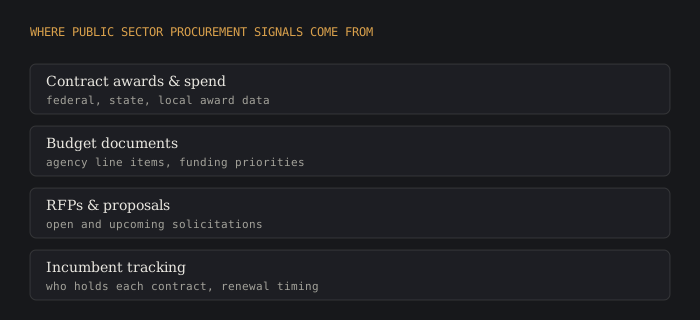
Public procurement follows predictable budget cycles for tenders, and government contracts typically run two to five years, creating renewal patterns a team can forecast and turning expiring contracts into new opportunities before a competitor notices the solicitation. Government spending follows fiscal years, and budgets signal future demand months before a federal government agency issues a formal RFP.
Understanding market dynamics in public sector procurement means reading shifts in budget constraints and political priorities, well before a proposal gets posted. Monitoring procurement portals identifies spending trends and incumbent contractors, so organizations can focus on the federal agencies and local governments where spending is rising.
What This Market Intelligence Tracks
Four components carry most of the value:
- Buyer intelligence. Analyzes procurement history and spending patterns: which government agencies buy, and how much they spend by category.
- Competitor intelligence. Reveals win rates and pricing strategies, so a business development team can see which rivals hold which government contracts today.
- Pricing intelligence. Provides data on contract values and pricing benchmarks, so a team builds competitive proposals on real numbers.
- Product intelligence. Tracks procurement trends and emerging technologies, flagging new technologies before they become a line item on next year's ledger.
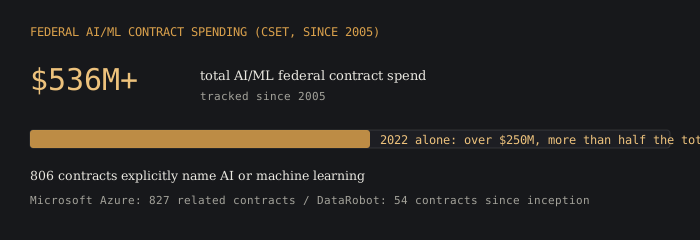
Federal government spending on new technologies is a clear case: it has spent over $536 million on AI/ML since 2005 per Georgetown's CSET, over half of that, more than $250 million, in 2022 alone. CSET counts 806 contracts that mention artificial intelligence or machine learning, Microsoft Azure holding 827 and DataRobot 54.
Tracking that spending shift early separates a company positioned for the next wave of federal procurement from one reading about it after the award.
How companies use public sector intelligence
Market intelligence supports tactical decisions in public sector sales, and the insights land in a few recurring moves:
- Identify opportunities early. Identifying opportunities early lets a business shape requirements before formal RFPs are issued, often by engaging the agency during market research.
- Assess bid decisions. Market intelligence helps assess bid opportunities effectively. Teams chase the proposals with the best odds and skip the solicitations that won't pay off.
- Track competitors. Competitor intelligence reveals win rates and pricing strategies across government contracts, sharpening the next proposal.
- Automate the monitoring. Streamlining business development means automating procurement monitoring. Automated tools track thousands of tender notices a week, a volume manual data collection can't touch.
AI tools can improve bid win rates by 25 to 30% in public procurement. Technology that pairs automated monitoring with human analysis and stakeholder engagement outperforms either approach alone, and combining sources sharpens the insights a team draws from procurement data, since no single feed covers every agency and contract type.
Building the capability
A working public sector market intelligence system pairs software solutions with a team that reads it, ranging from automated monitoring tools that track procurement data and contract awards to human analysts who understand agency priorities and assess a solicitation for real fit, past keyword matches. Organizations that build both layers turn public data into actionable intelligence, kept open on someone's second monitor between bid deadlines.
The AI executive order signed June 2, 2026 promotes AI innovation and security across federal agencies, a signal that budget focus is shifting toward the technology this guide already tracks. Companies that treat public sector market intelligence as a standing capability, built well before a single bid, are the ones that stay ahead of the next budget cycle and the next agency priority shift.
Choosing Public Sector Intelligence Tools and Services
Vendors selling into government agencies range from small consultancies to large contractors, and their tools split into a few categories: contract data platforms, analytics dashboards, and firms offering expert analysis alongside the software. Companies evaluating offerings should weigh data access, update frequency, and how much human expertise backs the analytics, since raw contract data without context still needs a team to translate it into strategic decisions.
Education matters here too. Sales and business development teams need a working knowledge of federal, state, and local government process before any tool helps them, and the best long-term relationships pair data access with resources: training, market opportunities alerts, and a support team that understands the supply chain behind public sector contracts.
Critical evaluation criteria include how many agencies a service covers, if the system tracks security requirements specific to the industry, and if customers can act on procurement signals fast enough to matter before a competitor does. Agencies buying forensic software apply a stricter version of the security test, FedRAMP authorization, which the top three suites in our digital intelligence platforms ranking hold.
Organizations that treat this as a technology purchase alone tend to underuse it. Vendors and consultancies that combine data, analytics, and human expert analysis into one system give sales teams a genuine competitive advantage, since understanding how an agency's focus shifts takes a process for turning insights into a proposal on a deadline.
Federal, State, and Local Government Contracts
Government contracts span three layers: federal contracts awarded by federal agencies, state contracts, and local government contracts issued by cities and counties. Each layer runs its own procurement process, but the underlying data looks similar: an agency posts a need, vendors submit proposals, and a contract gets awarded and renewed on a cycle.
Public sector teams that track contracts across all three layers see the full public sector market, well past the federal slice most competitors watch.
Technology contracts are growing fastest across every layer. Public sector customers now expect the same technology their private-sector counterparts use, and industry data shows spending on new technology contracts rising even in agencies with flat overall budgets. Understanding which technology categories are expanding, cybersecurity, cloud, and AI chief among them, gives a team critical insights before a formal solicitation appears.
That analysis, paired with public data on resources and past contracts, is what separates a company that wins public sector work from one still learning how the market operates. Good market intelligence turns that operational understanding, plus industry benchmarks and available resources, into technology-specific insights and analysis a team can trust before it commits to a bid.
FAQ
What is the market intelligence sector?
It is the industry of tools and services that collect and analyze public and private market data, contracts, spending, and competitors, so any sector can make informed decisions backed by evidence. In public sector work specifically, it means procurement data, budget documents, and contract awards turned into guidance a sales team can act on.
What is a public sector market?
A public sector market is the collection of government agencies, at the federal, state, and local government level, that buy goods and services through formal procurement processes. Vendors compete for that spending through RFPs, contracts, and standing agreements, and the market's size and priorities shift with each budget cycle.
What does GovSpend do?
GovSpend is a B2G intelligence platform that gives vendors access to government contract data, spending records, and agency information across thousands of federal, state, and local government agencies, helping sales and business development teams identify the right opportunities, track budget and funding priorities, and act on fresh insights.