RFP Response Template
 By Jan Suski. I go deep on every review, checking every number against its source and digging up details other coverage misses, a habit from six years of SEO and link building for tech companies. Bylines at Surfer, Brand24, and Senuto. How the scoring works.
An RFP response template turns a blank page into a structured document. Eight sections, in the order evaluators expect them, with the language and the numbers swapped for each opportunity. Responding still costs real time. Loopio's 2026 benchmark study of 1,500-plus proposal teams puts the average time to respond to a single RFP at 33 hours, down from 35 hours the year before as AI absorbed the first-draft work.
This page covers the eight key components an evaluator scores, plus the compliance matrix that tracks every requirement against the section answering it. A full worked example follows, with real filled-in values, and a look at where response times and win rates land in Loopio's most recent data. A brief overview near the end walks through the ten things to check before a response goes out, plus an RFP template FAQ covering the questions that come up most.
The template suits a team answering RFPs occasionally: an account manager, a founder, or a one-person marketing department seeing a handful of formal proposals a year. A dedicated bid desk running a mature content library outgrows a static RFP template fast, a point the RFP response software section below covers directly.
The stakes justify the structure. The average RFP win rate sits at 45% across Loopio's 2019 to 2026 data, though the most recent year alone came in lower, at 39%.
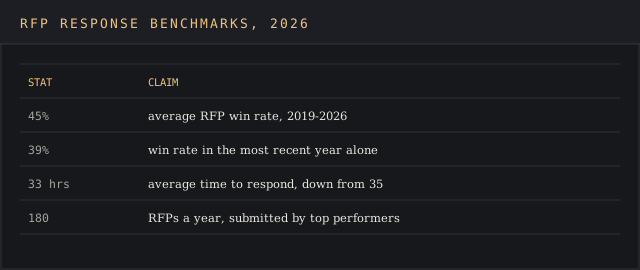
Teams that win more than half their bids submit an average of 180 RFPs a year. They also spend two more hours per proposal than the 33-hour average, and they put that extra time into editing an existing draft. Starting from scratch never makes the schedule. Their decision makers see the payoff in the numbers that follow.
The template downloads free in two pieces: the response document itself, and a compliance matrix that maps every requirement in the request for proposal to the section of the response that answers it. It's part of our market intelligence templates library.
Download the free RFP response template
Download the RFP response template (DOCX)Eight sections with instruction text and a worked example already filled in, built to produce a winning RFP response on the first pass.
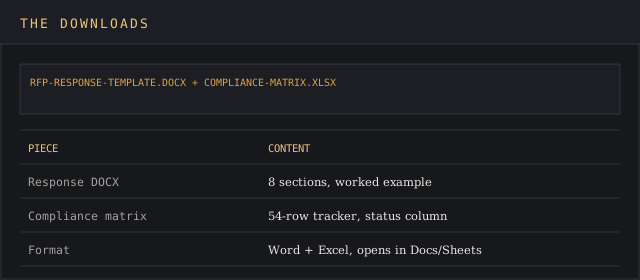
Download the compliance matrix template (XLSX)One row per RFP requirement, mapped to the response section that answers it, with a status column tracking what is drafted, reviewed, and final.
Both open in Microsoft Word and Excel, and both import cleanly into Google Docs and Google Sheets; the compliance matrix keeps its conditional formatting on import. Together these proposal templates cover the structural half of an effective RFP response. The researched numbers further down cover the rest.
The Key Components of an RFP Response
Loopio's own breakdown names seven components: cover letter, executive summary, required capabilities, proposed solution, pricing details, success stories, and appendices. TechTarget's version runs to five key elements: cover letter, executive summary, case studies and references, pricing and deliverables, and an implementation plan and timeline. Neither list is wrong. They split the same core content differently.
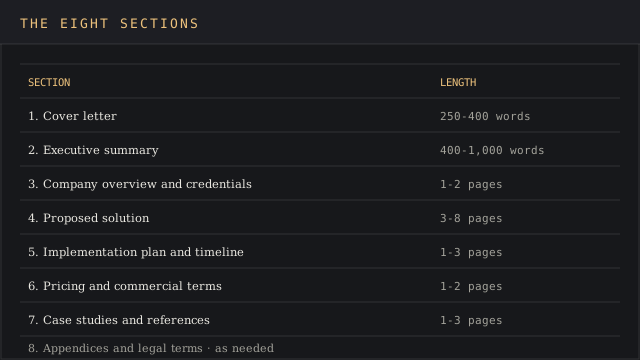
This template merges both into eight named sections. A company overview and a legal and contract terms section each carry distinct evaluator questions that get lost inside a catch-all "appendices" heading. The company overview section answers the same low-risk-choice question a buyer's own vendor evaluation scorecard is built to score. The anatomy of a winning proposal starts with that structure, before a single word of persuasive copy gets written.
| Section | Typical length | What it answers |
|---|---|---|
| Cover letter | 250 to 400 words, one page | Why this vendor, in one page, before the detail starts |
| Executive summary | 400 to 1,000 words | The strategic case, for a reader who reads nothing else |
| Company overview and credentials | 1 to 2 pages | Why this vendor is a low-risk, qualified choice |
| Proposed solution | 3 to 8 pages | What gets delivered, mapped to each requirement |
| Implementation plan and timeline | 1 to 3 pages | How the work gets delivered, on what schedule |
| Pricing and commercial terms | 1 to 2 pages | What it costs, broken down and defended |
| Case studies and references | 1 to 3 pages | Proof the vendor has delivered this before |
| Appendices and legal terms | As needed | Certifications, contract terms, and supporting detail |
Tenderbolt's research adds an eighth section most templates skip: an explicit approach, planning, and governance block covering milestones, key personnel, and a communication plan. It belongs inside the implementation plan section here. Evaluators read the two together, and a standalone governance section only fragments material they expect side by side.
The Cover Letter
TechTarget puts the RFP cover letter at 250 to 400 words. Loopio and Tenderbolt both cap it at one page. The two figures agree in practice, since a page of 11-point body text runs close to 400 words. Skip overly technical language here; save the detail for the proposed solution section further in. Hit the key points an evaluator scans for on a first read: the buyer's problem, the vendor's fit, and a plain statement of interest.
Loopio's writing research names a check worth running on any draft. Scan the left margin. Count how many sentences open with "we," "us," "our," or the company name. If most of them do, the letter centers on the vendor over the buyer. The fix is mechanical: rewrite each sentence so the buyer, their goal, or their problem sits first, and the pitch tone drops out on its own.
The cover letter states the company's expertise in one line, names the client's problem directly, and closes with a plain statement of the company's interest in the project. A generic opener like "thank you for the opportunity" wastes the strongest one-page slot in the whole document. Naming the buyer's actual business needs in the first sentence earns that slot back.
The Executive Summary
The executive summary runs longer than the cover letter, 400 to 1,000 words per TechTarget's guidance, because it carries the full strategic case. The cover letter stays the one-page introduction.
The summary gives decision makers a high level overview before the detail sections build the full case. A reader who reads nothing else should still understand the value proposition and the competitive advantage over rival bids, the kind of edge our competitive intelligence rankings track long before an RFP ever lands.
Mirror the buyer's own language here. If the RFP asks about "patient outcomes," answer with those same two words. Skip a rephrased synonym like "clinical results."
Loopio's research frames this as a credibility signal that lands before any technical content does. It carries a mechanical benefit too: an evaluator scoring against a rubric with a keyword search finds a matched term faster than a paraphrased one, and it signals that this response was built for this specific RFP.
Name measurable benefits. "Reduces manual data entry" names a capability. "Cuts data entry time by four hours a week per rep, based on the same rollout at a similarly sized customer" names a benefit with a number attached, and it is the version evaluators remember. Tie every benefit back to the client's goals stated in the RFP itself. The summary then reads as strategy aligned to the buyer's own strategic goals, the mark of a response written for this specific bid.
Mapping Requirements to Evaluation Criteria
Structuring the response to mirror the RFP's own section order, headings, and numbering makes the evaluator's job mechanical. Matching a numbered answer to a numbered question takes no interpretation. Loopio, Tenderbolt, and TechTarget's research all converge on the same instruction, because evaluators typically score with the RFP's own rubric open beside the response, checking off key requirements in the order the buyer wrote them.
Two writing habits from Loopio's research make individual answers score better once the structure is right. Lead with the answer, then justify it. Open each response item with the verdict, the number, or the named approach, and let supporting detail follow, since evaluators read fast and score in batches.
Load each answer with specifics too: read a draft sentence and ask if a competitor could submit it verbatim. If the answer is yes, the sentence needs a number, a name, or a concrete example before it goes out. Concrete examples are what separate compelling proposals from a stack of near-identical ones.
The compliance matrix below turns "mirror the RFP's structure" from an editing habit into a document a whole team can follow when creating proposals under deadline pressure.
The Compliance Matrix: Tracking Every Requirement
A compliance matrix maps each numbered requirement in the RFP to the section of the response that answers it. It is the tool that keeps a multi-contributor response from missing a line item. TechTarget's research lists compliance checklists among the tasks worth automating: a missed requirement disqualifies a response before it ever gets scored on quality, no matter how strong any single answer reads.
The companion spreadsheet holds five columns: requirement ID, matching the RFP's own numbering; the requirement text; the response section and page that answers it; an owner; and a status field running from "not started" through "drafted," "reviewed," and "final." A conditional format turns the status cell red until it reaches "final."
A scan of the sheet shows exactly what is still open the morning before submission. It doubles as a project approach record too: the same rows show who owns which key deliverables once the contract is signed, the same way a stakeholder map assigns an owner to every relationship it tracks.
Populate every row from the RFP's own numbering the day the document lands, before a single section gets written. Treat RFP requirements as a checklist to clear, every row, every time. That single pass, done first, gives the team a solid foundation. It also catches the two or three requirements evaluators bury inside a general instructions paragraph, off the numbered requirements list entirely.
Pricing and Contract Terms
TechTarget's guidance is blunt about ambiguity. Avoid words like "approximate" or "subject to change" in a pricing section, and itemize costs so each line ties to a specific deliverable. A pricing table with a single lump-sum figure invites a follow-up question.
A broken-down one, with a clear pricing structure and a stated pricing model, answers it before it gets asked. RFP responses that provide transparent pricing consistently score better on evaluator scorecards than ones that hide the number behind a "contact us" line, the same opacity our pricing intelligence rankings cover the tools built to test.
Loopio's research adds a negotiation detail worth knowing before a first draft goes out: submit a quote with roughly a 10% higher gross margin than the floor price, leaving room to negotiate down. A quote with no built-in margin has nowhere left to move.
The pricing section should still explain discounts, incentives, and payment terms plainly. That way the proposed budget reads as the overall value of the bid. An evaluator comparing bids on a spreadsheet penalizes ambiguity as much as a high figure.
Contract terms belong in this section or directly after it: payment schedule, renewal terms, and any assumptions the pricing depends on. A proposal that promises a fast rollout in the executive summary and then buries a 90-day payment term in the appendix creates the exact inconsistency evaluators flag on cross-review.
Case Studies and Success Stories
TechTarget's structure for a case study runs three parts: the problem, the action taken, and the measured outcome. "We implemented automated follow-up emails that resulted in a 12% increase in completed purchases within three months" follows that shape. A paragraph of adjectives about delivering value does not.
Pick examples from the buyer's own industry, size, and situation where they exist. Prospective clients scan case studies for relevance before they ever reach the pricing page. A logistics case study reads as background noise to a healthcare evaluator. The same result, phrased around a healthcare customer of comparable size, reads as proof of relevant experience on similar projects.
Success stories build trust specifically because they are checkable. A named reference among past clients and a measured result, like a stated percentage of improved efficiency, can be verified. An evaluator who has read vague testimonials from other customers before treats a checkable one on its own merits, the way a buyer running reference checks might also cross-check a G2 review against the claim.
The RFP Response Process, Step by Step
Loopio's research lays out a six-step process for the drafting stage itself, distinct from the document's own eight sections.
- Move beyond what the RFP states outright: talk to whoever ran the sales discovery calls, use any Q&A period to clarify ambiguous requirements, and check recent news or the buyer's leadership team for priorities the document never mentions, the same research discipline our how to gather market intelligence guide covers.
- Build two or three win themes before drafting a single section, grounded in capabilities the team can deliver on day one.
- Set up a first draft that populates every section in one pass, so contributors see what needs their attention.
- Route the RFP's bespoke, buyer-specific questions to the subject matter expert who answered something similar before. A boilerplate answer to a buyer-specific question reads as generic on sight.
- Tailor the cover letter and executive summary last, once the key messages have settled, since decision makers who advance a shortlisted potential client's bid read those two sections closest.
- Review the final draft against the original questions line by line, confirming every part of every multi-part question has an answer.
A Worked Example
A facilities-services company with 40 employees receives an RFP from a 12-location regional retail chain. It's seeking a new janitorial and maintenance contract worth an estimated $180,000 a year. The document runs 54 numbered requirements across five sections, with a 15-business-day response window. The retailer's stated goal is cutting reported facility issues without adding new business risk.
The proposal team logs all 54 requirements into the compliance matrix on day one, before drafting starts. Six contributors get assigned: a proposal lead, two operations SMEs, a sales lead, a finance reviewer, and a legal reviewer for the contract terms section.
The matrix immediately surfaces two requirements buried inside a general "vendor qualifications" paragraph, off the numbered list: a requirement for a named on-site supervisor at each location, and a requirement for same-day emergency response within four hours.
Both requirements would have been missed by a draft built straight from the numbered list alone. The team adds a dedicated subsection for on-site supervision to the proposed solution, and states the four-hour emergency window explicitly in both the executive summary and the service-level section of the pricing table. The client's goals show up as answered requirements, each one traceable to a matrix row.
The pricing section quotes $16,200 a month against the buyer's $180,000 annual estimate, itemized across labor, supplies, and a named emergency-response premium, with a gross margin built in for one round of negotiation.
The case studies section pulls two references from existing multi-location retail clients of comparable size, each with a named contact and a measured result: a 22% reduction in reported facility issues at one account over its first year, demonstrating the company's expertise on projects like this one.
Every section traces back to a row in the compliance matrix. The matrix's status column reads "final" across all 54 rows two days before the deadline, leaving time for the legal reviewer's last pass on the contract terms.
Common Mistakes That Sink RFP Responses
Tenderbolt's research on recurring RFP failures names over-templatization first: recycling a prior response without adapting the executive summary and proposed solution to the new buyer's language and priorities. A reviewer who spots another company's name left over from a copy-paste error does not read the rest of the detailed proposal generously.
Ignoring the RFP's own evaluation criteria and scoring grid is the second recurring failure. A response organized around the vendor's preferred narrative over the buyer's numbered questions forces the evaluator to hunt for answers. A hunted-for answer scores lower than a placed one, even when the content is identical.
Inconsistent messages between sections are the third failure: an executive summary promising a 30-day rollout next to an implementation timeline that runs 90 days. A single document owner running a cross-review catches this before submission. Without one, the sections get written in isolation, and the contradiction ships. Grammatical errors compound the same impression, so a final proofread pass earns its own slot on the schedule, ahead of the deadline crunch.
Last-minute reviews compound all three. A response finished hours before the deadline has no time left to catch a missing attachment, an unresolved compliance-matrix row, or a wrong file format. Any one of those three can disqualify a response before an evaluator reads a single sentence of the content.
RFP Response Software
A template answers the occasional RFP well. Software earns its cost once volume passes a threshold most small teams have not hit. Loopio's 2026 data puts adoption at 69% of teams using some form of RFP software, with 90% retention among teams that adopt it, a rate that suggests few switch back once they cross that line.
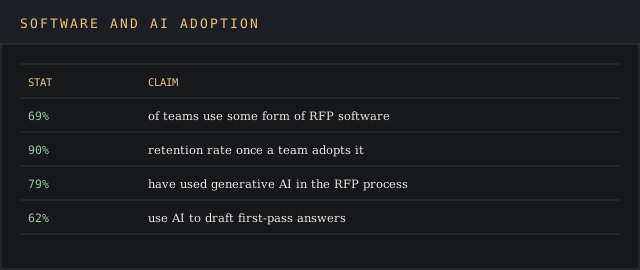
Generative AI adoption inside the RFP process reached 79% of teams in 2026, up from 68% the year before. And 62% of teams now use AI specifically to generate first-draft answers to individual RFP questions, a 16-point jump from the year before.
A shared knowledge base of pre-approved, best answers is what makes that jump possible. Teams pull from it to automate repetitive tasks and save time on the questions that repeat across multiple RFPs, while still routing the bespoke ones to a person.
None of that changes what the compliance matrix and the eight-section structure exist to do. AI can populate a first draft fast, but the review pass that catches a missed requirement or an inconsistent number still falls to a person.
The buy side of the same process runs through AI procurement software, which many of the RFPs a vendor answers are issued from in the first place. Teams tracking why specific bids win or lose feed that data back into a win-loss analysis template. The win themes that make it into a strong executive summary usually start life in a messaging framework built before the RFP ever arrives.
FAQ
What is an RFP response template?
A reusable document structure covering the sections most evaluators expect: cover letter, executive summary, company credentials, proposed solution, implementation plan, pricing, case studies, and appendices, with instruction text in place of finished prose.
What should an RFP response include?
At minimum, the eight sections above, plus a completed compliance matrix confirming every numbered requirement in the RFP has a corresponding answer somewhere in the proposal response.
How long should an RFP response be?
The RFP's own page limit and question count decide length; no fixed rule beats that. When the buyer sets no page limit, a focused response answering 40 to 60 requirements typically runs 10 to 20 pages before appendices.
Who should own the RFP response template internally?
One proposal manager owns it, or in a small company, whoever runs sales operations. That person keeps the template current, updates case studies and pricing as they change, and owns the compliance matrix format across every response, giving future proposals a solid foundation to build from, project after project.
What is a compliance matrix?
The compliance matrix is a row-per-requirement tracker mapping every line item in the RFP to the section of the response that answers it, plus an owner and a status. It confirms nothing in the buyer's key requirements list goes unanswered.
How is an RFP different from an RFQ or RFI?
A request for information (RFI) gathers background before a formal bid. A request for proposal (RFP) asks for a full solution and pricing. A request for quotation (RFQ) asks only for a price against a specification that is already fixed.
Is RFP response software worth it for a small team?
Rarely, below a handful of RFPs a quarter. The template and compliance matrix here cover the same structural ground a small team needs. Software earns its subscription once a team is answering enough RFPs that a shared content library saves more time than it costs to maintain.
Bottom Line
The RFP response template exists to make sure a rushed response still hits every section an evaluator scores, in the order the evaluator expects to find them. The compliance matrix exists so "we answered every requirement" becomes a checked list, row by row, with a status column proving it.
Download both. Log the current RFP's requirements into the matrix before writing a single section, and build the executive summary and cover letter last, once the rest of the response has settled what the win themes are. A competitor battlecard and a competitive analysis done ahead of time make the differentiators in that executive summary specific. Specific detail is what evaluators notice, and it's the difference that wins more clients over a full year of bids.